Explore Magical Realism and New Objectivity 1925-1950
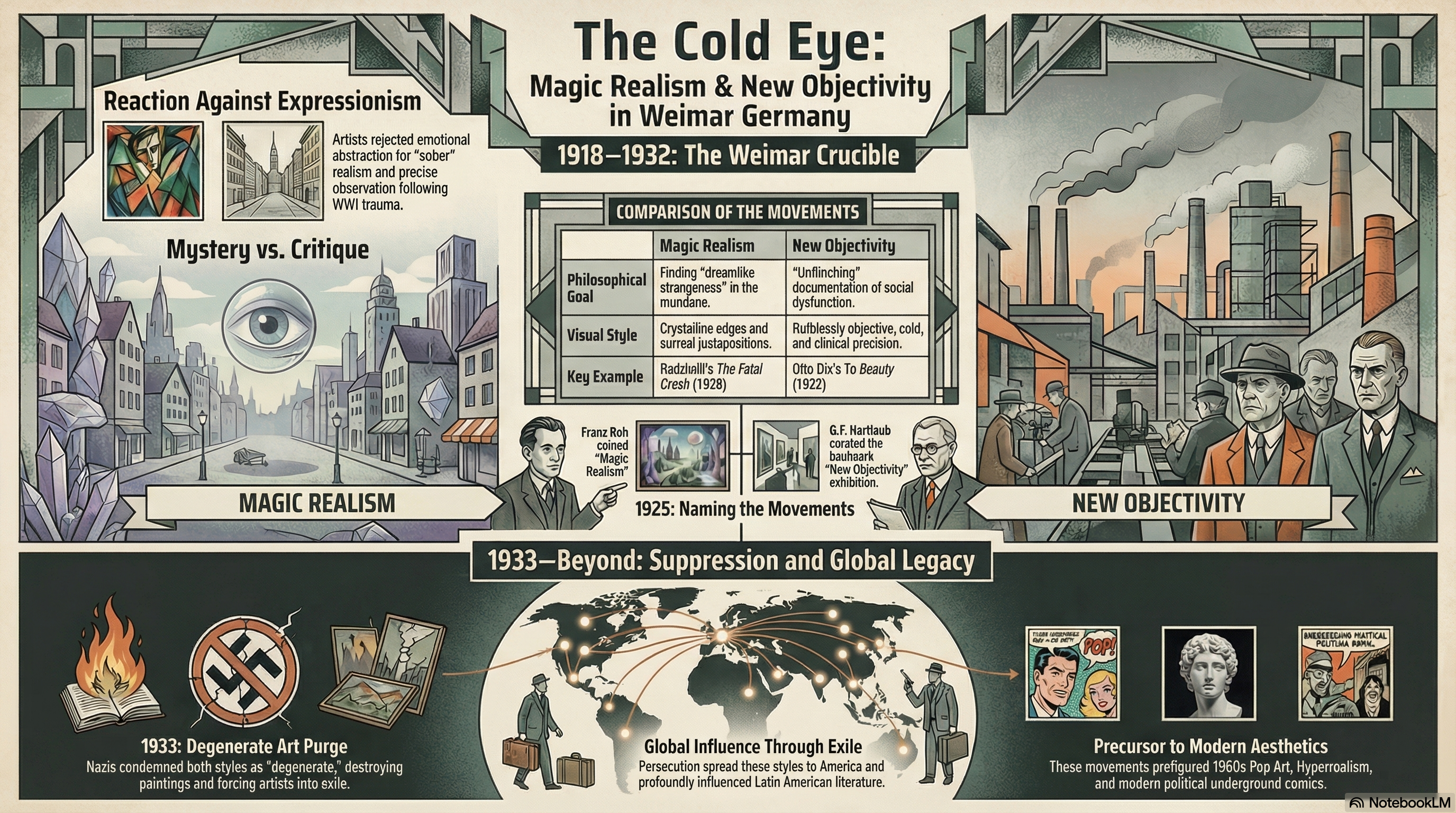
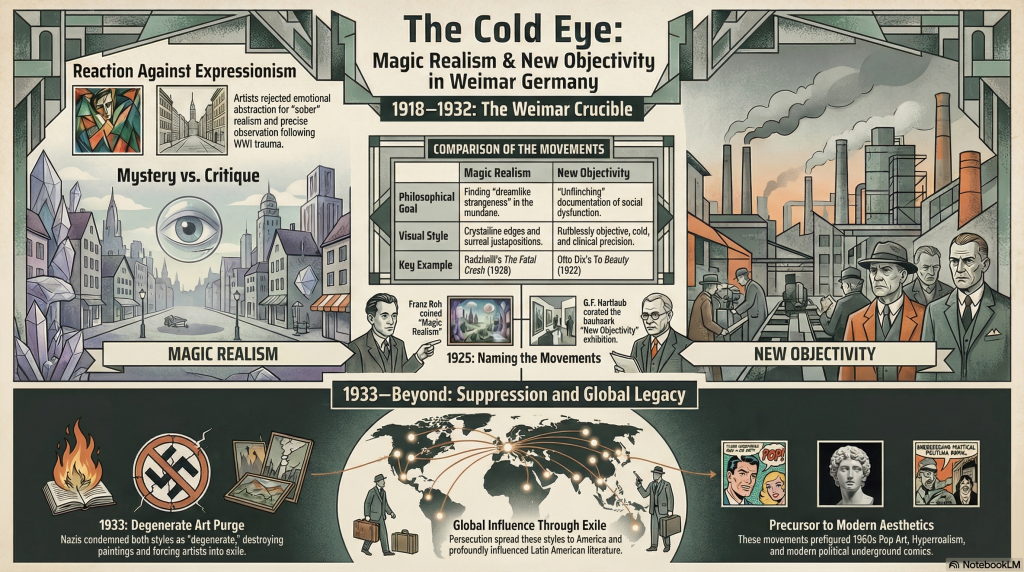
Magic realism, a term coined by Franz Roh, finds a sense of "mystery" in the mundane by depicting ordinary objects with a vibrating, dreamlike intensity. New Objectivity, or Neue Sachlichkeit, rejected the emotional distortion of Expressionism in favor of a cold, clinical, and "matter-of-fact" photographic precision. While both movements utilized a realistic style, Magic Realism looked for wonder in the quiet corners of life, whereas New Objectivity used the brush as a scalpel for biting social critique. These movements captured the "uncanny" nature of post-WWI Germany, making familiar scenes feel fundamentally "off" or unsettling to the viewer. Together, they documented the fragile stability of the Weimar Republic, stripping away romantic veils to reveal the alienation and grit of a society in transition.
Explicit content warning
Some talks contain artworks depicting nudity, violence or disturbing subjects. The material is presented for educational purposes.
THE CHAPTER
Talks and blogs
Each talk brings its video, illustrated notes, audio conversation and expanded article together in one place.
56-01
56-01 Magic Realism and New Objectivity
Magic realism, a term coined by Franz Roh, finds a sense of "mystery" in the mundane by depicting ordinary objects with a vibrating, dreamlike intensity. New Objectivity, or Neue Sachlichkeit, rejected the emotional distortion of Expressionism in favor of a cold, clinical, and…
56-01 Magic Realism and New Objectivity
Magic realism, a term coined by Franz Roh, finds a sense of “mystery” in the mundane by depicting ordinary objects with a vibrating, dreamlike intensity. New Objectivity, or Neue Sachlichkeit, rejected the emotional distortion of Expressionism in favor of a cold, clinical, and “matter-of-fact” photographic precision. While both movements utilized a realistic style, Magic Realism looked for wonder in the quiet corners of life, whereas New Objectivity used the brush as a scalpel for biting social critique. These movements captured the “uncanny” nature of post-WWI Germany, making familiar scenes feel fundamentally “off” or unsettling to the viewer. Together, they documented the fragile stability of the Weimar Republic, stripping away romantic veils to reveal the alienation and grit of a society in transition.
The following subjects are discussed — Otto Dix, Richard Oelze, Christian Schad, Conrad Felixmüller, George Grosz, Franz Radziwill, Alexander Kanoldt, Georg Schrimpf, Georg Scholz, Max Beckmann, Mense, Von Harden, Franz Roh, Schlichter, Tate, Räderscheidt, Christina, Germany, MoMA, Berlin, Weimar, Dresden, Munich and Paris.
Video
My notes
Audio
A discussion on Magic Realism and New Objectivity (created by Gemini Notebook from my notes):
From the blog
The Weimar Republic was never merely a historical era; it was a crucible. Between the armistice of 1918 and the catastrophe of 1933, Germany existed in a state of permanent whiplash, caught in the frantic rhythm of a society trying to outrun its own shadow. On the surface, the “Roaring Twenties” pulsed with the neon light of jazz clubs and avant-garde liberation. Beneath that veneer, the reality was a hallucinatory nightmare: a landscape of political street battles and an economic absurdity where hyperinflation forced citizens to carry billions of marks in wheelbarrows just to buy a single, stale loaf of bread.
In this volatile atmosphere, two overlapping artistic movements emerged as a “sober realism”—a new matter-of-factness (Neue Sachlichkeit) born from the trauma of the trenches. These artists rejected the blurry, emotional distortions of Expressionism in favor of a “ruthless objectivity.” They sought to document a brief, brilliant, and ultimately doomed existence. Here are five lessons from the art that mirrored a world on the brink.
1. Magic Realism was born in oil paint, not novels
While the term “Magic Realism” is now the cultural property of Latin American literary giants like Gabriel García Márquez, its lineage began with the tip of a German paintbrush. In 1925, the art critic Franz Roh coined the term to describe a specific “new matter-of-factness” in painting.
Roh wasn’t interested in the abstract or the purely fantastical. Instead, he identified a style that combined photographic precision with a “dreamlike strangeness.” For these artists, the “magic” wasn’t found in a secondary world, but in the precise observation of the tangible one. They sought to uncover the mystery hidden within the ordinary—the way a simple chair or a glass of water, when painted with enough clinical focus, begins to feel supernatural. Though García Márquez would later acknowledge the profound debt his literature owed to this visual tradition, the movement’s first manifesto was written in oil and tempera, seeking the infinite within the mundane.
2. Precision can be more terrifying than abstraction
We often assume that horror requires distortion, but the Weimar realists proved that “cold precision” is far more unsettling. By rendering the world with an unforgiving, clinical clarity, artists like Otto Dix and Christian Schad made the everyday feel like a fever dream.
Consider Otto Dix’s To Beauty (1922). Set in a garish nightclub, the work is a masterpiece of oil and collage that places the artist himself center-stage, surrounded by the debris of a decaying culture. An African-American drummer pounds out the frantic rhythm of the age while a semi-naked sex worker—the “Hure” used to shock the sensibilities of the bourgeoisie—gyrates alone. Dix renders the scene with such sharp, nightmarish detail that the viewer can almost smell the cheap perfume and stale tobacco. The title is a jagged piece of irony; it is a painting of sex and money, a society tilting off its axis. When critics called it “a slap in the face to good taste,” Dix knew he had succeeded. He wasn’t looking for beauty; he was performing an autopsy on a living city.
3. The “New Woman” was a portrait of alienation, not romance
The 1920s introduced the “New Woman”—a generation that had won the vote and rejected the corset in favor of bobbed hair, monocles, and cigarettes. But in the hands of the Neue Sachlichkeit painters, this liberation was “stripped of romance.”
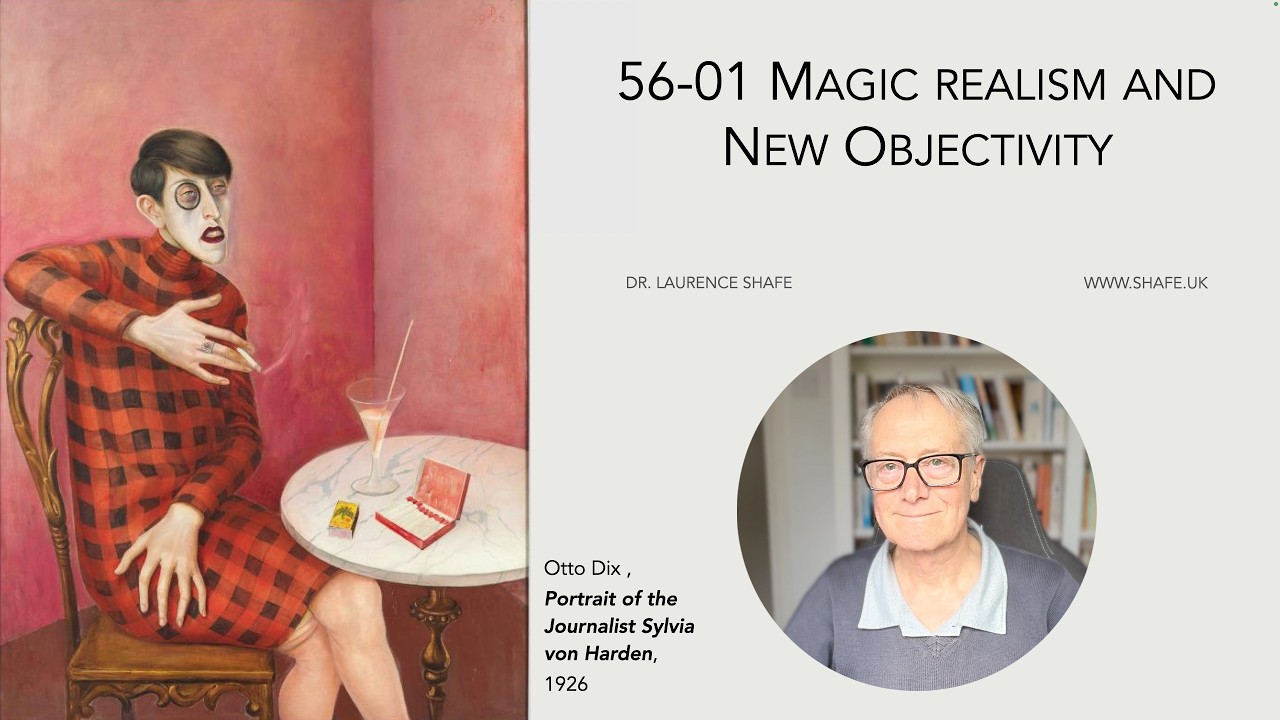
The definitive icon of this era is the Portrait of the Journalist Sylvia von Harden (1926). The story goes that Dix spotted her in a Berlin café and declared, “I must paint you! You are representative of an entire epoch!” He proceeded to render her with a “brutal precision” that von Harden initially found horrifying. He focused on her knobbly knees, her bony, elongated hands, and her stark, angular pose. She claimed he had made her look like a “monster,” but years later, she recognized the truth in the alienation Dix had captured, writing, “Dix saw what I couldn’t.” The portrait is a mirror of a generation’s ambition and its profound anxiety, capturing a woman who is utterly modern and utterly alone.
4. Art can be a literal prophecy of political collapse
For artists like George Grosz and Rudolf Schlichter, the canvas was a weapon of “unflinching social critique.” In Grosz’s Pillars of Society (1926), the grotesque caricatures of the ruling elite were not just satires—they were premonitions. He painted a journalist with a chamber pot on his head and a businessman wearing a swastika tie years before the Nazi seizure of power. Most chillingly, the businessman’s head is depicted as open, revealing that there is absolutely nothing inside.
Schlichter, who transitioned from the provocations of the Dada group to a documentary realism, painted Blind Power in 1932 as democracy was actively collapsing. His technique was almost photographic, yet his symbolism of a distorted military figure was a screaming warning of the rising fascist tide. As the critic Robert Hughes later noted regarding Grosz, “Grosz’s prophecy was horribly accurate. Every monster he painted came true.” These artists saw the rot in the floorboards of the Republic and painted it with a precision that makes the work nearly unbearable to look at in hindsight.
5. In a world of chaos, “Calm” is a radical act
While Dix and Grosz attacked the status quo with satire, a “classicist wing” led by Georg Schrimpf and Alexander Kanoldt sought a different kind of resistance: “order and harmony.” In an age of street battles and hunger, painting a “Sitting Girl” or a rigorously geometric “Still Life” was a “silent prayer for sanity.”
Schrimpf, a self-taught artist who had previously worked as a baker, produced works like Sitting Girl (1925) that recall the stillness of the Renaissance. There is no psychological angst here, only a “return to eternal values.” Similarly, Kanoldt’s still lifes achieved a metaphysical clarity that made the familiar feel alien through sheer attention. There is a tragic irony in their pursuit: despite their conservatism and search for stability, the Nazis labeled their work “degenerate art” in 1937 and purged it from museums. In a totalitarian world, even a silent prayer for sanity is viewed as a threat.
Conclusion: The Thin Line Between Triumph and Catastrophe
The art of Weimar Germany documents a brief, brilliant, and doomed existence. It serves as a permanent memento mori for modern civilization, reminding us how quickly the wings of progress can melt.
The metaphor for this entire generation is found in Franz Radziwill’s The Fatal Crash of Karl Buchstätter (1928). It is a haunting masterpiece of Magic Realism, depicting the “Death Dive” of an aviation pioneer. The plane is a tiny, fatal speck, a fragile Icarus falling against a heavy, suffocating sky that is entirely indifferent to human ambition. It is the image of a society soaring on the wings of modernism while hurtling toward an inevitable collapse.
When the world feels like it is tilting off its axis, these artists leave us with a lingering question: Do we need art that critiques the chaos by holding up a mirror to the monsters, or art that offers a sanctuary of order through a silent prayer for sanity?