
Explore Art Deco 1920-1930
Tamara de Lempicka was a prominent Art Deco painter who defined the visual elegance of high society during the 1920s and 1930s. Born in Poland, she eventually settled in Paris, where she rose to fame by creating bold, geometric portraits of the aristocracy and intellectual elite. Her work is characterized by a sleek, modern aesthetic that blended Cubist influences with a polished, sensual finish often found in her famous nude studies. Beyond her artistic achievements, her life was marked by social scandals, high-profile affairs, and a shift toward abstract and religious themes in her later years. This collection of documents provides a comprehensive look at her prolific portfolio, detailed biographical history, and the cultural impact of her sophisticated style. These sources emphasize her role as a formidable personality who successfully captured the glamour and arrogance of the Jazz Age.
Explicit content warning
Some talks contain artworks depicting nudity, violence or disturbing subjects. The material is presented for educational purposes.
THE CHAPTER
Talks and blogs
Each talk brings its video, illustrated notes, audio conversation and expanded article together in one place.
55-01
55-01 Tamara de Lempicka
Tamara de Lempicka was a prominent Art Deco painter who defined the visual elegance of high society during the 1920s and 1930s. Born in Poland, she eventually settled in Paris, where she rose to fame by creating bold, geometric portraits of the aristocracy and intellectual elite. Her…
55-01 Tamara de Lempicka
Tamara de Lempicka was a prominent Art Deco painter who defined the visual elegance of high society during the 1920s and 1930s. Born in Poland, she eventually settled in Paris, where she rose to fame by creating bold, geometric portraits of the aristocracy and intellectual elite. Her work is characterized by a sleek, modern aesthetic that blended Cubist influences with a polished, sensual finish often found in her famous nude studies. Beyond her artistic achievements, her life was marked by social scandals, high-profile affairs, and a shift toward abstract and religious themes in her later years. This collection of documents provides a comprehensive look at her prolific portfolio, detailed biographical history, and the cultural impact of her sophisticated style. These sources emphasize her role as a formidable personality who successfully captured the glamour and arrogance of the Jazz Age.
The talk also discusses André Lhote, Madame, Bouchard, Adam, Andromeda, Bugatti, Solidor, Ferry, Kuffner, Paris, New York, France, Baron, Ira, Europe and Art Deco.
Video

My notes
Audio
The following is a conversation about Tamara de Lempicka was generated by Google's Notebook. The voices and the conversation are completely AI generated.
From the blog
1. Introduction: The Woman in the Green Bugatti
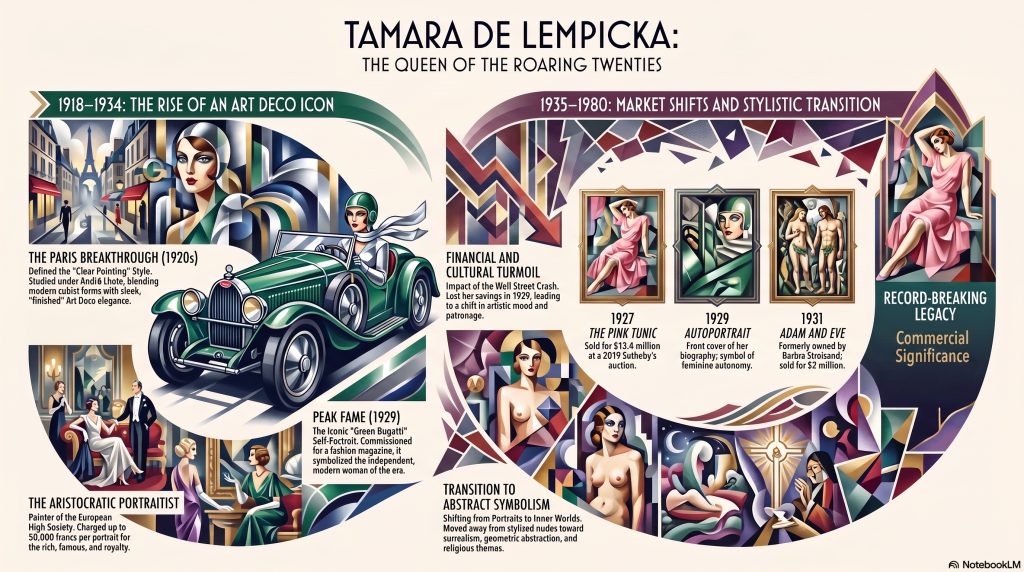
Paris in the 1920s—the années folles—was a city of frantic, neon-lit excess. At its center stood Tamara de Lempicka, a refugee of the Russian Revolution who understood better than anyone that in a world of crumbling empires, image was the only currency that didn’t devalue. She became the definitive “High Society Painter,” immortalizing an aristocracy that “played life on the surface” because they had lost their estates and power in the wake of World War I.
Under the tutelage of mentors like Maurice Denis and the influential André Lhote, Lempicka developed her signature “clear painting” style. It was a rigorous, hard-edged fusion of modern glamour and neo-Cubist geometry. While Lhote’s work remained tethered to the classical, Lempicka’s canvases were lively, daring, and unapologetically modern, rendering flesh with the cold, smooth precision of polished steel.
2. The Grand Illusion: Why the Bugatti was a Lie
The most enduring image of the Art Deco age is founded on a brilliant deception. In her 1929 Autoportrait, Lempicka stares out from the cockpit of a racing machine, the very embodiment of the “New Woman.” The painting was a commission for the German magazine Die Dame, designed to project chic, confident autonomy.
In reality, Lempicka never owned a Bugatti; she drove a modest yellow Renault. But a Renault did not fit the mask of the billionaire-artist she was meticulously constructing. This self-mythology was so pervasive that she was known to autograph photos as “Greta Garbo” for confused fans—a role she stepped into with wilful, domineering ease. The car, like the autograph, was a calculated tool of reinvention.
3. The Spiteful Stroke: The Husband with No Ring
Lempicka’s Portrait of a Man (Tadeusz de Lempicki) is often read as a tribute to her first husband, the man she had rescued from the Bolshevik secret police. In truth, it is a record of a marriage’s violent dissolution. By 1928, Tadeusz had tired of Tamara’s scandalous affairs and her singular obsession with fame. He famously fell for a woman named Irene Spiees at a dentist’s office—love at first sight—and abandoned Tamara.
For Lempicka, painting was the only way she knew how to show love; its withdrawal, therefore, was her ultimate weapon. Her process was disciplined: underpaint, face, then limbs. When Tadeusz left, she expressed her rage by refusing to finish the work.
“She always painted in the same way… This time she skipped the left hand and omitted the wedding ring and called it ‘Portrait of a Man.’ She finished it in 1928, the year they were divorced.”
4. The “Hot Little Potato” of Petrograd
Before the Paris salons, Lempicka was a “hot little potato”—a term used in Petrograd (St. Petersburg) for society women whose sexual appetites were the talk of the city. Her bisexuality was conducted with a scandalous transparency that only heightened her allure, leading her into the elite circles of Violet Trefusis, Vita Sackville-West, and Colette.
Her most potent erotic works were inspired by a model named Rafaëla, whom she discovered in the Bois de Boulogne. The resulting masterpiece, The Pink Tunic, shattered records in 2019 when it sold for $13.4 million, making it the most expensive painting by a Polish artist ever sold. Lempicka was never modest about her market dominance, once remarking:
“I was the first woman who did clear painting—and that was the success of my painting. Among a hundred paintings, you could recognize mine… It was neat, it was finished.”
5. Motherhood as a Prop: The Complex Kizette Dynamic
The relationship between Tamara and her daughter, Kizette, was a study in domineering irony. Tamara frequently used the girl as a social prop; she would bring Kizette to evening events to “counter-balance” her own scandalous reputation, allowing men to approach her under the guise of offering the child presents.
While Kizette was the subject of iconic works like Kizette on the Balcony, she was ultimately sent away to boarding school. Lempicka’s presence was so overwhelming that Kizette later admitted to feeling “empty without her,” spending the final two decades of her life catering to the whims of her mother. It is a final, poetic twist that the daughter Tamara so often sidelined became the keeper of the flame, authoring the biography Passion by Design.
6. The Work Ethic Behind the Wealth
The image of Lempicka as a flighty socialite haunting the Ritz and Maxim’s was merely her most successful performance. Beneath the silk was an “assiduous” worker whose drive was fueled by a terrifying brush with poverty. Though she earned a fortune in the late twenties, she lost everything when her bank went bust during the Wall Street Crash of 1929. This catastrophe only hardened her resolve.
Her “Montparnasse hustle” was a grueling cycle of discipline and calculated chaos:
- The Triple Session: She attended the Academy for morning, afternoon, and evening sessions daily.
- The Domestic Mask: Between academy sessions, she would rush home to prepare her husband’s meals.
- The Midnight Oil: After mixing with Picasso and Chagall at fashionable cafes, or entertaining the Futurist E.T. Marinetti (whom she once offered to drive to the Louvre so he could burn it down), she would return to her studio and paint until 6:00 AM.
- DIY Couture: Unable to initially afford the latest fashions, she would sew her own couture dresses in a single afternoon before wearing them to the Ritz.
7. Conclusion: A Legacy of Steel and Silk
As Art Deco’s sharp lines softened into the 1930s, Lempicka’s work transitioned into Surrealism, Geometric Abstraction, and even somber religious themes like La Vierge à l’Enfant. Though she faded from the cultural zeitgeist after moving to America, a 1970s Paris retrospective sparked a revival that proved her “clear painting” was timeless.
In an age of curated digital identities, we might find Tamara de Lempicka surprisingly recognizable. She understood that in the theater of high society, the mask is often more truthful than the face behind it. We are left to wonder: in the end, was her greatest masterpiece the canvases she finished, or the indomitable woman she invented to paint them?
PREVIOUS CHAPTER