23-01 Victorian Art – Turner and Turnips
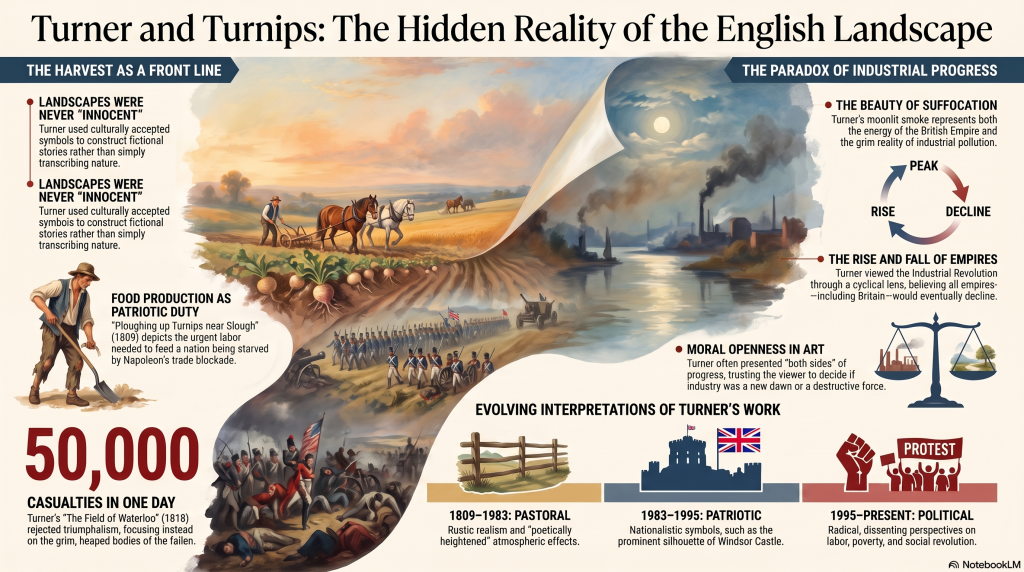
This talk is an overview of the influential British artist J.M.W. Turner. While Turner is famously celebrated for his ethereal light and romantic atmospheres, Shafe argues that his work deeply reflects the socio-political turmoil of the nineteenth century. The materials detail how landscape painting emerged during a period of agricultural revolution, rural poverty, and violent protests like the Swing Riots. By examining specific works such as Ploughing up Turnips near Slough, the text illustrates how art served as a complex response to industrialization and national crises. Ultimately, the collection highlights the tension between the tranquil imagery depicted by artists and the harsh realities of life for the working class.
(My YouTube talk will be published on 26 February 2027)
My notes on Turner and Turnips
An entertaining conversation about Turner and Turnips created by Google NotebookLM from my notes:
Introduction: Beyond the Pretty Picture
J.M.W. Turner is often remembered as the “painter of light,” a Romantic visionary who dissolved the world into clouds, horizons and luminous atmosphere. But this image hides the turbulent Britain he inhabited. The 19th-century countryside was shaped by poverty, agricultural unrest, machine-breaking and industrial change. Turner’s landscapes were not escapist scenes: they recorded, often indirectly, a nation being remade.
1. Landscape Was a Constructed Fiction
Landscape painting was not a neutral mirror of nature. Turner and his peers built “constructed fictions” from cultural signs, using landscape to address the anxieties of their age. As traditional religious certainty weakened, nature began to carry spiritual weight.
“Landscape painting was an act of faith and in the early nineteenth century as values declined, faith in nature became a form of religion.”
Turner’s Liber Studiorum, begun in 1807, shows this ambition clearly. By classifying pastoral, marine, mountainous and historical landscapes, he raised landscape to the level of serious art and turned scenery into a symbolic language.
2. Turnips Became a Weapon of War
Turner’s Ploughing up Turnips near Slough, exhibited in 1809, looks at first like a rural scene. Yet it belongs to the context of the Napoleonic Wars, when Britain’s food production became a patriotic necessity under pressure from Napoleon’s Continental System.
The muddy field is therefore a battlefield of survival. Windsor Castle appears in the distance, placing poor labour against royal authority. Turner also priced the work as a luxury object, heightening the tension between rural hardship and elite consumption.
3. Waterloo Became an Anti-War Statement
While many writers celebrated victory over Napoleon, Turner’s The Field of Waterloo, shown in 1818, refused easy triumph. He focused on the dead, presenting bodies from both sides together in darkness rather than turning battle into patriotic spectacle.
For the Royal Academy catalogue, Turner quoted Byron: “Rider and horse — friend, foe — in one red burial blent.”
Turner did not offer a simple political answer. Instead, he asked what national glory costs. In doing so, he created one of British art’s early anti-war images.
4. Industry Remained a Moral Open Question
In Keelmen Heaving in Coals by Moonlight, painted in 1835, Turner examined industrial Britain. Moonlight, smoke and coal merge into a scene that is both beautiful and oppressive.
The painting allows two readings:
* Pollution is a blight on creation.
* Smoke is also the breath of progress.
Its patron, Henry McConnel, was a Manchester textile manufacturer enriched by the same industrial system. Turner leaves the contradiction unresolved, showing progress as seductive, dirty and morally unstable.
5. Empire Already Contained Decline
Turner’s historical imagination was shaped by Edward Gibbon’s Decline and Fall of the Roman Empire. From Gibbon he absorbed the idea that empires rise, flourish and collapse.
This matters because Turner was sceptical while Britain was still expanding. In the 1830s, long before the empire reached its peak, he saw progress as cyclical rather than guaranteed. His landscapes carry both confidence and warning.
Conclusion: The End of Innocence
Turner was not merely a Romantic dreamer. He was a witness to social, agricultural and industrial revolution, alert to the fractures beneath sublime light. His landscapes are not innocent views of the countryside but coded documents of fear, duty, violence and change.
That makes them urgent today. If Turner’s turnips and coal smoke could mask war, poverty and environmental crisis, what hidden conflicts lie inside the pastoral images of our own time?
23-02 Victorian Art – The Politics of Early 19th Century Landscape
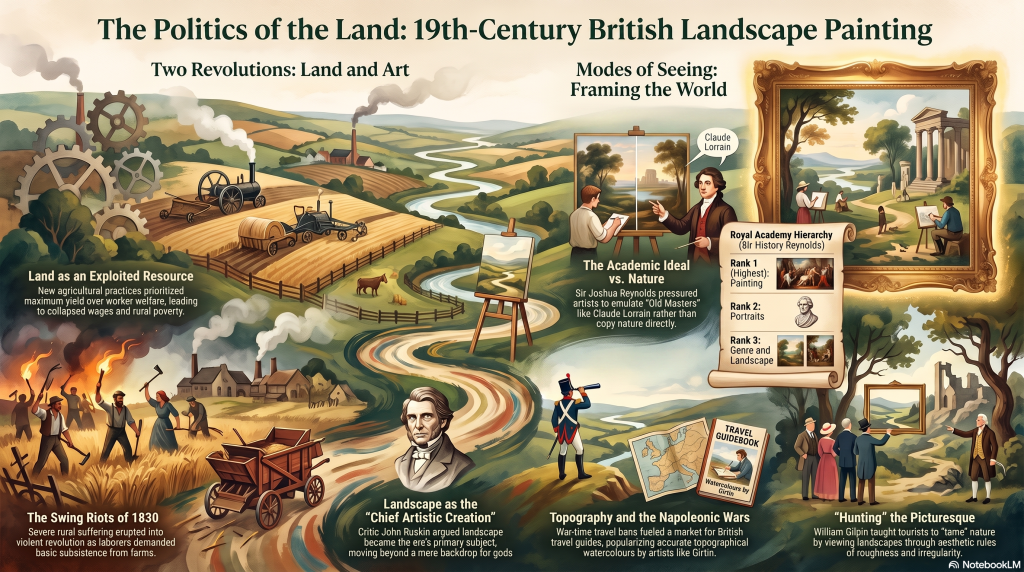
This lecture examines British landscape painting in the early nineteenth century as political and social document. Six modes of seeing, topographical, picturesque, sublime, pastoral, Romantic, and socially realist, each carry arguments about land ownership and rural suffering. Against enclosure, poor harvests, Swing Riots, Irish famine, and mass emigration, artists from Constable and Turner to Palmer, Morland, and Ford Madox Brown responded differently, some suppressing unrest, others confronting it directly. Ruskin called landscape the century’s chief artistic creation; this lecture interrogates why, revealing how every compositional choice encoded a position on who belonged to England’s contested land.
(My YouTube talk will be published on 05 March 2027)
My notes on The Politics of Early 19thC Landscape
An entertaining conversation about The Politics of Early 19thC Landscape created by Google NotebookLM from my notes:
We think of landscape painting as serene, escapist — rolling hills and placid rivers, hung in hushed galleries. But what if those images were arguments? What if every carefully composed horizon carried a position on poverty, enclosure, and who deserved to own the earth?
Dr Laurence Shafe’s lecture on early 19th-century British landscape painting reveals something far more charged than aesthetic pleasure.
The Land Was a Battlefield Before It Was a Canvas
Britain in 1800 was at war with France, harvests were failing, and rural wages were collapsing toward subsistence. By 1830, the Swing Riots saw thousands of agricultural labourers descend on farms demanding basic survival. Against this backdrop, artists were simultaneously remaking how the landscape was seen. That wasn’t coincidence — both revolutions involved a radically altered relationship with the land itself.
Turner Hid a Political Manifesto Inside a Turnip Field
Ploughing up Turnips near Slough (1809) looks, at first glance, like wartime pastoral propaganda — Windsor Castle gleaming in the distance, loyal workers feeding the nation. Look harder. The plough is broken. The harvest is meagre. A bottle sits conspicuously in the brightest patch of light. Art historian Michele Miller identified Turner’s deliberate naming of “Slough” — invoking Bunyan’s Slough of Despond, a place the King’s labourers have worked for centuries without improvement. Turner held beauty and hardship, progress and failure, in unresolved tension. That’s why it’s a masterpiece.
A Garden Renovation Was a Metaphor for Mass Dispossession
Humphry Repton’s before-and-after designs for his own cottage seem charming until you notice the beggar — one-eyed, wooden-legged — visible in the “before” view and entirely erased in the “after.” Repton wrote approvingly of “appropriation”: the exclusive right to a landscape view, “with the power of refusing that others should share our pleasure.” His small garden was a precise metaphor for the enclosures that stripped one sixth of England from common use between 1750 and 1850, driving smallholders into the very poverty that beggar represented.
Engravings Quietly Edited the Poor Into Acceptability
George Morland painted rural poverty with unflinching honesty — blank, depressed faces, hollow-cheeked children. When his brother-in-law James Ward engraved the same scenes for a paying middle-class market, something changed. The woman’s expression became a welcoming smile. The children were softened. Even the dog’s fur was fluffed up.
Art historian John Barrell argues these adjustments served an ideological function: the cheerful figures reassured viewers about the governability of the poor at a moment of acute social unrest.
Morland painted the countryside as it was. Ward sold the countryside as people needed it to be.
Constable Knew the Hayricks Were Burning — and Painted Serenity Anyway
In 1822, Constable’s brother wrote that there was “never a night without seeing fires near or at a distance.” The Swing Riots were erupting across East Anglia. Constable responded by pushing his labourers to the far distance, making them staffage — compositional furniture absorbed into nature rather than people with grievances. His revolutionary technique disguised a deeply conservative vision of the land. French audiences gave him a gold medal. English audiences complained about the white flecks.
A Landscape Painter Arrived at Impressionism Entirely Alone
David Cox painted Rhyl Sands in 1854 — twenty years before French Impressionism entered public consciousness, a decade before Monet and Renoir even met as students. His loose handling and light palette were unlike anything in British painting. Cox himself was anxious about it, suspecting the “oil men” were withholding secrets. There were no secrets. Working at seventy-one, he had simply arrived somewhere new by instinct.
These paintings were made during enclosures, famines, riots, and mass emigration. Their apparent calm was a choice — sometimes honest, sometimes evasive, sometimes quietly subversive.
The question worth sitting with: when we call a landscape “beautiful,” whose version of the land are we actually agreeing with?
23-03 Victorian Art – A Summary
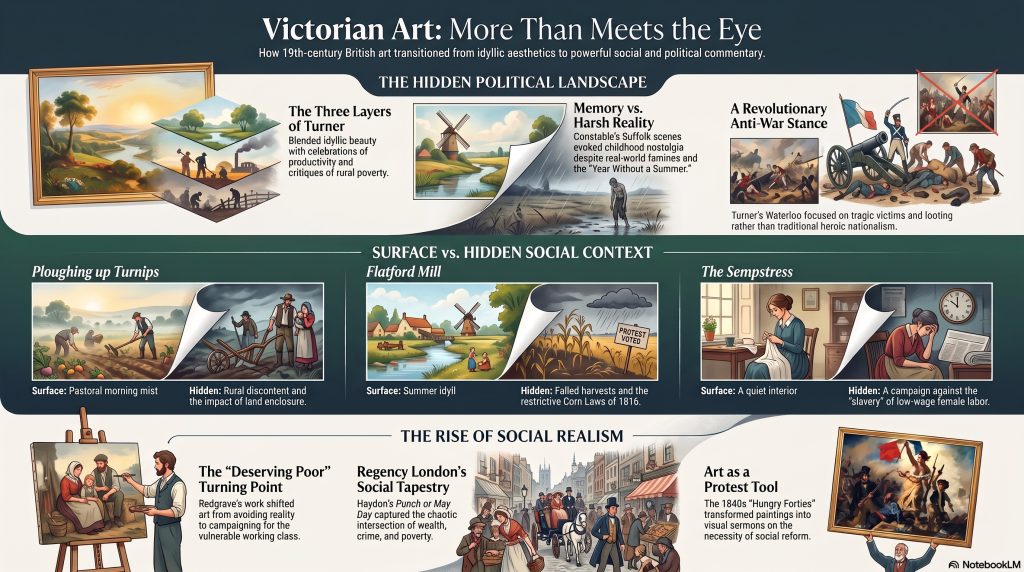
This talk provides a chronological history of Western Art, specifically focusing on the Victorian period. The primary source examines the complex meanings within Joseph Mallord William Turner’s painting, Ploughing up Turnips near Slough, noting that it serves as both a pastoral landscape and a political commentary. By highlighting details like a broken plough and the boggy soil of a “Slough of Despond,” the text suggests Turner was illustrating the hardships of rural labourers during the Napoleonic Wars. Additionally, the collection references other significant British artists such as John Constable and John Everett Millais to offer a personal tour of works held at Tate Britain. Ultimately, the sources aim to reveal how nineteenth-century art reflected deep social issues, including agricultural shifts and the tragic human cost of military conflict.
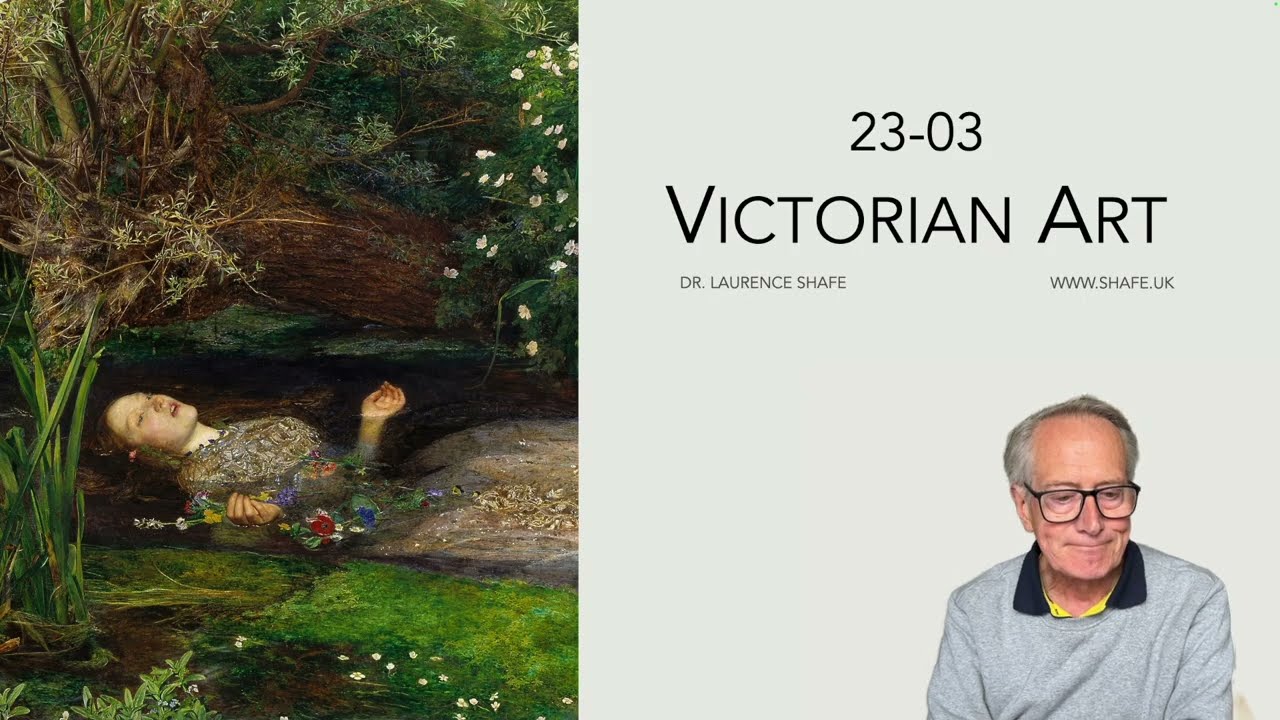
A conversation on Victorian Art produced by Google Notebook based on my notes:
To the casual museum-goer, Victorian art often looks like the ultimate exercise in decorative safety—stuffy, sentimental, and hopelessly ornamental. We see golden-hour landscapes and pious scenes and assume they are mere wallpaper for a bygone aristocracy. But if you peel back that polished veneer, you find a world of grit, politics, and social turmoil. These paintings weren’t just decorations; they were active, sometimes radical participants in a century-long struggle to define a rapidly industrializing world.
As Dr. Laurence Shafe notes, we must view this era through the lens of the “long Victorian period,” a stretch of the 19th century where artists grappled with the seismic aftershocks of the Napoleonic Wars, the Industrial Revolution, and the birth of class consciousness. When we look closer, we find that the “peace” in these masterpieces is often a facade. Here are five surprising takeaways that transform these classics into urgent social critiques.
1. The Hidden Code of Turner’s Turnips
J.M.W. Turner’s Ploughing Up Turnips near Slough (exhibited 1809) was praised for 170 years as a simple pastoral idyll, a masterclass in “poetically heightened atmospheric effects.” But Turner was never a simple painter. Working during the height of the Napoleonic Wars, when French blockades had brought England to the brink of starvation, Turner used this landscape to execute a biting structural indictment.
The painting operates in three layers. On the surface, it is a “Georgic” celebration of hard work. Beneath that, it is a patriotic nod to the wartime “turnip harvest” used to maximize yields. But the third layer—the political subtext—is where the grit resides. Turner populates the foreground with “disorderly” details: a bottle sits in the middle of the brightest patch of land, a silent signifier of idleness and drunkenness, while nursing women work the fields in a desperate “petticoat harvest,” signaling a catastrophic lack of male labor.
Turner’s most subversive move is compositional. He uses a sharp vertical alignment to link a patch of weeds and a broken, inefficient four-horse plough directly to the distant Royal Palace at Windsor. By tying the “filth of sin” (a nod to the “Slough of Despond” from Bunyan’s Pilgrim’s Progress) to the seat of the monarchy, Turner surreptitiously suggests that royal neglect was the true root of rural decay.
2. Constable’s Idyl vs. The “Year Without a Summer”
If Turner used landscape to confront the present, John Constable used it to escape it. His Flatford Mill (1816–7) presents a quintessential English summer, all scudding clouds and shimmering water. However, 1816 was actually the “Year Without a Summer.” Following the eruption of Mount Tambora in Indonesia, volcanic ash choked the global atmosphere, resulting in yellow skies, heavy rains, and a total harvest failure.
While Constable was “grateful” for his childhood memories, the reality outside his studio was one of blood and hunger. The Napoleonic Wars had ended, but the introduction of the Corn Laws kept bread prices artificially high, triggering famine and riots. This was the era of the Peterloo Massacre, the suspension of habeas corpus, and the dreaded workhouse.
Constable’s choice to ignore the yellow skies of 1816 was a deliberate retreat into a nostalgic dreamscape. For him, “painting is but another word for feeling,” and his feeling was a desperate need to sanitize the Suffolk countryside of the “Swing Riots” and social dissent that threatened the mill-owning class he belonged to.
3. The Gruesome Reality of “Waterloo Teeth”
While other artists were busy painting heroic charges and nationalistic fervor, J.M.W. Turner’s The Field of Waterloo (1818) was a pioneering anti-war confrontment. Exhibited just three years after the battle, Turner ignores the glory of victory and focuses instead on the visceral carnage: an estimated 65,000 men and 15,000 horses killed, wounded, or missing in a single day.
The painting is a dark, torch-lit nightmare of tangled bodies. Turner pointedly depicts women searching through the “red burial” of English and French corpses, wives looking for husbands—but also looters looking for profit. The most disturbing trade of the era was the “Waterloo teeth” market, where looters stripped the mouths of the dead to sell their teeth as souvenirs or for use in dentures.
Turner underscored this grim reality by including a quote from Lord Byron’s Childe Harold’s Pilgrimage in the exhibition catalogue:
“Rider and horse—friend, foe,— in one red burial blent!”
By refusing to distinguish between the bodies of allies and enemies, Turner argued that the dead belong to no nation, transforming a victory painting into a haunting philosophical critique of war itself.
4. When Art Became a Campaign Tool for the Poor
Richard Redgrave’s The Sempstress (1846) marks the moment Victorian art found its social conscience. A direct response to Thomas Hood’s “The Song of the Shirt”—a poem so startling it was compared to a form of slavery—the painting exposes the plight of the “deserving poor.”
It is 2:30 AM, and the seamstress is hunched over her work by the light of a single, flickering candle. Redgrave captures the physical wreckage of the trade: her eyes are swollen and inflamed from the strain, a condition that frequently led to blindness. Nearby medicine bottles and a mere morsel of food suggest a life lived on the razor’s edge of survival.
The painting was a calculated move to move the middle class by suggesting that the poor could be their own mothers or sisters. The seamstress looks toward heaven for support, a “fallen woman” in waiting, struggling to maintain her morality while the industry wears her out. As the poem famously warns:
“It is not linen you’re wearing out, / But human creatures’ lives.”
5. The “Revolting” Realism of a Working-Class Christ
By 1849, the Pre-Raphaelite Brotherhood had decided to declare war on the idealized beauty of the past. John Everett Millais’s Christ in the House of His Parents was the opening salvo. Rather than a divine, ethereal Holy Family, Millais gave the public ordinary, gritty laborers in a dirty carpenter’s shop.
The Victorian public was revolted. Charles Dickens was famously “appalled,” describing the depiction as one of “emaciation and deformity.” To a society used to a sanitized Christ, the sight of a “dirty” shop and the realistic, weathered bodies of the workers was offensive. Millais, however, was using this “ugliness” to ground divine prophecy in the physical struggle of the working class.
He loaded the scene with symbols—the nail wound on Christ’s hand foreshadowing the crucifixion, John the Baptist bringing water to wash the wound, and the ladder representing Jacob’s Ladder—all of it rendered with a minute, “revolting” observation that forced the viewer to confront the divinity in the dirt.
Conclusion: The Mirror in the Frame
Victorian art was rarely just about beauty; it was a complex mirror of a society grappling with the consequences of its own explosive growth. From Turner’s encoded landscapes to Millais’s gritty realism, these artists utilized a “genius of ambiguity” that allowed their work to function as both high art and urgent social commentary.
These masterpieces prove that the “Victorian veneer” was often a thin covering for much deeper struggles. The next time you see a “peaceful” landscape in a museum, ask yourself: what hidden struggles are waiting for you beneath the surface?
23-04 Victorian Art – The Art of the Industrial Revolution

This talk surveys how British artists from the mid-eighteenth to late nineteenth century responded to industrialisation. Wright of Derby, the first professional painter to engage the industrial spirit directly, used dramatic candlelight to elevate scientific experiment and iron forging to the dignity of history painting. Gainsborough bent topographical commissions toward personal vision, while Turner transformed factories, coal towns, and railway lines into sublime spectacle. Lesser-known figures such as Loutherbourg, Crowe, and Childs documented industrial labour and landscape with varying degrees of sentiment. Ford Madox Brown’s Work synthesised sanitation reform, Carlylean philosophy, and social observation into a single, extraordinarily complex canvas.
(My YouTube talk will be published on 12 March 2027)
My notes on The Art of the Industrial Revolution
An entertaining conversation about The Art of the Industrial Revolution created by Google NotebookLM from my notes:
We assume that when Britain’s factories roared to life, its painters rushed to document them. The reality is far stranger, more conflicted, and more revealing. Here are the sharpest insights from a deep dive into the art of Britain’s Industrial Revolution.
Artists Mostly *Avoided* Factories — and That Tells Us Everything
Eighteenth-century patrons wanted portraits and landscapes, not smokestacks. So the Industrial Revolution appears obliquely — in the faces of wealthy ironmasters, in altered rural terrain, in glowing nocturnal skies. The absence is as telling as any direct depiction.
Wright of Derby Was the First Painter to Truly “Get” Industrial Science
Joseph Wright moved in the orbit of the Lunar Society — that extraordinary dinner club of Watt, Darwin, and Wedgwood — and it shows. He granted scientific demonstrations the visual solemnity previously reserved for religious subjects, directly challenging the French hierarchy of genres. A candlelit orrery had no business looking this sacred. It did anyway.
A “Charming” Candlelight Scene Is Actually About Cruelty and Sexuality
Wright’s Two Girls Dressing a Kitten reads as innocent at first glance. Scholars read it as a meditation on adolescent female power over helpless males — the doll’s lifted skirt, the cat’s suggestive posture, the maniacal expression. Wright painted it while an asthmatic, depressed bachelor in his thirties who “had not yet married.” Make of that what you will.
Turner’s Famous Industrial Watercolours Were Celebrations, Not Critiques
John Ruskin claimed Turner’s Dudley expressed horror at industrialisation. The evidence says otherwise. Turner omits social hardship entirely. The accompanying text praised local mines for providing employment. Ruskin’s reading tells us about Ruskin’s anxieties — not Turner’s intentions.
“A region of almost exhaustless wealth, alive with worthy human activity.” — Reverend Luke Booker, Vicar of Dudley, 1825 — mirroring Turner’s actual mood far more accurately than Ruskin did.
Ford Madox Brown Hid a Complete Crime Story Inside One Painting
Work took thirteen years and required a five-page catalogue to decode. The navvies are laying sanitation pipes during a cholera crisis that killed 11,000 Londoners. Carlyle appears as a “brainworker.” And buried in a half-obscured wall poster is a wanted thief — identified by his fustian clothes, billy-cock hat, and a bull terrier pup. The chickweed seller concealing the very bill that describes him is the criminal. Brown spent years building this visual detective novel.
The Great Stink Literally Shut Down Parliament — and Reshaped Design
In 1858, Thames sewage was so overwhelming that parliamentary business halted entirely. Within weeks, £3 million was authorised for Bazalgette’s sewers. The obsession with bodily cleanliness this triggered also drove demand for cleaner decorative forms — excessive ornament, reformers argued, trapped filth. Hygiene shaped aesthetics.
The Industrial Revolution’s True Engine Was Interconnection, Not Lone Genius
Steam power, railways, sanitation, and factory production all depended on networks — of capital, talent, and infrastructure. The Boulton-Watt partnership. The Lunar Society. Turnpike roads cutting London-to-Edinburgh from two weeks to two days. No single inventor built this world. It was assembled, collaboratively, by people who met by moonlight.
The deeper question these paintings raise is one we still haven’t settled: when a society transforms itself at extraordinary speed, who decides which stories get told — and which get hidden in plain sight?
23-05 Victorian Art – Children in Victorian Art
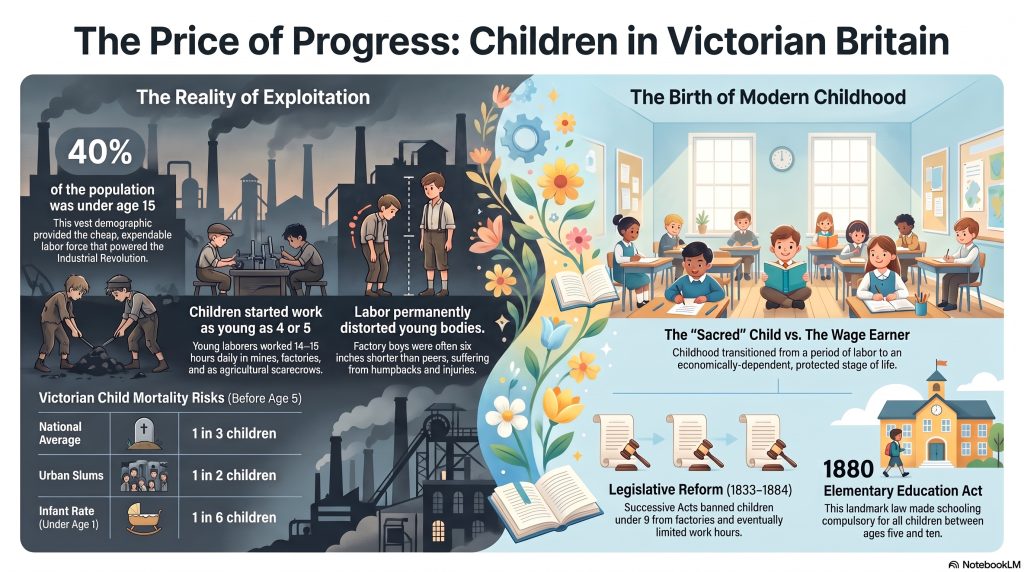
This talk examines the evolving perception and reality of childhood during the Victorian era through the lens of contemporary art. While famous paintings often depicted idealized, sentimental scenes of well-fed youth, the industrial revolution actually relied on a massive, exploited labor force of children as young as four. The text highlights how Romantic poets like Wordsworth shifted public thought by promoting the idea of innate childhood innocence, eventually leading to protective legislation and compulsory schooling. Artistic works by figures such as William Bell Scott and William Beechey are analyzed to show the stark contrast between the lives of the wealthy and the impoverished working class. Furthermore, the documents detail the extreme hardships faced by poor children, including high mortality rates, stunted growth from malnutrition, and dangerous labor in mines and factories. The talk illustrates how the modern concept of childhood as a protected life stage emerged from a period of systemic exploitation.
My notes on Children in Victorian Art
A conversation on Children in Victorian art created by Gemini Notebook from my notes:
When we look back at the Victorian era, we are often seduced by its sentimental gaze. We see the porcelain-skinned, golden-haired cherubs of the Pre-Raphaelite imagination—none more famous than the boy in John Everett Millais’ 1886 masterpiece, Bubbles. He is the ultimate symbol of a protected, “sacred” childhood: well-fed, elegantly dressed, and captivated by the ephemeral beauty of a soap bubble. The irony, of course, is that the painting was quickly commodified into an advertisement for Pears Soap. Even the “sacred” child was a product for sale.
But the archival reality is far grittier. In the mid-19th century, roughly 40% of the British population was under the age of 15. For the vast majority, childhood was not an “ever-lengthening interval” of play, but a brutal race toward utility. These children were the primary, expendable resource that fueled the Industrial Revolution. While we celebrate the genius of engineers like Brunel and Stephenson, we often ignore the fact that their bridges and locomotives were built on the backs of four-year-olds who worked 15-hour days. For the children of the poor, the “sacred” interval of innocence didn’t exist; it had to be invented.
The “White Slaves” of England
The British Empire’s global supremacy was rooted in a system of exploitation that contemporaries frequently likened to colonial slavery. The demand for child labor was so insatiable that it received the highest levels of state endorsement. During the Napoleonic Wars, when manufacturers complained they could no longer afford their taxes, William Pitt the Younger offered a chillingly pragmatic solution:
“Yoke up the children.”
This “yoking” was most predatory in the form of “Parish Apprenticeships.” This was essentially state-sponsored slavery. Orphans—the real-life Oliver Twists—were transported from London workhouses to remote factories in the north at ages seven or eight. They were indentured until 21 or 24, forced to sleep in shifts in cramped dormitories, and worked barefoot to prevent sparks from their clogs from igniting the dust-choked factory floors. The lack of freedom was no secret to the victims. Charles Bacon, a 13-year-old auctioned as an apprentice in 1871, later reflected that after reading Uncle Tom’s Cabin, he realized that the same “slavery” he pitied in the Americas was his own lived reality in England.
The Lifespan Paradox: The Health of a “Stunted” Generation
Historical data presents a startling health paradox. It is an undeniable tragedy that one in three children died before the age of five. However, research by Paul Clayton and Judith Rowbotham reveals that those who survived early childhood were, in many ways, physically superior to modern citizens.
Between 1850 and 1870, England enjoyed a “Golden Age” of health. Mid-Victorians possessed only 10% of the degenerative disease rates (heart disease, cancer, diabetes) seen today. This was driven by a nutrient-dense diet and extreme physical exertion. A Victorian “navvy” could shift 20 tonnes of earth a day, and the average worker consumed micro- and phytonutrients at ten times the levels considered normal today.
But this health was fragile and class-dependent. The physical toll of labor was visible in the skeleton itself. Factory boys were, on average, six inches shorter than their wealthy peers; an eighteen-year-old worker typically stood just five feet three inches tall. This demographic decline accelerated after 1875 with the introduction of “industrial foods”—sugar-laden condensed milk, white bread, and canned goods. By 1900, the metric of this decay was undeniable: 5 out of 10 young men volunteering for the Boer War were rejected because they were so physically stunted and undernourished they could not even chew a basic diet of vegetables.
Art as Social Propaganda: The Sinister Side of Sentiment
Victorian art often functioned as a sophisticated tool for manipulating public opinion, masking brutal economic truths with a veneer of “sentiment.” Two specific works highlight how the brush was used to defend the status quo:
- William Beechey’s Portrait of Sir Francis Ford’s Children (1793): On the surface, it shows wealthy children giving a coin to a beggar. In reality, it was pro-slavery propaganda. Sir Francis Ford was a strong pro-slavery MP with plantations in Barbados. The painting’s “hidden message” was a calculated political move: by showing his family’s charity to the English poor, Ford argued that his “white slaves” at home were worse off than those in the colonies, thereby justifying the slave trade through a false comparison of suffering.
- William Collins’ Rustic Civility (1833): This famous rural scene depicts children opening a gate for a gentleman. The gentleman is never seen; we only see his long, authoritative shadow cast upon the road. Collins, a High Tory, painted this as a visual argument against the 1832 Reform Bill. The message was clear: the rural poor were “deserving,” naturally subservient, and happy in their station—therefore, they had no need for the vote.
The Invention of the “Sacred” Child
The transition from viewing children as “fuel for the future” to the “economically-dependent sacred child” was a slow cultural revolution. Before this shift, religious tradition often viewed children as “naturally infidels” born with original sin, requiring strict, often violent “correction.”
This changed with the Romantic poets, most notably William Wordsworth. He argued that children were born “without sin,” special beings closer to God than adults. This radical shift in thought eventually forced Parliament to intervene in the machinery of industry. The 1833 Factory Act was the first major blow, banning children under nine from textile mills. Decades of struggle followed, culminating in the 1880 Education Act, which made school—not the factory or the brick kiln—the new compulsory rite of passage for the young.
The Dark Reality of the Rural “Idyll”
While Tory artists like Collins painted sun-drenched fields of “civility,” the reality of child agricultural labor—the nation’s largest employer—was a landscape of physical deformity. Six-year-olds served as “human scarecrows,” spending twelve hours in solitary, windswept fields. By age seven, boys were driving ploughs and carrying 40-pound loads, resulting in permanent “knock-knees,” humpbacks, and damaged pelvises.
The true cost is found in the “lost testimonies” of those underground and in the fields. Take the words of eight-year-old Sarah Gooder, whose 1836 testimony from the coal pits shatters any romantic notion of the era:
“Sometimes I sing but never in the dark. I don’t like being in the pit. I am scared.”
We see the same haunting reality in William Bell Scott’s Iron and Coal (1861). Amidst the “white heat” of industry, he includes a dog rose—a Victorian floral symbol for “pleasure and pain”—and a girl who represents the “ever-lengthening interval” of childhood. She sits on a gun barrel, a schoolbook in her lap, a quiet threat to the patriarchal world that viewed her brother only as a “climbing boy” for a 9-inch chimney.
A Debt of Respect
We have spent decades viewing the Victorian poor through a lens of pity, but it is our respect they have earned. These children were the engine of the modern world. They labored in the soot and the dark so that the “Great Engineers” could build the bridges we still cross today. As a historian, I believe they are heroes, whether there is a statue to them or not.
But as we read this on our modern devices, we must look at the demographics of our own century. Today, countries like Sudan, Liberia, and Nigeria face similar child-population percentages and labor conditions. It forces a haunting question upon the modern reader: How much of our current global “progress” is still built on the invisible labor of the young?
23-06 The Aesthetic Movement
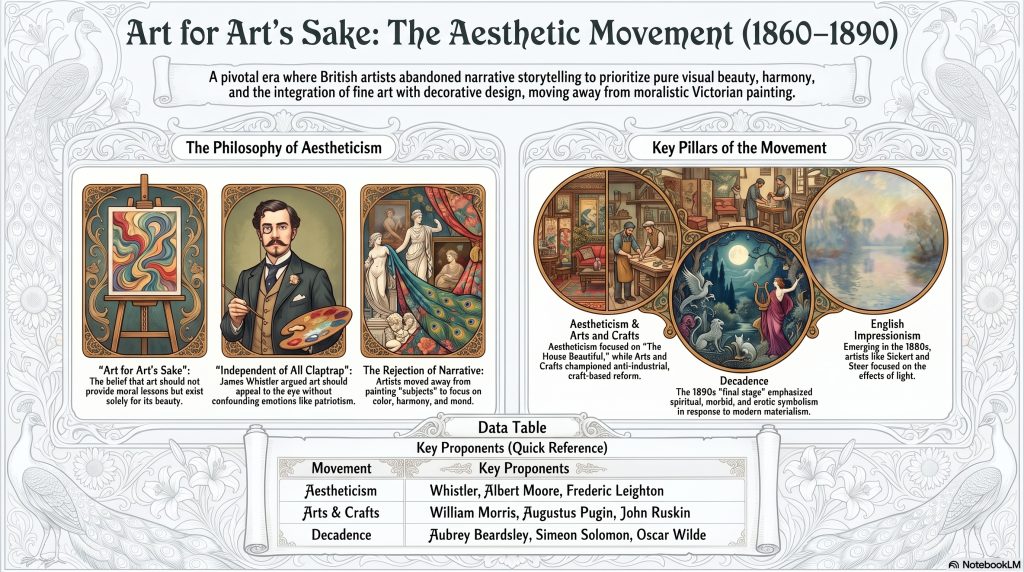
This talk is a duplicate of 28-03 The Aesthetic Movement 1860-1890 in the Chapter on the Aesthetic Movement.
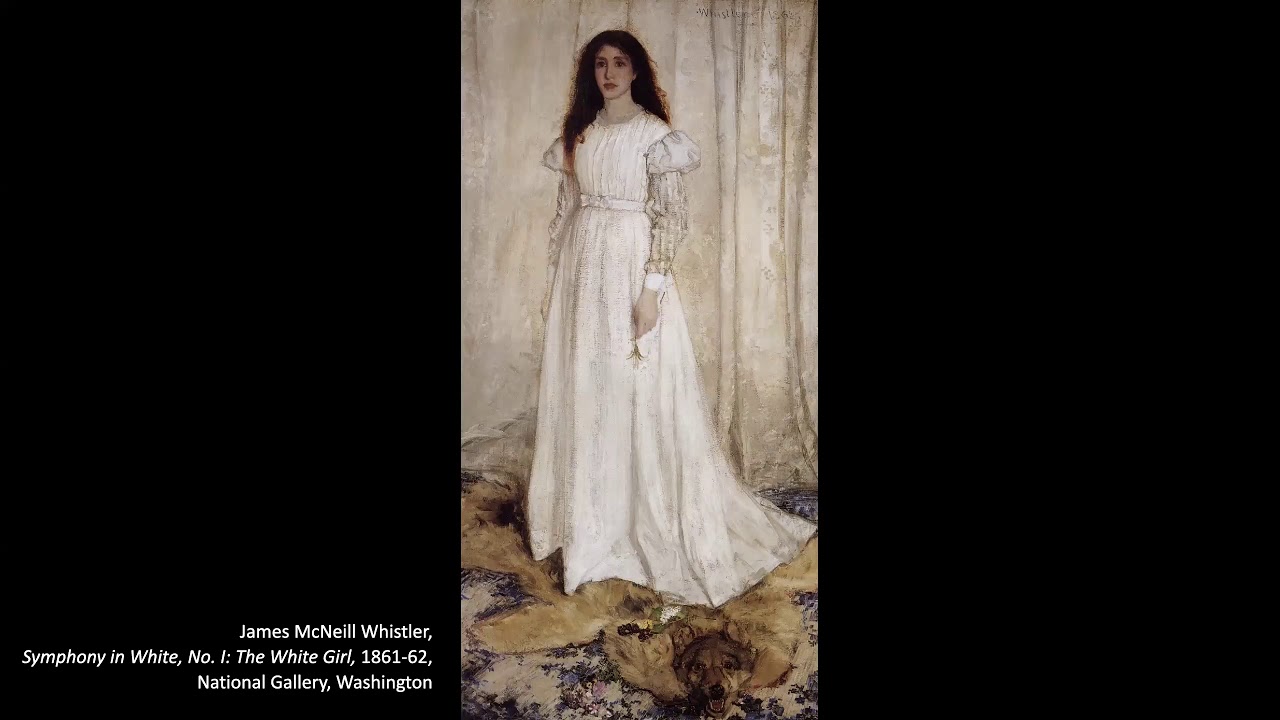
My notes on the Aesthetic Movement 1860-1890
A conversation about the Aesthetic Movement created by Gemini Notebook from my notes:
Why Must Art Have a Message?
When we stand before a canvas in a modern gallery, our first instinct is often to play the detective. We search for a hidden narrative, a social commentary, or a moral lesson. What is the artist trying to teach us? This impulse is a heavy inheritance from the Victorian era. Under the stern guidance of John Ruskin, the mid-19th century viewed art as a primary tool for moral instruction. Ruskin even championed the “Theoretic” faculty—a way of seeing beauty not as a sensual pleasure, but as something moral and transcendental.
However, between 1860 and 1890, a radical disruption occurred. The Aesthetic Movement—famously known as the “Cult of Beauty”—dared to suggest that art had no duty to improve our souls. It boldly asserted that art’s sole justification was its own beauty. To the Victorian establishment, this was more than a change in style; it was a revolution of the senses.
1. Art for Art’s Sake: The Radical Act of “Doing Nothing”
The core philosophy of the movement, “Art for Art’s Sake,” was not merely a tagline; it was a shared view of the role of art in society. In an age that demanded every painting tell a story or champion a virtue, the refusal to “mean” anything was a radical act. This shift stripped away what James McNeill Whistler called “claptrap”—the emotional and patriotic hooks used to manipulate the viewer’s feelings.
“Art should be independent of all claptrap —should stand alone […] and appeal to the artistic sense of eye or ear, without confounding this with emotions entirely foreign to it, as devotion, pity, love, patriotism and the like.” — James McNeill Whistler
This rejection of narrative explains why artists like Albert Moore remain relatively obscure today. Moore was a pioneer who painted “without a subject,” focusing on decorative arrangements of figures and harmony of color. Because his work lacked a clear “point,” contemporary critics often dismissed it as “trite.” They could not grasp that the absence of a moral lesson was, in itself, the movement’s most defiant statement.
2. When Fine Art Met the Teapot: The Birth of the “House Beautiful”
Aestheticism successfully demolished the wall between “high art” and interior design by championing the “autotelic” object—an item complete in itself, referring to no external story. This was the foundation of the “House Beautiful” movement. If a painting was a decorative object, then a teapot could be a work of art.
No one embodied this shift more than Christopher Dresser, the “father of industrial design.” While figures like William Morris looked backward to medieval crafts, Dresser looked toward a radical, abstract future. Influenced by “English Japanese” aesthetics, his metalwork was strikingly angular and prioritized plain, unadorned surfaces. This was a direct assault on the suffocating clutter of traditional Victorian decor. Dresser’s designs were so far ahead of their time—prioritizing geometry over organic flourish—that many were deemed impossible for mass production.
The poet Algernon Charles Swinburne, a perennial Nobel Prize nominee, captured this spirit perfectly when describing Moore’s work, a sentiment that applied to the entire Aesthetic home:
“Their reason for being is simply to be.”
3. The “Sly Trickster” Who Made Impressionism Palatable
While the movement conquered the home through the “House Beautiful,” it still had to win the battle of public opinion in the galleries. The bridge to modernism was built by an unlikely figure: Jules Bastien-Lepage. As the public recoiled from the “audacious humbug” of Claude Monet’s Impressionism, Bastien-Lepage offered a juste milieu—a middle way.
He combined the gritty realism of Jean-François Millet with the fleeting, scientific light of the Impressionists. He was so successful that one critic noted with a hint of exasperation: “The whole world paints so much today like Mr. Bastien-Lepage that Mr. Bastien-Lepage seems to paint like the whole world.”
To the purists, however, he was a “sly trickster who fakes naturalism in order to please.” By making a radical style ubiquitous and “safe,” he was accused of diluting the avant-garde. Yet, as the critic Roger Fry later noted, he provided the public with a “more acceptable route to Impressionism,” essentially tricking the Victorian eye into accepting the modern world.
4. From Radical to Reactionary: The Political Journey of Beauty
The Aesthetic Movement followed a curious political trajectory. In the 1870s, the “autonomy of art” was a radical demand for freedom from state and religious oversight. To choose beauty over a moral lecture was a claim to personal and artistic sovereignty.
However, the lens of history is fickle. By the 1970s, Marxist historians had rebranded the movement as “reactionary.” They argued that art always possesses a political role, and that the refusal to take a side is, in itself, a privileged political stance.
This journey concluded in the “Decadent” phase of the 1890s, led by figures like Aubrey Beardsley and Oscar Wilde. For them, the “autotelic” beauty of the previous decades became a weapon against “rampant materialism.” The beautiful object—be it a teapot or a poem—was no longer just an ornament; it was a spiritual escape from a modern world they found morally bankrupt.
5. The “Evil” Sunshine of Philip Wilson Steer
Perhaps the most startling truth is that a painting of pure sunshine could be labeled “evil.” This was the fate of Philip Wilson Steer’s Girls Running, Walberswick Pier (1888-94). To the casual observer, it is a carefree beach scene, but Steer’s Post-Impressionist technique created a deep psychological discomfort.
Steer utilized a “heavily worked paint surface” and a flat perspective that forced the viewer to confront the work as “paint on a flat surface” rather than a comfortable story. But the true unease lay in the details. Beneath the warmth of the afternoon light, there is a sense of claustrophobia. We see the two girls in the foreground, their hands parting in the shadow—a subtle, heartbreaking suggestion of a friendship breaking apart.
The long shadows stretching across the pier are not merely atmospheric; they suggest night falling and, metaphorically, death. By balancing precariously “between abstract pattern and profound meaning,” Steer proved that art doesn’t need a moral lesson to be haunting.
A Legacy of Pure Aestheticism
The Aesthetic Movement fundamentally altered the DNA of Western culture. By prioritizing the “artistic sense of eye or ear” over the didactic lecture, these artists paved the way for the total abstraction of the 20th century. They taught us that beauty is not a luxury or a mask for a message; it is its own excuse for being.
In our current age, where we are relentlessly bombarded by images designed to sell us a product, a lifestyle, or a political ideology, perhaps the movement’s most radical question remains: Is there still room in our lives for art that exists “simply to be”?
23-07 The Victorian Nude
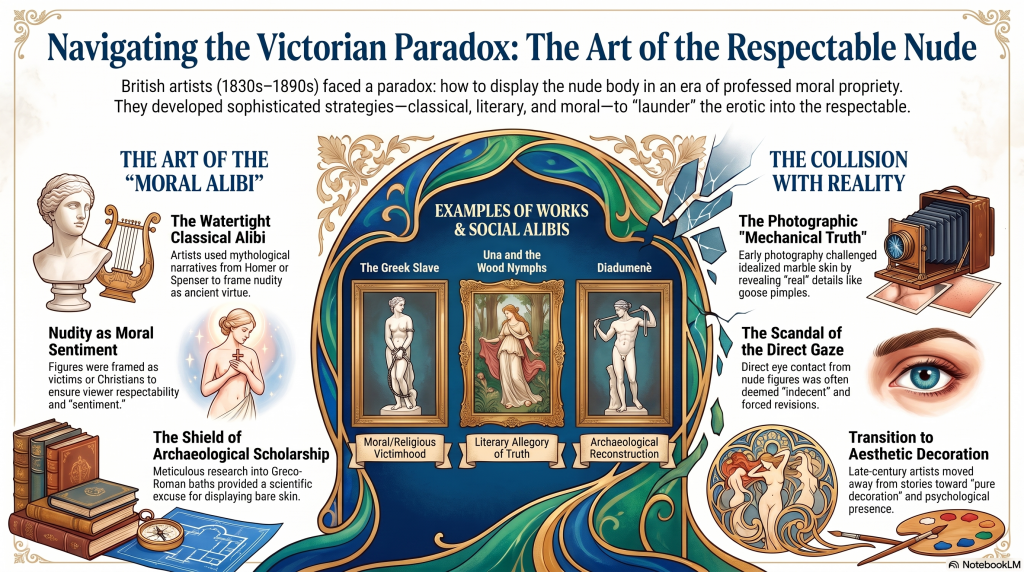
I examine the evolution of the nude figure in nineteenth-century art, highlighting how artists navigated the strict moral boundaries of the Victorian era. Works by painters and sculptors like William Etty, Hiram Powers, and Frederic Leighton utilized “classical alibis”—such as mythology, literature, and historical archaeology—to make depictions of the unclothed body socially acceptable. The text details a shift from moral allegories and virtuous narratives toward the more decorative and psychologically complex styles of the Aesthetic and Pre-Raphaelite movements. Controversy often arose when realism or direct gazes threatened these traditional justifications, leading some artists to alter their work to appease conservative critics. Ultimately, the collection illustrates how the Victorian nude served as a complex intersection of public propriety and private artistic expression. Through various media, including early combination photography, these creators established a lasting visual template that reflects the shifting social values of their time.
(My YouTube video will be published on 28 November 2026)
My notes on the Victorian Nude
A discussion on the Victorian Nude created by Google NotebookLM:
1. The Victorian Paradox
History paints the Victorian era as a time of stifling decorum, a society so concerned about the biological that they covered male genitals with fig-leaves. Yet a stroll through any 19th-century gallery reveals a startling irony: the era was obsessed with massive, fifteen-foot canvases of hyper-realistic, unclothed bodies.
This created the “Fundamental Paradox” of the age. Artists and their patrons had to navigate a minefield of professed moral propriety while indulging a voracious fascination with the human form. To resolve this tension, they developed a series of ingenious narrative “shields”—intellectual alibis that transformed the act of looking into a virtuous pursuit.
2. Takeaway 1: The “Classical Alibi” and the Moral Loophole
The primary defense for the Victorian nude was the “classical alibi.” By grounding a painting in mythology or archaeology, artists provided viewers with a watertight excuse: “Homer made me do it.” William Etty’s The Sirens and Ulysses (1837) set the foundation, though his “mortuary cadaver” realism—sketched from actual corpses—unsettled the critics. Later, Edward Poynter evolved this into “archaeological scholarship made fleshy.”
Poynter’s Diadumenè (1884) was a masterpiece of meticulously researched Greco-Roman bathing, yet even this “vaccination” against impropriety failed when the Bishop of Carlisle complained about the figure’s nudity. Poynter was forced to paint a draped variant for the squeamish market, proving that even the most learned citation couldn’t always ward off episcopal disapproval.
“A disgusting combination of voluptuousness and loathsome putridity.” — The Spectator on Etty’s work.
3. Takeaway 2: Queen Victoria Was the Nude’s Biggest Fan
Contrary to her “prude” reputation, the Queen was a significant patron of the genre. She adored the “well-lit female flesh” of William Edward Frost, whose literary nymphs were so “morally upright” they could hang in the drawing room.
The ultimate moral framing came when Victoria purchased a print of Oscar Gustave Rejlander’s scandalous The Two Ways of Life (1857) specifically for Prince Albert. By bringing a photographic allegory of “Vice”—complete with unblushing nudes—into the domestic sphere of the ultimate royal family, she signaled that the nude was officially “Art.”
4. Takeaway 3: Photography and the “Mechanical Truth”
The arrival of photography created a collision between “marble idealism” and “optical fact.” Early studies by Jean-Louis-Marie-Eugène Durieu revealed a reality the Academy tried to ignore: real skin had goose pimples, sagged under gravity, and models bore bored expressions.
While artists used these photos as secret aids, they were terrified of their raw honesty. Even the great Delacroix, while directing Durieu’s sessions, was caught “re-idealising the body in the margins” of the prints. The camera proved that the closer a nude got to a real person, the more dangerous it became to the social order.
5. Takeaway 4: The “Frankenstein” Art of Repainting
Many Victorian nudes were products of cold, practical revisionism. Dante Gabriel Rossetti’s Lady Lilith is a “Frankensteinian” act; he originally used his lover Fanny Cornforth as the model, but later scraped off her face and repainted it to resemble Alexa Wilding.
Similarly, John Everett Millais literally “scraped off” the head of the woman in The Knight Errant after critics found her direct gaze at the viewer “indecent.” He repainted her to look demurely away, reusing the discarded original head in another picture. This “averted gaze” became a social necessity—a signal that the figure was a passive object rather than a confrontational person.
6. Takeaway 5: From Heroism to “Feeling”
By the 1870s, the male nude shifted from “muscular heroism” to a symbol of emotional vulnerability. Edward Burne-Jones’s Phyllis and Demophoön (1870) depicted a male body that was “soft and yearning” rather than powerful. When the Old Water-Colour Society asked him to add a fig leaf to the figure, Burne-Jones resigned in protest.
This new naturalism extended to sculpture. Thomas Woolner’s Puck was “awkwardly real”—a chubby, knock-kneed adolescent fairy “whose ribs you can count.” These works moved the nude from a symbol of force to one of naturalistic feeling, unsettling those who preferred their men made of airbrushed stone.
7. Takeaway 6: The Invention of “Nude Wallpaper”
The most radical shift came from Albert Joseph Moore, who declared “there is no story.” In A Summer Night, his goal was “decorative harmony”—pure color and line. His nudes often sleep, a clever tactic ensuring the viewer can look without being looked at. By removing the myth and the moral excuse entirely, Moore achieved the unthinkable: he made the nude acceptable as pure aesthetic ornamentation.
“…having quietly made the nude into wallpaper of the most sophisticated kind.”
8. Conclusion: The Fault Lines of Desire
After Victoria’s death in 1901, the “elaborate justifications” for the nude fell away. Modernism had no use for Sirens or Greek baths; it preferred to handle the body directly or abstract it. However, the Victorian era’s defensiveness reveals more about their private desires than our own “open” era might care to admit. Their alibis map the exact fault lines of their society. It leaves us with a challenge: do we still use modern alibis—like “fitness,” “wellness,” or “health”—to justify our own eternal obsession with the body?
23-08 Victorian Art – Social Realism in Victorian Painting
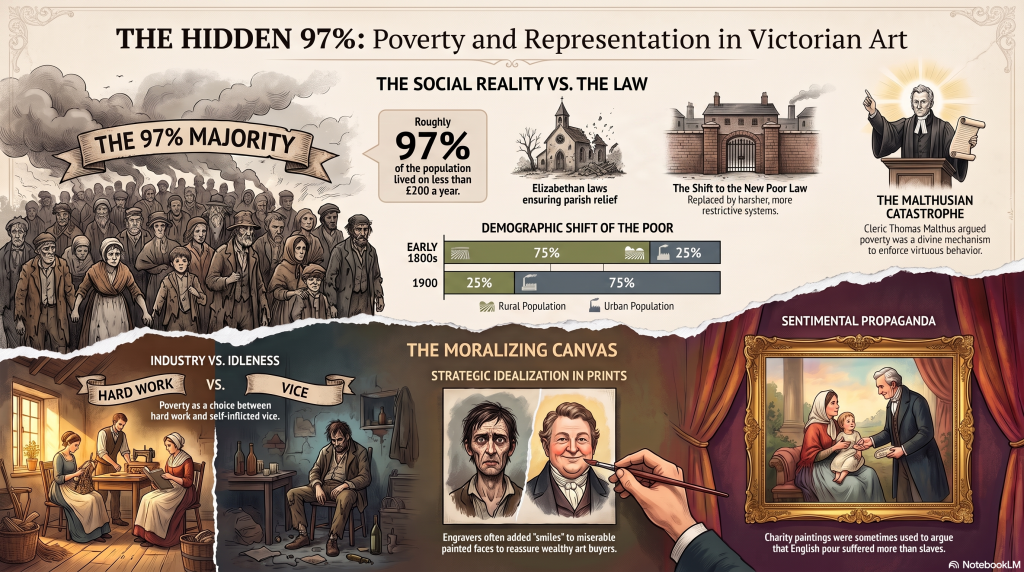
This lecture surveys how British painters from Hogarth to the Pre-Raphaelites represented the ninety-seven per cent of Victorians classed as poor. Beginning with Elizabethan poor law and Malthusian theory, it traces poverty’s visual record through moral allegory, sentimental genre painting, documentary illustration, and social realism. Individual works by Morland, Fildes, Redgrave, Watts, Herkomer, and Frith reveal how depictions of the deserving poor, fallen women, workhouses, Chartism, famine, and child mortality each constituted a political act — insisting that labouring and destitute lives deserved, at last, to be seen.
(My YouTube talk will be published on 19 March 2027)
My notes on Social Class in Victorian Painting
An entertaining conversation about Social Class in Victorian Painting created by Google NotebookLM from my notes:
We tend to think of Victorian Britain through its grand portraits, its lush landscapes, its morally tidy genre scenes. But here’s the uncomfortable truth: the people who built that world — who swept its streets, broke its stone, sewed its garments by candlelight — were almost entirely absent from its celebrated painting. Nearly 97% of the population were poor. The art barely shows them. When it finally did, the results were startling.
**A “Charity Portrait” Was Actually Pro-Slavery Propaganda**
William Beechey’s 1793 painting of wealthy children giving a coin to a beggar boy looks like a straightforward scene of sentiment. It wasn’t. The commissioner, Sir Francis Ford, was an outspoken pro-slavery MP who argued that his enslaved workers in Barbados lived better than England’s urban poor. The beggar boy wasn’t a subject of compassion — he was a rhetorical prop.
This painting tells us almost nothing about actual poverty, and everything about how wealth derived from slavery sought to launder its image through sentimental imagery. Look closely at any Victorian “charity scene” and ask: who commissioned it, and why?
**An Engraver Literally Erased Poverty From a Painting to Make It Sell**
George Morland painted rural poverty without idealisation — blank expressions, broken spirits. When his brother-in-law James Ward made an engraving to sell to a wider market, he quietly transformed it: the woman and child were now smiling, their clothes improved, the dog’s coat fluffed up.
Art historian John Barrell’s point cuts deep: those cheerful faces would have reassured viewers about the governability of the poor at a moment of genuine rural unrest. The original refused idealisation. The print erased that refusal. Every copy sold was a small act of political comfort.
**The Peterloo Massacre Was the Bloodiest Domestic Political Act of the Century — and Barely Exists in Fine Art**
On 16 August 1819, over 60,000 people gathered peacefully in Manchester to demand voting reform. Cavalry charged into the crowd with sabres. A two-year-old child was the first casualty; up to 700 were injured. It exists in the visual record almost entirely through a single radical print by journalist Richard Carlile.
“To Henry Hunt, Esq. … and to the female Reformers of Manchester … who were exposed to and suffered from the wanton and fiendish attack made on them by that brutal armed force.”
The near-absence of Peterloo from high art is itself a statement. Institutions commission the paintings that flatter them.
**The Victorian “Average Lifespan of 40” Is Almost Entirely Misleading**
The headline figure is true — and deeply deceptive. Strip out catastrophic child mortality, and a Victorian who survived to age five had a life expectancy of roughly 75 years, comparable to today. Between 1850 and 1870, analysis of census data suggests degenerative diseases occurred at roughly ten percent of modern rates, thanks to extraordinary levels of physical activity and nutrient-dense diets.
After 1875, cheap imports — canned fruit, condensed milk, white bread — degraded that diet rapidly. By 1900, five in ten men volunteering for the Boer War were rejected as undernourished. The Victorian health story is not one of steady progress. It’s a peak followed by a collapse.
**The Word “Cartoon” Was Invented as a Direct Attack on Government Indifference to Poverty**
In 1843, Punch published John Leech’s image of the destitute poor staring at artworks they couldn’t afford to see — a government-sponsored exhibition with an entrance fee beyond their means.
“The poor ask for bread, and the philanthropy of the State accords — an exhibition.”
This was Cartoon No. 1 — the piece that gave the modern word “cartoon” its meaning. Previously, a cartoon was a preparatory sketch for a fresco. Punch redefined it as a full-page satirical graphic. The language of modern visual commentary was born from an act of social protest.
The Question Worth Sitting With
Victorian social realist painters — Fildes, Watts, Redgrave, Herkomer — made a conscious, often career-risking choice to paint people polite culture preferred not to see. Their canvases are political acts dressed as art.
If 97% of a society can be almost invisible in its cultural record, what does our visual culture quietly choose not to show — and who benefits from that absence?
23-09 Victorian Art – Social Realism and Victorian Morality
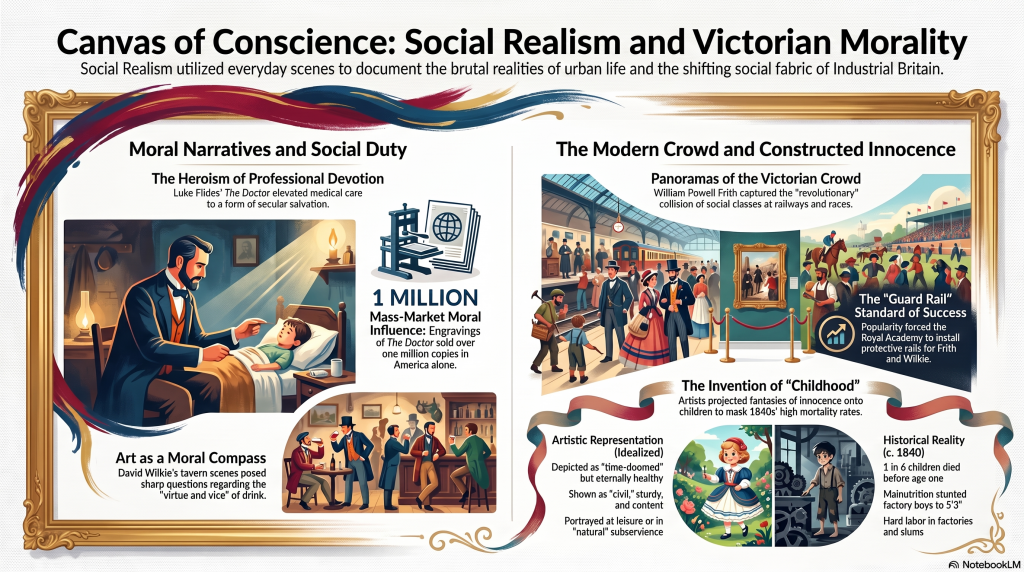
This talk covers Victorian genre and social realist painting from Wilkie and Frith through to Fildes, Watts, and Holl, showing how artists moved between cheerful crowd scenes and unflinching moral argument. It examines paintings of childhood, fallen women, prostitution, and poverty, tracing how academic convention was stretched to accommodate documentary urgency. Works by Redgrave, Holman Hunt, Egg, Millais, and Rossetti reveal how symbolism, literary sources, and personal grief were marshalled to expose the double standards and structural injustices shaping Victorian society.
(My YouTube talk will be published on 27 March 2027)
My notes on Social Realism and Victorian Morality
An entertaining conversation about Social Realism and Victorian Morality created by Google NotebookLM from my notes:
We tend to think of Victorian art as sentimental: rosy-cheeked children, weeping widows, cosy firesides. But look closer, and the canvases of the 1840s through 1880s are doing something far more radical. These paintings were arguments — about class, gender, poverty, and power — disguised as storytelling. Here are the most surprising things hiding inside some of Britain’s best-loved pictures.
The Doctor Isn’t Just Caring — He’s Dominating
Luke Fildes’s The Doctor (1891) looks like a tender vigil. But the physician’s pose deliberately echoes Michelangelo’s Lorenzo de’ Medici, nicknamed Il Pensieroso: The Thoughtful One. The implication is pointed. The doctor belongs to a thinking class. The ragged parents depend on him for physical salvation exactly as they depend on their priest for spiritual redemption. The painting sold over a million engravings in America alone. Its power came partly from how neatly it justified hierarchy.
“Sentimental” Art Was Often Political Propaganda
William Collins’s Rustic Civility (1833) shows poor children cheerfully holding a gate open for a passing gentleman. Charming — until you know Collins was a Tory who actively opposed the Reform Bill. The painting’s real argument: the poor are contented and naturally subservient, so why would they need the vote? Meanwhile, one in six children died before their first birthday. Collins erased all of that to make his case.
“A sentimentalist is one who desires to have the luxury of an emotion without paying for it.” — Oscar Wilde
Frith Was Making a Fortune From “Modern Life” 15 Years Before the Impressionists Dared
When William Powell Frith painted Ramsgate Sands in 1854 — ordinary people on a beach, no mythology — fellow artists were scornful. One called it “a piece of vulgar Cockney business.” Queen Victoria bought it for £1,000. Frith kept the reproduction rights and earned three times that in prints. Claude Monet painted a railway station in 1877. Frith had already made a fortune from one in 1862.
Every Object in *The Awakening Conscience* Is a Threat
Holman Hunt packed his 1854 painting with coded warnings. A cat toys with a broken-winged bird — her plight. A discarded glove signals the likely fate of a cast-off mistress. The mirror reflects a sunlit garden — God’s creation, and escape. Ruskin wrote to The Times that even the hem of her white dress carried a story of streets she might soon walk. The model was Annie Miller, a barmaid Hunt met when she was fifteen.
The Victorians Invented Childhood — Then Used It As a Weapon
Before the 1860s, children in painting were small adults. Millais changed that. His My First Sermon and My Second Sermon constructed childhood as a distinct, sacred, and time-doomed phase of life. The Archbishop of Canterbury cited the sleeping child as a warning against long sermons. But scholars identify something larger: Victorian child imagery created a screen onto which adults projected fantasies of innocence and nostalgia — a projection, they argue, that still shapes how Western culture understands childhood today.
A Painting About Seamstresses Helped Spark a Socialist Revolution
Richard Redgrave’s The Sempstress (1846) — a woman still sewing at 2:30 a.m., eyes inflamed, medicine bottles on the mantelpiece — was the founding work of social realist painting in Britain. Articles argued British workers were enslaved. A German living in England named Friedrich Engels was so struck by the material that he showed his study of working conditions to a friend in Paris. That friend was Karl Marx.
These paintings were never just pretty. They were dispatches from a society arguing furiously with itself about who deserved dignity, protection, and power.
The real question is: what are we not seeing in the art that surrounds us today?
23-10 Victorian Art – The Deserving Poor
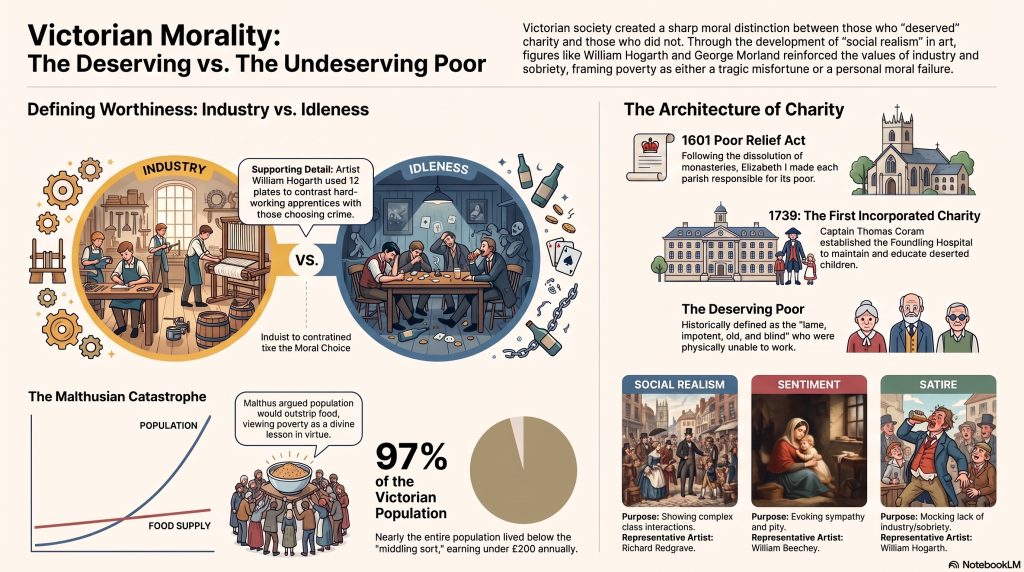
The talk explores the historical concept of the “deserving poor” by tracing the evolution of charitable institutions and social realism in art. The materials highlight the Hospital of St Cross as an early example of faith-based aid, while later developments like the Foundling Hospital integrated philanthropy with the arts through the support of William Hogarth and George Frideric Handel. Key intellectual shifts are examined, such as Thomas Malthus’s warnings about population growth and Henry Mayhew’s sociological studies of the lower classes. Artistic works by Emma Brownlow and Richard Redgrave are used to illustrate the transition toward depicting harsh social realities and the moral distinctions made between those seen as worthy of help and those labeled as idle. Ultimately, the collection demonstrates how Victorian society used visual culture and new legislation to navigate the complex challenges of poverty and class.
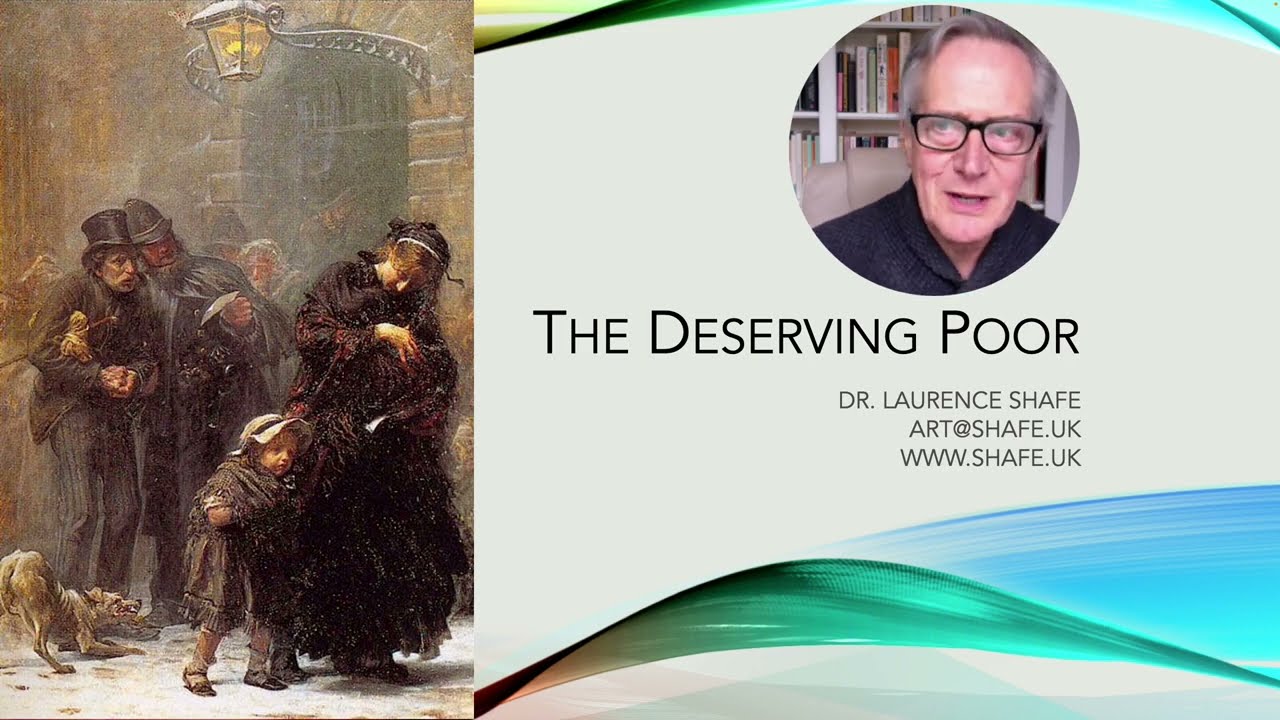
My notes on 23-10 Victorian Art – The Deserving Poor
This interesting conversation was produced by Google Notebook from my notes:
1. Introduction: The Moral Filter of the 19th Century
In the twilight of our enlightened century, one cannot pass through a London gallery without being struck by the stern audit of the soul that our age demands of the destitute. The phrase “deserving poor” has become more than a mere classification; it is the very pivot upon which the Victorian moral apparatus turns. To the mid-century mind, charity was never intended as a universal balm, but as a reward for the industrious and a rebuke to the idle.
As we moved away from the simple, often frivolous genre paintings of the Regency, a new “social realism” emerged, championed by such luminaries as Richard Redgrave. His 1846 masterpiece, The Sempstress, was no mere decoration; it was a visual sermon, forcing the comfortable classes to confront the unseen agonies of the London attic. However, we must peel back the varnish of these works to reveal a more complex truth. These paintings were far more than aesthetic triumphs; they were sophisticated instruments of social control, economic propaganda, and a rigid moral theology designed to reconcile Christian virtue with the grim realities of our industrial sprawl.
2. The Hospital That Invented the Public Art Gallery
It is a profound irony that the world’s first public art gallery was born not of a desire for high culture, but of a desperate need to save “exposed and deserted young children.” Long before our great national museums opened their doors, the Foundling Hospital, established by the tireless Captain Thomas Coram in 1739, served as the unlikely sanctum for London’s artistic elite.
The Governors’ Committee Room became a theater of contrast where the fashionable world mingled with the echoes of the abandoned. This was achieved through the savvy of William Hogarth and the divine genius of George Frideric Handel. Hogarth, ever the campaigner, invited the finest brushes—Gainsborough and Wilson among them—to exhibit their works, effectively using high art as a lure for wealthy patrons. Handel, meanwhile, consecrated the institution with his music. On May 27, 1749, the Foundling Hospital Anthem premiered in the chapel, its final chorus vibrating with a joy that seems almost haunting when one considers the “exposed” lives it was meant to sustain.
“Blessed are they that considereth the poor.” — The Foundling Hospital Anthem, George Frideric Handel. (The final chorus of this anthem, a piece of divine celebration, was taken from the Messiah—using the “Hallelujah Chorus” itself to fund the salvation of the nameless.)
3. Charity as Pro-Slavery Propaganda
One must be ever vigilant against the “calculated sentimentality” that often masks more sinister motives. Consider William Beechey’s Portrait of Sir Francis Ford’s Children Giving a Coin to a Beggar Boy (1793). To the untrained eye, it is a touching display of youthful philanthropy—two fashionably-dressed children, Francis and Mary, bestowing a coin upon a ragged wanderer.
However, the motive of their father, Sir Francis Ford, was far from pious. As an MP and a staunch defender of the slave trade, Ford commissioned this work as a visual argument for his interests in Barbados. By displaying his children’s “benevolence” toward an English beggar, he sought to argue that the enslaved people on his West Indian plantations lived lives of greater comfort and security than the “abject poor” of the English countryside. The children in the painting serve as human shields for a pro-slavery rhetoric, their very ability to give derived from the exploitation they sought to justify.
“Ford was a strong pro-slavery MP in Parliament and the wealth of the children comes directly from the exploitation of slave labour in Barbados.”
4. The Malthusian Catastrophe: Why Helping the Poor Was “Doomed”
The Victorian approach to poverty was haunted by the shadow of Thomas Robert Malthus. In his An Essay on the Principle of Population, Malthus posited a grim mathematical reality: population grows geometrically, while food supply increases only arithmetically. This led inevitably to what we now call the “Malthusian catastrophe”—a divinely ordained correction of famine and disease.
Malthus was an Anglican cleric, and he viewed these harsh economic laws as a divine pedagogical tool intended to teach virtuous behavior. To Malthus, helping the poor was not merely a mistake; it was an act of cruelty, as it encouraged the “undeserving” to breed beyond the earth’s capacity, leading only to further “misery and vice.” He famously criticized the Poor Laws for this very reason. Most tellingly, he supported the Corn Laws—taxing imported wheat and driving up the price of bread—believing that the resulting hardship was a necessary goad toward moral industry and self-restraint.
“The power of population is indefinitely greater than the power in the earth to produce subsistence for man.” — Thomas Robert Malthus
5. The Invisible 97%: Life on Less Than £25 a Year
While our art galleries celebrate the refined features of the gentry, we must remember the staggering reality of the Victorian demographic. At the pinnacle of our society sat a mere 180 peers of the realm. Below them, a few thousand gentry and the “middling sort”—those earning over £200 a year—accounted for a scant 3% of our population.
The remaining 97%—the vast, invisible laborers and artisans—lived in a state of constant precariousness. Between 1700 and 1900, our nation flipped from being 75% rural to 75% urban, a shift that thrust poverty into the glaring light of city streets. Within this 97%, the chasm was vast; while a skilled artisan might earn a modest living, fully half the population subsisted on less than £25 a year, a pittance that made survival impossible without the very charity our society so strictly audited.
The Victorian Class Hierarchy
- The Pinnacle: Royalty and only about 180 Peers of the Realm.
- The Gentry: Landowners, country squires, and high-ranking clergy.
- The Middling Sort (The 3%): Those earning over £200, including barristers and businessmen.
- The Labourers (The 97%): From the skilled artisan to the “professional” beggar, with half living on less than £25 per annum.
6. The “T” in Teetotaler: Alcohol and the Irony of Morland
Alcohol consumption has long been cited by the moralist as the primary “vice” of the lower orders. In 1833, Richard “Dicky” Turner gave us the word Teetotaler. It is a common misconception that the term refers to “tea”; rather, it was Turner’s idiosyncratic way of demanding “Total abstinence with a capital T.”
Art has frequently taken aim at this “failing.” David Wilkie’s The Village Holiday presents the struggle between virtue and vice with a mixture of humor and moralizing, showing a wife dragging her husband from the alehouse. Yet, we see a peculiar Victorian hypocrisy here; contemporary magazines romanticized the “jolly, ruddy” landlord even as the temperance movement grew.
Nowhere is this hypocrisy more evident than in the life of George Morland. He painted the Comforts of Industry and the Miseries of Idleness, the latter blaming the poor for their lack of self-control. Yet, Morland himself was a notoriously heavy drinker and debtor, often painting one or two pictures a day simply to pay for his next bottle. He died from alcoholism at the age of 41, a tragic testament to the “Do as I say, not as I do” ethos that so often defines our era’s moral filter.
7. Conclusion: A Legacy of Judgment
Victorian art served as a complex mirror, capturing a society struggling to reconcile the Christian mandate of charity with the cold calculations of industrialization. For decades, the elite were content to view the poor as mere subjects of “sentiment”—passive recipients of a coin, provided they remained “deserving.”
However, this era of paternalistic charity eventually met its breaking point. The 1819 Peterloo Massacre—where 60,000 gathered in Manchester not for bread, but for voting reform—and the subsequent Chartist Movement of 1838 signaled a tectonic shift. The poor were no longer content to wait for a label of “deservingness” to be bestowed upon them by their betters; they began to demand rights as citizens. When the “deserving poor” became “demanding revolutionaries,” the limits of Victorian charity were truly tested.
As we stand before these canvases today, we must ask: has the moral filter truly been removed? Or do our modern systems of support still perform a silent, stern audit, forever searching for the “deserving” among the many in need?Gemini Notebook can be inaccurate; please double-check its responses.
23-11 Victorian Art and Darwinian Beauty
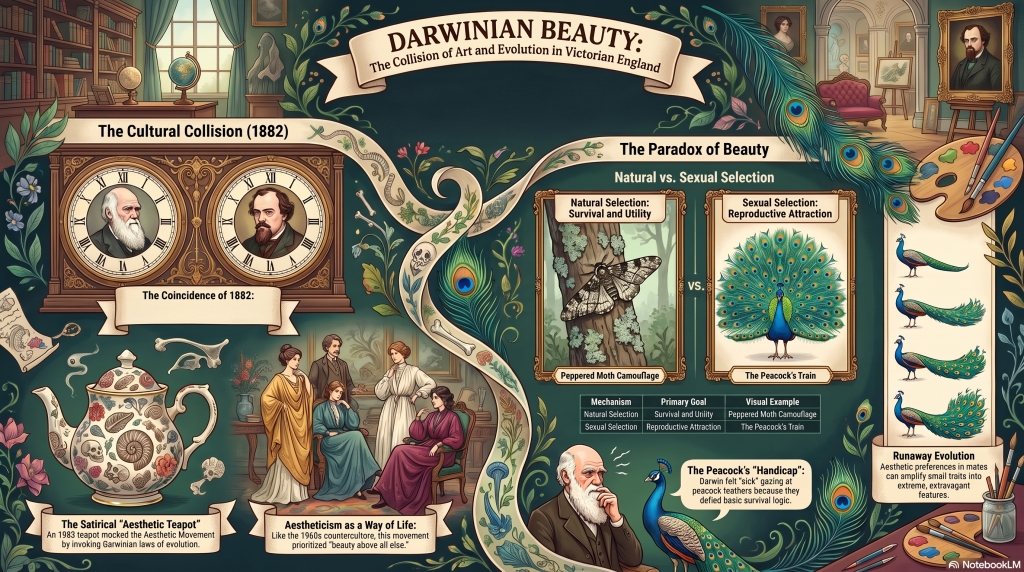
This lecture traces the collision of Darwin’s evolutionary theory with Victorian aesthetics, using a Royal Worcester teapot — inscribed with a warning about natural selection — as its governing emblem. Beginning with the Aesthetic Movement’s cult of sensuous beauty, satirised in Gilbert and Sullivan’s Patience, it moves through Darwin’s theory of sexual selection, the peacock’s troublesome tail, and the Victorian negotiation of the female nude. Rossetti, Leighton, Moore, and Beardsley each grapple with whether beauty is spiritual or sensual. The talk concludes by examining degeneration anxiety, Social Darwinism’s distortions, and Tiffany’s decorative resolution, revealing beauty as simultaneously biological, moral, and political.
(My YouTube talk will be published on 03 April 2027)
My notes on Victorian Art and Darwinian Beauty
An entertaining conversation about Victorian Art and Darwinian Beauty created by Google NotebookLM from my notes:
We think of art and evolution as separate conversations. But in the Victorian era, they were the same argument — and a single satirical teapot proves it.
A Teapot Contains an Entire Cultural Moment
In 1882, Darwin and the Pre-Raphaelite painter Rossetti died within ten days of each other. That year, a Royal Worcester teapot mocked the Aesthetic Movement with the inscription: “Fearful Consequences — Through the Laws of Natural Selection and Evolution of Living Up to One’s Teapot.” The fact that a commercial novelty item casually invoked Darwin tells you everything about how thoroughly evolutionary thinking had saturated popular culture within a decade of On the Origin of Species.
The Man We Call “Darwin” Was Often Spencer
Herbert Spencer — not Darwin — was the most widely read European intellectual of the late nineteenth century, the only philosopher in history to sell over a million copies of his work. He coined “survival of the fittest,” applied evolution to justify racial and social hierarchies, and dramatically changed his politics from radical to ultra-conservative. Darwin’s actual conclusions were far more careful. When historians speak of Darwin’s cultural influence, they are largely describing Spencer’s misreading.
The Peacock Made Darwin Feel Sick
“The sight of a feather in a peacock’s tail, whenever I gaze at it, makes me sick!”
— Darwin, letter to Asa Gray, 1860
The tail contradicts natural selection entirely — it helps predators catch the bird. Darwin’s answer, developed in The Descent of Man (1871), was sexual selection: females exercise genuine aesthetic judgement, choosing the most beautiful male. The female, not the male, possesses the aesthetic sense. Two-thirds of that book explores this idea.
Victorian Fashion Was Biologically Illiterate
Waist-to-hip ratio is a real secondary sexual characteristic — 0.7 in healthy women. A Punch cartoon from 1870 shows Victorian women shrieking in horror at the Venus de Milo’s waist and feet. They weren’t being silly. Lily Langtry, the era’s celebrated beauty, wore a corset producing a ratio of roughly 0.46. Victorian fashion had trained women to find classical proportion actively ugly.
“The Angel in the House” Was a Real Woman Who Defied the Myth
Coventry Patmore’s famous poem idealised his wife Emily as the perfect submissive Victorian woman. John Everett Millais painted her three years before the poem appeared. Emily was, in reality, an accomplished poet who openly criticised her husband’s work and entertained Ruskin, Tennyson, and Browning. She died aged thirty-six. Virginia Woolf later wrote that “killing the Angel in the House was part of the occupation of a woman writer” — recognising the archetype not as an honour, but as a cage.
Evolution Has No Direction — And the Victorians Couldn’t Accept That
Darwin was explicit in his notebooks: “In my theory there is no absolute tendency to progression.” Natural selection is blind to the future; it favours only what fits the present moment. Yet the era desperately wanted evolution to mean progress. Burne-Jones’s Wheel of Fortune (1883) painted exactly the opposite — blind chance raising and lowering kings, slaves, and poets alike. Critics condemned it as degenerate and “effeminate.” The painting’s real crime was being right.
Beauty Was Always a Political Argument
From Bocca Baciata to Olympia, every nude in this period navigated the same unwritten contract: classical setting, marble-like skin, passive gaze, no evidence of real life. Break one rule and you were “sensual” rather than “sensuous” — a distinction that destroyed careers. Darwin would have found the entire debate biologically meaningless. Bodily beauty evolved through sexual selection; it is inherently sensual. The Victorians built an elaborate cultural architecture to pretend otherwise.
The teapot, the peacock, the corset, the fallen woman, the degenerate painting — they were never separate subjects. They were one argument about what beauty is, who gets to define it, and what happens when science insists the answer is messier than anyone wants.
Which raises a question worth sitting with: if beauty evolved to serve reproduction, what exactly are we doing when we call something timeless?
23-12 Victorian Portrait Painting
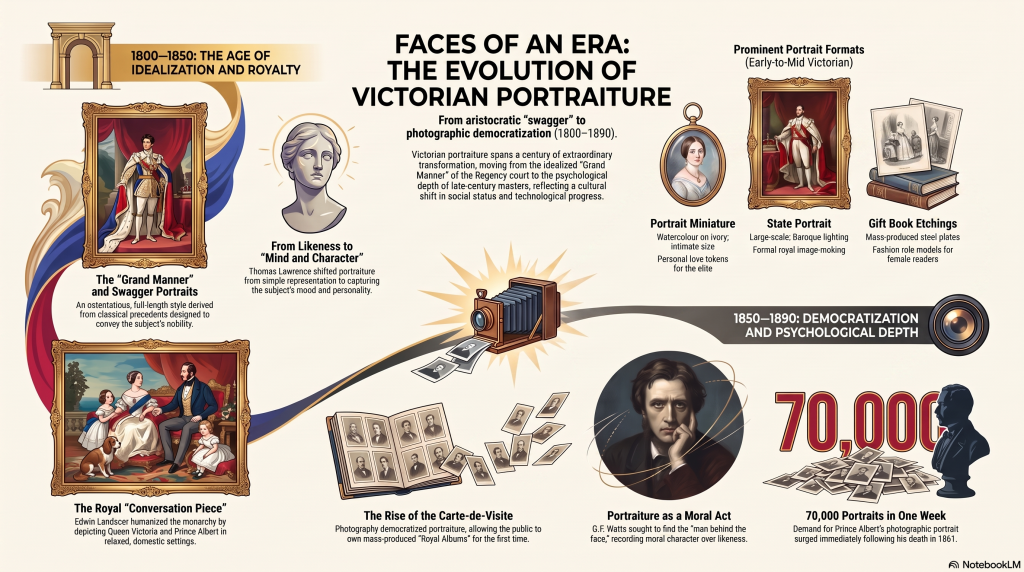
Victorian portrait painting is Dr Laurence Shafe’s subject across this wide-ranging lecture, which opens with Thomas Lawrence’s swagger portraits and closes with Sargent’s scandalous Madame X of 1884. Between these poles it traces royal image-making through Ross, Hayter, Landseer, Winterhalter and Grant, examines Pre-Raphaelite intensity in Rossetti, Millais and Hunt, and considers how photography through Mayall, Cameron and Thomson simultaneously democratised portraiture and transformed who deserved to be recorded. Whistler’s tonal abstractions and Watts’s moral Hall of Fame further demonstrate how Victorian portraiture constantly reinvented its purpose, revealing who Britain chose to see and how it wished to be seen.
(My YouTube talk will be published on 10 April 2027)
My notes on Victorian Portrait Painting
An entertaining conversation about Victorian Portrait Painting created by Google NotebookLM from my notes:
What does a painted face actually reveal — the sitter, the artist, or the society that commissioned the work? Victorian portrait painting spans a century of extraordinary ambition and contradiction, from child prodigies commanding royal courts to photographers accidentally inventing mass celebrity culture. The answers are more surprising than you’d expect.
A Portrait Was Never Just a Likeness
When Thomas Lawrence exhibited Elizabeth Farren in 1790, one critic wrote something that would have baffled painters a generation earlier:
“We have seen a great variety of pictures of Mrs. Farren, but we never saw her mind and character on canvas — arch, spirited, elegant and engaging.”
Previously, artists were paid for resemblance alone. Lawrence proved a portrait could convey personality. That shift — from likeness to psychological revelation — defines everything that followed.
Photography Didn’t Kill Portraiture. It Democratised It.
When Mayall photographed the Royal Family in 1860 and released a Royal Album of cartes-de-visite, hundreds of thousands sold almost immediately. When Prince Albert died the following year, seventy thousand copies of his portrait were ordered from one firm within a single week.
But the more profound change was quieter. John Thomson’s 1877 photograph of John Day — born in Lambeth, sleeping under railway arches — gave a face and a story to someone no painter would ever have sought. Photography proved that who gets recorded is always a question of power, not merit.
The “Domestic Bliss” Portraits Were Deliberate Political Strategy
Landseer’s Windsor Castle in Modern Times took four years of sittings and shows Victoria and Albert in a sunlit drawing room, hunting trophies on the floor, eldest daughter playing with a dead kingfisher. The scene is entirely invented. Winterhalter’s 1846 family portrait followed the same logic. Together, these images constructed a public argument for domestic virtue and moral propriety.
What Victoria understood was that image management was governance.
The Most Subversive Painting of 1859 Looked Like a Pretty Face
Rossetti’s Bocca Baciata depicted a recognisable model yet was never offered as a portrait. Its title comes from Boccaccio’s Decameron: a woman who passes through thousands of encounters yet is received by her husband as a virgin. William Holman Hunt condemned it as “remarkable for gross sensuality of a revolting kind.”
The rose signals innocence. The apple signals downfall. The moral is deliberately unresolvable. Rossetti had invented something new — a painting that used a face to ask an uncomfortable question rather than answer one.
Sargent’s Career-Defining Scandal Was Caused by a Shoulder Strap
Madame X was meant to cause a sensation. The original canvas showed one shoulder strap sliding down — and Paris was outraged. The painting destroyed his prospects in France.
When he later sold it to the Metropolitan Museum, Sargent wrote simply: “I suppose it is the best thing I have ever done.” Sometimes the work that ruins you is the work that defines you.
The Most Revealing Portraits Were the Ones Nobody Commissioned
Watts painted his Hall of Fame — likenesses of figures he believed “made or marred their country” — entirely at his own expense and choosing. When Tennyson sat to him, Watts described his aim so compellingly that Tennyson wove the words into Lancelot and Elaine: a painter who, “divinely through all hindrance, finds the man behind the face.”
A portrait made for money answers to the patron. A portrait made from conviction answers to posterity. The difference shows.
Victorian portraiture was never simply about recording faces. It was a contested space where power, ambition, morality, and technology collided. Which raises a question worth sitting with: when you look at any portrait — painted or photographed — whose vision of the subject are you actually seeing?
23-13 Victorian Landscape Painting Part 1
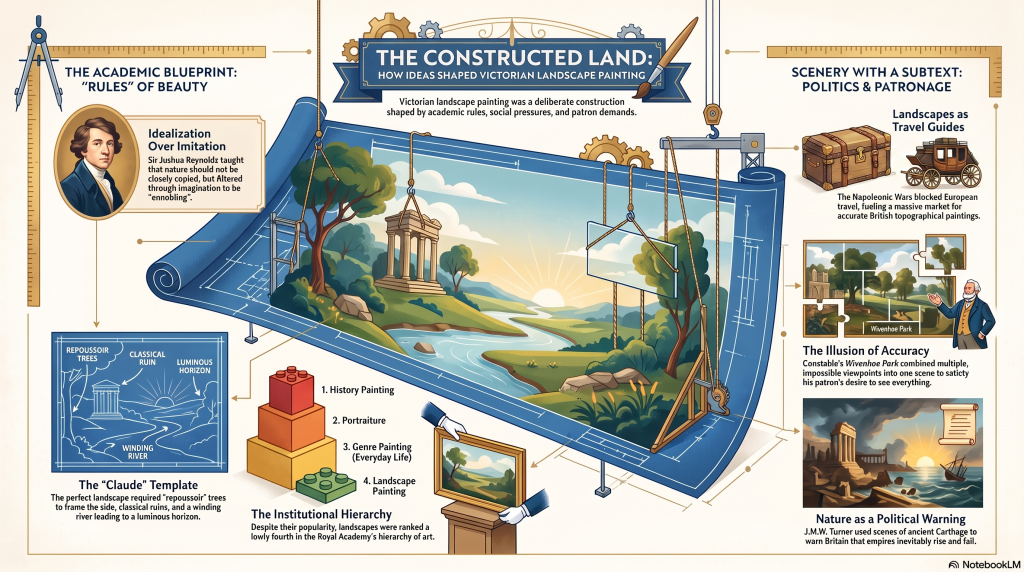
This talk examines the evolution of Victorian landscape painting, emphasizing that these works were complex social and artistic constructions rather than simple records of scenery. Led by Sir Joshua Reynolds and the Royal Academy, the British art establishment prioritized an idealized version of nature modelled after Old Masters like Claude Lorrain. Notable artists such as J.M.W. Turner adopted this classical framework, using luminous horizons and specific framing devices to imbue landscapes with moral weight and warnings of imperial decline. Conversely, the text highlights a shift toward topographical accuracy seen in the watercolours of Thomas Girtin, whose work merged faithful documentation with evocative atmosphere. Ultimately, the sources illustrate how the Victorian imagination was shaped by a tension between historical ambition and the rising demand for domestic, place-based observation.
(My YouTube talk will be published on 17 April 2027)
My notes on Victorian Landscape Painting Part 1
An entertaining conversation about Victorian Landscape Painting Part 1 created by Google NotebookLM from my notes:
Introduction: The Myth of the “Pretty Picture”
To the modern eye, a 19th-century British landscape looks like the ultimate “safe” art—a serene, decorative souvenir of a pre-industrial countryside. We treat these canvases like windows, assuming they are faithful records of a simpler time. But look closer: these weren’t snapshots. They were the original deepfakes.
In the Victorian era, art was a high-stakes tool of social engineering and political posturing. Controlled by the rigid gatekeepers of the Royal Academy, landscape painting was a medium of intense artifice, shaped by institutional pressure and national anxiety. Far from recording nature, these artists were “filtering” it, editing reality to project power, nostalgia, and stability. If you think digital manipulation started with Photoshop, you’re about two centuries late to the party.
1. The “Perfect” Landscape Was a Template, Not a Place
In the 19th century, copying nature too closely wasn’t just considered unoriginal—it was “bad art.” Sir Joshua Reynolds, the first President of the Royal Academy, spent his career codifying this elitism in his fifteen Discourses. To Reynolds, the literal imitation of the world was a lowly, mechanical task.
He was brutal about the dangers of realism:
“…nature herself is not to be too closely copied. There are excellences in the art of painting, beyond what is commonly called the imitation of nature.”
To be taken seriously, an artist had to “ennoble” the viewer, which meant landscape was forced into a strict hierarchy. It sat at a lowly fourth place, beneath History painting, Portraiture, and Genre (scenes of daily life). To move up the ranks, a landscape had to stop looking like England and start looking like the “Old Masters”—specifically the French painter Claude Lorrain.
Claude’s 1648 work, The Marriage of Isaac and Rebekah, became the mandatory template. To pass the Academy’s “vibe check,” a painting required:
* Repoussoir trees: Large, dark trees framing the sides to “push back” the scene and manufacture depth.
* The Winding River: A calculated curve to lead the eye toward a luminous, Italianate horizon.
* Classical Gravitas: Winding rivers and biblical or heroic figures to make the scene feel “poetical” rather than merely topographical.
2. Turner’s Landscapes Were Geopolitical Propaganda
Joseph Mallord William Turner was a prodigy who had his first work accepted by the Royal Academy at just 15 years old. But he wasn’t just a master of light; he was a master of the “call-out.”
His works Dido Building Carthage (1815) and The Decline of the Carthaginian Empire (1817) were pointed political warnings disguised as classical scenery. Turner used ancient Carthage—a maritime superpower—as a direct mirror for Britain during the Napoleonic Wars. His grand thesis was a warning of imperial hubris: empires rise, but their fall is as inevitable as the setting sun.
Turner was so obsessed with his place in history that he engineered a permanent, centuries-long argument. He bequeathed his work to the nation on the strict condition that Dido Building Carthage hang forever next to Claude Lorrain’s work in the National Gallery. It wasn’t just a tribute; it was a performative staging to prove he had evolved the medium into a weapon of historical commentary.
3. The Napoleonic Wars Created the British Travel Guide
We often credit local pride for the rise of British scenery, but it was actually a byproduct of a wartime lockdown. For decades, the “Grand Tour” of Europe was the ultimate status symbol for the wealthy. When the Napoleonic Wars slammed the borders shut, the art market was forced to “shop local.”
This vacuum birthed a booming market for topographical travel guides. However, there was a technical snobbery at play: these views were often captured in watercolor, a medium the Academy dismissively called “stained” or “tinted” drawings.
Thomas Girtin was the rebel who transformed these “tinted drawings” into high art. In his 1800 masterpiece The White House at Chelsea, Girtin showcased his technical chops by including “Fowler’s Mill”—a massive, 120-foot horizontal windmill that was a landmark of the time. But Girtin didn’t stop at accuracy. He engineered a “reflective hush” over the Thames, moving beyond the documentary to evoke a patriotic mood of lost time. He was so dominant that his rival Turner famously remarked: “If Tom Girtin had lived, I should have starved.”
4. Constable’s “Accurate” Views Were Photoshopped with a Paintbrush
If any artist is the face of “honest” British nature, it’s John Constable. Yet, his supposedly crystalline records of the countryside were impossible composites.
Take Wivenhoe Park (1816). On the surface, it’s a portrait of General Rebow’s Essex estate. But in 1959, art historian Ernst Gombrich performed a “reality check,” photographing the site to prove that the house and the lake cannot actually be seen from a single viewpoint.
Constable was essentially “stitching” images together. He physically edited the reality of the park, even adding strips of canvas to both sides of the painting to “fit in” everything the patron demanded—including a donkey cart featuring the General’s daughter. Constable admitted the struggle: “The great difficulty has been to get so much in as they wanted.” It wasn’t a record; it was a curated highlight reel.
5. Tranquil Art Born from a Global Climate Disaster
The most cynical truth behind these tranquil vistas is the year they were painted. 1816 was the “Year without a Summer,” a period of global climate collapse triggered by volcanic activity. While Constable was painting the “calm sunshine of the heart” in Wivenhoe Park, the real world was in chaos.
Crops failed, bread prices soared, and Europe was rocked by three years of riots, arson, and looting. People were literally starving in the fields Constable portrayed as idyllic playgrounds. Why paint a tranquil summer day during an agricultural apocalypse?
The answer lies in the market. As the critic C.R. Leslie noted in 1824: “Men do not purchase pictures because they admire them, but because others covet them.” Tranquil art was a psychological necessity—a way for the wealthy to project a sense of stability and order onto a landscape that was, in reality, failing to feed its people.
Conclusion: The Weight of the Victorian Imagination
Victorian landscape paintings were never just “pretty pictures.” They were active constructions of identity, tools for political survival, and the “VR” of their era. Before the digital age, the public flocked to “panoramas”—massive, 108-foot-long scrolled canvases that were the 19th-century version of an immersive headset.
As we navigate our modern world of AI-generated imagery and social media filters, we are essentially walking the path these masters cleared. Like the Victorian painters who added strips of canvas to “fix” a view, we continue to filter our world to fit an ideal. The technology has changed, but the impulse remains the same: we don’t paint the world as it is; we paint it as we wish it to be.
23-14 Victorian Landscape Painting Part 2

This talk explores the evolution of Victorian landscape painting, specifically examining how British artists interpreted the philosophical concept of the sublime. Drawing on the theories of Edmund Burke, the text explains how qualities like vastness, terror, and obscurity replaced classical notions of harmony and beauty in art. The sources highlight the work of Salvator Rosa as a precursor to this movement, alongside Philip James de Loutherbourg, whose paintings of industrial furnaces and Alpine disasters illustrate nature’s overwhelming power. Further analysis covers the apocalyptic visions of John Martin, whose massive canvases depicted divine judgment and the insignificance of humanity. Ultimately, the materials track a historical shift from Romantic emotionalism toward the scientific realism and naturalism that defined the later nineteenth century.
(My YouTube talk will be published on 24 April 2027)
My notes on Victorian Landscape Painting Part 2
An entertaining conversation about Victorian Landscape Painting Part 2 created by Google NotebookLM from my notes:
When we think of Victorian landscape paintings, we often imagine “safe” art—bucolic scenes of rolling hills and quiet cottages that served as a kind of pastoral wallpaper for the nineteenth-century elite. However, to the expert eye, these canvases reveal something much more volatile. Far from being merely decorative, the Victorian landscape was a philosophically charged territory where artists grappled with the terror of nature, the smoke of industrialization, and the impending collapse of human reason. These works were not just windows onto the world; they were battlegrounds for the Victorian soul.
Here are five ways Victorian artists used the landscape to redefine reality.
1. When Terror Became a Pleasure (The Birth of the Sublime)
In the mid-eighteenth century, a tectonic shift occurred in how Western thought perceived the “ugly” or the “frightening.” For centuries, following the logic of Augustine of Hippo, the ugly was dismissed as non-existent—a mere lack of form. This changed in 1757 with Edmund Burke’s Philosophical Enquiry into the Origin of our Ideas of the Sublime and Beautiful.
Burke argued that both beauty and the “Sublime”—the thrill and danger of untamed nature—could invoke pleasure, making them companions rather than opposites. He identified seven specific qualities that defined the Sublime: darkness, obscurity, deprivation, vastness, magnificence, loudness, and suddenness.
This was a psychological revolution that invited artists to seek “greatness beyond calculation.” To see this shift in action, one need only look at the work of Salvator Rosa, the “perpetual rebel” and proto-Romantic whose rugged, turbulent scenes stood in stark opposition to the order of the past.
“Romantic theorists saw Salvator Rosa… as sublime as his landscape was a vehicle of terror compared with Claude Lorrain… as the antithesis of the sublime as he represented classical beauty, elegance, harmony and luminosity.”
2. The “Masculine” Industrial Apocalypse
As the Industrial Revolution took hold, the Sublime moved from the mountaintops to the factory floor. Philip James de Loutherbourg’s Coalbrookdale by Night (1801) is the defining image of this transition. Depicting the Madeley Wood Furnaces in Shropshire, it captures the moment when human industry itself became a source of awe and dread.
In an Age of Enlightenment, where human reason was expected to master the natural world, these blazing furnaces represented a source of terror that reason could no longer contain. This was the moment words failed; it was, quite literally, an attempt at “painting the unpaintable.”
Modern theorist Barbara Claire Freeman distinguishes between two registers here: the “feminine” sublime, associated with rapture and metaphysical infinity, and the “masculine” sublime, rooted in terror and domination. De Loutherbourg’s furnaces are hit squarely in the masculine register. Interestingly, this specific aesthetic of industrial terror would not last; by the late nineteenth century, this register of the sublime fell away, displaced by the rising tides of scientific realism.
3. The £7 Masterpiece of “Mad Martin”
Perhaps no artist pushed the apocalyptic vision further than John Martin. He is best known for his Last Judgement Triptych, a series of vast canvases where cities are hurled into abysses and the very sky is torn asunder. While his themes were biblical, his visual vocabulary was modern. His son noted that Martin’s catastrophic visions were ignited by a night journey through the “Black Country” near Birmingham, where the glare of furnaces and thick coal seams made hell feel visible on earth.
The most famous of these works, The Great Day of His Wrath, was inspired by the breaking of the “Sixth Seal” in the Book of Revelation:
“… and, lo, there was a great earthquake’ and the sun became black as sackcloth of hair, and the moon became as blood; And the stars of heaven fell unto the earth… And the heaven departed as a scroll when it is rolled together; and every mountain and island were moved out of their places.” (Revelation 6:12-14)
The Royal Academy dismissed Martin’s work as “vulgar,” and his critical reputation fell into such profound obscurity that he became known as “Mad Martin.” In 1935, three of his massive paintings—once valued at thousands of guineas—sold for a mere £7. It wasn’t until 1974 that the Tate reunited them, recognizing them as essential statements of the Romantic movement.
4. The Hare, the Train, and the End of the Pre-Industrial World
J.M.W. Turner’s Rain, Steam and Speed (1844) captures a world in a state of violent, technological dissolution. The painting features a locomotive crossing the Maidenhead Bridge, a structure designed by Isambard Kingdom Brunel. At the time, the bridge was an act of technological audacity—its arches were the widest and flattest ever attempted, and many engineers feared it would collapse.
The painting is a masterclass in technological ambivalence. In the bottom right corner, a “tiny hare”—the fastest creature of the pre-industrial world—races ahead of the engine. Is the train triumphantly outrunning nature, or is the hare running in fear of a machine that has made it redundant in a single generation?
Turner does not offer a clear answer. Instead, he uses light as a “force” rather than a quality, dissolving the locomotive into the atmosphere. He captures the very essence of the dissolution of the old world into the new.
5. Deep Time and the Descent from the “Sublime to the Droll”
By the mid-Victorian era, the “Sublime” shifted from Turner’s dissolution of light toward the unsettling precision of “Deep Time.” William Dyce’s Pegwell Bay (1858) appears at first to be a simple family holiday on the coast of Kent, featuring Dyce’s wife, her sisters, and his son. Yet, Dyce used a microscopic detail to create a chillingly personal experience of the infinite.
Influenced by Charles Lyell’s Principles of Geology, Dyce rendered the flint-encrusted strata of the cliffs with the accuracy of a scientific survey, forcing the viewer to confront millions of years of history. To the right of the family, an “artist-scientist” holds a telescope, pointed toward the barely visible trail of Donati’s Comet—a celestial visitor that would not return for 2,000 years.
By placing his own family against the backdrop of geological and cosmic time, Dyce created a “travesty of the sublime,” where the intimate is swallowed by the infinite.
The Illustrated London News described the work as a “very curiosity of minute handiwork” but concluded that the ultimate effect was “a rapid descent from the sublime to the droll.”
Conclusion: The Enduring Ghost of Romanticism
The Victorian landscape was defined by a core tension: revolutionary methods versus conservative visions. We see this most clearly in John Constable’s The Hay Wain. While technically radical—English critics at the time complained about his flecks of white paint and “snowy” textures—the scene was socially twenty years out of date. He painted manual laborers in the fields at a time when he knew perfectly well that farms were being automated. He was painting a memory of order to mask a reality of change.
These artists were using art to face the unfaceable—the invisible forces of industry, the terrifying vastness of deep time, and the collapse of old certainties. It leaves us with a provocative question: How do we view our own “sublime” threats today? Whether we look toward environmental collapse or technological upheaval, we are still, in many ways, standing on that Kentish shore, using art to help us face what reason cannot yet master.
23-15 Women in Victorian Art
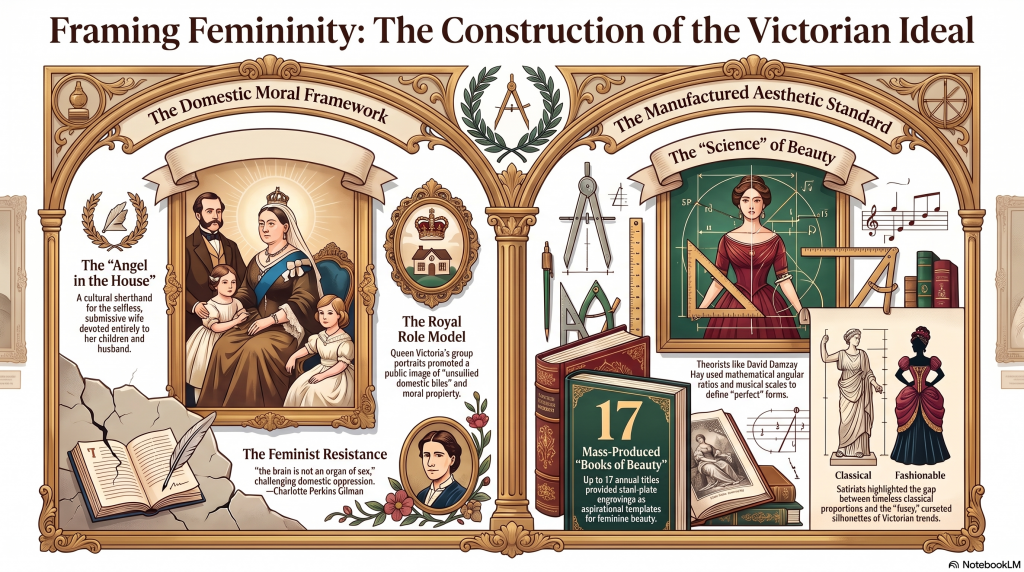
This lecture traces how Victorian Britain constructed, enforced, and contested ideals of femininity across painting, sculpture, poetry, and print culture. Beginning with the mass-produced Books of Beauty annuals, it moves through royal portraiture, the fraught public reception of the female nude, the moral coding of fallen women, and the dangerous allure of femmes fatales such as Lilith. Artists including Etty, Rossetti, Tissot, and Burne-Jones are shown simultaneously reinforcing and subverting prevailing definitions of womanhood, exposing the anxieties and contradictions beneath Victorian culture’s carefully maintained surface.
(My YouTube talk will be published on 01 May 2027)
My notes on Women in Victorian Art
An entertaining conversation about Women in Victorian Art created by Google NotebookLM from my notes:
We think of Victorian Britain as buttoned-up and prudish. But spend time with its paintings, sculptures, and popular print culture, and a far stranger picture emerges — one of obsessive ideal-making, institutional propaganda, and quietly subversive women pushing back against every frame that tried to contain them. Here are the most surprising takeaways.
The Victorian “Fashion Magazine” Was More Sinister Than It Sounds
Before Instagram, there were the Books of Beauty — lavish annuals stuffed with steel-engraved “ideal” female faces, published up to seventeen times a year between 1823 and 1857. Women bought them as literal templates for femininity. Even Thackeray, no radical, dismissed the figures as “slovenly, ricketty, wooden imitation” of real women. Sound familiar? The airbrushed size-zero model is a surprisingly old invention.
The Most Famous Sculpture in the Louvre Was a PR Stunt
The Venus de Milo’s legendary status was, in large part, French institutional propaganda. When authorities were forced to return the Venus de Medici to Italy after the Napoleonic Wars, they aggressively promoted their newly acquired Venus as the superior treasure — then quietly destroyed its original plinth, whose inscription would have dated it to the “inferior” Hellenistic period. Renoir, unimpressed, called it “a big gendarme.”
Queen Victoria Had a Secret Pin-Up
The same monarch who embodied domestic propriety commissioned a deliberately alluring self-portrait in 1843 — loose hair, minimal dress, a heart-shaped locket of Albert’s hair — as a surprise birthday gift for her husband. He kept it locked in his private writing room at Windsor and showed it to no one. It stayed out of public view until 1977. Victoria called it “the secret picture.”
“He thought it so like, and so beautifully painted. I felt so happy and proud to have found something that gave him so much pleasure.”
— Queen Victoria’s Journal, 26 August 1843
The “Angel in the House” Was Already Dead by 1891
Coventry Patmore’s poem celebrating the selflessly devoted wife became the defining phrase of Victorian femininity — and feminists were dismantling it almost immediately. Charlotte Perkins Gilman declared it extinct in 1891. Virginia Woolf later wrote that this phantom “bothered me and wasted my time and so tormented me that at last I killed her.” Gilman went further still:
“There is no female mind. The brain is not an organ of sex. Might as well speak of a female liver.”
The Painter of Domestic Virtue Was Living a Double Life
William Powell Frith’s Many Happy Returns of the Day — a masterpiece of middle-class family warmth — was exhibited at the Royal Academy on the exact day his secret mistress gave birth to their first child. Frith ultimately fathered nineteen children across two households. Manliness, as his biography demonstrates, was as much performance as principle.
A Woman Could Be Erotic or Pure — But Not Both (Unless You Were Rossetti)
Dante Gabriel Rossetti titled his lush 1859 portrait Bocca Baciata — “mouth that has been kissed” — after Boccaccio’s tale of a woman who sleeps with eight lovers yet successfully presents herself as a virgin bride. Victorian viewers literate in Boccaccio would have read the painting’s serene surface as deliberately, knowingly charged. The work doesn’t depict innocence. It depicts the enduring, self-renewing power of female sexuality — wrapped in the calm of a flower arrangement.
Lady Lilith Was the Victorian Feminist Nightmare — and Their Secret Fear
Rossetti’s Lady Lilith drew on a figure from Judaic legend: Adam’s first wife, created from the same dust as him — his equal — who refused subordination and left Eden entirely. For Victorian men, she embodied the terrifying logic of the emerging New Woman. Her poppy invokes laudanum. Her foxglove yields deadly digitalis. Even her hair is a weapon.
“Her beauty’s one boast is her dangerous hair. When Lilith winds it tight around young men, she doesn’t soon let go of them again.”
— Goethe’s Faust, quoted by Rossetti
Victorian Britain built an elaborate visual machinery to define what women should look like, feel, and aspire to be. But the cracks were visible almost from the start — in a queen’s secret self-portrait, a poisonous flower tucked behind a mirror, a radical Charlotte Perkins Gilman declaring the whole ideal already dead. The real question isn’t why that machinery eventually failed. It’s why it took so long for anyone to admit it was breaking.
23-16 Victorian Women Artists
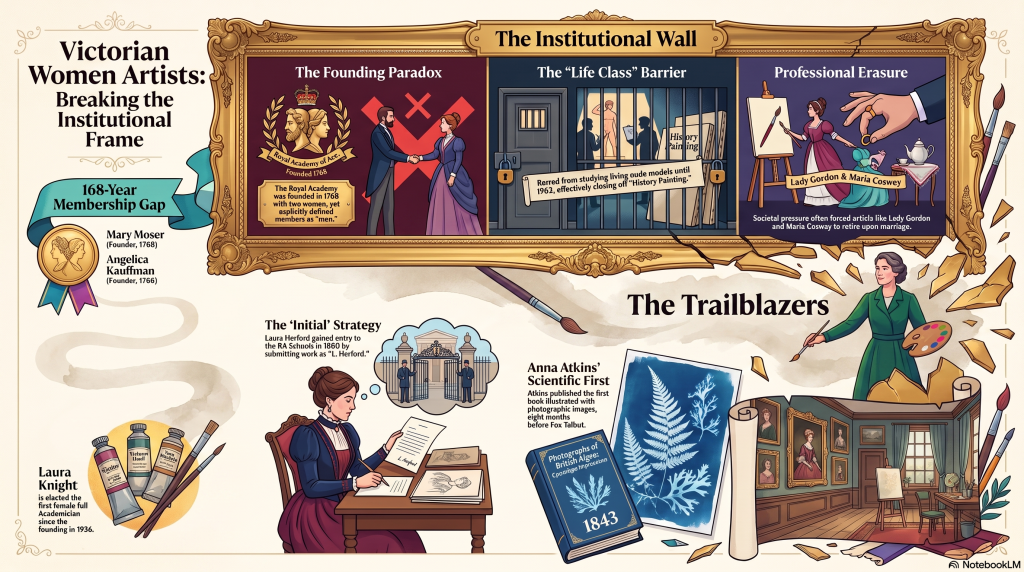
This lecture traces the careers of women artists in Victorian Britain against the institutional structures designed to marginalise them. Beginning with Zoffany’s 1771 painting, in which founding Academicians Kauffman and Moser appear only as portraits on the wall, it examines how the Royal Academy excluded women from full membership, life drawing, and professional parity for generations. Individual cases illuminate the broader argument: Siddal’s identity consumed by her role as model, Butler denied election despite public acclaim, Knight barred from life classes and rejected by the Academy she would eventually join. Exceptional talent repeatedly encountered a profession built to prevent it.
(My YouTube talk will be published on 08 May 2027)
My notes on Victorian Women Artists
An entertaining conversation about Victorian Women Artists created by Google NotebookLM from my notes:
We tell ourselves that art is a meritocracy — that talent rises regardless of who holds the brush. Victorian Britain tested that idea thoroughly, and the results were not flattering. Here are the most striking revelations from a lecture tracing women artists through one of history’s most systematically exclusionary institutions.
Two Founding Members Were Hung on a Wall Instead of Invited In
When Johann Zoffany painted The Academicians of the Royal Academy in 1771, he included every founding member — except the two women. Mary Moser and Angelica Kauffman appear only as portraits on the wall, physically present but officially nowhere. This wasn’t artistic licence; it reflected law. The Academy’s founding document defined Academicians explicitly as men of fair moral character, barring women from full membership until 1860, and from studying the living nude until 1903.
The gap between founding and full inclusion: 170 years.
The Fastest Route Into Art School Was to Hide Your Name
Laura Herford gained entry to the Royal Academy Schools in 1860 through a straightforward trick: she submitted her work under the initial L. Herford. The selectors assumed male, and admitted her. Only then was the gender revealed.
This wasn’t cunning — it was necessity. Eleanor Vere Boyle, the era’s foremost female illustrator, published entirely under the initials EVB because her husband’s aristocratic rank made commercial exhibition socially unacceptable for a woman of her position. Invisibility was the price of participation.
Being Beautiful in a Male-Dominated World Marked You as a Subject, Not a Maker
When Dante Gabriel Rossetti heard that Marie Spartali — later judged by William Michael Rossetti as probably “the most gifted intellectually” of all the women his brother admired — was to study under Ford Madox Brown, his response was immediate: “box her up and don’t let fellows see her, as I mean to have first shy at her in the way of sitting.”
Spartali refused the category. Over sixty years she produced more than a hundred works, exhibiting regularly in Britain and America, and outlived every original Pre-Raphaelite. When she died in 1927, she was the last surviving link to the Brotherhood — and had spent a career insisting on authorship over objecthood.
A Painting Bought by the Queen Was Still Called Vulgar
Laura Knight’s Self-Portrait with Nude (1913) showed her painting a model — a composition she made deliberately, because as a student she had been barred from life classes and permitted only to draw from casts. The Royal Academy rejected it. The Daily Telegraph called it vulgar.
“It might quite appropriately have stayed in the artist’s studio.”
Knight exhibited it throughout her career regardless. After her death, the National Portrait Gallery acquired it as a landmark in female self-portraiture. The institution that rejected it now enshrines it.
Even Wartime Achievement Was Framed as a Charming Exception
Laura Knight’s 1943 portrait of Ruby Loftus — a 21-year-old with no factory experience operating machinery that normally required eight years’ training — received enormous press coverage. As historian Brian Foss later argued, neither woman was read as evidence of what women could routinely achieve. Both were framed as remarkable exceptions, which quietly reinforced the assumption that the lathe and the Royal Academy alike were male by default.
The pattern held across the entire century: exceptional talent, absorbed into a narrative of exception rather than equality.
The structural question this history keeps returning to is simple and still unresolved: when institutions control who gets trained, exhibited, elected, and remembered, how much genius goes unrecorded? The Victorian women in this lecture answered it partly — by working anyway. The rest of the answer remains with us.
23-17 Late Victorians, 1890-1900
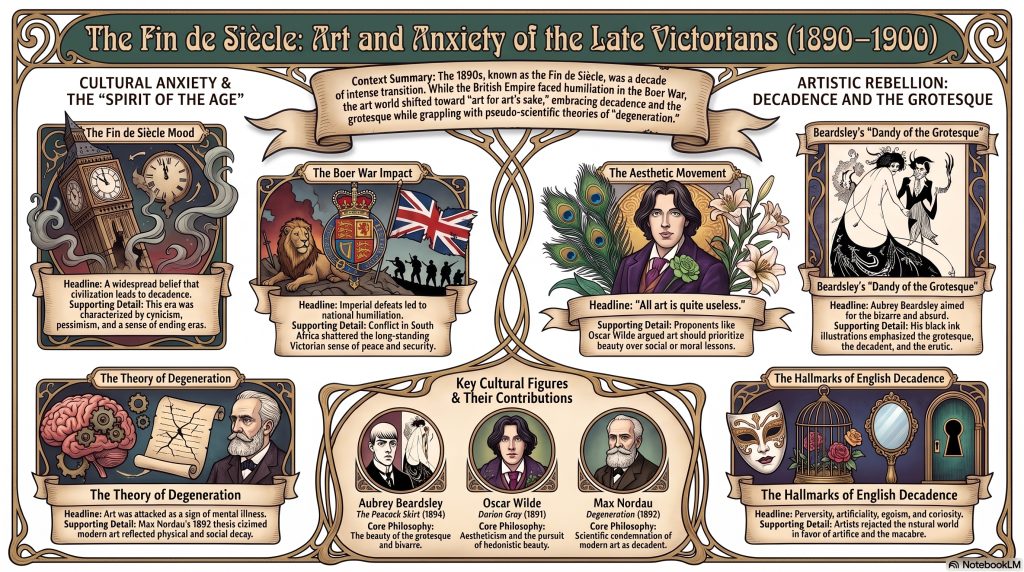
This talk provides a cultural and artistic overview of the Late Victorian era between 1890 and 1900, specifically highlighting works found at Tate Britain. The text examines the somber mood of the period, which was defined by the Boer War and a pervasive sense of pessimism known as the fin de siècle. Intellectuals of the time wrestled with the concept of degeneration, a theory suggesting that society and the human body were in a state of decay. Prominent figures like Aubrey Beardsley and Oscar Wilde are featured as leaders of the Decadent movement, which prioritized artificial beauty and the grotesque over traditional naturalism. Additionally, the sources analyze specific paintings, such as John Byam Liston Shaw’s tribute to Boer War mourning, to illustrate how art reflected the era’s transition toward modernism. Overall, the materials offer a deep look into how late 19th-century anxieties regarding imperial decline and scientific advancement shaped British creative expression.
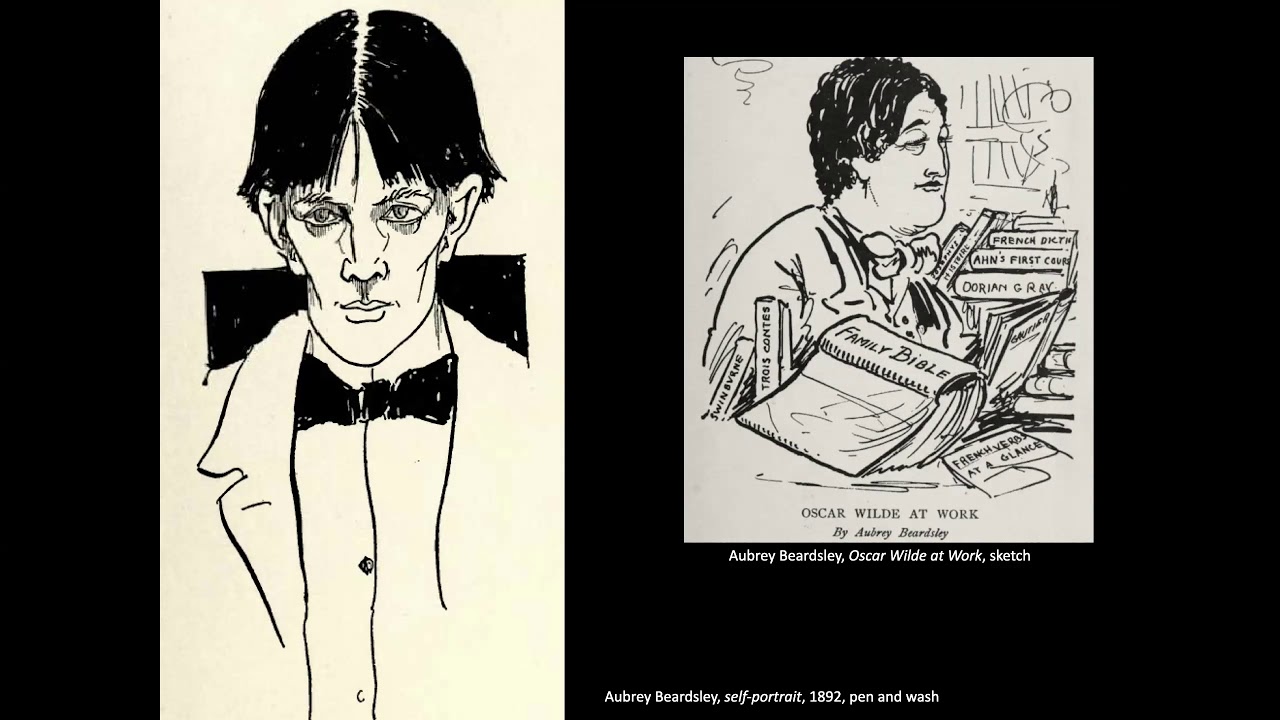
My notes on 23-17 Late Victorians, 1890-1900
A conversation about the Late Victorians created by Google notebook from my notes:
The 1890s in Britain were a decade of profound mid-life crisis—a period gripped by a strange, intoxicating “ennui.” While the British Empire basked in the sunset of its material wealth and the “Belle Époque” promised regional peace and technological mastery, a deep-seated anxiety regarding the inevitable decline of civilization brewed beneath the surface. It was a time caught between the arrogant pride of a global superpower and a haunting fear of its collapse. How did an era of such peace and prosperity end in a “pessimistic wave” of cynical art, Gothic horror, and the harsh humiliation of colonial war?
The Radical Rejection of Moral Art
The Four Hallmarks of English Decadence
In the final decade of the 19th century, the Aesthetic Movement staged a revolutionary coup against the traditional Victorian mandate that art must serve a social or moral purpose. As exemplified by Oscar Wilde, the movement proposed a radical principle: art should exist solely for the sake of beauty. This “aestheticism” was not merely a stylistic preference but a hedonistic lifestyle choice, where the ideal life mimicked art—beautiful, individualistic, and entirely divorced from social utility.
Holbrook Jackson, in his seminal work The Eighteen Nineties, identified four specific characteristics that defined this English Decadence:
- Perversity: A calculated rejection of the “natural.” While Romanticism saw physical traits as windows to the soul, the Decadents valued the “unclean” and the not conventionally beautiful.
- Artificiality: A belief in “abject beauty” that favored artifice and symbolism over the natural world.
- Egoism: A form of “ego-mania” that resulted in a deep attention to one’s own endeavors, often leading to a sense of alienation and a distinct preference for the cityscape over the country.
- Curiosity: Expressed through “diabolism”—the exploration of the evil, immoral, or macabre without the burden of a moral lesson.
“All art is quite useless.” — Oscar Wilde, The Picture of Dorian Gray
The Scientific Scandal: When Art was Considered a Disease
The Medical Theory of “Degeneration”
While artists celebrated the subversive, the medical establishment reacted with a shocking reductionism. In 1892, the critic Max Nordau published Entartung (Degeneration), a pseudo-scientific thesis that treated modern art movements as literal symptoms of a diseased visual cortex. Drawing on the criminologist Cesare Lombroso—who attempted to measure “criminal characteristics” through physical traits—Nordau claimed that the Pre-Raphaelites and Impressionists were suffering from mental illnesses caused by rapid urbanization and the exhaustion of modern life.
The historical irony of Nordau’s work is staggering. Although Nordau was a Jew and a founder of the Zionist movement, his theory of “degeneracy” was later weaponized by the Nazi regime to suppress multiculturalism and “degenerate art” (Entartete Kunst). It was not until the rise of psychoanalysis that these ideas were seriously challenged; in 1905, Sigmund Freud drily questioned if the label of “degeneracy” added any real value to our understanding of the human condition.
Beardsley and the “Dandy of the Grotesque”
The Aesthetic Paradox: Finding Beauty in the Revolting
Aubrey Beardsley, the quintessential “dandy of the grotesque,” became the visual architect of the Fin de Siècle. His style, characterized by stark black-and-white ink work, blended Japanese woodcut influences with erotic and macabre themes. Beardsley explicitly aimed for “the grotesque”—a term derived from the Domus Aurea (Nero’s “House of Gold”), where 15th-century excavators found ancient Roman decorations featuring “absurd combinations” like horses with leaf-legs.
Beardsley’s public persona was as stylized as his prints; he was known for his grey suits, yellow gloves, and shocking green hair. Yet, his life ended in a poignant paradox. Stricken with tuberculosis, he converted to Catholicism shortly before his death at age 25 and begged his editor to destroy his erotic works. Fortunately for the history of Art Nouveau, those wishes were ignored.
“I have one aim—the grotesque. If I am not grotesque I am nothing.” — Aubrey Beardsley
Mutations of the Mind and Body
The Psychological Shift: The Gothic Body and Fear of Change
The “spirit of fin de siècle” found its most urgent expression in Gothic literature. Fuelled by scientific fears of “mutation, corruption, and decay,” the writers of the 1890s turned the human body into a site of horror. While Robert Louis Stevenson’s Strange Case of Dr Jekyll and Mr Hyde (1886) set the stage by introducing the concept of moral and physical regression, the 1890s exploded with works that reflected evolutionary anxieties:
- The Picture of Dorian Gray (1891): The body as a hidden canvas of sin.
- The Time Machine (1895): The devolution of the human race into the Morlocks and Eloi.
- Dracula (1897): The fear of blood corruption and the primitive invading the modern.
These themes resonated because they mirrored a collective fear that civilization itself leads inevitably to decadence, and that beneath the veneer of Victorian progress lay a terrifying potential for biological and moral “mutation.”
The Reality Check: The Humiliation of the Boer War
A Century of Peace Ends in Mourning
The Victorian “Golden Age” met a somber end with the Boer War (1899–1900). This conflict against Dutch settlers in South Africa resulted in heavy British defeats at Stormberg and Magersfontein, bringing a wave of national humiliation and mourning.
John Byam Liston Shaw’s painting The Boer War (1900) serves as the visual epitaph for the era. Interestingly, Byam Shaw himself provided a “surprising takeaway”: while the Aesthetes were bohemians, Shaw was a “committed Tory imperialist” who looked “more like a bookie on a race-course” than an artist. His painting depicts a young woman in mourning—modeled by his sister Margaret Glencair, who was actually mourning a cousin killed in the conflict. The scene is thick with symbolism: a single swan feather (representing a lifelong bond broken) and a black crow suggesting death.
“Last summer green things were greener, / Brambles fewer, the blue sky bluer” — Christina Rossetti
Conclusion: A Provocative Farewell to the 19th Century
The Fin de Siècle was the vital bridge between the emotional grandeur of Romanticism and the fragmented, disillusioned realities of Modernism. It was a decade that looked backward at the decay of an empire and forward into a century defined by radical shifts in the human psyche.
If the Victorians were so unsettled by their own creative output that they labeled their most avant-garde art a sign of medical “degeneration,” what would they make of us? Today, we celebrate “subversion” as a cultural virtue. One has to wonder: are we more truly “degenerate” than the late Victorians were, or have we simply lost the capacity to be anxious about it?Gemini Notebook can be inaccurate; please double-check its responses.
23-18 The Edwardians, 1900-1910
The primary emphasis of this talk is the Edwardian era, a decade defined by significant social shifts, the rise of political reform, and a transition away from traditional Victorian aesthetics. A major focal point is the 1910 Post-Impressionist exhibition organized by Roger Fry, which served as a controversial but pivotal moment that introduced modern French art to the United Kingdom. The talk also highlight the influential role of the Slade School of Fine Art and its prominent teachers, such as the surgeon and painter Henry Tonks. Finally, the talk provides a comprehensive gallery guide and inventory of notable works from 1900 to 1910, including pieces by John Singer Sargent, Augustus John, and Jacob Epstein.
My notes on 23-18 The Edwardians,1900-1910
A conversation about the Edwardians created by Google Notebook from my notes:
The Brink of the Modern
The Edwardian era, spanning the brief, gilded reign of Edward VII from 1901 to 1910, is frequently misread as a mere sunset of the Victorian age—a final, leisurely gasp of empire before the carnage of the Great War. Yet, for the art historian, this decade was far more than a historical footnote; it was a volatile bridge, a period of fractured intensity where the rigid “cold dignity” of the past collided with the modern future. The year 1910, in particular, represents a definitive “big break,” a moment when the cultural tectonic plates shifted so violently that the world of art was forever changed. What follows are the surprising truths of a decade that was anything but quiet.
The Exhibition That Was Called “Evil”
In November 1910, the critic Roger Fry organized an exhibition at the Grafton Galleries titled Manet and the Post-Impressionists. To the British public, this was not merely an art show; it was a cultural assault. Against a backdrop of political upheaval—hunger-striking Suffragettes, the death of the King, and the looming specter of Irish Home Rule—Fry’s collection of French works felt like a revolutionary bomb.
The critics were visceral in their disgust, famously dismissing the works as the “output of a lunatic asylum” and the “visualized ravings of a maniac.” Many saw the exhibition as a coordinated plot to dismantle the very fabric of European civilization. The sense of moral danger was so profound that professionals were warned to stay away for their own protection. Art dealer Oliver Brown recalled a chilling admonition given to him by a friend of his father:
“Don’t go in there young man, it will do you harm. The pictures are evil.”
A Label Pulled Out of Thin Air
Today, “Post-Impressionism” is a foundational term in the art historical canon, but its origin was entirely accidental. Cornered by his own curators and a looming deadline, Roger Fry had initially proposed the title “Expressionists.” When his friends rejected the label, Fry, in a moment of frantic improvisation, pulled “Post-Impressionism” out of thin air.
The great irony of the 1910 “modernist” explosion was that most of the works were actually historical. By the time they horrified London, the paintings by Van Gogh, Gauguin, and Cézanne were twenty to thirty years old—hardly “new” by Parisian standards. Yet they stood in stark, jarring contrast to the British status quo, which remained obsessed with the academic naturalism of the Newlyn School and sentimental landscapes. To see the gulf, one only had to compare the popular, traditional aesthetic of Robert Noble’s View of East Linton (1907) with the raw, vibrating energy of Van Gogh’s Crows over Cornfield (1890). Even the “radicals” of the day were divided; the formidable Augustus John admired Picasso as “wonderfully fine,” yet he dismissed the work of Matisse as “vulgar and spurious.”
The Surgeon of the Slade and the “Crisis of Brilliance”
The epicenter of this shifting consciousness was the Slade School of Fine Art, which endured what its most famous teacher, Henry Tonks, described as two “crises of brilliance.” The first era produced titans like Augustus John and William Orpen; the second ushered in the radical generation of Stanley Spencer, Dora Carrington, Paul Nash, and C.R.W. Nevinson.
Tonks himself was a man of staggering contradictions. A former surgeon standing 6’ 4”, he eventually used his medical precision to create haunting pastel drawings of facial injuries during the First World War. There is a sharp irony in his legacy: a man who meticulously recorded the literal “shattered” faces of soldiers was simultaneously repulsed by the “shattered” forms of the Post-Impressionists. By the time of the 1912 exhibition, Tonks was so fearful that this new abstraction would “contaminate” his students that he begged them not to attend.
Tonks became “the most renowned and formidable teacher of his generation.”
A Leisurely Era Built on Global Ambition and Paradox
We often remember the Edwardian era through a nostalgic lens—the “picture hat” aesthetic of the elite. However, as the source context reminds us, this was a “leisurely time when women wore picture hats and did not vote,” a period where the rich lived conspicuously while the foundations of their world were eroding. While the British sun had not yet set, the economic crown had already passed to the United States.
By the 1890s, the US economy had overtaken the UK, fueled by high productivity and the birth of early global brands that defined the new century: American Express, Coca-Cola, and—most surprisingly for the era—Kentucky Fried Chicken. While the British relied on old-world political force, the Americans were building the future of commerce. Internally, the UK was wrestling with the Liberal Reforms and the “People’s Budget” of 1909, which taxed the landed gentry to fund welfare, signaling the rise of the Labour Party. The art of the time reflected this friction—a desperate attempt to cling to Victorian elements while simultaneously trying to break free from them.
The Verdict of 1910
The magnitude of this transition is best understood by contrasting the old guard with the new. Consider Frederic Leighton’s And the Sea Gave Up the Dead Which Were in It (exhibited 1892). While it possessed what critics called a “cold – almost oppressive – dignity,” it represented the pinnacle of an academic tradition that could no longer contain the intensity of the twentieth century. Artists were moving toward “significant form” and a raw, extraordinary intensity that rendered the old dignity obsolete.
Looking back at this moment of total transformation, author Virginia Woolf (attributed as “Wolfe” in some contemporary records of the 1924 lecture) famously pinpointed the shift:
“On or about December 1910 human character changed.”
A Legacy of Contradiction
The Edwardian decade was a period of radical transition cleverly disguised as a garden party. It began with the lofty, academic thought of the Victorians and ended with the public screaming “evil” at the walls of the Grafton Galleries. The outrage of 1910 was the birth cry of the modern age, proving that art was no longer a mere decoration of beauty, but a force capable of assaulting and redefining human perception.
As we stand before these works today—paintings that were once called the “ravings of a maniac” but now anchor our national museums—one must ask: in our age of digital saturation and constant novelty, does art still possess the power to change human character, or have we finally become immune to the shock of the new?Gemini Notebook can be inaccurate; please double-check its responses.
23-19 Newlyn, Glasgow, Camden Town
This talk provides a comprehensive historical overview of late Victorian art, focusing on the transition toward modernism. As the dominance of the Royal Academy waned, new creative collectives emerged, including the Newlyn School, the Glasgow School, and the Camden Town Group. These movements were shaped by a complex social landscape marked by imperial prosperity, deep-seated intellectual pessimism, and significant urban migration. The material specifically highlights the career of Stanhope Forbes, whose commitment to outdoor painting and rural subject matter helped introduce Impressionist influences to the British public. Ultimately, the text illustrates how diverse artistic communities challenged traditional standards to redefine the Western art canon during a period of rapid industrial and social change.
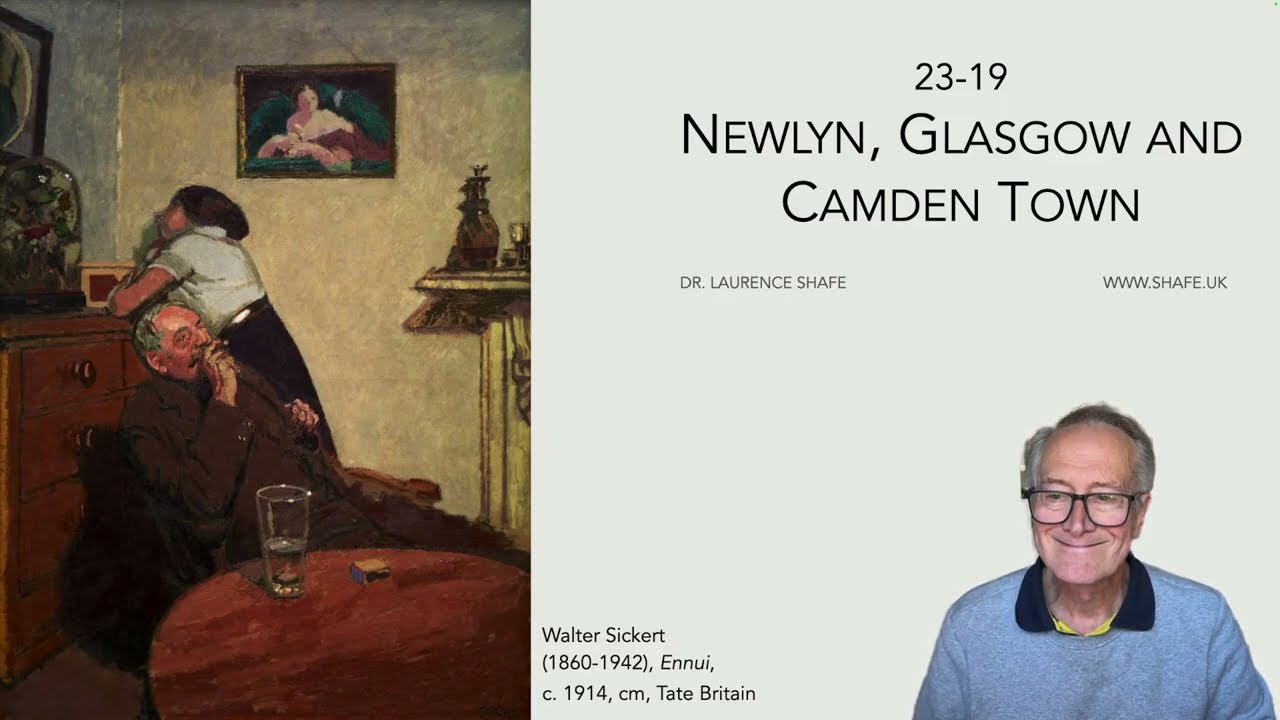
My notes on the Newlyn School, Glasgow School and the Camden Town Group
A conversation about the Newlyn School, Glasgow School and the Camden Town Group created by Google Notebook from my notes:
1. Introduction: The Gilded Veneer of the Late Victorian Era
At the height of the British Empire, the sun never set on a realm of unprecedented global prosperity. Yet, beneath this triumphant surface, a profound secret anxiety was taking root among the nation’s intellectuals. Despite the Empire’s reach, the “Long Depression” of 1873-79 had left a lingering scar on the national psyche, and a sense of impending doom began to permeate the cultural conversation.
In the art world, this tension manifested as a desperate rebellion against the status quo. The Royal Academy had become increasingly ossified, personified by figures like Frank Dicksee, who represented a rigid academic monopoly that was slowly crumbling. This vacuum allowed for the rise of an avant-garde that was as much a product of social crisis as it was of aesthetic innovation.
2. Art as a “Mental Disease”: The Shocking Critique of the Moderns
The transition toward modernism was not a quiet affair; it was met with fierce hostility from conservative critics who viewed movements like Impressionism as a “subversive foreign influence.” Perhaps no critic was more vitriolic than Max Nordau. In his book Decadence, Nordau made the startling claim that modern art—beginning with the Pre-Raphaelites—was the signature of a “diseased mind.”
Nordau argued that the mysticism and irrational thinking found in these works were symptoms of a cognitive collapse that threatened to bring down civilization itself. This extreme reaction highlights the era’s deep-seated fear: that the rational, “academic” order was being forcibly replaced by the “irrational” and the mystical. For the cultural establishment, these new movements weren’t just bad art; they were a medical emergency.
3. The Boer War and the Art of the “Healthy Body”
If art was suffering from a perceived mental decline, the British state was equally terrified by physical deterioration. The 1899 Boer War delivered a crushing blow to public confidence when Britain required 450,000 troops to defeat just 35,000 Boers. The health of the British recruit was in shambles; nationally, five out of every ten volunteers were rejected because they were too undernourished to serve.
In some industrial towns, the rejection rate for poor health reached a staggering 90%. This crisis directly influenced the work of Henry Scott Tuke, whose paintings of athletic, sun-drenched youths began to serve a specific nationalistic purpose. Tuke shifted from a homoerotic focus to a “homosocial” one, aligning his work with the “Muscular Christianity” promoted by Thomas Arnold at Rugby School.
“The deterioration in the health of the ‘rough boys’ of the working class was regarded as a serious problem for the Empire and Tuke shows the type of healthy working-class boys that the Empire needed.”
Tuke’s controversial depictions of naked youths remained acceptable to the establishment for two reasons. He had recently secured his reputation as a “manly” marine painter and had painted a portrait of Alfred de Pass, a wealthy South African. By framing his subjects as the “healthy sons of empire,” Tuke rebranded the male nude as a celebration of national vigor rather than a subversion of morality.
4. The Newlyn Paradox: Painting the “Dirty Hole”
While the Victorian public swooned over the rustic beauty produced by the Newlyn School, the reality behind those canvases was far less romantic. Founded by Stanhope Forbes, this colony of artists sought a rural idyll but harbored a sharp disdain for the actual village. Forbes famously described Newlyn as a “dirty hole,” and artists frequently complained about the pervasive smell of rotting fish.
The relationship with the locals was purely transactional; artists were frustrated to find that Newlyn residents charged them twice as much as the fishing families in France did. These painters weren’t social reformers trying to improve the lives of the fishermen. They were there because it was cheap and provided the exact “working life” subjects needed to secure the dream of having a painting accepted by the Royal Academy.
The dedication required to capture this “dream” was grueling. Forbes painted his masterpiece, A Fish Sale on a Cornish Beach, entirely outdoors over the course of a year. He battled relentless rain, punishing winds, the stench of rotting fish, and models who frequently fainted during the long sessions.
5. From Fine Art to Sunlight Soap: The Commercial Near-Miss
In the late 19th century, the line between high art and mass commerce was surprisingly thin. Consider the history of Stanhope Forbes’s The Health of the Bride. The painting’s £600 sale in 1889 was so significant that it literally funded Forbes’s own wedding to the artist Elizabeth Armstrong.
The painting almost became a tool for the soap magnate Lord Lever, who saw the scene as a perfect marketing opportunity. Lever remarked that the painting “scarcely wants a touch” and proposed replacing the best man’s wine glass with a box of soap. He even drafted a potential advertising slogan:
“Happy is the Bride that Sunlight Soap Shines Upon.”
Ultimately, the painting was promised to the “sugar magnate” Henry Tate, who gave it to the nation upon the founding of the Tate Gallery. This narrow escape spared the masterpiece from becoming a Victorian billboard, preserving the “solemn awkwardness” of the scene for the national collection.
6. The “Spook School” and the Glasgow Girls’ Secret Influence
While the Newlyn School looked to the coast, the Glasgow School was busy redefining European modernism. At the center were “The Four”—including Margaret Macdonald and her sister Frances—often disparagingly called the “Spook School.” Their collective included other “Glasgow Girls” like Jessie M. King and Bessie MacNicol, who blended Celtic Revival and Japonisme into a radical new aesthetic.
Margaret Macdonald, in particular, was a pivotal influence on the giants of the Vienna Secession. After exhibiting with her husband, Charles Rennie Mackintosh, at the 1900 Vienna Secession, her innovative designs were arguably adopted by Gustav Klimt. One can trace the sinuous lines of her work directly into Klimt’s Beethoven Frieze and The Kiss.
Macdonald’s work was characterized by a haunting, mystical quality. This spirit was perfectly captured in her 1898 design Ex Libris, which bore the evocative inscription:
“There Where Mystery Dwells Shall the Flowers of Imagination Bloom.”
7. Conclusion: The Echoes of the “Other”
As the Victorian era faded, the focus shifted from “primitive” fishing villages—which intellectuals viewed as being as geographically remote as Japan—to the grit of the urban experience. The Camden Town Group, established by Walter Sickert, brought a social documentary style to English art, eventually merging with the Vorticists in 1913 to form The London Group.
The rebels of this era left us with a lingering question that still resonates in our galleries today. Should art be a sanctuary—a window into an idealized, “unchanging view of life”? Or is its true purpose to confront us with the harsh, tragic, and marginalized realities of the lives we actually lead?Gemini Notebook can be inaccurate; please double-check its responses.
23-20 Victorian Art – Fairy Painting

The talk explores the phenomenon of Victorian fairy painting, an art genre that reached peak popularity by reflecting the unique obsessions and anxieties of nineteenth-century British society. These works served as a sentimental escape from the harsh realities of the Industrial Revolution, offering a blend of literary tradition, eroticism, and folklore that bypassed traditional social censures. Artists like Richard Dadd, Joseph Noel Paton, and Henry Fuseli drew significant inspiration from Shakespearean plays, creating intricate fantasy worlds that were often both beautiful and grotesque. Beyond mere whimsy, the movement possessed a serious intellectual side, as some contemporary thinkers viewed fairies through a pseudo-scientific lens as a potential lost race. The sources also contextualize this genre within the broader decline of the Royal Academy and the rise of modern movements like the Pre-Raphaelites and Impressionism. Ultimately, fairy painting is presented as a complex cultural salve that allowed Victorians to explore their deepest desires and imaginations within a rapidly changing world.
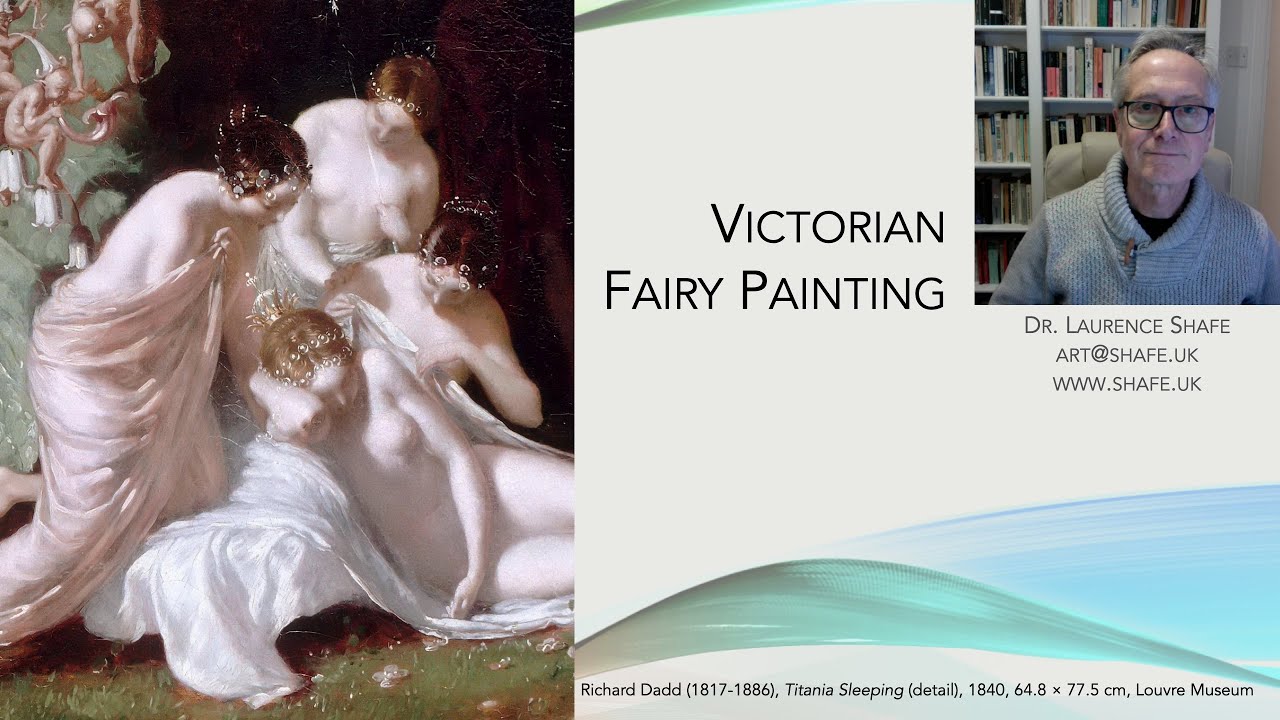
An interesting conversation about Fairy painting created by Google Notebook from my notes:
1. The Industrial Nightmare and the Winged Dream
To the uninitiated, Victorian fairy paintings appear as mere chocolate-box sentimentality—the “pixie dust” of a bygone era. Yet, to view them as simple whimsy is to miss the psychological drama of the 19th century. These canvases functioned as a pressurized steam-release for a society suffocating under its own moral and industrial soot. This was the age of the Great Stink, of a “clatter of steam” and the “choking fog” of a London where mortality was a constant, grimy companion.
As the population surged and roughly half the citizenry migrated from the pastoral peace of rural life to the mechanical drudgery of urban centers, the collective psyche reached a breaking point. Fairy painting offered more than just an escape to the woods; it provided a vital psychological valve. It was a “salve” for a world of “steam trains, pollution, disease, and early death,” allowing the Victorian mind to retreat into a lost world of wonders where the cold logic of the factory was replaced by the shifting, blurred visions of the liminal.
2. The Erotic Loophole: Shakespeare as a Shield for Censure
One of the most provocative aspects of this genre was its role as a “sexual element that avoided censure.” In an era where the human body was draped in layers of social and physical fabric, fairyland provided a rare “Erotic Loophole.” By grounding their work in high-status literature—specifically the “high-culture” shield of William Shakespeare’s A Midsummer Night’s Dream—artists could explore carnal desires and nudity that would otherwise have been deemed obscene.
Fairy painting was, quite literally:
“…a salve that combined Shakespeare with eroticism.”
In Luis Ricardo Falero’s A Fairy Under Starry Skies, we see a lithe, completely nude figure suspended against a celestial backdrop—an image of pure astronomy-inflected eroticism that would have been scandalous in a contemporary setting. Similarly, Henry Fuseli’s Titania and Bottom presents a nearly naked Queen of the Fairies succumbing to a spell, surrounded by a “darker side” of fairyland populated by “devilish faces” and, most disturbingly, an “old man on a lead.” These works created an “Other” world—strange, exotic, and safely distant—where the Victorian audience could project their deepest, most repressed desires through the “shield” of classical inspiration.
3. The Scientific “Fact” of Fairyland
While we moderns relegate fairies to the nursery, many 19th-century intellectuals sought to colonize the supernatural with the tools of science. There was a “serious, scientific aspect” to the obsession, where fairies were viewed not as spirits, but as a historical reality. A small but influential circle of thinkers proposed the “Pygmy Theory,” arguing that folk legends across Europe were actually the distorted memories of a real race of tiny, prehistoric people.
Proponents pointed to the discovery of pygmy tribes in Africa as proof that a “race of tiny people” could exist in remote areas. They argued that these beings had interacted with humans thousands of years ago, leaving behind a global legacy of folklore. This was the Victorian mind at its most characteristic: unable to endure the irrational, they attempted to categorize the “uncanny” within the framework of anthropology and history. Even the supernatural had to submit to the era’s “scientific” logic.
4. The Madman’s Masterpiece: Art from Bedlam
No story in the genre is more haunting than that of Richard Dadd. A leading talent of “The Clique” and a “noble, gentle” star of the Royal Academy, Dadd’s life fractured during an 1842 journey up the Nile. He underwent a “dramatic personality change,” emerging from the trip with the terrifying delusion that he was an agent of the Egyptian god Osiris. Upon returning to England, convinced his father was the “Devil in disguise,” Dadd committed a brutal patricide and fled to France.
He was eventually committed to the criminal department of Bethlem Royal Hospital (the infamous “Bedlam”) and later to Broadmoor. It was within these institutions that Dadd, likely suffering from what we now recognize as “paranoid schizophrenia or bipolar manic depression,” created his magnum opus: The Fairy Feller’s Master-Stroke. Dadd labored over this small, hallucinatory canvas for nine years, employing an obsessive “layering technique” to create a claustrophobic, three-dimensional thicket of detail. Despite the decade of toil, he considered it fundamentally incomplete, adding “Quasi” to its title. It remains a staggering testament to the Victorian fascination with the borderlands of the mind—a masterpiece created while its author was officially diagnosed as being of “unsound mind.”
5. Darker than Disney: Slavery, Abduction, and the “Changeling” Defense
The Victorian fairy was often far more sinister than the sanitized sprites of the modern era. Artists frequently tapped into the “anxiety of child abduction” and the ancient terror of the “changeling”—a fairy offspring left in place of a stolen human child. Joseph Noel Paton’s The Fairy Raid is a chilling visual representation of this “atavistic” fear.
In Paton’s work, we see a clearing marked by “standing megaliths,” where the Fairy Queen’s route is lined by “grotesque” attendants. A “knight… about to plunge his lance into… a monster maiden” suggests the violent “Otherness” of this realm. Most disturbing are the “three human children” in the foreground. At first glance, they appear to be dancing, but a closer inspection reveals a “thin chain round their ankles.” They are captives, and the work is a stark depiction of “slave owners and the slaves they have stolen.”
This folklore had grim real-world consequences. In the 1895 trial of Bridget Cleary, her husband used the “changeling” defense to justify her murder, claiming he was merely trying to “get his wife back” from the spirits. This case, occurring during the heated debate over Irish Home Rule, was weaponized by critics to suggest that the Irish were too “superstitious” to govern themselves. Here, the fairy world and the political world collided, proving that these “imaginary” beings held a very real power over life and death.
Conclusion: The Shifting Border of Reality
Though fairy painting today is often dismissed as anachronistic, it served as the vanguard for modern art. By embracing “mysticism and irrational thinking,” movements like the Pre-Raphaelites broke the “stranglehold” of the Royal Academy. While critics like Max Nordau vilified such art as the product of “diseased minds,” these artists were actually pioneers of the avant-garde, venturing into the irrational decades before the Surrealists.
Not everyone appreciated this flight from reality. The great critic John Ruskin, reflecting on Turner’s Queen Mab’s Cave, observed it as a:
“…strange example of the way in which the greatest men may at times lose themselves.”
Ultimately, fairyland was a shifting, blurred vision on the border between dreaming and reality. It was a metaphor for a society in transition, caught between the “steam and disease” of the present and an imagined, mystical past. As we inhabit our own era of digital avatars and virtual realities—our own “Other” worlds that offer an escape from the pressures of a hyper-connected life—we must ask: What are the “fairies” of our modern, digital age?Gemini Notebook can be inaccurate; please double-check its responses.
23-21 Victorian Orientalism
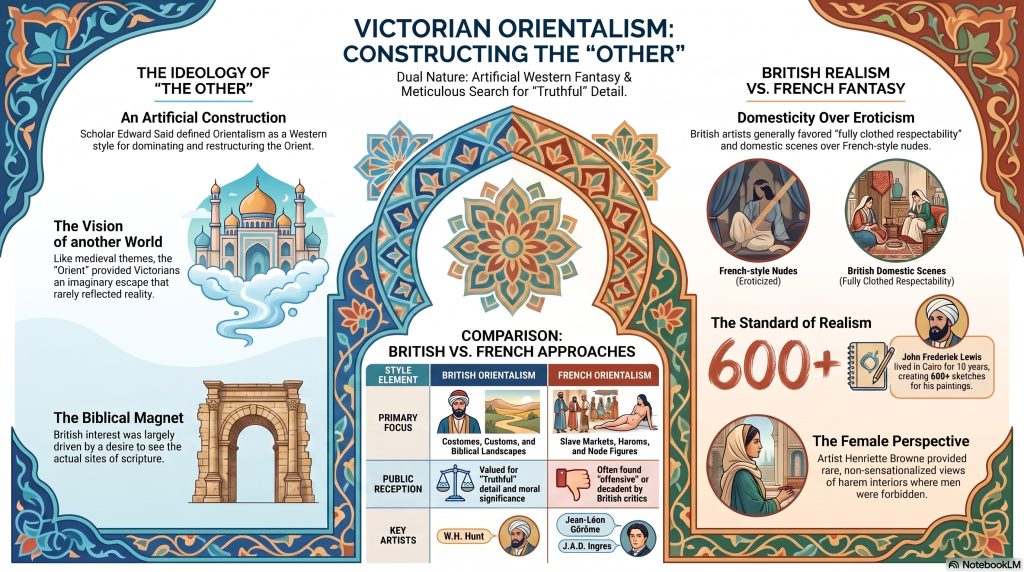
During the Victorian era, Orientalism became a popular artistic theme that portrayed the Middle East and Asia through a lens of Western imagination and cultural bias. According to scholar Edward Said, these works often presented the “East” as an inferior, exotic, or backward “Other” to justify European intervention and satisfy domestic fantasies. While French artists like Jean-Léon Gérôme frequently depicted provocative scenes of slave markets and harems, British painters generally focused on Biblical landscapes, intricate costumes, and domestic realism. Notable figures such as David Wilkie and John Frederick Lewis traveled to the region to improve the accuracy of their sketches, though they often used Western models or idealized their subjects. Female artists like Henriette Browne provided a rare, less sensationalized glimpse into private spaces like the harem, which remained inaccessible to her male peers. Ultimately, this movement reflected a period of significant social and economic change in Britain, where art served as a tool for defining Western identity against a constructed Eastern backdrop.
My notes on Victorian Orientalism
A conversation about Victorian Orientalism created by Google Notebook from my notes:
1. Introduction: The Allure of the “Other”
Victorian Orientalist canvases are a sensory deluge—saturated with pigments that seem to hum with a frequency unknown to the smog-choked streets of industrial London. To the 19th-century viewer, these paintings provided a portal into a liminal space, an exoticized geography of sun-drenched landscapes and intricate silks. Yet, as we interrogate the canvas, we find that the “Orient” presented was a visual theater, a meticulous orchestration of “imaginary worlds” designed to satisfy the specific prejudices and psychological requirements of the British public. Rather than reflecting a Middle Eastern reality, these works were a script written entirely by the West to perform its own fantasies of power and domesticity.
2. The “East” Was a Western Invention
To deconstruct this movement, one must employ the semiotics of hegemony. Edward Said, in his seminal 1978 work Orientalism, posited that the “Orient” was not a geographical fact but an artificial construction—a “Western style for dominating, restructuring, and having authority over the orient.” By portraying Arab culture as irredeemably exotic, backward, and “uncivilised,” the West effectively certified its own moral and “civilized” superiority.
The art historian Linda Nochlin observed that the very “picturesque” quality of this art served a specific function:
“…to certify that the people encapsulated by it, defined by its presence, are irredeemably different from, more backward than, and culturally inferior to those who construct and consume the picturesque product. They are irrevocably ‘Other.’”
This construction was a psychological imperative. The artist John Frederick Lewis, for instance, spent a decade in Cairo living as an “Ottoman nobleman”—a performance of identity that underscores the movement’s artifice. By framing the East as an inferior realm in need of “rescue,” the British Empire could justify its imperial paradigm as a moral necessity.
3. The Harem: Fantasy vs. Domestic Reality
The harem remains the primary site where the voyeuristic “male gaze” of the West met its most sensationalist limits. French masters like Gérôme and Ingres frequently depicted it as a decadent site of nudes, serving a purely carnal French market. In contrast, British sensibilities required a different kind of restructuring.
Long before the 19th-century painters, Lady Mary Wortley Montagu provided a rare first-hand account in her letters, noting the enormous variety of harem life, from the Grand Vizer’s wife living in “austere, sparsely furnished rooms” of prayer to the “gloriously beautiful” deputy’s wife. In 1860, Henriette Browne (the pseudonym of Madame Jules de Saux) utilized her gender to gain entry where men were strictly forbidden. As the daughter of a Count and the wife of a French diplomat, Browne’s obsession with social standing led her to produce A Visit: Harem Interior, Constantinople, showing fully clothed women and children engaged in the mundane act of chatting.
John Frederick Lewis took this a step further, domesticating the exotic into a state of “English domesticity.” Using his own wife as a model, Lewis transformed the harem into a space of “moral healthiness” and “fully clothed respectability,” effectively colonizing the Eastern interior with Western domestic values.
4. Western Faces in Eastern Frames
Perhaps the greatest irony of Victorian Orientalism is that the “Other” was frequently played by the “Self.” To make the exotic more palatable to the British viewer, artists often utilized Western models. We see this explicitly in Lewis’s The Coffee Bearer (1857).
Look closely at the servant: despite the arched entranceway and Egyptian minaret, she possesses unmistakably Western features and pale skin. The artistic interest lies not in her identity, but in the texture of her costume—specifically her “short navy jacket with gold leaf-pattern embroidery.” In this imperial paradigm, the Middle East was merely a wardrobe choice, a collection of everyday items used as staffage to frame a familiar face in a silk dream.
5. Seeking the “Biblical” Truth
However, not every artist was chasing a mirage of hedonism. For men like David Wilkie and William Holman Hunt, the Orient was a site of religious zeal. They traveled to the region seeking “documentary accuracy” to revitalize religious art through the “works of God.”
Hunt, a co-founder of the Pre-Raphaelite Brotherhood, believed that minute detail possessed moral significance; to paint the Holy Land with anything less than absolute truth was to fail in one’s spiritual duty. His The Finding of the Saviour in the Temple (1860) was a quest for authenticity, even as he struggled with the “heat and dust” of the reality. Wilkie, too, sought a “truthful representation” of Biblical customs, a quest that ended tragically. He fell ill at Malta and died off the coast of Gibraltar in 1841, buried at sea in the Bay of Gibraltar while returning from his search for a more accurate religious vision.
6. From “Offensive” Scandal to Multi-Million Dollar Sales
The cultural friction of the era is best exemplified by the polarization of British attitudes toward nudity. When Gérôme exhibited For Sale; Slaves at Cairo at the Royal Academy in 1871, it was “widely found offensive” by a London public that prized “respectability” over French sensuality. In England, the Oriental nude was rare, typically justified only by classical or mythological settings, such as those by Henrietta Rae.
Today, the market reflects a fascinating reversal of the gaze. John Frederick Lewis, once “largely forgotten” for decades, now commands prices in the millions of pounds. His The Arab Scribe, Cairo fetched over £2 million in 2009. Intriguingly, these works are now primarily purchased by Arab collectors—specifically women buying for the home. They value Lewis not for his fantasies, but for the “historically accurate” premium he placed on Islamic architecture and intricate decoration, effectively reclaiming the recorded reality from the Victorian fiction.
7. Conclusion: The Mirror of Art
Ultimately, Orientalism was a mirror. It was less a study of the Middle East than a study of how the Victorian British Empire saw its own reflection during a period of profound anxiety. The late Victorian era was haunted by the “Long Depression” (1873-79) and a creeping pessimism about national decline.
Public confidence was shattered during the Boer War when it was discovered that half of all young men conscripted were in too poor health to serve—with rejection rates hitting a staggering 90% in some industrial towns. In this climate of physical and imperial decay, the construction of a “backward” or “decadent” Orient was a necessary antidote to maintain the illusion of Western vigor.
We must ask: does our modern media not continue to construct “imaginary worlds” of other cultures to satisfy our own contemporary anxieties? Just as Wilkie remains buried beneath the waves of Gibraltar, much of the true “Orient” remains submerged beneath the enticing, silk-threaded fantasies of the Victorian mind.Gemini Notebook can be inaccurate; please double-check its responses.