
Explore Harlem Renaissance
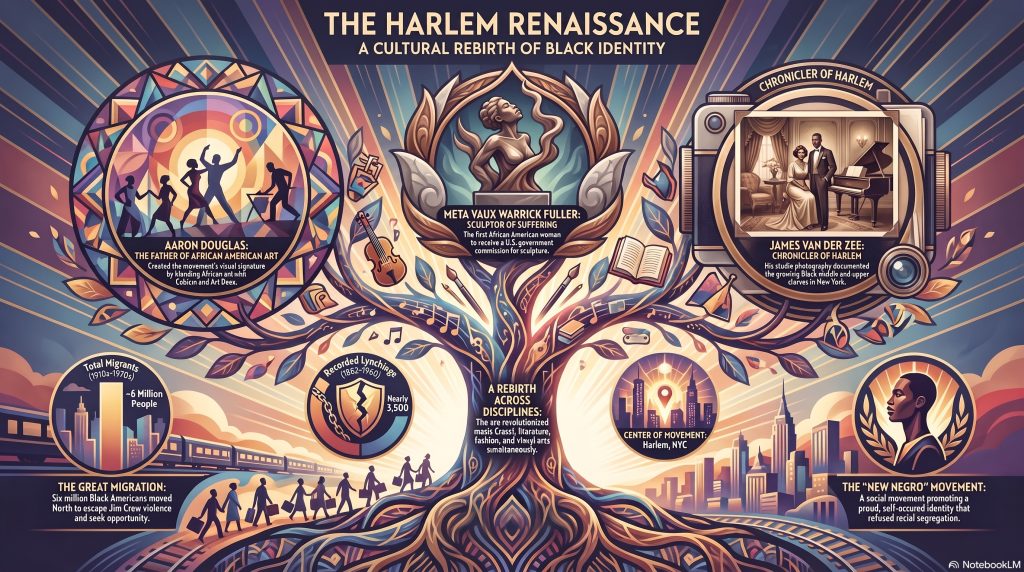
This talk looks at the Harlem Renaissance, an influential cultural rebirth centred in New York City between the two World Wars. The materials examine the movement’s origins, noting how the Great Migration and the escape from Jim Crow laws drove a surge in Black artistic expression. Featured artists include sculptors like Meta Vaux Warrick Fuller, whose work highlighted African identity, and photographers like James Van Der Zee, who documented the community's rising middle class. The text also highlights painters such as Laura Wheeler Waring and Aaron Douglas, who utilized diverse styles to challenge racial stereotypes. I hope this talk and my notes will serve as an educational guide to the visual arts and historical context of this transformative era.
Explicit content warning
Some talks contain artworks depicting nudity, violence or disturbing subjects. The material is presented for educational purposes.
THE CHAPTER
Talks and blogs
Each talk brings its video, illustrated notes, audio conversation and expanded article together in one place.
50-01
50-01 The Harlem Renaissance
This talk looks at the Harlem Renaissance, an influential cultural rebirth centred in New York City between the two World Wars. The materials examine the movement’s origins, noting how the Great Migration and the escape from Jim Crow laws drove a surge in Black artistic expression.…
FROM THE BLOG
Harlem Renaissance — summary
50-01 The Harlem Renaissance
This talk looks at the Harlem Renaissance, an influential cultural rebirth centred in New York City between the two World Wars. The materials examine the movement’s origins, noting how the Great Migration and the escape from Jim Crow laws drove a surge in Black artistic expression. Featured artists include sculptors like Meta Vaux Warrick Fuller, whose work highlighted African identity, and photographers like James Van Der Zee, who documented the community’s rising middle class. The text also highlights painters such as Laura Wheeler Waring and Aaron Douglas, who utilized diverse styles to challenge racial stereotypes. I hope this talk and my notes will serve as an educational guide to the visual arts and historical context of this transformative era.
The following subjects are discussed — Meta Vaux Warrick Fuller, Aaron Douglas, Loïs Mailou Jones, Augusta Savage, Charles Alston, Hale Woodruff, Jacob Lawrence, Laura Wheeler Waring, James Van Der Zee, Alice Dunbar Nelson, Archibald John Motley Jr, Ernest Borough Johnson, Born, Harriet Tubman, Talladega, African, New York, Atlanta, Paris, Chicago, Boston, Smithsonian, Africa, America, Alabama, Alice and France.
Video
My notes
Audio
A conversation on the Harlem Renaissance created by Google Notebook from my notes:
From the blog
The Great Migration and the Making of Harlem: The Harlem Renaissance was made possible by the Great Migration — the movement of hundreds of thousands of African Americans from the rural South to the urban North in the years after the First World War, fleeing Jim Crow laws and agricultural poverty in search of better wages and greater freedom. Harlem became the destination of choice, a neighbourhood that concentrated African American talent, ambition, and political energy as never before in American history.
The “New Negro” — A Philosophy of Pride and Self-Determination: The intellectual framework of the Harlem Renaissance was provided by the philosopher and critic Alain Locke, whose anthology The New Negro (1925) announced the arrival of a new African American self-consciousness. The “New Negro” — in contrast to the submissive stereotypes of white American culture — was educated, proud, creative, and politically assertive. Art was central to this project: it was through cultural achievement that African Americans would claim full citizenship.
Aaron Douglas — The Visual Voice of the Renaissance: Aaron Douglas (1899–1979) is the central visual artist of the Harlem Renaissance. His distinctive style — flat, silhouetted figures in tones of blue and purple, overlaid with radiating circles and angular Art Deco geometry — created an immediately recognisable visual language that synthesised African formal traditions with modernist design. His murals for the Harlem branch of the New York Public Library (1934) remain the most powerful visual statement of the Renaissance.
Jacob Lawrence and the Migration Series: Jacob Lawrence (1917–2000), though slightly younger than the central Renaissance generation, produced what is perhaps the movement’s greatest single visual achievement: the Migration Series (1940–41), sixty panels narrating the Great Migration in a bold, simplified style of flat colour and angular form influenced by Cubism and Goya’s chronicle prints. The series was acquired jointly by the Museum of Modern Art and the Phillips Collection — the first work by a Black artist to enter MoMA’s collection.
Jazz, Blues, and the Art of Sound: The Harlem Renaissance was inseparable from the musical revolution happening simultaneously in its clubs and dance halls. Duke Ellington’s residency at the Cotton Club (1927–31), Louis Armstrong’s trumpet virtuosity, Bessie Smith’s blues — these were not merely entertainment but a cultural assertion of African American genius that crossed racial boundaries in ways that visual art could not always achieve. Jazz became the defining sound of modern America, and Harlem was its cathedral.
Legacy — The Foundation of African American Cultural Identity: The Harlem Renaissance did not end racism in America, and the Great Depression hit Harlem’s Black community particularly hard. But it permanently changed the terms of African American cultural life. It established that African American artists, writers, and musicians were not imitators of European or white American models but the creators of an independent and vital tradition. That legacy — reaffirmed by the Black Arts Movement in the 1960s, by Jean-Michel Basquiat and Kara Walker in more recent decades — remains one of the most significant contributions to American culture.