TWO PERSPECTIVES
Arts & Crafts
The Design Reform Movement · William Morris & The Arts & Crafts Movement
Explore Arts & Crafts
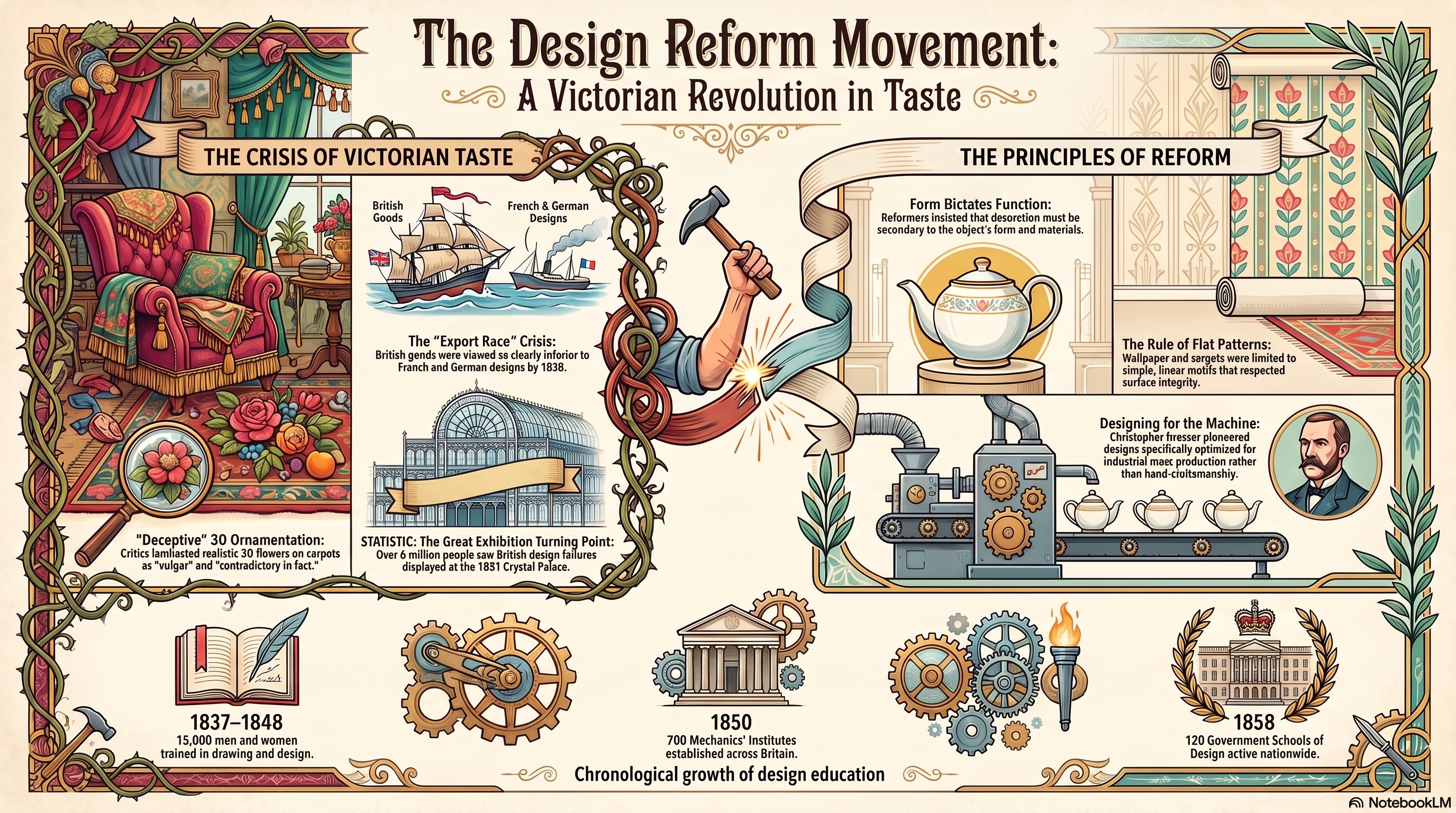
The Design Reform Movement emerged during the Victorian era as a governmental effort to improve the quality and global competitiveness of British manufactured goods. Originating from the establishment of the Government Schools of Design in 1837, the movement sought to replace gaudy, excessive ornamentation with principles where function and materials dictated form. Key figures like Henry Cole and Richard Redgrave championed these aesthetic and moral changes, eventually leading to the influential Great Exhibition of 1851, which highlighted the superiority of international design. Despite internal conflicts regarding the teaching of fine art and figure drawing, these schools laid the foundation for prestigious institutions like the Royal College of Art. The movement served as a critical precursor to the Arts & Crafts movement, shifting focus toward simpler motifs and cleaner, more hygienic domestic environments. Ultimately, this period of reform transformed the British educational landscape and spurred the development of major cultural landmarks in South Kensington.
Explicit content warning
Some talks contain artworks depicting nudity, violence or disturbing subjects. The material is presented for educational purposes.
TWO PERSPECTIVES
Talks and blogs
Each talk brings its video, illustrated notes, audio conversation and expanded article together in one place.
34-01
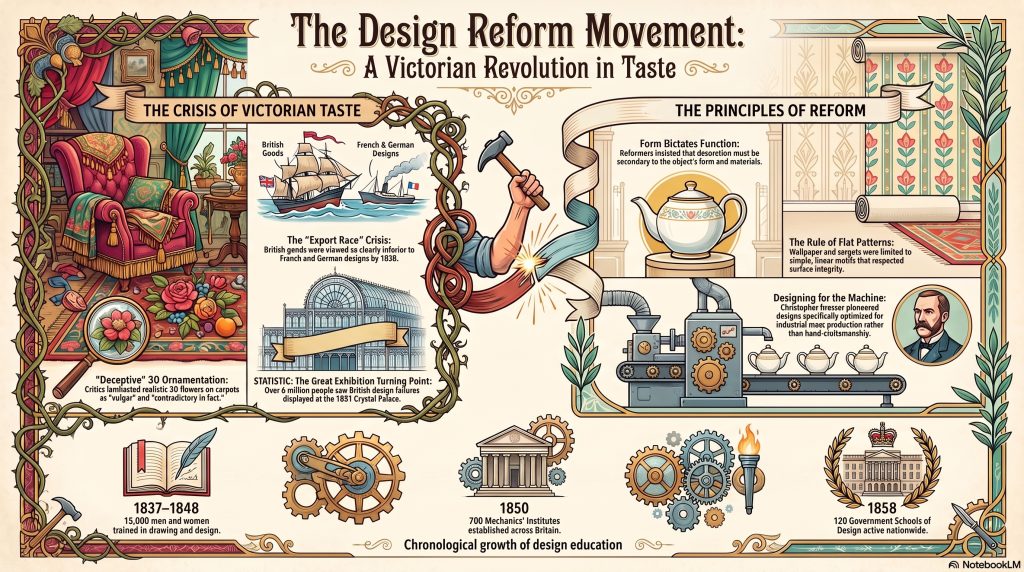
34-01 The Design Reform Movement
The Design Reform Movement emerged during the Victorian era as a governmental effort to improve the quality and global competitiveness of British manufactured goods. Originating from the establishment of the Government Schools of Design in 1837, the movement sought to replace gaudy,…
34-02
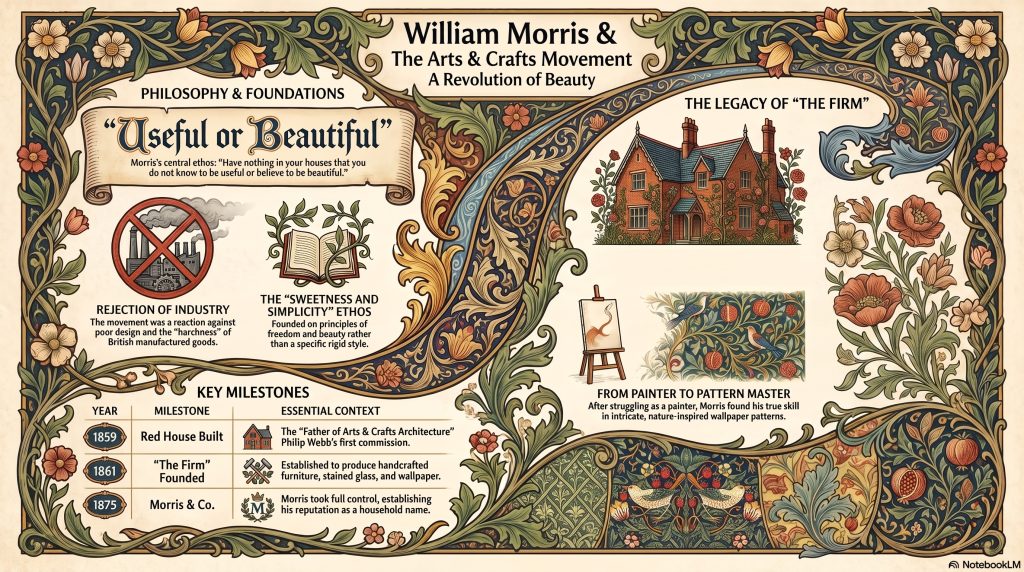
34-02 William Morris & The Arts & Crafts Movement
The Arts & Crafts Movement was a significant Victorian cultural shift led by the socialist William Morris, who sought to reclaim the beauty of pre-industrial craftsmanship. Rooted in the philosophies of John Ruskin and August Welby Pugin, the movement rejected the poor design and…
34-01 The Design Reform Movement
The Design Reform Movement emerged during the Victorian era as a governmental effort to improve the quality and global competitiveness of British manufactured goods. Originating from the establishment of the Government Schools of Design in 1837, the movement sought to replace gaudy, excessive ornamentation with principles where function and materials dictated form. Key figures like Henry Cole and Richard Redgrave championed these aesthetic and moral changes, eventually leading to the influential Great Exhibition of 1851, which highlighted the superiority of international design. Despite internal conflicts regarding the teaching of fine art and figure drawing, these schools laid the foundation for prestigious institutions like the Royal College of Art. The movement served as a critical precursor to the Arts & Crafts movement, shifting focus toward simpler motifs and cleaner, more hygienic domestic environments. Ultimately, this period of reform transformed the British educational landscape and spurred the development of major cultural landmarks in South Kensington.
The following subjects are discussed — Christopher Dresser, Owen Jones, Thomas Cole, Augustus Pugin, Richard Redgrave, William Morris, James Abbott McNeill Whistler, John Ruskin, Joseph Mallord William Turner, James Barry, William Dyce, David Ramsay Hay, Rossetti, Wallpaper, Henry Cole, Kensington Museum, Queen Victoria, Albert Museum, Horsley, London, Victoria, Westminster, Great Exhibition, France, Britain, Germany, Japan, England, Edinburgh, Hyde Park, Minton, South Kensington Museum, Sydenham, School of Design, Schools of Design, Crystal Palace, Grammar of Ornament, Government Schools of Design, Royal Academy, Somerset House, Gothic, Aesthetic Movement and Arts and Crafts.
Video

My notes
Audio
A conversation about the Design Reform Movement based on my notes and created by Google Notebook:
From the blog
1. Introduction: The Victorian Taste Crisis
When we think of the Victorian era, we often conjure images of rigid refinement, buttoned-up decorum, and perhaps a bit too much lace. In reality, the mid-19th century was a period of absolute aesthetic chaos. As the Industrial Revolution accelerated, British factories began churning out an endless stream of household goods—most of which were, by the standards of the day’s intellectual elite, spectacularly gaudy.
This “taste crisis” wasn’t just a headache for socialites; it was a national emergency. A group of bureaucrats and artists looked at the cluttered, over-ornamented homes of the middle class and saw a threat to the British soul and, more importantly, the British wallet. This was the birth of the Design Reform Movement: a mission led by aesthetic police on a government payroll to save British industry from its own most flamboyant impulses.
2. Art was a Matter of National Security (The “Export Race”)
We tend to view art movements as matters of passion and philosophy, but the Design Reform Movement began as a panicked government trade policy. By the 1830s, the British government realized that while they were the “workshop of the world,” their products were being systematically humiliated on the global market.
The 1836 Parliamentary Report on Art and Manufactures warned that British design was so “appalling” that English manufacturers were actually fleeing to France, Germany, and the United States to buy better designs. The “economic argument” was blunt: if British goods remained ugly, the country would lose the “export race.” It is a delicious irony of history that what we now consider a sophisticated design philosophy actually started because a Parliamentary Committee was terrified of losing market share to the French.
3. The Scandalous Ban on the Human Figure
The government’s solution was the establishment of the Schools of Design in 1837. However, these institutions were immediately paralyzed by bureaucratic turf wars. The Royal Academy, which held a monopoly on “Fine Art,” was terrified that design students might try to become actual painters, thereby devaluing the high-end art market.
To protect this monopoly, the Schools of Design took the radical step of categorically banning students from drawing the human figure. The goal was to train “designers,” not “artists.” This led to a moralistic rigidity in the curriculum, championed most famously by Superintendent John Calcott Horsley.
Horsley was nicknamed ‘Old Clothes Horsley’ (or ‘Mr. J. Clothes Horsley’ by Punch) because of his fierce opposition to the use of nude life models in art education, which he regarded as fundamentally immoral.
Students were essentially told to sit down, stay quiet, and focus on flowers—drawing anything with a pulse was considered a gateway drug to the “fine arts.”
4. The “Dictionary Error” That Changed Design History
One of the great tragedies of British design may have been caused by a simple linguistic blunder. In France, the highly successful Écoles de Dessin were “schools of drawing” (derived from the Italian disegno).
However, British reformers took the word “design” in a tragically restricted sense. Rather than seeing it as a holistic process of creation—as the French did—the British treated design as mere “ornamentation” to be slapped onto an object after it was made. This meant the British were essentially teaching “decorating” while the French were teaching “thinking.” This century of confusion meant that for generations, British students were discouraged from high-level artistic expression and forced to focus on the mere application of patterns to teapots.
5. The Great Exhibition was a National Embarrassment
The 1851 Great Exhibition at the Crystal Palace was meant to be Britain’s “mic drop” moment. While it was a massive financial success—clearing a profit of £186,000—it was an aesthetic nightmare.
The exhibits were a riot of “ornate, artificial” items that ignored the natural qualities of their materials. Even the building itself was a source of controversy; Owen Jones, one of the movement’s leaders, decorated the interior with a radical scheme of only primary colors—blue, red, and yellow—generating fierce debate over its “vulgarity.” A teenage William Morris, the future founder of the Arts and Crafts movement, famously refused to enter the building on the grounds of “good taste.”
The art historian Nikolaus Pevsner would later describe the exhibits as showing “ignorance of that basic need in creating patterns, the integrity of the surface” and a pervasive “vulgarity in detail.”
6. The War on “Deceptive” Vegetables
The reformers’ biggest pet peeve was “deception.” They harbored a specific hatred for three-dimensional, illusionistic patterns on two-dimensional surfaces. To them, a carpet that looked like a 3D field of roses wasn’t just “busy”—it was a moral failure and a “contradiction in fact.”
They mocked conventional tastes, claiming that on such carpets “vegetables are driven to a frenzy in their desire to be ornamental.” The logic was literal: why would you want to walk on 3D flowers with “heavy boots” that would, in reality, “crush and wither” them? This clash was immortalized by Charles Dickens in Hard Times, where a Government Inspector scolds a young student named Sissy Jupe for her “pretty and pleasant” taste:
“Suppose you were going to carpet a room. Would you use a carpet having a representation of flowers upon it?” … Sissy Jupe replies, ingenuously, that she would because, “If you please, sir, I am very fond of flowers.”
To the reformers, Sissy’s “fancy” was the enemy of “Fact, fact, fact!”
7. The Inventor of the Christmas Card was a Design Bureaucrat
While many reformers were busy shouting at carpets, the movement’s driving force, Henry Cole, was busy inventing the modern world. Cole was a man of many parts: he helped introduce the Penny Black (the world’s first postage stamp) and used the pseudonym “Felix Summerly” to design prize-winning teapots.
His most famous contribution, the first Christmas card in 1843, was actually born out of a desire for efficiency (or perhaps laziness) to avoid the etiquette of writing long letters. The card featured a controversial scene of a child drinking a glass of wine, which offended Victorian temperance advocates. While these cards originally sold for a shilling, their value has skyrocketed; in 2001, a version signed by Cole himself sold at auction for a staggering £22,500.
Conclusion: From Dust-Free Homes to Modern Minimalism
The legacy of the Design Reform Movement is surprisingly modern. It eventually paved the way for the Arts and Crafts movement and even influenced the health and hygiene trends of the day. Designers began advocating for “dust-free homes,” creating furniture without the excessive carving and “fluff” that were seen as “enemies of life” because they trapped dirt.
Perhaps the greatest “truth” is that this once-mocked bureaucratic experiment succeeded beyond its founders’ wildest dreams. The London School of Design eventually became the Royal College of Art, which has been ranked the number one university for art and design in the world for nine consecutive years as of 2023.
As we look at our modern preferences for “clean lines” and “minimalism,” we have to wonder: are our current aesthetic rules just as rigid as the Victorian reformers’? Or should we, like Sissy Jupe, be allowed to just like things because they are “pretty and pleasant”?Gemini Notebook can be inaccurate; please double-check its responses.
34-02 William Morris & The Arts & Crafts Movement
The Arts & Crafts Movement was a significant Victorian cultural shift led by the socialist William Morris, who sought to reclaim the beauty of pre-industrial craftsmanship. Rooted in the philosophies of John Ruskin and August Welby Pugin, the movement rejected the poor design and dehumanizing nature of the Industrial Revolution. Morris founded a decorative arts company to produce hand-made goods, such as his famous “Acanthus” wallpaper, though the high cost of labor meant his products were often only affordable for the wealthy. He was supported by a close circle of collaborators, including the architect Philip Webb, who designed the influential Red House, and various Pre-Raphaelite artists. Despite his Utopian goals of making artistic and useful items available to everyone, Morris faced a central paradox as his commercial success grew alongside his commitment to Socialism. Ultimately, these sources highlight how Morris and his colleagues integrated fine and decorative arts to leave a lasting international impact on design.
The talk also discusses Dante Gabriel Rossetti, Edward Burne-Jones, Philip Webb, David Lloyd George, Walter Crane, John Ruskin, Marie-Thérèse Walter, Ford Madox Brown, Edward Poynter, Thomas Cole, George Frederic Watts, Siegfried Bing, Charles Francis Annesley Voysey, Hector Guimard, Victoria, Albert Museum, Arthur, Faulkner, Marshall, Mackmurdo, Letchworth, Jane Burden, Nowhere, London, Britain, Sussex, Oxford, Paris, Garden City, Red House, Birmingham, England, Japan, Kelmscott Manor, Kelmscott Press, Art Nouveau and Gothic.
Video

My notes
Audio
A conversation about the Arts & Crafts Movement and Wiliam Morris created by Google Notebook from my notes:
From the blog
In our era of digital saturation and rapid-fire consumption, many of us feel a nagging dissatisfaction with the “disposable” nature of the modern world. We are surrounded by objects that lack a soul—mass-produced items designed for obsolescence rather than endurance. This modern exhaustion makes the life of William Morris (1834–1896) feel remarkably contemporary.
Morris was not merely a Victorian designer of floral wallpapers; he was a radical rebel who spent his life in open revolt against the Industrial Revolution. Rooting his philosophy in the teachings of art theorist John Ruskin and the Gothic Revivalist A.W.N. Pugin, Morris sought to reclaim a lost sense of human dignity through “sweetness, simplicity, freedom, and beauty.” Yet, beneath the intricate vines of his famous patterns lies a life of startling contradictions, industrial guilt, and human drama.
1. The Great “Hand-Made” Contradiction
The Arts & Crafts movement was built on a fundamental irony. Morris sought to escape the harshness of industrialization by returning to the methods of medieval craftsmen. He wanted to create affordable, handcrafted goods that reflected the worker’s creativity—qualities he believed were impossible to find in factory-produced “sweated wares.”
However, Morris was also a shrewd businessman. To fund his crusade, he relied on a substantial inheritance from his father’s investments in Devon Great Consols—a copper mine. This “industrial” wealth fueled his anti-industrial mission. Because he insisted that everything be handmade by skilled craftsmen, his manufacturing costs remained astronomical. Consequently, his “anti-elitist” goods were only affordable to the wealthy 1%. Morris became rich selling luxury items to the very class he criticized, and interestingly, the wealthier he became from these mining shares and high-end sales, the more radical his Socialism grew.
“Have nothing in your houses that you do not know to be useful or believe to be beautiful.”
2. The “Master” was a Struggling Painter
While we remember Morris as a master of design, his early career was a series of “frightful” failures in the fine arts. Persuaded by Dante Gabriel Rossetti to abandon architecture for painting, Morris found the transition agonizing. His only completed easel painting, La Belle Iseult (1858), took months of work, yet he still described the portrait of his wife, Jane Burden, as “unfinished.”
His early furniture fared even worse with critics. The St. George Cabinet (1861), intended to showcase his new firm’s medieval spirit, was savaged for its amateurishness. One critic noted it was “hardly better made than a… packing chest,” while the painted figures were dismissed as “frightfully ill drawn.” It was only when Morris abandoned the easel for the woodblock that he found his true genius. His shift to wallpaper design produced triumphs like “Trellis” (1862), inspired by the rose-trellis in his own garden, and “Daisy” (1864), a naively beautiful pattern based on medieval mille-fleurs tapestries.
3. The Radical Spirit of the Museum Restaurant
In 1867, Morris’s firm landed its first major public commission: a suite of eating rooms at the South Kensington Museum (now the V&A). This was a forward-looking vision by Henry Cole to create the first museum restaurant in the world, lit by gaslight so that working people could visit in the evenings.
The project highlighted the era’s eclectic tastes through three distinct spaces. While the central Gamble Room was “heavy and complex” with iron plates and ornate enameling, the Green Room (now the Morris Room) was intentionally “austere,” featuring olive-branch plasterwork and deep, moody colors. The project was also a milestone for professional women; while Morris and Philip Webb designed the Green Room, a special tile-painting class for ladies from the Schools of Design was employed to execute Edward Poynter’s blue Dutch tile designs for the adjacent Grill Room. Engaging women for such a public professional commission was a radical, free-thinking move for 1860s London.
4. The Scandal Behind the “Beautifulest Place on Earth”
The domestic life of the Morris family was far from the serene scenes depicted in his textiles. In 1859, Morris asked his friend Philip Webb to design the Red House in Bexleyheath. Rejecting architectural norms, the “L-shaped” brick building was a cooperative dream that cost Morris a staggering £4,000 at a time when his mining shares were losing value. Edward Burne-Jones described it as “the beautifulest place on Earth,” yet Morris lived there for only five years before financial strain forced a sale.
The human cost was higher still. Jane Burden later admitted she never loved Morris, having married him for his private means. She soon began a long-standing affair with Rossetti. In a radical rejection of Victorian “ownership,” Morris joint-rented Kelmscott Manor with Rossetti in 1871, essentially endorsing a ménage à trois. Morris even famously departed for an extended holiday to Iceland, leaving his wife and children at the manor with his rival, proving he did not view Jane as a “possession.”
5. The Moral Crusade Against “Dishonest” Design
For Morris, poor design was a moral failing. Influenced by Ruskin’s “The Nature of Gothic,” he led a crusade against “dishonest” design—decoration that relied on deception, such as wallpaper that imitated marble or woodgrain. He viewed these “shams” as prejudicial to the soul.
“If you are content to teach a lie in your belongings, you can hardly wonder at petty deceits being practised in other ways.”
To combat this, Morris spearheaded a “flatness revolution.” While most Victorian wallpapers were covered in illusionistic, 3D illustrations of flowers, Morris—inspired by the “floating world” of Japanese Ukiyo-e prints and Hokusai woodblocks—insisted on flatter, nature-based patterns. He believed that ornament must be secondary to the thing decorated, rejecting the “shadow of unreality” in favor of patterns that emphasized the “pleasure in doing.”
A Question for the Modern Home
William Morris was a workaholic who eventually wore himself out, dying at the age of 62. He spent his final years preoccupied with Socialist activism and the Kelmscott Press, leaving behind a legacy of “sweetness and beauty” that still adorns homes worldwide.
His life raises a provocative question for our own age of digital saturation and mass-produced “shams”: If our belongings are a reflection of our values, what does our current environment say about us? In a world of fleeting digital interactions, is Morris’s insistence on the “pleasure in doing” and the moral honesty of our objects more necessary than ever?