Explore Russian Art 1890-1930
This talk takes a look at the evolution of Russian art from the late 19th century through the early 20th century, framed by the country's turbulent political history. It tracks the movement from Tsarist-controlled academic styles toward more rebellious and independent collectives, such as The Wanderers, who focused on realistic portrayals of Russian life and landscapes. The narrative highlights the influence of wealthy patrons like Savva Mamontov, whose artists' colony nurtured geniuses like Valentin Serov and Mikhail Vrubel. As the revolution approached, the focus shifted toward the radical avant-garde, featuring pioneers like Natalia Goncharova and the invention of Rayonism. Finally, the sources explore how the limitless creative possibilities of the 1917 Revolution were eventually stifled by the rise of Stalinist censorship and the mandatory adoption of Socialist Realism.
Explicit content warning
Some talks contain artworks depicting nudity, violence or disturbing subjects. The material is presented for educational purposes.
THE CHAPTER
Talks and blogs
Each talk brings its video, illustrated notes, audio conversation and expanded article together in one place.

32-01
32-01 Russian Art 1890-1930
This talk takes a look at the evolution of Russian art from the late 19th century through the early 20th century, framed by the country's turbulent political history. It tracks the movement from Tsarist-controlled academic styles toward more rebellious and independent collectives,…
32-01 Russian Art 1890-1930
This talk takes a look at the evolution of Russian art from the late 19th century through the early 20th century, framed by the country’s turbulent political history. It tracks the movement from Tsarist-controlled academic styles toward more rebellious and independent collectives, such as The Wanderers, who focused on realistic portrayals of Russian life and landscapes. The narrative highlights the influence of wealthy patrons like Savva Mamontov, whose artists’ colony nurtured geniuses like Valentin Serov and Mikhail Vrubel. As the revolution approached, the focus shifted toward the radical avant-garde, featuring pioneers like Natalia Goncharova and the invention of Rayonism. Finally, the sources explore how the limitless creative possibilities of the 1917 Revolution were eventually stifled by the rise of Stalinist censorship and the mandatory adoption of Socialist Realism.
The following subjects are discussed — Kazimir Malevich, Natalia Goncharova, Wassily Kandinsky, Alexander Rodchenko, Vladimir Tatlin, Marc Chagall, Valentin Serov, Mikhail Vrubel, El Lissitzky, Stalin, Petersburg, Ivan, Shishkin, Lenin, Tate, Mamontov, Tretyakov, Rayonism, Moscow, Russia, Paris, Soviet Union, Germany, Tretyakov Gallery, Belarus, Saint Petersburg, Ukraine, Royal Academy, Suprematism, Constructivism, Cubism, Futurism, Bauhaus and Abstract Art.
Video
My notes
Audio
A conversation on Russian Art between 1890 and 1930 created by Google Notebook from my notes:
From the blog
1. Introduction: A Nation in Flux
To understand Russia, one must first grapple with its impossible scale. This is a land that breathes through the canopy of more than one-fifth of the world’s trees, an expanse so vast it swallows eleven time zones. For nearly four centuries, this immense geography was the private estate of the Romanov dynasty. When Nicholas II abdicated in 1917, it wasn’t just a change in government; it was the collapse of a 370-year era that began in 1547—the same year England’s Henry VIII drew his final breath.
In the vacuum left by the Tsars, a brief, lightning-strike moment occurred. For a 15-year window between 1917 and 1932, the feverish ambitions of avant-garde artists and the iron-willed plans of the Bolsheviks were identical. Both believed art was not a luxury, but a tool to fundamentally remake the soul of a nation. For a time, the possibilities seemed limitless, and the “universal language of abstraction” became the new mother tongue of the Revolution.
2. The “Revolt of the 14”: When Painting the Classics Became a Crime
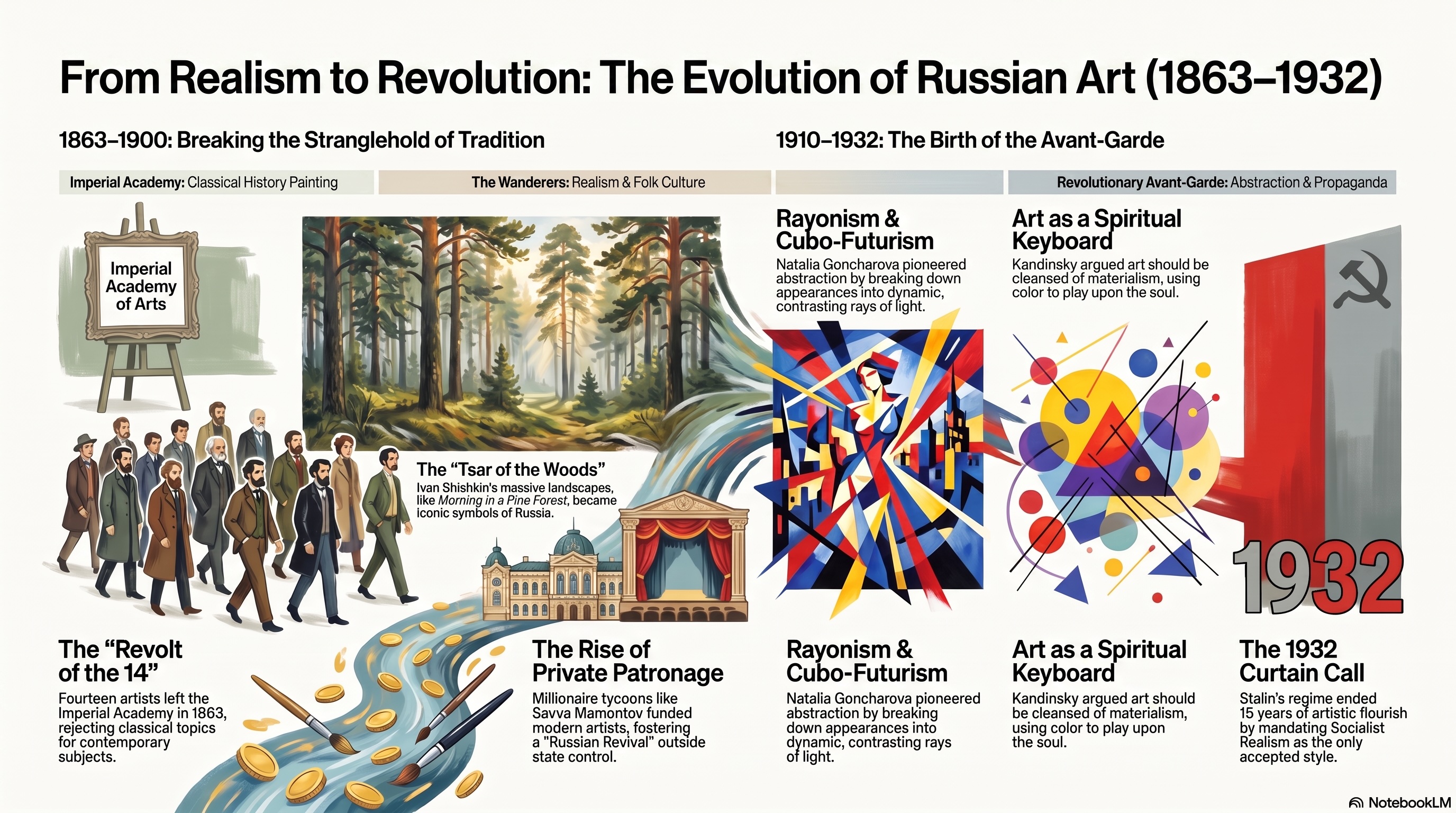
The artistic revolution did not begin with the Bolsheviks; it began with a riot in the halls of tradition. In 1863, the St. Petersburg Academy of Arts was the “government department” of aesthetics, demanding students paint mythological fantasies. Fourteen top students staged a rebellion, refusing to paint the assigned classical exam subjects. They demanded the right to paint the real Russia: the suffering, the village life, and the raw landscape.
Expelled and defiant, they formed “The Wanderers” (Peredvizhniki). They didn’t just paint; they toured. Their mission was to take art out of elite metropolitan galleries and drag it into the provinces. By choosing contemporary Russian themes over Roman gods, these rebels turned art into a political weapon, proving that a canvas could be as radical as a pamphlet.
3. The “Accountant of Leaves” and the Chocolate Bar Legacy
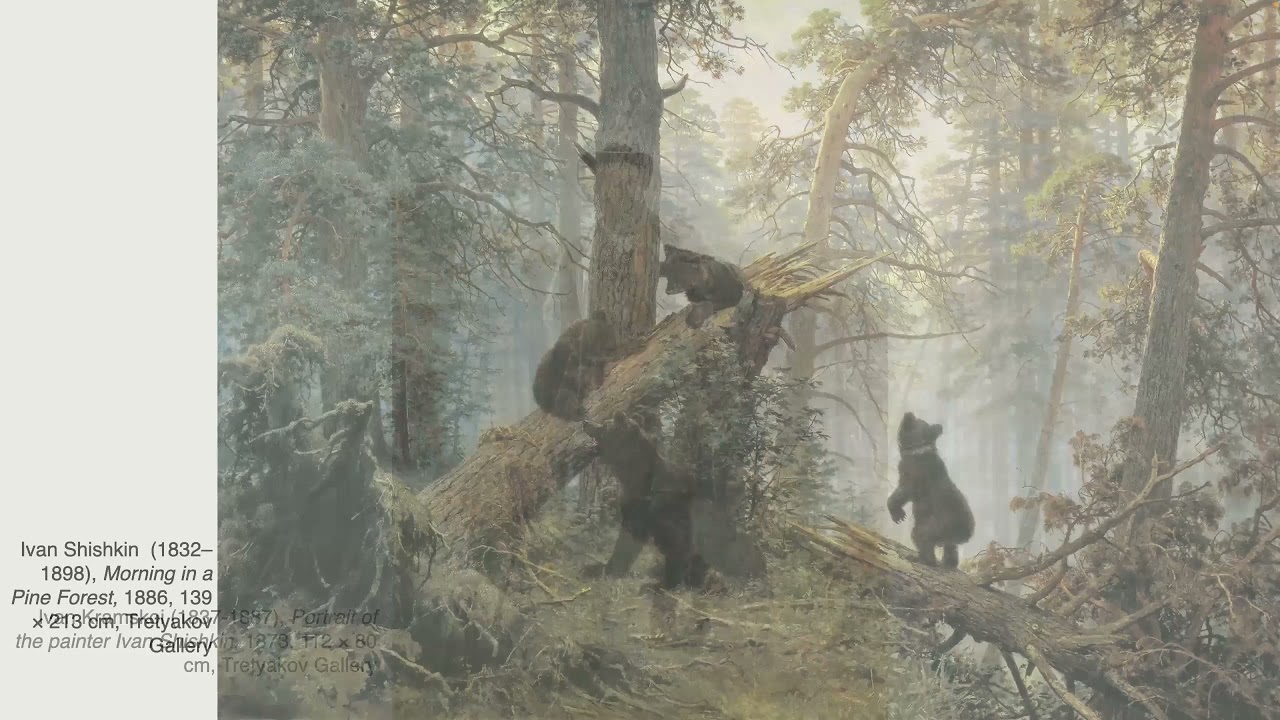
Among the Wanderers was Ivan Shishkin, a man of such obsessive precision he was nicknamed the “accountant of leaves.” While he was the “Tsar of the Woods,” painting immersive forests that functioned as a song of praise to Mother Russia, he did so with a botanist’s cold eye for detail. His 1886 masterpiece, Morning in a Pine Forest, remains the second most popular painting in all of Russia.
Shishkin used a radical perspective to pull his audience into the wilderness:
“The compositional technique is often found in the artist’s paintings, when the tops of trees are cut off by the edge of the canvas, and huge powerful trees seem to not even fit into a fairly large canvas. A peculiar landscape interior appears. The viewer has the impression that he was inside an impassable thicket.”
The ultimate irony? This high-art landscape of “eternal Russia” became a staple of Soviet consumerism. It was widely reproduced on household goods, most famously on the “Clumsy Bear” chocolate bars produced by the Krasny Oktyabr (Red October) factory. Shishkin’s forest didn’t just hang in galleries; it was wrapped around the sugar rations of the working class.
4. The Porridge-Fueled Riot: Valentin Serov’s Modern Cult Following
Valentin Serov’s Girl with Peaches is often cited as the singular masterpiece of Russian painting. The sitter was Vera Mamontova, the 11-year-old daughter of railway tycoon Savva Mamontov. To capture the shimmering, contre jour (against the light) effect that gave the work its legendary “freshness,” Serov was ruthless. He later admitted, “I painted it for over a month and tortured her, poor child, to death, because I wanted to preserve the freshness.”
Serov’s work retains a cult following that borders on the fanatical. In 2016, a retrospective in Moscow drew 400,000 people. Despite temperatures plunging to -10°C, the crowds refused to leave. On the day Vladimir Putin visited the exhibition, the pressure of the crowd became so intense that the museum’s heavy doors were actually broken down. The Ministry of Culture had to intervene, ordering the gallery to stay open through the night and serve the shivering masses hot tea and porridge.
5. Natalia Goncharova: The Original Performance Artist
Natalia Goncharova was the radical soul of the avant-garde. Leading groups like the “Jack of Diamonds” and the more provocative “Donkey’s Tail,” she intentionally broke with European influence to create something uniquely Russian. Her rebellion was public and physical; in 1913, she staged what was likely the first instance of performance art, walking topless through the streets of Moscow with symbols painted on her skin.
She was a woman who refused to let gender define her. Whether she was designing stage sets for the Ballets Russes or illustrating socialist newspapers, Goncharova pushed boundaries until they snapped. She was even charged with “obscenity” for painting nudes and religious icons—a defiance that ultimately forced her into a lifelong exile in Paris after the Revolution made her return impossible.
6. The Law Professor and the Haystack: Kandinsky’s Spiritual Awakening
The father of abstract art was an unlikely candidate for revolution. Wassily Kandinsky was a 30-year-old professor of law and economics who had grown up in Odessa, Ukraine, before settling into a comfortable academic career. His life changed forever at an exhibition in Moscow when he saw a Monet Haystack. He failed to recognize the object, and that failure was a revelation. He realized that color and form could exist independently of reality.
Kandinsky abandoned his law career for a “fairy-tale power.” He viewed art as a mystical, musical experience, believing it should be “object-free.” He famously synthesized sight and sound through his piano metaphor:
“Colour is the keyboard, the eyes are the hammers, the soul is the piano with many strings. The artist is the hand which plays, touching one key or another, to cause vibrations in the soul.”
7. The Uncrossable Line: From Malevich’s Square to Brik’s Erasure
To understand the “Square” in this revolution, one must look to Kazimir Malevich. Born in Ukraine to Polish parents, Malevich drew an “uncrossable line” between the old world and the new with his Black Square (1915). It was the ultimate “Square”—a secular icon hung high in the corner of the room where religious icons usually sat. It signaled that the material world was dead.
Alexander Rodchenko took this to the logical conclusion of the “Tsars to Squares” journey. He famously exhibited three canvases—one red, one blue, and one yellow—declaring that painting was “all over,” before turning to the power of photography and propaganda. His most iconic work was the “LENGIZ BOOKS” poster featuring Lilya Brik.
Brik was the face of the literacy revolution, but she suffered a tragic, state-mandated erasure. Despite being a central figure in the avant-garde and the lover of the “best and most talented” Soviet poet, Vladimir Mayakovsky, her legacy was weaponized against her. After Mayakovsky’s death, Stalin canonized the poet while airbrushing Brik out of history. Her name was scrubbed from his biographies and her face was removed from photographs of them together. She remained a global icon of design on posters, even as the state tried to delete her from existence.
8. Conclusion: The Curtain Falls
The “limitless” optimism of 1917 was a fragile thing. By 1932, Joseph Stalin had seen enough of experimental “Squares.” He initiated a brutal clampdown, drawing the curtain on creative freedom and mandating “Socialist Realism”—a return to representational art that served the state’s message. The avant-garde pioneers were denounced, suppressed, or driven into exile.
Yet, the history of this revolution leaves us with a haunting question: If art has the power to “remake an entire nation,” is it ever truly safe from the state that sponsors it? The artists of the Russian Revolution were often destroyed by the very fire they helped light, but their universal language of abstraction didn’t die. It escaped, becoming the foundation for the global modern design we see every time we look at a screen or walk through a modern city.