Explore Degenerate Art 1890-1900
This talk provides a biographical and artistic examination of Aubrey Beardsley, a pivotal figure in the late nineteenth-century Decadent movement. Despite a career lasting only six years due to his early death from tuberculosis, Beardsley revolutionized book illustration through his distinctive black-and-white style and provocative subject matter. The talk outlines his major commissions, such as Le Morte d’Arthur and the controversial Salome, while highlighting his role as art editor for the scandalous Yellow Book. Influenced by Japanese prints and the Pre-Raphaelites, his work often explored themes of transgression, the grotesque, and social satire. The talk also address the personal complexities of his life, including his public association with Oscar Wilde and his intense focus on productivity while facing a terminal illness. Ultimately, the material portrays an artist who defined the visual language of the fin de siècle by challenging Victorian moral codes through innovative and often shocking imagery.
Explicit content warning
Some talks contain artworks depicting nudity, violence or disturbing subjects. The material is presented for educational purposes.
THE CHAPTER
Talks and blogs
Each talk brings its video, illustrated notes, audio conversation and expanded article together in one place.
29-01
29-01 Aubrey Beardsley: Decadence & Death
This talk provides a biographical and artistic examination of Aubrey Beardsley, a pivotal figure in the late nineteenth-century Decadent movement. Despite a career lasting only six years due to his early death from tuberculosis, Beardsley revolutionized book illustration through his…
29-01 Aubrey Beardsley: Decadence & Death
This talk provides a biographical and artistic examination of Aubrey Beardsley, a pivotal figure in the late nineteenth-century Decadent movement. Despite a career lasting only six years due to his early death from tuberculosis, Beardsley revolutionized book illustration through his distinctive black-and-white style and provocative subject matter. The talk outlines his major commissions, such as Le Morte d’Arthur and the controversial Salome, while highlighting his role as art editor for the scandalous Yellow Book. Influenced by Japanese prints and the Pre-Raphaelites, his work often explored themes of transgression, the grotesque, and social satire. The talk also address the personal complexities of his life, including his public association with Oscar Wilde and his intense focus on productivity while facing a terminal illness. Ultimately, the material portrays an artist who defined the visual language of the fin de siècle by challenging Victorian moral codes through innovative and often shocking imagery.
The talk also discusses Edward Burne-Jones, William Morris, James Abbott McNeill Whistler, Salome, Mabel, Lysistrata, Oscar Wilde, Smithers, Victoria, Albert Museum, Arthur, Herod, Juvenal, Leonard, Poe, Siegfried, London and Moon.
Video
My notes
Audio
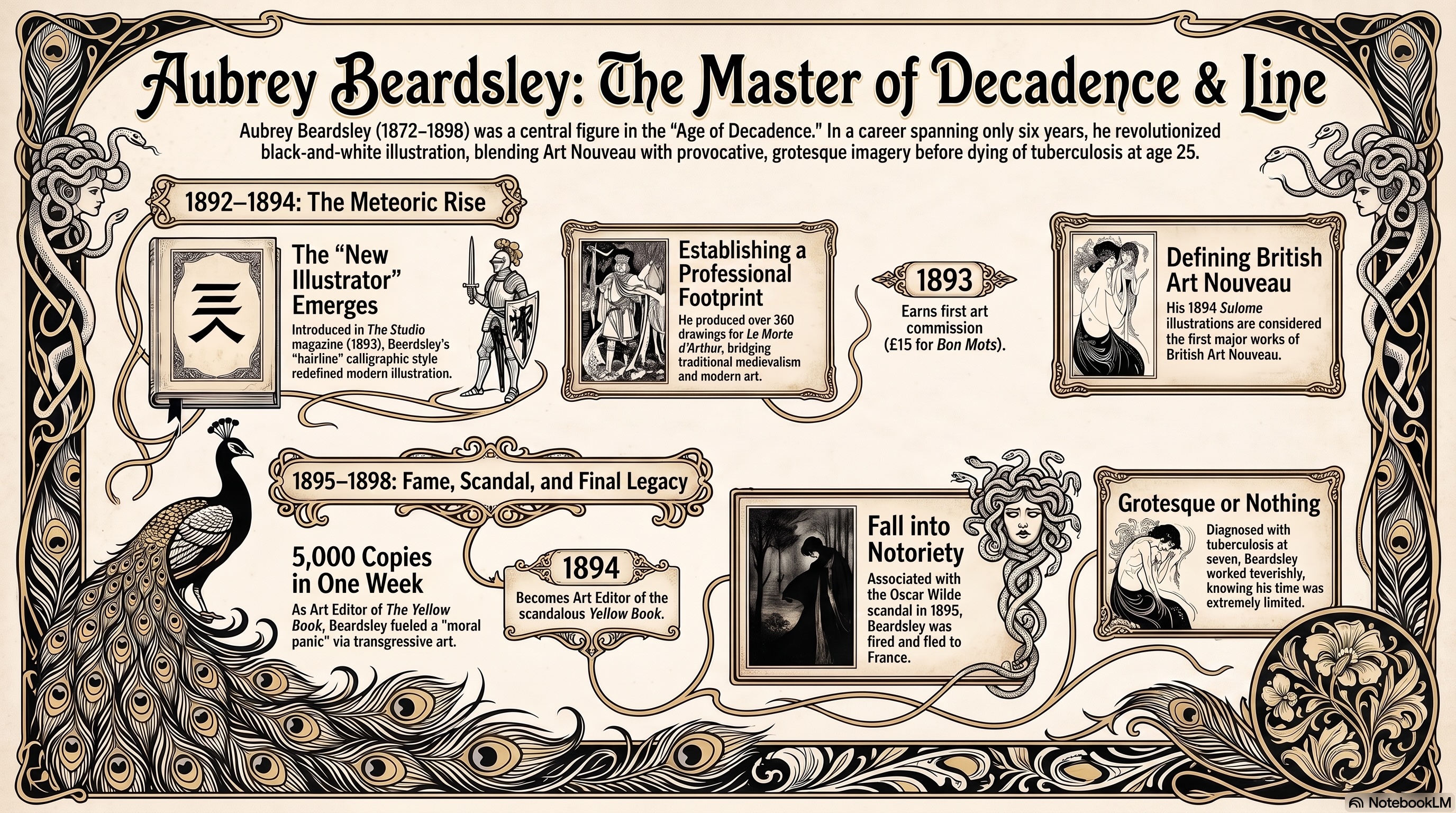
A conversation about Aubrey Beardsley created by Google Notebook from my notes:
From the blog
The late Victorian era was a suffocating velvet curtain of propriety, yet beneath its heavy folds, the fin de siècle was beginning to rot. This “Age of Decadence” was defined by a world-weary cynicism—a cocktail of boredom and rebellion where the elite toyed with sexual perversity as an antidote to the dull materialism of bourgeois life. Into this hothouse stepped Aubrey Beardsley, a silver-hatchet-faced phantom haunting the salons of the 1890s. Known as the “Master of Line,” Beardsley’s meteor-like career lasted a mere six years. He lived on borrowed time and produced art that looked like it had been etched by a clinical voyeur of his own decay.
The Myth of “Effortless” Genius
To his contemporaries, Beardsley cultivated the mask of the dandy-iconoclast, claiming he produced his intricate designs effortlessly in “mystic seclusion.” In reality, his precision was the result of a frantic, labor-intensive struggle. Beardsley would sketch everything in pencil first, “constantly rubbing out and blocking in” forms until the paper’s surface was “raddled with lines”—a chaotic battlefield of graphite.
Only then would he apply Chinese ink, often ignoring his original marks to create those legendary hairline calligraphic flourishes that defined his style. He would eventually scrub away the mess to reveal a final image of stark, impossible cleanliness. This process was a metaphor for the man himself: a messy, dying body producing the most precise visual branding of the century. He even branded his work with a mysterious three-bar symbol signature, which historians suggest was a stylized representation of sexual intercourse—a final, silent wink to those in the know.
The Self-Taught Outsider with a Westminster Polish
Beardsley was the ultimate outsider who conquered the titans of the establishment. Though largely self-taught, he was no amateur; he eventually sought a “finishing school” at the Westminster School of Art under Professor Fred Brown to sharpen the technical bite of his line. His true entry into the pantheon, however, came in 1891.
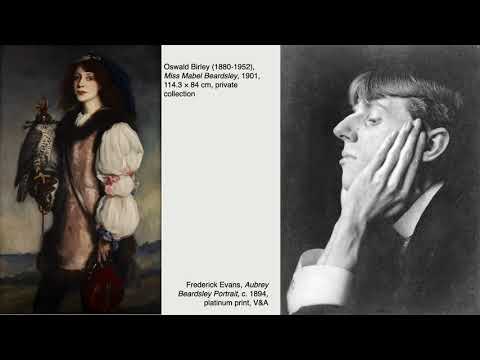
At nineteen, Beardsley and his sister Mabel—a flamboyant actress who allegedly drew the line at reading Carlyle—visited the studio of his idol, Edward Burne-Jones. The master was spellbound by the boy’s portfolio, declaring, “Nature has given you every gift to become a great artist.” That afternoon, Beardsley had tea with the Burne-Joneses and Oscar Wilde. Wilde would later describe Beardsley as having “a face like a silver hatchet and grass-green hair.” It was a meeting of the era’s most dangerous minds, and it solidified Beardsley’s manifest:
“I have one aim — the grotesque. If I am not grotesque I am nothing.”
Weaponizing the “New Woman”
By 1894, as the art editor of The Yellow Book, Beardsley became the chief provocateur of the “Naughty Nineties.” The magazine was an instant sensation, selling 5,000 copies in its first week by exploiting the emerging concept of the “New Woman.” Society was already terrified of these bicycling, smoking, opinionated women who rejected marriage for intellectual independence.
Beardsley took this archetype and made her “more sinister,” weaponizing her against a public gripped by Max Nordau’s fears of “Degeneration” and Social Darwinism. He wasn’t interested in the politics of feminism; he was interested in transgression. By making the New Woman a clinical, powerful, and often predatory figure, he probed the fragile moral codes of the Victorian status quo, transforming a social movement into a gothic nightmare.
Creative Fuel from the “Red Death”
Beardsley’s fascination with morbidity was literal. Diagnosed with tuberculosis (the “Red Death”) at age seven, he suffered major hemorrhages at seventeen and twenty-four. He was a man who knew his expiration date. This frantic urgency fueled his work; he “worked and worked” because every sunrise was a gamble.
Nowhere is this more evident than in his illustrations for Edgar Allan Poe’s The Masque of the Red Death. In a story defined by the color red, Beardsley tells the tale through the absolute absence of it—using stark black and white to convey impending doom. He famously transformed Poe’s Prince Prospero into a princess, or perhaps a hermaphrodite, populating the scene with his characteristic “naughty” preoccupations: bare breasts and a cold, voyeuristic eye that watched the guests die one by one, much as he watched his own lungs fail.
The Irony of the Yellow Scandal
The height of Beardsley’s fame led to a downfall as absurd as it was tragic. In 1895, Oscar Wilde was arrested for sodomy. As Wilde was led away, he was seen carrying a yellow-bound book. The “Yellow Book” was already shorthand for corruption—it was a yellow-bound French novel that had “corrupted” Dorian Gray in Wilde’s famous book. Although the volume Wilde carried was actually Pierre Louÿs’s Aphrodite, a confused, moralistic mob attacked the publisher’s office, thinking it was Beardsley’s magazine.
The ultimate irony? Beardsley had specifically insisted Wilde be kept out of The Yellow Book to protect its respectability. He had tried to banish the dandy to save the editor, yet he was destroyed by association anyway. Fired by John Lane and cast out of the British establishment, Beardsley fled to France, his reputation a casualty of a mere color choice and a “guilty” friend.
The Legacy of the Grotesque
In his final year, living in exile at the Cosmopolitan Hotel in Menton, Beardsley converted to Catholicism—a final pivot for the man who had spent his life illustrating the profane. His last works, the illustrations for Aristophanes’s Lysistrata, were “outrageous erotica” inspired by Greek vase paintings, complete with stage-prop phalluses and depictions of sexual frustration. They were so explicit they had to be published by the “shady” Leonard Smithers to avoid obscenity laws.
Beardsley died at just twenty-five, viewing the world until the end with what Wilde called a “cold eye.” He left behind a body of work that was dismissed by contemporaries as “naughty scribbles” but is now recognized as the definitive first step of British Art Nouveau and modern graphic design. One must wonder: was Beardsley merely a decadent ghost of a dying century, or was he the true architect of the 20th century’s visual audacity?Gemini Notebook can be inaccurate; please double-check its responses.
PREVIOUS CHAPTER
← 28 Aestheticism 1870-1890
NEXT CHAPTER