FIVE PERSPECTIVES
Neo-Classicism 1770-1830
Neo-Classical Art – Mary Moser · Neo-Classical Art – Angelica Kaufmann · Neo-Classical Art – Angelica Kaufmann (Version 2) · Neo-Classical Art – Jacques-Louis David
Explore Neo-Classicism 1770-1830
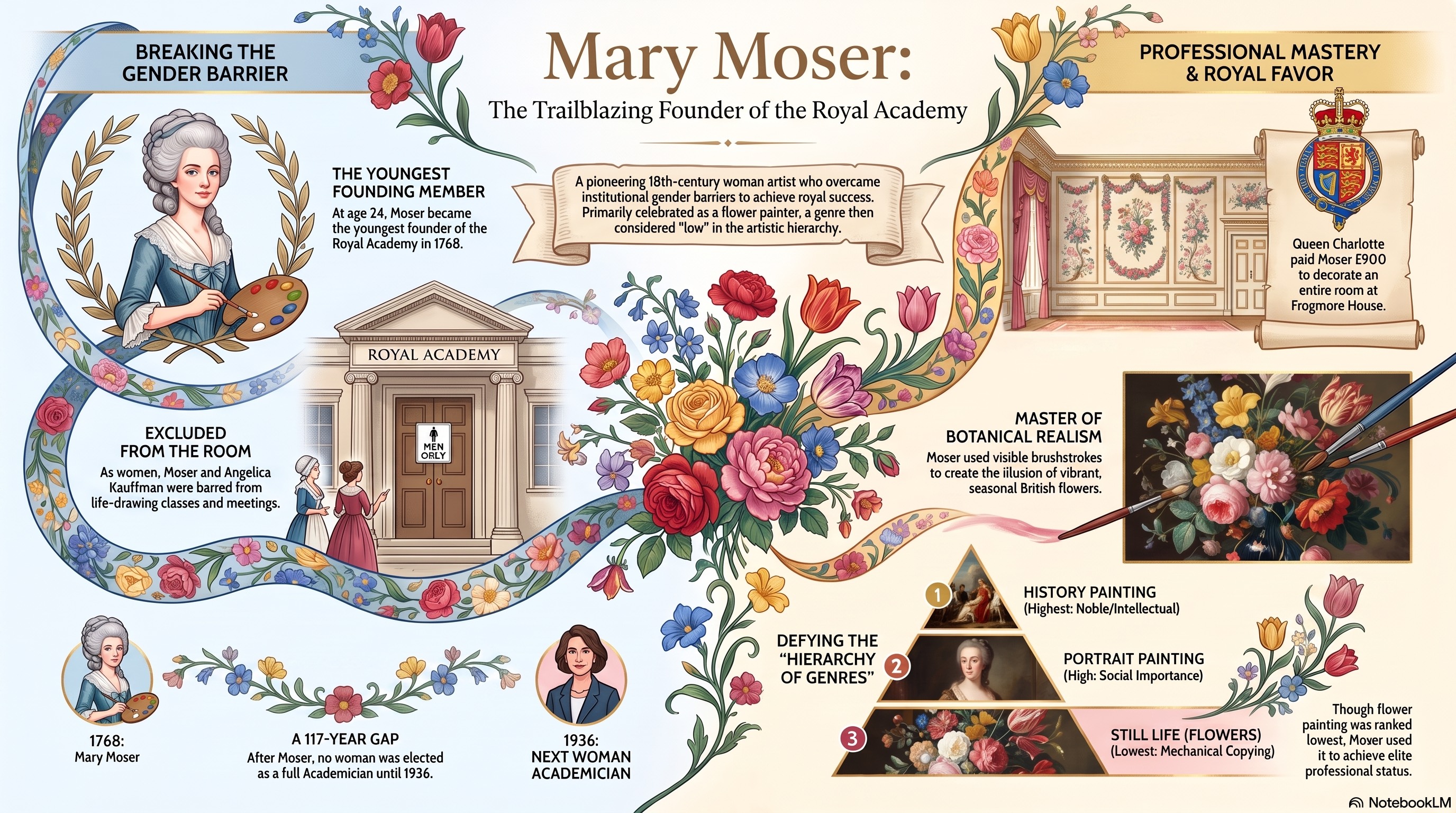
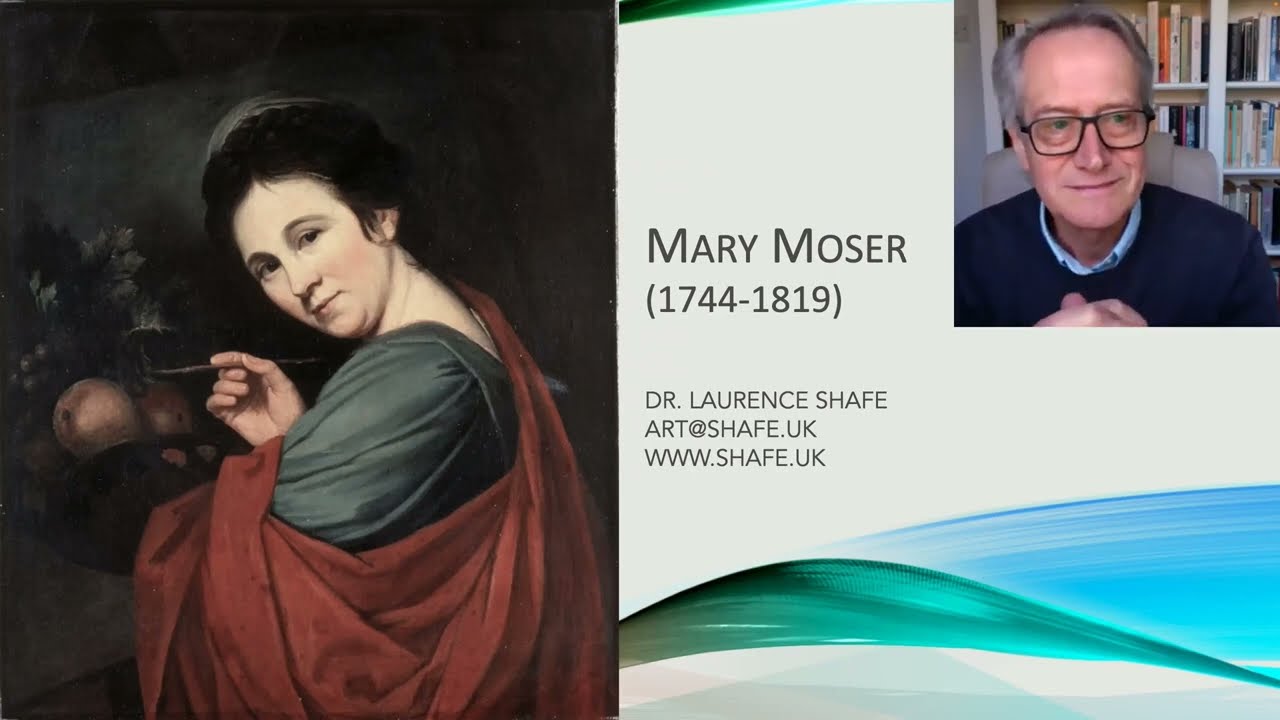
Mary Moser was a pioneering eighteenth-century British artist who made history as one of only two female founders of the Royal Academy of Arts. While she was primarily celebrated for her meticulously detailed flower paintings, the sources reveal she was also a skilled portraitist who navigated a male-dominated profession with significant social and technical constraints. Her father, George Michael Moser, a prominent Swiss-born artist and teacher, provided the foundational training that allowed her to achieve professional success at an early age. Despite her inability to attend the Academy’s life drawing classes due to her gender, she earned prestigious royal commissions, including the decoration of a dedicated floral room for Queen Charlotte. The text further highlights her complex personal life, including a scandalous affair with Richard Cosway and her competitive relationship with fellow artist Angelica Kauffman. Ultimately, the sources reposition Moser as a figure of immense talent and grit whose legacy paved the way for future generations of women in the fine arts.
Explicit content warning
Some talks contain artworks depicting nudity, violence or disturbing subjects. The material is presented for educational purposes.
FIVE PERSPECTIVES
Talks and blogs
Each talk brings its video, illustrated notes, audio conversation and expanded article together in one place.
20-01
20-01 Neo-Classical Art – Mary Moser
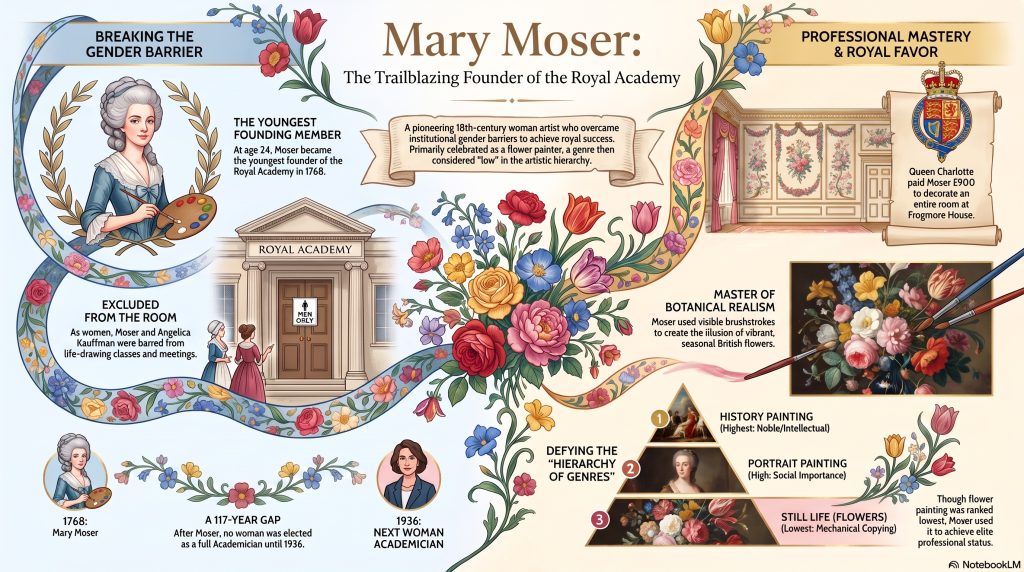
Mary Moser was a pioneering eighteenth-century British artist who made history as one of only two female founders of the Royal Academy of Arts. While she was primarily celebrated for her meticulously detailed flower paintings, the sources reveal she was also a skilled portraitist who…
20-02
20-02 Neo-Classical Art – Angelica Kaufmann
This talk traces Angelica Kauffman’s entire career, from her prodigious Swiss childhood through her London triumph to her distinguished final Roman years. Born in 1741, she mastered multiple languages, history painting, and portraiture…
20-03
20-03 Neo-Classical Art – Angelica Kaufmann (Version 2)
Open this talk to explore Neo-Classical Art – Angelica Kaufmann (Version 2).
20-04
20-04 Neo-Classical Art – Jacques-Louis David
This talk outlines the life and career of Jacques-Louis David, the preeminent figure of French Neoclassicism. It tracks his journey from a student in Rome to a radical revolutionary and, eventually, the official court painter for Napoleon Bonaparte. Through descriptions of…
FROM THE BLOG
20-04 Jacques-Louis David
20-05
20-05 Neo-Classical Art – Jean-Auguste-Dominique Ingres
This talk examines the life and legacy of Jean-Auguste-Dominique Ingres, a preeminent figure of French Neoclassicism who studied under the master Jacques-Louis David. The materials highlight the artistic tension between Neoclassical rationality and the rising tide of Romanticism,…
FROM THE BLOG
Jean-Auguste-Dominique Ingres
20-01 Neo-Classical Art – Mary Moser
Mary Moser was a pioneering eighteenth-century British artist who made history as one of only two female founders of the Royal Academy of Arts. While she was primarily celebrated for her meticulously detailed flower paintings, the sources reveal she was also a skilled portraitist who navigated a male-dominated profession with significant social and technical constraints. Her father, George Michael Moser, a prominent Swiss-born artist and teacher, provided the foundational training that allowed her to achieve professional success at an early age. Despite her inability to attend the Academy’s life drawing classes due to her gender, she earned prestigious royal commissions, including the decoration of a dedicated floral room for Queen Charlotte. The text further highlights her complex personal life, including a scandalous affair with Richard Cosway and her competitive relationship with fellow artist Angelica Kauffman. Ultimately, the sources reposition Moser as a figure of immense talent and grit whose legacy paved the way for future generations of women in the fine arts.
The talk also discusses David Lloyd George, Richard Cosway, Angelica Kauffman, Joshua Reynolds, William Hogarth, Walter De Maria, Johann Zoffany, Henry Fuseli, Sir Godfrey Kneller, Thomas Gainsborough, Benjamin West, George Romney, James Thornhill, Paul Sandby, Henry Singleton, Joseph Nollekens, Laura Knight, Morris Louis, George III, Queen Charlotte, St Martin, William Chambers, Flower Piece, Maria Cosway, Daphne, Richard Wilson, Slaughter, Catholic, Design, Mary Moser RA, Spenser, Thomas Coram, England, London, Frogmore House, Burlington House, Europe, Rome, Windsor, Piccadilly, Holland, Italy, Old Somerset, Denmark, Great Britain, Trafalgar Square, Wales, Royal Academy, The Royal Academy, Somerset House, The Academy, Vase of Flowers, Pall Mall, National Gallery, Society of Artists, Society of Arts, Royal Academy of Arts, Foundling Hospital, Yale Center, Renaissance, Baroque, Rococo, Apollo, Venus, Hercules and Cupid.
Video
My notes
Audio
An interesting discussion about Mat Moser created by Google Notebook from my notes:
From the blog
In the annals of 18th-century art, names like Joshua Reynolds and Thomas Gainsborough dominate the narrative. There is a profound irony in the fact that Mary Moser (1744–1819), a “founding mother” of the Royal Academy and a woman once considered a viable candidate for its presidency, is largely forgotten today. To rediscover Moser is to find an artist who was as resilient and scandalous as she was meticulously talented—a pioneer who thrived in a male-dominated guild only to be moved into the background of the very history she helped create.
Takeaway 1: She Was a Prodigy Who Cracked the Glass Ceiling at 24
Mary Moser did not merely enter the art world; she was born into its inner sanctum. Her father, George Michael Moser, was a celebrated Swiss enameller and the Royal Academy’s first Keeper. Under his tutelage, Mary’s talent flourished early. At 14, she won her first “premium” from the Society of Arts, followed by another at 15.
Her professional ascent culminated in 1768 when, at 24, she became the youngest-ever founding member of the Royal Academy. Alongside Angelica Kauffman, she was one of only two women among the 36 original members. The exclusion that followed was staggering: after Moser’s death in 1819, the Academy would not admit another woman as a full member for 117 years—a 168-year gap from the institution’s founding until Dame Laura Knight’s election in 1936. Despite this eventual erasure, Moser’s contemporary standing was so high that her peers viewed her as leadership material.
“…she was even proposed as a candidate for the presidency, the most prestigious appointment in art in the country.”
Takeaway 2: She Painted with Her Nose an “Inch from the Canvas”
Moser’s precision was born of proximity. She suffered from severe near-sightedness, a physical “infirmity” that required her to sit with her nose nearly touching the canvas. In the 18th-century “Hierarchy of Genres,” still-life was often dismissed as “mechanical copying”—a mere exercise in realism. However, Moser’s work defied this lowly classification.
While Dutch masters favored exotic, imported species to signal wealth, Moser distinguished herself by focusing on the English garden. Her paintings of roses, poppies, and carnations were not just copies of nature; they were intellectual compositions of “harmony”—a quality usually reserved for the “higher” genre of history painting. As one contemporary observer noted:
“it is astonishing with such an infirmity she could display such harmony.”
Takeaway 3: The Scandalous “Sketching Tour” and the Cosway Affair
Moser is often characterized as a respectable flower painter, but her personal life was punctuated by rejection and rebellion. Early in her career, she “set her cap” at the artist Henry Fuseli, only to be rebuffed in favor of the “angelic” Angelica Kauffman. Moser, described as having a good sense of humor but a “troublesome” penchant for arguments, eventually married Captain Hugh Lloyd in 1793 at the age of 49.
Social decorum dictated that a married woman of her status retire from professional practice, and Moser began exhibiting as an “amateur.” However, her “retirement” was anything but quiet. That same year, she embarked on a six-month European sketching tour with the dandy and libertine Richard Cosway. Cosway’s notebooks later detailed the affair through “lascivious statements” and “invidious comparisons” between Moser and his wife, Maria, claiming the 50-year-old Moser was far more “sexually responsive” than her younger rival.
Takeaway 4: She was “Invisible” at Her Own Academy
The gendered barriers of the Enlightenment are perfectly captured in Johann Zoffany’s The Portraits of the Academicians. The painting depicts the members gathered in a life drawing class around a nude male model. Moser and Kauffman are physically absent; because women were strictly forbidden from viewing the nude form, they could not participate in the Academy’s intellectual life classes.
The scene contains a biting personal irony: while Mary is relegated to a framed portrait on the wall—rendered as an object rather than an artist—her father, George Michael Moser, is front and center, physically posing the model. This visual exclusion forced Mary to specialize in flower painting, the “lowest” rung of the artistic ladder, despite her proven skill in portraiture and her ability to capture the human form in works like her portrait of the sculptor Joseph Nollekens.
Takeaway 5: The £900 Room: A Royal Endorsement
Despite the systemic limitations of the Academy, Moser reached a professional peak that made her the envy of her male colleagues. Enjoying the dedicated patronage of Queen Charlotte, Moser was commissioned in the 1790s to decorate an entire room at Frogmore House.
She transformed the South Pavilion into an “arbor open to the skies,” painting floral schemes on both canvas and directly onto the walls. For this single commission, she was paid £900—a massive sum for the era. This was a significant triumph over the “hierarchy of genres”; Moser proved that even “still-life” could command royal fees and intellectual respect. Known today as “Miss Moser’s Room,” it remains a rare, preserved monument to her career.
Conclusion: A Legacy in Bloom
Mary Moser’s life was a masterclass in navigating the constraints of her era. She was a woman who leveraged her “insider” status to crack a glass ceiling, overcame physical limitations to achieve artistic harmony, and lived with a scandalous independence that defied the image of the quiet flower painter.
Through her royal commissions, she challenged the notion that botanical art was a secondary pursuit. Her story is a necessary reminder of the pioneers who helped build our cultural institutions only to be “framed” on the sidelines. One must wonder: how many other female masters remain hidden in the shadows of history’s portraits, waiting for their own moment to bloom?Gemini Notebook can be inaccurate; please double-check its responses.
20-02 Neo-Classical Art – Angelica Kaufmann
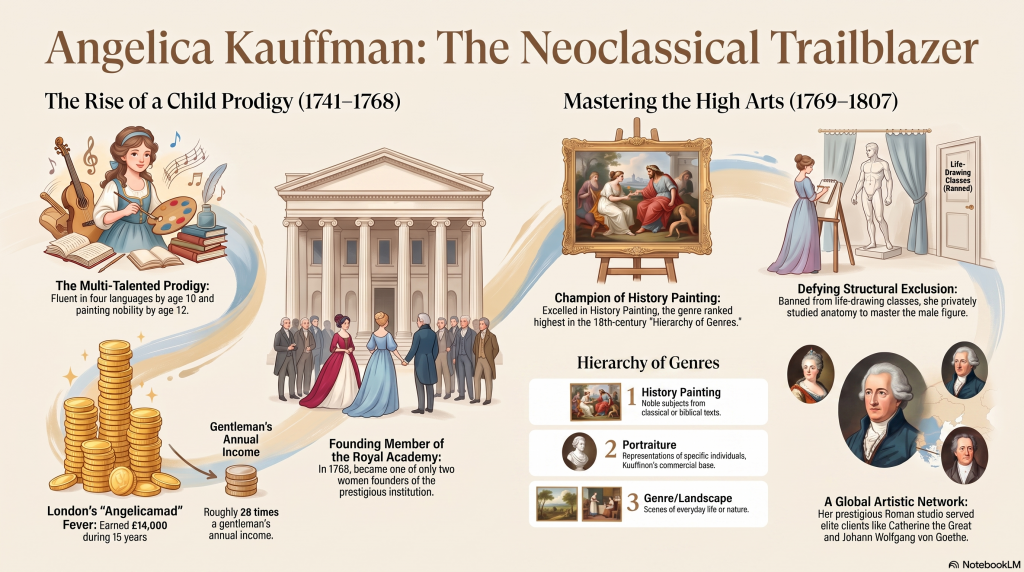
This talk traces Angelica Kauffman’s entire career, from her prodigious Swiss childhood through her London triumph to her distinguished final Roman years. Born in 1741, she mastered multiple languages, history painting, and portraiture against formidable institutional barriers, including exclusion from life-drawing classes essential to academic training. One of only two women among the Royal Academy’s founding members in 1768, she earned extraordinary wealth through engravings, decorative commissions, and royal patronage across Europe. Her legacy, though undervalued by Victorians and modernism alike, is now receiving long-overdue scholarly reassessment as one of the eighteenth century’s most consequential artists. In the above infographic “Kuuffinon” should be “Kauffman” (or “Kaufmann” her birth name).
The following subjects are discussed — Angelica Kauffman, Angelica Kauffmann, David Lloyd George, Walter De Maria, Mary Moser, Benjamin West, Stanley Spencer, Ernest Borough Johnson, Henrietta Laura Pulteney, Raphael, Michelangelo, The Bacchus, Thomas Gainsborough, Evelyn de Morgan, David Garrick, Henry Fuseli, Montagu, Vigée Le Brun, Introduction Angelica Kaufman, Johann Zoffany, John Constable, Design, Odysseus, Portraiture, Saltram, Circe, Winckelmann, Troy, Achilles, Andromache, Muse, Zeuxis, Ariadne, Hector, Neoclassical, Disegno, Aeneas, Harrop, Johann Wolfgang von Goethe, Maria Carolina, Ryland, Aphrodite, Sir Joshua Reynolds, Armida, Edward I, Eleanora, Laurence, Nathaniel, Sibyl, Zeus, Angel, Antonio Zucchi, Horn, Rinaldo, Wendy Wassyng Roworth, London, Rome, Ulysses, Paris, Britain, Naples, Italy, Penelope, Europe, Ferdinand, Bath, Trojan, Carolina, Chur, Minerva, Ireland, Athena, Devon, Weimar, Amelia, Burlington, Florence, Georgian England, Georgiana, Saltram House, Leonardo, Naxos, Switzerland, Venice, Royal Academy, The Royal Academy, Somerset House, Tate, Council Room, Renaissance and Romanticism.
Video
(My YouTube talk will be published on 13 February 2027)
My notes
Audio
An entertaining conversation about Angelica Kaufmann created by Gemini Notebook from my notes:
From the blog
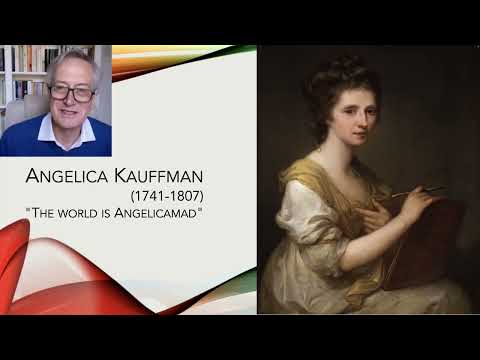
Most people can’t name a single female artist from the 18th century. That’s not an accident — it’s the result of systems designed to make success structurally impossible for women. Angelica Kauffman beat those systems anyway, and the story of how is more surprising than you’d expect.
“Angelicamad”: London Lost Its Mind Over Her
When Kauffman arrived in London in 1766, a fever swept the city. Contemporaries literally coined a word for it. One engraver who did nothing but reproduce her latest works described the entire population as “Angelicamad” — and no one wanted to be cured.
Over fifteen years she produced roughly 800 oil paintings, earned approximately £14,000 at a time when a gentleman lived well on £500 a year, and received royal commissions from Queen Charlotte. Her linguistic fluency — Italian, French, German, English — unlocked patronage networks most British artists couldn’t reach.
They Literally Painted Her Onto the Wall Instead of Letting Her In
Johann Zoffany’s famous 1771 portrait of the Royal Academy’s founding members tells the whole story in one image. Every male Academician stands in the life-drawing room. The two female founders — Kauffman and Mary Moser — appear only as portraits hung on the wall.
No formal rule banned them. But attending a class with a naked male model was considered wholly indecent. The consequence was professional, not merely social: life drawing was the foundation of history painting — the most prestigious genre — and without it, women were structurally barred from the highest artistic ambition. Kauffman got in anyway.
She Cracked the Code No One Else Could
History painting was the summit of artistic achievement and had almost no market in England. Kauffman solved this not by painting better — but by reinventing distribution.
Her partnership with engraver William Wynne Ryland was transformative. By 1783 Ryland had shares worth £7,000, a royal pension, and business income of £2,000 a year — all built largely on her images.
“More engravings after Kauffman were purchased than after any other painter of standing in the eighteenth century.” — Wendy Wassyng Roworth
Her compositions also appeared on watch-cases, snuff boxes, vases, and tea trays. She understood that visibility was currency, and she spent it shrewdly.
She Turned Down a Queen — Twice
On the Continent, Kauffman’s fame grew beyond anything London had offered. Maria Carolina, Queen of the Two Sicilies — who already owned a large collection of her prints — pressured her to become court painter. Kauffman declined.
Her reasoning was precise:
“My circumstances permit me to preserve my freedom.”
She was wealthy enough to refuse. She’d built that wealth deliberately, including negotiating a prenuptial agreement on her second marriage to ensure her assets remained entirely her own. Independence was not an accident — it was a strategy.
History Forgot Her. Scholars Are Fixing That.
The Victorians ignored her. Modernism made her mythological scenes seem remote. Her reputation suffered what Goethe had feared: diluted by cheap reproductions and commercialisation.
But her finest portraits — overlooked for a century — arguably stand equal to those of Reynolds. A catalogue raisonné is now in preparation. A planned Royal Academy retrospective was cancelled, meaning British audiences haven’t had a dedicated showing since 1992.
Much of her work sits in country houses. Saltram in Devon holds eleven paintings. A woman who once filled all of London now waits, largely, in rooms most people never visit.
Kauffman didn’t just survive a system built against her — she made it dependent on her images. The real question her career leaves open is this: how many others like her never got the chance?
20-03 Neo-Classical Art – Angelica Kaufmann (Version 2)
This is another talk on the life and times of Angelica Kauffman. Born in 1741, she mastered multiple languages, history painting, and portraiture against formidable institutional barriers, including exclusion from life-drawing classes essential to academic training. One of only two women among the Royal Academy’s founding members in 1768, she earned extraordinary wealth through engravings, decorative commissions, and royal patronage across Europe. Her legacy, though undervalued by Victorians and modernism alike, is now receiving long-overdue scholarly reassessment as one of the eighteenth century’s most consequential artists.
The following subjects are discussed — Angelica Kauffman, Angelica Kauffmann, Joshua Reynolds, Walter De Maria, David Lloyd George, Mary Moser, Benjamin West, The Bacchus, Thomas Gainsborough, Henrietta Laura Pulteney, David Garrick, Richard Hamilton, William Henry Fox Talbot, Raphael, Ernest Borough Johnson, Michelangelo, Vigée Le Brun, Henry Fuseli, Introduction Angelica Kaufman, John Constable, Montagu, Nathaniel Bacon, Design, Tate, Ariadne, Odysseus, Ryland, Saltram, Achilles, Circe, Male, Winckelmann, Andromache, Hector, Theseus, Troy, Aeneas, Maria Carolina, Poor Maria, Althorp, Anna, Johann Wolfgang von Goethe, Zeuxis, Zucchi, Edward I, Eleanora, Emma, Antonio, Armida, Harrop, Laurence, Portraiture, London, England, Rome, Ulysses, Naples, Paris, Italy, Penelope, Britain, Ferdinand, Henrietta, Weimar, Bath, Europe, Eleanor, Ireland, Saltram House, Chur, Minerva, Devon, France, Royal Academy, The Royal Academy, National Gallery, The Royal Family, Somerset House, Renaissance and Venus.
Video
My notes
Audio
An entertaining conversation about Angelica Kaufmann created by Google NotebookLM from my notes:
From the blog
In 1971, the art historian Linda Nochlin published a seminal challenge to the Western canon: “Why Are There No Great Women Artists?” Her essay posited that the very concept of the “artist genius” was a male-coded construction, reinforced by a history that only had eyes for boy prodigies like Turner or Picasso. Yet, had Nochlin posed that question in late 18th-century London, she might have been laughed out of the coffeehouses. At that time, the British capital was in the grip of a fever that no doctor could cure—a phenomenon the press dubbed “Angelicamad.”
The object of this obsession was Angelica Kauffman, a Swiss-born polyglot and prodigy who was not merely a participant in the art world, but its reigning sovereign. Long before she was “forgotten” by the Victorian era, she was hailed as the “Female Raphael of the Arts,” a title that underscored her status as a legitimate heir to the Renaissance masters. By the age of twelve, she was already painting bishops; by her twenties, she was the most sought-after personality in Europe.
A Creature of the Market: Branding the Neoclassical
Kauffman was a master of market penetration before the concept of branding had a name. She recognized that for an artist to be truly immortal, her vision had to inhabit the private lives of the public. While her peers were content with gallery walls, Kauffman was a savvy navigator of the nascent currents of celebrity culture. She partnered with the prolific engraver William Wynne Ryland to ensure her elegant, ennobling designs were commodified into what J. Moser described as an “incalculable variety of articles.”
Her aesthetic became the visual language of the English home. Kauffman’s reach extended to:
- Ornamental “tea-waiters” (serving trays)
- Enamelled snuff boxes and watch-cases
- Exquisite Derby Porcelain and hand-painted vases
- Mechanical paintings (aquatints transferred to canvas for the middle market)
This business acumen was not just about fame; it was about power. During her fifteen years in London, she earned a staggering £14,000. To put this in perspective, a gentleman of the era could live in high style—complete with servants and a carriage—on just £500 a year. This financial independence allowed her to navigate the world on her own terms, a choice she immortalized in her 1794 work, Self-portrait of the Artist hesitating between the Arts of Music and Painting. In it, she portrays her younger self tenderly saying goodbye to the Muse of Music to follow the more “arduous” but ennobling path of Painting.
The Invisible Founder: Navigating the Royal Academy
In 1768, Kauffman achieved the unthinkable: she was named a founding member of the Royal Academy of Arts. Alongside Mary Moser, she was one of only two women among the original forty members—a distinction that would not be repeated for nearly two centuries.
Yet, her status was a study in contradictions. The reality of her exclusion is frozen in Johann Zoffany’s famous group portrait, The Academicians of the Royal Academy (1771-72). The painting depicts the male academicians gathered around a nude male model, a space deemed “highly improper” for a lady. Consequently, Kauffman and Moser are present only as imago clipeata—portraits on shields hanging on the wall. This traditional Roman device, used to represent absent or venerated members, highlighted the irony of her career: she was a cornerstone of the institution, yet physically barred from its core pedagogical practice of life drawing.
Conquering the Masculine Pinnacle
Kauffman’s greatest defiance lay in her refusal to stay in the “feminine” lanes of flower painting or still life—the lowest rungs of the 18th-century “Hierarchy of Painting.” She aimed for the pinnacle: History Painting. This genre required a deep mastery of anatomy and classical literature, territories guarded by men. One contemporary journalist sneered that a woman’s “compulsive delicacy” prevented her from “studying nudities” and “muscular motion.”
Kauffman circumvented these barriers with intellectual grace. She specialized in female-centered history paintings, such as Penelope at Her Loom, and used her fluency in several languages to interpret classical narratives from a uniquely feminine perspective. Catherine the Great, a devoted patron, observed that Kauffman “unites elegance with nobility,” noting that her figures possessed an “ideal beauty” that surpassed the gritty realism of her male rivals. Whether through private studies of the male form—likely supervised by her father—or the sheer force of her imagination, she proved that the “noble spirit” of history was not a male birthright.
The Analytic Eye and the Modern Pantheon
In an age where Samuel Johnson could flatly state that “staring in men’s faces is very indelicate in a female,” Kauffman’s career as a portraitist was a radical act of looking back. To capture the essence of a sitter, one must stare. Her professional breakthrough, the 1764 Portrait of Johann Joachim Winckelmann, showed her ability to analyze the leading intellectual of the age.
She was the center of the “Bluestocking” movement—a network of scholars, writers, and artists that Richard Samuel depicted in his Portraits in the Characters of the Muses in the Temple of Apollo. In this modern pantheon, Kauffman is not just a muse but a creator. Her portraits of men, like Joshua Reynolds and David Garrick, were often subversive. In her portrait of Garrick, she utilized an intertextuality that only a true art historian would appreciate, borrowing the defensive, gripping pose from Frans Hals’s Portrait of Isaac Massa. Garrick was so unsettled by her analytical gaze that he penned a poem warning her: “Take, if you please, my Mind and Face, / But let my Heart alone.”
The Scandal as a Shield
Kauffman’s personal life was nearly derailed in 1767 by a scandal fit for a period drama. She was tricked into a secret marriage by a valet posing as the Swedish “Count Frederick de Horn.” While such a humiliation could have ended a lesser career, Kauffman’s “good network” of royal patrons—including Queen Charlotte—protected her.
More impressively, she synthesized this disaster into a professional asset. For the next fourteen years, she maintained an ambiguous social status—neither fully wife nor widow. She used this “scandal” as a shield, keeping other suitors at bay so she could maintain the solitude required for her massive artistic output. When she did finally marry Antonio Zucchi at age forty, she insisted on a “prenup,” ensuring her fortune remained under her own control—a move as strategic as any of her classical compositions.
A Funeral Like Raphael’s
When Angelica Kauffman died in Rome in 1807, the world she had conquered paid its respects with a spectacle of state-like proportions. Organized by the sculptor Antonio Canova, the funeral was modeled after that of the Renaissance master Raphael. A “huge crowd” followed her coffin through the streets of Rome, while her greatest paintings were carried aloft like sacred relics. Her bust was subsequently placed in the Pantheon, right beside Raphael himself.
If an artist as wealthy, influential, and internationally revered as the “Female Raphael” could be faded from the popular canon by the Victorian cult of the “male genius,” we must ask ourselves a difficult question. The history of art is not merely a record of who was great, but a record of who we chose to remember. If the world was once “Angelicamad,” why did it take us so long to find our way back to the light of her genius?
20-04 Neo-Classical Art – Jacques-Louis David
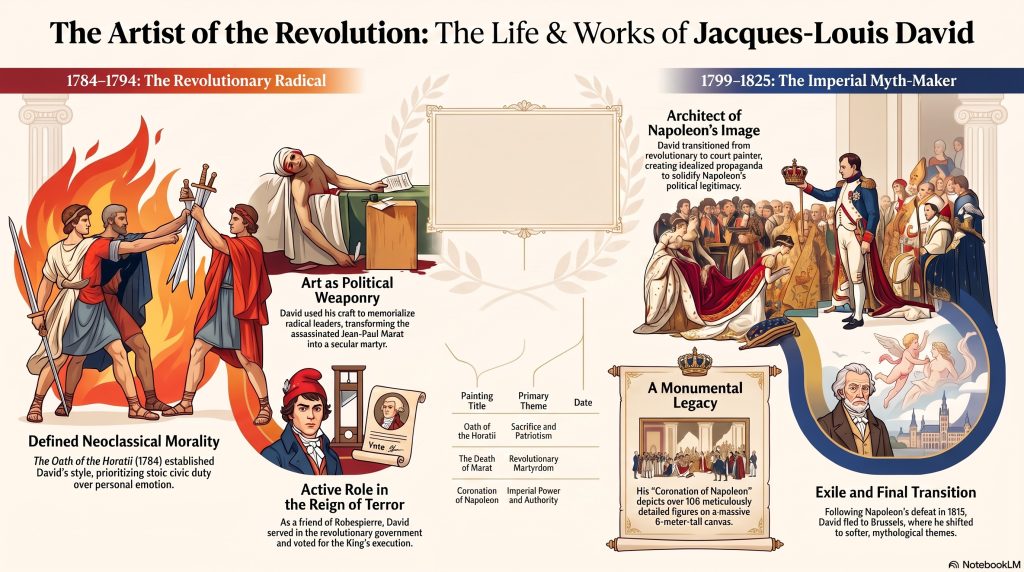
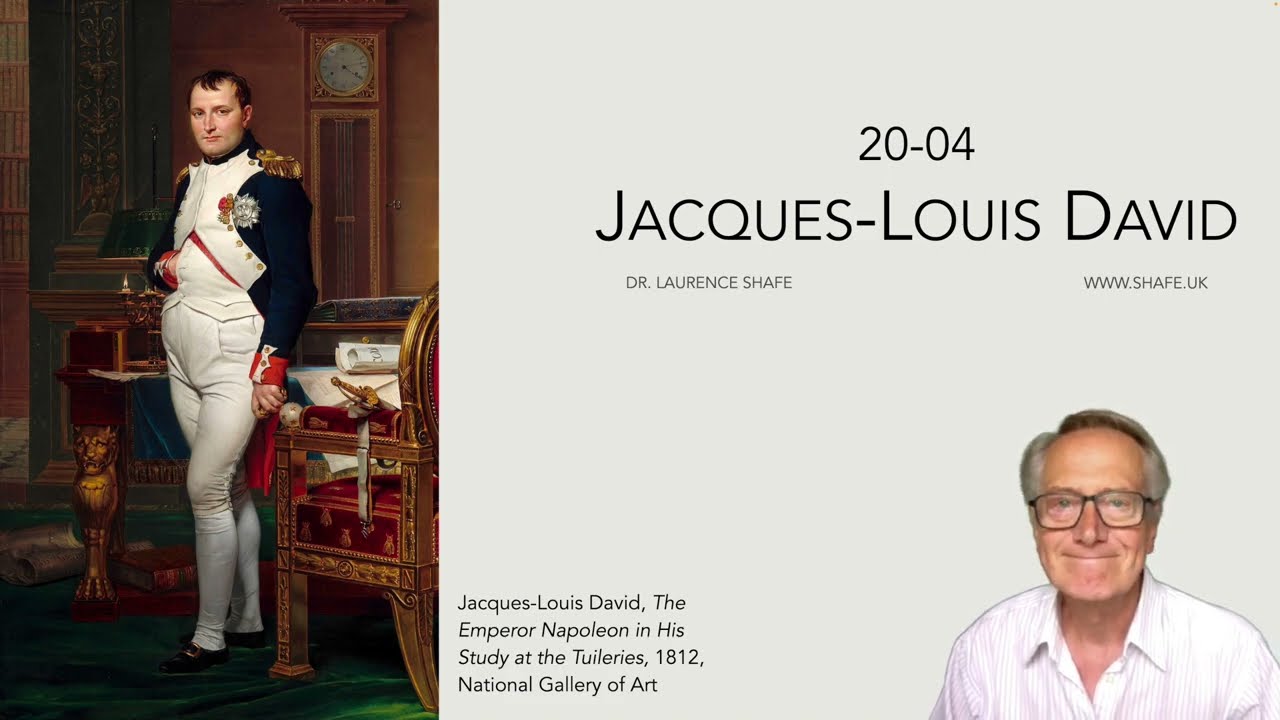
This talk outlines the life and career of Jacques-Louis David, the preeminent figure of French Neoclassicism. It tracks his journey from a student in Rome to a radical revolutionary and, eventually, the official court painter for Napoleon Bonaparte. Through descriptions of masterpieces like The Oath of the Horatii and The Death of Marat, the sources illustrate how David utilized classical aesthetics to promote civic virtue and political propaganda. The narrative also examines his transition from monumental history painting to imperial portraiture and his eventual exile in Brussels. Ultimately, these excerpts present David as a pivotal artist whose work was inseparable from the political upheavals of late 18th and early 19th-century France.
The talk also discusses Napoleon, Horatii, Brutus, Marat, Hector, Robespierre, Socrates, Rome, Louvre, France, Paris, Cupid and Psyche.
Video
My notes
Audio
A discussion on Neo-Classicism 1770-1830 (created by NotebookLM from my notes):
From the blog
Jacques-Louis David – Artist of Revolution and Empire
This talk provides an overview of the life, artistic development, and significant works of Jacques-Louis David, focusing on how his art was deeply intertwined with the political and social upheavals of late 18th and early 19th century France.
I. Introduction to Jacques-Louis David
The talk introduces Jacques-Louis David (1748–1825) as a pivotal figure in Western Art, particularly within the Neoclassical movement. David is described as a “serious, intense and immersed in the horrors and the drama of revolution and empire.” He is recognized for his profound influence, shaping European art into the 19th century, leaving a body of work that is “visually stunning and historically significant.”
II. Early Life and Artistic Formation
Born in Paris in 1748, David’s early life was marked by tragedy with his father’s death in a duel when David was nine. Raised by his mother, he grew up in an environment that “valued education and the arts.” Showing early talent, he began rigorous training under classicizing painter Marie-Joseph Vien.
A crucial turning point in David’s artistic development was winning the prestigious Prix de Rome in 1775. This award funded five years of study (1775–1780) at the French Academy in Rome, where he immersed himself in “Ancient Greek and Roman art, Renaissance masters, and classical sculpture.” This period was “crucial in shaping his style, as he absorbed the austere, noble qualities of classical forms.” Upon his return, he fully embraced Neoclassicism, rejecting the “elaborate and frivolous Rococo style.”
Neoclassicism, as defined in the source, “favoured simplicity, clarity, and disciplined form based on the ideals of harmony, proportion, and restrained emotion found in classical sculpture, architecture, and literature.”
His early work, “Andromache Mourning Hector” (1783), demonstrates this shift. It depicts a scene from Homer’s Iliad with “monumental and sculptural” figures displaying “composure and dignity rather than overt emotion.” This work, influenced by his studies in Rome, highlights his growing interest in history painting as a “vehicle for teaching civic virtue through sacrifice and noble grief.”
III. The Artistic Voice of Revolution
David’s career became deeply intertwined with the French Revolution (1789). He became “the artistic voice of the revolution,” a friend of radical leader Maximilien Robespierre, and even “voted for the execution of Louis XVI.”
Key Revolutionary Works:
“The Oath of the Horatii” (1784/85): This masterpiece, commissioned by Louis XVI, cemented David’s reputation as “the leading figure of French Neoclassicism.” It depicts three Roman brothers swearing an oath to defend Rome, embodying “heroic sacrifice, patriotism, and loyalty to the state above personal interests.” The painting’s “austere design, heroic themes, and moral rigor” resonated strongly, and when exhibited in 1785, “it was read not only as a call to civic virtue but—by some—a veiled call for political reform.” It became a “turning point where art, politics, and history converged.”
“The Death of Socrates” (1787): Completed during “a period of rising intellectual ferment in France,” this painting depicts Socrates choosing death over compromising his principles, symbolizing “moral integrity, courage, and commitment to truth amid adversity.” The work “implicitly addresses issues of justice, law, and conscience that were vigorously debated at the time,” foreshadowing David’s later revolutionary themes.
“The Lictors Bring to Brutus the Bodies of His Sons” (1789): Painted in the year the Revolution began, this work portrays Lucius Junius Brutus, founder of the Roman Republic, confronted with the bodies of his sons condemned for treason. It dramatizes “the tension between private grief and public duty,” symbolizing “the principle that loyalty to the state and to republican ideals must come before personal affections, no matter how painful the sacrifice.” This “powerful allegory for late 18th-century France” became an important “symbol call for republican virtue and the willingness to sacrifice for freedom.”
“The Tennis Court Oath” (sketch, 1791): David was commissioned to paint this pivotal event of the French Revolution, depicting members of the Third Estate vowing “not to separate, and to reassemble wherever circumstances require, until the constitution of the kingdom is established.” Although never finished due to “political reversals and financial difficulties,” the sketches show David’s intention to capture the drama of the moment, with figures like Robespierre present and a “storm blowing through windows reflecting the political storm blowing through the country.”
“The Death of Marat” (1793): Following the assassination of his close friend Jean-Paul Marat, a radical journalist, David “transformed Marat into a secular saint or martyr of the Revolution using Christian iconographic parallels.” The stark composition focuses on Marat’s “pale, emaciated body to evoke sympathy and revolutionary zeal,” making it “potent propaganda for the Jacobins at the height of the Terror, encouraging political fanaticism and justifying extreme revolutionary sacrifice.”
IV. From Revolution to Empire and Exile
David’s deep association with Robespierre led to his imprisonment twice during the Reign of Terror (1794). His self-portrait from 1794, painted while incarcerated, “reveals a sober, intense man confronting the consequences of revolutionary violence and political responsibility.” He survived due to the efforts of friends and political opponents who saw him as “useful to the new regime.”
Following his release in 1795, David’s “revolutionary zeal diminished somewhat,” and he turned towards teaching. However, his career saw a resurgence with the rise of Napoleon Bonaparte. David met Napoleon in 1797 and “quickly became an admirer,” transitioning “from revolutionary artist to imperial court painter.” His style evolved into an “Empire aesthetic,” characterized by “warmer colors and imperial grandeur.”
Major Imperial Works:
“The Intervention of the Sabine Women” (1799): Completed during the post-Terror period, this painting depicts Sabine women intervening in a war between their Roman husbands and fathers. It functions as “a powerful allegory for reconciliation, peace, and the restoration of social order after revolutionary chaos.” This work marked David’s “shift from pure revolutionary propaganda toward a message of peace and social cohesion as France transitioned from Revolution to Empire.”
“Portrait of Madame Récamier” (1800): This intimate portrait captures a leading socialite in post-Revolutionary Paris. While departing from his grand history scenes, it reflects “the era’s classical taste mingled with emerging Empire style,” balancing “formal classical influences with individual character study.”
“Napoleon Crossing the Alps” (1801): This painting “glorifies the military and political leader at a pivotal moment,” depicting “a heroic, calm Napoleon atop a spirited, rearing horse, commanding nature itself.” David deliberately chose “heroic fiction over realism to create a propaganda piece, which successfully shaped Napoleon’s image as a military genius and saviour of France.” This work solidified David’s role as “the official artist of the Napoleonic Empire.”
“The Coronation of Napoleon” (1805-07): A colossal painting depicting Napoleon crowning himself Emperor in 1804. It served as “official imperial propaganda emphasizing Napoleon’s secular supremacy over the church.” David “painted more than a hundred figures with painstaking detail,” showcasing “imperial power and authority as well as subtle theatricality.”
“The Emperor Napoleon in His Study at the Tuileries” (1812): This intimate portrait shows Napoleon working late, with his “hand tucked inside his waistcoat express[ing] authority and contemplative leadership.” The surrounding objects—books, papers, clock—”symbolise discipline and intellectual command.” This portrait “humanises the emperor while reinforcing his role as a tireless guardian of the state.”
Following Napoleon’s defeat at Waterloo in 1815 and the subsequent Bourbon Restoration, David faced political exile. He chose to live in Brussels, Belgium. His artistic output slowed, focusing on “smaller works and teaching.”
Late Works:
“Cupid and Psyche” (1817): One of David’s final major paintings, this work is a “departure from his earlier austere history paintings to a softer, more romantic theme grounded in classical mythology.” Created during his exile, it reflects “a more intimate and tender tone,” with “delicate handling of forms, graceful poses, and warmer colour palette contrast[ing] with earlier revolutionary and imperial grandeur.” David’s portrayal of Cupid as an “ungainly teenager smirking at his sexual conquest” highlights his exploration of “idealized love and physical reality.” “Mars Being Disarmed by Venus” (1822-1825): This was David’s last painting, completed just before his death in 1825.
Jacques-Louis David died on December 29, 1825, in Brussels, having lived a life inextricably linked to the dramatic changes of his era, from a “prosperous Parisian boy to the most influential neoclassical painter of his time.” His legacy remains profound, reflecting his “deep engagement with the ideals and upheavals of his era.”
20-05 Neo-Classical Art – Jean-Auguste-Dominique Ingres
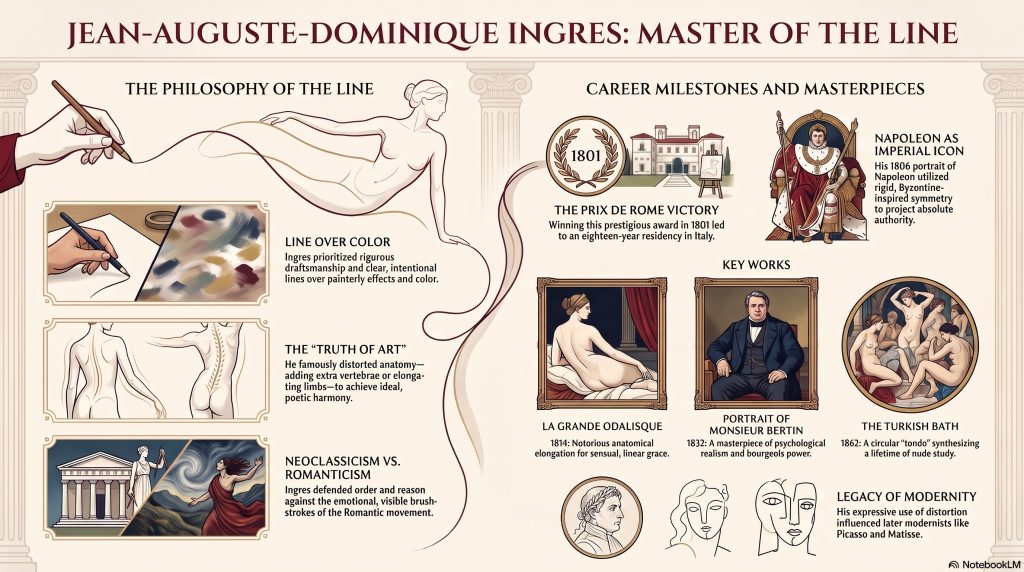
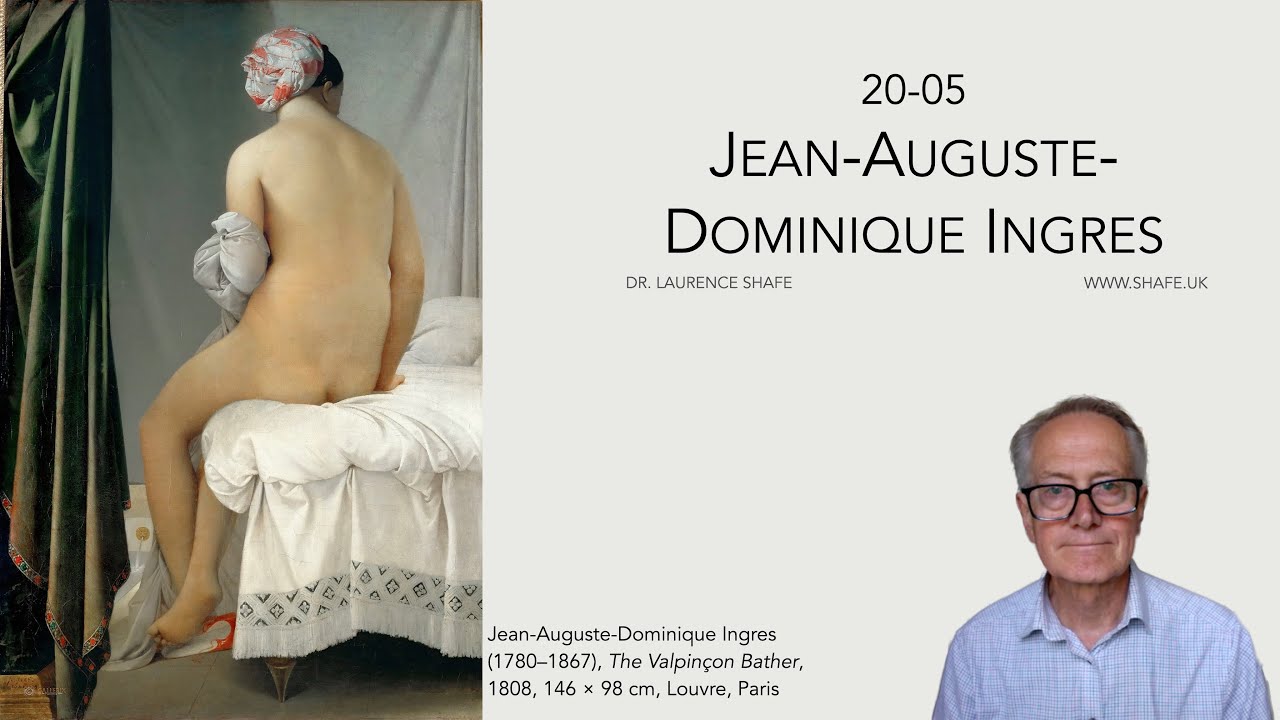
This talk examines the life and legacy of Jean-Auguste-Dominique Ingres, a preeminent figure of French Neoclassicism who studied under the master Jacques-Louis David. The materials highlight the artistic tension between Neoclassical rationality and the rising tide of Romanticism, noting Ingres’s unwavering commitment to line and draftsmanship. Throughout his career, Ingres became famous for his anatomical distortions and idealized forms, seen in iconic works like La Grande Odalisque and The Turkish Bath. His biography details his prestigious Prix de Rome win, his influential leadership at the French Academy, and his success as a high-society portraitist. Ultimately, the texts present Ingres as a bridge between academic tradition and modernity, whose stylistic innovations influenced later artists such as Picasso and Matisse.
The talk also discusses Jacques-Louis David, Raphael, Napoleon, Thetis, Angelica, Bertin, Caroline, Louis XIII, Ruggiero, Valpinçon Bather, Rome, Louvre, Paris, France, Jupiter, La Grande Odalisque, Neoclassicism and Renaissance.
Video
My notes
Audio
An interesting conversation about Jean-Auguste-Dominique Ingres created by Google Notebook from my notes:
From the blog
The talk provides a detailed exploration of Ingres’s life, artistic development, and his pivotal role in French Neoclassicism, particularly in contrast to the emerging Romantic movement. The materials are developed with assistance from AI systems and information from public websites, with specific references provided for exhibitions or unique sources.
The briefing extensively outlines the core tenets of Neoclassicism and its successor, Romanticism, providing a crucial contextual framework for understanding Ingres’s work.
A. Neoclassicism (c. 1760-1830)
B. Romanticism (c. 1800-1850)
Ingres’s biography highlights his early talent, rigorous academic training, and the influences that shaped his distinctive Neoclassical style.
The talk emphasizes David’s profound influence on Ingres, as well as Ingres’s eventual divergences that paved the way for modern art.
A. Shared Foundations:
B. Divergences and Innovations:
C. Critical and Historical Legacy:
The talk details several significant works, illustrating Ingres’s consistent themes, stylistic choices, and critical reception.
Ingres died in Paris on January 14, 1867. He left a “legacy of discipline, idealism, and innovation, his work influencing generations of artists from the Impressionists and Cubists to the present day.” He is remembered as “the last great champion of academic classicism—a custodian of tradition yet in many ways the herald of modernity.”