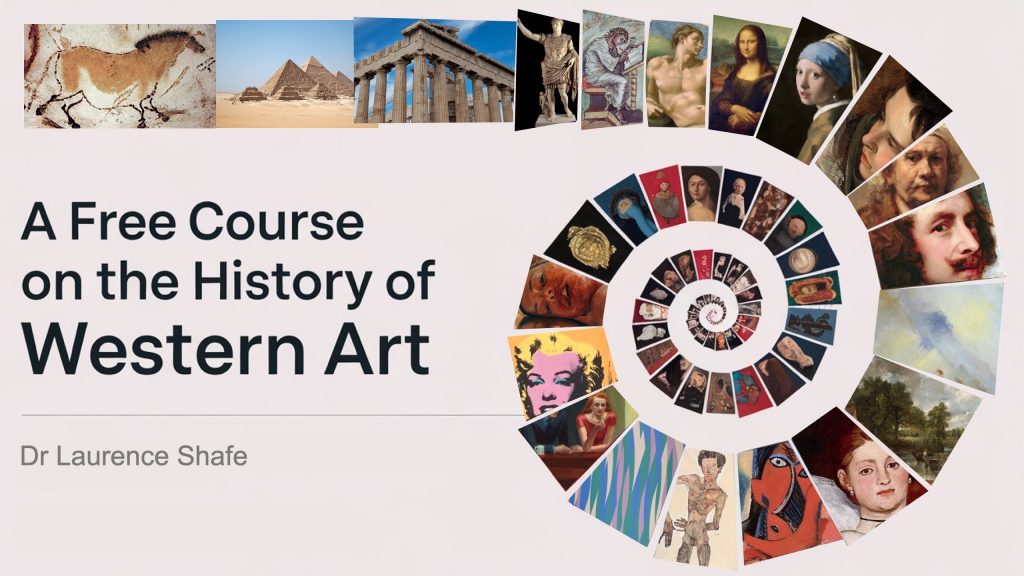
41-01 Cubism Abstraction and the British Avant Garde
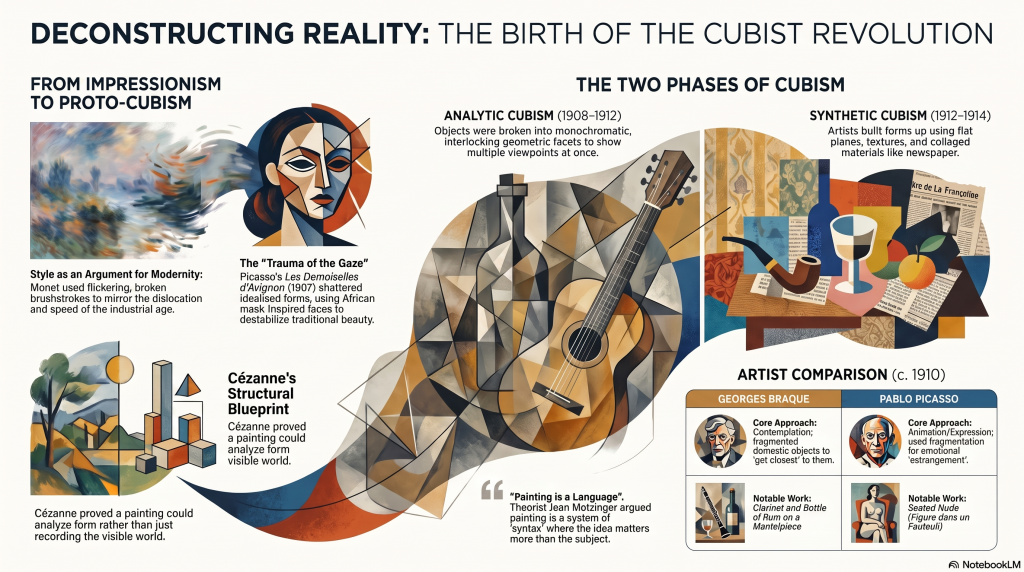
This talk traces early twentieth-century Western art’s revolutionary break from representation. Beginning with Monet’s Gare Saint-Lazare paintings as modernist argument rather than mere style, it moves through Cubism via Braque, Picasso, and Duchamp, before examining pure abstraction in Mondrian’s gradual geometric reduction, Malevich’s provocative Black Square, and Kandinsky’s spiritually driven canvases. The lecture then crosses to Britain, where Roger Fry’s landmark 1910 Post-Impressionist exhibition cracked open the established order, enabling Slade-trained artists including Bomberg, Nevinson, Gertler, Carrington, Nash, Knights, and Spencer to forge distinctively modern visions from the turbulent years surrounding the First World War.
(My YouTube talk will be published on 26 June 2027)
My notes on Cubism Abstraction and the British Avant Garde
An entertaining conversation about Cubism Abstraction and the British Avant Garde created by Google NotebookLM from my notes:
We all know modern art is supposed to be challenging. But most of us absorb it as a timeline — Cubism, then abstraction, then the avant-garde — without grasping why any of it was genuinely shocking, or what each breakthrough actually cost the people who made it. These takeaways from Dr. Laurence Shafe’s survey of early twentieth-century Western art change that.
Monet Was Making an Argument, Not a Style
Impressionism’s flickering surfaces weren’t technical shorthand — they were a philosophical position. When Monet painted the Gare Saint-Lazare in 1877, the method was the message: sketchy, unresolved, impossible to fix. The disorientation a viewer feels mirrors the experience of living through modernity itself. He had found a style that embodied the era rather than depicting it.
Picasso’s Celebrity Swallowed Braque Whole
The two men worked so closely between 1909 and 1914 that their canvases became literally indistinguishable. Yet Braque is routinely treated as a footnote. He described the partnership with brutal accuracy:
“We were like mountain-climbers roped together.”
It was largely Braque’s technical innovations — simultaneous perspective, the rejection of Renaissance spatial logic — that formed Cubism’s most important breakthroughs. Picasso’s fame consumed the history.
Mondrian Was Trying to Save the World
The grids and primary colours look cold and calculated. They weren’t. Mondrian left his fiancée and his career at thirty-nine, moved to Paris, and spent the rest of his life convinced that reducing painting to its purest essentials could model spiritual transformation for everyone. He believed vertical and horizontal lines expressed the two opposing forces that constitute life itself. He wasn’t decorating walls. He was writing a manifesto.
Malevich Hung a Black Square Where the Icon Should Be
When Malevich first exhibited Black Square in 1915, he placed it high in the corner of the gallery — the precise position Russian Orthodox families reserved for devotional icons. A sincere declaration: this object demands contemplative attention equal to a sacred image, but contains nothing. It is, in a meaningful sense, the first painting in history that is not a painting of anything.
Kandinsky Discovered Abstraction by Accident — Twice
Standing before Monet’s Haystacks in 1896, he failed to recognise the subject. The shock revealed that colour could act entirely independently of the object it described. Years later he returned from a walk to find a canvas accidentally turned on its side — and fell to his knees in tears at its beauty.
“He had been liberated from attachment to an object.”
Both moments confirmed the same insight: the subject was always the least important thing in the room.
Roger Fry’s Exhibition Changed Human Character
Virginia Woolf’s verdict on the 1910 Manet and the Post-Impressionists show — “On or about December 1910, human character changed” — sounds like hyperbole. The critical response makes it feel precise. The press called the works “the visualised ravings of a maniac.” Most of what Fry showed was already twenty to thirty years old. Britain encountered continental modernism a full generation late — and it still hit like a bomb.
The Most Neglected Painter Neglected Herself
Dora Carrington rarely exhibited, almost never signed her work, and treated painting as a private practice rather than a profession. Tate Director John Rothenstein later called her “the most neglected serious painter of our time” — a judgement that stings, because so much of the neglect was self-engineered.
The question these stories leave open is worth sitting with: if the most radical breakthroughs in this revolution came from artists who believed art could change how people live — spiritually, politically, perceptually — what do we lose when we hang their work in silence and call it decoration?
41-02 Pablo Picasso
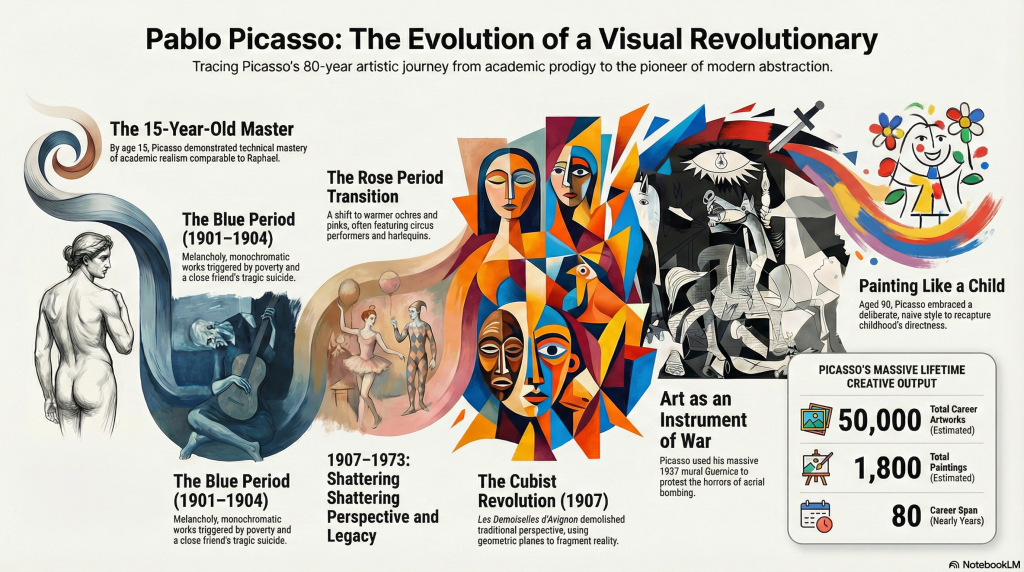
Pablo Picasso was a Spanish artist and one of the most influential figures in 20th-century art. He co-founded Cubism, produced works such as Les Demoiselles d’Avignon and Guernica, and worked across painting, sculpture, printmaking, ceramics, and stage design, constantly reinventing his style throughout a long career.
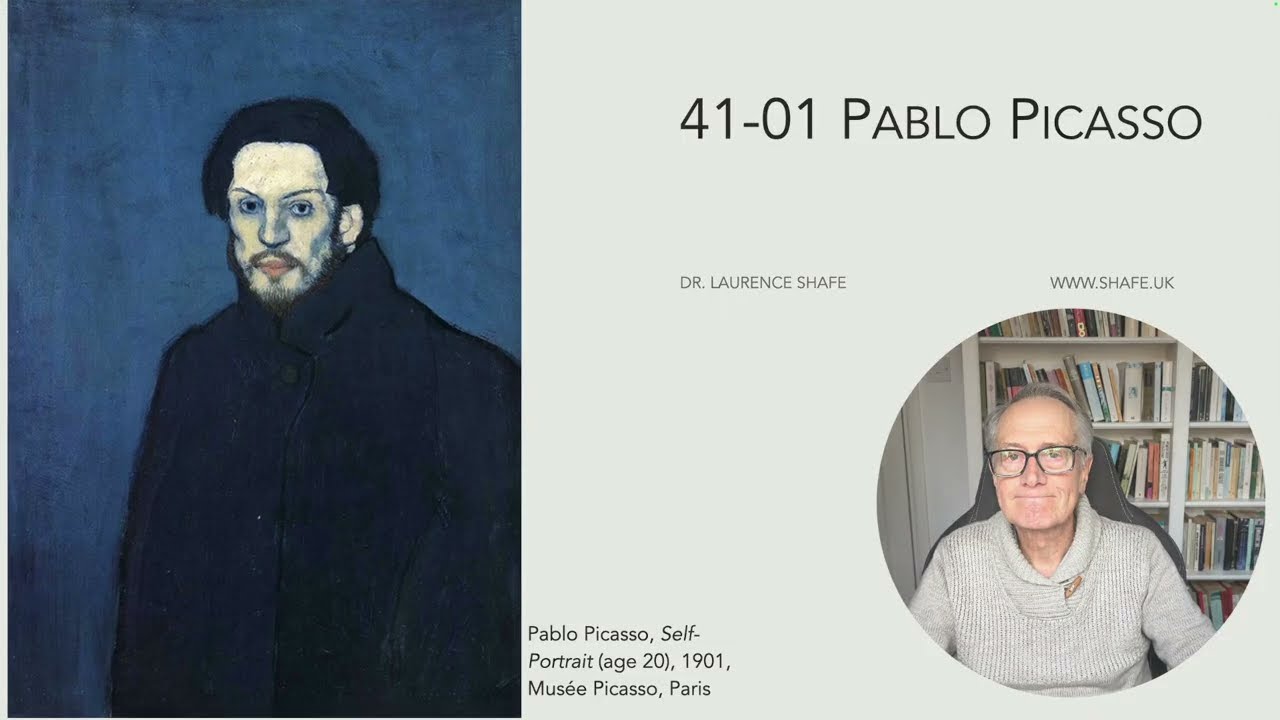
Pablo Picasso. The name itself is synonymous with 20th-century art, a monolithic figure whose career spanned nearly 80 years and produced an estimated 50,000 works. He is the legend, the revolutionary, the name his own mother said he would make famous, no matter his profession.
But the myth often obscures the man, flattening a complex life into a series of stylistic innovations. The true story of his work is a study in contradiction: a constant battle between technical mastery and raw emotion, between public revolution and intensely private life. To understand the artist, we must look past the gallery walls and into the moments of grief, passion, and fury that forged his most iconic works.
——————————————————————————–
1. He Mastered Realism by 15, Then Spent 75 Years Trying to Paint Like a Child
Picasso’s journey into radical abstraction wasn’t born from a lack of traditional skill; it was a deliberate rejection of a mastery he had already achieved as a teenager. His father, an art teacher, recognized his son’s prodigious talent early on. By age 13, Picasso’s abilities had so surpassed his father’s that the elder man reportedly handed his son his own palette and brushes and vowed never to paint again.
His academic prowess was just as stunning. When applying to Barcelona’s prestigious La Lonja School of Art, he completed the month-long entrance examination in a single day. He was immediately admitted to the advanced classes, where critics noted he could already paint like Raphael. This mastery set the stage for the defining paradox of his life, a sentiment he famously summarized: “It took me four years to paint like Raphael, but a lifetime to paint like a child.” This confession is the key to his entire career. He had to completely master tradition before he could spend a lifetime learning how to destroy it, all in a relentless quest to rediscover the raw, unfiltered creative freedom of a child’s perspective.
——————————————————————————–
2. The “Blue Period” Wasn’t Just an Aesthetic—It Was Born from Grief and Poverty
The haunting, monochromatic sadness of Picasso’s Blue Period (1901-1904) was far more than a stylistic choice. It was a direct and devastating emotional response to the suicide of his close friend, Carles Casagemas. This tragedy plunged the young artist into a state of depression and poverty that defined his work for years.
Living in squalor in Paris and Barcelona, Picasso was so poor that he was forced to burn his own drawings just to stay warm. The cold, melancholic blue that dominates these canvases was a reflection of his internal and external reality. The period’s masterpiece, La Vie (1903), contains a hidden, psychologically fraught testament to this grief. X-rays reveal that the main male figure was originally a self-portrait, but Picasso painted over his own face with that of Casagemas. Standing across from him is a woman named Germaine—the very lover whose rejection had precipitated Casagemas’s suicide. The painting is not just a tribute, but a haunting confrontation with the entire tragedy, powerfully demonstrating how art can transform personal suffering into something profound and enduring.
——————————————————————————–
3. The Painting That Ignited a Revolution Was Hidden for 9 Years Because His Friends Hated It
Today, Les Demoiselles d’Avignon (1907) is hailed as the work that “changed everything,” a single canvas that demolished 500 years of Western painting conventions. But at its creation, it was so radical that it was met not with acclaim, but with horror.
When Picasso first revealed the painting—which he privately called “mon bordel” (my brothel)—his closest friends and fellow avant-garde artists were appalled. Henri Matisse, his great rival, considered it a “bad joke.” Because of this universally hostile reception, the groundbreaking work was not publicly exhibited until 1916, nine years after it was finished. For nearly a decade, one of the 20th century’s most significant breakthroughs was a private failure. Yet the story doesn’t end there. Georges Braque, who initially hated the painting, found himself unable to forget it. He studied it obsessively, and the artistic dialogue that followed between him and Picasso gave birth to Cubism. The painting’s first and harshest critic became its most important convert, co-founding a revolutionary movement on its principles—a testament to a vision so radical it had to create its own disciples.
——————————————————————————–
4. His Political Masterpiece, Guernica, Was an Act of Rapid-Response Journalism
The monumental anti-war painting Guernica (1937) was not a long-planned work. It was an immediate and furious artistic response to a current event. On April 26, 1937, Nazi warplanes bombed the Basque town of Guernica. Picasso read a searing eyewitness account in the newspaper and was moved to action.
Abandoning his existing plans for a mural for the Spanish Pavilion at the Paris World’s Fair, he began work on the massive canvas, stretching over 11 feet tall and 25 feet wide. The timeline was staggering: he started on May 1st and completed the painting by June 4th. This act of rapid creation cemented the painting’s famous anecdote: when a German officer visiting his Paris studio saw a photograph of the work and asked, “Did you do that?” Picasso replied, “No, you did.” His intent was clear, driven by his belief that “Painting is not done to decorate apartments, it is an instrument of war.” Guernica stands as one of history’s most powerful examples of art as a political weapon, a visceral cry against brutality forged in the heat of the moment.
——————————————————————————–
5. His Most Abstract Works Were Secret Declarations of Love
While Picasso’s Cubist works are often seen as purely intellectual experiments, many were deeply personal. The painting Ma Jolie (1911-12) represents the zenith of Analytical Cubism, a complex web of fractured planes where the human figure is almost completely dissolved. It was created at the movement’s most abstract and difficult moment, just months before Picasso and Braque would reintroduce recognizable elements through collage.
Yet, inscribed on this nearly impenetrable canvas are the words “Ma Jolie,” which means “My Pretty One.” This was not just the title of a popular song; it was Picasso’s personal nickname for his new lover, Eva Gouel. By embedding this intimate phrase into the work, he grounds the radical abstraction in a specific, emotional reality. The painting is a declaration of love encoded in a revolutionary artistic language. This hidden detail provides a new, deeply human lens for his most intellectually challenging works, revealing the passionate man who existed within the formal innovator, even at his most remote.
——————————————————————————–
Conclusion: Art Forged by Life
Behind the monolithic legend of Picasso was a complex man whose art was not created in a vacuum but forged in the fire of lived experience. His greatest innovations were inseparable from love, grief, political outrage, and a relentless paradox: the need to destroy the perfect technique he possessed in order to express a more profound human truth. The final question, then, is not about the art, but about us: how does knowing the human story behind a masterpiece change the way we see it?