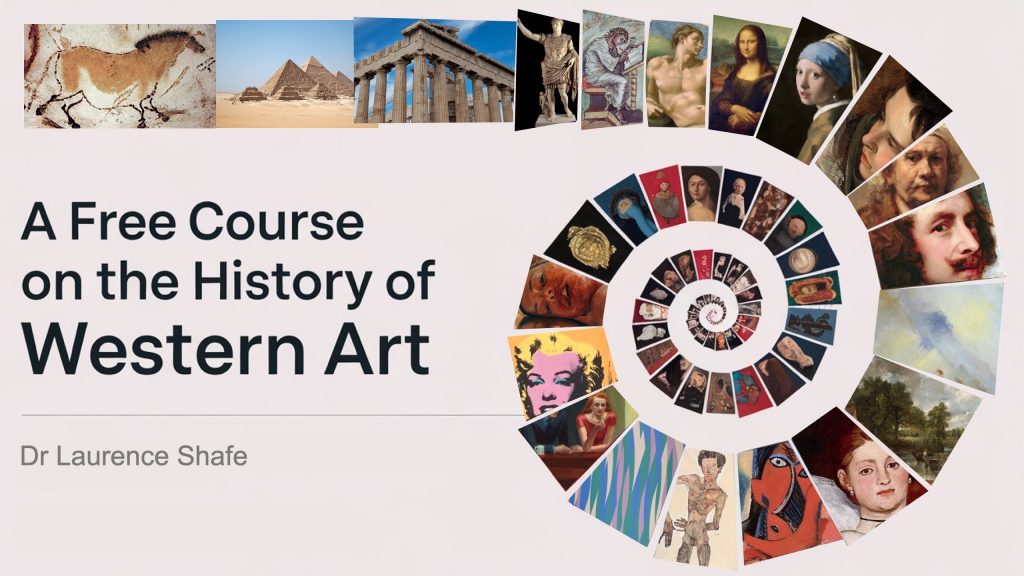
Modernism in art was not a single style but a sustained cultural project running from approximately 1860 to 1970, united by the conviction that traditional forms of representation, inherited conventions, and the established relationship between art and its audience had all to be questioned and, where necessary, abandoned. Beginning with the Impressionists’ challenge to academic painting and accelerating through Cubism, Abstraction, Dadaism, and Surrealism, modernism progressively dismantled the visual language that European art had developed since the Renaissance. It was driven by intellectual currents — Freudian psychology, Marxist social theory, Einsteinian physics — that together suggested that the stable, orderly world that traditional art had depicted was a fiction. Art had to reflect a reality that was fragmented, subjective, and in constant motion. The result was an art of extraordinary diversity and creative ambition that transformed not only painting and sculpture but architecture, design, film, and music.
What Was Modernism — And When Did It Begin? Modernism is most usefully understood not as a style but as a set of attitudes: a rejection of tradition for its own sake, a commitment to formal experiment, a belief that art must respond to the conditions of modern life rather than offering escapist consolation. Its beginnings are variously dated to Manet’s scandalous Olympia (1865), Cézanne’s structural experiments of the 1880s, or the eruption of Cubism around 1907. All of these were moments of rupture — of art deliberately breaking with what had come before.
The Impact of New Technologies: Modernist art emerged alongside the technologies that transformed modern life: the railway, electricity, the telephone, the aeroplane, cinema. These new speeds and new distances changed how people experienced the world — and art had to change too. Futurists painted the dynamism of machines; Cubists fragmented objects as if seen simultaneously from multiple viewpoints; filmmakers discovered that moving images could create entirely new kinds of narrative time.
Cézanne — The Father of Modernism: Paul Cézanne (1839–1906) is the figure to whom almost every subsequent modernist movement traced its origins. His insistence on “treating nature by the cylinder, the sphere, and the cone” — reducing perceived reality to its underlying geometric structures — pointed the way to Cubism. His equal insistence on the reality of the picture surface, rather than the illusion of depth, pointed the way to abstraction. For Picasso, Matisse, and Braque, Cézanne was simply “the father of us all.”
The Shock of the New — Audiences and Incomprehension: One of the defining features of modernism was the scandal it provoked. The Impressionist exhibitions of the 1870s were greeted with ridicule; the Armory Show of 1913 that brought European modernism to America caused genuine public outrage; Stravinsky’s Rite of Spring provoked a riot at its premiere. This pattern of provocation and rejection became almost a badge of authenticity for modernist artists: incomprehension by the majority was taken as evidence of genuine originality.
Abstraction — The Logical Conclusion: If art was not obliged to represent the visible world, what else could it do? By 1910, Kandinsky, Mondrian, and Malevich had each independently arrived at a fully non-objective art — painting that referred to nothing outside itself. Kandinsky’s early abstractions used colour and line to evoke musical experience; Mondrian reduced painting to primary colours and right angles; Malevich created a Suprematism of pure geometric form. All argued that abstract art could reach deeper truths than representation ever could.
The Death of Modernism — Or Its Transformation: By the 1960s, critics were beginning to detect signs of exhaustion in the modernist project. Pop Art, Minimalism, and Conceptual Art each represented a reaction against the high seriousness and formal purity of modernist abstraction. Postmodernism, emerging in the 1970s and 1980s, rejected modernism’s faith in progress and originality, embracing instead quotation, irony, and the mixing of high and popular culture. Whether this represented the end of modernism or simply its next phase remains one of the most debated questions in contemporary art.
38-01 The 20th Century British Nude
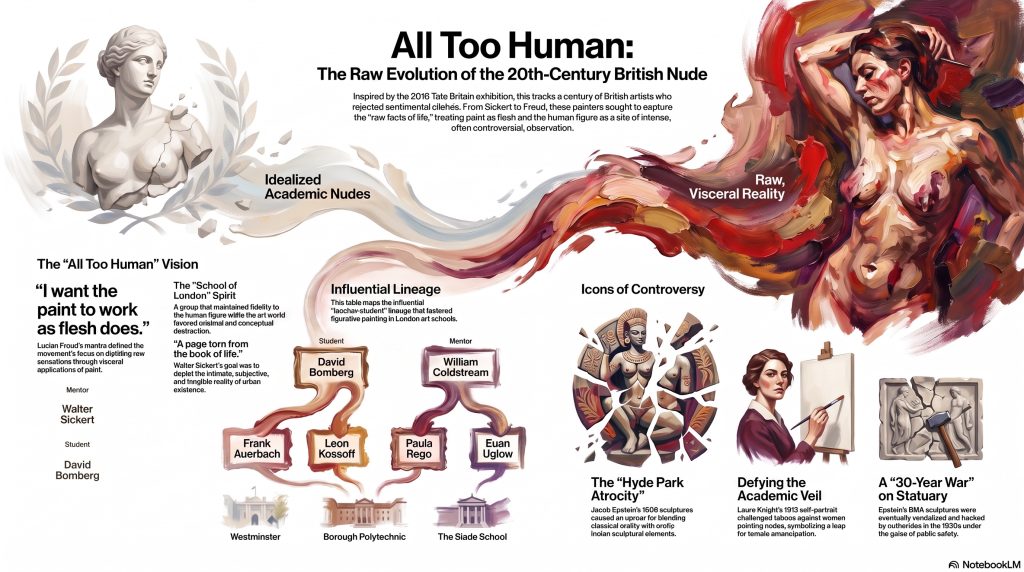
I provide an overview of 20th-century British figurative art, specifically focusing on the evolution of the nude and the “School of London.” The talk is loosely based on an exhibition called “All Too Human,” which highlights how artists like Lucian Freud and Francis Bacon rejected abstract trends to capture the raw, visceral reality of the human form. Key historical figures such as Walter Sickert are featured for their role in moving away from idealized academic nudes toward gritty, intimate, and often controversial depictions of everyday life. I also detail the public outcry surrounding Jacob Epstein’s early modern sculptures, illustrating the tension between traditional sensibilities and the emerging modern aesthetic. By examining a diverse group of painters and sculptors, the talk traces a lineage of intense observation and expressive paint handling that defined a century of British art. The artists sought to portray the tangible reality of existence without sentimentality.
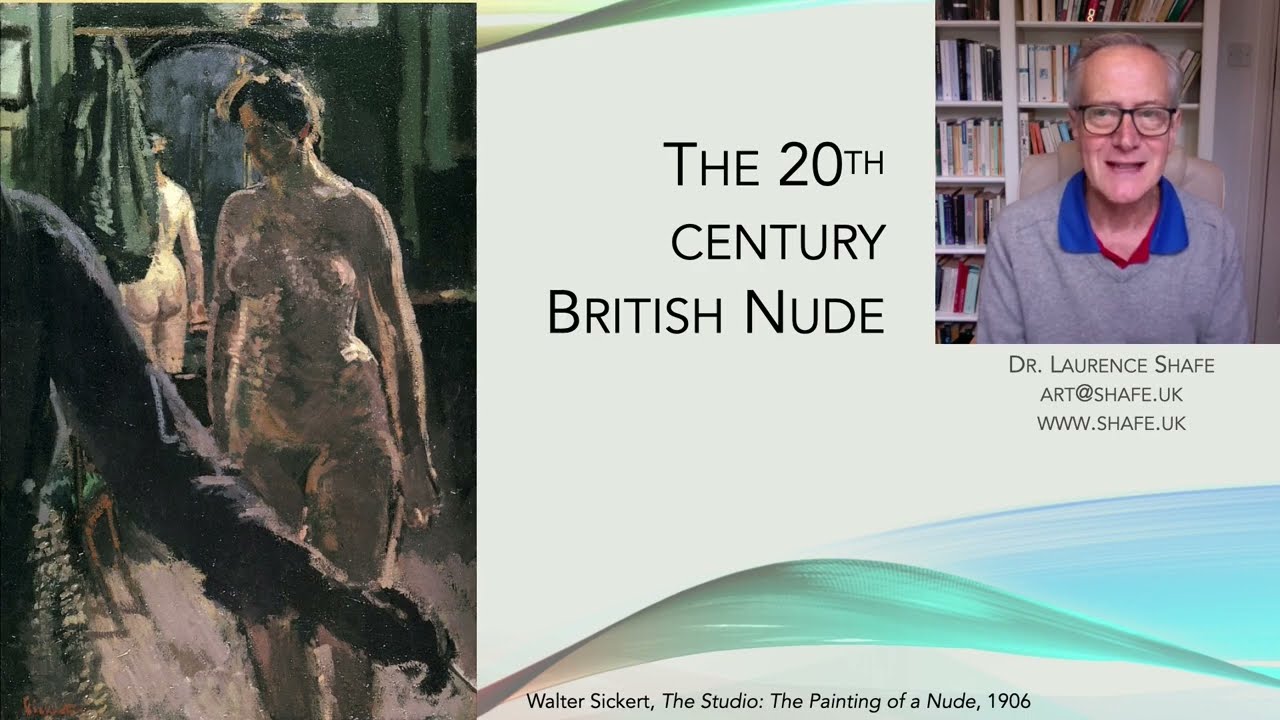
My notes on the 20th Century British Nude
A conversation produced by Gemini Notebook based on my notes:
1. Introduction: Beyond the Academic Veil
We are often conditioned to view art through a sanitizing “academic veil,” treating the masterpiece as a distant, decorative luxury designed to harmonize with a drawing room’s décor. This polite distance, however, is an insult to the visceral spirit of 20th-century British figuration. For the artists later grouped under the banner of the “School of London”—a term coined by R.B. Kitaj in 1976 to describe those who maintained a fierce fidelity to the human form while the world pivoted toward abstraction—art was an unapologetic confrontation with the “raw facts of life.”
The 2018 Tate Britain exhibition, All Too Human: Bacon, Freud and a Century of Painting Life, served as a powerful reminder that British art is not merely a record of aesthetics, but a repository of startling, often counter-intuitive human dramas. To truly understand these works, we must look past the paint to the “all-too-human” shadows of their creators, uncovering the scandals, frauds, and dark obsessions that fueled their drive to capture the tangible reality of existence.
2. The Murder in the Studio: Walter Sickert’s Dark Obsessions
Walter Sickert, a “painter’s painter” whose career spanned the Victorian and Modern eras, famously sought to portray the “sensation of a page torn from the book of life.” To achieve this, he rejected the idealized, vacuous nudes of the academy, preferring the grimy reality of cheap bedrooms in North London.
In 1907, the “Camden Town Murder”—the brutal slaying of a prostitute named Emily Dimmock at Agar Grove—provided Sickert with the ultimate narrative fuel. He used the tragedy to “bamboozle” historians and challenge what he termed the “artistic and intellectual bankruptcy” of sentimental art. Sickert produced a series of works featuring a clothed man and a naked woman, often titling them The Camden Town Murder to court controversy and “prurient sensationalism” in the press. Yet, with a theatricality typical of his actor’s background, he would frequently change titles; one such “murder” scene was also exhibited as What Shall We Do for the Rent?, shifting the narrative from violence to the quiet melancholy of poverty.
Sickert’s obsession with urban darkness led to sensationalist claims linking him to the Jack the Ripper murders of 1888. While the Oxford Dictionary of National Biography dismisses these as “fantasy,” the claims gained traction through figures like Joseph Gorman, who purported to be Sickert’s illegitimate son (before later admitting he lied), and novelist Patricia Cornwell. Whether or not he walked the Ripper’s path, Sickert’s philosophy was clear:
“The plastic arts are gross arts, dealing joyously with gross material facts.”
By utilizing unconventional cropping and intimate, grimy settings, Sickert transformed the British nude from a dry exercise into a haunting drama of working-class reality.
3. A Monument to Vandalism: Jacob Epstein’s 30-Year War
While Sickert was exploring the shadows of Camden Town, Jacob Epstein was launching a “thirty-year war” against British public morality. In 1908, he received a commission for 18 large nude sculptures for the British Medical Association on The Strand. The public reaction was a literal “gasp of horror.” The scandal was twofold: the figures were deemed too sexually explicit for Edwardian sensibilities, and the work was a jarring injection of Modernism influenced by classical Indian sculpture.
The Evening Standard warned that no “careful father” should allow his daughter or fiancée to see such statuary. This stripping away of the “academic veil” resulted in a tragic climax decades later. In the 1930s, under the guise of public safety following the fall of a small piece of masonry, authorities hacked off all the protruding pieces of the figures. This “monument to vandalism” remains on the building today, a scarred reminder of British iconoclasm.
Epstein faced similar vitriol for his Rima memorial in Hyde Park, which the Morning Post branded the “Hyde Park Atrocity” and “Mr. Epstein’s nightmare in stone.” Reflecting on the chaos his work incited, Epstein noted: “Perhaps this was the first time in London that a decoration was not purely ‘decorative’.”
4. Defying the Casts: Laura Knight and the Taboo of Life Painting
In 1913, Laura Knight produced Self-Portrait with Nude, a virtuoso statement of defiance that targeted the institutional sexism of the art world. For decades, the ability of women to acquire a “thorough knowledge of the figure” was systematically crippled. Edward Poynter, the first principal of the Slade, explicitly stated in his 1871 inaugural address that female students were “debarred” from the same study of the model open to men. At best, women were restricted to the study of the “half-draped model” or, as Knight deeply resented, inanimate plaster casts.
By painting herself at the easel with a live, naked model (the artist Ella Naper), Knight committed a radical political act. The Daily Telegraph dismissed the work as “vulgar,” suggesting it “might quite appropriately have stayed in the artist’s studio.” This was more than an aesthetic critique; it was an attempt to push women’s perspectives back into the private sphere. Knight persisted, eventually becoming the first woman elected as a Royal Academician since 1768. Today, the painting stands as a pivotal symbol of female emancipation, reclaiming the right of the female gaze to study the “gross material facts” of life.
5. The Fraudulent Muse: The Bizarre Triangle of Stanley Spencer
Stanley Spencer, a visionary who saw life “violently and strangely,” produced some of the most hauntingly objective portraits of the century. His 1937 Double Nude Portrait: The Artist and his Second Wife is an exercise in what critics call “abrasive, anti-sentimentalising objectivity.”
The personal reality behind the canvas was a bizarre triangle of fraud and frustration. Spencer’s muse and second wife, Patricia Preece, was a lesbian whose devotion remained with her lifelong partner, Dorothy Hepworth. In a stunningly counter-intuitive move, Preece went on her “honeymoon” with Hepworth, leaving Spencer alone.
The investigative reality reveals a deeper art-world fraud: Preece, the more sociable of the two, signed many of the shy Hepworth’s superior paintings and sold them as her own to negotiate her financial survival. This deception continued even after Preece’s death, with Hepworth’s works still being exhibited under Preece’s name. In Spencer’s Double Nude, the presence of an “uncooked leg of mutton” signifies the bleak, physical nature of sex and the utter indifference of his muse. It is a portrait not of love, but of the raw, unappetizing reality of a failing marriage.
6. The Sins of the Artist: Eric Gill’s Dark Legacy
The history of British art is often punctuated by public iconoclasm, as seen in the treatment of Epstein’s work and, more recently, the legacy of Eric Gill. Gill’s influence was ubiquitous; his typefaces like Gill Sans were adopted by the BBC, Penguin Books, and British Railways. His sculpture Prospero and Ariel has stood as a spirit of the air over the entrance to the BBC’s Broadcasting House since 1932.
However, the 1989 biography by Fiona MacCarthy shattered the “academic veil” surrounding Gill, revealing him as a child rapist who sexually abused his daughters and even the family dog. This revelation turned his “joyous” eroticism into something stomach-turning for the modern viewer. The tension culminated in 2022 when a protester spent four hours attacking the Prospero and Ariel sculpture with a hammer. As a historian, one must synthesize these physical attacks on art—from the BMA building to the BBC—as a recurring dialogue on British morality. We are left with the haunting question: To what extent do the sins of the artist render their art unviewable?
7. Conclusion: The Flesh and the Paint
The trajectory of 20th-century British art was defined by a movement away from the “decorative” toward a “tangible reality of life.” By rejecting sentimentality, these artists sought to capture a “page torn from the book of life,” regardless of the cost to their reputations or the comfort of their audiences. They sought an art that was sculptural, visceral, and unyieldingly honest.
As Lucian Freud famously remarked:
“I want the paint to work as flesh does.”
When we look at these masterpieces today, we are forced to confront a final, unsettling truth. Are we seeing the subject on the canvas, or are we looking into the deep, often shadowed, and “all-too-human” realities of the creators themselves? In the end, the paint and the person are inseparable.
38-02 Modernism – Picasso 1932
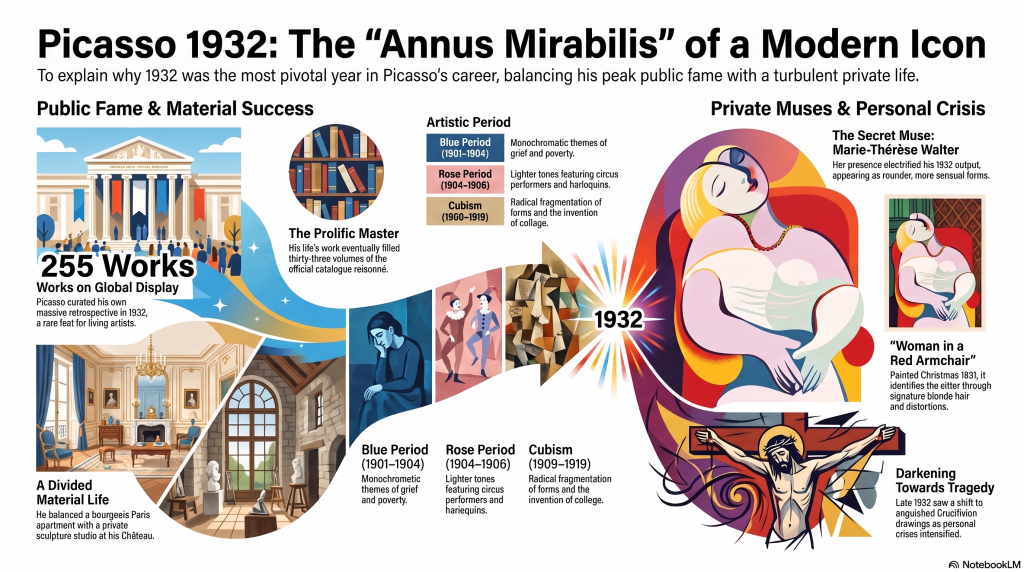
This talk examines Picasso’s remarkable year of 1932, when he turned fifty, staged his own retrospective, and produced some of his most psychologically charged work. Driven by a secret affair with the teenage Marie-Thérèse Walter, his output moved between sensual exuberance and surrealist darkness. The talk traces his Cubist evolution, his divided domestic life between wife Olga Khokhlova and his hidden lover, and the Boisgeloup sculptures that captured Walter’s form. As Europe moved towards catastrophe, personal crisis deepened into lamentation, prefiguring the anguish of Guernica five years later.
(My YouTube talk will be published on 19 June 2027)
An entertaining conversation about Picasso 1932 created by Google NotebookLM from my notes:
Most of us know Picasso as an icon. Fewer of us know the strange, turbulent machinery behind his greatest work. In 1932, he turned fifty, staged his own retrospective, and produced paintings of almost unbearable psychological intensity — all while conducting a secret affair, managing a crumbling marriage, and watching Europe drift toward catastrophe. Here are the most surprising truths from that extraordinary year.
He Met His Greatest Muse Outside a Department Store — and She’d Never Heard of Him
In 1927, Picasso approached seventeen-year-old Marie-Thérèse Walter outside the Galeries Lafayette in Paris. She was athletic, non-intellectual, and completely indifferent to his fame. He had to point to his name in a newspaper to prove he existed. She remained unmoved by his art. That indifference, apparently, was the point. Their secret affair lasted eight years before anyone knew.
He Deliberately Kept Chaos One Floor Above Respectability
Picasso maintained a spotless bourgeois apartment on the rue La Boétie — controlled entirely by his wife Olga. His response? He rented the identical apartment directly above it as a studio and turned it into total disorder. Order and anarchy, separated by one ceiling.
His Own Retrospective Was a Provocation, Not a Celebration
When asked how he would curate his own show, Picasso replied: “Badly.” He mixed works from different decades, removed all dates, and scattered his newest 1932 paintings throughout — as if to insist that everything he’d ever made was equally alive right now. Then, when fashionable Paris gathered for the opening in evening gowns and tails, Picasso went to the cinema.
“If 1932 began for Picasso under the sign of love, it ended with a premonition of tragedies to come.” — Tate exhibition notes
A Psychiatrist Diagnosed Him Schizophrenic Based Solely on His Paintings
After the retrospective travelled to Zurich, Carl Gustav Jung attended and published a review suggesting Picasso showed signs of schizophrenia because his pictures revealed “alienation from feeling.” The diagnosis reveals rather more about Jung’s anxiety than Picasso’s psychology. Commercially, the show was a total failure: no sales in Paris, one in Zurich.
The Drowning Paintings Foreshadowed Guernica
Late in 1932, Marie-Thérèse contracted a serious infection after swimming in the sewage-contaminated river Marne. She lost her famous blonde hair and spent seven months hospitalised. Picasso responded with a series of anguished drowning images — contorted, screaming figures that would reappear, almost unchanged, in Guernica four years later as symbols of civilian agony.
His Most Celebrated Painting Sold for $150 Million — and No Reproduction Does It Justice
The Dream, painted on 24 January 1932, was built up with a palette knife, its wallpaper thick and vibrating. Scholar T.J. Clark argued that in Marie-Thérèse, Picasso found “a licence to risk everything.” The painting sold in 2013 for $150 million. Those who have stood before it say the same thing: you must see it in person.
The road from those luminous, sensual nudes of early 1932 to the weeping women of 1937 begins precisely in this single year. Which raises a question worth sitting with: can a life lived in deliberate contradiction — between comfort and transgression, between tenderness and possession — actually be the source of the work, rather than its obstacle?
38-03 Auguste Rodin
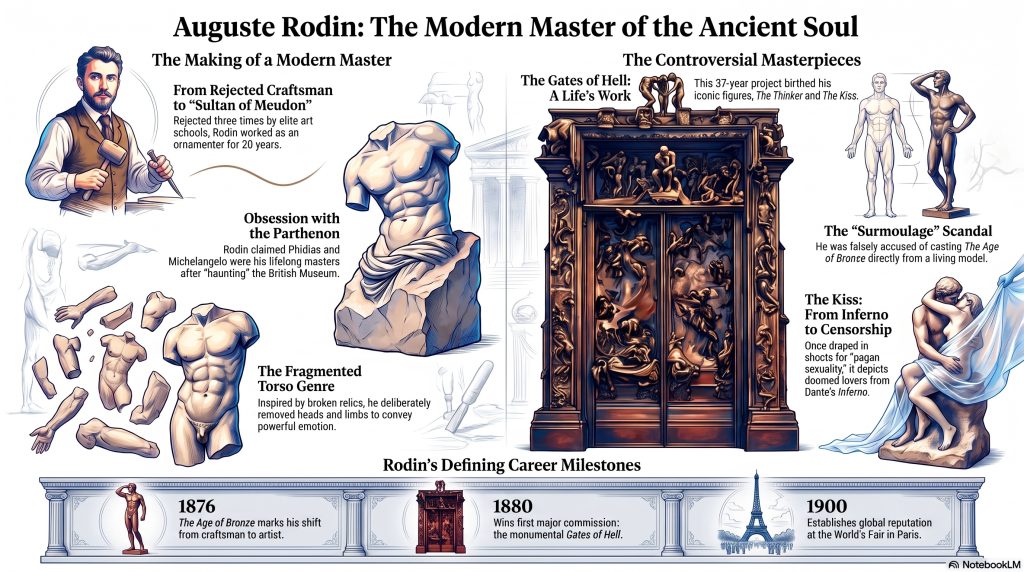
The talk details the life and artistic evolution of the renowned sculptor Auguste Rodin, focusing on his transition from a struggling craftsman to a master of modern art. Deeply influenced by Michelangelo and the classical relics of Ancient Greece, Rodin developed a signature style that emphasized the raw emotional power of the human form, often through intentionally fragmented or unfinished figures. The talk highlights his most iconic masterpieces, such as The Thinker and The Kiss, noting that many began as smaller components of his monumental, lifelong project, The Gates of Hell. Beyond his professional achievements, the narrative explores his tumultuous personal life, including his long-term partner Rose Beuret and his complex, creative bond with Camille Claudel. Despite facing early rejection and later public controversy over the sensual nature of his work, Rodin is celebrated today for revolutionizing sculpture and bridging the gap between traditional and abstract forms. It is a look at the historical significance and enduring legacy of an artist who fundamentally redefined sculptural expression.
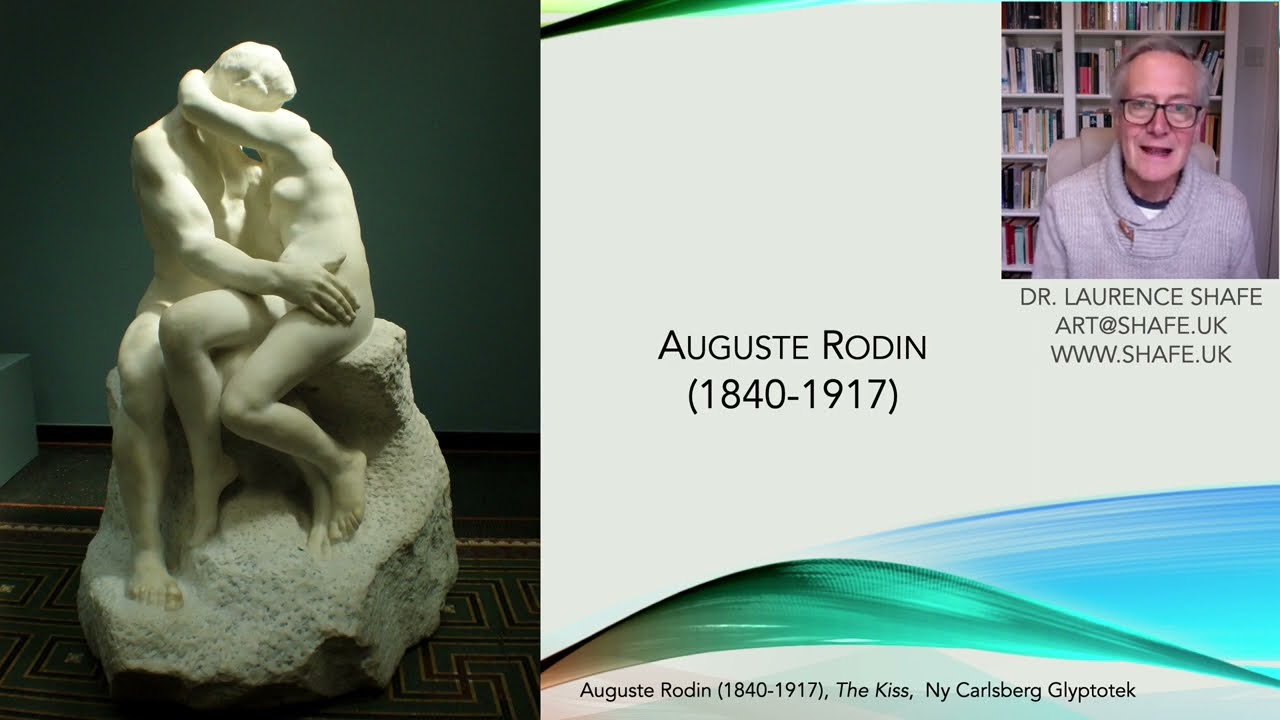
My notes on 38-03 Auguste Rodin
An interesting conversation on Auguste Rodin created by Google Notebook from my notes.
The Artist Who Nearly Never Was
Today, Auguste Rodin is draped in the heavy velvet of “Old Master” status, yet his career began in a state of absolute academic heresy. He was a man forged in the fires of rejection, a “late starter” whose primary education in the arts was the bitter sting of exclusion. Three times, he auditioned for the prestigious École des Beaux-Arts; three times, the gatekeepers of Parisian neoclassicism slammed the door, their refined tastes offended by a style that did not yet exist.
Consequently, Rodin spent twenty long years—the peak of most men’s artistic vigor—relegated to the shadows of the trade. He was a mere craftsman, an ornamenter who spent his days modeling staircase embellishments and mass-produced door decor. It was not until he reached the age of 40 that he finally clawed his way toward a major commission. This era of manual labor as a tradesman, rather than an academic darling, arguably saved him; it allowed him to develop a muscular, tactile understanding of material that no classroom could replicate.
1. The Scandal of the “Too Real” Body
In 1877, Rodin emerged from obscurity with The Age of Bronze, a work of such terrifying vitality that it nearly ended his career in the cradle. The sculpture—a life-size male figure modeled on a Belgian soldier—possessed an anatomical precision so uncanny that critics immediately cried foul. They accused Rodin of surmoulage: the ultimate artistic sin of taking a cast directly from a living model.
This accusation of cheating was a backhanded compliment that Rodin found intolerable. To prove his technical mastery and dispel the scandal, he committed to a radical pivot in methodology, ensuring his subsequent works were either deliberately smaller or much larger than life-size. This defensive maneuver led to a creative liberation. Reflecting on this seismic shift away from the rigid standards of the Salon, he noted, “It is Michelangelo who has freed me from academic sculpture,” specifically citing the influence of the Renaissance master’s Dying Slave.
2. Why He Purposely Broke His Statues
Rodin’s aesthetic was defined by a haunting obsession with the Parthenon. During his frequent escapes to London, he admitted, “In my spare time I simply haunt the British Museum,” studying the Phidias masterpieces with religious fervor. He was captivated by how these ancient Greek fragments, though weathered and broken over millennia, maintained an overwhelming expressive power through the body alone.
Rodin performed an act of sculptural violence by taking “damage” and turning it into a deliberate genre. He began to aggressively remove heads and limbs from his own completed figures to create the “headless, limbless torso.” He viewed anatomy as architecture; the iliac crest—that pronounced muscle at the top of the groin—functioned as the “architrave of the body,” separating the structure of the torso from the thighs. By elevating the fragment to a finished state, he proved that a torso alone could speak with more profound emotional volume than a complete, polished figure.
3. Masterpieces Born from the “Gates of Hell”
The public often views The Thinker and The Kiss as standalone icons, but they were actually accidental spin-offs. They were originally conceived as small, subordinate figures for a single, colossal commission: The Gates of Hell. Inspired by Dante’s Inferno, the portal was intended for a decorative arts museum that was never built. Rodin labored over it for the rest of his life, populating the gates with 186 figures that would eventually be enlarged and isolated.
The romanticized myth of The Kiss is particularly ironic given its origin. Far from a tribute to love, it depicts the doomed Paolo and Francesca at the moment just before they are murdered for their adultery. Its history is steeped in scandal; when a marble version was displayed in Lewes Town Hall in 1913, it was so offensive to local sensibilities that it was draped with a sheet and surrounded by railings to shield the public from its “pagan sexuality.” Similarly, the iconic Thinker was originally titled “The Poet,” intended to represent Dante himself. Its current name was a casual designation by foundry workers who noticed its resemblance to a Michelangelo statue nicknamed Il Penseroso (The Thoughtful One).
4. The “Sultan of Meudon” and His Stormy Muses
As his fame peaked around 1900, Rodin’s country estate became the center of a chaotic, erotic court. Known as the “Sultan of Meudon,” he was besieged by a deluge of women—dancers, models, and socialites—begging to be his muse. Among them was the Welsh artist Gwen John, whose overwhelming passion resulted in over 1,000 letters to the sculptor.
Rodin’s life was a permanent “double life.” He maintained a lifelong partnership with Rose Beuret, the seamstress who stayed with him through his lean decades, yet he engaged in a stormy, tragic liaison with the brilliant Camille Claudel. While his relationship with Claudel ended in her institutionalization, his domestic letters to Beuret remained unexpectedly tender: “I think of how much you must have loved me to put up with my caprices… I remain, in all tenderness, your Rodin.”
Yet, there was an extreme and disturbing edge to his work during this era. Critics like Waldemar Januszczak have pointed to the “melodrama” of works like Iris, a headless female who contorts herself to offer a crudely detailed view of her anatomy. This was Rodin at his most subversive, producing 7,000 drawings of models in uninhibited, often masturbatory poses, relentlessly exploring the female form.
5. The Paradox of Authenticity
Rodin’s legacy is rooted in a “sense of incompletion” that directly paved the way for 20th-century abstraction. However, this legacy raises a thorny question regarding the nature of a “genuine” Rodin. Throughout his career, he modeled almost exclusively in clay. He was rarely seen with a hammer and chisel; the final, prestigious marble statues were carved by professional stone carvers, and the bronzes were cast by foundries.
The famous versions of The Kiss on display in global museums are often plasters taken from marbles that Rodin himself never actually carved. This forces us to confront a provocative truth: if the artist’s hand never touched the final stone or bronze, where does the genius truly reside? In Rodin’s world, authenticity was not about the physical labor of the carving, but the primal, raw vision captured in the initial clay.
The Legacy of the Unfinished
In the end, Rodin’s true rebellion was his refusal to provide the public with a “finished” object. By leaving his work seemingly in transition—scarred, fragmented, and raw—he challenged the viewer to participate in the act of creation. Does the fact that he was a director rather than a carver diminish his status? Or was he the first modern artist to realize that the concept of the body, captured in its most contorted and “broken” state, is more real than any academic perfection? If Rodin’s genius lies in the vision rather than the chisel, then he did not just rewrite bronze; he rewrote the very definition of what it means to be an artist.Gemini Notebook can be inaccurate; please double-check its responses.