The Pre-Raphaelite Brotherhood was founded in 1848 by three young painters — Dante Gabriel Rossetti, John Everett Millais, and William Holman Hunt — in explicit rebellion against what they saw as the mechanical conventionality of painting since Raphael. Inspired by the intensity and spiritual sincerity of fifteenth-century Italian and Flemish painting, they adopted a technique of vivid colour applied to a wet white ground, creating a jewel-like luminosity entirely unlike the darker tonal painting of the Academy. Their subjects combined medieval romance, literary illustration, and religious imagery with a radical attentiveness to the natural world, their landscapes painted in almost obsessive botanical detail. Though the original Brotherhood dissolved by 1853, a second wave led by Rossetti and including Edward Burne-Jones and William Morris transformed the movement into a broader aesthetic project that encompassed painting, poetry, design, and what became the Arts and Crafts movement. Pre-Raphaelite painting remains among the most beloved and widely reproduced art of the nineteenth century.
The Brotherhood — A Youthful Rebellion Against the Academy: In 1848, Millais, Hunt, and Rossetti formed the Pre-Raphaelite Brotherhood, signing their works with the mysterious initials “PRB” and declaring war on what they called “the slosh” of conventional academic painting. They were young — Millais was only nineteen — and their manifesto was clear: return to truth, to nature, and to the spiritual intensity of art made before Raphael corrupted it with theatrical grandeur.
The Technique — White Ground and Jewel-like Colour: The Pre-Raphaelites developed a distinctive technique: painting in thin, vivid glazes over a white or near-white ground while the paint was still wet, achieving a luminosity unlike anything in contemporary British painting. The result was a peculiarly intense, enamel-like quality of colour — greens more brilliantly green, reds more richly red — that made their canvases instantly recognisable.
Millais — From Rebel to President of the Academy: John Everett Millais is one of the most paradoxical figures in British art. His early PRB works — Christ in the House of His Parents (1850), Ophelia (1852) — are among the most technically accomplished and emotionally intense paintings of the century. Yet by the 1870s he had moved towards a more commercially successful, less technically radical manner, becoming eventually President of the Royal Academy — the very institution he had once revolted against.
Rossetti and the Femme Fatale: Dante Gabriel Rossetti never exhibited publicly after the furore surrounding his early PRB works, but his studio paintings — erotic, languid images of thick-necked, heavy-lipped women — became some of the most influential images of the century. His models, beginning with Elizabeth Siddal and later Jane Morris, were presented as archetypes of a mysterious, dangerous female beauty that influenced Symbolism, Art Nouveau, and popular culture to this day.
Hunt’s Religious Intensity: William Holman Hunt remained truest to the Brotherhood’s original ideals of moral and spiritual sincerity. He made several journeys to Palestine to paint religious subjects with documentary accuracy, believing that art had a duty to convey spiritual truth with factual precision. His The Light of the World (1851–54), showing Christ knocking at a door overgrown with weeds, became one of the most widely reproduced images of the Victorian era.
Burne-Jones and the Second Wave: In the 1860s and 1870s, Rossetti’s influence produced a second generation of Pre-Raphaelite painters, of whom Edward Burne-Jones was the most gifted. Burne-Jones moved the movement away from its original realist impulse towards a world of Arthurian romance, classical myth, and languorous, otherworldly beauty that anticipated Symbolism and profoundly influenced Art Nouveau across Europe.
25-01 Pre-Raphaelite Brotherhood – Early Days
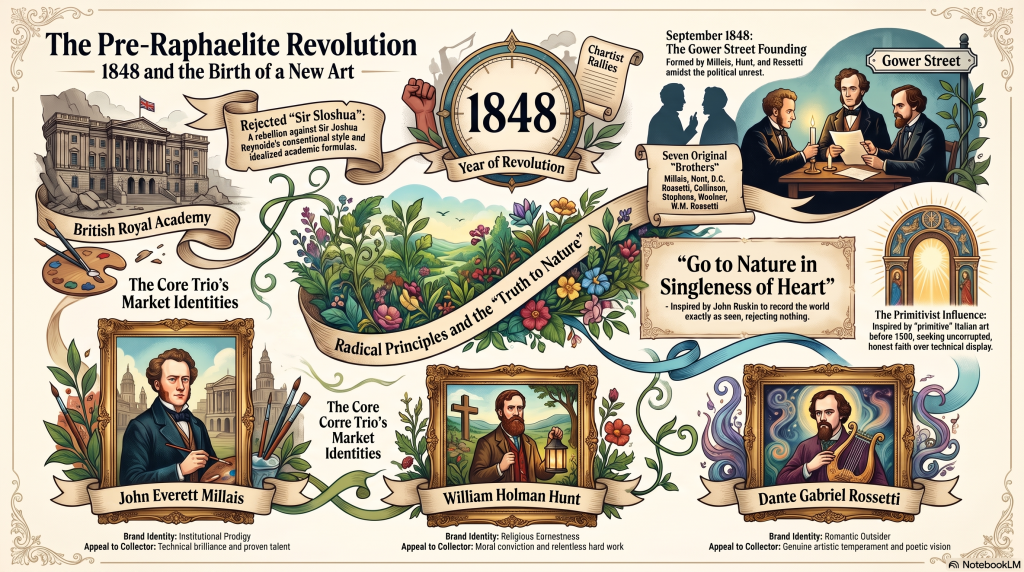
In September 1848, seven young artists formed the Pre-Raphaelite Brotherhood, determined to overthrow Royal Academy convention. Founded in the charged atmosphere of Chartist unrest, the Brotherhood — Millais, Holman Hunt, Rossetti, Woolner, Collinson, Stephens, and William Michael Rossetti — drew inspiration from Ruskin’s truth to nature, the Nazarenes, and Lasinio’s engravings of Gozzoli’s Pisan frescoes. Their early paintings, from Isabella to Christ in the House of His Parents, provoked furious critical reaction before Ruskin’s Times letters of 1851 secured their reputation, and works like Ophelia confirmed that their radical vision had permanently reshaped Victorian art.
(My YouTube talk will be published on 15 May 2027)
My notes on Pre-Raphaelite Brotherhood – Early Days
An entertaining conversation about Pre-Raphaelite Brotherhood – Early Days created by Google NotebookLM from my notes:
In 1848 — the year barricades went up across Europe — seven young artists met in a London townhouse and declared war on the art establishment. No cannons, no pamphlets. Just paint. The result reshaped British art for generations.
Here are the most surprising, counter-intuitive takeaways from the story of the Pre-Raphaelite Brotherhood.
They Were Born on the Same Day as a Near-Revolution
On 10 April 1848, Millais and Hunt stood at the edges of Kennington Common as tens of thousands of Chartists gathered, with cannon trained on the bridges and over 100,000 special constables deployed across London. Five months later, on an evening in early September, those same two artists founded the Pre-Raphaelite Brotherhood with Rossetti.
The word “Brotherhood” alone alarmed critics, who read into it a whiff of organised dissent. Revolutionary year. Revolutionary art. Revolutionary name.
Their Greatest Champion Had Never Met Them
John Ruskin — Victorian Britain’s most powerful critic — had no relationship with the Brotherhood when he wrote to The Times in May 1851 defending their work. He acknowledged their name was ill-conceived and their knowledge of early painting slight, but insisted their commitment to drawing what they actually saw redeemed them entirely.
“They may, as they gain experience, lay in our England the foundations of a school of art nobler than the world has seen for 300 years.”
That letter was decisive. Ruskin’s championing shaped how British collectors received them — all without a single studio visit.
Charles Dickens Was Their Harshest Critic
The same novelist celebrated for his compassion toward the poor savaged Millais’s Christ in the House of His Parents with extraordinary venom, describing the Virgin Mary as “horrible in her ugliness” and Christ as “hideous, wry-necked, blubbering.” The painting’s crime? Depicting the Holy Family as ordinary working people — dirty fingernails, muscular arms, unglamourised faces.
The critical consensus held that the most beautiful soul must have the most beautiful body. Millais disagreed, and the furore proved he had touched something real.
Their Most Radical Technique Was Simply Paying Attention
Millais spent five months painting Ophelia’s landscape on the banks of the Hogsmill River — eleven hours a day, six days a week — advancing each session by an area no larger than a five-shilling piece. By November he had a hut built beside the river to push through the snow.
The result was a flat tapestry where foreground and background receive identical weight. No atmospheric blur, no painterly hierarchy. Salvador Dalí, writing in 1936, recognised it immediately:
“How could Salvador Dalí fail to be dazzled by the flagrant surrealism of English Pre-Raphaelitism.”
They Were Commercially Shrewder Than They Appeared
Scholar Elizabeth Prettejohn has argued the Brotherhood’s diversity of persona was commercially astute: Millais projected institutional respectability, Hunt offered moral seriousness, and Rossetti played the volatile Romantic outsider. Together they covered the full spectrum of middle-class taste without competing directly against one another.
Each man sold not just paintings — but a convincing reason to buy.
The Brotherhood began as a secret society of seven. Within a decade it had drawn in Tennyson, Morris, Swinburne, and Christina Rossetti, expanding into poetry, design, and architecture. What started as rebellion became the dominant cultural tendency of the Victorian age.
The question worth sitting with: if genuine artistic revolution requires rejecting everything your teachers told you was beautiful — what are we still too polite to question today?
25-02 Pre-Raphaelite Brotherhood – Later
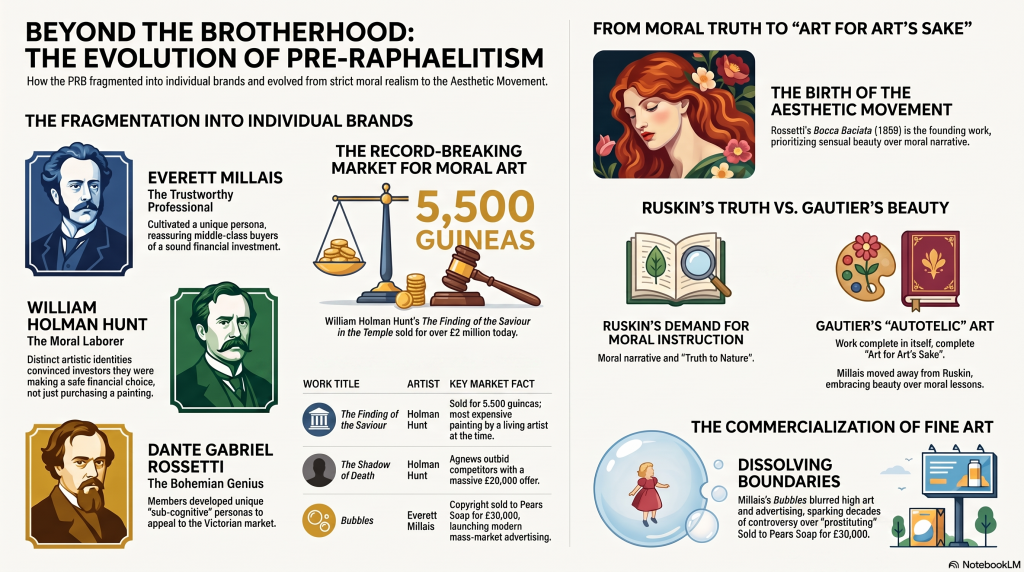
This lecture traces the Pre-Raphaelite Brotherhood’s later decades, following Millais, Hunt, Rossetti, Ford Madox Brown, and their associates as shared ideals fragmented into distinct careers. It examines Ruskin’s decisive critical championing and his damaging libel defeat by Whistler, then tracks each artist’s individual trajectory: Millais’s drift toward art for art’s sake, Hunt’s obsessive religious painting, Rossetti’s sensual femme fatale imagery. Broader figures including Brett, Hughes, Burne-Jones, Waterhouse, and Cowper show how Pre-Raphaelite methods persisted and evolved long after the Brotherhood dissolved, ultimately prompting questions about whether modernism’s dismissal of Victorian painting was ever genuinely justified.
(My YouTube talk will be published on 22 May 2027)
My notes on Pre-Raphaelite Brotherhood – Later
An entertaining conversation about Pre-Raphaelite Brotherhood – Later created by Google NotebookLM from my notes:
We think we know the Pre-Raphaelites: soulful women, medieval dreams, righteous moral purpose. But dig into their actual lives and the story gets stranger, messier, and far more interesting. Here are the most surprising truths hiding behind the luminous surfaces.
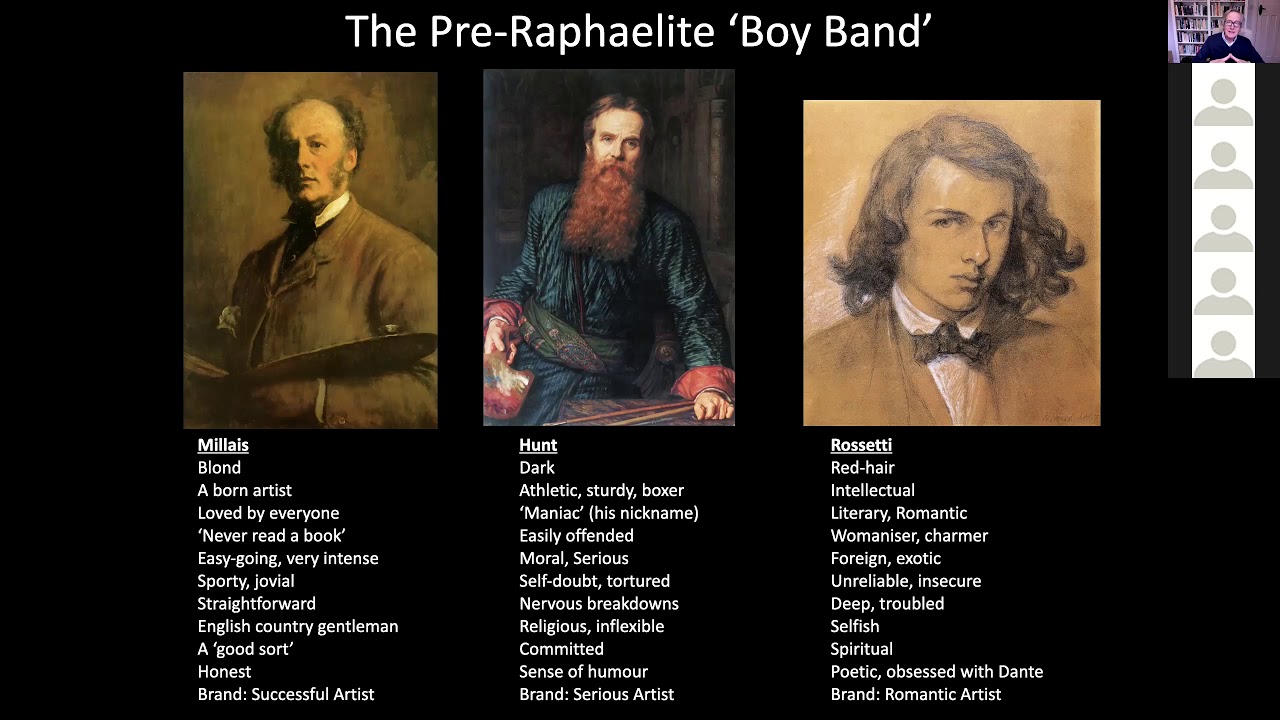
The Movement Was Basically a Boy Band — With Serious Branding Strategy
Each Brotherhood member cultivated a distinct personal brand aimed squarely at middle-class buyers. Millais projected trustworthy English respectability. Hunt sold moral seriousness and documented authenticity from Holy Land pilgrimages. Rossetti offered something else entirely: the irresistible myth of the genuine bohemian. Buyers weren’t just acquiring paintings — they were buying carefully constructed identities.
The Critic Who Made Them Nearly Destroyed Himself Defending Them
John Ruskin’s two 1851 letters to The Times were decisive for the Brotherhood’s acceptance. Yet his 1877 attack on Whistler — accusing him of “flinging a pot of paint in the public’s face” — backfired catastrophically. Whistler won the libel case. The damages awarded? One farthing. Whistler still went bankrupt within six months, but Ruskin’s reputation never fully recovered, and his mental health collapsed shortly after.
Millais Quietly Invented Advertising’s Greatest Controversy — A Century Early
When Thomas Barratt of Pears Soap acquired rights to Millais’s Bubbles and renamed it for a mass marketing campaign, the art world was scandalized. The novelist Marie Corelli attacked Millais for prostituting his talent. His defence was blunt: he’d sold the copyright.
“The art world was scandalised about this use of fine art and the argument continued into the twentieth century until Andy Warhol united fine art and mass marketing.”
The campaign also carried an explicit racial ideology, promoting soap as “the first step in lightening the white man’s burden” — making Bubbles as historically troubling as it is famous.
Hunt’s Most Ambitious Masterpiece Was Blamed on Demonic Interference
The Triumph of the Innocents occupied Hunt across three separate Holy Land trips spanning over a decade. The canvas buckled repeatedly, and Hunt genuinely suspected demonic forces were preventing its completion. He eventually painted an entire replica. He also married his deceased wife’s sister — then illegal under British canon law — causing a permanent family rupture. The novelist Evelyn Waugh descended from the same family.
The “Founding Work of the Aesthetic Movement” Was Painted for a Blacksmith’s Daughter
Bocca Baciata — widely regarded as the painting that launched the Aesthetic Movement — was modelled by Fanny Cornforth, born Sarah Cox, daughter of a blacksmith. She became Rossetti’s housekeeper and mistress. As both grew older, they affectionately called each other “Dear Elephant” and “Rhino.” The high-minded philosophy of art-for-art’s-sake had very human, unglamorous origins.
Ford Madox Brown May Have Invented Impressionism — In Hampstead, in the Cold
The critic R. A. M. Stevenson told Brown’s son-in-law:
“By God! the whole history of modern art begins with that picture. Corot, Manet, the Impressionists never did anything but imitate that picture.”
Brown painted Pretty Baa-Lambs entirely outdoors, capturing coloured shadows years before French Impressionism theorised them. He was so terrified of the 1853–54 cholera outbreak killing eleven thousand Londoners that he bathed every single day — extraordinarily unusual for the era.
“Modernity” May Simply Be Another Form of Imperialism
Frank Cadogan Cowper painted in the Pre-Raphaelite style with transparent glazes on a white ground until 1958 — over a century after the Brotherhood’s founding. Critics dismissed him as irrelevant. But scholar Tim Barringer draws a sharp parallel: modernism, like imperialism, colonises a territory, rewrites its history, and consigns everything prior to a static, finished past.
The Pre-Raphaelites were declared over. Then Warhol arrived. Then digital art collapsed every boundary again.
Which raises the real question: who gets to decide when a movement is finished — and why should we believe them?
25-03 The Pre-Raphaelites, 1840-1860
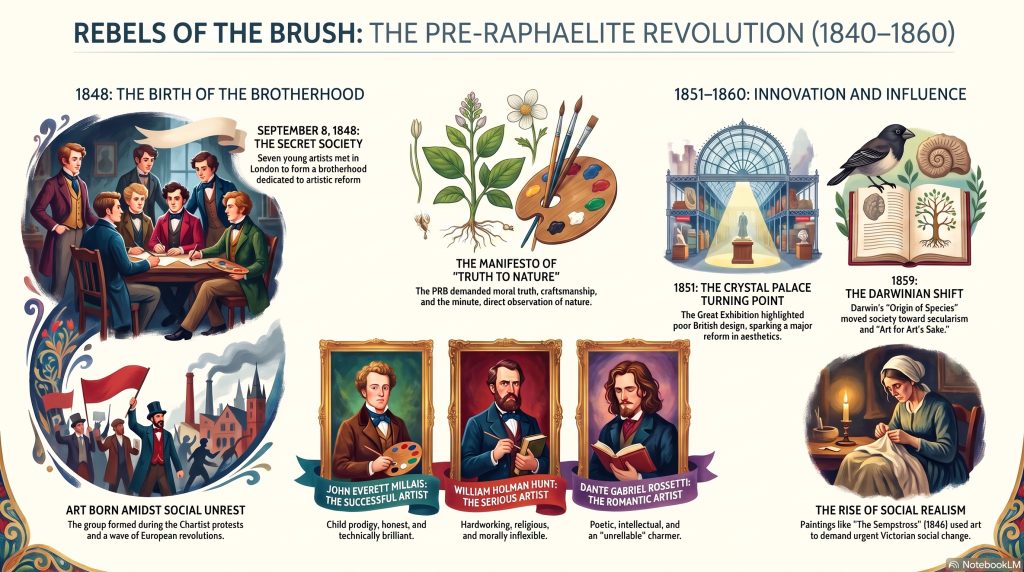
This talk focuses on the Pre-Raphaelite Brotherhood between 1840 and 1860. The talk places this artistic movement within the broader Victorian era, highlighting major historical influences such as the Industrial Revolution, the Great Exhibition of 1851, and the rise of the British Empire. Detailed biographies are provided for the founding members, including John Everett Millais, William Holman Hunt, and Dante Gabriel Rossetti, noting their commitment to moral truth and the minute observation of nature. Additionally, the talk explores the radical nature of the group, contrasting their controversial “brotherhood” with contemporary social upheavals like the Chartist movement. The documents also trace the group’s evolution and eventual transition into the Aesthetic Movement later in the century. Through timelines and artist profiles, the sources illustrate how these figures challenged the Royal Academy to transform British art.
My notes on The Pre-Raphaelites, 1840-1860
A conversation on the Pre-Raphaelites created by Google Notebook from my notes:
1. Introduction: A Year of Fire and Canvas
To the modern gallery-goer, the oil paintings of the Victorian era often appear as the very definition of “staid and irrelevant”—sentimental, technically precise windows into a stiflingly conservative world. Yet, to understand their genesis, one must look past the gilded frames and transport themselves to 1848, a year defined by “revolution across Europe.” In a London vibrating with social upheaval and the threat of anarchy, a radical insurgency was brewing. This was not a revolution of muskets and barricades, but of brushes and iconoclasm.
The Pre-Raphaelite Brotherhood (PRB) was born from a youthful, arrogant desire to shatter the establishmentarian weight of the Royal Academy. Far from the conservative elders we imagine today, these young men were the avant-garde agitators of their time, wielding a hyper-realistic “truth” as a weapon against artistic artifice. To examine the PRB today is to rediscover a history of codified celebrity, public scandal, and the surprising collision of evolutionary science with the domestic teapot.
2. Truth #1—The Codified Branding of the “Boy Band”
Before the mechanisms of modern celebrity were codified by the music industry, the Pre-Raphaelite Brotherhood operated with a sophisticated “brand” strategy. The three founders were less a traditional collective and more a carefully curated ensemble, each possessing a distinct persona designed to appeal to specific sectors of the burgeoning middle-class art market.
- John Everett Millais (The Child Prodigy): Born to a wealthy family from St Ouen (pronounced ‘won’), Jersey, Millais was a natural phenomenon. He attended Sass’s prep school at the age of ten and entered the Royal Academy school in 1840 at just eleven years old—a feat that left his older peers awed. His brand was that of the “Successful Artist”: an honest, easy-going Englishman whose prodigious talent made him a safe, blue-chip investment for the establishment.
- William Holman Hunt (The Serious “Maniac”): Emerging from a humbler background as the son of a warehouse manager, Hunt’s path was one of dogged persistence; he was only accepted to the Royal Academy on his third attempt in 1844. Nicknamed “the Maniac” for his intense, jovial, yet inflexible nature, his brand was that of the “Serious Artist.” His religious convictions and exhaustive work ethic ensured the moral integrity of his canvases.
- Dante Gabriel Rossetti (The Unreliable Romantic): An intellectual from a literary family, Rossetti was “not a natural painter” and famously erratic in his attendance at the Academy. He provided the group’s “foreign, exotic” allure. His brand was the “Romantic Artist”—deep, troubled, and brilliantly unreliable, he satisfied the public’s thirst for the image of the tortured, spiritual genius.
3. Truth #2—The Scandal of the Word “Brotherhood”
When this triumvirate met on the evening of Friday, September 8, 1848, at Millais’s parents’ house at 83 Gower Street, they formulated a manifesto demanding “truthfulness in art” and the “minute observation of nature.” However, it was not merely their technical radicalism that offended the Victorian gatekeepers; it was their name.
In the historiography of 1849, the term “Brotherhood” was dangerously loaded, redolent of secret societies, Continental anarchy, and the looming specter of republicanism. By choosing this label over “clique” or “association,” the PRB intentionally signaled an insurgency against the Royal Academy. As William Holman Hunt later reflected with a certain grim satisfaction:
“Præraphaelites had first been used as a term of contempt by our enemies.”
By adopting the æ ligature and reclaiming a slur as a badge of honor, they successfully crafted a radical identity that both horrified and fascinated a public already on edge from political instability.
4. Truth #3—The Farcical Backdrop of the Five-Million-Signature Prank
Just months before the PRB’s formation, Millais and Hunt stood on the sidelines of a different revolution. On April 10, 1848, the Chartist movement converged on Kennington Common to present a massive petition for political reform. The government, paralyzed by terror, prepared for a massacre, mobilizing between 85,000 and 170,000 special constables and soldiers, with cannons positioned to open fire.
The reality was farcical. As Millais and Hunt watched from outside the rails, the revolution simply “melted away” by two o’clock, leaving only a few boys playing ball games. While the special constables—including future Prime Minister Gladstone and a pipe-smoking Prince Louis Napoleon—lounged on the toll bridges, the Chartist leadership presented a petition of 5.7 million signatures. However, House of Commons clerks soon discovered the “truth”: only 1.9 million were valid. The rest were forgeries featuring the names of “Queen Victoria,” “the Duke of Wellington,” and “Mr. Punch,” alongside pseudonyms like “Pugnose” and “No Cheese.” In the famous daguerreotype of the rally, one can see the “Oil of Vitriol Manufactory” (a sulphuric acid plant) looming in the background—a fitting symbol for a movement that began with corrosive intent but ended in high-stakes comedy.
5. Truth #4—Staged Realism: The Compromised Truth of the Camera
The PRB’s obsession with unvarnished “truth” coincided with the harrowing birth of war photography. Roger Fenton, a pioneering British photographer, captured the first images of the Crimean War in 1854. Yet, this “mechanical truth” was as meticulously composed as any PRB canvas.
Fenton’s process was a physical trial; he suffered from broken ribs, high temperatures, and cholera while managing 350 usable negatives. However, the technological limitation of long exposures forced him to “pose” his subjects, creating a form of staged realism. Furthermore, under pressure to produce propaganda that countered press criticism, Fenton avoided any depiction of “dead, injured and mutilated soldiers.”
Fenton viewed his work as “fine art,” and he was professionally shattered when, at the 1862 International Exhibition, photography was reclassified alongside “machinery and tools.” This mechanical demotion reflected a profound Victorian anxiety: could a mere machine ever capture the “moral truth” that the Præraphaelites pursued with such painstaking spiritual labor? Fenton eventually sold his equipment in disgust, returning to the law as a barrister.
6. Truth #5—The Aesthetic Teapot: When Darwin Met Oscar Wilde
The most surprising legacy of the Pre-Raphaelite revolution was its eventual synthesis with evolutionary science. When Charles Darwin published On the Origin of Species in 1859, he triggered a seismic shift in the perception of beauty. If beauty was an evolutionary adaptation rather than a divine gift, artists felt empowered to worship “beauty for its own sake”—the foundational creed of the Aesthetic Movement.
By the 1880s, this aestheticist fervor had moved from the studio to the drawing room, manifesting in everything from the “unisex clothing of the intellectual” to the famous 1882 Royal Worcester teapot. This vessel featured a satirical inscription that bridged high science and high fashion:
“Fearful Consequences—Through the Laws of Natural Selection and Evolution of Living Up to One’s Teapot.”
This was a direct jab at the ultimate Aesthetic celebrity, Oscar Wilde, who famously lamented during his years at Oxford:
“I find it harder and harder every day to live up to my blue china.”
Darwin’s revolutionary theories had become so embedded in the cultural mainstream that they were being used to sell satirical ceramics to a public obsessed with “Aesthetic” living.
7. Conclusion: The Legacy of the Avant-Garde
The fire of the Pre-Raphaelite Brotherhood did not extinguish; it merely changed hue. What began as a radical cell of twenty-somethings demanding “truth” in a parents’ living room became the bedrock of the modern avant-garde. Their influence rippled through the century, evolving into the “Art for Art’s Sake” ethos of the Aesthetic Movement.
As we view these “staid” Victorians through the lens of the twenty-first century, we must wonder if our modern art movements are truly as controversial. In a world of staged photographs and forged petitions, the act of young men in 1848 demanding a minute, unvarnished observation of the world remains a profoundly radical act. Are we, in our era of digital artifice, still capable of living up to their standard of truth?
25-04 The Pre-Raphaelite Sisters
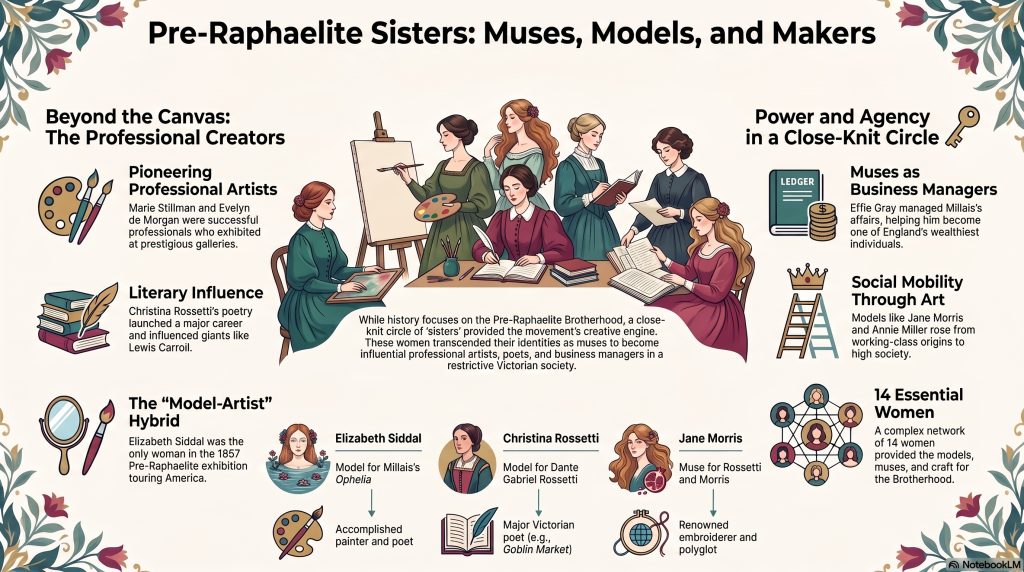
This talk explores the “Pre-Raphaelite Sisters“, highlighting the often-overlooked women who served as models, muses, and creators within the 19th-century artistic movement. While history frequently centers on men like Millais, Rossetti, and Hunt, this text focuses on figures such as Effie Gray, Elizabeth Siddal, and Fanny Eaton, detailing their complex personal relationships and professional contributions. The talk examines how these women transitioned from being subjects of iconic paintings to becoming accomplished artists and poets in their own right despite social constraints. It further discusses the symbolism and controversy surrounding famous works, such as the erotic undertones of Bocca Baciata and the technical innovations of The Eve of St. Agnes. By tracing the interconnected lives of fourteen specific women, the narrative reframes the Pre-Raphaelite Brotherhood as a tight-knit community of both genders. Ultimately, the records illustrate the agency and influence of these women, many of whom rose from humble origins to become central figures in Victorian culture.
My notes on The Pre-Raphaelite Sisters
A conversation on the Pre-Raphaelite Sisters created by Google Notebook from my notes:
The history of 19th-century British art is often told as a masculine drama of rebellion. We are intimately familiar with the “Brotherhood”—the founding trio of John Everett Millais, Dante Gabriel Rossetti, and William Holman Hunt—whose names are etched into the Victorian avant-garde. For over a century, however, the women who moved within their orbit were relegated to the status of passive “muses” or tragic, silent faces on a canvas. This narrative was fundamentally upended by the 2019 National Portrait Gallery exhibition, Pre-Raphaelite Sisters, which brought these figures into the foreground not as objects of the male gaze, but as sovereign agents. By shifting our focus, we find a collaborative ecosystem of artists, poets, and managers who were often more radical than the men who painted them.
The Unconsummated Marriage and the “Graceful Doll”
Effie Gray is perhaps the most famous figure in the scandalous annals of Victorian art, yet her agency is often overshadowed by the men she married. Originally wed to the influential art critic John Ruskin in 1848, Effie endured a marriage that remained bafflingly unconsummated. Ruskin’s own explanation for his lack of physical interest in his wife remains one of the era’s most peculiar documents:
“It may be thought strange that I could abstain from a woman who to most people was so attractive. But though her face was beautiful, her person was not formed to excite passion. On the contrary, there were certain circumstances in her person which completely checked it.”
While historians have long speculated on these “circumstances,” Effie’s response was one of quiet, legal revolution. She eventually secured an annulment—a rare feat that avoided the public spectacle of a parliamentary divorce. During this period of matrimonial limbo, she modeled for Millais’s The Order of Release, a title that proved poignantly prophetic.
After marrying Millais in 1855, Effie transitioned from the “graceful doll” of her youth into a formidable business manager, overseeing Millais’s vast wealth and affairs. She continued to lend her image to his work, notably for The Eve of St. Agnes. Here, Millais utilized the Pre-Raphaelite convention of “precise representation,” posing Effie in a freezing Jacobean mansion for three nights so he could capture the “lattice shadow effect” of moonbeams across her body. Effie’s younger sister, Sophie Gray, also joined this visual lexicon; her portrait, Portrait of a Girl, broke Victorian conventions with a direct, confrontational gaze that historians have described as “knowing”—a sharp departure from the era’s preference for female passivity.
Lizzie Siddal: The “Supermodel” as Sovereign Artist
Elizabeth “Lizzie” Siddal is immortalized as the floating, tragic figure in Millais’s Ophelia, but the “supermodel” of the Pre-Raphaelite world was a creative force in her own right. Discovered in a milliner’s shop, she maintained a position of unusual power by keeping her part-time job while modeling, ensuring a degree of financial independence rare for women of her class. Walter Deverell famously remarked on her presence:
“[She is] like a queen, magnificently tall, with a lovely figure, a stately neck, and a face of the most delicate and finished modelling.”
Siddal was more than a face; she was the only woman included in the 1857 Pre-Raphaelite exhibition that toured the United States. Financially supported by Ruskin, she produced drawings and poems that contemporaries noted for their “high praise” and “hopelessly sad” intensity. Her life was marked by the tragic irony of her relationship with Rossetti—a long engagement followed by an opiate overdose in 1862. In a final, macabre gesture of romantic theater, Rossetti buried his poems in her hair, only to have her body exhumed seven years later to retrieve the manuscript.
The Multicultural Avant-Garde and the Lost Genius
The traditional British art narrative often overlooks the multicultural reality of the 19th-century scene. Fanny Matilda Eaton, a Jamaican-born model, became a pivotal figure in diversifying the Pre-Raphaelite aesthetic. She was the “first choice” for artists seeking to depict biblical or “exotic” characters, appearing in the works of Simeon and Rebecca Solomon.
Eaton’s significance is best understood through her collaboration with Joanna Boyce Wells, a “wonderfully gifted” artist whom contemporaries hailed as a genius. Boyce Wells’s career was a meteoric rise; a prodigy who studied in Paris, she exhibited her masterpiece Elgiva at the Royal Academy in 1855. Her Head of a Multiracial Woman (1861), for which Eaton modeled, showcases a technical sensitivity that rivals the PRB’s founding members. Boyce Wells’s trajectory was tragically cut short when she died from complications of childbirth at just 29, leaving behind works that suggest she would have been one of the movement’s defining voices had she lived.
The Subversive Power of Bocca Baciata and the Zambaco Scandal
In 1859, Rossetti painted Bocca Baciata (“Kissed Mouth”), using Fanny Cornforth—with her “harvest-yellow” hair and sensual features—as his model. This work launched the Aesthetic Movement, championing “art for art’s sake” through the use of thick oils and sensual Venetian colors. The title refers to a Boccaccio proverb that served as a radical manifesto for the era’s changing morals:
“A kissed mouth does not lose its freshness, but renews itself like the moon.”
This celebration of “animal passion” was part of a broader, more scandalous social landscape. The high stakes of these relationships were made literal by Maria Zambaco, a talented sculptor and model for Edward Burne-Jones. Their tempestuous affair culminated in a public scandal bordering on farce when Zambaco attempted suicide by jumping into the Regent’s Canal.
Within Bocca Baciata, Rossetti embedded coded messages that subverted the “Angel in the House” ideal:
- Marigolds: Conventionally signifying grief and pain.
- Apples: Representing temptation and the acquisition of knowledge.
- White Roses: Traditionally symbols of innocence, here placed in a “disturbing” proximity to the subject’s voluptuous lips.
The Awakening Conscience and Art as Activism
As the movement matured, the Pre-Raphaelite style began to incorporate explicit social commentary. William Holman Hunt’s The Awakening Conscience, modeled by Annie Miller, remains a masterclass in the “nouveau-riche vulgarity” of the Victorian interior. The painting is a dense thicket of symbolism, from the cat toying with a bird to the “coded messages” on the frame itself:
- The Star: Placed above the subject’s head as a sign of spiritual revelation.
- The Marigold: Decorating the frame to signify sorrow.
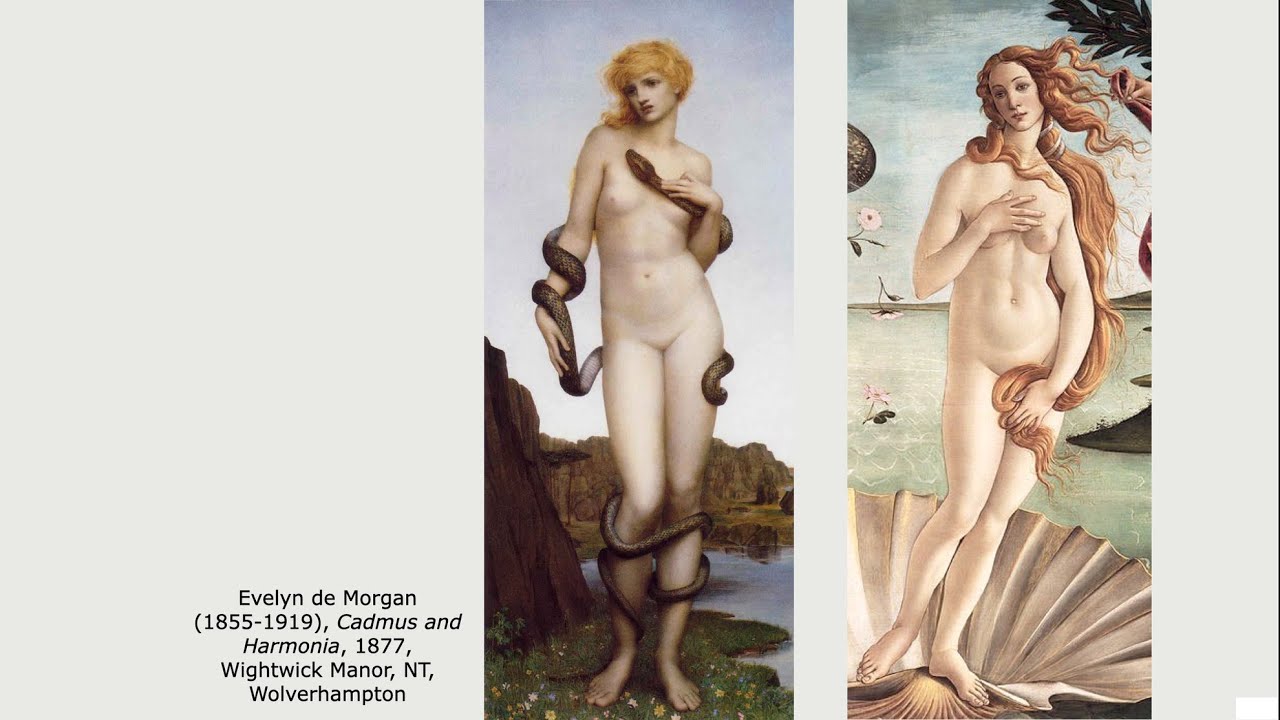
The transition from “fallen woman” narratives to active political engagement is best embodied by Evelyn de Morgan. Born into the aristocracy, she adopted a gender-neutral name to enter the professional world and became a prize-winning student at the Slade. Her final work, The Gilded Cage (1919), serves as a powerful metaphor for the social entrapment of married women. De Morgan’s art was a reflection of her personal activism; she was a staunch pacifist and a signatory of the 1889 Declaration in Favour of Women’s Suffrage, proving that the “Sisters” had moved from the canvas to the front lines of social change.
Conclusion: Redeeming the Silent Land
To study the Pre-Raphaelite Sisters is to realize that the vibrant, often chaotic world of 19th-century art was a collaborative ecosystem. To truly understand these masterpieces, we must look past the male signatures on the frames and acknowledge the poets, painters, and managers who built the movement. Christina Rossetti, perhaps the greatest poet of the era, captured the essence of this struggle for legacy in her poem “Remember”:
“Yet if you should forget me for a while And afterwards remember, do not grieve: For if the darkness and corruption leave A vestige of the thoughts that once I had, Better by far you should forget and smile Than that you should remember and be sad.”
As we re-examine these “vestiges” left behind on the canvases and in the archives, we must ask the question posed by the 2019 exhibition: how many other sisters remain hidden in the shadows of art history, simply because we were taught they were only there to be beautiful?Gemini Notebook can be inaccurate; please double-check its responses.
25-05 Edward Burne-Jones
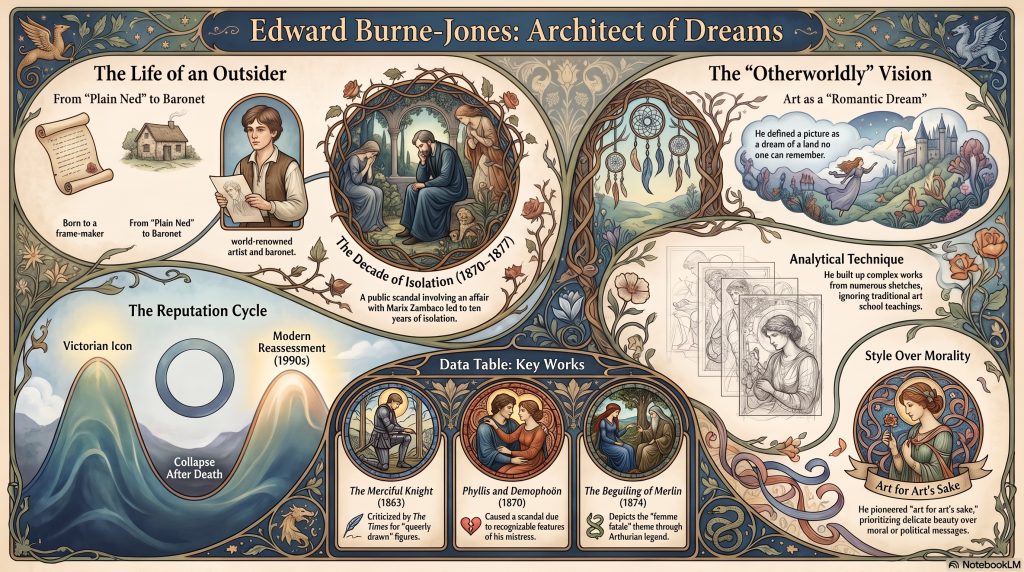
Sir Edward Coley Burne-Jones was a prominent Victorian artist who rose from humble beginnings to become a leading figure in the international Symbolist movement. Though initially associated with the Pre-Raphaelite Brotherhood through his mentor Dante Gabriel Rossetti, he eventually pioneered a unique Aesthetic style focused on mythical, biblical, and romantic themes. His career was marked by significant collaborations with William Morris in the decorative arts and was punctuated by a scandalous public affair that led to a period of professional isolation. Despite a long decline in popularity after his death, his reputation was restored in the late 20th century as his literary approach and analytical technique were recognized for their influence on modern art. The talk looks at his biographical history, artistic philosophy, and the complex personal relationships that shaped his creative output using a mix of visual analysis, historical timelines, and personal quotes to illustrate his lasting impact on the European art world.

A conversation on Edward Burne-Jones created by Google Notebook from my notes:
In the mid-19th century, Britain was a landscape forged in the fires of the Industrial Revolution—a world defined by the visceral grit of coal soot, the relentless rhythm of steam engines, and the rigid, cold logic of materialistic science. Yet, while his contemporaries were busy documenting the harsh realities of the “Iron Age,” Edward Burne-Jones was weaving a sanctuary of ethereal stillness. He chose to reside in a parallel universe, a “dreamy otherworldliness” constructed from the fragments of medieval myth, Arthurian legend, and biblical mystery.
Why did one of the most successful figures of the Victorian era choose to live so firmly in a world that never was? For Burne-Jones, art was not a mirror to reflect the smog of London, but a portal to a land of desire. He famously distilled this aesthetic rebellion into a singular vision:
“I mean by a picture a beautiful romantic dream of something that never was, never will be – in a light better than any light that ever shone – in a land no one can define, or remember, only desire.”
1. The Literary Outsider: From “Plain Ned” to British Art Royalty
Before he was the master of the Grange, the artist was known merely as “plain Ned Jones,” the son of a humble Welsh frame-maker in Birmingham. His mother died only six days after his birth, leaving him to a childhood overseen by a grieving father and a housekeeper. His rise to the title of Sir Edward Coley Burne-Jones, Baronet, is a narrative of profound transformation. By the end of his life, he was lauded across the Continent as one of the “greatest artists to have emanated from Britain,” a plural distinction that places him in the highest tier of the historical canon.
His path to the heights of the international art world was notably unconventional. While he briefly attended the Birmingham School of Art between 1848 and 1852, his pivotal development took place at Oxford. This university background, rare for artists of his time, gifted him a “literary approach” to his canvases. Rather than following the rigid dictates of traditional art schools, Burne-Jones approached his work analytically, building compositions from a deep knowledge of poetry and theology. He remained an outsider to the formal Academy for much of his life, yet this very detachment allowed him to become a pioneer of the Symbolist movement.
2. The Little Venice Tragedy: A Scandal of Greek Tragedy Proportions
The ethereal stillness of Burne-Jones’s canvases was often bought at a staggering personal cost. In 1866, he was introduced to Maria Zambaco, a wealthy heiress of Greek descent and a talented artist in her own right. Maria was part of a collective of beauties known among friends as “The Three Graces,” alongside her cousins Marie Spartali Stillman and Aglaia Coronio. The ensuing affair was a storm of passion that nearly drowned the artist’s reputation.
The drama reached a harrowing peak in 1869 beside a canal in London’s Little Venice. Amid the shadows and the cloying scent of desperation, Maria entreated Burne-Jones to join her in a suicide pact by laudanum overdose. The situation grew so volatile that police intervention was required to prevent a dual tragedy.
This turmoil did not remain behind closed doors; it bled onto the gallery walls. In 1870, he exhibited Phyllis and Demophoön, a work in which the features of his lover were unmistakably recognizable. When the Old Water-Colour Society, offended by the work’s “female sexual assertiveness” and nudity, requested a “slight alteration,” Burne-Jones’s response was a defiant refusal. He chose to withdraw not only the painting but himself, resigning from the Society and entering a seven-year period of professional isolation rather than compromise his vision of his muse.
3. Technical Insurgency: Turning Watercolor into “Jewels”
In the studio, Burne-Jones was a technical rebel who delighted in subverting his medium. He ignored the standard art school teachings that dictated watercolor should be thin, light, and transparent. Instead, he utilized bodycolor—an opaque watercolor mixed with white pigment—to create a surface that was heavy, thick, and jewel-like. His analytical process was painstaking, often taking years to complete a single major work as he built the image from numerous individual fragments and sketches.
Yet, this solemn, spiritualized professional facade hid a biting wit. His friends described him as “Puck beneath the cowl of a monk,” a man who could pivot from the high drama of Arthurian legend to “quick-fire” caricatures and humorous sketches of “fat tattooed ladies.” This duality was the engine of his creativity: the analytical monk produced the masterpieces, while the mischievous Puck kept the spirit alive through the drudgery of the Industrial Age.
4. The Fluid Aesthetic that Scandalized the Critics
Perhaps the most modern aspect of Burne-Jones’s legacy is his “gender-fluid attitude” toward the human form. He famously bypassed traditional Victorian gender roles, often imbuing his women with masculine strength and his men with a refined, “effeminate” beauty. This spiritualized style of beauty was a direct challenge to the “virility” prized by 19th-century critics.
Even his mentor, the influential John Ruskin, struggled with Burne-Jones’s evolution. In 1867, Ruskin dismissed the artist’s “visible faults” as the result of not beginning his training early enough in boyhood. Years later, however, his critique turned toward the artist’s essence; in a letter to G.F. Watts, Ruskin lamented that Burne-Jones’s refusal to confront the “hard-edge” realities of the world made him, in his view, “in essence a woman.” While critics saw a lack of virility, Burne-Jones’s devoted followers, such as his nephew Rudyard Kipling, praised the “delicate beauty” of these fluid forms, seeing them as essential inhabitants of a world beyond the binary.
5. Painting Angels as a Protest Against Science
For Burne-Jones, the act of painting was a moral and ethical stance. While he was deeply versed in the Bible, his wife Georgiana noted he had little interest in the structures of formal Christianity. Instead, he used religious iconography as a weapon against what he called the “materialistic science” of his era.
He viewed the cold reach of data and industry as a threat to the human spirit. While his friend William Morris sought to change the world through socialist politics, Burne-Jones staged his protest on the easel. He saw the presence of the divine in his work as a necessary counterweight to a world turning toward the mechanical:
“The more materialistic science becomes, the more angels shall I paint. Their wings are my protest in favour of the immortality of the soul.”
The Step-Stone to Modernity
Burne-Jones died in 1898, the first artist to be honored with a memorial service at Westminster Abbey. Though his reputation faded as the 20th century embraced a different kind of realism, he is recognized today as an essential “stepping stone” to Symbolism and a pioneer who offered the first psychological and sexual insights that would define the modern era.
His life leaves us with a question that feels more urgent today than ever: In our own age of increasingly hard data, algorithms, and “materialistic science,” do we still need the “wings” of a parallel dream world to preserve the soul?Gemini Notebook can be inaccurate; please double-check its responses.
Report ‘The Victorian Dreamweaver: 5 Surprising Truths About the Rebel Who Painted Angels’ is ready.