Landscape Introduction
3 October 2005-10-03
Constable and Whistler were compared.
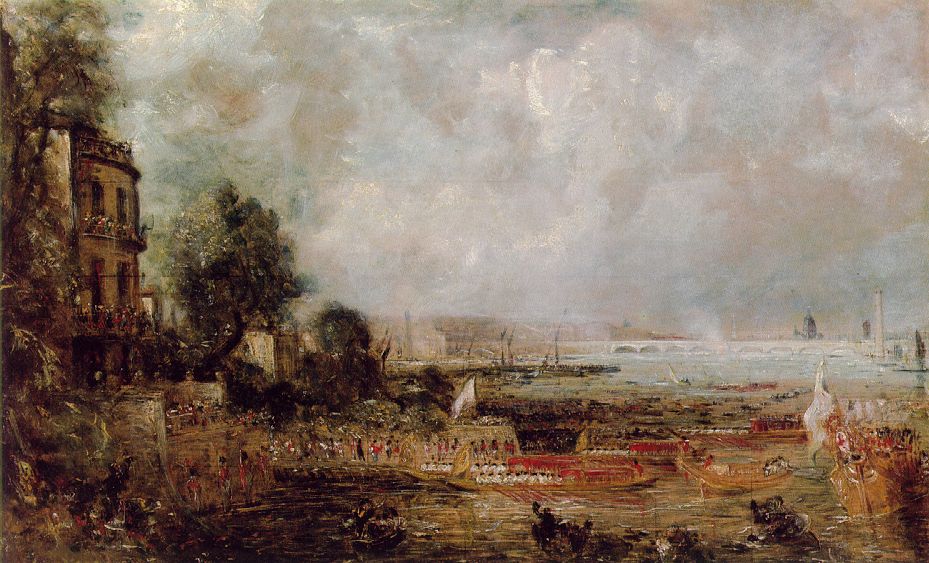
Whitehall Stairs, June 18th, 1817 (The Opening of Waterloo Bridge). 1832. Oil
on canvas. Tate Gallery, London, UK.
(also see The Opening of Waterloo Bridge 1829, Oil on canvas, 24 3/8 x 39 in (62
x 99 cm), Yale Center for British Art, New Haven)
Constable first started to plan a large canvas about the opening of Waterloo
Bridge around 1819, but over the years his ideas about how to treat it changed.
Originally he intended to focus on the royal embarkation at the foot of
Whitehall Stairs. However, in the finished picture, shown here, this recedes
into the middle distance, and the sky and river both assume greater importance.
This was the largest of Constable's exhibition canvases. It owes a debt to
the Thames subjects of Canaletto and the great 'historical' landscapes painted
by the seventeenth-century French artist Claude Lorraine.
Married Mary Bicknell in 1816 and moved to Keppel Street, Bloomsbury (between
Gower Street and Malet Street). Constable was made an ARA in 1819 and an RA in
1829.
When John Constable was exhibiting his “Opening of Waterloo Bridge”, Turner
stood behind Constable watching himput colour on the flags, next day Turner
brings his palette and paint a red buoy on the sea then just left….”He has
been here’ said Constable, ‘and fired a gun’.
Did Constable work on it for 15 years on and off?
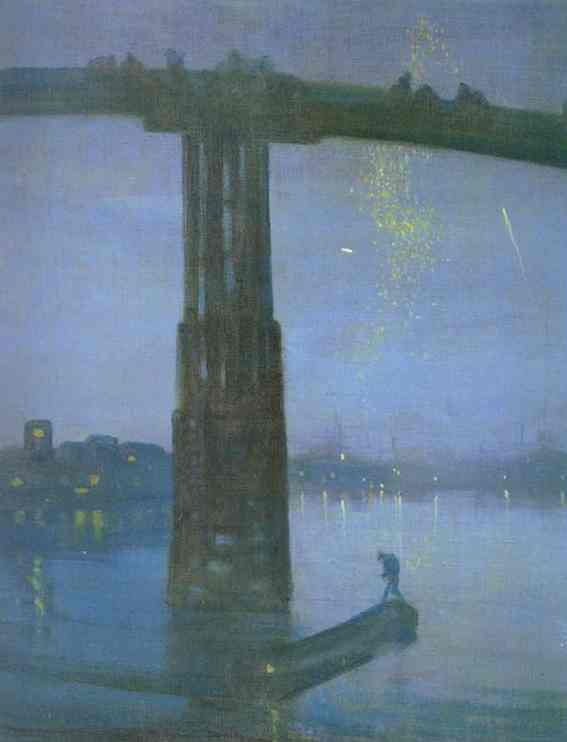
James Abbott McNeill Whistler. Nocturne in Blue and Gold – Old Battersea
Bridge. 1872-75. Oil on canvas. Tate Gallery, London, UK
'It is a perfect example of Whistler’s translations from the Japanese. Its
point of origin was probably a woodblock print by Hiroshige, which features a
large curving bridge with fireworks behind it, on a river at night. Whistler’s
version brings the big T of the pier and roadway of the bridge so high that it
no longer resembles Hiroshige’s, or bears the least physical resemblance to any
structure over the Thames, let alone Battersea Bridge. The dim figure in the
foreground, balanced on the stern of a barge, could equally well be a Japanese
boatman. But the essence of the painting is its haunting, intense, twilight blue
– a blue so ethereal and pervasive that it appears to supersede nature in
artifice, while the falling rocket fire spangles it like the gold flakes
embedded in Japanese maki-e enamel.'
Text from
“American Visions”, by Robert Hughes, see
http://www.artchive.com/artchive/W/whistler.html
Constable Whistler Classical landscape type Linking painting and music Snow effect Harmonious and abstract like music Light everywhere, no cast shadows Faithful representation of background? Trying to get in RA? Difficult to decipher Nationalistic Fireworks Pageantry Embankment built at this time Impasto Depicting pollution Too far away to see bridge clearly Too near to see bridge clearly An actual historical event Did Whistler use photographs?Impressions, feelings
The issue of the use of photographs needs to be explored. Sickert, Degas used
them but others were coy.
The both have a sense of nostalgia. The Constable has pageantry, is up-beat,
busy, with action, and no shadows cast. Whistler has a sense of loss.
Do these paintings challenge our sense of modernity?
Memory played a very important role in the the 19thC. The famous row between
Gauguin and van Gogh was about memory, Gauguin thought painting from memory was
the only way.
The Constable shows a contemporary event. It was the time of the juste milieu
in France, Corot, pre-Barbizon. Constable's Haywain received a Gold Prix in
Paris in 1824.
On this course we will cross the boundaries between styles and try to forget
the stereotypes of Romanticism, Realism, Impressionism, Post Impressionism and
Aestheticism.
Historical Background
There was little landscape in the ancient world as pictures centered on human
activities and the relationship between man and the world.
One of a few Greek wall paintings that survived, is the Tomb of the Diver, c.
475 BC in Paestum Italy, from a necropolis (city of the dead) of Poseidonia (The
older Greek name of Paestum). Scenes of a Symposium, males in love and Kottabos
players and a diver. A normal tomb was a rectangular hole cut in the rocky
ground sometimes lined internally with stuccoed travertine slabs. Some sources
consider this an Etruscan tomb but even then there due to the close relations
with the Greeks in Italy it a piece with Greek influence.
Egyptian — Field of Reeds
Odyssey landscape: attack of the Laestrygonians
The story starts with literature, Theocrotus, and the idea of the rural life,
withdrawal into a rural bliss and simplicity. This idea was picked up by Virgil
in his Eucologues and Georgics.
The sacral-idyllic landscape — see Pompeii 70AD — the sacral idyllic
landscape. Little temples, altars and statues of the gods. Pastoral scenes of
shepherds and agricultural work. Based on lost Greek descriptions.
Villa of P. Fannius Synostor at Boscoreale. Creating trompe l'oeuil views of
architecture and landscape recreated at the Met in New York.
Garden of Livia, Prima Porta, an illusionistic landscape. So in Roman times
we see the distinction between the real and the ideal sacral-idyllic landscape.
Perspective
- Diminishing forms
- Individual perspective for each object but no overall perspective
based on parallel lines meeting at a vanishing point on the horizon. This was
invented by Brunelleschi in 1413. - Aerial perspective – things further away are bluer, paler and
fainter. Stronger and darker colours are used for near objects. - Strong detail in the foreground and the use of small objects such
as weeds and pebbles. - Shadow to create pockets of three-dimensionality.
- The background is often raised by the use of mountains or hills in
the distance. In reality we rarely see hills rising in the background but in
painting this technique is often used.
The ideal landscape of Claude, ‘Landscape with Hagar and the Angel’, 1646.
London, The National Gallery, was seen by Turner and Constable.
Poussin and the heroic landscape (see
http://www.artcyclopedia.com/feature-2000-08.html)
Landscape with a Man Killed by a Snake, 1648, Oil on canvas, 119,4 x
198,8 cm, National Gallery, London
Topographical landscape: Ruisdael
Full title: ‘A Landscape with a Ruined Building at the Foot of a Hill by a
River’, about 1655, Jacob van Ruisdael, 1628/9? — 1682. The attribution has been
questioned. There are two other versions.
‘A Dutch Ship and other Small Vessels in a Strong Breeze’, 1658, Willem van
de Velde, 1633 – 1707
We have the Italianate landscape versus the Dutch landscape.
Realism and naturalism are a minefield. A realistic painting includes
components we accept as real as opposed to say romantic comedy.
Issues we will be dealing with are Englishness (is landscape an English
style). Cliffs and rolling hills.
Function and display. Eidometropolis.
The Blind Girl (1856). John Everett Millais (June 8, 1829'August 13,
1896) was a British painter and illustrator who was one of founders of the
Pre-Raphaelite Brotherhood
Robert Andrews and His Wife Frances. Detail. About 1748-49. Oil on canvas.
National Gallery
Samuel Scott 1702-1772, Part of Old Westminster Bridge, Tate.
Patrick Heron, Cobalt and Indigo in Ultramarine, 1970.
Christopher Richard Wynne Nevinson, The Soul of the Soulless City (`New York
– an Abstraction’), 1920. — Tate 2003
Turner, Rain, Steam, and Speed The Great Western Railway.
Exhibited at the Royal Academy in 1844. Oil on canvas, 91 x 122 cm. Turner
Bequest.
The scene is fairly certainly identifiable as Maidenhead railway bridge,
which spans the Thames between Taplow and Maidenhead. The bridge, designed by
the engineer Isambard Kingdom Brunel and completed in 1839, has two main arches
of brick, very wide and flat. The view is to the east, towards London.
On the left people are boating on the river, while to the right a ploughman
works on a field. The tranquility of these traditional activities contrasts with
the steam train rushing towards the viewer, the stark outline of its black
funnel clearly visible. In front of the train a hare, one of the speediest of
animals, dashes for cover.
Turner’s picture can be associated with the ‘railway mania’ which swept
across England in the 1840s. It is also an outstanding example of his late style
of painting. Sky and river landscape are dissolved in a haze of freely applied
oil paint, to give a striking impression of the contrasting movement of driving
rain and speeding train.
John William Inchbold1830-1888
Recollection. Barden Fells1866
John Brett1831-1902
Britannia’s Realm1880, Oil on canvas, support: 1054 x 2121 mm
John Brett was unusual among marine artists in that in his early career he
was known as the Pre-Raphaelite painter of ‘The Stonebreaker’ (1858) and of
mountain landscapes. These pictures were remarkable for their fine detail. He
believed that paintings of the sea should also show detail clearly, and that
artists should not make things easier to paint by blurring objects at a
distance. Many of his seascapes like this one were designed in a double square
format. This view is near Tenby, in Pembrokeshire. It is an exceptionally broad
panorama, and Brett here broke his habit of giving his paintings the
straightforward titles of their location.
Tony Craggborn 1949
Britain Seen from the North1981
Richard Billingham (born 1970), Ethiopian Landscape IV, 2001, photograph.
Richard Long, Brownstone Circle New York, 2000