The ancient Egyptian civilisation lasted for over 3,000 years. In fact, we are today nearer in time to Cleopatra than she was the the building of the pyramids. The enormous timescale can be subdivided into the:
Early Dynastic period (c. 3150-2613 BCE)
Old Kingdom (c. 2613-2181 BCE)
First Intermediate Period (2181-2040 BCE)
Middle Kingdom (2040-1782 BCE)
Second Intermediate Period (c. 1782-1570 BCE)
New Kingdom (c. 1570-1069 BCE)
Third Intermediate Period (c. 1069-525 BCE)
Late Period (525-332 BCE)
Ptolemaic Period (323-30 BCE)
The commemorative slab shown below is from the Middle Kingdom shows a son on the right bringing food and drink to his parents Khety and Henet on the left. The surprising thing to us is that this is tomb art. His parents are dead, so why is he bringing the food and drink including a massive calf’s leg that he is holding out to them. Most ancient Egyptian wall art is found in tombs and was never designed to be seen by the living. It is there to assist the dead to enter paradise, known as the Field of Reeds. When you consider that they thought a person consisted of multiple parts that had to be assisted into the world of the gods then the complexity is easy to understand. The Book of the Dead consisted of spells and procedures to assist the journey which involved the weighing of the heart by Anubis, the jackal-headed god. If the person had lived a decent life and their heart weighed less then the feather of Matt, the goddess of truth and justice, then they were worthy to live forever in paradise with Osiris.
For more information on this mysterious and intriguing period my YouTube video on ancient Egyptian art is here:
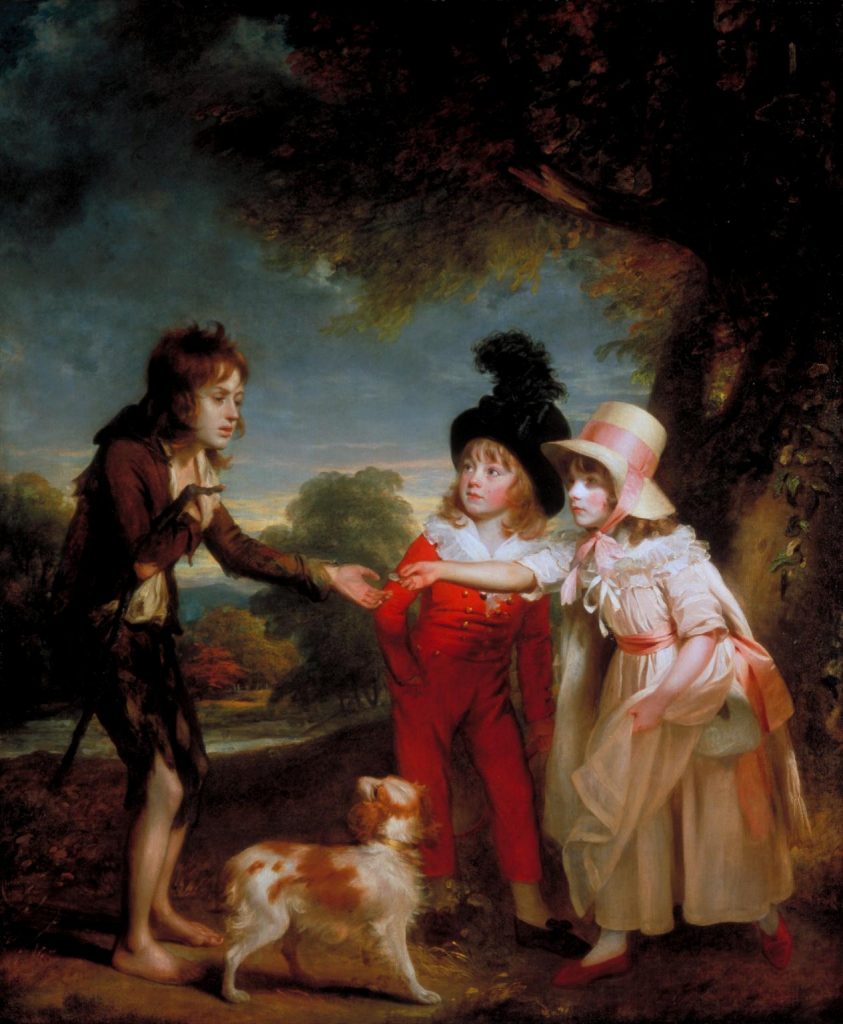
Sir William Beechey (1753-1839), Portrait of Sir Francis Ford’s Children Giving a Coin to a Beggar Boy, exhibited 1793
The 1790s were a time when society and the arts debated the relative merits of good sense and reason as opposed to sensibility. ‘Sensibility’ was a heightened awareness of beauty and deep feelings. Jane Austen’s Sense and Sensibility was published in 1811 and was set in the same decade as this painting. We see this heightened sense of feeling takes the form of a fashionably dressed girl and her brother handing a coin to a hunched over beggar. Such emotional scenes of charity had become fashionable at this time but there might be another justification for this scene.
Pro-Slavery Propaganda?
The artist, William Beechey, did not identify the children when he exhibited the work but they were recognised by Horace Walpole, son of the first British prime Minister, Robert Walpole. They are Francis Ford and his sister Mary, the children of Sir Francis Ford, who owned a sugar plantation in Barbados and a property in Ember Court, Thames Ditton, Surrey.
While William Wilberforce was fighting to stop the British slave trade there were many wealthy plantation owners, like Ford, who were arguing that their slaves enjoyed a better quality of life than the poor in England. It is possible therefore that he commissioned this painting not just to show the refinement and sensibility of his children but as pro-slavery propaganda, to show how his family cared for both the poor in England and his slaves in Barbados. Although not connected, Ford fell ill the year this painting was exhibited and died in 1801 after eight years of suffering from ‘a severe and painful illness’.
Finally, following a twenty-year campaign for abolition Parliament passed the Slave Trade Act in 1807. Many believed this would end slavery but it only slowed the trade and slavery continued for a further twenty-six years. The Royal Navy enforced the ban on the slave trade and between 1808 and 1860 they seized approximately 1,600 slave ships and freed 150,000 Africans who were aboard.
William Beechey
William Beechey was a sound artist known for his lack of extravagance which appealed to those like King George III, who regarded other artists, such as Thomas Lawrence, as too flamboyant and ‘eccentric’. When this painting was exhibited the well-known portrait painters Thomas Gainsborough and his rival Sir Joshua Reynolds had both died and the year was a turning point in Beechey’s life and career. He painted a full-length portrait of Queen Charlotte who appointed him her official portrait painter and he was elected an associate of the Royal Academy. He went on to paint not only the royal family but most of the famous and fashionable of the period. The up-and-coming portrait painter was Thomas Lawrence who also painted Queen Charlotte but she did not like the picture. Lawrence’s flamboyant approach appealed to many including the Prince Regent but Beechey remained the favourite of George III and Queen Charlotte while Lawrence went on to become the leading portrait artist of the period.
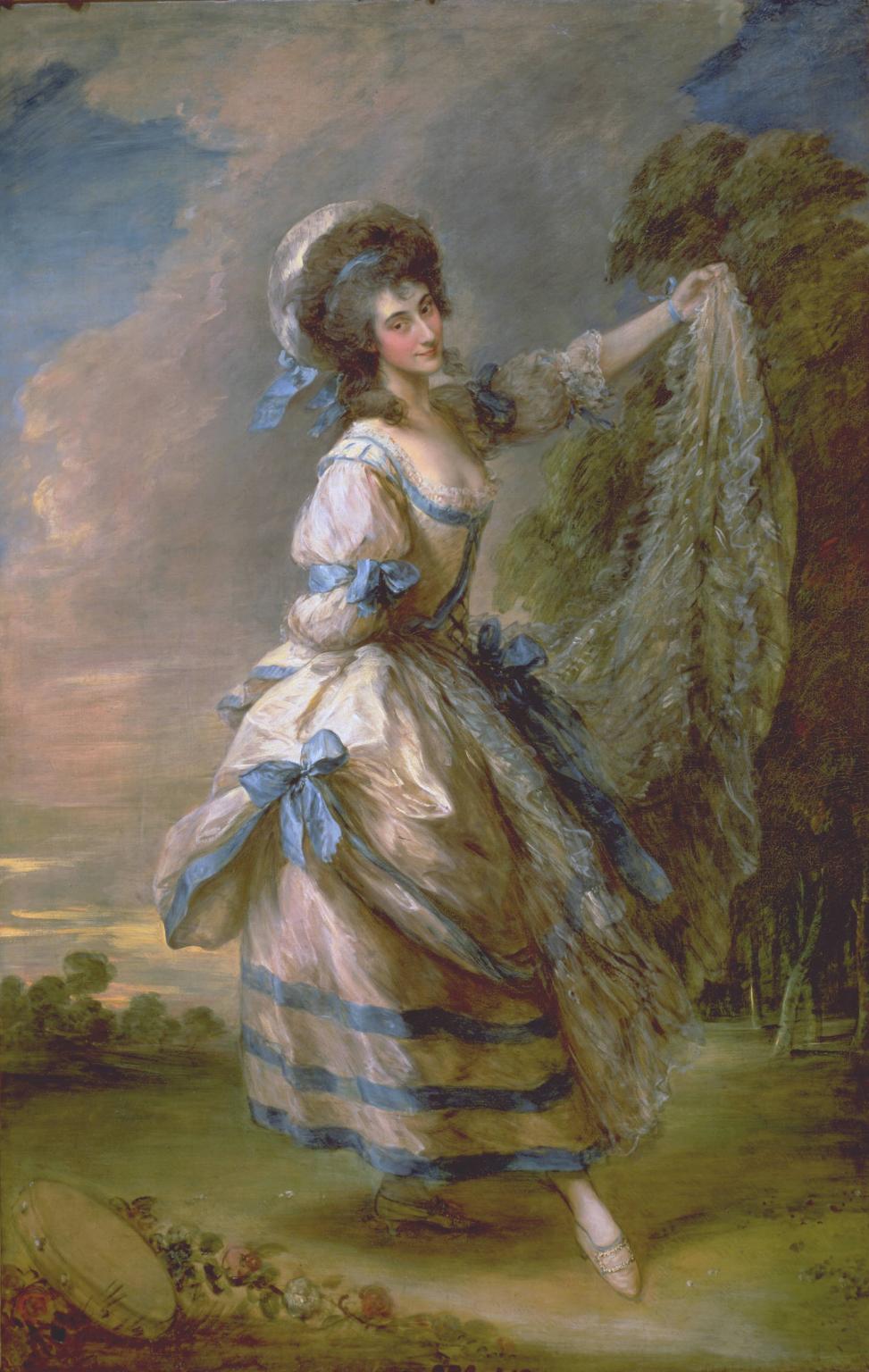
If you have visited Knole House near Sevenoaks, Kent, then you might have noticed a nude woman reclining on a chaise longue at the bottom of the stairs. This is a sculpture of Giovanna Baccelli by Giovanni Battista Locatelli. Baccelli was principal ballerina at the King’s Theatre Haymarket and mistress of John Frederick Sackville, 3rd Duke of Dorset, the owner of Knole. He was a handsome, extravagant man with a string of mistresses but he thought highly of Baccelli and set her up in a suite of rooms at Knole. A few years later he commissioned Thomas Gainsborough to paint her full-length in a dynamic pose with the costume and heavy make-up she wore for one of her roles. When the painting was exhibited at the Royal Academy in 1782 an embarrassing incident was narrowly avoided. Gainsborough had also painted the Duke and the picture was going to be shown at the same exhibition. To exhibit a Duke alongside his mistress would have been a flagrant breach of decorum and the Duke’s portrait was withdrawn, we presume for that reason.
When the Duke was appointed ambassador to France, Baccelli accompanied him to Paris and she was a great success as a ballet dancer at the Paris Opéra. It is said that when he was awarded the Order of the Garter she performed with the blue ribbon of the Garter tied around her head. They became friends of Queen Marie-Antoinette but as the French Revolution unfolded they returned to Knole. They separated the same year but remained friends and the Duke married a respectable heiress with a dowry of £140,000. According to an inventory of Knole in 1799, the statue of Baccelli was rechristened ‘A Naked Venus’ and moved to a less prominent position and she was given an annual pension of £400 and left her son to be brought up by the Duke as a gentleman.
The painting by Gainsborough is now at Tate Britain and is a wonderful example of his mature style with its lightly flicked brushstrokes and immediate sense of delicate animation. Accounts at the time describe her as charming rather than beautiful and her character was thought to have been captured by Gainsborough. As one contemporary critic wrote, the portrait was, ‘as the Original, light airy and elegant’.