- This section is devoted to entertaining subjects that cross artistic styles and movements.
99-01 Christmas
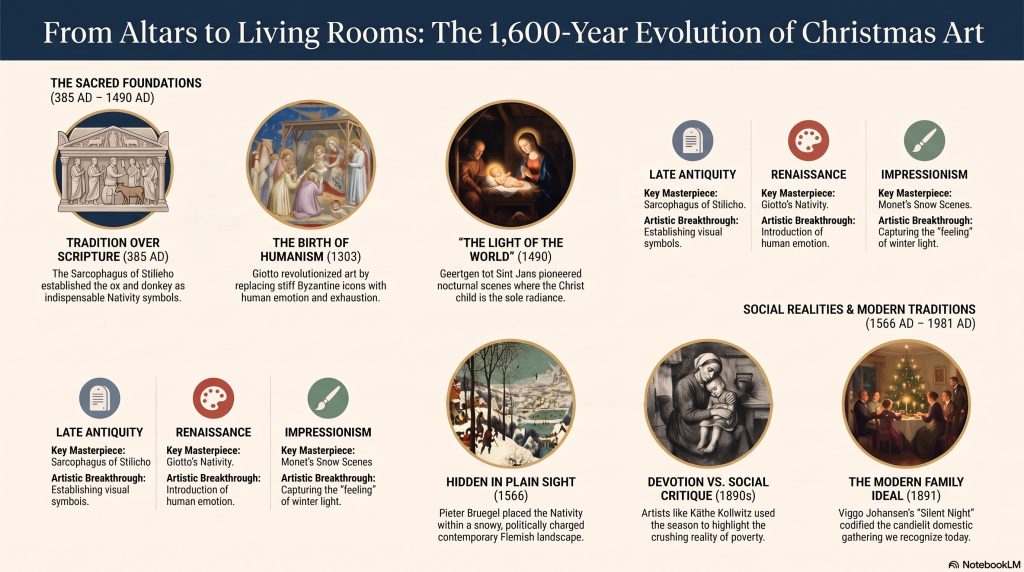
My talk provides an expansive art historical survey of how the Christmas season has been depicted from late antiquity to the modern era. By examining a diverse collection of masterpieces, the source tracks the transition of the holiday from sacred religious devotions to secular winter traditions. The overview features iconic works ranging from early Christian sarcophagi and Renaissance frescoes to Pop Art and contemporary portraiture. To balance the scholarly formal analysis of these paintings, the presentation incorporates traditional Christmas cracker jokes (groan), ensuring the journey through centuries of art remains engaging. Ultimately, these sources illustrate the evolution of humanism and social reality as reflected in the changing visual language of midwinter magic.
(The YouTube talk will be published on 25 December 2026)
A conversation about Christmas in Art created by Gemini Notebook from my notes:
1. Introduction: The Christmas We Think We Know
When we close our eyes and think of Christmas, a standard reel of imagery usually plays: a cozy stable, a bright star, and perhaps a dusting of snow. We tend to view these scenes as timeless, as if the visual vocabulary of the holiday was delivered fully formed alongside the frankincense and myrrh. However, the history of Christmas art is far more surprising, multi-layered, and deeply human than the greeting cards suggest.
The journey of the festive season on canvas is a fascinating evolution—a structural shift from the sacred devotion of late antiquity to the social realities of the Renaissance, and finally to the secular, sometimes cynical traditions of the modern age. As an art historian and cultural critic, I find that the most compelling stories aren’t just in the pigment, but in the motives behind the brushstrokes. To keep our spirits bright on this journey from the 4th century to the 20th, we will pair our formal analysis with a bit of traditional levity: the “Christmas cracker joke.” Let us begin our tour of midwinter magic.
2. Tradition Trumps Scripture: The Mystery of the Ox and the Ass
Our journey begins in Milan with the Sarcophagus of Stilicho (c. 385 AD). This is one of the earliest known depictions of the Nativity, and it contains a detail so standard we rarely question it: the presence of the ox and the donkey.
The surprising truth is that these two animals—indispensable to every modern Nativity set—are completely absent from the Gospels of Matthew and Luke. Their presence is a triumph of tradition over scripture. They were actually imported from the Book of Isaiah (“The ox knows its owner, the donkey its master’s manger”) and the apocryphal Gospel of Pseudo-Matthew. By 385 AD, they were already considered so vital that the sculptor carved them in as a matter of course. For 1,700 years, tradition has held its ground where the Bible remained silent, proving that sometimes, the “atmosphere” of a story is more resilient than the text itself.
Christmas Cracker Joke: So why did the artist add an ox and ass to the Nativity scene? Because they added stable-ity to the composition!
3. Funded by Guilt: The Birth of Humanism in the Scrovegni Chapel
Moving to the early 14th century, we find Giotto di Bondone’s The Nativity (1303–1305) in the Scrovegni Chapel. This work is a revolutionary pivot point. Giotto moved away from the stiff, flat Byzantine icons of the past toward genuine human emotion. Look at Mary: she isn’t a distant, golden icon; she is an exhausted mother tenderly reaching for her newborn.
The origin of this masterpiece is delightfully counter-intuitive, rooted more in the fear of damnation than simple piety:
“The Scrovegni Chapel was commissioned by Enrico Scrovegni partly to atone for his father Reginaldo’s sins—Dante had placed Reginaldo in the seventh circle of Hell for usury. The result is one of the greatest religious commissions in Western art, funded by banking guilt.”
Giotto’s realism was so startling for the time that legends grew around it. The biographer Vasari later recorded that Giotto once painted a fly on a master’s canvas so realistically that the owner tried to brush it away with his hand. This naturalism transformed the Nativity from a theological diagram into a human event.
Christmas Cracker Joke: Why did Giotto’s Mary look so exhausted? Well, she’d just given birth—and still had another thirty-seven frescoes to sit for!
4. Optical Theology: The Revolutionary Light of a Tragic Prodigy
By the late 15th century, Northern European artists were experimenting with light in radical ways. Geertgen tot Sint Jans’ Nativity at Night (c. 1490) is a tiny painting—barely larger than an A4 sheet—but it is a giant of “optical theology.”
The impactful takeaway here is that the Christ child is the sole light source, literally illustrating the concept of “the Light of the World.” Geertgen, a tragic prodigy who died at only 28, used sophisticated “differential light.” The shepherds outside are bathed in a separate angelic glow that never mixes with the radiance inside the stable. It is a sophisticated, physical representation of a spiritual truth, and for a man who never reached 30, it remains a masterpiece of atmospheric control.
Christmas Cracker Joke: What did the Early Netherlandish art critics say about Geertgen’s dramatic use of light in the dark? They gave it a glowing review!
5. Christmas as Political Satire: Bethlehem in the Frozen North
In 1566, Pieter Bruegel the Elder painted The Census at Bethlehem. At first glance, it is a charming scene of a snowy Flemish village. However, this was a dangerous piece of covert political satire.
Bruegel set the Biblical census in 16th-century Flanders under the Spanish Habsburg occupation. The officials demanding registration are Spanish soldiers extracting taxes from a subject population. Mary and Joseph are “hidden in plain sight,” tiny figures lost in the market-day crowd. By anchoring a sacred story in the gritty, snowy reality of contemporary oppression, Bruegel made the Nativity a biting commentary on the dangers of his own time, where the central figures of faith are overlooked by a world preoccupied with bureaucracy and survival.
Christmas Cracker Joke: Why was Bruegel’s Bethlehem so incredibly busy? Because everyone had the census to be there!
6. Faith Among the Crutches: Romanticism and Personal Breakdown
The 19th century brought a shift toward the personal and the psychological. Caspar David Friedrich’s Winter Landscape (1811) features a crippled man who has abandoned his crutches to pray before a crucifix in the snow.
This is a deeply personal piece. Friedrich struggled with severe depression and suffered a complete breakdown in 1801. The abandoned crutches represent a man healed by faith alone—Friedrich’s most optimistic theological statement. He famously believed that: “The painter should not only paint what he sees before him, but also what he sees within himself.” In this work, he shows us that the quietest winter landscapes are often the ones found within the human soul.
Christmas Cracker Joke: What do you call a man who leaves his crutches in the snow at Christmas? Either deeply faithful—or very forgetful.
7. Impressionism and the “Silent Night” Improvisation
As we move toward the modern era, Christmas art becomes increasingly secular. Claude Monet’s Snow Scene at Argenteuil (1875) captures the “feeling” of a white Christmas without a single religious figure. Monet was fanatically committed to his craft, painting in sub-zero temperatures with fingerless gloves. This dedication to the “human story” of art was supported by his fellow artist and patron Gustave Caillebotte, who frequently kept Monet financially solvent so he could continue his frozen experiments in light.
Similarly, Viggo Johansen’s Silent Night (1891) captures the warmth of the “Family Christmas” using his own wife and children as models. The backstory of the eponymous carol is a lesson in grace: it was composed in 1818 by Joseph Mohr and Franz Xaver Gruber for the guitar because a church organ in Austria had broken on Christmas Eve. Like the Impressionists, it was a moment of beautiful improvisation.
Christmas Cracker Joke: Why is the family standing still? Because if anyone trips, they’ll set the house on fire—they’re real candles!
8. The Grotesque Carnival: A Warning for the Modern Age
Our tour ends with a jarring, neon-soaked warning: James Ensor’s Christ’s Entry into Brussels in 1889 (1888). Ensor presents modern mass festivity as a “grotesque, dehumanising carnival.”
In this massive canvas, Christ is buried under consumerist slogans, leering masks, and cheap entertainment banners. The colors are garish and insidious—insincere reds and carnival greens that signal a collective hysteria. It is a precise critique of what happens when a sacred occasion is swallowed whole by mass culture. Ensor suggests that our modern tinsel might just be hiding the face of the divine, or worse, erasing the individual entirely in favor of the mob.
Christmas Cracker Joke: Why did James Ensor’s festive parade turn into such absolute chaos? Because everyone was mask-ing their true feelings!
9. Conclusion: What We Carry Forward
We have traveled from the stone sarcophagi of Milan, where ancient traditions were carved into being, to the garish, crowded streets of Ensor’s Brussels. We have seen Christmas used as a tool for atonement, a weapon of political satire, and a mirror for personal healing.
As we look at our own modern celebrations, we are left with a final, thought-provoking question: In our age of mass celebration, are we looking for the “Light of the World” in the quiet stable, or are we lost in the crowd of the carnival? Ultimately, the history of Christmas art proves that art doesn’t just reflect the holiday—it creates it. We carry these images forward, forever unwrapping the canvas to find the human heart beneath the holiday.
99-02 Turner and Constable – Fire and Water
The talk examines the contrasting lives and artistic philosophies of two legendary British painters, J.M.W. Turner and John Constable. Using the 1831 metaphorical description of “Fire and Water,” the text explores Turner’s energetic, light-filled focus on the future against Constable’s scientific, nostalgic approach to the English landscape. The sources link these differences to competing geological theories of the era, specifically Plutonism and Neptunism, which debated whether heat or water shaped the earth. Beyond their professional rivalry, the text highlights intimate biographical details, such as Turner’s secretive double life under a pseudonym and Constable’s meticulous meteorological cloud studies. This overview also addresses modern cultural depictions, noting how films and historical records reveal the complex, often difficult personalities behind their masterpieces. Ultimately, the documents offer a deep look at how these rival geniuses navigated the scientific, social, and political shifts of the nineteenth century.
This talk was given to a Save The Children event on 25 February 2026 to raise funds for the charity. The talk was given when an exhibition called “Turner & Constable: Rivals & Originals” was held at Tate Britain between 27 November 2025 and 12 April 2026.
(My YouTube video will be published on 19 December 2026)
My notes on Turner and Constable.
A conversation about Turner and Constable created by Google NotebookLM:
Fire, Water, and Geological Warfare: The Intellectual Duel of Turner and Constable
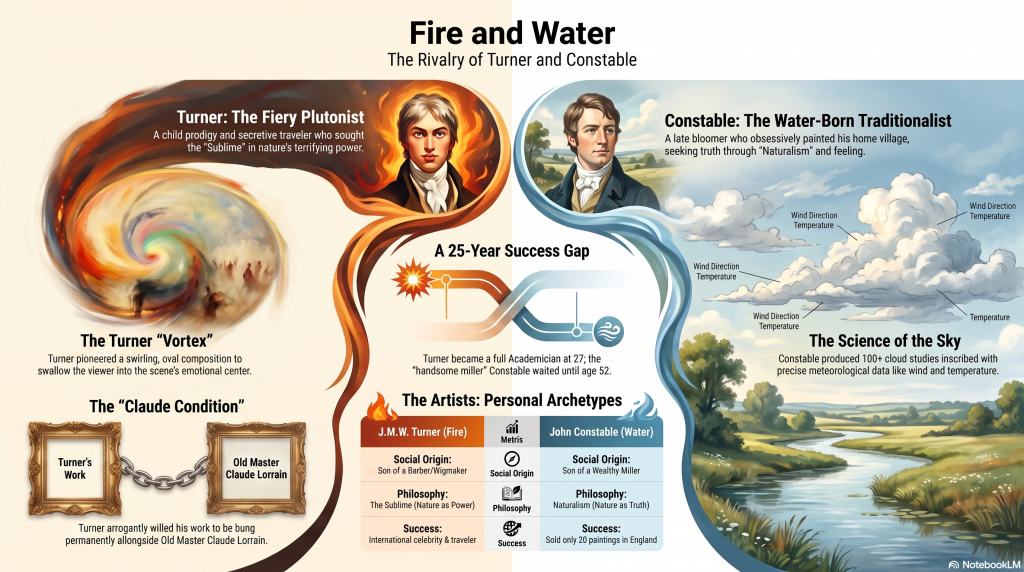
Tate Britain is currently celebrating the 250th anniversary of the births of J.M.W. Turner and John Constable with an exhibition that foregrounds a peculiar dichotomy: “Fire and Water.” This is not merely a shorthand for their respective palettes, but a reference to a biting 1831 review in the Literary Gazette that framed their artistic rivalry as a clash of scientific fundamentalism.
To understand why these two landscape masters were viewed through the lens of geological combat, one must look at the era’s obsession with the Earth’s origins. As the Literary Gazette noted on May 14, 1831:
“Fire and Water. If Mr. Turner and Mr. Constable were professors of geology, instead of painting, the first would certainly be a Plutonist, the second a Neptunist.”
1. Takeaway 1: Painting as a Geological Battleground
In the early 19th century, geology was a fierce ideological battlefield. “Plutonists,” inspired by James Hutton and Charles Lyell, argued that internal molten heat was the primary agent of change, operating across “deep time.” Turner, the “Plutonist,” embraced this fiery, uniformitarian view. His work was a vortex of energy; indeed, his 1812 masterpiece Snow Storm: Hannibal Crossing the Alps marked the first appearance of his signature swirling composition—a visual manifestation of nature’s terrifying, transformative heat and power.
John Constable, by contrast, was the “Neptunist.” This theory, led by Abraham Gottlob Werner, posited that a primordial ocean had once covered the Earth, depositing rocks in layers. Constable’s “Water” was rooted in the “Naturalism” of the present. He treated the sky as a laboratory for “natural philosophy,” using Luke Howard’s 1803 cloud classifications to record weather with clinical precision. While Turner painted the internal heat of the world, Constable meticulously documented the humidity of its surface.
2. Takeaway 2: The Myth of the Grunting Recluse
The popular cinematic image of Turner—the taciturn, grunting figure portrayed in the 2014 film Mr. Turner—belies a historical reality of sophisticated sociability. Turner was a child prodigy and a full Academician by the age of 27, whereas Constable was a “late bloomer” who waited until 52 for the same honor.
Far from being a misanthrope, the historical Turner was witty, hosted dinners, and was deeply engaged with the scientific elite. His later reclusiveness was a choice to protect his domestic happiness with Sophia Booth. Living under the pseudonym “Mr. Booth,” he protected his private life from the Royal Academy. He was, however, shrewdly eccentric: he notoriously trained a pet parrot to scream abuse at visitors he didn’t like.
3. Takeaway 3: The Apocalypse Hidden in an Idyll
Constable’s 1816 work Flatford Mill is often cited as a pinnacle of rural bliss, yet its creation coincided with environmental catastrophe. 1816 was the “Year Without a Summer,” triggered by the 1815 eruption of Mount Tambora. The resulting volcanic ash blocked the sun, creating eerie yellow skies, harvest failures, and bread riots.
For Constable, a staunch Tory who viewed the Great Reform Act as a “slippery slope to anarchy,” painting this “pastoral bliss” was a political act. While England suffered from famine and social unrest, he used landscape as an escape hatch into childhood memory. By omitting the agricultural distress and bread riots of his era, he was preserving a vision of “hallowed soil” and a fixed natural order where “people know their place.”
4. Takeaway 4: Performance Art on Varnishing Day
The two artists’ methods were as polarized as their worldviews. Constable was a perfectionist who used a drawing frame and a sheet of glass to trace perspectives with scientific accuracy. Turner, meanwhile, turned the act of creation into theater.
The peak of this “performance art” occurred during the 1834 “Varnishing Days” at the British Institution. Turner arrived with a canvas for The Burning of the Houses of Lords and Commons that was little more than grey and white daubs. For three days, he finished the entire work in public, frantically using brushes, rags, palette knives, and even his fingernails to mimic the flickering chaos of the fire. It was a spectacle that mirrored the literal fire of the event itself.
5. Takeaway 5: Arrogance as a Legacy (The “Claude Condition”)
Turner’s competitive streak was extreme, fueled by a desire to surpass the Old Masters. This culminated in his legally mandated “Claude Condition.” He bequeathed Dido Building Carthage to the National Gallery on the condition that it hang forever alongside two works by Claude Lorrain: Seaport with the Embarkation of the Queen of Sheba and The Mill.
Turner’s bluntness was a defense of his artistic standing. He famously remarked, “Socially, I am a dog,” rejecting the expectations of polite society in favor of a legacy built on his own uncompromising terms. His insistence on hanging next to Claude was a bold, arrogant act of “Fire,” ensuring he would be judged for eternity against the greatest landscape artist of the past.
Conclusion: The Enduring Vortex
The rivalry between Turner and Constable signals a definitive shift from the Age of Reason to the Age of Feeling. Landscapes were no longer mere backdrops; they became a “mirror for human feelings.” As Constable himself noted, “Painting is but another word for feeling.”
Today, we are left to choose between two versions of nature: Constable’s “Naturalism,” where truth is found in the soil and the scientific observation of a cloud, or Turner’s “Sublime,” where nature is a terrifying, shifting power that renders human ambition insignificant. One offers us a home; the other offers us a vortex.
99-03 Too Good to Eat
This talk gathers a selection of engaging and unexpected topics from across the broad sweep of art history, offering short illustrated introductions to subjects that fall outside the main chronological narrative but richly reward exploration. Here you will find discussions of individual masterworks, intriguing artists who defied easy categorisation, thematic surveys of recurring subjects such as animals, gardens, and the nude, and reflections on the ways art intersects with science, literature, and popular culture. The talks are self-contained and accessible, requiring no prior knowledge of art history, and can be enjoyed in any order as an enjoyable supplement to the main course. Whether you are a committed student working through every chapter or a casual visitor dipping in for pleasure, these shorter explorations offer fresh perspectives and surprising connections that illuminate the larger story of Western art. The aim, as always, is to make the visual riches of the past genuinely accessible and alive for a contemporary audience.
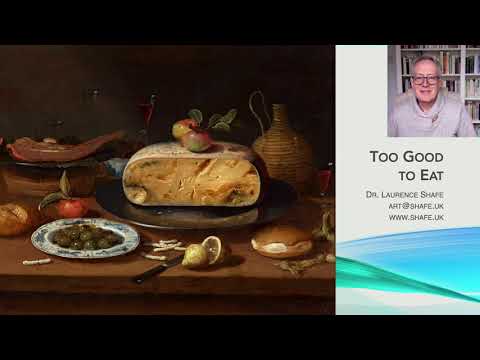
An interesting conversation on the subject “Too Good to Eat” in art created by Google Notebook from my notes:
We have stared at Leonardo’s Last Supper for centuries, peering through the shadows for Da Vinci codes and divine secrets, yet we have consistently overlooked the most basic human detail: the menu. For as long as we have possessed the impulse to create, we have possessed the impulse to record what sustains us. To the uninitiated, a still-life painting is merely a “pretty picture”—a decorative arrangement of flora and fauna. In truth, these canvases are sophisticated repositories of economic data, biological curiosities, and the often bizarre scientific hubris of our ancestors.
Consider the unsettling intimacy of a work attributed to Jan van Kessel the Elder, Still Life with Cheese (c. 1650). It is a diminutive masterpiece, measuring a mere 16.5 by 20.3 centimeters, yet within this tiny frame lies a world of decay and artifice. Amidst the mouldy cheese and a lemon surrendered to rot, one notices a scattering of small white worms across the table. They are not, however, a testament to infestation, but to a seventeenth-century sweet tooth. These are “ragged comfits”—strips of cinnamon, nuts, or seeds coated in jagged layers of sugar. This interplay between the appetizing and the queasy serves as a perfect gateway into the counter-intuitive history of the human table.
1. Leonardo’s Culinary Subversion: The Eel on the Table
In the popular imagination, the meal shared by Christ and his disciples was the traditional Passover Seder: roasted lamb, bitter herbs, and unleavened bread. However, when Leonardo da Vinci sat down to compose his mural, he chose to prioritize his own palate over scriptural literalism.
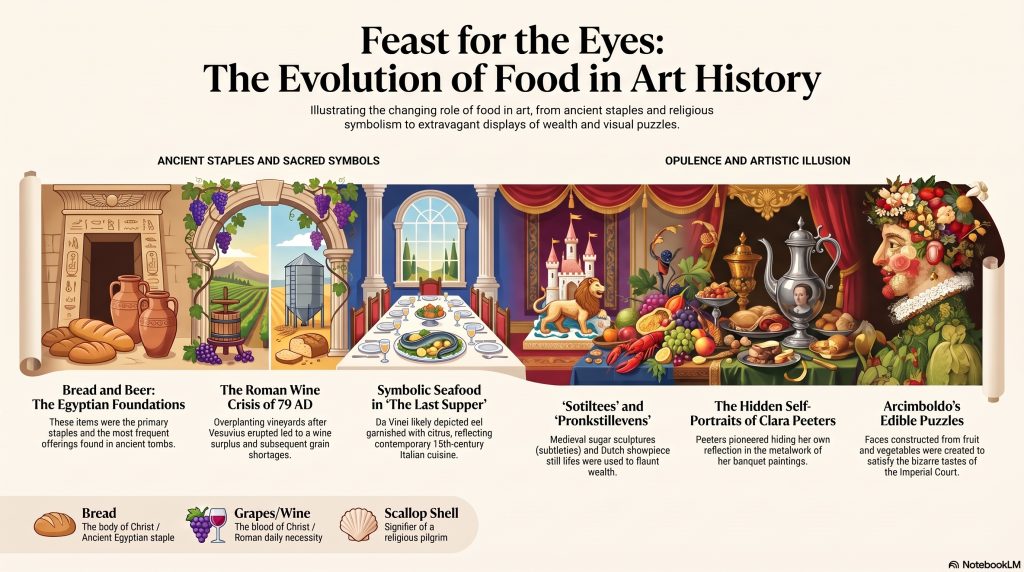
Through the remarkably preserved copy of the mural by Giampietrino—a work that offers a clarity the decaying original in Milan has long lost—we see the truth of Leonardo’s table. There is no lamb. Instead, the plates are laden with chunks of eel garnished with elegant slices of orange or lemon. This was no theological statement; it was an act of gastronomic stubbornness. Leonardo’s personal library contained a contemporary cookbook featuring two specific recipes for eel prepared in exactly this fashion. The world’s most famous sacred meal was, in reality, a reflection of the artist’s favorite snack, proving that even the most “divine” art is often rooted in the hunger of the man holding the brush.
2. The “Dangerous” Salad: Medieval Gastronomic Terror
To the modern diner, a crisp, raw salad represents the pinnacle of vitality. To the Medieval mind, however, “fresh and raw” was synonymous with “deadly.” Under the prevailing medical wisdom of humoral theory, raw fruits and vegetables were considered cold, moist, and inherently hazardous to the digestive fire.
In the fourteenth-century manuscript Livre du roi Modus et de la reine Ratio, we find a charming visual of peasants sharing a communal meal of bread and drink. The scene looks warm and inviting, yet the period’s culinary texts provide a chilling subtext. One contemporary cookbook offered a stern warning that would baffle a modern nutritionist:
“Beware of green salads and raw fruits, for they will make your master sick.”
Because of these fears, the medieval kitchen was a place of total transformation. Vegetables were boiled into oblivion within thick pottages, and meat was salted or smoked to a desert-dryness. This historic “salad phobia” serves as a striking reminder of how our biological understanding of health is perpetually in flux.
3. Tasting 2500 B.C.: The Resurrection of Egypt’s Living Bread
The relationship between art and food is rarely literal, but in the case of ancient Egypt, it has become biological. A painted limestone fragment from 2500 B.C. depicts a scene of domestic industry: servants meticulously tending to dough and brewing vats. In Egypt, bread and beer were not merely staples; they were the essential currency of the afterlife, frequently deposited in tombs to sustain the soul in eternity.
In a breathtaking bridge between the visual and the visceral, a team of researchers in Queensland, Australia, recently isolated dormant yeast found within these very tomb offerings. By awakening these ancient microorganisms, they have succeeded in baking genuine Egyptian bread—a “living” connection to a civilization long turned to dust. Their current efforts to recreate Egyptian beer using these same isolated strains mean that we may soon be able to taste the exact flavors depicted on those limestone walls four and a half millennia ago.
4. Volcanic Economics: How Vesuvius Crashed the Market
The lush wall paintings of Pompeii, such as the vibrant depictions of pomegranates and grapes from A.D. 70, suggest a society of effortless abundance. Yet, these images of “trompe l’oeil” fruit hide a story of fragile systems and economic catastrophe.
The eruption of Mount Vesuvius in 78 AD did more than bury a city; it annihilated the most vital wine-producing region of the Roman Empire. The resulting supply shock caused prices to spike so violently that it triggered a frantic, unregulated “gold rush” of viticulture. Landowners across Italy abandoned grain production to plant lucrative vineyards. This over-correction eventually led to a massive wine surplus and a subsequent price crash that bankrupted producers. Crucially, the loss of grain fields triggered a widespread food shortage. This ancient cycle of disaster and market volatility mirrors our modern anxieties, such as the invasion of Ukraine—once the world’s “breadbasket”—and its immediate impact on global wheat exports. The Pompeian frescoes remind us that the stability of the dinner table has always been at the mercy of both nature and geopolitics.
5. Arcimboldo’s Optical Riddles: The Architecture of the Larder
In the sixteenth-century courts of Vienna and Prague, intellectual life was defined by an obsession with the bizarre and the metamorphic. No artist captured this better than Giuseppe Arcimboldo. His puzzle-paintings, such as The Greengrocer, appear at first as cluttered, unremarkable bowls of produce. However, when the canvas is rotated 180 degrees, the onions, carrots, and radishes coalesce into a human face.
This was more than a mere courtly gimmick; it was a play on the biological phenomenon of facial recognition. While those with prosopagnosia (face blindness) struggle to recognize even their own kin, the average human brain is hard-wired to find a face in almost any pattern. Arcimboldo’s work was largely forgotten after his death, dismissed as a curiosity, until the Surrealists rediscovered him in the twentieth century, recognizing in his “food faces” a precursor to their own explorations of the subconscious. His work remains a testament to a time when the contents of a larder could be transformed into a sophisticated optical riddle for the elite.
Conclusion: We Are What We Paint
As the recent “Feast & Fast” exhibition at the Fitzwilliam Museum reminded us, the history of food in art is the history of the human condition. Whether it is the “pronkstilleven” (showpiece still life) of the Dutch Golden Age—overflowing with imported porcelain and luxury—or the humble, symbolic crusts of a Caravaggio, these images are mirrors of our vanity, our scientific errors, and our deep-seated fears.
If an artist were to paint your “still life” today, what would the canvas reveal? Would it be a story of globalized abundance, or a warning of the fragility of our modern systems? History suggests that the most profound truths about a society are rarely found in its manifestos, but are instead hidden somewhere on the plate.
99-04 Art at the Seaside
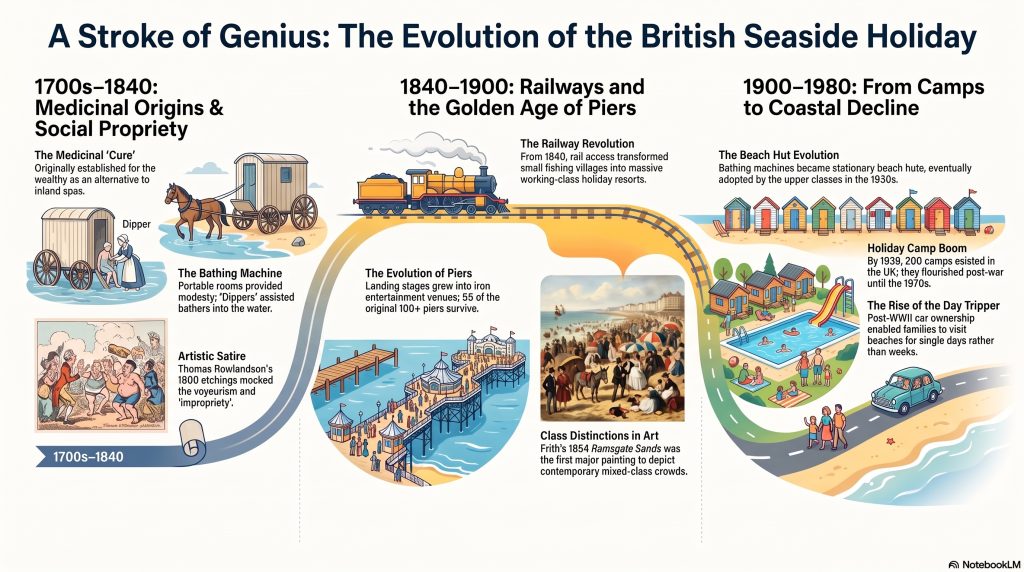
This talk outlines the history of British seaside culture and its representation in art. It explores how coastal trips evolved from medicinal spa treatments for the wealthy in the 1700s to popular working-class vacations facilitated by the expansion of the railway. The sources highlight the social etiquette of early bathing, noting how bathing machines were used to maintain modesty while satirical artists like Thomas Rowlandson poked fun at the era’s voyeurism. Beyond leisure, the documents address the seaside as a workplace for the fishing industry and a creative hub for art colonies in places like St. Ives and Newlyn. Profiles of famous painters such as J.M.W. Turner and John Sell Cotman illustrate how the unique light and landscape of the coast inspired significant English landscapes. Ultimately, the materials track the rise and fall of holiday camps and the enduring legacy of the British seaside through centuries of social and artistic change.
My notes on Art at the Seaside
A conversation about Art at the Seaside created by Google Notebook from my notes:
To the modern traveler, the British seaside is a landscape of casual nostalgia—a place of colorful buckets, sandy sandwiches, and the faint scent of salt and vinegar. We view the coast as a site of total relaxation, yet its history is rooted in a culture of rigid social codes, extreme modesty, and bizarre medical theories. Long before it was a playground, the ocean was a pharmacy. In the 18th century, “cold-water immersion” was prescribed as a violent shock to the system, intended to cure everything from hysteria to gout.
The journey from the rugged, working coastline to the manicured resort was neither natural nor accidental; it was a calculated cultural rebranding. We must ask: how did a terrifying medicinal “cure,” once reserved for the ailing elite, evolve into a multi-billion-pound leisure industry? The answer lies at the strange intersection of theology, voyeurism, and high art.
The “Big Bang” of the British Holiday: A Vicar and a Cure
The concept of the seaside holiday did not exist before the 1700s. Historically, the coast was a site of industry—the smell of fish and the labor of salvage—viewed with little romantic interest. The transformation began when the wealthy, seeking alternatives to the overcrowded “taking of waters” (internal consumption) at inland spa towns, pivoted toward “immersion” (external application).
While Scarborough—already a popular spa town—successfully pivoted to the sea, the “Big Bang” of the formalized British holiday can be traced to a single date: July 22, 1736. On this day, a British vicar is credited with formalizing the seaside retreat as a distinct cultural entity. This was the moment the coastline shifted from a workplace into a sanctuary for the rich, moving the medicinal focus from the spring to the surf.
Modesty on Wheels: The Ancestry of the Beach Hut
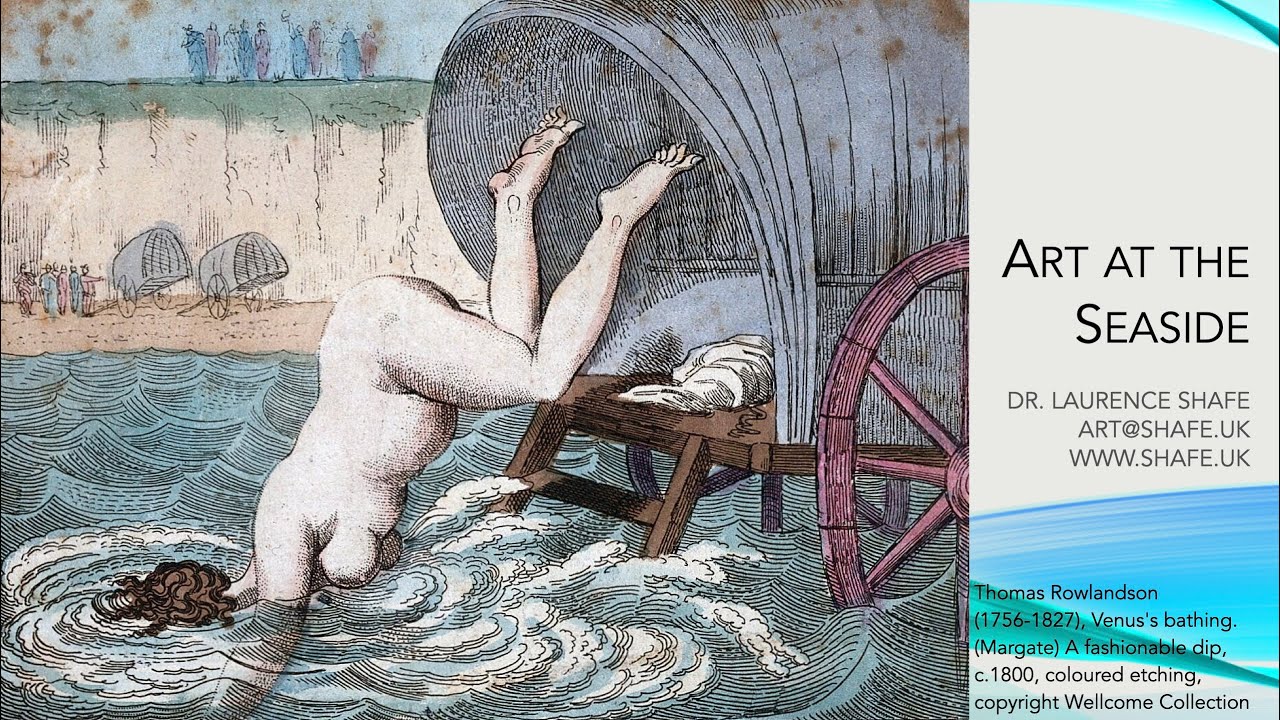
By 1735, the “etiquette of bathing” required a specialized piece of technology: the bathing machine. First appearing in Devon (and later perfected in Margate around 1750), these wooden huts on wheels were designed to protect the bather’s modesty from the “gendered gaze.” A bather would enter the machine on dry land, change into their costume, and be rolled into the surf by a horse or a “Dipper”—a professional dunking assistant whose job was to plunge the bather into the water.
Equipped with flags to signal a return to shore, these machines represent the peak of the Victorian obsession with propriety. Over time, as social mores relaxed in the 1890s, they were parked permanently at the top of the beach, evolving into the high-priced beach huts of today. Even royalty submitted to this ritual. On July 30, 1847, Queen Victoria recorded her first experience in her journal:
“I… went into the bathing machines, where I undressed & bathed in the sea (for the 1st time in my life), a very nice bathing woman attended me. I thought it delightful till I put my head under water, when I thought I should be stifled.”
The Nudity Paradox and the Victorian Hair Fetish
Seaside etiquette was defined by a startling double standard. Until the 1860s, men typically bathed nude, a practice considered respectable as long as they remained distant from the ladies. Conversely, middle-class women were weighed down by heavy, thick woolen costumes that became cumbersome and revealing when wet—often riding up to the neck in the waves.
This tension was heightened by the Victorian “hair fetish.” Respectable women were never seen with loose hair except by their husbands in the bedroom. Hair was a cultural obsession; at the peak of this fad in the 1840s and 50s, whole suites of jewelry were fashioned from the plaited hair of family members and lovers. Consequently, drying one’s hair in public after a dip was a scandalous, eroticized act.
Thomas Rowlandson’s 1813 etching, Summer amusement at Margate, satirized this voyeuristic “gendered gaze,” depicting crowds of men—and even some women—using “magnifying mediums” (telescopes) to view “nude groups and sportive syrens.” The source concludes that Margate was “not a place which attracted truly modest women,” particularly as working-class groups often engaged in “mixed nude bathing,” horrifying middle-class observers. The resistance to clothing was captured in 1874 by a local rector who fumed in his diary about the “detestable custom” of wearing drawers:
“If ladies don’t like to see men naked why don’t they keep away from the sight?”
J.M.W. Turner’s Secret Sanctuary: “Admiral Booth”
The seaside was a sanctuary for J.M.W. Turner, who maintained a profound 20-year connection to Margate (1827–1847). To escape London life, Turner lived a double identity, staying with Sophia Booth at her Cold Harbour guesthouse. Following the death of Sophia’s husband, Turner adopted the name “Mr. Booth”—and was known locally as “Admiral Booth”—becoming Sophia’s long-term companion.
His 1822 painting, Margate, demonstrates a critic’s eye for the “lee shore”—a coast where the wind blows toward the land, making it a trap for sailing ships. The work depicts a ship breaking up while townspeople engage in complex salvage operations. For Turner, the seaside was never just a resort; it was a site of elemental power and a private refuge for his secret life.
The “Vulgar” Success of William Powell Frith
In the mid-19th century, the seaside transitioned from a medicinal site to a subject of “fine art.” William Powell Frith’s Ramsgate Sands (Life at the Seaside) (1852–54) was revolutionary. Two decades before the French Impressionists, Frith documented the contemporary Victorian crowd.
Frith famously used his own family as models—the little girl paddling in the center is his daughter, and he included a self-portrait peeping over a shoulder on the far right. While the art establishment labeled the work a “piece of vulgar Cockney business,” the public was obsessed. When displayed at the Royal Academy, a guard rail had to be installed to protect it from the crushing crowds—the ultimate mark of a “vulgar” success. Queen Victoria herself purchased it for £1,000.
Piers, Propaganda, and the Strayed Sheep
As resorts grew, infrastructure followed. Piers evolved from landing stages for ferries—like Ryde Pier (1814)—into entertainment venues designed by luminaries such as Eugenius Birch. However, the coast also held a serious political weight.
William Holman Hunt’s Strayed Sheep (Our English Coasts) (1852) is a masterpiece of Pre-Raphaelite “truth to nature.” The detail is microscopic; one can see the sun shining through the sheep’s ears, illuminating the blood vessels. Yet, beneath the beauty was a sharp political allegory. Painted during the 1852 fear of a French invasion, the vulnerable sheep on the cliff’s edge represented England’s poorly defended coasts. The “lost sheep” served as a religious warning: those who stray from the path of righteousness are in danger of “falling into sin,” or in this case, falling from the English cliffs.
Conclusion: The Changing Tide
The British seaside reached its cultural zenith with the “all-in” holiday camps of the 1930s through the 1960s, such as Butlins and Warners. This popularity waned in the 1970s as cheap foreign package holidays offered guaranteed sun. Yet, the allure of the shore has not disappeared; it has simply become a luxury.
Today, a 12×10-foot beach hut can sell for a staggering £330,000. This valuation suggests that we are still seeking that 18th-century “medicinal” escape, though we now pay for the horizon itself rather than the cold-water shock. Are we still trying to “stifle” our modern anxieties in the same waves that Queen Victoria found so overwhelming in 1847? Perhaps, despite our modern costumes, the human need for the salt-air sanctuary remains the one constant in an ever-changing tide.
99-05 Cabarets and Clubs in Modern Art
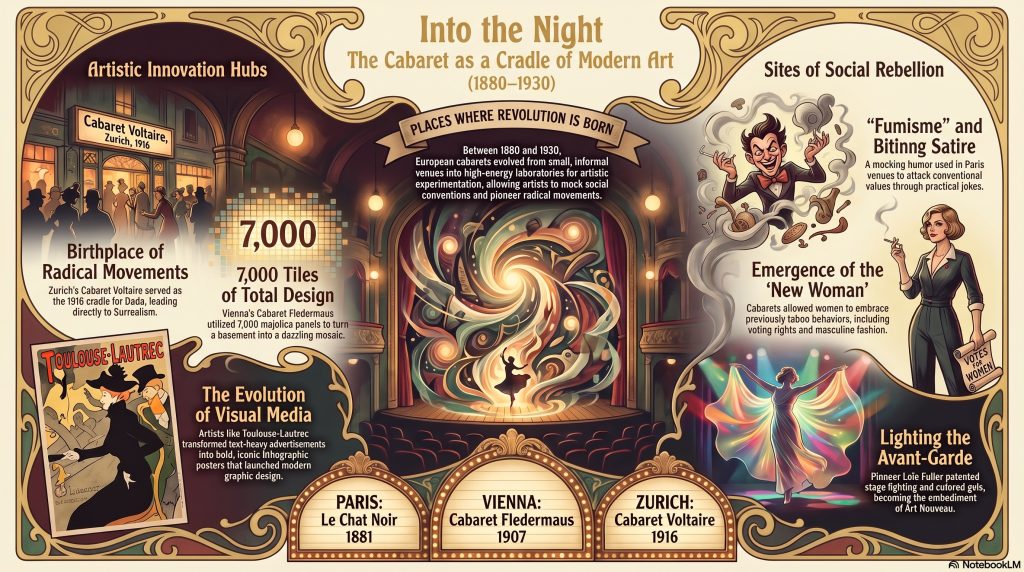
During the late nineteenth and early twentieth centuries, European cabarets and clubs served as vital hubs for artistic experimentation and the subversion of social norms. Emerging first in Parisian districts like Montmartre, these intimate venues—most notably Le Chat Noir, the Moulin Rouge, and the Folies-Bergère—fostered a culture of satirical humor and avant-garde performance. Renowned artists such as Henri de Toulouse-Lautrec and Édouard Manet captured the era’s complex atmosphere, documenting everything from the extravagant can-can to the somber realities of the working class. Iconic performers like Loïe Fuller and Jane Avril became symbols of the Art Nouveau movement, utilizing innovative stagecraft and lighting. This “Belle Époque” period saw the birth of the modern poster, which used bold lithography to advertise a world of decadence and progress. Ultimately, these nightlife spaces acted as precursors to radical movements like Dada, reflecting the profound cultural and political shifts of the time.
My notes on Cabarets and Clubs in Modern Art
A conversation about the role of Cabarets and Clubs in Modern Art created by Google Notebook from my notes:
1. Introduction: Beyond the Can-Can
When we look back at the late nineteenth century, our collective memory is often filtered through a glittering, cinematic lens: the high-kicking dancers of the Moulin Rouge, the extravagance of the Folies-Bergère, or the smoke-filled nostalgia of Liza Minnelli’s Berlin. This was the era of La Belle Époque—a “Beautiful Epoch” of perceived peace and prosperity. Yet, beneath the optimistic veneer enjoyed by the wealthy was a massive underclass living in slums, and it was in the friction between these worlds that the cabaret emerged. Far from being mere tourist traps for “risqué” entertainment, these venues were radical laboratories where the social conventions of the day were meticulously mocked. Between 1880 and 1930, the cabaret became the haunt of an intellectual elite that used these informal spaces to experiment with the ideas that would define the twentieth century.
2. The Cabaret as a “Revolutionary Birthplace”
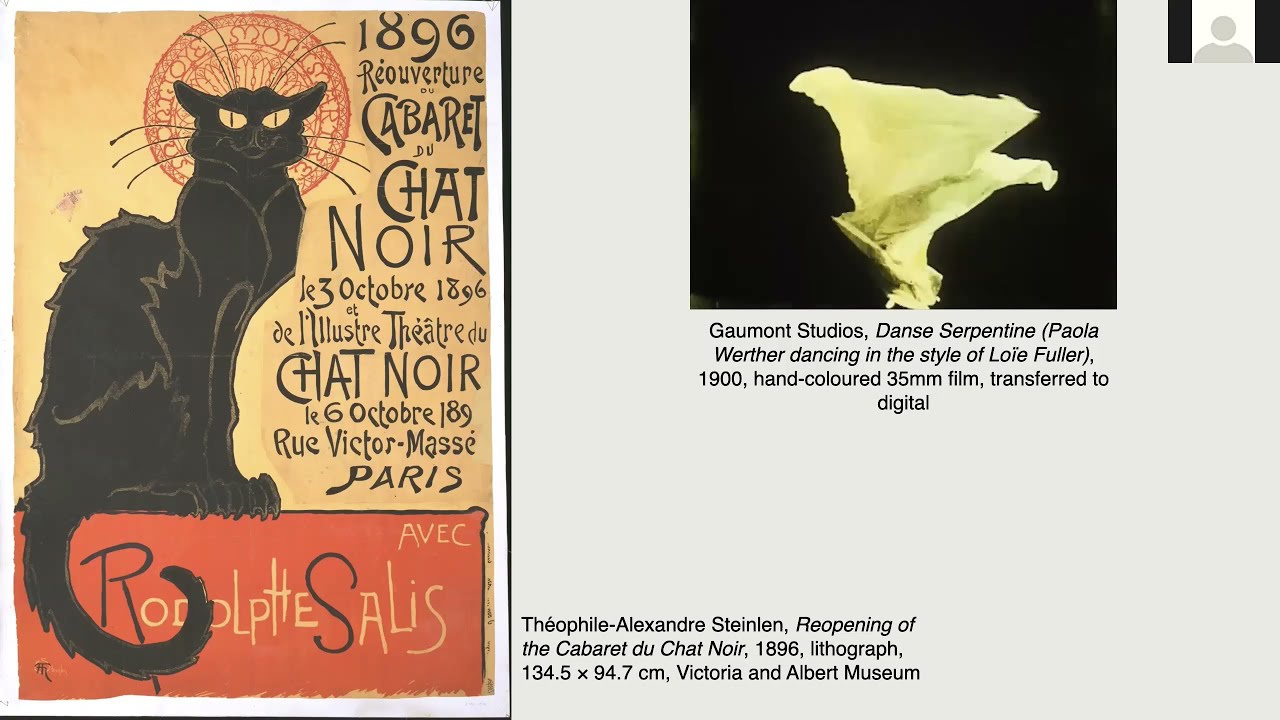
The modern cabaret began in 1881 with the opening of Le Chat Noir (The Black Cat) in Montmartre. It was here that the concept of fumisme—a biting, self-deprecating satire designed to assault conventional morality through “practical jokes” and mischief—found its first home. This spirit of subversion traveled quickly. In London, Frida Strindberg founded the Cave of the Golden Calf (1912–1914), a venue featuring “art-subversive interiors” by Wyndham Lewis and Jacob Epstein. These spaces were not merely bars; they were sites of ideological transformation. As the historical record suggests:
“The cabaret is ‘a place where the conviction that “I am nothing and I should be everything” takes shape … a place where the revolution is born’.”
3. Manet’s Barmaid: The Original Study in Human Disconnect
Édouard Manet’s final masterpiece, A Bar at the Folies-Bergère (1882), is perhaps the most profound critique of the cabaret as a capitalist engine. The central figure, a barmaid named Suzon, stands amidst a sea of commodities: bottles of Bass Pale Ale, peppermint liqueur, and oranges. Art critics have long obsessed over the “incorrect” reflection in the mirror behind her; however, X-ray analysis reveals that Manet deliberately shifted the reflection over several iterations to make it less correct, heightening the sense of Suzon’s detachment. She is presented not as a person, but as a commodity for sale—a sentiment echoed by a feminist interpretation of the era, which notes that barmaids at the Folies-Bergère were frequently forced into prostitution to survive. Manet captures the “psychological gap between the sexes,” rendering Suzon as a “vile slave” to a consumerist system that demanded her availability while ignoring her humanity.
4. The “Electric” Innovation of Loïe Fuller
The cabaret was also a forge for technological advancement. At the Folies-Bergère, American dancer Loïe Fuller became the literal embodiment of the Art Nouveau movement. She was as much an inventor as a performer, utilizing lighting from the Edison Electric Light Company only two years after its commercial debut. Fuller held numerous patents for her stage lighting and colored gels, using them to transform her body into shimmering, organic forms. While she famously introduced Isadora Duncan to Paris, it was the poster artist Jules Chéret who codified her image for the masses. In 1929, Chéret was hailed as the “father of women’s liberation” because his vibrant posters depicted women—modeled after the lively Fuller—as joyous, elegant, and independent figures capable of engaging in previously taboo activities like smoking in public.
5. Futurism’s Bizarre War on Pasta
In Rome, the restaurant Bal Tic Tac (1921) served as a canvas for the Futurists, with interiors designed by Giacomo Balla. The movement sought to bridge the gap between art and science through “universal dynamism.” This obsession with modernity even reached the kitchen. Filippo Marinetti launched a radical campaign against pasta, labeling it an “absurd gastronomic religion” that induced “pessimism” and “nostalgic inactivity.” The Futurists believed that the “tangible miracles of contemporary life” required a lighter, more dynamic diet. As one Futurist writer argued:
“Spaghetti poisons us… our thoughts wind round each other, get mixed up and tangled like the vermicelli we have taken in.”
They recommended rice instead, viewing it as a fuel more suited to the speed and violence of the new century.
6. Cabaret Voltaire: Art as a Shelter from War
By 1916, the focus of the avant-garde shifted to Zurich. At the Cabaret Voltaire, refugees like Hugo Ball and Marcel Janco used “collective confusion” to process the trauma of World War I. This was the crucible of Dadaism, a movement that rejected any form of “ultimate truth” in response to a society that had descended into industrial slaughter. Hugo Ball famously performed his phonetic poems while encased in a “rigid Cubist costume,” a visual manifestation of the absurdity of the age. Through parody and the deconstruction of language, the performers at Cabaret Voltaire sought to shatter the systems of government and philosophy that had led to the war.
7. The Duality of the “New Woman” in Weimar Berlin
The Weimar Republic saw Berlin emerge as the most “degenerate” and socially liberal city in Europe. This era introduced the “New Woman”—an archetype characterized by short hair, masculine attire, and the right to vote. This image reached its mechanical extreme with the Tiller Girls, whose “sexless” and precise mechanical performances mirrored the industrialization of the human form. However, the shimmering life of the nightclub often masked a brutal reality. Many “New Women” faced low pay and long hours, all while the legendary hyperinflation of the 1920s saw a loaf of bread cost 100 billion marks. No one embodied this volatility more than Anita Berber, who performed “erotic fantasies” fueled by ether and morphine. Though rumors of an overdose persisted, she died a pauper in 1928 of tuberculosis, a stark reminder of the darkness that lurked behind the cabaret’s neon lights.
8. Conclusion: The Shimmering Legacy of the Night
The early nightclubs were far more than sites of hedonism; they were the essential hubs where the “dynamic sensation” of modern life, as championed by Gino Severini, was first articulated. From the mathematical precision of Georges Seurat’s Pointillism in Le Chahut to the “art-subversive” interiors of the Cave of the Golden Calf and the mosaic-tiled elegance of Vienna’s Cabaret Fledermaus, these venues challenged the illusory nature of reality itself. They forced a confrontation with the psychological and social gaps of the modern world, proving that the most important artistic revolutions did not start in the academy, but in the dark.
In our modern world of curated digital spaces, where does the “revolution” happen today?Gemini Notebook can be inaccurate; please double-check its responses.
99-06 The Thames in Art

The Thames has served as London’s commercial center, a site for public gatherings, and a profound source of creative inspiration for centuries. This talk examines the river’s historical evolution through a curated selection of artworks and manuscripts, ranging from prehistoric artifacts to seventeenth-century descriptions. Significant items include the Dagenham Idol, a 4,000-year-old figure found in river marshland, and a Roman medallion from 296 AD that depicts the city’s recapture. The sources also highlight medieval maps created by Matthew Paris in the 1250s, which offer some of the earliest visual depictions of London and its iconic landmarks. By documenting the river’s role in international trade and cultural legend, the text underscores why the Thames remains the defining feature of the English capital. These varied perspectives combine to tell a story of the river as both a functional waterway and a symbolic foundation for the nation.
An interesting conversation on the Thames in Art created by Google Notebook from my notes:
1. Introduction: The River that Built a Kingdom
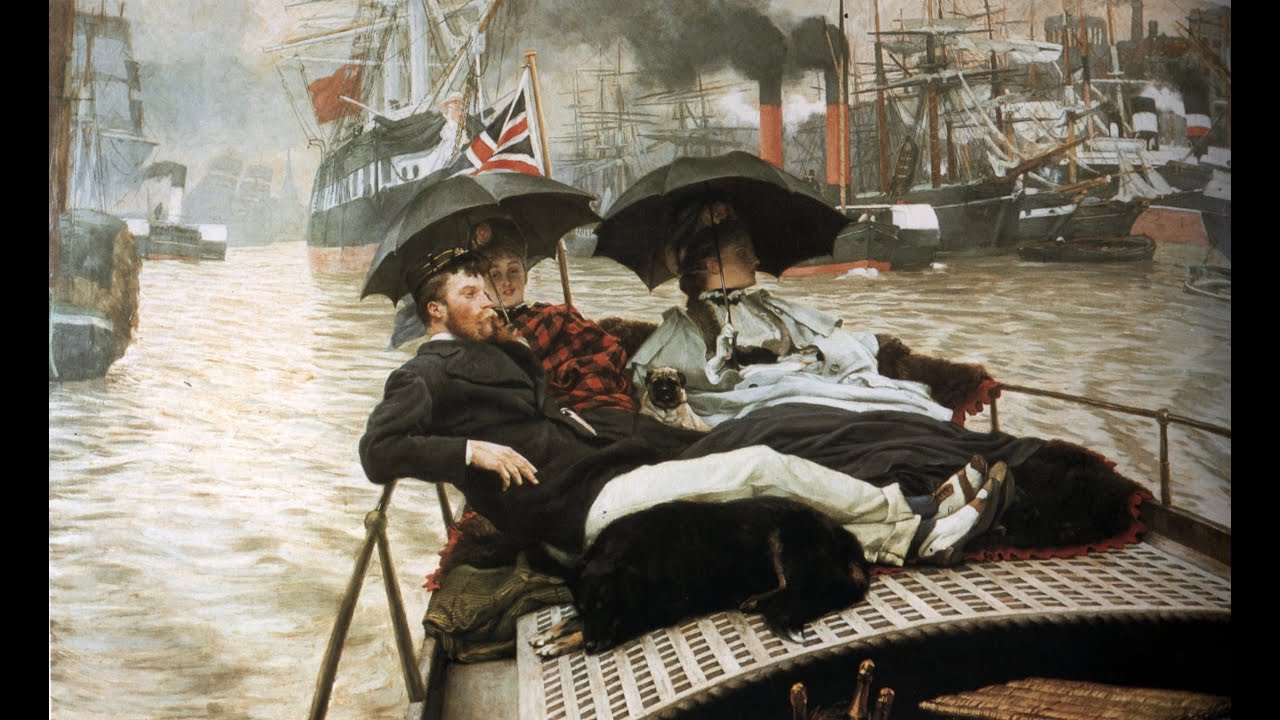
To the modern observer, the River Thames is a disciplined, civilized waterway, flanked by engineered embankments and sanitized by modern infrastructure. Yet, as any cultural historian will attest, this “liquid history” was for centuries a site of profound contradiction: a center of global trading chaos, the epicenter of the “Great Stink,” and a wild, shifting landscape that inspired both terror and artistic sublimity. To understand London, one must peel back the layers of its river, moving beyond the postcard images to the artifacts and archives that reveal its true character.
This exploration seeks to uncover the most impactful and counter-intuitive takeaways from the Thames’s historical and artistic record. As Dr. Laurence Shafe notes:
“The Thames has been the trading heart of London, a source of entertainment, the location for ice fairs, and the cause of the Great Stink.”
Beyond these well-known associations lie deeper secrets—relics of ancient fertility rites, vast “blind spots” in our visual memory, and the political myths used to justify the divine right of kings.
2. The Bronze Age Offering: The 4,000-Year-Old “Dagenham Idol”
Long before the first Roman stone was laid, the Thames was a sprawling, liminal environment. In the early Bronze Age (c. 2250 BCE), the river was significantly wider and more sluggish than the channel we recognize today, bordered by treacherous marshes and dense reed beds. This prehistoric landscape was essentially a series of shifting wetlands, a “marvellous quiet course” that was as much a barrier as a highway.
The most evocative witness to this era is the “Dagenham Idol,” unearthed three meters deep in a layer of peat during a 1922 excavation. This 18-inch wooden figure is a haunting example of a votive offering. The presence of a hole in the pubic region suggests the figure is female—likely a fertility sacrifice—and its burial alongside the skeleton of a deer indicates a sophisticated ritualistic culture.
Crucially, the geology of the riverbed determined the very existence of the city. While the marshes restricted movement, a specific “seam of gravel” near the current London Bridge provided the first reliable ford. This geological accident fixed the location of a Celtic center that would eventually provide the bridgehead for the Roman city of Londinium.
3. The Invisible Millennium: London’s 1,200-Year Visual Gap
For the art critic, perhaps the most startling fact about London is that it remained effectively invisible for the majority of its existence. We face a staggering 1,200-year “visual gap” in the city’s history. Between the departure of the Romans and the production of Matthew Paris’s map in 1250, there is almost no surviving visual record of the city.
As the historical record emphasizes:
“Unfortunately, we have almost no visual record for about two-thirds of London’s history.”
The singular, precious exception is a gold medallion struck in Trier in AD 296. This is not merely a coin but a sophisticated piece of political iconography. It commemorates the general Constantius Chlorus’s arrival to reclaim Britain from the usurper Allectus. Below the “LON” letters, one sees a kneeling figure that personifies London; she is depicted giving thanks to the Roman general for not sacking the city. Beyond this tiny, gold-pressed window, the city’s appearance for the next millennium remains a matter of archaeological conjecture rather than visual fact.
4. The Legend of “New Troy”: When London Traced its Roots to Noah
When the visual record finally resumes in the 13th century with Matthew Paris’s Historia Anglorum, it does so with a heavy dose of “pseudo-history.” Paris, a Benedictine monk and cartographer, illustrated a pilgrimage route from London to Jerusalem. In the Anglo-Norman text accompanying the illustration of London, he records a shocking claim: that the city was founded as “New Troy.”
The text asserts that a Trojan named Brutus was the first inhabitant of England and the founder of London (la funda e lapela troie la nuvele). This legend, popularized by Geoffrey of Monmouth in his 1136 work Historia Regum Britanniae, served a critical political function. By tracing a lineage back to Brutus, and subsequently to Noah and Adam, British kings used this mythological pedigree to justify their power as divinely sanctioned. In this framework, the Thames was not just a commercial artery but the sacred seat of a Trojan heritage.
5. The Little Ice Age and the Mystery of the 1677 “Frozen” Painting
The river’s environmental history is a story of extremes, swinging from the Medieval Warm Period (c. 950–1250) to the “Little Ice Age” (c. 1300–1850). This latter period saw the rise of the famous Frost Fairs, occurring sporadically between 1608 and 1814.
However, a close iconographic analysis of Abraham Hondius’s 1677 painting, The Frozen Thames, reveals a mystery of artistic license. The work vividly depicts vast blocks of ice and figures traversing the river toward Old London Bridge and the church of St. Mary Overie (now Southwark Cathedral). Yet, historical meteorological records are clear: the Thames did not freeze in 1677. Hondius was likely reimagining the river based on the freeze of 1608 or his own compositional memories.
The river froze more frequently in this era for a technical, man-made reason: Old London Bridge. With its numerous narrow arches and “sterlings,” the bridge acted like a weir, creating a six-foot drop in water level and restricting the flow. This effectively stilled the water enough to allow the upstream sections to solidify—a phenomenon that vanished after the bridge was replaced in the 1830s.
6. The “Winchester Geese”: The Lawless South Bank
Wenceslaus Hollar’s 1647 masterpiece, The Long View of London, is a 2.7-metre-long etching composed of six plates that offers a topographically accurate look at the mid-17th-century city. Viewed from the tower of the church then known as St. Saviour (now Southwark Cathedral), it highlights the South Bank—or Bankside—as a zone of regulated lawlessness.
Because this area sat within the “Liberty of Southwark,” it was outside the jurisdiction of the City of London’s strict regulations. Consequently, it became the “entertainment” district, home to The Globe Theatre and brutal bear-baiting pits. This “liberty” was controlled by the Bishop of Winchester, who held the rights to license and tax the area’s numerous prostitutes. These women became known as “Winchester Geese.” The term has a grim linguistic legacy: a “bite from a Winchester goose” was slang for syphilis, and “goose bumps” originally referred to the distinctive skin symptoms of the disease.
7. Conclusion: The River as a Living Archive
The evolution of the Thames—from the prehistoric marshlands that swallowed the Dagenham Idol to the “principal store house” described by John Stow in 1603—reflects the evolution of Britain itself. The river has transitioned from a slow-moving wetland to a bustling, dirty industrial heart, and finally to the cleaner, regulated waterway of the 21st century.
As we look at the river today, we are forced to wonder what current aspects of the Thames—perhaps our modern embankments or our current struggle against rising sea levels—will most surprise cultural historians in the year 2500. For now, the river remains as Stow described it in his Survey of London:
“Thames the most famous river of this island… with marvellous quiet course to London… the principal store house, and staple of all commodities within this Realm.”Gemini Notebook can be inaccurate; please double-check its responses.
99-07 Venice – City of Water
This talk provides the history and a cultural analysis of Venice, largely through the lens of its architectural and artistic legacy. The talk chronicles the city’s evolution from a seventh-century refuge in a lagoon to a dominant European maritime power, ultimately transitioning into a celebrated center for eighteenth-century tourism. Detailed descriptions of historical paintings by Canaletto and Bellini highlight significant landmarks like the Grand Canal, St. Mark’s Basilica, and the Rialto Bridge. Beyond architecture, the material explores unique local traditions such as the Venetian Carnival and its specialized masks, as well as the city’s reputation for decadent allure and artistic excellence. The narrative emphasizes that Venice’s improbable survival on water continues to fascinate observers through its mysterious beauty and storied past.
My notes on Venice – City of Water
An interesting conversation about Venice in Art created by Google Notebook from my notes:
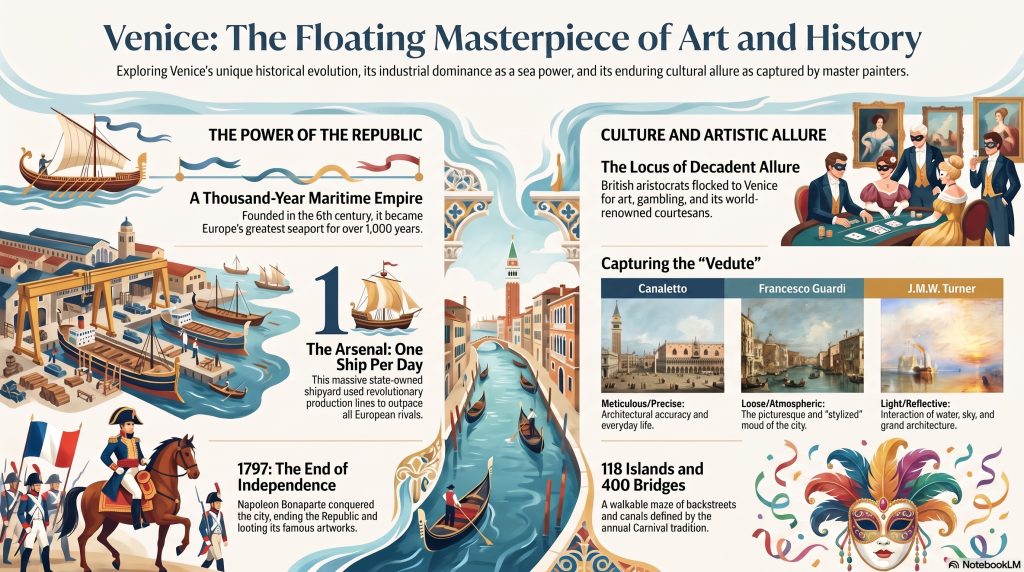
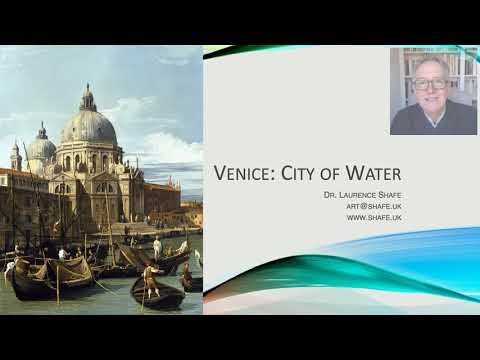
Venice is a geographical impossibility. At merely two and a half miles long by just over one mile wide, the city is a dense, labyrinthine miracle of 118 small islands and over 400 bridges. It is so intricate that one can walk across its entire breadth in an hour, yet even a seasoned traveler can become hopelessly entangled in its “sestieri” (districts), a maze of backstreets and dead ends.
To the art correspondent, Venice is less a city and more a series of vedute—those precise, architectural “views” that served as the eighteenth-century precursor to the modern postcard. As the historian Thomas F. Madden aptly noted: “No one forgets the first glimpse of Venice… there is that startling moment when one looks across the waves and finds what should not be there—stone towers, rich churches, and packed buildings rising out of the sea. The extraordinary beauty of Venice only adds to its improbability. How does such a city exist?” To answer that, we must look past the surface shimmer of the lagoon and into the canvases where the city’s secrets are hidden in plain sight.
1. A Refuge Born of Fear: The Marshland Origin
The grandeur of the Venetian Republic began not with a master architectural plan, but with a desperate flight for survival. In the 6th and 7th centuries, Romans fled the Germanic invasions of the Huns, seeking safety in the middle of a tidal lagoon. The marshy environment provided a natural “safe haven” because the treacherous terrain made it exceptionally difficult for marauding forces to mount a successful attack.
There is a profound irony in these humble beginnings. A city founded in mud and terror eventually transformed into the greatest seaport in Europe. By the late medieval period, these marshlands became the center of an ever-expanding trading empire, proving that the very geography that once protected the refugees would eventually provide the foundation for global dominance.
2. The World’s First Industrial Production Line: The Arsenal
Behind the public-facing beauty of the Grand Canal lies the Arsinale (Arsenal), a massive state-owned shipyard hidden away from the primary tourist routes. This was the engine of Venetian power, and it was technologically revolutionary—functioning as the world’s first large-scale industrial assembly line.
While the rest of Europe relied on slow, guild-based hand-crafting, the Arsenal utilized standardized components. At its peak, the facility was so efficient it could produce and fit out one fully equipped vessel per day. In a precursor to modern manufacturing, ships were moved along a canal to specialist workers, rather than the workers moving to the ship. This efficiency allowed Venice to dominate the Mediterranean for centuries, a truth often obscured by the more delicate vedute of the city’s palaces.
3. Beauty Funded by Vice: The Revenue of “La Serenissima”
By the 17th century, the Venetian economy shifted dramatically. As traditional trade routes were challenged, the city became increasingly dependent on tax revenue from gambling and prostitution. This transition was rooted in a 14th-century crisis; after the Black Death decimated the population in 1348, the city legalized prostitution in 1358 as a “lesser of two evils” to address social instability.
This gave rise to the “courtesan”—a refined, cultivated class of woman who became a central part of the city’s brand. The diarist Thomas Coryate famously estimated there were “at the least twenty thousand” such women, noting they were said to “open their quivers to every arrow.” This “decadent Italianate allure” was immortalized in works like Titian’s Venus of Urbino. Often thought to portray the courtesan Angela del Moro, the painting captures the unapologetic sensuality that made Venice a mandatory, if scandalous, stop for British aristocrats on their Grand Tour.
4. Architecture with an Agenda: The Secret of the Chimneys
If you look at Vittore Carpaccio’s Miracle of the Holy Cross at the Rialto Bridge (c. 1496), you will see more than just a religious event; you see a record of a lost city. The painting depicts the Rialto Bridge as it was—a wooden structure that would eventually collapse in 1524. Looming over the scene are Venice’s peculiar, bell-shaped or flared chimneys.
These were not mere aesthetic flourishes. In a city as densely packed and combustible as Venice, fire was a constant existential threat. These chimneys were engineered to whirl the air around, cooling sparks before they could escape and ignite the wooden roofs. It is a prime example of how Venetian aesthetics were driven by the extreme practicalities of surviving in a city built on water.
5. A History of Stolen Splendor: The Relics of San Marco
Venice’s identity was literally constructed from the spoils of its neighbors. Its most iconic landmarks are monuments to theft and conquest. A 13th-century mosaic on the north portal of St. Mark’s Basilica depicts the church itself, complete with the four bronze horses on the terrace—treasures stolen from Constantinople during the sack of 1204.
Even the city’s spiritual heart was acquired through a heist. In 828-9, Venetian merchants stole the relics of St. Mark from Alexandria, bringing them to the lagoon to replace the city’s original, less prestigious patron, St. Theodore. The city’s architecture is a physical ledger of an empire that used its naval might to transplant the splendors of the East into its own backyard.
6. The Masked Vote: Privacy in the Republic
Venetian masks were far more than festive costumes; they were essential tools of social and political utility. The Bauta mask, with its stark white face and prominent beak-like chin, was designed so the wearer could eat and drink without unmasking. This was crucial for the Republic’s administration, as it enabled men to vote in secret in public assemblies.
In contrast, other masks were tools of protection or control. The Medico della Peste (Plague Doctor), with its long beak filled with sweet-smelling flowers to ward off “miasma,” was a functional medical garment. Meanwhile, the Moretta—a silent, black velvet mask held in place by a button gripped between the teeth—rendered the female wearer mute. In a city where women were excluded from politics and administration, the Moretta served as a poignant symbol of social exclusion.
7. Wedding the Sea: The Ceremony of the Golden Bull
Every year, the Doge performed a symbolic “marriage” to the Adriatic in a ritual of sovereignty. He would board the Bucintoro—the state galley whose name derives from the Italian for “Golden Bull”—and cast a ring into the waves to wed the city to the water. The ship was a masterpiece of propaganda, featuring a throne in the stern and a figure of Justice on the prow.
The significance of this union was not lost on the city’s conquerors. When Napoleon Bonaparte took Venice in 1798, he ordered the destruction of the Bucintoro. This was not mere looting; it was a deliberate symbolic act to signify the end of Venetian independence and the annulment of its marriage to the sea.
Conclusion: The Echoes of an Abandoned Theater
The transition of Venice from a global naval superpower to a museum-city is perhaps best captured by the Lithuanian-Jewish artist Arbit Blatas, who remarked: “In the winter, Venice is like an abandoned theatre. The play is finished, but the echoes remain.”
While Canaletto’s precise, architectural vedute captured the city’s hyper-real clarity, later artists like Francesco Guardi adopted a looser, more atmospheric style that hinted at the city’s fading glory. Perhaps most haunting is J.M.W. Turner’s The Sun of Venice Going to Sea. While the painting appears idyllic, Turner’s own poem about the work warns of “the demon that in grim repose expects his evening prey,” a chilling reflection on the city’s fragility.
Today, Venice remains suspended between its glorious past and a tourist-dominated present. Looking at its art, we are forced to ask: is Venice still a living city? Or has it finally become what it always seemed—a poetic fancy rising from the waves, a miracle that, by all laws of nature, simply shouldn’t exist at all?
99-08 Art meets Science
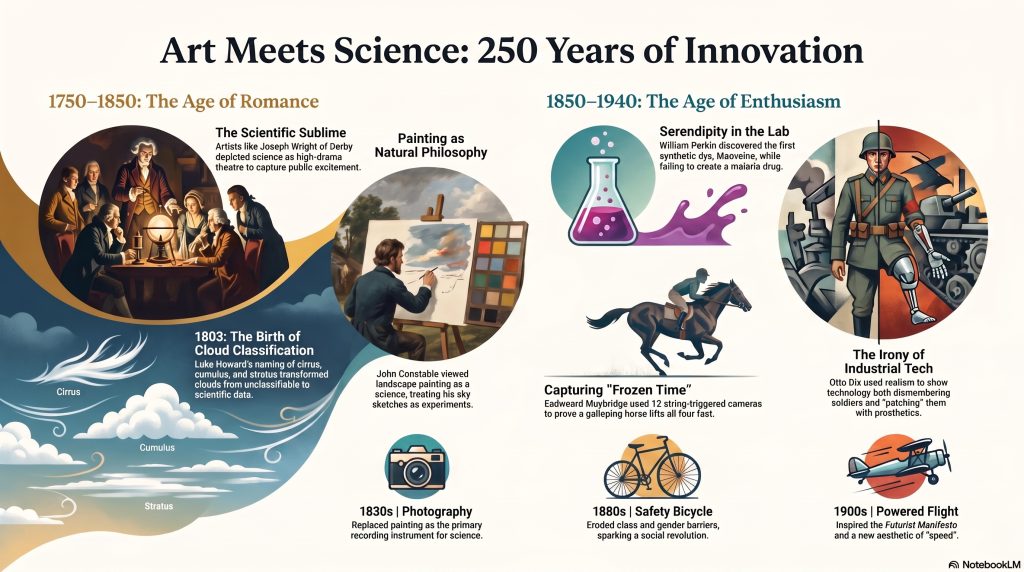
This talk examines the intersection of scientific progress and artistic expression across two and a half centuries of history. By analyzing works like Joseph Wright’s enlightenment lectures and John Constable’s meteorological cloud studies, the text illustrates how painters functioned as early observers of natural philosophy. The collection documents the Industrial Revolution’s dramatic impact, shifting from the emotional awe of the Romantic era to the practical emergence of photography and modern manufacturing. It further explores how technological breakthroughs, such as the invention of blueprints and steam power, were both celebrated and satirized within popular culture. Ultimately, the material portrays art and science as allied forces that collectively captured the evolving human experience from the eighteenth century to the digital age.
An interesting conversation about Art Meets Science created by Google Notebook from my notes:
Introduction: The Unseen Thread
History is often served to us as a dry list of dates and discoveries—a collection of cold facts found in the sterile pages of a textbook. Yet, if we pull back the curtain, we find that the evolution of human knowledge was actually a high-stakes drama, a public spectacle fueled by theatre, biting humor, and intense cultural strife. For the last 250 years, “Art” and “Science” have not been rival disciplines but inseparable allies, each helping the other make sense of a world being radically transformed by the Industrial Revolution.
To understand how we reached our modern era, we must look through the eyes of the artists who witnessed these breakthroughs. Their work documents a journey through three distinct cultural epochs: the “Age of Romance,” where discovery was a source of wonder; the “Age of Enthusiasm,” where speed and color promised a social utopia; and finally, our current “Age of Ambivalence,” where technology is viewed with a mixture of necessity and dread.
The Age of Romance: Science as High-Stakes Theatre
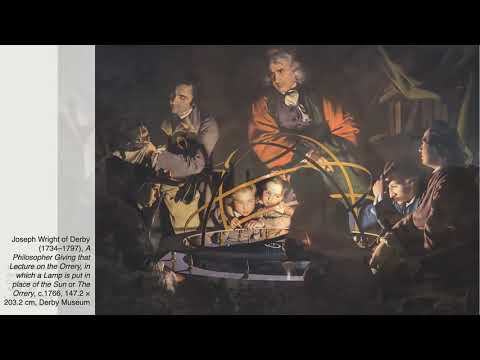
In the 18th century, science was not confined to the laboratory; it was a popular, ticketed event. In 1762, in the town of Derby, a clockmaker named John Whitehurst was busy selling tickets for a lecture by James Ferguson, the most famous traveling scientist of the day. These lectures were high-society spectacles, attracting a mixed audience of the curious, the young, and the old.
The artist Joseph Wright of Derby captured this “Scientific Sublime” in his 1766 masterpiece, A Philosopher Giving that Lecture on the Orrery. The painting depicts an orrery—a mechanical model showing the planets’ motion—but Wright’s genius lay in the lighting. He replaced the Sun in the model with a single lamp, the sole light source for the entire scene. This “theatre of knowledge” illuminated the faces of the spectators with a glow that symbolized the Enlightenment’s reliance on observation and reason. Wright became the first truly “modern” painter, shifting away from wealthy portraits to document the artisans and the “magical” steam-powered factories of the Lunar Society—a group of thinkers who famously met only during the full moon so they could see their way home after a night of debate.
The “Fart Joke” That Paused Progress: James Gillray’s Satire
Art has the power to promote science, but it also has the power to paralyze it. In 1802, the biting satirist James Gillray turned his attention to the newly founded Royal Institution. His target was a lecture on “pneumaticks,” or the study of gases. At the time, the audience for such events consisted of “men of the first rank and talent… blue-stockings and women of fashion,” making them ripe for ridicule.
Gillray produced a caricature that was, on its surface, a crude fart joke involving bellows and escaping gas. However, the subtext was lethal. At the time, scientists studying gases, like Joseph Priestley, were often political radicals who supported the French Revolution. When the brilliant Humphrey Davy began experimenting with nitrous oxide—famously sealing himself in an airtight box on Boxing Day 1798 for a “psychedelic” experience—the public was already wary. Davy emerged from his gas-filled box claiming:
“Nothing exists but thoughts! The universe is composed of impressions, ideas, pleasures, and pains.”
Gillray’s cartoon successfully linked these scientific “discoveries” to radical politics and social absurdity. This association became so toxic in the public imagination that serious medical research into nitrous oxide as an anesthetic was effectively halted for years.
The Age of Enthusiasm: The Scientific “Fake” on the Moon
By the mid-Victorian era, the concept of “truth to nature” became a deeply moral activity. Victorians believed that recording God’s world accurately was a form of worship, and photography was hailed as the ultimate objective tool. However, the technology was not always up to the task.
James Nasmyth, a man who made a massive fortune from his invention of the steam hammer, was also a gifted artist. In fact, at the Great Exhibition of 1851, the prize he received was not for his industrial machinery, but for his stunning six-foot square painting of the moon. In 1874, he published The Moon: Considered as a Planet, a World, and a Satellite. The book featured “photographs” of the lunar surface that transported readers to another world. In reality, these were photos of plaster models Nasmyth had built based on his telescope sketches. To the Victorian mind, these were not “fakes”; they were more “truthful” than the blurry, direct photographs of the era because they used art to represent an observed reality that the camera could not yet see.
A Purple Accident: William Perkin’s Mauveine
In 1856, 18-year-old William Perkin was working as an assistant to August Hofmann, who challenged him to synthesize quinine to treat malaria. Perkin failed, but while cleaning a flask with alcohol, he discovered a vibrant purple residue. Through pure serendipity, he had created “Mauveine,” the first aniline or coal-tar dye.
Before this discovery, the world was visually muted; clothes were mostly “beige and brown,” as colorful dyes were prohibitively expensive. Perkin collaborated with Arthur H. Church, a talented painter interested in the chemistry of pigment, to refine the process. The impact was an overnight social sensation. When Queen Victoria and Empress Eugénie of France began wearing the color, the “Mauve” boom drove scientific wealth into the stratosphere. More importantly, this transition from coal-tar byproducts to dyes eventually led to a medical revolution: by 1891, scientists realized these dyes were selectively absorbed by bacteria, leading to the first chemical treatments for syphilis and malaria.
The Two-Wheeled Social Revolution: The 1890s Bicycle
While the “Age of Enthusiasm” celebrated the telephone and the aeroplane, the humble bicycle arguably triggered the greatest social revolution. By the 1890s, the precarious “penny-farthing” had been replaced by the John Kemp Starley “Rover” safety bicycle.
In 1892, The Times noted that the bicycle was not merely a boon but a “social revolution.” It provided women with unprecedented freedom and mobility, eroding gender barriers and moving the culture from “mobility to maternity.” This progress was met with fierce resistance; men, viewing this new freedom as a threat to the social order, frequently pelted women cyclists with sticks and stones. Yet the bicycle persisted, eventually inspiring the Futurist movement, which declared that “the world’s splendour has been enriched by a new beauty: the beauty of speed.”
The Railway Dragon: Speed vs. Sentiment
The arrival of the locomotive in the 1840s created a profound cultural dichotomy. J.M.W. Turner’s Rain, Steam and Speed (1844) captures this tension as a train crosses the Maidenhead Railway Bridge, outrunning a hare—the fastest mammal in Britain. This imagery suggested a world moving faster than nature intended.
The public’s fear was best captured by George Cruikshank’s 1845 engraving, The Railway Dragon. He portrayed the engine as an anthropomorphic beast bursting into a family Christmas dinner to “eat up” their traditions. The era was a clash of two worlds:
- The Old World: Represented by the Maidenhead riverbank, where dancers in ancient robes invoke quiet village pleasures and the antiquity of the Thames.
- The New World: Defined by the Maidenhead Railway Bridge, bringing with it an “Industrial Machine” of noise, smoke, and pollution that threatened to consume the old way of life.
The Age of Ambivalence: Otto Dix and the Dehumanizing Machine
By the 1920s, the “Age of Enthusiasm” had curdled into an era of “New Objectivity” (Neue Sachlichkeit). World War I was the first industrialized war, where machines were used to dismember humans on a mass scale. The artist Otto Dix, a veteran who won the Iron Cross, used his work to protest the dehumanizing effects of this “progress.”
In his 1920 painting The Skat Players, Dix depicts disfigured veterans playing a three-handed trick-taking card game. He framed the war as a “gamble,” a game of Skat where the players were the losers. The painting is a bitter irony: the same industrial technology that blew these men apart was now being used to “patch them up” with mechanical prosthetics and glass eyes. To personalize this identification with the “disposed” members of society, Dix even labeled a soldier’s artificial jaw—the one wearing the Iron Cross—with the text “lower jaw prosthesis brand Dix.”
Conclusion: A Forward-Looking Reflection
This 250-year journey has seen our relationship with discovery evolve from the theatrical wonder of the “Age of Romance” to the “Age of Enthusiasm” for a high-speed, colorful utopia, and finally to our current “Age of Ambivalence.”
Art remains the essential mirror for science, providing the ethical and emotional framework we need to process a world that often changes faster than we do. As we move into an era defined by AI and algorithms—technologies that often feel as mysterious as the 18th-century orrery—we must ask ourselves: Will we view these new tools with the wonder of the Enlightenment, or with the political pessimism of the modern age?Gemini Notebook can be inaccurate; please double-check its responses.
99-09a The RA Summer Exhibition (Part 1)
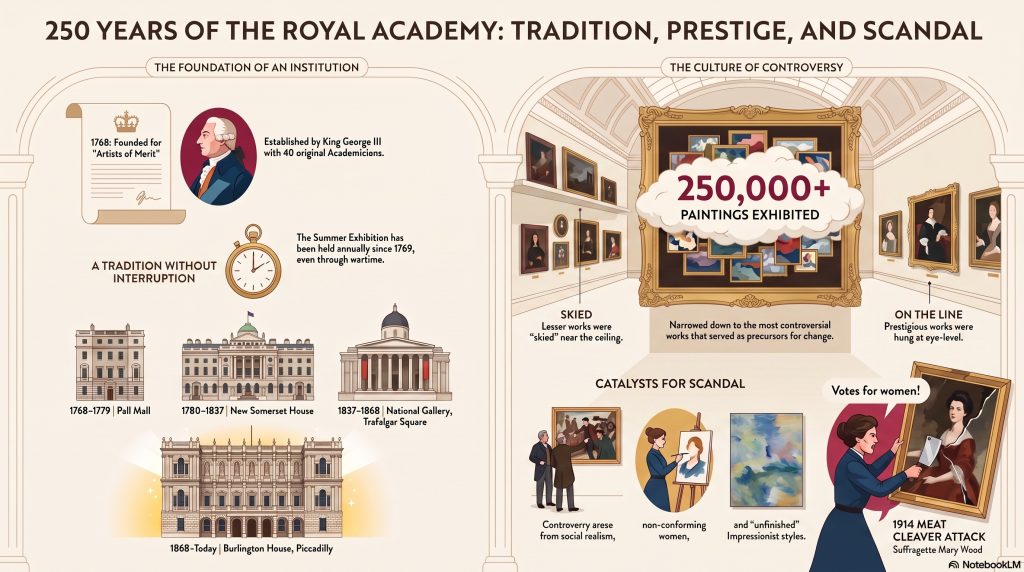
The talk provides a comprehensive history of the Royal Academy of Arts, focusing on its mission to elevate British art through formal training and its famous Summer Exhibition. Established in 1768 by King George III, the institution has hosted this annual public showcase without fail for over 250 years, transitioning through various London landmarks before settling at Burlington House. The talk highlights how the exhibition evolved into a prestigious yet often controversial event, featuring works that challenged societal norms regarding gender, social realism, and artistic style. Key figures such as Joshua Reynolds and Thomas Gainsborough are discussed alongside specific traditions, including the practice of hanging paintings “on the line” or “skying” them near the ceiling. Furthermore, the sources track the Academy’s influence from its Enlightenment-era foundations to its modern role, noting the inclusion of diverse artists and the impact of significant artistic debates. This overview effectively captures the Academy’s enduring legacy as a central hub for British cultural life and artistic evolution.
My notes on The RA Summer Exhibition (Part 1)
An entertaining conversation about the Royal Academy (Part 1) created by Google Notebook from my notes:
For over two and a half centuries, the Royal Academy (RA) Summer Exhibition has been the heartbeat of the British art world, an annual ritual that has seen more than a quarter of a million paintings grace its walls since 1769. Yet, to view it merely as a prestigious gallery show is to miss the theater of its history. In the eyes of a historian, the RA is less a static institution and more a battlefield where “change helps define periods and movements in art.” It is a place where controversy serves as the necessary friction for evolution, revealing the startling gap between the Academy’s lofty intellectual aspirations and the messy, often scandalous reality of the London social season.
1. The Literal Height of Success: “The Line” and Gainsborough’s Great Exit
In the early years of the RA, artistic merit was measured in feet and inches. The “Hanging Committee” held absolute power over an artist’s fortune, deciding which works were placed “on the line”—where the bottom edge of the frame sat exactly eight feet from the floor—and which were “skyed,” or thrust so high toward the ceiling they vanished into the gloom.
Being “on the line” was not merely an aesthetic choice; it was the Academy’s business model. This coveted placement was reserved for “swagger” portraits and massive history paintings, the very commissions that allowed Academicians to maintain their “comfortable living.” In 1784, this hierarchy sparked one of the most famous defections in art history. Thomas Gainsborough, a founding member, was incensed when the Committee refused his “unreasonable” request to hang his royal portraits at the precise height of 5.5 feet. Gainsborough withdrew his works in a fit of pique and moved his exhibition to his own residence at Schomberg House in Pall Mall. The move was a quintessential piece of Georgian drama: Gainsborough’s dignified studio sat at No. 80, directly adjacent to the “Temple of Health and Hymen”—a notorious establishment featuring a £50-a-night “celestial bed” for infertility—and a high-class brothel.
2. The Paradox of the Founding Mothers: Imago Clipeata and the Intellectual Divide
When King George III founded the Academy in 1768, two of the 34 founding members were women: the floral painter Mary Moser and the child prodigy Angelica Kauffman. Kauffman was such a sensation that the Danish Ambassador famously noted, “The whole world is Angelicamad.” However, their inclusion came with a stinging caveat of gendered exclusion.
In Johann Zoffany’s iconic group portrait, The Portraits of the Academicians (1771-72), the male members are depicted as “mentally alert creative artists” gathered around a naked male model. Moser and Kauffman, however, are physically absent from the room, as witnessing a nude male was considered “highly improper.” Instead, they are represented as imago clipeata—portraits on round shields hanging on the wall. This visual reduction highlights the RA’s core mission: to prove that art was a “humanist endeavor” of the mind rather than a mere “mechanical skill” or “industry of the hands.” While the men are shown discussing the intellectual merits of classical literature, the founding mothers were literally relegated to the woodwork, treated as objects of art rather than its practitioners.
3. The Meat Cleaver in the Gallery: 1914’s “Votes for Women” Protest
The RA has always prided itself on being a sanctuary for “civilised appreciators of culture,” but on May 4, 1914, that veneer of civilization shattered. Suffragette Mary Wood entered the Summer Exhibition on opening day and approached John Singer Sargent’s portrait of the author Henry James. With a meat cleaver concealed in her clothing, she hacked at the canvas three times, smashing the protective glass and slashing the author’s likeness.
The incident triggered a visceral transformation in the gallery’s elite visitors. The “civilised appreciators,” horrified by the assault on a high-art icon, instantly regressed into a mob. As Wood was apprehended, the crowd thinned for lunch hour but remained bloodthirsty, with witnesses reportedly shouting “Lynch her!” It remains a haunting reminder of how quickly the pursuit of “intellectual” art can be overtaken by the raw violence of social upheaval.
4. Undercover Royalty: The Secret Submissions of Churchill and “C”
Despite being occasionally savaged by critics as a “parade of the hackneyed and incompetent,” the RA remained the ultimate arbiter of an “appropriate standard of excellence.” This drew even the most powerful figures to seek anonymous validation, stripping away their titles to see if their talent could survive the scrutiny of the Hanging Committee:
- Winston Churchill (1947): Though he held the prestigious title of Honorary Academician Extraordinary, Churchill submitted Winter Sunshine, Chartwell under the pseudonym “David Winter.”
- Prince Charles (1987): The Prince of Wales submitted a watercolor of a Norfolk farm building signed simply with the initial “C.”
Both were accepted on their merits, illustrating a rare moment where the Academy’s rigid gatekeeping functioned as a true meritocracy, indifferent to the crowns of its contributors.
5. The “Stare Case” and Architecture as Voyeurism
When the RA moved to New Somerset House in 1780, architect Sir William Chambers intended the building to be a “monument to the taste and elegancy of His Majesty’s reign.” Above the door to the Great Exhibition Room, a Greek inscription warned: “ΟΥΔΕΙΣ ΑΜΟΥΣΟΣ ΕΙΣΙΤΩ”—Let no stranger to the Muses enter.
The reality was far less elitist. The 1780 exhibition attracted a staggering 61,381 visitors, turning the “national splendour” into a crowded, sweaty gauntlet. The building’s center-piece was a notoriously steep and impractical staircase, which Thomas Rowlandson immortalized in his 1811 caricature, Exhibition Stare Case. Rowlandson’s satire suggested that the male spectators were far more interested in “living flesh than in painted nudes,” as the steep climb caused women to tumble down the stairs, exposing themselves to the voyeuristic crowd below. It was a sharp critique of Chambers’ architecture: a design that prioritized visual effect over practical utility, turning a temple of the Muses into a site of public embarrassment.
6. Conclusion: Beyond the Frame
Today, the Royal Academy continues to navigate the tension between its 18th-century roots and the demands of the contemporary avant-garde. It has traded the scandals of the “Stare Case” for a modern prestige that includes awarding over £70,000 in annual prize money. This includes the esteemed Charles Wollaston Award, a £25,000 prize for the most distinguished work, recently claimed by modern masters like David Hockney and Jeff Koons.
As the exhibition enters its next quarter-millennium, it remains anchored by the philosophy of its first president, Joshua Reynolds. To Reynolds, the Academy’s purpose was to elevate the artist above the craftsman, reminding us that the finest works are those where the mind directs the brush.
“[Painting] is not the industry of the hands, but of the mind.” — Joshua ReynoldsGemini Notebook can be inaccurate; please double-check its responses.
99-09b The RA Summer Exhibition (Part 2)
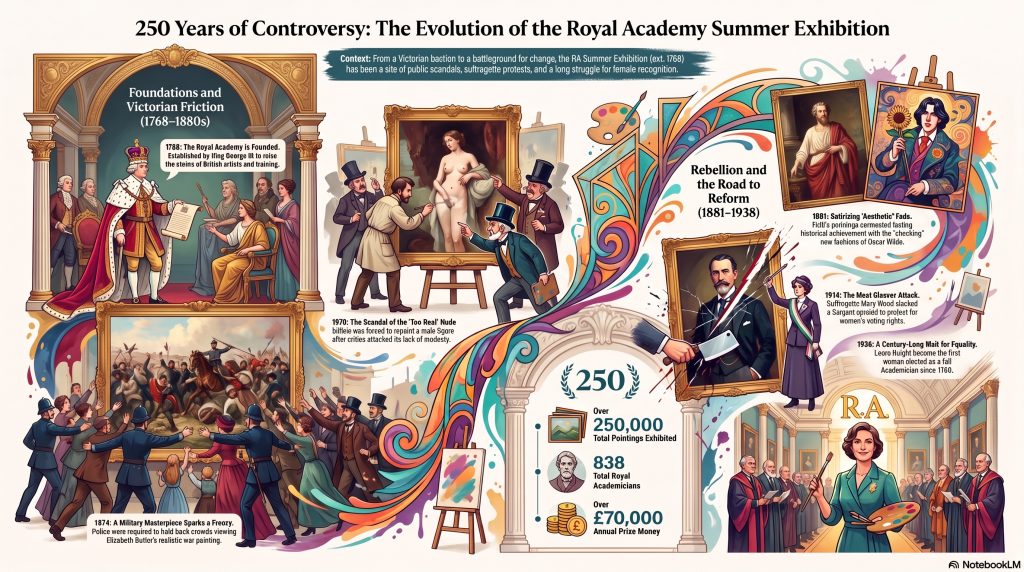
The talk traces the extensive history of the Royal Academy Summer Exhibition, an annual event established in 1769 to showcase artistic excellence to the public. The text highlights the institutional challenges and controversies faced by creators, particularly the obstacles encountered by female artists like Elizabeth Butler who struggled for formal recognition despite national fame. It further examines the evolution of artistic styles and social morals, illustrated by the backlash against the Aesthetic Movement and the scandalous reception of female nudes in Victorian painting. Specific masterpieces by figures such as James McNeill Whistler and John Everett Millais serve as case studies for how the Academy navigated shifting cultural values over two centuries. Ultimately, these records document the Royal Academy’s transition from a rigid traditionalist body to a more modern institution that reflects contemporary artistic flux.
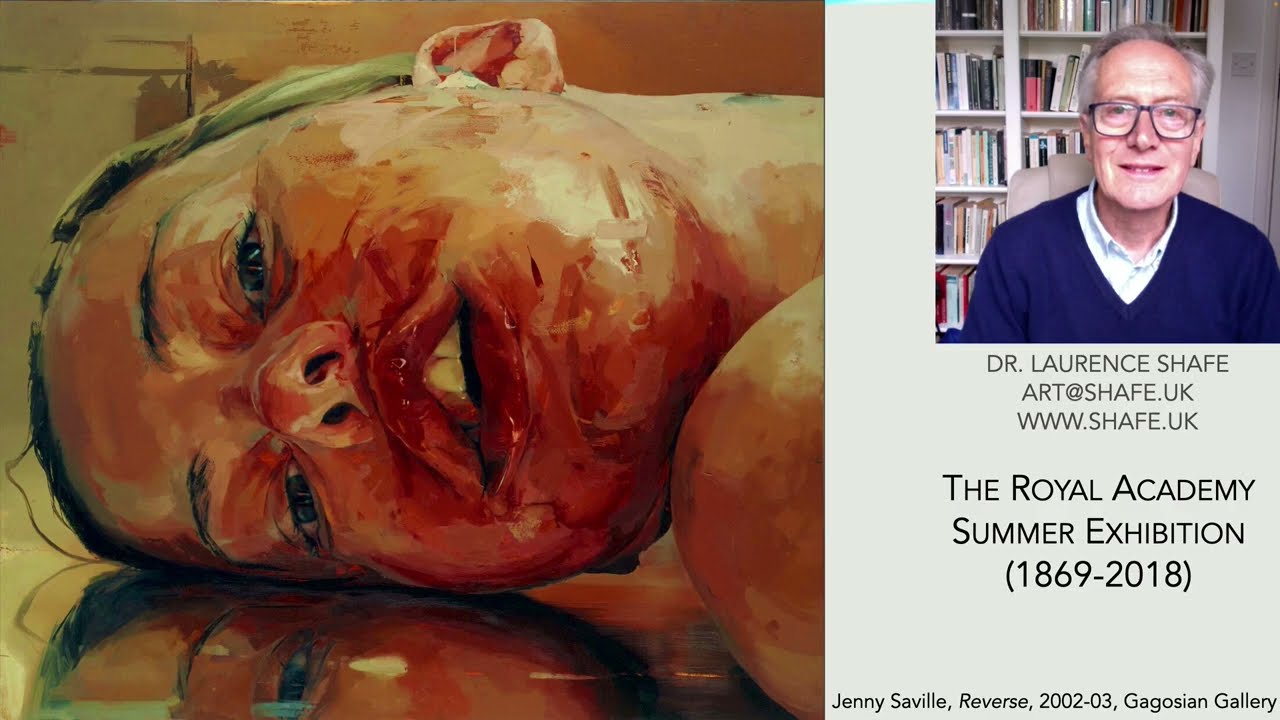
My notes on The RA Summer Exhibition (Part 2)
An entertaining conversation about the Royal Academy (Part 2) created by Google Notebook from my notes:
On May 4, 1914, the Royal Academy of Arts was the most paranoid building in London. The Council, gripped by a state of high-alert anxiety, had already shuttered its Winter exhibition early, fearing the rising tide of political vandalism. They were right to be nervous. At roughly half-past one, as the opening-day crowd thinned for lunch, a woman named Mary Wood approached John Singer Sargent’s portrait of Henry James—a work the author had famously hailed as a “living breathing likeness.” With the swift, practiced motion of a seasoned insurgent, Wood produced a meat cleaver from beneath her coat and hacked three jagged gashes into the canvas.
The reaction from the gallery’s refined patrons was anything but civilized. They didn’t call for the guards; they called for blood. Wood was nearly mobbed by a swarm of “appreciators of culture” who abandoned their aesthetic detachment for a more primitive impulse.
“Lynch her!” they shouted.
Wood’s assault was a political echoes of Mary Richardson’s earlier attack on the Rokeby Venus, a desperate attempt to force the suffrage conversation into the sanctuary of the establishment. Yet, this explosion of physical violence was merely an escalation of a much older conflict. For two and a half centuries, the Royal Academy’s Summer Exhibition has been a battlefield where the British soul—caught between its impulse for progress and its obsession with propriety—has repeatedly bruised itself.
Since George III signed the instrument of foundation in 1768, the Summer Exhibition has been held every single year without interruption, a 250-year-long ledger of the nation’s shifting tastes. It was conceived as an egalitarian ideal: a show open to “all artists of merit,” judged blindly by a committee of Academicians. But as any historian of the “human” element knows, institutions are rarely as tidy as their charters.
If Mary Wood brought a cleaver to the gallery, the Academy’s own members often wielded a more subtle instrument: the poison pen of moral preservation. In 1881, the tension between the “old guard” and the “new trendy” was immortalized in William Powell Frith’s satirical masterpiece, A Private View at the Royal Academy. Frith populated his canvas with a “who’s who” of Victorian worthies, but the true subject was the “shocking” intrusion of the Aesthetic Movement. At the center of the friction stood Oscar Wilde, a sunflower-buttonholed intruder surrounded by what Frith called “a family of pure aesthetes” dressed in “eccentric forms.” To the traditionalists, this was a circus; to the public, it was the height of fashion.
This cultural friction reached a fever pitch in 1885 during a moral panic over the female nude. Critics were appalled by the “fleshy” realism of John Collier’s Circe, complaining that the goddess looked less like a Greek myth and more like a middle-class English woman sitting naked on damp grass. The backlash was spearheaded by a letter to The Times signed by a “British Matron,” who pleaded for the removal of such “indecent” works. In a delicious fit of institutional hypocrisy, the “Matron” was revealed to be J.C. Horsley—a powerful Royal Academician effectively trolling his own audience from behind a metaphorical dress. Horsley’s crusade was rigid:
“…at an exhibition purporting to be for general edification or entertainment, no picture should find place before which a modest woman may not stand hanging on the arm of father, brother or lover without a burning sense of shame.”
Even the pillars of the establishment were forced to bend. When John Everett Millais exhibited The Knight Errant (1870), the original composition featured a nude woman making direct, “immoral” eye contact with her savior. To make the piece salable, Millais was forced to perform a gruesome bit of artistic surgery: he cut out the woman’s head and repainted her facing away in a posture of “acceptable” shame. The original, excised head didn’t go to waste; Millais recycled it into another canvas, The Martyr of The Solway, where the woman’s nudity was suddenly sanctified by the context of religious execution.
While women’s bodies were welcome on the walls, their presence in the Academy’s voting booths was a different matter. Elizabeth Butler became a national sensation in 1874 with The Roll Call, a painting of Crimean War soldiers so popular that police had to be stationed in front of it to control the throngs. Despite her fame, Butler was never elected an Academician, falling short in 1879 by just two votes. The glass ceiling was reinforced by the domestic weight her male peers never had to carry. While they had wives to manage their studios, Butler was expected to accompany her husband to military postings in Ireland, manage his affairs, and raise six children, all while painting the brutal reality of the front lines.
“I never painted for the glory of war, but to portray its pathos and heroism.”
By the early 20th century, the Academy found a way to monetize social anxiety through the “problem picture.” Works like John Collier’s The Prodigal Daughter (1903) offered no clear moral resolution. Did the young woman in her fancy dress return home repentant, or was she a “New Woman” asserting her independence? The press sponsored competitions to “solve” these visual puzzles, transforming the gallery into a public forum for a society grappling with the flux of modern gender roles.
This egalitarian spirit—the idea that the work should speak louder than the name—has occasionally allowed the most powerful figures in the world to seek the validation of the “common” artist. In 1947, Winston Churchill submitted two works under the pseudonym “David Winter.” Forty years later, in 1987, Prince Charles followed suit, submitting a watercolor signed simply “C.” Both were accepted by the selection committee on their own merit, proving that even a future King or a Prime Minister still craves the unvarnished approval of a blind judging process.
Today, as we look back on 250,000 paintings exhibited over 250 years, the Royal Academy remains a study in institutional whiplash. An organization founded by George III now hands out the £25,000 Charles Wollaston Award to the likes of Jeff Koons and the Chapman brothers—artists who would have given J.C. Horsley a fatal stroke.
In a world where, as the Academy’s own history suggests, “everything is in flux,” perhaps its greatest achievement is its survival. It remains a chaotic, occasionally scandalous, and perpetually fascinating mirror—one that suggests that while art may change, our human desire to argue, panic, and find ourselves within it remains entirely constant.Gemini Notebook can be inaccurate; please double-check its responses.
99-10 The World’s Most Expensive Paintings
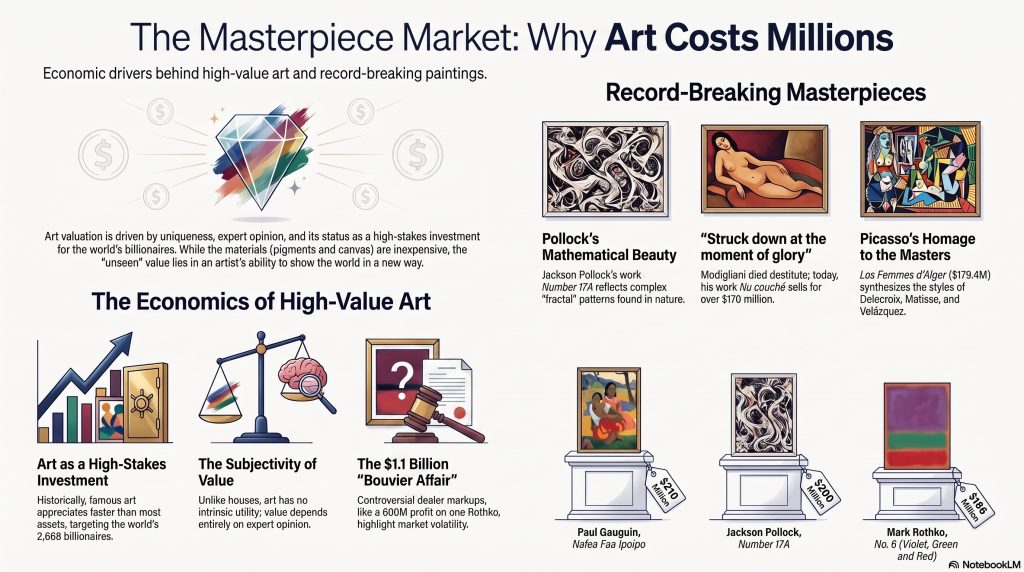
The talk examines the world’s most expensive paintings, exploring the economic, historical, and artistic factors that drive multi-million dollar valuations. The text highlights how high-end art functions as a risky investment for billionaires, with prices often dictated by expert opinion and the prestige of owning unique cultural artifacts. Notable masterpieces by artists such as Rembrandt, Picasso, Modigliani, and Rothko are featured, detailing their specific sales records and the scandals that sometimes accompany private transactions. Beyond finances, the materials provide biographical sketches of the creators, linking their personal struggles and innovative styles to the enduring value of their work. Ultimately, the collection serves as a guide to both the aesthetic significance and the complex market dynamics of the global art world
My notes on The World’s Most Expensive Paintings
An entertaining conversation about the world’s most expensive paintings created by Google Notebook from my notes:
To the uninitiated, the high-stakes art market feels like a sophisticated fever dream. How can a collection of cheap pigments smeared on a canvas command a price higher than the GDP of a small nation? Unlike a house, which offers the intrinsic value of shelter, or a company with tangible assets, a painting’s value is a “shortcut” created by fame. In a world saturated with billions of images, we pay for a rare commodity: the ability to see the world in a new and exciting way. When art experts and the ultra-wealthy reach a consensus that an artist possesses this vision, the price tag becomes a proxy for that rarity. But beneath the cold metrics of the auction block lies a visceral human drama—one defined by poverty, legal loopholes, and the tragic legends that drive posthumous value.
1. The Billionaire Who Bought a Masterpiece with an Amex
In November 2015, Amedeo Modigliani’s Nu couché (Red Nude) sold at Christie’s for $170.4 million, then the second-highest price ever paid for art. The buyer, Liu Yiqian, embodies the aggressive growth of the modern art market. A former taxi driver who left school at 14 to sell handbags on the streets of Shanghai, Liu built his staggering fortune by buying shares in newly unlisted companies during China’s 1990s economic boom.
The valuation of Nu couché is a haunting irony when contrasted with its origins. In 1917, the Polish dealer Léopold Zborowski provided Modigliani with a small apartment and paid his models a mere 5 Francs a day to pose. When the work debuted at Berthe Weill’s gallery, the “strikingly real” nudes caused a traffic jam. A police officer from the station across the street, deeming the exhibition “indecent,” ordered it shut down. Today, that once-scandalous canvas is a blue-chip asset, its value inflated by the very “tragic legend” that saw the artist die in poverty while his models earned pennies.
2. The $60 Million Secret Markup
The lack of transparency in the private art market represents a significant risk for even the most seasoned billionaires. This was laid bare in the contentious sale of Mark Rothko’s No. 6 (Violet, Green and Red). In 2014, Russian billionaire Dmitry Rybolovlev purchased the work for €140 million, believing he was paying a standard commission to his dealer, Yves Bouvier.
In reality, Bouvier had allegedly purchased the painting for €80 million just days before, flipping it to Rybolovlev for a secret €60 million profit. This single transaction sparked a global legal war; Rybolovlev eventually accused Bouvier of swindling him out of more than €1.1 billion across the acquisition of 38 works. For the market analyst, this saga serves as a cautionary tale: in the opaque world of private sales, the “value” of a masterpiece is often whatever a middleman can convince a buyer it is worth.
3. The Artist Who Tried to “Ruin the Appetite” of the Elite
While his works now trade for hundreds of millions, Mark Rothko—the master of “color field painting”—was famously repulsed by the elite who bought them. In 1958, he was commissioned to create the “Seagram Murals” for the Four Seasons restaurant in New York. Rothko, a man of deep integrity who feared the day “the black swallows the red,” accepted the job with “strictly malicious intentions.”
“I hope to paint something that will ruin the appetite of every son of a bitch who ever eats in that room.”
After dining at the restaurant, Rothko was appalled by the prices and the atmosphere, telling his assistant, “Anybody who will eat that kind of food for those kind of prices will never look at a painting of mine.” He realized his art would become mere decorative “baubles” for the wealthy. He returned his $7,000 advance and eventually donated the works to the Tate in London, stipulating they be hung near the works of J.M.W. Turner. In a tragic finale, the news of Rothko’s suicide reached the Tate on the very day the paintings arrived in 1970.
4. The “Superman” Who Hid a Deadly Secret
Amedeo Modigliani’s posthumous fame is fueled by a narrative of the “doomed genius,” drawing frequent parallels to Vincent van Gogh. Known to his teachers by the nickname “Superman” for his constant quoting of Nietzsche’s Thus Spoke Zarathustra, the artist believed that true creativity required “defiance and disorder.”
However, his chaotic lifestyle of absinthe and hashish was a calculated mask. Born into a Sephardic Jewish family in Livorno, Modigliani contracted tuberculosis at age 16. In the early 20th century, carriers of infectious diseases were ostracized, whereas “drunks were tolerated.” He used substance abuse to hide the symptoms of the disease that eventually claimed his life. He died of tubercular meningitis at just 35, a “master of living art” whose market value skyrocketed only after he was, as his epitaph says, “Struck down by Death at the moment of glory.”
5. The Birth That Saved the Master’s Legacy
Modigliani’s entry into the world was as miraculous as his end was destitute. He was born as his father’s business collapsed into bankruptcy. As bailiffs entered the home to seize assets, his mother, Eugenia—a bright and resourceful woman—was in labor. Under an ancient law, creditors were forbidden from seizing the bed of a woman in labor. The family piled their most valuable possessions onto Eugenia’s bed, saving their legacy as the artist was born.
Eugenia noted in her diary when her son was eleven: “Perhaps an artist?” She later fulfilled a promise made during his bout with typhoid fever to take him to the Uffizi in Florence. Despite this resourceful beginning, the artist died destitute. His pregnant companion, Jeanne Hébuterne, was so distraught that she committed suicide the following day. This extreme human drama—from the “miraculous” bed of his birth to the “extreme sacrifice” of his companion—is precisely what billionaires are buying when they swipe an Amex for $170 million.
Conclusion: More Than Just an Investment
Whether it is the $180 million paid by the Louvre and Rijksmuseum for Rembrandt’s Pendant Portraits—the only full-length portraits the master ever painted—or a Jackson Pollock drip painting sold for $200 million, the price of art is never about the cost of materials. It is a tribute to human drama. These prices reflect the secrets kept by the artists, the integrity they maintained against the elite, and their unique ability to show us the world anew.
Is the astronomical price of a painting a “big con,” or is it a necessary tribute to the rare individuals who enable us to see the world in new and exciting ways? As these stories show, we aren’t just buying pigments; we are investing in the tragic, beautiful, and complicated history of the human spirit.
99-11 The Family in Art
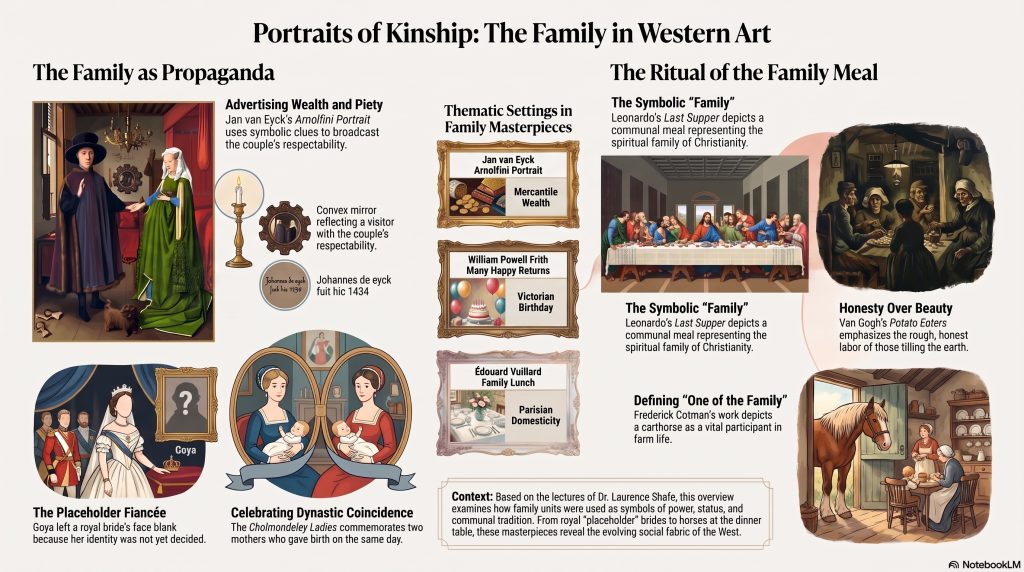
This talk is a guide to “The Family in Art,” exploring how various masterpieces represent domestic life across history. It categorizes famous works into thematic sections, such as The Family as Propaganda, The Family Meal, and The Family and War, providing both historical context and artistic analysis. Notable highlights include the symbolic mysteries of Jan van Eyck’s Arnolfini Portrait, the royal dynastic messaging in works by Velázquez and Goya, and the communal spirit of Leonardo’s The Last Supper. The talk further offers technical insights into the artists’ lives and the specific visual metaphors used to communicate wealth, piety, and kinship. Together, these excerpts illustrate the evolving portrayal of the family unit as a tool for social status and a reflection of human connection.
(The YouTube talk on the Family in Art will be published 2027)
A conversation about the Family in Art created by Gemini Notebook from my notes
1. Introduction: The Secret Life of the Family Portrait
At first glance, a historical family portrait can appear to be a stiff, dusty record of the past—a collection of unblinking ancestors frozen in formal attire. However, step closer and these canvases reveal themselves to be far more than passive memories. Throughout art history, the family portrait has functioned as a high-stakes “flex,” a tool for radical social statements, and even a carefully constructed mask for deep-seated scandals.
From “posh graffiti” on the walls of merchant homes to royal galleries featuring blank-faced “placeholder” fiancées, these works are filled with hidden clues about wealth, power, and the complex reality of human relationships. These paintings aren’t just records; they are active agents of propaganda and personal mythology. The following reveal the most surprising takeaways from the history of the family in art.
2. The Renaissance “Flex” and 17th-Century “Photo Updates”
In the 15th and 17th centuries, the family portrait was less about capturing a moment and more about “advertising” status, piety, and dynastic stability. Jan van Eyck’s Arnolfini Portrait (1434) is a masterclass in the Renaissance “flex,” executed with an extraordinary attention to detail. While the woman is often mistaken for being pregnant, she is actually holding up yards of fashionably oversized green fabric to demonstrate her husband’s success as a silk merchant.
Van Eyck treated the wall of this merchant’s home as a legal document, signing it with the phrase “Jan van Eyck was here, 1434,” above the convex mirror. This wasn’t just a signature; it was a witness statement—”posh graffiti” verifying the sanctity of the scene. As the source context notes:
“Its symbols, such as the convex mirror reflecting the couple, the dog symbolizing loyalty, and the lit candle signifying divine presence, all relate to the sanctity of marriage.”
Two centuries later, Diego Velázquez used portraiture to manage the “calculated distance” of royal engagement. Tasked with painting the Infanta Margarita Teresa, Velázquez produced a series of seventeenth-century “photo updates” sent to Vienna so her fiancé (and uncle), Emperor Leopold I, could monitor her growth. Up close, Velázquez’s work is startlingly modern, utilizing loose and sketchy brushwork that only resolves into shimmering silk from a distance.
Margarita Teresa was more than a child; she was a fashion icon. Her iconic hair bows became a national sensation known as “Infanta bows.” These portraits bridge geographic gaps, polishing a young girl into a perfect symbol of future Habsburg alliances.
Truth #1: The Portrait is a Billboard, not a Memory.
3. Goya’s “Warts and All” Monarchy and the Placeholder Fiancée
By 1800, Francisco Goya’s The Family of Charles IV demonstrated that royal propaganda could be shockingly literal. Goya famously refused to flatter his subjects, capturing the Spanish royals with such brutal honesty that one wit described them as “the corner baker and his wife after winning the lottery.” The figures appear stiff and disconnected, emphasizing their material wealth over any sense of interpersonal affection.
The most bizarre detail is the “placeholder fiancée.” To the left, a young woman stands with her face turned sharply away. At the time of painting, the bride-to-be for Prince Ferdinand had not yet been selected. Rather than stall the commission, Goya left her features blank—a literal placeholder in the dynastic lineup. Counter-intuitively, the royals were delighted with this “warts and all” display, viewing the stiff, wax-museum-like arrangement as a testament to their unshakeable power and stability.
Truth #2: Power Thrives on Display, Even When the Truth is Ugly.
4. The Victorian Double Life of William Powell Frith
William Powell Frith’s Many Happy Returns of the Day (1856) is the ultimate hymn to Victorian “cosy domesticity.” It depicts a little girl’s sixth birthday, with Frith himself appearing as the proud father presiding over the table. In the Victorian era, the father was the pater familias—a role associated with the Roman tradition of a head of household who held total duty to rule, protect, and control his family.
This painting was a vital social mask. In the mid-19th century, the concept of “manliness” was shifting from purely spiritual duty toward “Muscular Christianity”—a commitment to physical health and the stern, disciplined protection of the home. Yet, while Frith was winning acclaim for these portrayals of upright values, he was secretly maintaining a second household just a mile away. Between his wife, Isabelle, and his mistress, Mary Alford, Frith fathered a total of 19 children. This canvas, which celebrates the father as the “central pivot point” of moral life, was actually exhibited at the Royal Academy on the very day his mistress’s first baby was born.
Truth #3: The Idealized Home is Often a Mask for a Messy Reality.
5. Van Gogh’s Radical Honesty: Why Beauty is Found in “Unpeeled Potatoes”
In 1885, Vincent van Gogh rejected the glamour of traditional portraiture to find truth in what he called “unpeeled potatoes.” In The Potato Eaters, he deliberately chose “coarse and ugly” models to represent a peasant family in Nuenen. He wanted to show people who “tilled the earth with the very hands they put in the dish,” using a palette as dark and earthy as the soil itself.
Despite being mocked for “wonky anatomy,” Van Gogh considered this his best work, prioritizing the honesty of labor over the “pretty” standards of the art world. As Van Gogh reflected:
“He believed the painting successfully conveyed the message that these people ‘have tilled the earth themselves with these hands they are putting in the dish… that they have thus honestly earned their food.’”
Truth #4: Authentic Art Finds Worth in Labor, Not Just Luxury.
6. Redefining the Guest List: When a Horse is “One of the Family”
Sometimes, art expands the definition of family to include those essential for survival. In Frederick George Cotman’s One of the Family (1880), the “unexpected guest” is a carthorse poking its head into a farmhouse kitchen. This sentimental scene captures a rural reality: the horse, having pulled the plough all day, has earned its place at the head of the “guest list.” Here, the definition of family is determined by the shared labor of the harvest.
Contrast this rural sentimentality with the urban “Intimism” of Édouard Vuillard. In his Family Lunch, the family is not defined by a guest list, but by their environment. The diners are almost “stitched” into the very fabric of the home, their forms dissolving into the flickering patterns of the wallpaper and tablecloths. Growing up in his mother’s dressmaking workshop, Vuillard viewed the family as inseparable from the textiles that surrounded them. While Cotman’s family is an assembly of laborers, Vuillard’s family is a part of the architecture itself—private, quiet, and woven into the domestic patterns of the home.
Truth #5: A Family is Defined by Its Environment, Not Just Its Bloodline.
7. Conclusion: What Makes a Family “Art”?
From the calculated propaganda of the Habsburgs to the radical, earthy honesty of Van Gogh, artists have used the family to comment on morality, status, and the human condition. These works remind us that every family portrait is an edited version of the truth, containing secrets that only time and careful observation can reveal.
If you were to paint your family today, what “clues” would you hide in the background for historians to find 600 years from now?
99-12 My Top Ten Strangest Paintings
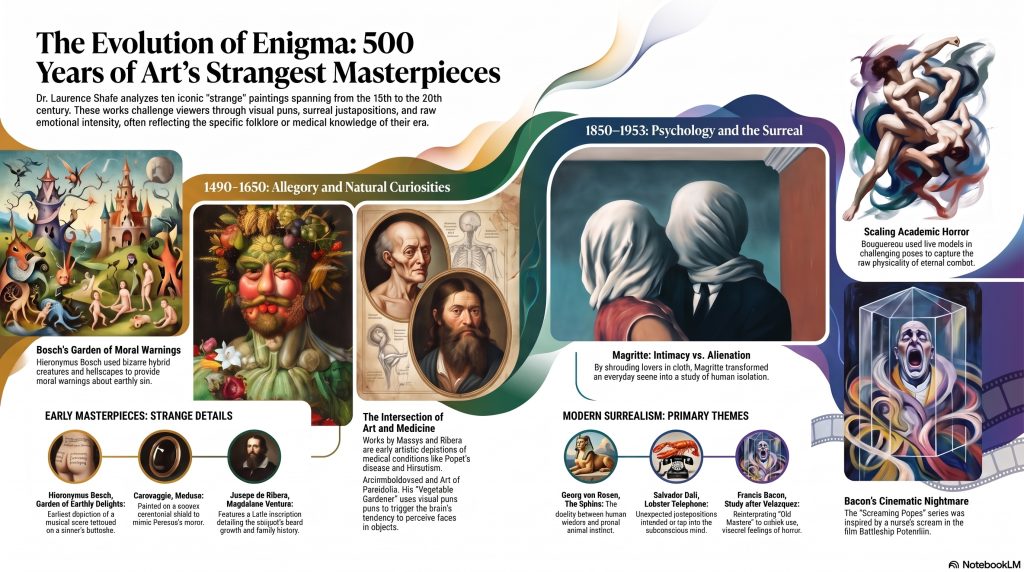
This talk presents a curated selection of history’s most eccentric and unsettling masterpieces, beginning with an AI-generated image that previews the bizarre themes to come. The collection features Hieronymus Bosch’s The Garden of Earthly Delights, a complex triptych interpreted as a moral warning filled with surreal creatures and sexual allegories. It also explores Giuseppe Arcimboldo’s The Vegetable Gardener, a visual pun demonstrating pareidolia by turning a bowl of produce into a human face. The overview includes Caravaggio’s realistic Medusa, painted on a convex shield, and Quinten Massys’s The Ugly Duchess, which likely depicts a real medical condition. Other notable inclusions are Jusepe de Ribera’s portrait of a bearded woman and William-Adolphe Bouguereau’s visceral depiction of Dante and Virgil in hell. These sources analyze how these artworks use symbolism, anatomy, and optical illusions to challenge and fascinate viewers throughout various centuries.
My notes on My Top Ten Strangest Paintings
A conversation about My Top Ten Strangest Painting generated by Goggle’s Notebook from my notes:
1. Introduction: The Magnetic Pull of the Bizarre
Why are we so relentlessly drawn to art that unsettles us? Throughout history, the most enduring masterpieces have often been those that defy logic or embrace the grotesque. This “strangeness” is far more than a stylistic gimmick; it serves as a profound window into the collective subconscious, ancient folklore, and the very boundaries of the human experience.
From the nightmarish visions of the 15th century to modern surrealist sculpture, artists have used the bizarre to capture truths that ordinary realism simply cannot reach. In this curation, we explore eleven of the most impactful and strange takeaways from centuries of Western Art. As a digital curator, I’ve even included a look at the future of this tradition, using the Flux image generator to visualize how machine-led “hallucinations” are beginning to map the next frontier of the grotesque.
2. The Original Surrealist: Hieronymus Bosch and the “Music of the Damned”
Hieronymus Bosch’s The Garden of Earthly Delights (c. 1490–1510) remains the ultimate enigma of the Northern Renaissance. While modern eyes often see heresy, the work was likely commissioned by Hendrik III of Nassau-Breda as a complex moral allegory—a visual sermon on the fragility of sin. Technical analysis has deepened the mystery: recent infrared reflectography revealed that Bosch was a perfectionist of the peculiar, significantly altering his composition and completely repainting the figure of God in the Paradise panel.
The detail that haunts every viewer is the “buttock music” in the hell panel—actual musical notation tattooed onto a sinner’s backside. But Bosch’s symbolism goes deeper. The lovers enclosed in a glass bubble emerging from a flower represent a specific 15th-century warning:
“Pleasure is as fragile as glass.”
Beyond the iconic “treeman” with his cracked-egg torso, Bosch subverted the sacred to highlight the profane. He depicted figures with their hands in the contemporary gesture of prayer—crossed thumbs and touching fingers—but placed those hands over their genitals. To a medieval audience, this was a clear, stinging reference to the “sin of self-abuse,” then considered a grave transgression against nature.
3. The Ultimate Visual Pun: Giuseppe Arcimboldo’s Reversible Face
Giuseppe Arcimboldo was the resident wit of the Hapsburg courts, and The Vegetable Gardener (1590) is his crowning achievement in pareidolia—our brain’s hardwired tendency to impose faces on random stimuli.
When the artist debuted this work in Milan, it appeared to be a simple, rustic bowl of vegetables. However, when inverted, it transforms into a grinning, bulbous face. This was no mere party trick; it reflected the Mannerist fascination with the microcosm and the god Vertumnus, who could shift his form at will. Interestingly, the vegetables are so precisely rendered that they serve as a perfect horticultural snapshot of 16th-century Milan.
4. A Mirror of Horror: Caravaggio’s Self-Portrait as Medusa
Caravaggio’s Medusa (1597) is a visceral masterpiece of “revolutionary naturalism.” Painted on a convex ceremonial shield, the work mimics the very mirror Perseus used to avoid the Gorgon’s petrifying gaze.
The immediate horror is achieved through chiaroscuro—a dramatic, spotlight-like lighting that makes the severed head appear to project into the room. The detail is so fastidious that herpetologists have identified the specific Italian snake species writhing in her hair. Most unsettling of all is the psychological layer: Caravaggio likely used his own face as the model for the Gorgon, immortalizing himself in a permanent state of decapitated shock.
5. Satire Meets Science: Massys and “The Ugly Duchess”
Quinten Massys’s The Ugly Duchess (c. 1513) has long been the poster child for the satire of vanity. It depicts an elderly woman in outdated, fashionable regalia, desperately trying to recapture a youth long since fled. For centuries, it was viewed as a cruel caricature—famously serving as the inspiration for John Tenniel’s illustration of the Duchess in Alice’s Adventures in Wonderland.
However, historical context reveals a more complex narrative. This painting was likely half of a satirical diptych, originally paired with a now-lost portrait of an “ugly man” to mock mismatched lovers. More recently, medical researchers have moved beyond satire to science, suggesting the Duchess wasn’t a caricature at all, but a realistic depiction of a woman suffering from Paget’s disease, which causes the bones of the face to enlarge and distort.
6. The Dignity of the “Marvel”: Ribera’s Bearded Woman
Moving from the medical reality of the Duchess to the medical curiosities of the Spanish Baroque, we find Jusepe de Ribera’s Magdalena Ventura with Her Husband and Son (1631). Magdalena, known as the “Bearded Woman of Abruzzo,” suffered from severe hirsutism, which resulted in a full beard and masculine features.
Ribera’s unflinching naturalism captures her nursing a child, a jarring contrast to her facial hair. In the 17th century, such “marvels of nature” were not just curiosities; they were legal minefields. Society’s need to clearly differentiate the sexes was a tool for maintaining social order and property rights. Yet, Ribera refuses to mock her. He portrays Magdalena with a profound, quiet dignity, treating her medical condition with the same gravity he would a saint.
7. Academic Violence: Bouguereau’s Hellish Neck-Bite
William-Adolphe Bouguereau is usually associated with porcelain-skinned nymphs and sentimental sweetness. However, his early Dante and Virgil (1850) is a tour de force of raw, academic violence.
The scene captures two damned souls in a primal, eternal struggle, one sinking his teeth into the other’s neck. To capture this visceral intensity, Bouguereau forced live models into agonizing, strained poses. This work was a desperate bid for the Prix de Rome; while he failed to win the top prize with this specific hellscape, the judges were sufficiently impressed that he won a consolation second prize later that year for Shepherds Find Zenobia on the Banks of the Araxes.
8. The Riddle of the Sphinx: Georg von Rosen’s Human-Animal Duality
In Georg von Rosen’s The Sphinx (1907), the mythological beast is no longer a distant legend but a looming, physical threat. Confronting the viewer with the famous Greek riddle—what walks on four legs, then two, then three?—the creature waits for an answer before she pounces.
The answer, of course, is Man (the infant, the adult, the elderly). The discarded black cloak on the right suggests a traveler has already succumbed. Influenced by Darwinian theory, Von Rosen explored the duality between human wisdom and primal instinct. He famously used his own daughter as the model for the Sphinx’s face, creating a direct, human gaze that terrified early 20th-century audiences with its predatory intimacy.
9. The Loneliness of Intimacy: René Magritte’s Shrouded Lovers
René Magritte’s The Lovers (1928) is the definitive image of the barrier between even the closest souls. We see a couple attempting an intimate kiss, yet their heads are entirely wrapped in white cloth, transforming an act of passion into one of alienation.
I sometimes think it is my job as an historian to spoil a good story; for decades, we’ve linked this image to the suicide of Magritte’s mother, whose body was allegedly found with her nightdress covering her face. While modern research suggests this was a tall tale invented by a nanny for the press, the painting’s power remains in its mystery. As Magritte himself noted:
“The mind loves the unknown. It loves images whose meaning is unknown, since the meaning of the mind itself is unknown.”
10. The Sexualized Mundane: Salvador Dalí’s Lobster Telephone
Salvador Dalí’s Lobster Telephone (1936) is the ultimate Surrealist “unexpected juxtaposition.” By placing a plaster lobster over a Bakelite receiver, Dalí created a “dream-object” that merged the technological with the biological.
Dalí’s obsession with lobsters was deeply rooted in their perceived sexuality—a theme he famously extended to high fashion when he designed the iconic lobster-print dress for Elsa Schiaparelli. His surrealist vision was so unrelenting that he even proposed installing “breathing walls” for his patron Edward James that would move in and out like a dog’s stomach. James, perhaps fortunately for his house guests, politely declined.
11. Unlocking the Valves of Feeling: Francis Bacon’s Screaming Pope
Finally, we arrive at the nightmare world of Francis Bacon. His Study after Velázquez’s Portrait of Pope Innocent X (1953) takes a dignified 17th-century masterpiece and traps it in a ghostly, vertical cage.
Bacon was so obsessed with the original Velázquez portrait that he produced over 45 variants of the subject, despite the surprising fact that he never saw the original painting in person. The silent, glass-shattering scream was actually inspired by cinema—specifically the wounded nurse in Sergei Eisenstein’s Battleship Potemkin. For Bacon, the goal was never to compete with the Old Masters, but to “unlock the valves of feeling” that their work, and the horrors of the modern world, forced open.
12. Conclusion: Art as a Mirror to the Unknown
These eleven “strange” masterpieces are more than historical oddities; they are mirrors reflecting the most fundamental human concerns: mortality, social order, medical curiosity, and the hidden depths of the subconscious.
As we move into an age where AI generators like Flux can “hallucinate” new distortions on command, we must ask ourselves a final question: will these machine-generated images ever be as strange as those born from the human psyche? Perhaps not. For while an AI can rearrange the grotesque, it cannot feel the “valves of feeling” that drove Bacon, or the desperate vanity of Massys’s Duchess. The most profound weirdness will always be rooted in our own internal experiences.Gemini Notebook can be inaccurate; please double-check its responses.
99-13 Art at the Seaside
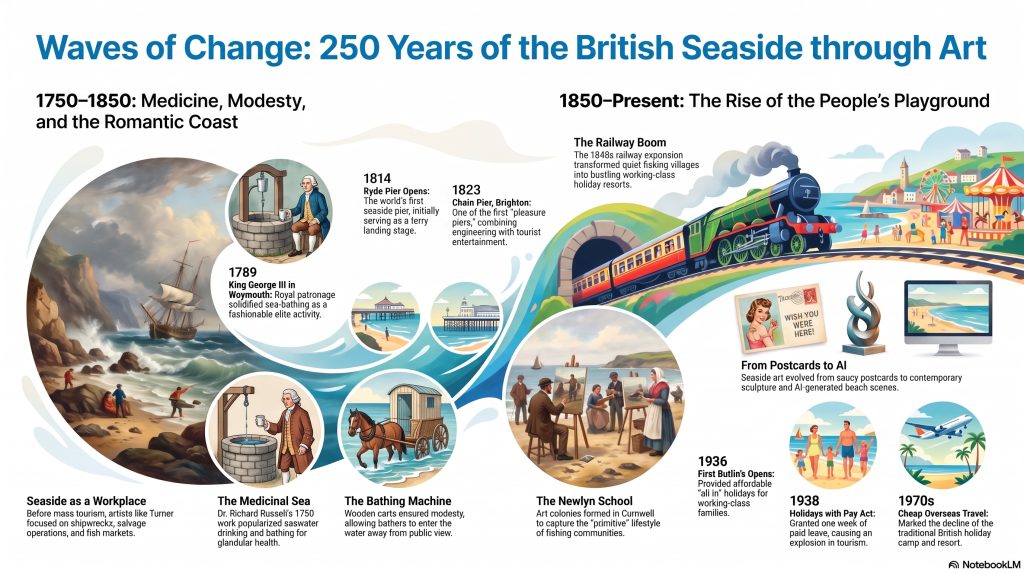
A second version of Art at the Seaside produced for a charity raising event for Save the Children in 2025. The first version is 99-04 Art at the Seaside.
This talk traces the 250-year evolution of the British seaside holiday through a diverse range of artistic works. The material explores how coastal visits shifted from exclusive medicinal treatments for the elite to popular mass-market excursions facilitated by the arrival of the railway. Through paintings by figures like Turner, Constable, and Frith, the text examines the tension between Victorian propriety and the practicalities of sea bathing. The talk also highlights the seaside as a place of industry, featuring the fishing communities that inspired artistic colonies in Newlyn and Staithes. Modern developments are captured via travel posters, holiday camps, and saucy postcards, illustrating a gradual shift toward leisure and relaxation. Finally, the collection concludes by contrasting contemporary sculpture and photography with the emerging influence of artificial intelligence in generating coastal imagery.
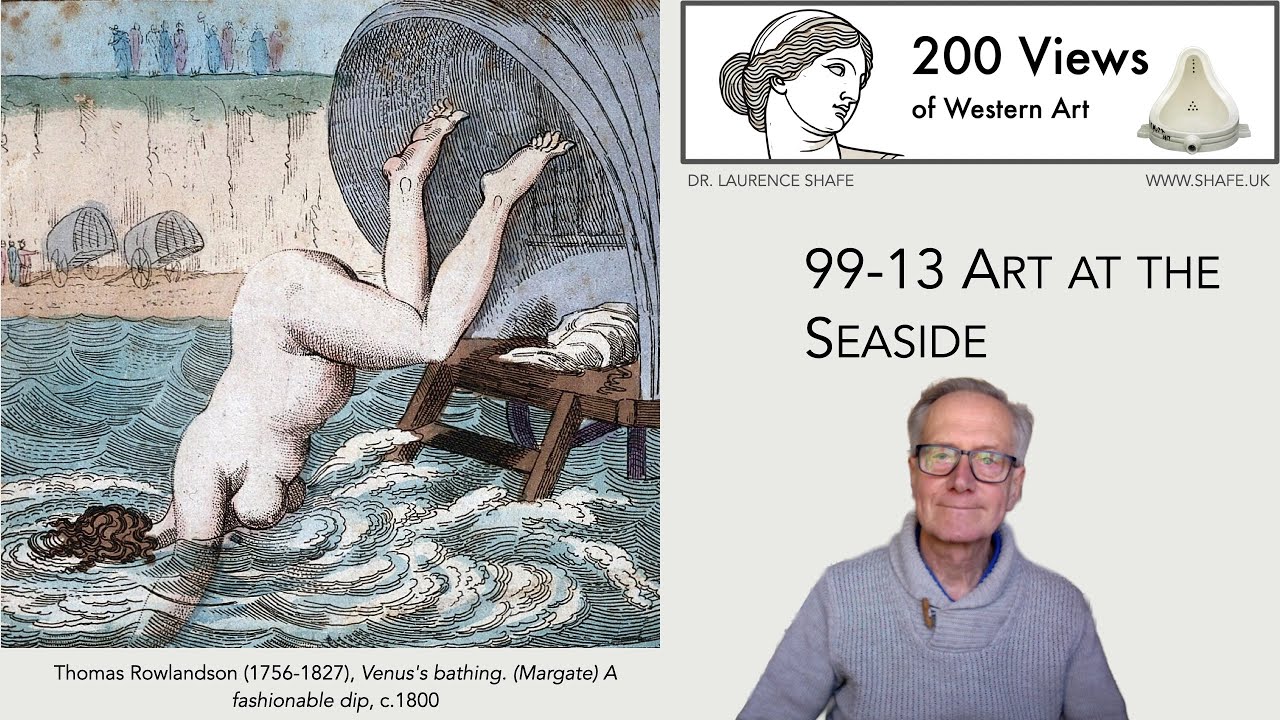
My notes on Art at the Seaside
A conversation about Art at the Seaside produce by Google’s Notebook from my notes:
The talk explores the evolution of the British seaside experience from the 18th century to the present day, using a diverse range of artworks as illustrative examples. It traces the shift from the sea as a source of trepidation and industry to a leisure destination, examining the social customs, artistic movements, and cultural phenomena associated with the seaside. The lecture concludes with a brief discussion of the potential impact of Artificial Intelligence on art.
Main Themes and Important Ideas/Facts:
1. The Origins of Seaside Holidays (18th Century):
- Seaside holidays began in the 1700s for the wealthy, initially driven by the belief in the medicinal properties of seawater.
- Dr. Richard Russell’s 1750 publication, “A Dissertation on the Use of Seawater in the Diseases of the Glands,” was influential.
- Royal patronage, particularly King George III’s visits to Weymouth for sea bathing to alleviate his mental instability, significantly popularised the practice.
- Scarborough is mentioned as potentially the first seaside town, already established as a spa town.
- The concept of the “first proper seaside holiday” is attributed to a vicar, Reverend Clarke, in 1736.
2. The Development of Seaside Etiquette and Social Norms:
- Sea bathing raised “issues of propriety,” particularly concerning nudity and interactions between the sexes.
- Bathing machines were invented around 1750 in Margate to provide modesty and shelter for middle-class women. They sometimes employed “Dippers” to assist bathers.
- Men and women bathed separately. Men initially bathed naked, a practice considered respectable until the 1860s. Women wore “thick, heavy woollen costumes” that even then caused concerns about exposure.
- The naked body was the “fundamental problem,” with middle-class anxieties surrounding respectability and behaviour at the seaside.
- Concerns extended to seemingly simple acts like women drying their hair in public, as “respectable women were never seen with their hair loose except by their husbands when going to bed.”
- Segregation of bathing areas was legally enforced until 1901, and bathing machines became extinct by 1820.
- Margate was known for “promiscuous bathing,” where men and women bathed together naked, leading to it being considered a less modest resort. Rowlandson’s etching, Summer amusement at Margate, or a peep at the mermaids, 1813, humorously depicts men using telescopes to view naked women bathing, highlighting contemporary anxieties.
- Quote: “According to the magazines of the period the crowds at Margate often used telescopes to get a better view of the “nude groups and sportive syrens”. It was also reported that these “magnifying mediums” were as likely to be used by ladies as by gentlemen. The conclusion was that Margate was not a place which attracted what was called the “truly modest women.””
3. The Seaside as a Workplace:
- Coastal towns were centres for the fishing industry.
- British fishermen had a long history in Icelandic waters and the Grand Banks.
- The 19th century saw the rise of major fishing ports like Brixham and Grimsby due to new trawler designs. By the end of the 19th century, Britain had over 3,000 fishing trawlers.
- J.M.W. Turner’s painting, Hastings: Fish Market on the Sands, Early Morning, 1824, depicts the working life of the seaside, including fishermen and fishwives alongside fashionable visitors, highlighting the dual nature of these locations. The inclusion of figures in Greek costume references the Greek War of Independence, reflecting contemporary British support for the cause.
4. The Development of Piers:
- Piers began as landing stages in the early 19th century and evolved into entertainment venues.
- Ryde Pier (Isle of Wight, opened 1814) is the world’s oldest surviving seaside pier.
- Margate Pier became the first iron pier in 1855.
- Eugenius Birch became a famous pier designer.
- Southend Pier is the longest surviving pier (1.34 miles).
- The number of piers has declined from over 100 to 55.
- Brighton’s Chain Pier (opened 1823) was initially for cargo and ferries but became a tourist attraction. Constable’s painting, Chain Pier, Brighton, 1826–7, captures the bustling atmosphere. The pier was destroyed by a storm in 1896.
- Brighton’s West Pier (opened 1866, closed 1975) and Palace Pier (opened 1899, still operating) further exemplify the evolution of piers as pleasure destinations.
5. The Rise of Seaside Resorts and Royal Influence:
- Brighton’s popularity surged due to George IV’s Brighton Pavilion.
- Ramsgate also became a popular resort, receiving the title ‘Royal Harbour’ from George IV. Frith’s painting, Ramsgate Sands (Life at the Seaside), 1852-4, offers a detailed snapshot of Victorian seaside life, showcasing class distinctions and social interactions. Queen Victoria’s early visit to Albion House in Ramsgate is mentioned, as is her first sea bath in Osborne in 1847.
- Quote (Queen Victoria’s Journal): “‘drove down to the beach with my maid & went into the bathing machines, where I undressed & bathed in the sea (for the 1st time in my life), a very nice bathing woman attended me. I thought it delightful till I put my head under water, when I thought I should be stifled.’”
6. Seaside Art Colonies:
- The lecture highlights the emergence of various art colonies along the British coast, attracting artists drawn to the scenery and lifestyle. Examples include:
- Newlyn (Stanhope Forbes, Henry Scott Tuke) – associated with a “primitive” lifestyle and Rousseau’s “Noble savage” ideal. Forbes’ A Fish Sale on a Cornish Beach, 1885, exemplifies the Newlyn School’s focus on everyday coastal life painted en plein air. Bramley’s A Hopeless Dawn, 1888, also from Newlyn, depicts the tragic realities of fishing communities.
- Lamorna (Lamorna Birch, Alfred Munnings)
- St. Ives (Barbara Hepworth, Ben Nicholson, Alfred Wallis)
- Walberswick (Philip Wilson Steer, Charles Rennie Macintosh) – Steer’s Girls Running, Walberswick Pier, 1888–94, is presented as a significant example of British Impressionism.
- Staithes (Laura and Harold Knight) – Laura Knight’s The Fishing Fleet, c. 1900, was painted here. Her later move to Newlyn and her use of nude models, as seen in The Bathing Pool, 1912, are discussed, highlighting her breaking of artistic conventions.
- Cullercoats (Winslow Homer)
- Kirkcudbright (Glasgow Boys, Scottish Colourists)
- The Barbizon School in France is mentioned as a precursor to these art colonies, inspiring artists to paint directly from nature.
- Henry Scott Tuke, associated with Newlyn, is discussed for his depictions of nude youths, often in bathing scenes, which were not always overtly sexual but were viewed through the lens of Victorian social norms and later re-evaluated by gay artists. Paintings like The Bathers, 1889 and Ruby, Gold and Malachite, 1902 are highlighted, with interpretations ranging from depictions of a “lost rural idyll” to the “healthy sons of empire.”
7. Holiday Camps:
- Holiday camps emerged in the early 20th century, evolving from tented camps to those with wooden huts (first in 1920).
- Large chains like Warners (1931) and Butlins (1936) popularised the concept of affordable, all-inclusive seaside holidays for the working class.
- Billy Butlin aimed to create a “fantasy world” as an escape from cramped boarding houses. His camps offered various activities and amenities at a fixed price.
- Holiday camps flourished in the 1950s and 60s but declined in the 1970s with the rise of cheap foreign package holidays.
- A Butlins poster from 1940 is shown, illustrating the early appeal of these camps.
- Quote (advertisement for Butlin’s): “With the true art of showmanship, he made the camp attractive, entertaining – in fact, you cannot spend a single dull moment there.”
8. The Day Tripper and Beach Huts:
- The car enabled day trips to the beach after World War II, leading to a resurgence in seaside visits.
- Beach huts, evolving from bathing machines, became popular. A beach hut at Mudeford Spit sold for a significant sum in recent times, indicating their continued desirability.
9. Art and Social Commentary:
- Rowlandson’s satirical prints critique the evolving customs of sea bathing and social voyeurism.
- Frith’s Ramsgate Sands provides a detailed social panorama of the Victorian seaside.
- Punch cartoons, such as “‘A very natural mistake’, Punch (6 September 1856)”, offer humorous commentary on changing gender roles at the seaside, though Dr. Shafe suggests this particular example reflects a masculinised fashion rather than a “profound shift in society.”
- Dyce’s Pegwell Bay, Kent – a Recollection of October 5th 1858 reflects middle-class scientific interests, particularly geology, against the backdrop of Darwin’s and Lyell’s groundbreaking works. The comet depicted in the painting and the autumnal setting evoke themes of time and mortality.
- Stanley Spencer’s painting, Southwold, Suffolk, 1937, hints at the complexities of his personal life and explores themes of love and relationships in a seaside setting.
- Paul Nash’s Totes Meer (Dead Sea), 1940-41, uses the imagery of wrecked aircraft at Cowley to create a powerful and unsettling metaphor of war, linked to a seemingly static and dead “sea.”
- William Patrick Roberts’ The Seaside, c. 1966, represents a later, more modernist take on the traditional seaside scene.
10. Modern and Contemporary Art at the Seaside:
- Antony Gormley’s Another Place at Crosby Beach (1997) uses multiple cast-iron figures to explore the human relationship with nature and themes of exploration and migration.
- Tracey Emin’s acquisition of a Margate beach hut connects back to the lecture’s starting point, highlighting the personal and artistic significance of the seaside.
- Quote (Tracey Emin): “I was completely broke, and it was really brilliant, having your own property by the sea.”
11. The Impact of Artificial Intelligence on Art:
- The lecture concludes with a brief exploration of AI’s potential to create art.
- Examples of AI-generated images from Ideogram and Stable Diffusion are shown, including prompts for photographic and painterly depictions of families on a beach.
- Dr. Shafe notes the rapid improvement in AI image generation and suggests it will “dramatically change the world of commercial art.”
- The creativity of AI neural networks is discussed, with errors being termed “hallucinations,” linking this to Leonardo da Vinci’s observation about finding landscapes in stains on walls.
- Google’s “deep dreaming” project is mentioned to illustrate AI’s ability to create images from random noise.
- Quote (Leonardo da Vinci): “Look at walls splashed with a number of stains, or stones of various mixed colours. If you have to invent some scene, you can see there resemblances to a number of landscapes, adorned with mountains, rivers, rocks, trees, great plains, valleys and hills, in various ways … The mind of the painter is stimulated to new discoveries … because by indistinct things the mind is stimulated to new inventions.”
Conclusion:
The talk provides a rich and engaging historical overview of the British seaside holiday through the lens of art. By examining a diverse range of paintings, prints, and even postcards, the lecture illuminates the evolving social customs, recreational activities, and artistic responses to this enduring aspect of British culture. The inclusion of modern and contemporary art, alongside a brief look at AI, brings the narrative up to the present day, prompting reflection on the future of seaside representation in art.
99-14 Art History from A-Z
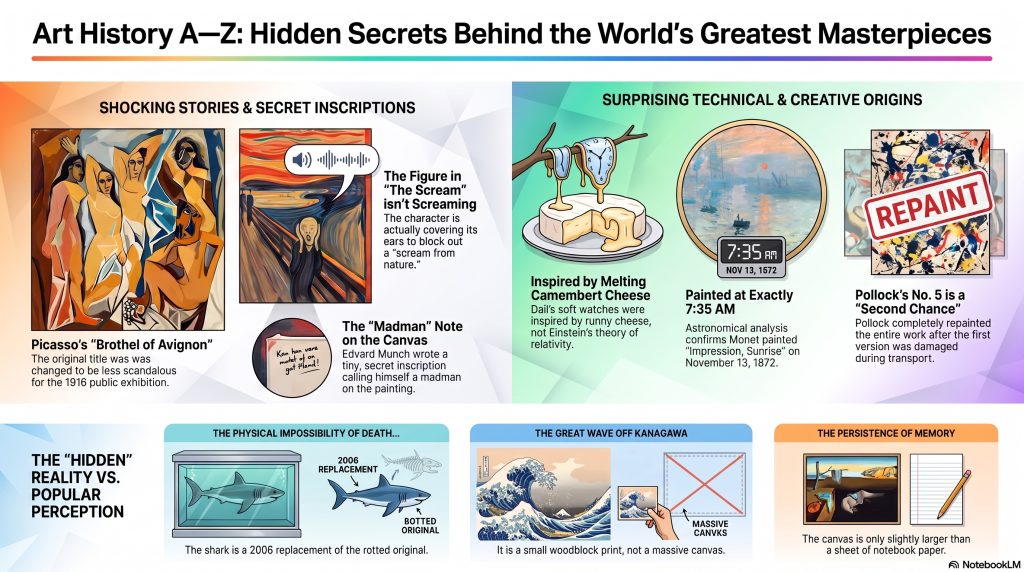
This talk explores the evolution of human creativity by assigning a specific art movement or artist to each of the twenty-six letters of the alphabet. For every entry, Shafe identifies a canonical masterpiece and provides three relatively unknown historical or technical facts to engage and challenge the audience. The subjects range from ancient architectural motifs like the Ziggurat of Ur to modern icons like Damien Hirst’s preserved shark. Throughout the discourse, the author highlights how social context, personal tragedy, and technological innovation have shaped famous works. Additionally, the document explicitly credits various artificial intelligence systems and academic websites for assisting in the research process.
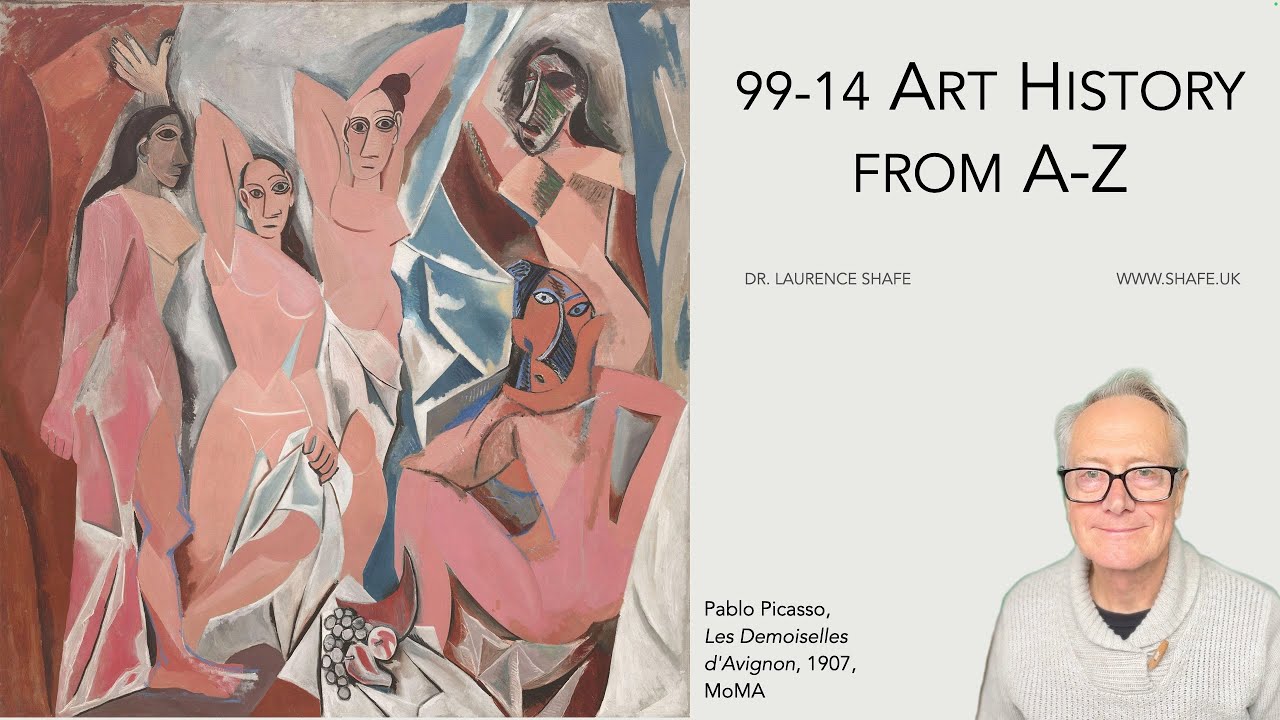
My notes on Art History from A-Z
A conversation about Art History from A-Z created by Google Notebook from my notes:
Six Art History Facts That Will Change How You See These Masterpieces
We’ve all seen them—the world-famous paintings reproduced on everything from coffee mugs to posters. We see them so often that we feel like we already know their stories. But behind these iconic images are surprising, counter-intuitive, and sometimes shocking truths that can change our entire understanding of the art and the artist. Prepare to see these timeless masterpieces in a completely new light.
1. The Figure in The Scream Isn’t Screaming—It’s Reacting
The most common misconception about Edvard Munch’s The Scream is that the skeletal figure is letting out a terrible shriek. The truth is the opposite: the figure is covering its ears to block out an external sound. Munch called this “the scream of nature,” a piercing cry he felt passed through the world around him. The painting’s original German title was even Der Schrei der Natur (The Scream of Nature). His own diary entry makes this clear:
I was walking along the road with two friends—the sun was setting—suddenly the sky turned blood red—I paused, feeling exhausted, and leaned on the fence—I felt a great, infinite scream pass through nature.
As a final, strange note, Munch himself added a secret pencil inscription on the painting, likely in response to early criticism, which reads: “Could only have been painted by a madman!” This completely changes our interpretation. The figure is not an agent of terror, but a victim of it. This transforms the painting from a simple depiction of a personal crisis into a universal symbol of modern existence—the feeling of being overwhelmed by a world that has grown too loud.
2. A Runny Camembert Inspired Dalí’s Melting Clocks
Many assume the famous melting clocks in Salvador Dalí’s The Persistence of Memory were inspired by Albert Einstein’s theory of relativity. The real inspiration was far more mundane. Dalí claimed the idea came to him one evening after dinner during a surreal hallucination in which he observed a “very strong” Camembert cheese melting in the sun. This gave him the central image of “the Camembert of time.”
Look closely at the fleshy, monstrous creature slumped in the painting’s center. This is no random beast; it’s a distorted, dream-like self-portrait of Dalí himself. With its large nose and long, insect-like eyelashes, it represents the artist as a fading creature within his own hallucinatory dreamscape. Adding to the surprise, the painting—so monumental in our imagination—is actually very small, measuring only 24 x 33 cm, slightly larger than a sheet of notebook paper. This trivial origin demystifies one of Surrealism’s most profound images, grounding its dreamlike logic not in complex physics, but in a fleeting moment of everyday observation.
3. The Original Fountain Was Lost (and Maybe Wasn’t Made by Duchamp)
Marcel Duchamp’s Fountain, a simple urinal signed “R. Mutt,” is one of the most influential artworks of the 20th century. However, the original object from 1917 was lost—likely thrown out as rubbish—shortly after being exhibited. Every version you see in a museum today is a replica that Duchamp authorized decades later in the 1950s and 60s.
Even more shocking is the well-supported theory that Duchamp wasn’t the artist at all. Evidence suggests he submitted the work on behalf of a friend, the German Dada artist Baroness Elsa von Freytag-Loringhoven. In a 1917 letter to his sister, Duchamp wrote:
One of my female friends, who had adopted the masculine pseudonym Richard Mutt, sent me a porcelain urinal as a sculpture.
Duchamp’s own explanation of the signature “R. Mutt” reveals the work’s anti-art humor. “Mutt” was a pun on J.L. Mott Iron Works, a popular plumbing manufacturer, and “Mutt and Jeff,” a famous newspaper comic strip. These facts—the lost original, the challenged authorship, and the low-brow commercial pun—perfectly embody the Dadaist idea that the concept is more important than the physical object or even the artist’s identity.
4. “Impressionism” Was Originally an Insult
When Claude Monet’s painting Impression, Sunrise was shown at an exhibition in 1874, it baffled critics. Art critic Louis Leroy, in particular, was appalled by the loose, seemingly unfinished style. In a review dripping with satirical venom, he seized on Monet’s title to dismiss the entire group of artists.
Leroy contemptuously titled his review “The Exhibition of the Impressionists” and wrote that “wallpaper in its embryonic state was more finished than this seascape.” But a profound irony was at work. The artists, rather than being defeated by the mockery, embraced the insult. They defiantly adopted “Impressionist” as their official name, turning a term of derision into a revolutionary badge of honor that would define one of art history’s most famous movements.
5. The Shark in Damien Hirst’s Masterpiece Is a Replacement
Damien Hirst’s 1991 artwork, The Physical Impossibility of Death in the Mind of Someone Living, features a massive tiger shark suspended in formaldehyde. However, the original shark was poorly preserved in what Hirst called a “too weak solution of formaldehyde” and began to deteriorate within a few years, shrinking, wrinkling, and turning the liquid murky. When the artwork was sold for a reported $8 million in 2004, Hirst had the animal replaced with a brand-new shark preserved with more advanced techniques.
From its debut, the public was skeptical, captured by the tabloid headline: “£50,000 for fish without chips.” The replacement sparked a major philosophical debate: Is it the same artwork if the central object is entirely different? Hirst’s unwavering argument is that the concept—the terrifying confrontation with death—is the art, not the specific shark. This radical stance challenges our most fundamental ideas of what an artwork is, forcing us to ask if art resides in the object we see or the idea that created it.
6. The Father of Minimalism Hated Being Called a Minimalist
Donald Judd is universally considered a pioneer and “the father of minimalism.” It’s deeply ironic, then, that Judd vehemently rejected the label his entire career. He found the term too general and simplistic to describe his work or that of his peers.
Instead, he preferred to call his works “specific objects,”arguing they were a new category that was neither painting nor sculpture. In a 1965 essay, he made his feelings clear:
The new three dimensional work doesn’t constitute a movement, school, or style. The common aspects are too general and too little common to define a movement. The differences are greater than the similarities.
An artist becoming the icon for a movement he actively disowned reveals a central truth about art history. It shows the fascinating power struggle between the artist’s intent and the narrative constructed by critics, curators, and the public. In the end, history’s labels can be more powerful than the artist’s own voice.
A New Way of Looking
These stories reveal that the true histories behind famous artworks are often more complex, mundane, and surprising than the images themselves. From a melting piece of cheese to a critic’s insult, the reality behind the canvas irrevocably alters our relationship with the art itself. Now that you know the story, which of these masterpieces will you never see the same way again?