The Tate network of galleries — Tate Britain, Tate Modern, Tate Liverpool, and Tate St Ives — constitutes the most important public collection of British and international modern art in the United Kingdom, and Tate Modern is now among the most visited art museums in the world. Founded as the National Gallery of British Art in 1897 through the philanthropic gift of the sugar merchant Sir Henry Tate, the original collection on Millbank grew steadily through the twentieth century and separated from the National Gallery to become fully independent in 1955. The transformation of the decommissioned Bankside Power Station into Tate Modern, which opened in 2000 to extraordinary public and critical acclaim, demonstrated that a former industrial building of massive scale could become not merely a container for art but itself an act of cultural reimagination. Tate’s acquisition policy, publishing programme, and exhibition record have made it central to the development and public understanding of modern and contemporary art in Britain. Its online collection — the largest freely accessible museum database in the world — has transformed access to the history of British art globally.
Henry Tate’s Gift and the Foundation of a National Collection: The Tate’s origin lies in the gift of Sir Henry Tate (1819–1899), the sugar refiner who had made his fortune introducing the pre-cut sugar cube to Britain. Tate offered his collection of sixty-seven paintings by Victorian artists — along with £80,000 to build a gallery — to the nation in 1889, on condition that the government provide a site. After years of negotiation, the National Gallery of British Art opened on Millbank in 1897. Tate’s taste ran to the academic Victorian painters of his own generation, but the collection he founded eventually became home to the most radical art of the following century.
From Millbank to the Bankside Powerhouse: By the 1980s, Tate’s original Millbank building was hopelessly inadequate for the international modern collection it had accumulated. The search for a new home led to the most transformative architectural decision in British museum history: the conversion of Giles Gilbert Scott’s decommissioned Bankside Power Station, on the south bank of the Thames opposite St Paul’s Cathedral, into a gallery of international modern and contemporary art. The Swiss architects Herzog & de Meuron won the competition; Tate Modern opened in May 2000, drawing two million visitors in its first year.
Tate Modern — The Turbine Hall as Cultural Event: The most dramatic feature of Tate Modern is the former Turbine Hall — a vast industrial nave 155 metres long and 35 metres high — which has become a venue for large-scale commissions by major international artists. Louise Bourgeois’s giant spiders, Olafur Eliasson’s artificial sun, Ai Weiwei’s carpet of ceramic sunflower seeds, Carsten Höller’s giant slides — these Turbine Hall installations have become major cultural events in their own right, bringing millions of people into direct physical encounter with contemporary art.
Tate Britain — The National Collection of British Art: Following the opening of Tate Modern, the original Millbank building was renamed Tate Britain and refocused on its core purpose: the national collection of British art from 1500 to the present. Its permanent collection — the largest collection of British art in the world — includes supreme works by Hogarth, Gainsborough, Constable, Turner, the Pre-Raphaelites, and every major British artist of the twentieth century. The annual Turner Prize, awarded at Tate Britain since 1984, is the most discussed prize in British contemporary art.
The Turner Prize — Controversy as Cultural Engine: The Turner Prize, awarded annually to a British artist under fifty for an outstanding exhibition or other presentation of their work, has been the most reliably controversial event in the British art calendar since its foundation in 1984. Its shortlist has repeatedly provoked tabloid outrage — unmade beds, lights switching on and off, a shark in formaldehyde — while simultaneously making modern art a topic of genuine public debate. Whether one sees this controversy as evidence of the prize’s irrelevance or its cultural power probably says more about the respondent than about the prize.
Tate’s Global Mission — Beyond the British Collection: Tate has increasingly positioned itself as a global institution, building partnerships with museums worldwide, developing a substantial international loan and touring programme, and constructing the largest freely accessible online art database in the world. Its acquisition of major works of international modern art — by Picasso, Matisse, Rothko, and many others — has made it a comprehensive resource for the history of art since 1900. The question of whether a national institution primarily funded by British taxpayers should pursue a global collecting mandate continues to generate vigorous internal and external debate.
98-01 A History of the Tate

I chronicle the Tate’s history and the evolution of art appreciation in England. The sources trace the shifting role of the artist from a simple decorator in the Tudor era to a high-status academic during the Italian Renaissance. Key historical figures like Henry VIII and early art collectors such as Thomas Howard are highlighted to illustrate how royal pageantry transitioned into sophisticated private collecting. The text also explains the origin of modern museums, describing their growth from private cabinets of curiosities into public institutions. Detailed analysis of iconic works, including Raphael’s “The School of Athens” and paintings of the Field of the Cloth of Gold, serves to contextualize the cultural importance of the Tate’s collection. Ultimately, the materials provide a comprehensive chronological framework for understanding British art from the 16th century through the postmodern era.
My notes on 98-01 A History of the Tate
A conversation created by Gemini Notebook from my notes:
1. The Gallery You Think You Know
The Tate is a world-renowned icon of culture, a constellation of galleries that define the very topography of the British artistic landscape. To the modern visitor, its grand porticos and serene white walls suggest a lineage of uninterrupted refinement and prestige. However, the foundations of this institution are far grittier, more chaotic, and more ironically poised than its polished exterior implies. How did the refined domesticity of a “sugar king” and the raw human misery of a “penitentiary” become the bedrock of British art? The story of the Tate is a study in contrasts—a narrative where the sweetness of a Victorian fortune collided with the bitterness of a high-security prison to create a “temple of art” from the rubble of scandal and rejection.
2. The “Interior Decorator” Era: When Art Was Just Expensive Wallpaper
Before the Tate could rise as a monument to aesthetic genius, the British understanding of art value had to undergo a radical, intellectual evolution. During the Tudor period, a painting was rarely viewed as a standalone masterpiece of the soul. Instead, art was a functional demonstration of “magnificence,” relegated to religious icons or the fleeting splendor of pageants and festivals.
In this era, painters were considered the social and professional equivalents of modern-day interior decorators. The most talented among them found work painting inn signs, flags, and cloth tapestries. A work’s value was calculated with the cold precision of a merchant: it was worth the sum of its materials—the yardage of the cloth, the weight of the gold thread—rather than the spark of artistic skill. While the Italian Renaissance saw the status of the artist rise to that of a “theologian or academic” as early as the 1400s, Britain remained culturally sluggish. It took another century for the British elite to stop viewing artists as mere craftsmen of “wallpaper” and begin appreciating the intellectual depth of a canvas.
3. The Case of the Severed (Painted) Head
British art history is littered with bizarre moments where political survival overrode aesthetic integrity. Perhaps the most peculiar involves the 16th-century painting The Field of the Cloth of Gold, a work on timber and canvas depicting the lavish 1520 meeting between Henry VIII and Francis I.
In the early 17th century, this painting became a sudden diplomatic liability. As King James I prepared to walk down a corridor with a Spanish ambassador to discuss peace, civil servants allegedly performed a tactical “beheading” on the canvas. As the historical records suggest:
“Spain still hated Henry as he had shamed them across Europe when he divorced Catherine of Aragon so the civil servants cut off his head and later sewed it back again.”
While scholars maintain a degree of integrity regarding the ambiguity of the tale—we have the written records of the incident, though we cannot be entirely certain which specific painting was the victim—the act itself reveals how art was once treated as a disposable political tool. A king’s head could be snipped and stitched back according to the prevailing diplomatic winds.
4. Wunderkammers and “Appointment Only” Entry
Long before the public could stroll freely through the Tate, the “museum” was a scene of baroque clutter and encyclopedic chaos. These were the “Wunderkammers” or “Cabinets of Curiosities”—private rooms where sophisticated monarchs like Rudolf II displayed “weird and wonderful objects” to prove their worldly connoisseurship. The aesthetic was a jumble of natural history and art: floor-to-ceiling displays where a masterpiece might hang beneath an actual crocodile suspended from the ceiling, flanked by antlers, feathers, and geological specimens.
Even as the concept of the public museum emerged, the “public” was hardly invited. The original British Museum, founded in 1753, was accessible by appointment only. This was a calculated gatekeeping measure intended to prevent the perceived “hordes of the public” from descending upon and destroying the exhibits. The transition from these restrictive, private “rooms of wonders” to truly national spaces was a slow and reluctant democratic process.
5. Britain’s Sluggish Start in the Art Race
It is a humbling fact for the British ego that the nation was a distinct “late bloomer” in the global art scene. While the great families of Italy, Spain, and France had been aggressively curating massive collections since the 15th century, the first serious art collector in England, Thomas Howard, the Earl of Arundel, didn’t appear until the 1620s.
Britain was, in fact, one of the last major European countries to open a national gallery. While the rest of the continent boasted grand repositories of culture, the National Gallery in Trafalgar Square was not founded until 1824. The government’s hesitation was legendary; in 1777, Parliament famously turned down the chance to buy Sir Robert Walpole’s world-class collection, allowing it to be snapped up by Catherine the Great for the Hermitage in St. Petersburg—a staggering cultural loss for the British Isles.
6. The Sugar King’s Rejected Gift
The Tate exists today only because of the persistence of Henry Tate, a man whose life followed a classic Victorian arc from grocer’s apprentice in Liverpool to millionaire “sugar king” after he purchased the patent for the sugar cube. Despite his immense wealth, Tate was a man of modest, almost retiring character who preferred anonymous donations and built “The Tate Institute”—a bar and dance hall—for the recreation of his refinery workers.
In 1889, Tate offered his collection of 65 paintings to the nation. However, he faced a wall of institutional snobbery. The trustees of the National Gallery rejected the gift, claiming they lacked the space. The subtext, however, was clear: the establishment preferred the “Old Masters” of the High Renaissance and looked down upon Tate’s collection of contemporary British art. This rejection fueled a campaign for a dedicated space, culminating in Tate donating £150,000 to ensure the gallery that now bears his name would finally be built.
7. From Convicts to Canvas: The Prison Site
There is a profound, almost poetic irony in the physical location of Tate Britain. The “temple of art” designed by architect Sidney R.J. Smith, with its grand portico and classical dome, sits directly atop the site of the demolished Millbank Penitentiary.
For much of the 19th century, this was a place of dread—the primary departure point for convicts being “transported” to Australia. The prison was demolished in 1890, and just seven years later, the site of incarceration and exile was transformed into a site of cultural elevation. Where cells once stood and prisoners once waited for the long voyage to the colonies, Smith’s Britannia now sits atop a pediment, guarding a collection dedicated to the “encouragement and development of British art.”
8. Conclusion: A Legacy of “Ennobling Enjoyment”
From its origins as a rejected private collection to its current status as a global powerhouse, the Tate has fulfilled a vision larger than its founder could have imagined. Today, the four galleries draw millions—with Tate Modern alone attracting 5.7 million annual visitors—vindicating the 1857 Parliamentary Commission’s belief that:
“The existence of the pictures is not the end purpose of the collection, but the means only to give the people an ennobling enjoyment.”
As we walk through the quiet halls of the Tate today, we must ask: does this gritty, scandalous, and often accidental history add a layer of value to the art on the walls? Perhaps the knowledge that this “ennobling enjoyment” was built upon a foundation of sugar and iron makes the beauty of the collection all the more remarkable.
98-02 Tate & The Turner Prize
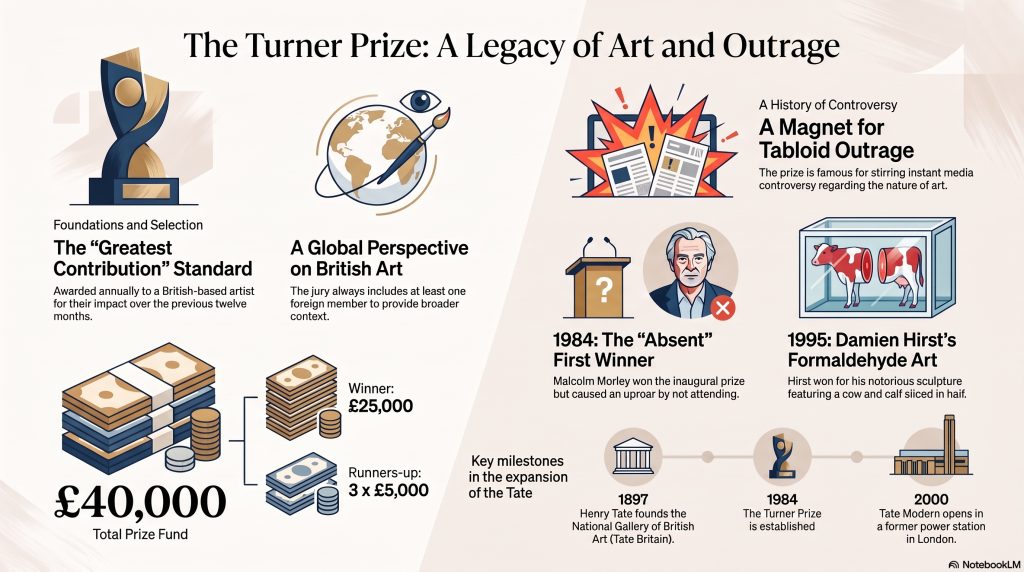
I outline the history and significance of the Turner Prize, an annual award established in 1984 by the Tate to recognize outstanding contributions to British contemporary art. Managed by a rotating jury of experts, the prize has evolved into a major cultural institution known for its bold exhibits and the frequent public controversy they ignite in the national press. Key examples of past winners include Malcolm Morley, the inaugural recipient, and other famous figures like Damien Hirst and Rachel Whiteread, whose works have sparked debates over the definition of art. The materials also trace the growth of the Tate gallery system, which now includes four major locations across the United Kingdom. The talk highlights the way in which the prize uses provocative media attention to bring diverse forms of modern visual expression into the public eye.
My notes on Tate & The Turner Prize
A conversation created by Gemini Notebook from my notes:
Every year, like clockwork, a specific corner of the British press works itself into a predictable lather. The culprit is never a politician or a footballer, but a contemporary art award. Why does a prestigious prize consistently generate headlines about “clowns,” “circuses,” and “outrage”?
The Turner Prize is more than a trophy; it is a forty-year-old cultural lightning rod. Founded in 1984 by the Patrons of New Art under Tate Director Alan Bowness, it was designed to be the visual arts’ equivalent to the Booker Prize. It was named after J.M.W. Turner—an artist whose late, misty works were considered absolute gibberish by the critics of his own day. In that sense, the prize has remained remarkably faithful to its namesake’s legacy of institutionalized irony.
1. The “British” Winner Who Couldn’t Be Bothered
The prize established its tradition of defiance at the very first ceremony in 1984. The inaugural winner was Malcolm Morley, an artist who had lived in the United States for twenty years. This triggered an immediate identity crisis: how could someone “hardly qualify as a British artist” win the top British gong?
Morley didn’t help matters by failing to show up. While two million people watched on the BBC, the guest of honor’s chair remained empty. The friction was palpable. Lord Gowrie, the Arts Minister, handed over the £10,000 cheque while openly stating he would have preferred to give it to the land artist Richard Long. Art critic Waldemar Januszczak had already dismissed Morley as a “dark horse” with “no chance.”
This win set the tone. The Turner Prize was never going to be a safe, predictable pat on the back for local favorites. It was a provocateur from day one.
2. When Being the “Worst” Artist Pays Better Than Being the Best
If you want to understand the genius of the Turner Prize, look at the career of Rachel Whiteread. In 1993, she won for House, a monumental concrete cast of the interior of a Victorian terrace. It was a haunting, architectural ghost, but it drove the populists mad.
In a move of peak British irony, the K Foundation awarded Whiteread the “Anti-Turner Prize” for being the “worst artist in Britain.” The punchline? The anti-prize was worth £40,000—exactly double the actual Turner Prize purse at the time.
Whiteread didn’t just take the insult; she laundered it into a PR masterclass. She accepted the cash and immediately handed £30,000 to artists in need and £10,000 to the housing charity, Shelter. It proved that the prize’s real value isn’t just in the aesthetics, but in the dialogue it forces between establishment recognition and populist backlash.
3. Mediums of Outrage: From Paint to Elephant Dung
For decades, the prize was an argument about what “visual art” even means. The public was comfortable with paint, clay, and plaster. Then came the elephant dung.
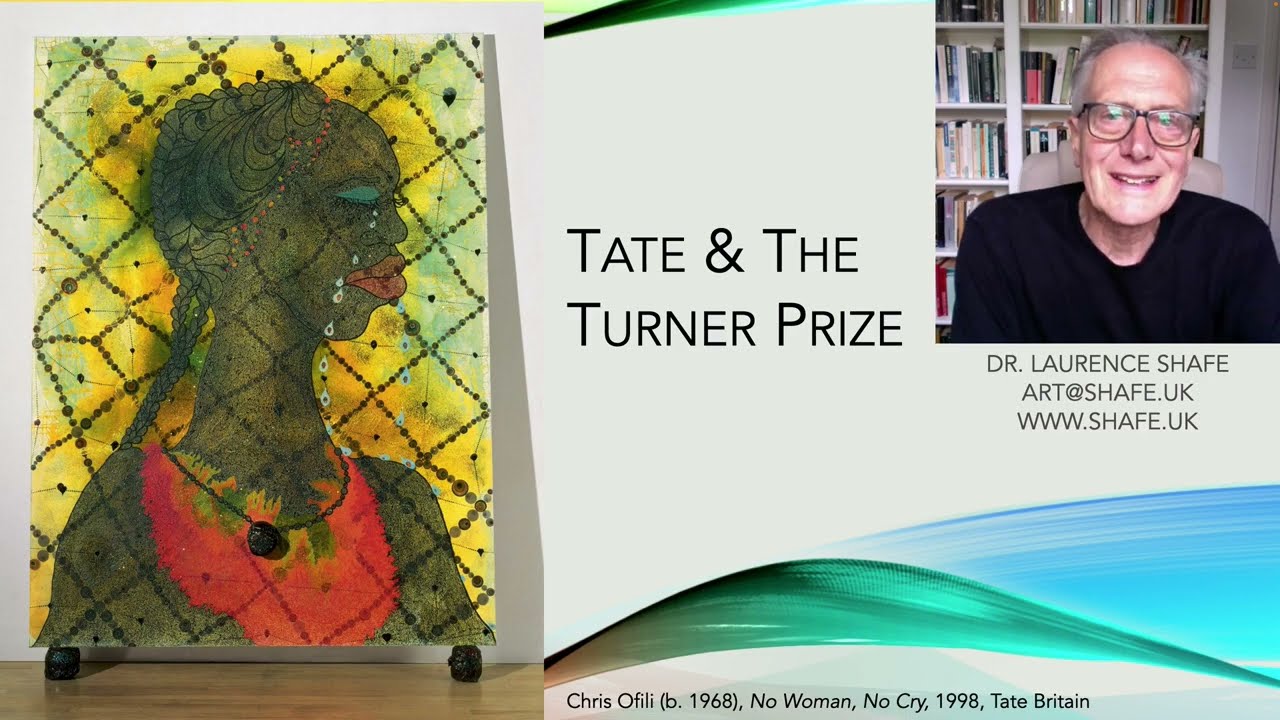
Chris Ofili’s 1998 win for No Woman, No Cry—a tribute to the murdered Stephen Lawrence—was famously propped up on clumps of dung. Three years earlier, Damien Hirst had won for Mother and Child, Divided, featuring a cow and a calf sliced in half in formaldehyde.
These works caused instant tabloid cardiac arrest. Critics were equally horrified by the shift toward video. Writing for the Daily Telegraph, Mark Hudson ran the headline “Heaven help us,” and concluded his review with: “If the future of art is going to be all about watching videos in darkened rooms, God help us.”
The irony, of course, is that the controversy is the point. By moving beyond traditional mediums, the prize forces us to ask if art is a thing we look at, or an idea we grapple with.
4. The Institution as Ringmaster
If the artists are the stars, the protesters are the dedicated supporting cast. The Turner Prize has inspired a unique brand of creative dissent. In 2000, a group called “The Stockists” dressed as clowns to protest the ceremony, calling the prize an “ongoing national joke.” They claimed J.M.W. Turner himself wouldn’t be “in danger” of winning it today.
In 2001, the feedback became visceral. When Martin Creed won for Work No. 227: the lights going on and off (which was exactly what it sounds like), artist Jacqueline Crofton expressed her critique by throwing eggs at the gallery walls.
The Tate, however, isn’t a victim of this circus; it’s the ringmaster. Under leaders like Sir Nicholas Serota, the institution realized that “playing up the controversy” was the fastest way to turn a small event at Tate Britain into a national icon. The gallery doesn’t just endure the chaos; it enjoys the publicity.
5. From Swearing Superstars to Syrian Prisons
By 2004, the prize was so deeply embedded in the culture that Madonna was invited to present it. She proceeded to swear on live television and declare that “everyone is a winner.” It was the ultimate “low-brow meets high-art” moment.
However, the prize eventually pivoted away from sensationalist materials and toward data that shocks the conscience. By 2018, the nominees reflected a new, more political era. We saw:
- Forensic Architecture, who used 3-D reconstructions to recreate the harrowing interior of a Syrian prison.
- Luke Willis Thompson, whose silent film portrait of Diamond Reynolds confronted racial violence in the U.S.
- Charlotte Prodger, praised for her nuanced exploration of queer identity politics.
- Naeem Mohaiemen, whose work investigated the pain of exile and migration.
The prize shifted from shocking the senses with dead sharks to shocking the soul with the reality of the human condition.
The Turner Prize remains a demanding, divisive, and essential British institution. It has survived forty years by refusing to be boring. It invites us to have an opinion, even if that opinion is a desire to reach for an egg. But as we look at its legacy, we must ask: if the Turner Prize ever stops making us angry, will that be the moment British art truly dies?
98-03 Tate Britain in 60 Minutes
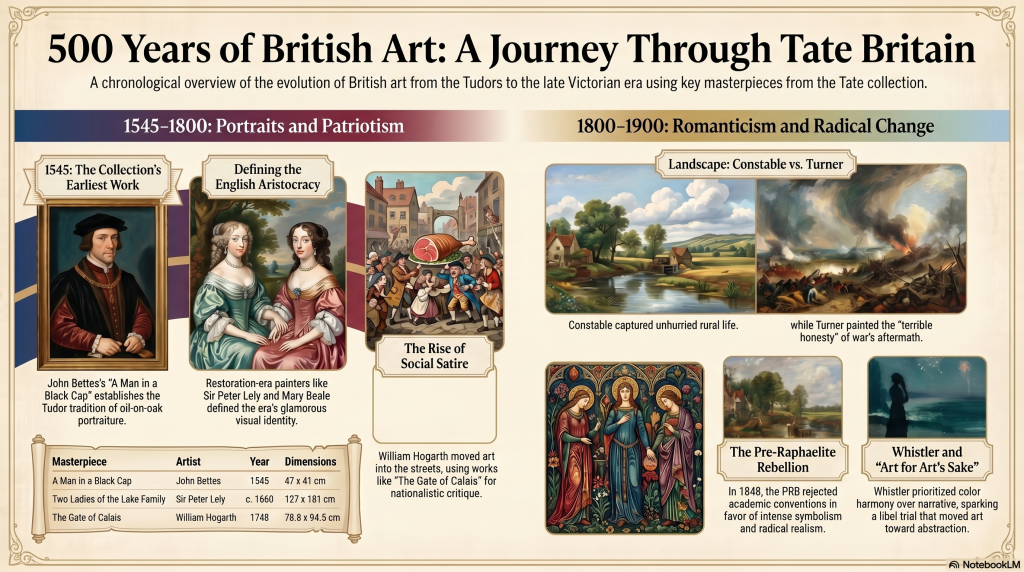
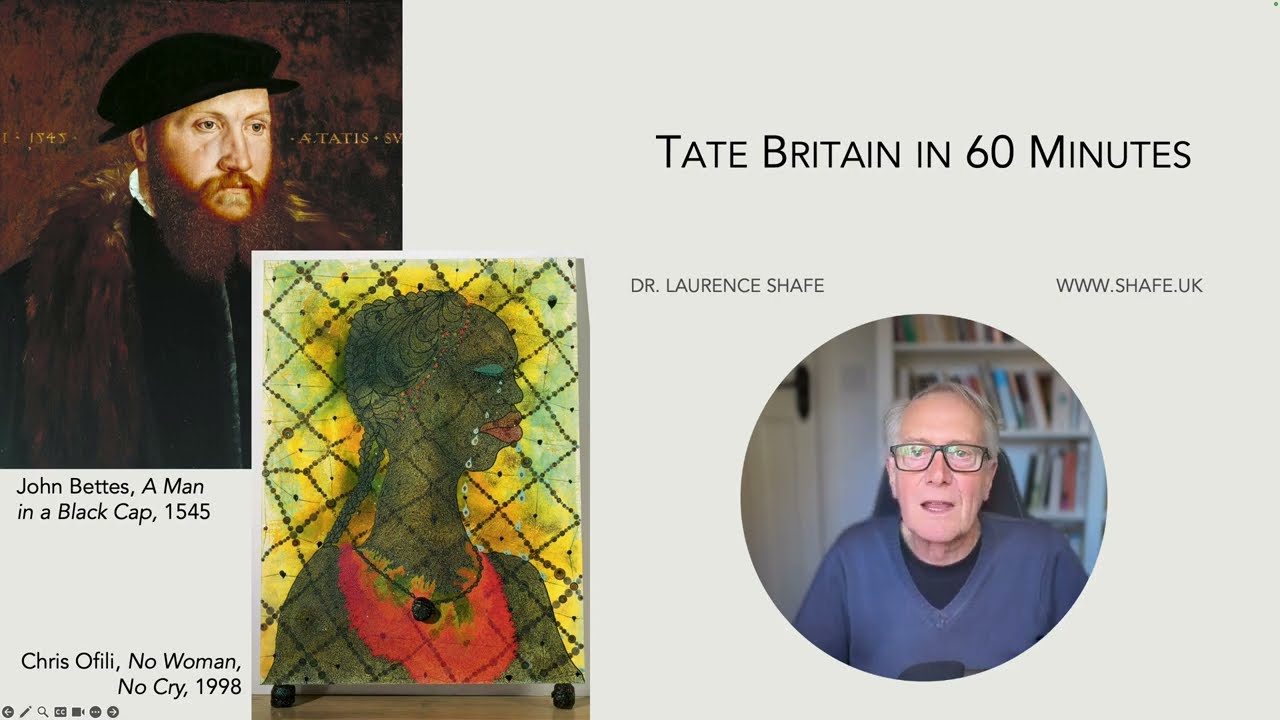
This talk introduces a comprehensive chronological survey of Western art history, focusing specifically on nearly five centuries of British masterpieces housed at Tate Britain. I provide a structured guide that bridges the gap between monarchic history and artistic evolution. The notes lists English rulers from the Anglo-Saxon period to the Windsors, offering a historical framework for the diverse collection. Key highlights include Tudor portraiture, the Grand Manner of the eighteenth century, and the social satires of William Hogarth. By profiling influential figures like Mary Beale and Sir Peter Lely, the sources document the shifting cultural identity and technical advancements of British art through the early 2000s.
My notes on 98-03 Tate Britain in 60 minutes
A discussion about the talk produced by Google NotebookLM from my notes:
The Museum as a Time Machine
Step away from the gift shop and join me for a heist of history. To the casual observer, the grand, neoclassical halls of Tate Britain offer a quiet sanctuary for “stuffy” oil paintings and silent marble. But if you know where to look, these galleries are less of a cemetery and more of a crime scene. We are standing within a repository for five centuries of human drama, fueled by personal revenge plots, scientific obsessions, and social scandals that once set London ablaze.
What we now view as venerable masterpieces were, in their day, radical acts of subversion or gruesome technical experiments. Before we begin our whistle-stop tour, remember that a painting is never just a pretty picture—it is an argument frozen in pigment. Let’s pull back the curtain on six of the most fascinating “conspirators” hidden within these walls.
1. The Earliest Face in the Tate (And Its Faded Blue Sky)
Our first stop is tucked away in 1545. John Bettes’s A Man in a Black Cap is the elder statesman of the collection, the earliest work the Tate owns. While the unidentified 26-year-old sitter appears stoic, he is a survivor of a much larger, lost work. The oak panel was once larger but has been brutally cut down at the sides and bottom, leaving us with a literal fragment of history.
Bettes was no amateur; he worked for Henry VIII and even received commissions from the King’s final wife, Catherine Parr. He likely trained in the studio of the legendary Hans Holbein the Younger, a pedigree proven by his use of “pink priming” on the wood. However, time has betrayed Bettes’s original vision. The background, a somber brown today, was originally a vibrant, royal blue. Bettes used “smalt,” a cheap cobalt-glass pigment that is notoriously unstable. Unlike the prohibitively expensive ultramarine, smalt fades when exposed to light, turning a brilliant sky into a muddy shadow.
On the reverse of the panel, Bettes left a defiant, bilingual signature:
“faict par Johan Bettes Anglois” (Done by John Bettes, Englishman)
It is a curious bit of Tudor branding—signing in the “sophisticated” French of the court while loudly asserting his English identity.
2. The Professional Mother Who Outearned the Masters
In the 17th century, the “Grand Manner” was a man’s world, yet Mary Beale (1633–1699) didn’t just participate; she dominated. Operating a bustling studio in Pall Mall, she was the primary financial provider for her family. This was a sophisticated family firm: her husband, Charles, acted as her studio manager and bookkeeper, meticulously tracking commissions and technical experiments in his notebooks.
By 1677, Beale was earning nearly £430 a year—a staggering fortune for the era. While she painted the aristocracy for profit, her most evocative works are the intimate oil sketches of her son, Bartholomew. These were not merely maternal tributes; they were “test subjects” for Mary and Charles’s investigations into new pigments and cost-cutting methods. There is a delicious irony in Bartholomew’s childhood as a constant model: he eventually abandoned the canvas entirely to become a physician, trading his mother’s pigments for a doctor’s prescriptions.
Beale was a savvy businesswoman who charged five pounds for a half-length portrait.
3. Culinary Patriotism: The Painting That Was a Literal Act of Revenge
William Hogarth’s The Gate of Calais (1748) is a masterpiece of nationalistic bile born from a personal grudge. While visiting France, Hogarth was arrested for spying after he was caught sketching the fortifications at Calais. Furious at his treatment, he used his brush to deliver a scathing rebuttal upon his return to London.
The painting is a study in “culinary patriotism.” At its center, a massive side of English beef is carried toward an English tavern, while ragged French soldiers and a bloated, corrupt friar look on with “naked longing.” Hogarth used the scene to contrast “Protestant England”—a land of plenty—with “Catholic France,” which he depicted as a realm of watery soup and superstition. Note the most biting detail in the bottom right corner: a broken Jacobite, one of the Scots who fled to France after the failed 1745 rebellion, sits pathetic and defeated with nothing but an onion and a dry crust. To the left, Hogarth even sketched himself into the scene, captured just as the hand of a French officer descends on his shoulder.
4. The Artist as Mad Scientist: Dissections in the Farmhouse
George Stubbs is often dismissed as a “sporting painter,” a label used by the 18th-century elite to deny him the status of “High Art.” In truth, Stubbs was a scientific radical. To achieve an anatomical precision that remains unsurpassed, Stubbs spent 18 gruesome months in a rented Lincolnshire farmhouse dissecting horse carcasses.
Working alongside his common-law wife, Mary Spencer—whose stomach for the macabre must have been legendary—Stubbs suspended the animals from the ceiling to strip away layers of muscle and sinew. This research resulted in The Anatomy of the Horse (1766), a project that took six years of morning and evening labor to engrave. The irony of Stubbs’s career is twofold: first, the Royal Academy snubbed him for his “low” subject matter; second, his very scientific precision is what makes his work so fragile today. He often used thin, diluted oils that have left his canvases vulnerable to the ravages of time.
5. The Prophet vs. The Physicist: Why William Blake Hated Isaac Newton
The Enlightenment celebrated Sir Isaac Newton as the man who brought light to the universe. As Alexander Pope famously wrote:
“God said ‘Let Newton be, and all was light’.”
But to the visionary poet William Blake, Newton was a teacher of “single vision”—the reduction of the organic, spiritual universe to mere cold mechanics. In his famous print Newton, Blake depicts the scientist naked and hunched at the bottom of the sea. Newton is so obsessed with his geometrical diagrams and his compasses that he is entirely blind to the coral-encrusted, colorful beauty of the rock behind him.
In a brilliant bit of art-historical “theft,” Blake lifted Newton’s muscular, constricted pose from Michelangelo’s Abias in the Sistine Chapel. By doing so, Blake transformed a Renaissance figure of power into one of limitation, arguing that the physicist’s rationalism brought only a new kind of darkness by ignoring the imaginative experience of the world.
6. “Hideous, Loathsome, and Disgusting”: The Masterpiece Charles Dickens Hated
What we today consider a Victorian treasure was once the target of a ferocious media firestorm. In 1850, John Everett Millais exhibited Christ in the House of His Parents, a work of “radical realism” that depicted the Holy Family as ordinary working people in a cluttered, dusty carpenter’s shop.
Critics were horrified by the “ugliness”—the dirty fingernails and the muscular, veined arms of Joseph. Most scandalous of all was the Christ child himself, who was depicted with red hair. In the Victorian imagination, red hair was a symbol of “degeneration” and traditionally associated with Judas Iscariot. Charles Dickens led the charge in his journal Household Words, claiming the family looked like they had walked out of Saint Giles, the most notorious, crime-ridden slum in London’s history. Dickens wrote:
“Wherever it is possible to express ugliness of feature, limb, or attitude, you have it expressed… [the Christ child is] a hideous, wry-necked, blubbering boy.”
The public’s definition of beauty eventually shifted. By 1898, the once-revolting painting was “passionately loved,” proving that today’s blasphemy is tomorrow’s icon.
The Living Gallery
These works are not static relics; they are arguments in paint that have survived centuries of shifting tastes. They remind us that the history of British art is a history of rebellion, innovation, and intense personal conviction.
As we conclude our tour, consider this: if the masterpieces we revere today were once dismissed as “revolting” or “mere illustration,” it raises a compelling question for our own era. What “hideous” smudge on a canvas today will be the “passionately loved” treasure of the year 2524?
98-04 Tate Modern: Artist and Society

This talk explores the profound relationship between artists and the societies they inhabit, specifically through works exhibited at Tate Modern’a Art & Society collection. Note that the collection is updated regularly and this talk will be out-of-date regarding what is currently on display.The narrative begins with the architectural history of the gallery itself, detailing its transformation from the industrial Bankside Power Station into a global center for contemporary art. Shafe highlights the work of Rachel Whiteread, whose sculptures and “Demolished” screen-prints serve as memorials to lost domestic spaces and failed urban experiments. The focus then shifts to photographer Mitch Epstein, whose “American Power” series documents the environmental and social consequences of energy consumption. By examining these diverse creators, the talk illustrates how art acts as a critical mirror, raising awareness and documenting the often-ignored remnants of human and industrial history.
(My YouTube talk will be published on 14 August 2027)
My notes on Tate Modern Artist and Society
An entertaining conversation about Tate Modern Artist and Society created by Google Notebook from my notes:
The very ground upon which Tate Modern stands was once a monument to industrial combustion. Before it became a global cultural hub in 2000, this brick behemoth was the Bankside Power Station, designed by Giles Gilbert Scott—the same architect responsible for the iconic red telephone box and the gothic gravity of Liverpool Cathedral. Even the museum’s name carries the heavy sediment of history. It is named for Henry Tate, the sugar refiner who funded the National Gallery of British Art with a fortune built on an 1872 patent for sugar cubes. It is a timeline worth noting: Tate’s patent came nearly forty years after the abolition of slavery in the British Empire (1833), yet the “industrial weight” of such fortunes still anchors the institution.
The conversion by Herzog & de Meuron didn’t just recycle brick; it performed a secular exorcism, turning a site of combustion into a site of confession. The ‘Artist and Society’ wing operates on a direct, urgent premise: that art is not a decorative distraction but a mirror held up to the world—a forensic tool used to raise awareness and argue for change.
1. The Building That Won’t Die: Beirut’s “Tower of Bitterness”
In the work of Marwan Rechmaoui, we see how architecture can become an “unwilled monument” to human suffering. His work Monument for Living (2001–2008) is a meticulous scale model of the Burj el Murr, a concrete ghost in the Beirut skyline. The stats alone are a testament to stasis: 34 floors, 510 windows, and seven basement levels that ground the structure in a history of violence.
Construction began in 1974, but the Lebanese Civil War (1975–1990) left it a hollowed-out shell. During the “War of the Hotels,” the tower was prized by snipers for its height and became a notorious site for torture and “tossings” from the roof. Today, the Burj el Murr is literally too dense to implode and too tall to safely knock down. It stands because it has to. Rechmaoui argues that this architectural paralysis is a blueprint for the modern city, where the “security” of the state increasingly cannibalizes the freedom of the citizen.
“The whole world is moving in this direction. This is why Beirut is important. It’s the future. Populations are moving wholesale into cities… All these issues about security and terrorism mean that Western societies, which believe they are free, are starting to lose the benefits of being free.”
2. Memorializing the Void: When Demolition Becomes Art
Rachel Whiteread has built a career casting the “negative space” of our lives—fixing in solid material the voids inside baths, under chairs, and within entire rooms. In her 1996 portfolio Demolished, she turns her forensic gaze outward, documenting the destruction of three tower-block estates in Hackney.
Through twelve duo-tone screen-prints, Whiteread captures these buildings mid-collapse. The images contrast the 1950s “utopian dream” of social housing with the “failed experiment” of the 1990s. The enlarged grain of the prints lends them the aesthetic of a war zone, yet there is an eerie beauty in the dust clouds that memorializes what were once people’s homes. Whiteread remains a provocative figure: when she won the K Foundation’s £40,000 award for “worst artist” in 1993, the Foundation threatened to burn the money if she didn’t accept it. She took the cash and promptly gave it to Shelter and young artists.
“I don’t think art changes the world in terms of stopping people dying of Aids or of starvation or being homeless. But for an individual… it can enhance daily life, reflect our times and, in that sense, change the way you think and are.”
3. The Menacing Beauty of “American Power”
If Epstein documents the physical scars of power, he also documents the erosion of the “open society.” His series American Power (2003–2009) explores the heavy toll of energy consumption, beginning in Cheshire, Ohio—a town effectively erased after residents were bought out for $20 million by a coal plant poisoning their air.
Epstein’s work captures a post-9/11 paranoia; his attempts to photograph power infrastructure led to multiple arrests and FBI interrogations. He notes that the smoke from the Cheshire plant, when shot from below, creates a compositional echo of the World Trade Center towers—a formal inversion that makes the industrial feel threatening. In his 2005 image of Biloxi, Mississippi, he captures the wreckage of Hurricane Katrina—a mattress and clothes snagged in tree branches—bathed in a warm evening light that renders the devastation “unnervingly beautiful.”
Epstein documents three specific manifestations of power:
Corporate and Industrial Power: The environmental cost and “corporate avarice” of energy production.
Political and Security Power: The tightening of restrictions on public space and the “edge of fundamental freedoms.”
Natural Power: The chaotic, unstoppable force of the environment, most poignantly rendered in the Biloxi debris.
4. The Secular Icon: Escaping the “Dead Weight” of the World
Kazimir Malevich and Wassily Kandinsky sought to outrun the physical scars of power entirely, viewing abstraction as a social tool for spiritual harmony. Malevich founded Suprematism in 1915 to champion “pure feeling,” famously rejecting the “bits of nature”—Madonnas and nudes—of traditional art. For Malevich, reproducing nature was a form of bondage. He argued that the artist who reproduces “little corners of nature” is like a “thief being enraptured by his leg irons.”
His radical Black Square was originally hung high in the corner of a gallery, the traditional place for religious icons in Russian homes, proposing a secular replacement for spiritual contemplation. Kandinsky, meanwhile, viewed the soul as a sensitive instrument to be played by the artist through color and form.
“Colour is the keyboard, the eyes are the hammers, the soul is the piano with many strings. The artist is the hand which plays, touching one key or another, to cause vibrations in the soul.”
5. The Year of the Hole: Hepworth’s Radical Perspective
In the early 1930s, Barbara Hepworth introduced a revolutionary concept to modern sculpture: the “pierced form.” This sparked a lifelong “creative friction” with Henry Moore, who later acknowledged her primacy by dubbing 1932 “The Year of the Hole.” While Moore’s holes often felt like anatomical features, Hepworth’s Oval Sculpture No. 2 (1943) was an internalization of the landscape.
Living in St Ives during the war, Hepworth was inspired by the Cornish coastline’s caves and bays. The oval became a recurring symbol for her, representing birth, eroticism, and “prenatal dreams.” By carving through the wood—often using whatever seasoned timber she could scavenge during wartime—she allowed the viewer to look through the work, demanding we acknowledge the space within the object as much as the object itself.
Conclusion: Can We Ever Truly Leave the Room?
The works within the Tate Modern suggest that art is never truly detached from the society that produces it. Whether it acts as a forensic witness to the destruction of homes and environments or as a spiritual declaration of a better world, art insists on its engagement with reality.
As we navigate an era of increasing urban density and heightened security, the questions raised by Rechmaoui and Epstein remain more relevant than ever: In our pursuit of safety and energy, are we beginning to lose the “benefits of being free”? If the Burj el Murr is our future, can art still provide the negative space we need to remember what it felt like to be free?
98-05 Tate Modern: In the Studio
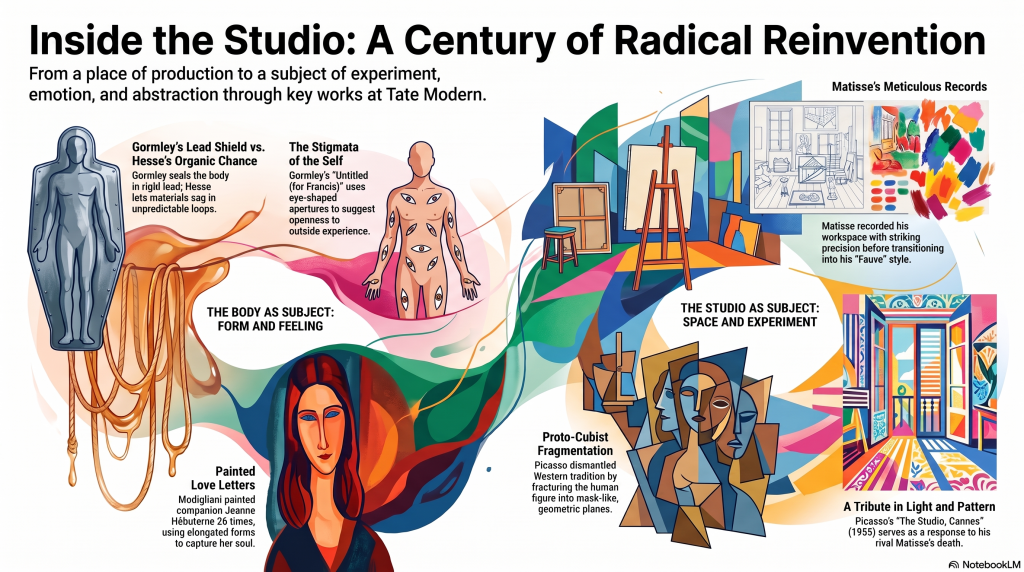
This talk provides an overview of a Tate Modern collection “Inside the Studio”, focusing on how the artist’s studio serves as a laboratory for experiment and radical reinvention. Note that the collection is updated regularly and this talk will be out-of-date regarding what is currently on display. The talk highlights a significant dialogue between Antony Gormley’s Untitled (for Francis), which uses the artist’s own lead-encased body to explore spiritual stigmata, and Eva Hesse’s Addendum, a Post-Minimalist sculpture that contrasts mathematical order with organic sagging. Both artists utilize the physical form to examine inner life and the boundaries between the self and the world. I further trace the history of modern art through the tragic lives and intimate portraits of figures like Amedeo Modigliani and Jeanne Hébuterne. Ultimately, the collection illustrates a transition from rigid, academic traditions toward more expressive, conceptual, and psychological modes of making.
(My YouTube talk will be published on 21 August 2027)
My notes on Tate Modern In the Studio
An entertaining conversation about Tate Modern In the Studio created by Google NotebookLM from my notes:
We are perpetually seduced by the myth of the artist’s studio, imagining it as a hermetically sealed laboratory where genius is manufactured in solitude. Yet, to walk through the history of modern art—specifically as it has been curated within the walls of the Tate Modern—is to realize that the studio is less a factory and more a site of radical vulnerability. It is where the “act of making itself” becomes a mirror for the messy, unrefined business of being alive. By peering into the private architectures of these masters, we discover that their technical struggles are, in fact, profound lessons on how to navigate our own human boundaries.
The Body is a Vessel, Not a Portrait (Antony Gormley)
In the corner of the gallery stands a figure encased in lead, its head tilted back in a gesture that straddles the line between exhaustion and ecstasy. To create Untitled (for Francis) (1985), Antony Gormley engaged in what can only be described as a slow-motion choreography of claustrophobia. The process was a physical penance: his wife, the painter Vicken Parsons, wrapped his naked frame in clingfilm before applying layers of plaster and jute. Once the shell set, it was cut free like a second skin, reassembled, and reinforced with resin. Finally, twenty-four sheets of roofing lead were hammered over the cast and soldered into a dark, poisonous armor.
Gormley, who spent years in India studying Buddhist meditation, utilized his capacity for stillness to endure this grueling molding process. But this is no self-portrait; it is an attempt to use the physical to speak of the spirit. Look closely at the breast of the figure: you will find a small aperture shaped like a pentagram or a house. Gormley deliberately chose to leave this “wound” open rather than welding it shut, suggesting a radical openness to the world. It is a reminder that to be a closed system is to be a corpse. As Gormley himself reflects:
“Sculpture, for me, uses the physical as a means to talk about the spirit … a visual means to refer to things which cannot be seen.” — Antony Gormley
The lesson here is found in the stigmata-like holes at the hands and feet: “In order to be whole,” Gormley suggests, “you have to be wounded.”
Why Logic Needs to “Droop” (Eva Hesse)
If Gormley offers a body sealed in metal, Eva Hesse—or “Hess-a,” as scholars often debate the pronunciation to honor her German-Jewish roots—offers a logic that sags under the weight of history. Her work Addendum (1967) initially presents as a masterpiece of Minimalist rigour: seventeen papier-mâché hemispheres, each exactly five inches in diameter, fixed to a seven-foot bar. Their spacing follows a strict mathematical sequence, increasing incrementally (1/8, 3/8, 5/8, and so on).
Yet, Hesse immediately subverts this cold arithmetic. Each dome is hand-molded, bearing the slight, irregular indentations of her fingers, and from each hangs a ten-foot rope that falls to the floor in unpredictable, “drooping” loops. This tension between order and chance was Hesse’s way of reintroducing the organic body into the sterile gallery. Fleeing Nazi Germany as a child and haunted by family tragedy, she created work that echoed the “electrical” look of the wires in Andy Warhol’s Lavender Disaster—a reference to the electric chair. In Hesse’s hands, these dangling ropes suggest the vulnerability of the individual against the rigid, sometimes violent, structures of the state.
“It is my main concern to go beyond what I know and what I can know.” — Eva Hesse
By allowing her materials to sag, Hesse teaches us that when our own rigid systems of logic fail, we find the “essence” or “soul” of our humanity in the mess that remains.
The Intimacy of the “Blank Stare” (Amedeo Modigliani)
From the vulnerability of materials, we move to the vulnerability of the heart. Amedeo Modigliani, the “prince of vagabonds” who famously destroyed his early “bourgeois” work, is a study in obsessive devotion. His portraits of Jeanne Hébuterne, the art student who became his companion, were not mere likenesses; they were “painted love letters.” He painted her twenty-six times, refining her form into the signature Modigliani silhouette: the swan neck and the almond-shaped eyes.
While contemporaries like Pierre-Auguste Renoir viewed models with a casual, often tactile dismissiveness—Renoir once crudely remarked that a nude wasn’t finished until he felt the urge to “slap her backside”—Modigliani exhibited a profound, almost religious respect for his subjects. He famously refused to paint a subject’s eyes until he felt he truly understood them. In his portraits of Jeanne, the eyes are often blank, a stylistic choice that signals an intimacy so deep it transcends the need for a gaze. Their story is a tragedy of the highest order: Modigliani died of tubercular meningitis at thirty-five; Jeanne, eight months pregnant and inconsolable, followed him into death the next day.
“When I know your soul, I will paint your eyes.” — Amedeo Modigliani
Modigliani’s lesson is one of patience; he reminds us that true connection requires us to look past the surface until the soul reveals itself.
Dreaming is More Accurate than Looking (Pierre Bonnard)
If Modigliani looked for the soul, Pierre Bonnard looked for the dream. In his 1915 painting Coffee, we are presented with a domestic scene that is intentionally disorienting. The table tilts so steeply it resembles a vertical cliff, and a vertical bar on the right seems to have no logical connection to the room. Look closely, and you’ll see that the figure on the right was a late addition—a ghost appearing in the studio long after the initial sketch.
Bonnard rarely painted from life. He took hurried notes and then retreated to his studio to reconstruct the scene through the haze of memory. This reclusive life was partly shaped by his wife, Marthe, whose antisocial behavior and obsessive washing habits kept them in a state of quiet, domestic seclusion. Marthe was a woman of secrets; it was only after thirty years of marriage that Bonnard discovered she had lied about her age when they met, claiming to be sixteen when she was actually twenty-four. In the studio, Bonnard didn’t just paint Marthe; he painted his memory of her, allowing “whimsical puzzles” to replace reality.
“I take notes. Then I go home. And before I start painting I reflect, I dream.” — Pierre Bonnard
Bonnard teaches us that our memories, with all their tilts and late additions, are often more “accurate” than the cold reality of sight.
The Power of Obsessive Reticence (Gwen John)
Finally, we encounter the quiet, self-scrutinizing intensity of Gwen John. Long overshadowed by her flamboyant brother, Augustus John—who famously predicted that one day he would be known merely as “the brother of Gwen John”—Gwen lived a life of deliberate, ascetic focus. She lived as a squatter in Paris, subsisting on a diet of fruit and nuts, working as “God’s little artist” in near-solitude.
In her portrait of Chloë Boughton-Leigh, we see the evidence of her meticulous process. John added a small strip of wood to the bottom of the canvas just so she could accommodate the sitter’s hands—a tiny technical adjustment that speaks volumes about her refusal to compromise. Her work lacks any flashiness; it is “simple, plain,” and deeply moving. Trained under Whistler, she turned the struggle of the female artist—often acting as her own model because she could not afford others—into a site of solitary power.
“In fifty years’ time I shall be known as the brother of Gwen John.” — Augustus John
Gwen John’s lesson is the power of reticence. She proves that a quiet, “obsessive” focus can eventually outshine even the most assertive celebrity.
Conclusion
These disparate studio practices—Gormley’s leaden penance, Hesse’s drooping ropes, Modigliani’s soul-searching, Bonnard’s dreams, and John’s quiet intensity—reveal a singular truth: art is the boundary between each of us and the world. The studio is not merely where art is made; it is where the “interdependency of life” is negotiated.
As we look back at these masters, we must consider our own lives. Do we view our daily “making”—our homes, our work, our relationships—as a site of routine, or as a site of radical experiment? By treating our own boundaries not as walls, but as sites where meaning can arise, we might find that we are all, in some small way, masters of the act of being human.
98-06 Tate Modern: Materials and Objects
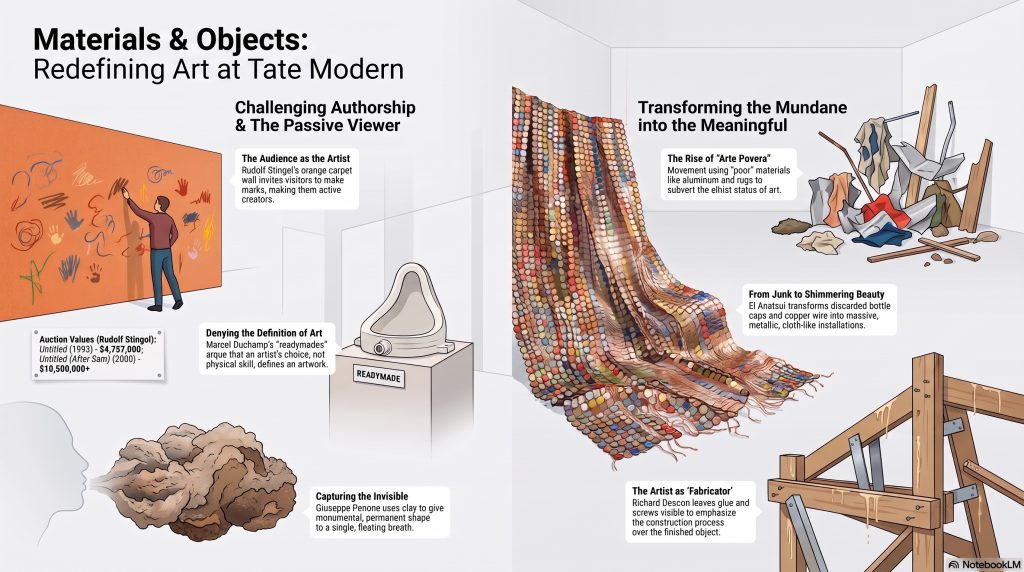
I highlight various contemporary masterpieces found within the Materials and Objects gallery at the Tate Modern. Note that the collection is updated regularly and this talk will be out-of-date regarding what is currently on display. The collection emphasizes how non-traditional mediums—ranging from industrial aluminum and discarded bottle caps to orange carpeting—can redefine the relationship between a viewer and a work of art. Key artists discussed include Rudolf Stingel, who invites the public to physically mark his installations, and Marisa Merz, a central figure in the Arte Povera movement. Other featured creators, such as El Anatsui and Nairy Baghramian, utilize reclaimed materials and anatomical metaphors to explore themes of colonial history, human vulnerability, and global consumerism. I show how the physical properties of an object are inseparable from its artistic meaning and cultural impact.
My notes on Tate Modern: Materials and Objects
A conversation created by Gemini Notebook from my notes:
We have all experienced that flicker of skepticism while standing in a white-walled gallery: the sight of a crumpled pile of metal or a household appliance perched on a pedestal that triggers the reflexive thought, “My child could do that.” It is a natural reaction to a century of art that has abandoned the pursuit of unattainable manual skill in favor of something more elusive. However, within the “Materials & Objects” gallery at Tate Modern, this skepticism is not an end point, but an invitation. In this space, the mundane is not merely present; it is undergoes a conceptual alchemy. By shifting our gaze from how a thing is made to why it was chosen, these works challenge us to find the extraordinary within the debris of the everyday.
1. Art You Are Invited to Vandalize: Rudolf Stingel’s Orange Wall
Upon entering the gallery, one is immediately confronted by a massive, 5.2 by 9-meter wall of plush orange Savannah carpeting. In the hallowed silence of a museum, the cardinal rule is “do not touch.” Yet, for Rudolf Stingel’s Untitled (1993), touch is the work’s very lifeblood.
Stingel upends the tradition of the “passive viewer” by inviting the public to act as the artist. Visitors are encouraged to inscribe their own patterns, names, or abstract gestures into the 1.5cm pile of the Wilton carpet. Because these marks are as easily erased as they are made, the wall becomes a living record of human presence and the inherent transience of modern life—a place where individual expression and fleeting trends disappear like a finger-trace on a rug.
“I [allow] painting, but not by [my] assistants who carry out [my] concept but by a public that inscribes its own individual response in a material way into the work.”
2. The Urinal That Broke the Rules: Marcel Duchamp’s “Fountain”
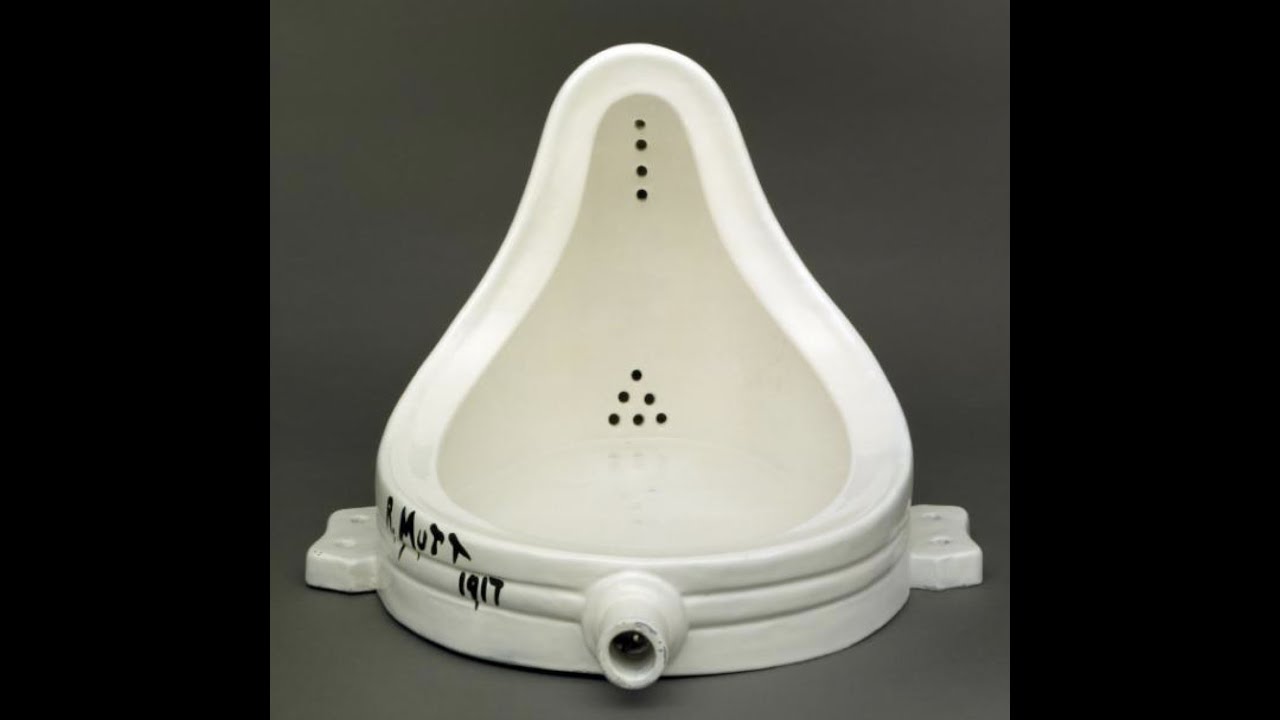
If Stingel invites us to join the creative process, Marcel Duchamp’s Fountain (1917) remains the ultimate act of artistic rebellion. In April 1917, a mysterious artist named “R. Mutt” submitted a standard porcelain urinal, rotated ninety degrees, to the Society of Independent Artists in New York. The board—which included Duchamp himself—rejected the piece as a “bathroom appliance,” claiming it was unoriginal and indecent.
The board did not realize they were being baited. Duchamp had submitted the piece under a pseudonym to test the society’s promise that all works would be exhibited for a $6 fee. When they failed the test, he resigned in protest. Fountain was never about the porcelain; it was about the act of “intellectual interpretation.” By choosing an anonymous, mass-produced object, Duchamp proved that an artist’s most potent tool is their choice. It was a move that successfully “de-deified” the artist, shifting the value of art from physical craft to the power of the idea.
Duchamp defined readymades as “a form of denying the possibility of defining art.”
3. Turning Global Trash into Shimmering Gold: El Anatsui’s Metal Tapestries
While Duchamp chose the readymade to deny art’s definition, Ghanaian artist El Anatsui uses the found object to reclaim history. At a distance, Ink Splash II (2012) possesses the “undeniably glamorous bravado” of a royal Kente cloth or a shimmering gold tapestry. Closer inspection reveals a different reality: a sprawling mesh of thousands of flattened aluminum bottle tops, stitched together with copper wire.
Anatsui’s materials are heavy with the ghosts of the “triangular trade”—the movement of rum, slaves, and colonial goods between Europe, the West Indies, and Africa. However, the bottle caps he uses are Nigerian-made, representing brands like “Star beer” and “Club beer” that helped turn local economies around after independence. By transforming these discarded seals into what critic Roberta Smith calls a “voluptuous sculptural presence,” Anatsui turns the “junk” of consumerism into a symbol of African industry and wonder.
4. Sculpting the Invisible: Giuseppe Penone’s Breath
Where Anatsui gives weight to history, Giuseppe Penone attempts to give weight to the weightless. In Breath 5 (1978), Penone uses terracotta to capture the impossible: the shape of a human exhale. The 1.5-meter vase features a physical imprint of the artist’s body and, at its mouth, a clay cast of the inside of his own oral cavity, suggesting the “billowing forms” of air leaving the lungs.
This work is a monumental manifestation of Duchamp’s concept of the “infra-thin”—the subtle, almost imperceptible difference between two states. To understand the infra-thin, one must think of “the warmth of a seat that has just been left,” the slight difference between identical twins, or “smoke exhaled from a mouth” taking a brief, three-dimensional form. By freezing a temporary condition of being alive into clay, Penone forces us to confront the physical presence of our own invisible existence.
5. The “Poor Art” Revolution: Marisa Merz’s Kitchen Sculpture
Marisa Merz, the only female protagonist of the Arte Povera (Poor Art) movement, sought to subvert the elitism of the art world by embracing the humble. While her peers worked with “soil, rags, and twigs,” Merz’s Untitled (Living Sculpture) (1966) utilized industrial aluminum tubes stapled together into a flexible, organic mass.
There is a visceral domesticity to this work. Merz originally hung it in her kitchen while raising her daughter, Beatrice. The sculpture was “living” and nomadic; it flowed around the kitchen furniture and eventually grew to cover the television. It possessed a haunting quality—Beatrice remembers being terrified of it as a child, and it even “starred” in a horror film where it appeared to devour actors. Shortly after its domestic life, it was installed in a nightclub in Turin, highlighting its transition from a private household “specter” to a public, prestigious museum piece.
6. Rescuing the “Orphans” of Cinema: John Stezaker’s Mask Collages
The move from the domestic to the salvaged continues in the work of John Stezaker. His Mask XIII (2006) appears deceptively simple: a vintage postcard of the Temple of Diana at Nîmes is positioned over an old movie still. Stezaker specifically uses “virgins”—actors whose publicity photos were taken but who never actually appeared in a film.
By inverting the postcard, Stezaker creates a haunting convergence: the arches of the ruin become skeletal eye sockets, and the dark foliage of the trees transforms into the actress’s hair. This “mask” creates a new identity while erasing the old one, channeling the “melancholy of the forgotten.” While a casual observer might suggest a five-year-old could cut and paste such an image, Stezaker spent 40 years making these collages in private, “pondering” these “orphan” images for decades before making a single, definitive cut.
The Aura of the Everyday
These artists share a common thread: they rely on what philosopher Walter Benjamin called the “aura”—the unique presence of a work in time and space—to shift value away from manual labor and toward conceptual inspiration. They prove that when an object is removed from its functional context, it gains the authority to generate reflection and wonder.
If an artist’s greatest tool is not their brush, but their ability to see the monumental in a bottle cap, the “infra-thin” in a breath, or the “living” potential in a pile of aluminum tubes, we must ask ourselves: what “art” are we walking past every day?
98-07 Tate Modern: Media Networks
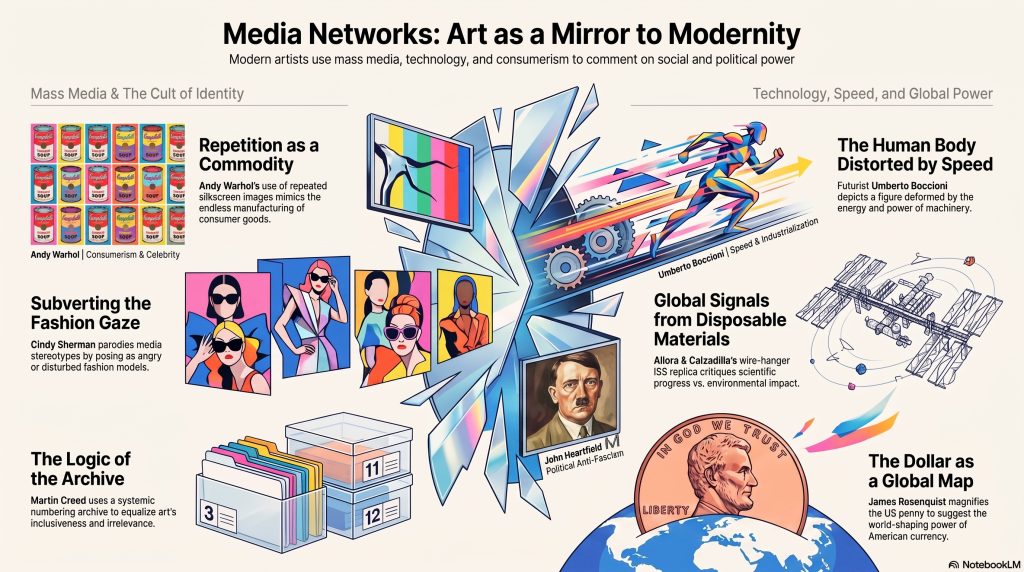
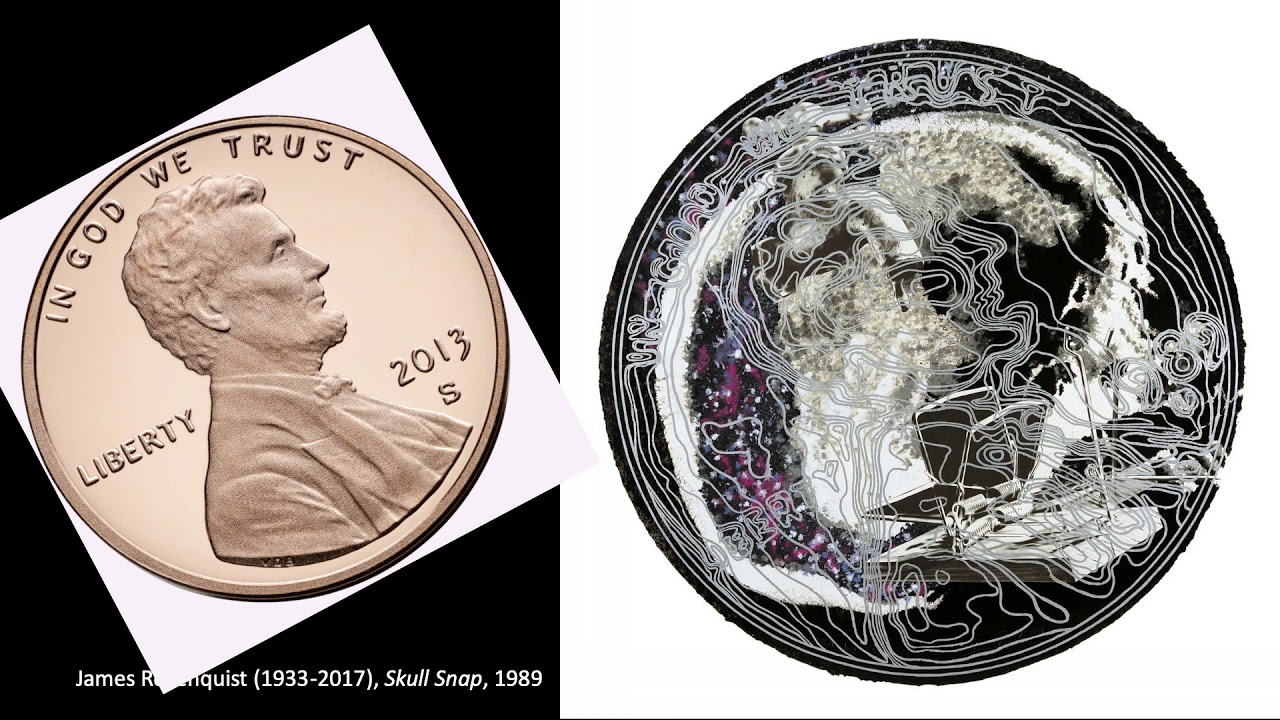
I talk about a number of works in Tate Modern’s Media Networks collection, highlighting the intersection of modernity, celebrity, and political commentary. Note that the collection is updated regularly and this talk will be out-of-date regarding what is currently on display. Through the work of Martin Creed, I consider how minimalist concepts and systemic archiving can simultaneously represent the inclusiveness and irrelevance of art. The documents further analyze Andy Warhol’s “Marilyn Diptych” and James Rosenquist’s “Skull Snap,” illustrating how Pop Art utilizes mass-marketing icons to critique consumerism and global power. Environmental and social concerns are addressed through the collaborative sculptures of Allora & Calzadilla, who use discarded materials to challenge the dominance of powerful nations. The records also offer biographical insights into Pablo Picasso and Sonia Delaunay, emphasizing the evolution of Cubism and the historical struggles for recognition faced by female artists. Finally, the collection highlights Umberto Boccioni’s “Unique Forms of Continuity in Space” as a quintessential example of Futurism, celebrating the era’s obsession with technological speed and energy.
My notes on Tate Modern: Media Networks
A conversation created by Gemini Notebook from my notes:
We are often told that a pile of twisted wire hangers is a replica of the International Space Station, and a hand-stitched baby blanket is a revolution. To the uninitiated, the modern gallery feels less like an exhibition of beauty and more like an ontological minefield—a place where the mundane is elevated to the miraculous through a series of “Media Networks” that most of us weren’t invited to join. We walk past a flickering lightbulb or a row of identical soup cans, feeling the prickle of a private joke we haven’t been told.
But at the Tate Modern, these collisions between technology, celebrity, and politics aren’t meant to exclude us; they are meant to expose the machinery of reality itself. When we look closer at these six pivotal figures, we find that the avant-garde isn’t a retreat from the world, but a high-stakes attempt to decode the networks—legal, commercial, and psychological—that define our lives.
1. The Math of Inclusivity: When 1 + 1 = 1
In 2000, to mark the opening of the Tate Modern, the museum commissioned Martin Creed to create a statement. He responded with Work No. 232: the whole world + the work = the whole world.
On the surface, it looks like a tautology—a piece of neon signage stating the obvious. But Creed’s “math” is born from a profound, almost paralyzing struggle with the burden of choice. This is the man who won the 2001 Turner Prize for Work No. 227: the lights going on and off, a piece that existed simply because he couldn’t decide whether the lights should be on or off, so he chose both.
His neon equation is a node in a network of negation. As Creed explains, “I find it a lot easier if it negates itself at the same time as pushing itself forward – so there’s an equal positive and negative which adds up to nothing, but at the same time is something too.” By creating a work that “adds up to nothing,” Creed issues a warning against the search for hidden, “propaganda-like” meanings. In his world, art is significant precisely because it doesn’t try to change the world’s sum; it simply exists within the total.
2. The Lawsuit That Legitimized Abstraction
While Creed used logic to define art, Constantin Brâncuși had to use the law. In 1926, US Customs officials looked at his sculpture Bird in Space—a slender, polished bronze curve—and refused to see a bird. Instead, they tried to tax it as an “industrial item,” arguing that a work of art must realistically represent nature.
The resulting landmark trial became the moment the legal system finally caught up to modernism. The court eventually ruled that art could represent an abstract concept like “flight” rather than a feathered creature. Brâncuși, who grew up as a poor peasant herding sheep in Romania, was fundamentally uninterested in outward form. He had famously walked away from a prestigious position in Auguste Rodin’s studio after just two months, noting that “nothing can grow under big trees.”
Defiant against those who called his work a departure from reality, he insisted: “There are idiots who define my work as abstract; yet what they call abstract is what is most realistic. What is real is not the appearance, but the idea, the essence of things.”
3. High Art’s Secret Ingredient: A Hand-Stitched Baby Blanket
If Brâncuși found the “essence” of things in the heavens, Sonia Delaunay found it in the nursery. In 1911, domestic necessity sparked a career in high abstraction: she stitched a patchwork blanket for her newborn son. Inspired by the chaotic, vibrant fabric arrangements she had seen in the houses of Russian peasants, the blanket struck her as a physical manifestation of Cubist theory.
This mundane household object became the catalyst for “Orphism,” a movement that used color and geometry to evoke the “sensuous experiment” of living. Delaunay refused to acknowledge a hierarchy between the Louvre and the laundry room. She designed haute couture, furniture, and interiors with the same intellectual rigor as her canvases, becoming the first woman to have a retrospective at the Louvre during her lifetime.
“I have done everything. I have lived my art,” she said. When critics searched for cosmic or “celestial” meanings in her circles, she brought them back to earth: “No, no, no. I’m too earthy.” For Delaunay, the media network of the home was as fertile as any gallery.
4. Why the “Best Art” is Actually Good Business
Andy Warhol understood the network better than anyone because he was a product of its furthest reaches. Born Andrew Warhola to Slovakian immigrants, he spent his childhood bedridden with St. Vitus’ Dance, an outcast collecting movie star photos to pass the time. By the time he moved to New York, he had transformed his “outcast” status into a brand.
Using his background as a commercial designer, Warhol realized that in a media-saturated age, movie stars were identical to consumer products. In his Marilyn Diptych (1962), he created a “secular altar” to Marilyn Monroe just weeks after her death. While many see his silkscreens as purely mechanical, Warhol hand-printed the left panel, specifically changing the “registration of each colour” to create a shimmering, human imperfection against the monochrome fade of the right.
Warhol’s genius was in leaning into the commodity. “Being good in business is the most fascinating kind of art,” he claimed. “Making money is art and working is art and good business is the best art.” By repeating Marilyn’s face until it became a mask, he reminded us that we created the product “Marilyn,” while the human, Norma Jeane Mortenson, was the one who was lost.
5. The Art of the Getaway: Photomontage as a Political Weapon
For John Heartfield (born Helmut Herzfeld), the “network” was a tool of survival and subversion. His life was defined by abandonment; at age five, he and his three siblings were left by their parents in an Austrian wood, discovered four days later by locals. This trauma forged a “troubled and quick-tempered” man who used art as a literal weapon.
Heartfield anglicized his name as a protest against German anti-British fervor during WWI and pioneered “photomontage”—cutting and reassembling photographs to expose the rot within the Third Reich. His 1932 masterpiece, Adolf, The Superman, featured an X-ray of Hitler showing a spine made of gold coins, a direct hit on the Nazi party’s claim to represent the worker.
The stakes were lethal. In 1933, the SS smashed into his Berlin apartment. In a scene fit for cinema, Heartfield escaped by jumping from his balcony into a rubbish bin. He eventually became the fifth most-wanted man by the Gestapo. His work remains a testament to the power of the image to dismantle the very authority that seeks to control it.
6. Subverting the Gaze: The “Anti-Fashion” Shoot
Cindy Sherman’s Untitled #126 (1983) is where the media network of fashion eats itself. Commissioned for high-end “fashion shoots” by French Vogue and a retail entrepreneur, Sherman was supplied with top-of-the-range garments from designers like Jean-Paul Gaultier.
In a world expecting glamour, Sherman delivered its antithesis. She styled herself not as a model, but as characters who were “angry, exhausted, abused, and grimy.” By using the expensive lighting and makeup of the industry to create “disturbed” personas, she held up a mirror to the viewer’s own consumption.
Sherman’s goal was to puncture the bubble of the glossy magazine, stating, “Obviously, I’m trying to make someone feel bad for having a certain expectation.” Her work suggests that in the media age, our identity is not a core “self,” but a series of curated appearances we manipulate to meet—or subvert—the expectations of others.
Whether through Martin Creed’s mathematical negations, Brâncuși’s legal battles, or Heartfield’s rubbish-bin escape, these artists demonstrate that our reality is woven from the networks of media, business, and law. They challenge us to look past the surface of the soup can or the fashion spread to find the “essence” that Brâncuși so fiercely defended.
As we curate our own digital identities today, repeating masks and seeking registrations of color that feel “real,” we would do well to remember the creative credo that guided the patriarch of modern sculpture: “Work like a slave; command like a king; create like a god.”