Art forgery occupies a uniquely fascinating position at the intersection of art history, criminology, psychology, and philosophy — it is both a crime and, in the most audacious cases, a demonstration of extraordinary technical skill and cultural knowledge. The history of forgery is as long as the history of the art market: wherever there is a premium placed on authenticity and rarity, there will be those who profit from manufacturing false versions of both. The most celebrated forgers — Han van Meegeren, Elmyr de Hory, John Drewe and John Myatt — became celebrities in their own right, their stories revealing as much about the credulity of experts and the corruptibility of the art world as about their own remarkable abilities. The detection of forgeries has become a sophisticated technical science, deploying x-ray fluorescence, infrared reflectography, radiocarbon dating, and computational image analysis to detect anachronisms invisible to the naked eye. Yet the philosophical question that forgery raises — whether a perfect copy is genuinely different from the original — remains one of the most provocative in the philosophy of art.
What Makes a Forgery Different from a Copy? A copy is made openly, with the knowledge that it is a copy; a forgery is made with the intention to deceive, to pass off a new work as an old one. But this distinction, which seems obvious, is philosophically unstable. If two works are physically identical and indistinguishable to the eye and to scientific testing, why is one worth millions and the other worthless? The philosopher Nelson Goodman’s answer — that the history of production of a work is part of its aesthetic identity — remains the most compelling, but the question nags.
Han van Meegeren — Forger as Trickster and Patriot: Han van Meegeren (1889–1947) is the most celebrated forger in the history of art. Rejected by the establishment as a minor painter, he created a series of fake Vermeers of the seventeenth century so convincing that they fooled the greatest Vermeer expert of the age, Abraham Bredius. One of his fakes — Christ and the Woman Taken in Adultery — was sold to Hermann Göring during the Nazi occupation of the Netherlands. After the war, Van Meegeren was charged with collaboration; to prove his innocence, he confessed to the forgery and demonstrated his methods by painting a new “Vermeer” in his prison cell. He became a national hero.
Elmyr de Hory — The Man Who Fooled the Art World: The Hungarian émigré Elmyr de Hory (1906–1976) produced hundreds of fake Picassos, Matisses, Modiglianis, and Dufys that found their way into major American galleries and private collections in the 1950s and 1960s. His story was told by Clifford Irving in the biography Fake! (1969) — and Irving himself was subsequently revealed to have fabricated his “authorised biography” of Howard Hughes. The layers of deception become vertiginous.
The Drewe-Myatt Conspiracy — Forging the Records: The British case of John Myatt and John Drewe in the 1990s introduced a new dimension to forgery: the corruption not just of the paintings but of the provenance documentation itself. Myatt painted fake works in the styles of Léger, Giacometti, and others; Drewe — a former physicist with a talent for manipulation — infiltrated the archives of major London institutions including the Victoria and Albert Museum and inserted false catalogue entries to give the fakes a credible history. Scotland Yard called it “the biggest art fraud of the twentieth century.”
Scientific Detection — The Forger’s Arms Race: The development of scientific methods for detecting forgeries has transformed the field. X-ray fluorescence can identify pigments anachronistic to the supposed period; radiocarbon dating can establish the age of organic materials; infrared reflectography can reveal underdrawings inconsistent with the attributed artist’s practice. Gas chromatography can identify synthetic binding agents not available before the twentieth century. Yet forgers have responded by using genuine old canvases, period pigments, and artificially aged varnishes — making the detection ever more sophisticated and expensive.
The Philosophical Sting — Does Authenticity Matter? The most provocative aspect of art forgery is the question it poses about the nature of aesthetic value. If a fake Vermeer was genuinely beautiful yesterday, why is it worthless today? We have not changed our visual experience of it; only our knowledge of its history has changed. This suggests that what we value in art is not purely its visual qualities but something else — its authentic connection to a particular human mind at a particular historical moment. Art forgery, in revealing this, performs a kind of philosophical service: it makes visible the assumptions that underlie our entire system of artistic valuation.
97-01 Forgery – The Genius of Art Forgery
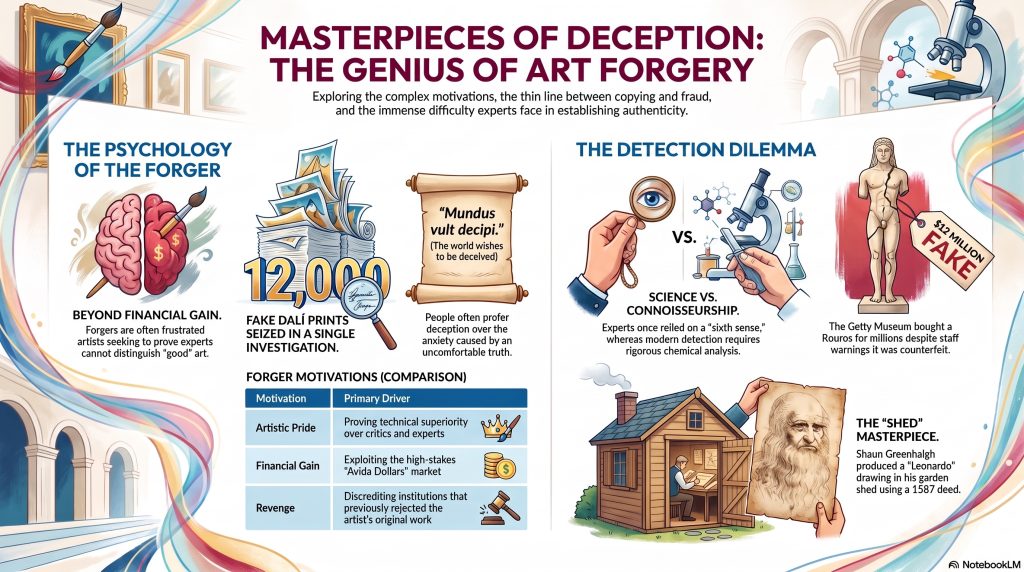
I explore the complex world of art forgery, distinguishing between dishonest imitation and the historical tradition of legitimate copying. While forgery is a criminal act of fraud, the text highlights that many famous artists, such as Michelangelo, originally honed their “genius” by replicating the works of old masters to prove their technical skill. The narrative examines the psychological motivations of forgers, noting that they often seek to embarrass the art world or satisfy a public that “wishes to be deceived.” This analysis extends to major museums, detailing how institutions like the Getty and the National Gallery have struggled with misattributed works and sophisticated fakes. I address the technical challenges of authentication, where scientific analysis often clashes with the subjective “sixth sense” of connoisseurs. In the end the line between a masterful reproduction and a fraudulent criminal act is often defined by intent and the pride of the collector.
My notes on The Genius of Art Forgery
A conversation produced by Gemini Notebook based on my notes:
Walk through the halls of any major museum, and you are surrounded by the curated weight of history and the prestige of the “original.” Yet, a quiet, unsettling truth lingers behind those gold-leaf frames: a significant number of the works we admire are fakes. Art forgery is one of the rare crimes that demands world-class skill, often earning the perpetrator a strange, backhanded brand of respect from the very institutions they humiliate. We are perpetually captivated by these beautiful lies because the line between a masterpiece and a fraud is often thinner than the varnish protecting them. Perhaps the forger’s greatest accomplice is not their brush, but the victim’s own vanity.
1. The World Wants to be Deceived: The Psychology of Belief
The success of a forgery rarely depends on the technical brilliance of the artist alone; it relies heavily on the “wishful thinking” of the collector. Deception is a collaborative act. When a discovered work reinforces an expert’s existing theory or fills a convenient gap in a museum’s collection, it triggers a cascade of positive feelings that effectively blinds the critical eye. In the high-stakes theater of the art world, people would often rather be deceived than face the professional anxiety and public ego-bruising that the truth provides.
“Mundus vult decipi, ergo decipiatur” (The world wants to be deceived, so let it be deceived.)
This Latin maxim, found in the shadow world’s foundational texts, captures the art world’s ultimate vulnerability. Whether it is a curator dreaming of a career-defining discovery or a billionaire seeking the social currency of a rare acquisition, the desire for the work to be “real” creates the very space the forger inhabits.
2. Michelangelo’s Secret Origin: The Genius Began with a Forgery
It is a startling historical irony that Michelangelo, perhaps the greatest artist in human history, built his early reputation on a calculated fraud. In 1496, the 21-year-old sculptor set out to produce a marble statue that could pass as an ancient Roman original. His process was a masterclass in technical deception; he didn’t just carve the marble, he aged it through physical intervention. According to his first biographer, Paolo Giovio, Michelangelo buried the work to let the earth do his dirty work.
“Michelangelo achieved the highest glory in sculpture when he made Eros of marble and afterwards kept him buried in the ground for some time, and then presented the light again, but already with those spots and marks that he acquired, as well as with other minor imperfections that were intentionally applied to her [the statue of Eros] in such a way that Eros looked like an ancient one.”
When the buyer, Cardinal Riario, discovered the Sleeping Eros was a modern creation, he did not call for an arrest. Instead, he was captivated by the world-class skill required to dupe him. In the Renaissance, the ability to copy the “Old Masters” was not a crime of character but the ultimate demonstration of technique. The work eventually became so valuable that it was gifted to Isabella d’Este as a “genuine Michelangelo”—a forgery that transformed into a masterpiece by virtue of the hand that faked it.
3. The “Studio” Paradox: When is a Dalí Truly a Dalí?
To understand the gray area of authenticity, one must look at Salvador Dalí. Known as “Avida Dollars” (an anagram for his name meaning “greedy for dollars”), Dalí turned his own brand into a factory. As his physical powers waned due to age and illness, the “master’s hand” became a legal abstraction. His assistant, the award-winning artist Antoni Pitxot, moved into Dalí’s villa full-time in 1966, leading many to believe Pitxot took over the production of “Dalí” works entirely.
This creates a “legal art forgery” conundrum. Dalí signed thousands of blank canvases to be filled in by others, a practice that led to the seizure of 12,000 fake prints in a single investigation. While this feels like fraud, it is actually a modern extension of the historical “studio system.” Since the master artist sanctioned the work and affixed his signature, is it a forgery or simply an apprentice-led commission? When the master’s hand never touches the brush, but his bank account receives the wire transfer, the definition of a “fake” becomes a matter of institutional pride rather than legal fact.
4. The Shed vs. The Salon: The $150 Million “Screaming Fake”
The narrative of the portrait La Bella Principessa illustrates the “class war” inherent in art connoisseurship. For years, elite experts led by Professor Martin Kemp argued that the vellum portrait was a lost Leonardo da Vinci, leading to an insurance valuation of $150 million and a high-security home in a Zurich vault. Kemp relied on a “sixth sense” for style and high-tech analysis to justify the attribution.
This elite fantasy was shattered by the bluntly unpretentious confession of Shaun Greenhalgh. Writing from his parents’ council house in Bolton, Greenhalgh claimed he painted the “masterpiece” in 1978. His materials weren’t sourced from Renaissance workshops, but from his father George’s workplace:
Greenhalgh mounted the vellum on an oak board from an old Victorian school desk lid, taken from the storeroom of Bolton Industrial Tech, where his father worked as a cleaner.
The “Renaissance” subject was actually “Sally,” a girl who worked with Greenhalgh at the local Co-op butchery. This clash of the Bolton shed versus the Zurich salon mirrors the 1920 case of Hahn v. Duveen. In that instance, the legendary dealer Sir Joseph Duveen labeled a version of La Belle Ferronnière a fake without even seeing it, relying solely on a monochrome photograph. Such elite arrogance often bypasses physical evidence in favor of “connoisseur’s pride,” proving that the “expert” eye is often the most easily blinded.
5. Hyper-Restoration: The Invisible Line Between Fixing and Faking
The line between “restorer” and “forger” is often blurred by a specific type of vanity. Jef van der Veken, a Belgian restorer, was the master of “hyper-restoration.” His work on the Renders Madonna was so technically perfect that it took decades and the advent of infrared spectroscopy to realize the painting was almost entirely his own creation, painted over a scrap of damaged original work.
The historical irony of Van der Veken’s skill reached its peak during World War II. He helped assemble a collection for Emile Renders that was eventually sold to Nazi leader Hermann Göring for a staggering 300 kg of gold (roughly £11 million today). Göring, who prided himself on his “Teutonic” taste, was thoroughly duped, clutching a “Memling” that was largely a modern Belgian restoration as he fled the Allies. This reveals a dark truth: the museum curator and the forger are often “two of a kind.” Both are driven by the self-deluded belief that they can perfectly channel the hand of a long-dead master, making the “limit of restoration” one of the most dangerous frontiers in art.
Conclusion: The Value of the Visual
Ultimately, the history of art is inseparable from the history of copying. From Roman replicas of Greek bronzes to the Bolton forger’s desk-lid Leonardo, the act of imitation has shaped our visual heritage. We are left with a final, uncomfortable question: does the name on the frame matter more than the power of the image?
Consider the 2010 sale of the “Hahn” version of La Belle Ferronnière. Even though it was sold as a copy by a “follower” and not the master himself, it fetched $1.5 million—three times its estimate. The buyer was uninterested in the decades of litigation or the academic posturing.
“He just loved the painting. He thought it was a powerful, beautiful work of art.”
If a work of art moves you deeply, does it matter whose hand held the brush—or are we simply in love with the deception itself?
97-02 Forgery – The 12 Greatest Art Forgers (Part 1)
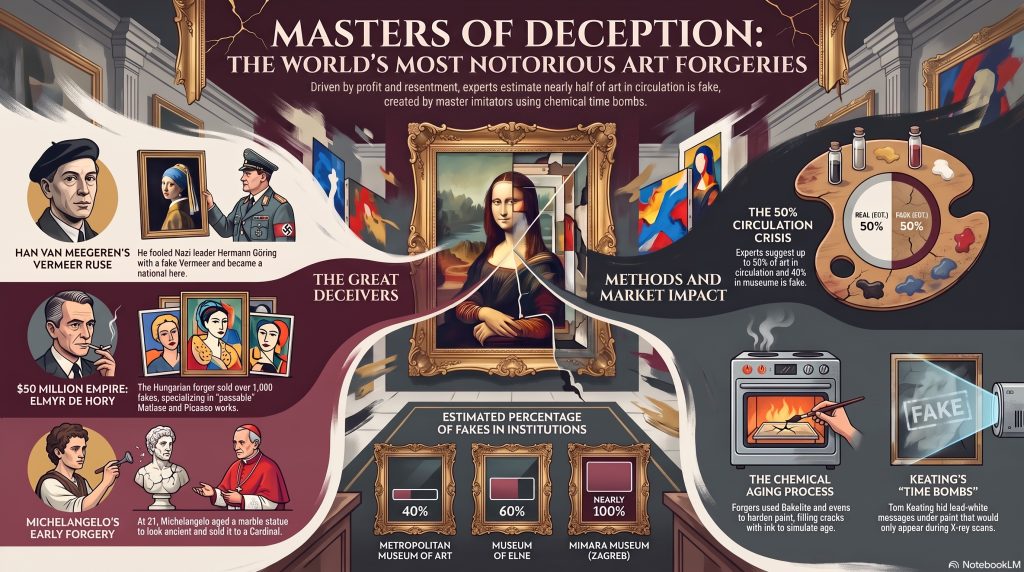
I look at the extensive history and motivations behind art forgery, ranging from antiquity to the modern digital age. Historical examples demonstrate that copying masterworks was once a standard learning method, though it often crossed into deception, as seen in Michelangelo’s early career when he aged a statue to sell it as an ancient artifact. The talk also details how famous artists like Albrecht Dürer and William Hogarth pursued legal action against counterfeiters, eventually leading to the creation of the Hogarth Act to protect intellectual property. Beyond history, I list numerous notorious forgers and discuss contemporary challenges, such as the emergence of NFTs and the high percentage of fakes currently held in museum collections. It seems that many forgers are driven by a desire to expose the incompetence of art experts while demonstrating their own immense technical skill.
My notes on The 12 Greatest Art Forgers (Part 1)
A conversation produced by Gemini Notebook based on my notes:
1. INTRODUCTION: The Ghost in the Gallery
The museum walls are haunted by ghosts we’ve invited in. We walk through these hushed, high-ceilinged cathedrals of culture, operating under the assumption that the institutions are the ultimate arbiters of truth. But look closer. Thomas Hoving, the former director of the Metropolitan Museum of Art, famously shattered this illusion by stating that up to 40% of the art in major museums is either forged or misattributed.
The scale of the deception is staggering. Consider the Mimara Museum in Zagreb—a veritable “temple of counterfeits” where nearly all 3,754 works are allegedly fake. Or look at the prolific Camille Corot; historians note he painted roughly 3,000 works in his lifetime, yet an impossible 5,000 of them reside in the United States alone. In this industry, the distance between a “masterpiece” and a “scam” is often nothing more than a convincing provenance and a layer of dirt.
2. TAKEAWAY 1: The Greatest Forger is the One Who Is Still Unidentified
In the investigative world of art history, we suffer from a profound “survivorship bias.” We study the forgers who were caught—those like Elmyr de Hory or Han van Meegeren—because they made a technical error or, more often, because their ego demanded an intentional reveal. The truly successful forgers, however, are the ones currently hanging in private collections and prestigious galleries, perfectly undetected.
The masterpieces we celebrate today are simply the forgeries that haven’t failed yet. As a cultural historian, one must realize that the “greats” we discuss are technically the failures of their craft. The most talented forgers in history remain invisible, their names lost, while their work masquerades as the peak of human achievement in plain sight.
3. TAKEAWAY 2: Even Michelangelo Got His Start as a “Cheeky Faker”
Long before he was the divine master of the Renaissance, a 21-year-old Michelangelo was a high-stakes deceiver. In 1496, he carved a marble statue of a Sleeping Eros. To command the price of a classical antiquity, he used his workshop skills to age the marble, making it appear to be a centuries-old relic. He successfully sold the work to Cardinal Raffaele Riario, a sophisticated collector and the grandnephew of the Pope.
When the ruse was eventually discovered, the outcome provided a fascinating insight into market psychology: the discovery of the fake actually increased Michelangelo’s value. The dealer simply returned the Cardinal’s money and sold the statue as a work by the “now famous” Michelangelo for a handsome profit. Riario was so impressed by the young artist’s ability to fool him that he became Michelangelo’s first patron in Rome. This highlights a recurring psychological profile in forgers:
“Annoyed at being unrecognised, aware of their skill and disdainful of the competence of dealers and buyers they create works to demonstrate their ability and show how incompetent the so-called experts are at judging art.”
4. TAKEAWAY 3: The Forger Who Became a National Hero by Fooling the Nazis
The story of Han van Meegeren is perhaps the most high-stakes “con” in art history. Dismissed by critics as a derivative painter, Van Meegeren set out to prove his genius by “inventing” new Vermeers. During the Nazi occupation of the Netherlands, he sold a forgery titled Christ with the Woman Taken in Adultery to the notorious Nazi leader Hermann Göring for a sum equivalent to millions today.
Van Meegeren was an obsessive technician. He bought 17th-century canvases and cleaned them, used badger hair brushes (known to be used by Vermeer), and ground his own pigments. To simulate 300 years of age, he used Bakelite (phenol formaldehyde) mixed with lilac oil to harden the paint, baking the canvases at 100-120°C. He then rolled the works over a cylinder to create cracks, filling them with India ink to mimic three centuries of embedded dust.
Post-war, Van Meegeren was charged with treason—a capital offense—for selling Dutch cultural property to the enemy. To save his life, he confessed the work was a fake. When the court refused to believe him, he was forced to paint another “Vermeer,” Young Christ in the Temple, in front of court-appointed witnesses. He died a national hero, celebrated for conning the Nazi regime and exposing the ignorance of the collaborationist “experts.”
5. TAKEAWAY 4: Creating “New” Masterpieces vs. Simple Copying
The most sophisticated forgers avoid the “copy.” Modern technology makes a direct duplicate too easy to debunk. Instead, forgers like Guy Ribes utilize the “invention” method. Ribes didn’t just imitate lines; he performed a psychological deep dive, identifying a “series” of 20 or 50 similar designs a master might produce and “slipping one in the middle.”
Ribes’ research was exhaustive, often taking months. He had to determine the exact year, month, and even the day of manufacture for the work he was inventing. He had to locate the place where it was supposedly made and understand the exact state of mind the artist was in, as well as the specific materials and pigments available to them at that precise moment.
“I put myself in the artist’s shoes. When I painted a Picasso, I was Picasso. When I painted a Chagall, I thought like Chagall. To make the illusion perfect, Guy Ribes never copied anything: he created paintings that did not exist.”
6. TAKEAWAY 5: The “Hogarth Act” and the Birth of Art Law
Forgery has been a catalyst for legal evolution since the Renaissance. While William Hogarth is often cited as the father of art copyright, the first art-specific lawsuit actually occurred centuries earlier when Albrecht Dürer sued Marcantonio Raimondi in Venice. Dürer won the case, though the court ruled Raimondi could continue copying the work as long as he did not use Dürer’s monogram—a precedent against “passing off” work as another’s.
By the 18th century, William Hogarth found his popular series The Harlot’s Progress being widely forged. These were often reversed engravings, a byproduct of the fact that forgers were creating their plates directly from prints rather than original drawings, which flips the image during the printing process. Furious at this theft of intellectual property, Hogarth successfully lobbied Parliament for the Engravers’ Act of 1735 (The Hogarth Act). It was the first law specifically designed to protect the unique vision of the artist.
7. CONCLUSION: The Future of the “Aura”
The battle between forger and expert has now moved into the digital and molecular realms. Today, paintings are being protected by the artist’s own DNA, and the concept of “provable ownership” has been revolutionized by blockchain and NFTs. Unlike physical currency, which is fungible—a dirty bank note is worth the same as a crisp one because their unique serial numbers don’t change their value—art is non-fungible.
If you lose a friend’s dog and buy them a “perfect copy,” it isn’t the same; dogs, like art, have a unique identity. This is what Walter Benjamin called the “aura”—the unique, fascinating history of a work created by a specific human hand. Even the most perfect 3D-printed copy remains “fungible,” while the original possesses a history that cannot be synthesized. This leaves us with a provocative question: in an age where a copy can be made indistinguishable from the original, is the “aura” of the creator the only thing left that cannot be forged?
97-03 Forgery – The 12 Greatest Art Forgers (Part 2)
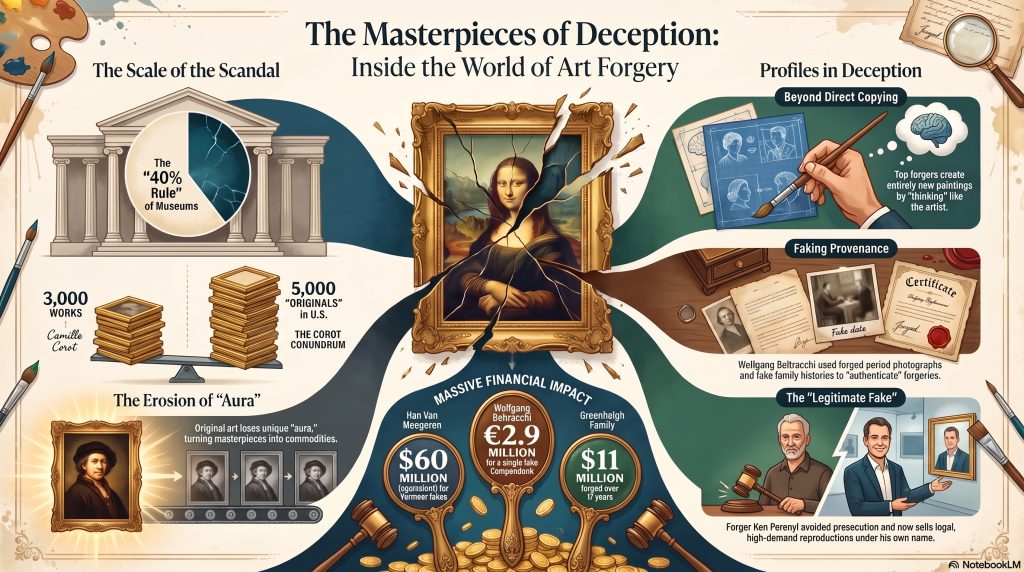
I explore the secretive and lucrative world of art forgery and identify several high-profile fakers, including Shaun Greenhalgh, who claims credit for a disputed Leonardo da Vinci masterpiece, and Ken Perenyi, who spent decades selling thousands of replicas to elite auction houses. Beyond individual profiles, the talk highlights the staggering prevalence of counterfeit art, noting that some experts believe up to 40% of museum collections consist of fakes. It also examines the technical methods used to deceive experts, such as mimicking historical pigments and specific historical contexts. Additionally, I touch on modern efforts to verify authenticity through DNA protection and the rise of NFTs as a digital solution for provable ownership. There appears to be a pervasive uncertainty within the art market, where the line between a brilliant reproduction and a criminal forgery is often blurred.
My notes on The 12 Greatest Art Forgers (Part 2)
A conversation produced by Gemini Notebook based on my notes:
1. The Hook: The Illusion of Authenticity
We walk into a world-class gallery and surrender to a specific kind of hushed reverence, assuming the canvases before us are the “real deal” simply because they are guarded by laser sensors and velvet ropes. But the truth is a beautifully staged riot. Thomas Hoving, the former director of the Metropolitan Museum of Art, famously pulled back the curtain when he estimated that a staggering 40% of the art in major museums is fake. The line between a timeless masterpiece and a brilliant deception is thinner than the varnish on a counterfeit Vermeer; if the institutional gatekeepers can’t discern the difference, we must ask: what are we actually worshipping?
2. The “Leonardo” from the Supermarket
Consider the case of La Bella Principessa (pronounced ‘PRIN-che-pacer’). For years, this delicate vellum portrait was hailed as a long-lost Leonardo da Vinci, possessing the technical grace and historical gravity of a Renaissance titan. That is, until the notorious British forger Shaun Greenhalgh stepped out of the shadows to claim it as his own. His “insider” secret? The regal noblewoman was actually modeled after a supermarket checkout girl he knew in the late 1970s. This revelation exposes the fragile consensus of art-world expertise: if a modern forgery can masquerade as a Leonardo, the very concept of “certainty” becomes a beautifully painted fiction.
3. The Invisible Museum: A Stylish Numbers Game
The prevalence of fakes isn’t merely a collection of isolated scandals; it is a statistical reality that creates an “invisible museum” hiding in plain sight. Consider these sobering figures:
- The Corot Paradox: While the artist Camille Corot was prolific, his “market reach” is mathematically impossible.
- The Museum of Elne: This institution in the Pyrénées-Orientales discovered a humiliating truth—60% of its entire collection consisted of counterfeits.
- The Mimara Museum: Located in Zagreb, this museum faces allegations that nearly all of its 3,754 works are fraudulent.
As the industry’s favorite punchline goes:
“Camille Corot painted 3,000 paintings, 5,000 of which are in the United States.”
4. Painting vs. Storytelling: The Tetro Method
For Anthony “Tony” Tetro, technical skill was merely the baseline. Tetro understood that to fool a dealer, you don’t target their eyes; you target their imagination. He realized that the forger’s true craft is not brushwork, but the construction of a seductive narrative.
To sell a fake Matisse, Tetro executed a library heist worthy of a Hollywood thriller. He purchased a catalogue raisonné for £2,000, surgically replaced a page with a high-quality print of his own forgery, and planted the doctored volume on the shelf of a dealer’s local library. After stealing the dealer’s personal copy of the book, he forced the mark to visit the library to verify the work. When the dealer saw the “Matisse” in the reference book, the trap was shut. This storytelling is so potent that it continues to deceive: as recently as 2019, it was revealed that four of the seventeen paintings loaned to the then Prince Charles for Dumfries House—supposedly by Picasso, Dalí, Monet, and Chagall—were actually Tetro’s handiwork.
“Being a great forger is not being a great painter but rather a convincing storyteller.”
5. The Grandmother Who Never Was: Beltracchi’s Provenance Fraud
Wolfgang Beltracchi didn’t just copy paintings; he filled the “gaps” of history by inventing works in the style of masters like Max Ernst or Heinrich Campendonk. His true genius lay in forging “provenance”—the pedigree of ownership.
Beltracchi and his wife, Helene (pronounced ‘hell-EN’), concocted a tale of a hidden collection stashed away from the Nazis by her grandfather. To “prove” it, they forged old photographs: Helene dressed in period costume, posing as her own grandmother in front of her husband’s fakes. These staged histories were so convincing they bypassed the skepticism of the world’s elite auction houses. Even seasoned collectors fell victim; the actor Steve Martin famously lost approximately $850,000 (€700,000) on a fake Campendonk titled Landscape With Horses before the ring was finally dismantled.
6. The Millionaire Who Went “Legit”
Ken Perenyi (pronounced ‘pear-ainy’) spent thirty years as an art world phantom, flooding the market with imitations of 19th-century masters like Martin Johnson Heade (pronounced ‘heed’), James Buttersworth, and Charles Bird King. His work—including a meticulous imitation of Monet’s View of Vétheuil (vay-tur-ee’)—was so flawless that it routinely sold through Christie’s and Sotheby’s.
Despite a five-year FBI investigation launched in 1998, Perenyi was never charged; the forgeries were always sold by third parties, keeping him legally insulated. Today, having outrun the statute of limitations, he sells “legitimate fakes.” Ironically, his notoriety has made his legal reproductions more valuable than standard copies. He still refuses to sign his own name, claiming a signature would “compromise the integrity of the fake.” His memoir, Caveat Emptor, remains the definitive blueprint for a three-decade deception.
7. The Fading “Aura”: A Reflection on Value
The philosopher Walter Benjamin argued that an original work possesses an “aura”—a unique quality derived from the physical touch of the artist. Forgers like Tetro and Beltracchi didn’t just forge paint; they forged this aura by inventing the fiction of that touch through meticulously crafted backstories and “historical” photographs.
Modern technology is now the primary battlefield to reclaim this fading aura. From spectroscopic analysis and the hunt for the artist’s DNA (found in skin cells embedded in the paint) to the use of Non-fungible tokens (NFTs) to manufacture digital scarcity, the industry is desperate to protect the concept of “the original.” But in a world where a 3D-printed replica or a master’s imitation can be indistinguishable from the source, the aura becomes increasingly ethereal.
8. Conclusion: The Question of the Original
If a forgery is so perfect that experts, scientists, and even the “aura” cannot distinguish it from the original, does the difference even matter? We have seen that the most prestigious galleries and even Hollywood icons like Steve Martin can be seduced by a clever storyteller and a staged photograph.
We are left with a provocative reality: that “masterpiece” in the gold frame might just be a supermarket girl from the 1970s. As long as the illusion holds and the story is told with enough conviction, the art world—and its millions—keeps rolling on.
97-04 Forgery – Can You Spot a Fake (Parts 1 & 2)
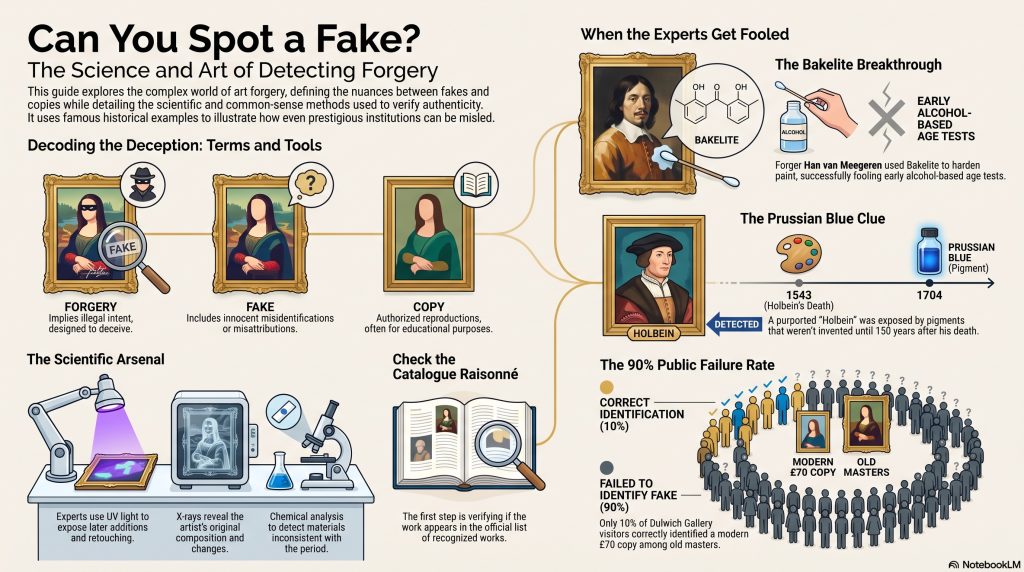
I explore the complex world of art deception, distinguishing between intentional forgeries, misidentified fakes, and legitimate copies. Identifying a fraudulent work is often a difficult, high-priced endeavor that requires combining visual connoisseurship with advanced scientific analysis like infrared reflectography and chemical testing. The talk highlights that even prestigious museums and the general public are frequently misled by high-quality imitations of masters such as Vermeer and Botticelli. I also profile famous figures in the field, ranging from notorious forgers like Han van Meegeren to skilled modern copyists like Leo Stevenson. While provenance and technology are vital, the immense talent of forgers makes the pursuit of authenticity a perpetual challenge.
My notes on Forgery – Can You Spot a Fake (Parts 1 & 2)
A conversation produced by Gemini Notebook based on my notes:
1. Introduction: The $22,000 Gamble
In 1998, a delicate portrait on vellum titled La Bella Principessa crossed the block at Christie’s. Catalogued as a 19th-century German imitation of the Renaissance style, it sold for just under $22,000. It was a modest sum for a beautiful thing, but a few years later, the art world was electrified. Professor Martin Kemp, a preeminent Leonardo scholar, argued that the work was no imitation. He claimed it was a genuine, multi-million dollar masterpiece by Leonardo da Vinci himself.
The narrative took a sharper, more forensic turn in 2015 when Shaun Greenhalgh, a notorious forger from Bolton, made a startling confession from prison. Greenhalgh claimed he had created the work in 1978 at the age of 20, mounting the vellum on an old Victorian school desk lid. His model? A supermarket checkout girl named Sally who worked at the local Co-op.
If a supermarket clerk can be mistaken for a Sforza princess, and if the most seasoned curators can find themselves embroiled in a decade-long dispute over a piece of “old” vellum, what hope does the average enthusiast have? This is the central friction of the art market: a high-stakes arms race where the “truth” is often a moving target. To navigate this world, we must look beyond the aesthetic and into the counter-intuitive mechanics of deception.
2. The Nuance of the Lie: Fakes vs. Forgeries vs. Copies
In the specialized lexicon of the connoisseur, words carry legal weight. Authenticity is not a binary; it is a spectrum of intent.
- A Forgery: An item crafted specifically to deceive. It implies a deliberate act of illegality—a premeditated lie told in pigment and canvas.
- A Fake: A broader umbrella. While it includes forgeries, it also encompasses works that have been innocently misidentified by a seller or owner.
- A Copy: A work that may be entirely genuine in its history—perhaps a student in a master’s atelier producing an authorized replica. To remain legitimate, these should be signed by the copyist, yet they often drift into the market unsigned, waiting for a hopeful eye to “rediscover” them as originals.
Pro Tip: If you find yourself at an auction and harbor suspicions, use the word “fake.” It describes the object’s status without making the legally actionable accusation of “forgery,” which requires you to prove the creator’s criminal intent.
3. The Forger Who Became a National Hero
Perhaps no figure embodies the paradox of the “patriotic forger” better than Han van Meegeren. In the aftermath of World War II, Van Meegeren was arrested for treason. The charge: selling a priceless national treasure—a Vermeer—to the Nazi Reichsmarschall Hermann Göring. Facing the death penalty for collaborating with the enemy, Van Meegeren offered a defense that sounded like a desperate fever dream: he couldn’t have committed treason because the painting wasn’t a Vermeer. He had painted it himself.
When the authorities scoffed, Van Meegeren proved his “guilt” to save his life. Under guard in a courtroom, he painted a new “Vermeer” before their eyes. He revealed a technical brilliance that had even bypassed the era’s scientific gatekeepers. Experts at the time used an “alcohol test”—rubbing the surface to see if the paint dissolved, indicating it hadn’t yet hardened with age. Van Meegeren had outsmarted them by mixing his pigments with Bakelite, artificially curing the paint to a centuries-old hardness.
In a final twist of historical irony, Van Meegeren was acquitted of treason and died a national hero, celebrated for having successfully swindled the Nazi leadership with a seventy-pound batch of fake paint and Bakelite.
4. The Great Gender Mystery: Where are the Women?
There is a glaring “missing data point” in the history of art crime: the total absence of identified female forgers. The annals are crowded with men—Greenhalgh, Myatt, Hebborn, Brandrett—yet women are non-existent in the records of the caught.
Theories abound for this silence. Many forgers are driven by a specific, bitter motivation: the “overlooked artist” syndrome, a desire to punish an establishment that has ignored their original talent. Historically, no group has been more overlooked by the art world than women. This leads to a provocative, if unproven, conclusion: perhaps female forgers are simply too skilled to be detected. If the hallmark of a great forgery is that it is never found, the women of the trade may be the only ones who truly mastered the craft.
5. Even the Giants Fall: The Disraeli Deception
Even the most prestigious institutions can succumb to the allure of a “find.” In 1874, the National Gallery in London purchased two works attributed to Botticelli. The acquisition had political gravity; Prime Minister Benjamin Disraeli personally championed the purchase, dismissing critics of the high price tag by insisting the nation should own these “rare and wondrous” works.
The irony was expensive. The gallery paid £1,627 for An Allegory—a work later dismissed as the product of a “feeble imitator”—while the genuine masterpiece, Venus and Mars, was acquired for the lesser sum of £1,050. It wasn’t until the 1950s that stylistic analysis, backed by infrared reflectography, confirmed the curators’ fears. While the materials were period-accurate egg tempera and azurite, the “Allegory” was merely a contemporary Florentine work, not a Botticelli.
Deception also takes the form of “Victorian Beautification.” The National Gallery’s Woman at a Window was originally a 16th-century portrait of a courtesan. In the 19th century, her features were “scrubbed” of their provocative intent to suit Victorian sensibilities. Forensic cleaning later revealed the original: a woman with a more “pinched” nose and a pomegranate—a traditional symbol of Venus and desire—drawing back a curtain. Curators discovered her nipples had been literally brushed away by a 19th-century artist to make her appear “sweeter” and more innocent for the public eye.
6. The £70 Masterpiece: A Modern Experiment
In 2015, the Dulwich Picture Gallery decided to test the public’s eye. They replaced one of their 270 Old Masters with a £70 copy of Jean-Honoré Fragonard’s Portrait of a Young Woman, commissioned from the Meishing Oil Painting Manufacture Company in China.
Out of 3,000 visitors who cast a vote to find the interloper, a staggering 90% failed. The modern copy hung undetected alongside genuine masters. The secret to spotting the “cheap” fake lay not in the composition, but in the tempo. Fragonard was famous for his “Fantasy Figures,” created with lightning-fast, visible daubs of paint to showcase his bravura. The Chinese copy, while accurate in color, betrayed itself with a “smooth finish” in the skin tones—the mark of a methodical, slow-working student rather than a frantic master.
7. High-Tech Detective Work: The “A-ha!” Moment
As forgers like Leo Stevenson—who can mimic a Canaletto so precisely he accounts for the evolution of cloud-painting after John Constable—continue to refine their craft, science has become the final arbiter.
The exposure of the Portrait of Alexander Mornauer is a masterclass in this detective work. For centuries, it was hailed as a Hans Holbein the Younger. However, microscopy revealed a damning detail: the blue background sat above two distinct layers of 18th-century varnish. Analysis identified the pigment as Prussian Blue, a color not available until the 1720s—nearly two centuries after Holbein’s death in 1543. The painting wasn’t a total fake; it was a 15th-century work that had been “upgraded” with a blue background and a modified hat to pass as a more valuable Holbein.
The modern forensic toolkit now includes:
- Dendrology: Dating wood panels to the exact year a tree was felled.
- Thread Counting: Utilizing X-rays to match the warp and weft of a canvas to the specific supplies of a known artist’s studio.
- Gas Chromatography (GC-MS): Bombarding paint samples with electrons to identify binding mediums like Bakelite.
“A word of warning: art forgers are very skilled artists and so visual analysis should always be backed up by scientific analysis. They know all of the techniques described here and can overcome most of them, so detecting a forgery is very difficult and very expensive.”
8. Conclusion: The Price of Uncertainty
The world of art forgery is an evolving arms race. For the collector, the advice remains grounded in rigorous research: always consult the catalogue raisonné—the official list of an artist’s recognized works. If a work is missing from those pages, it is, by definition, an outlier and likely a fake. The rule of thumb for the uninitiated is simple: if you cannot afford an expert and the exhaustive cost of scientific verification, you should only pay “unknown artist” prices.
We are left with a haunting philosophical question that science cannot answer: If a forgery is so perfect that neither the eye nor the microscope can catch it, does it lose its beauty—or only its price tag?