Page Contents
61-01 David Hockney
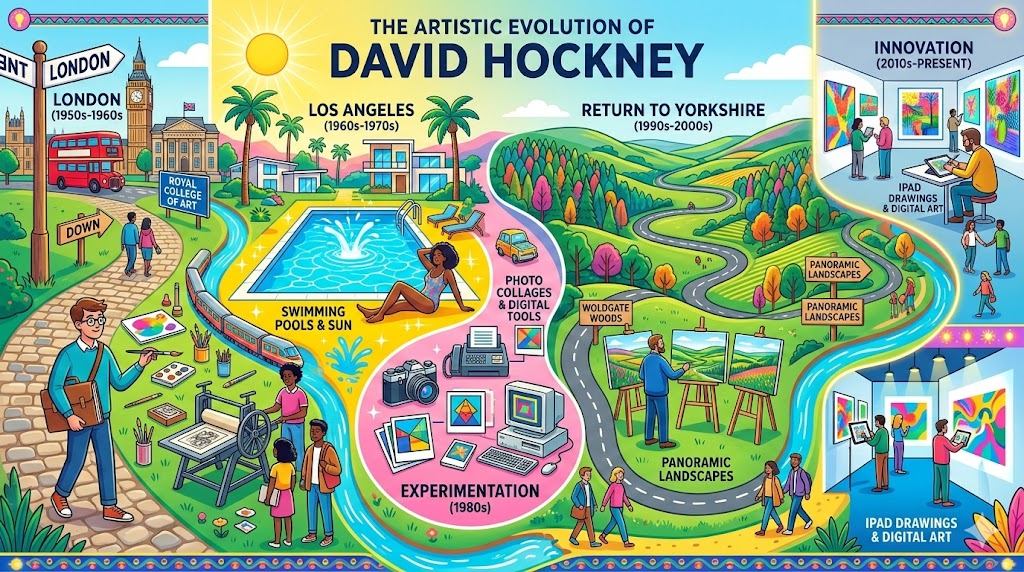
David Hockney (b. 1937) is a prolific British artist central to the Pop art movement. Renowned for his versatility, he has mastered painting, photography, and digital art. His vibrant California pool series and later multi-canvas Yorkshire landscapes reflect his lifelong, experimental pursuit of representing human vision..
61-01 David Hockney audio discussion (created by NotebookLM from my notes):
61-02 Grayson Perry
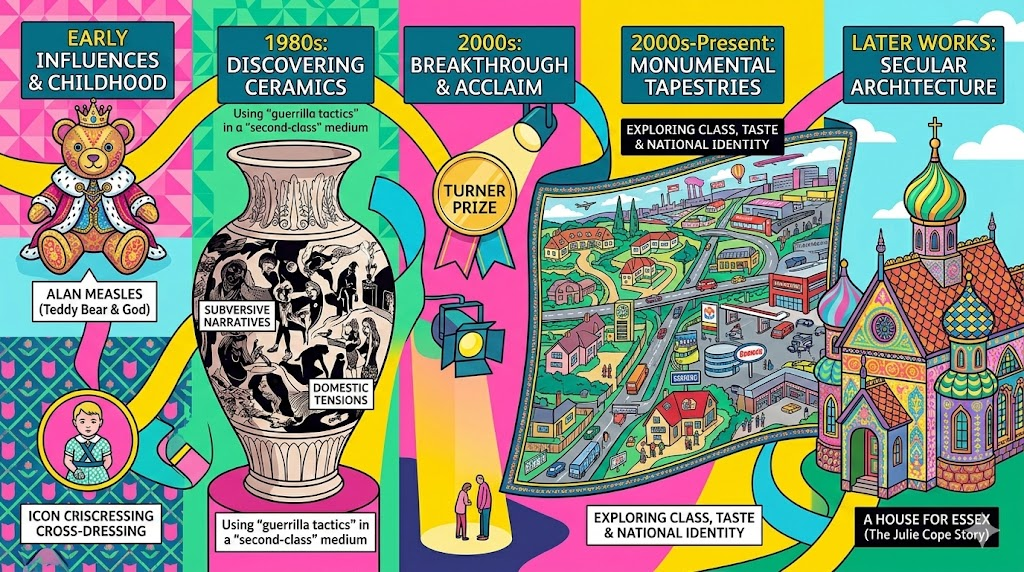
Grayson Perry is a groundbreaking British artist renowned for ceramic vases, tapestries, and sculptures. His art explores identity, social commentary, and British life through intricate, provocative narratives and vibrant imagery. He addresses themes like class, gender, and consumerism with humor and satire, challenging societal norms. Known for his public persona as Claire and his “Alan Measles” teddy bear figure, Perry bridges the gap between high art and popular culture with unique style.
61-02 Grayson Perry audio discussion (created by NotebookLM from my notes):
61-03 Francis-Bacon
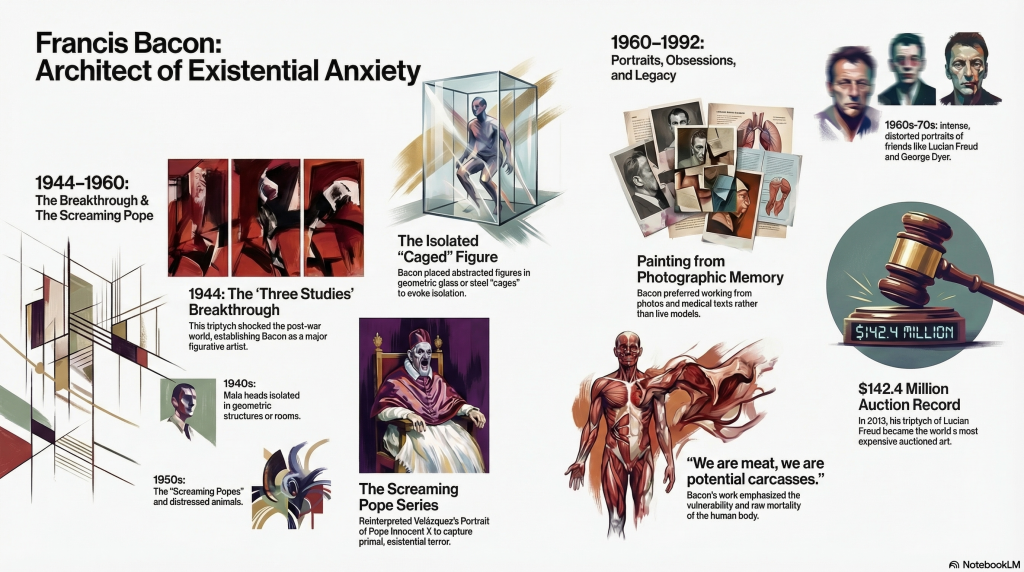
Francis Bacon (1909–1992) was born in Dublin to English parents and lived most of his life in London. Largely self-taught, he destroyed much of his early work and dated his mature career from Three Studies for Figures at the Base of a Crucifixion (1944), which shocked post-war London. Drawing on Velázquez, Muybridge’s photography, and medical imagery, he developed a distinctive style — contorted figures trapped within geometric armatures, rendered in visceral impasto against flat colour fields. His long creative partnership with and portraits of George Dyer became central to his oeuvre. Bacon remains among the most highly valued painters at auction worldwide.
A discussion on Francis Bacon (created by NotebookLM from my notes):
Why would an artist obsessed with “slaughter and butchery” become the most expensive painter in history? In 2013, Francis Bacon’s Three Studies of Lucian Freud sold for a staggering $142 million, a record-breaking sum that forces us to ask: what is the market value of raw agony? Bacon (1909–1992) was far more than a provocateur; he was the bleak chronicler of the post-war human condition. He bridged the gap between traditional representation and raw sensation, reinventing realism to capture the “nervous system” rather than a mere likeness. His work does not just illustrate the world—it dismantles and reconstructs it to show how existence actually feels.
1. The Great Erasure: He Tried to Delete His Own History
Francis Bacon’s career is sharply divided by a self-imposed year zero: 1944. Before he painted the harrowing triptych Three Studies for Figures at the Base of a Crucifixion, Bacon drifted through London as a “bon vivant,” gambler, and interior decorator. He designed rugs, furniture, and bathroom tiles—work he later admitted was “beautiful, but lifeless.” He spent years looking for a subject matter that could sustain his interest, and once he found it, he became his own most ruthless editor.
Upon finding his true voice in the grotesque animal-like Furies of 1944, Bacon took the radical step of destroying almost all the work he had produced in the previous decade. He insisted that no retrospective ever include his early, decorative attempts, effectively curating his own “birth” as a serious artist. He wanted the world to believe he emerged fully formed from the shadows of the Blitz, trading the elegance of Art Deco for the visceral intensity of the scream.
2. The Anatomy of an Accident: Painting by “Chance”
Bacon’s creative process was defined by a paradox: the desire for an ordered image that arrived via “accident.” This “controlled accident” mirrored the existential uncertainty of the era. Bacon was deeply influenced by the philosophical dread of thinkers like Jean-Paul Sartre, Friedrich Nietzsche, and Albert Camus. In a universe they described as “absurd” and “indifferent,” Bacon’s technique became a way to register that same sense of instability.
He didn’t just use brushes; he applied paint with rags, his hands, and even unconventional debris. In his 1945 work Figure in a Landscape, Bacon incorporated actual dust from his studio floor to achieve the specific, grimy texture of a suit. This was his way of bypassing the conscious mind to tap into something more primal.
“I want a very ordered image, but I want it to come about by chance.”
3. The “In Camera” Secret: Why He Preferred Photos to People
While his contemporary and rival Lucian Freud demanded months of grueling live sittings, Bacon almost never painted from life. He preferred the “emotional distance” provided by “In Camera” sources. His studio was a reservoir of images: medical textbooks detailing diseases of the mouth, film stills from Sergei Eisenstein’s Battleship Potemkin, and the sequential motion studies of Eadweard Muybridge.
Bacon was particularly haunted by the “nurse screaming in terror” from Potemkin and hand-colored plates of open mouths from a 1935 medical book. He also relied heavily on photographs by John Deakin, whose intimate close-ups and double-exposures provided the distorted starting point Bacon needed. By working from photos, he could dismantle the human face and reconstruct it to register visceral truth over literal appearance.
“I’m just trying to make images as precisely off my nervous system as I can.”
4. “We are Potential Carcasses”: The Philosophy of Meat
Bacon was obsessed with the physical vulnerability of the body and what he called the “slime” of human presence. To Bacon, the human form was little more than meat—a temporary vessel for sensation. When critic Jean Clair asked about the “slaughterhouse” nature of his work, Bacon replied that the Crucifixion was, fundamentally, a barbaric way of killing someone.
“We are meat, we are potential carcasses.”
He frequently referenced Rembrandt’s Slaughtered Ox, using hanging carcasses as a metaphor for the fragility of the flesh and the shared reality of the butcher shop. By stripping away religious iconography and replacing it with “mutilated meat,” Bacon turned the Crucifixion into a universal symbol of human suffering and mortality.
5. The Ghost of Velázquez: An Obsession Built on a Reproduction
The “Screaming Pope” series remains Bacon’s most iconic contribution to art history. Born from an obsession with Diego Velázquez’s 1650 Portrait of Pope Innocent X, the series is a masterclass in existential terror. Remarkably, Bacon never saw the original painting in person during his travels to Rome; he worked entirely from reproductions, claiming to be “haunted and obsessed” by the image.
To trap his Popes in their state of perpetual anguish, Bacon used a recurring formal device: a “geometric cage” or “spatial armature.” These thin, angular lines isolated the figure within the frame, creating a sense of claustrophobia and entrapment. He transformed a symbol of ultimate authority into a victim of modern anxiety, confined within a steel frame of his own making.
6. Love and the Abyss: The Tragic Muse of George Dyer
In 1963, Bacon met George Dyer, a man from an East End family “steeped in crime” who spent his life drifting between theft and jail. Legend says they met when Dyer tried to burgle Bacon’s studio. Dyer became Bacon’s lover and his most frequent subject, but the relationship was a volatile mixture of alcoholism and despair.
The tragedy reached a chilling climax in 1971. Just two days before Bacon’s major retrospective at the Grand Palais in Paris, Dyer committed suicide in their hotel room. In an unsettling display of professional defiance, the hotel agreed not to announce the death for forty-eight hours so the exhibition could proceed. Bacon spent the day of his greatest triumph surrounded by critics and friends, secretly knowing his lover was dead just a few floors away. This trauma shifted his work toward the “sombre and inward-looking,” as seen in the haunting Triptych May-June 1973.
7. The Final Pulse: Defiance Until the End
In his final decade, the “angst and fear” of Bacon’s earlier work began to soften. His relationship with his heir, John Edwards—a platonic and somewhat fatherly bond—brought a newfound “calmness and warmth” to his portraits. While early subjects were tortured and fragmented, his depictions of Edwards were rendered with softer brushstrokes and a sense of psychological gravity.
Bacon remained defiant until the very end. His 1991 work Study of a Bull serves as a final reflection on power, virility, and the dissolution of the self. Left on his easel at the time of his death in 1992 was an unfinished self-portrait—a poignant coda to a life spent exploring the boundaries of identity. Even as he faced mortality, he was still trying to capture the elusive “trail of the human presence.”
Conclusion: A Trail of Human Presence
Francis Bacon reinvented figurative painting for the nuclear age, moving beyond the face to capture the raw “nervous system.” He left behind a legacy of images that refuse to offer the comfort of a simple illustration. He believed that life itself was more horrific than any art could ever be, and he spent his life trying to bottle that horror in paint.
“I would like my pictures to look as if a human being had passed between them, leaving a trail of the human presence… as a snail leaves its slime.”
Bacon’s work challenges us with a final, provocative question: should art merely illustrate the world as it appears, or should it—as he did—dismantle that world to show us exactly how it feels to be alive?
61-04 Lucian Freud
A discussion on Lucian Freud (created by NotebookLM from my notes):
1. The Man Who Painted Under the Shadow of the Mind
To carry the name “Freud” in the 20th century was to bear the weight of the human subconscious. While his grandfather, Sigmund, famously explored the labyrinth of the psyche from the analytical safety of the couch, Lucian Freud (1922–2011) moved that investigation to the unforgiving glare of the studio.
Lucian’s work presents a provocative paradox: his paintings are frequently described as “uncomfortable,” “ugly,” or “ruthless,” yet they command tens of millions of dollars and global reverence. Why does the world obsess over these churned, tactile topographies of aging skin and naked vulnerability? To understand Freud is to realize that he wasn’t interested in the “look” of a person, but rather the visceral truth of their existence. He was a non-conformist who rejected the easy grace of abstraction for the difficult, raw humanity of the flesh.
2. The Goal Was Never Beauty, but Discomfort
For Freud, the traditional aims of portraiture—flattery, poise, and aesthetic polish—were irrelevant. He operated with what he termed “visual aggression,” a method of sitting in claustrophobic proximity to his subjects, staring with an intensity intended to strip away the social mask.
In early works like Girl with a White Dog, Freud utilized a razor-sharp, almost “scratchy” precision that forced the viewer to confront the sitter’s complex, often anxious state of mind. He rejected the idealized image in favor of a startling clarity that revitalized the genre of portraiture by making it candidly, even painfully, psychological.
“The task of the artist is to make the human being uncomfortable.”
3. When Paint Becomes Literal Flesh
Freud’s technical evolution is a remarkable journey from the meticulous to the sculptural. He famously transitioned from the thin, detailed brushwork of the 1950s to the dense, heavy impasto of his mature years. This wasn’t merely a change in style; it was an attempt to make the medium itself embody the subject.
In works like The Painter’s Mother Resting I, he often began with an “optical pivot”—a central point of focus, such as his mother’s nose—from which the rest of the face would radiate. This approach, combined with a rejection of “modernist color,” created a unique atmosphere. He avoided saturated colors because he believed they carried an “emotional significance” that would interfere with the raw truth he sought. For Freud, texture was the primary vehicle for truth.
- The Philosophy: “I want paint to work as flesh… my portraits to be of the people, not like them. Not having a look of the sitter, being them… As far as I am concerned the paint is the person.”
4. The Marathon of the Gaze: 2,400 Hours for One Canvas
Freud’s process was a grueling test of endurance. He famously demanded a staggering level of commitment from his sitters, often working on a single canvas for over a year.
A definitive example is Ria, Naked Portrait (2007). The model, Ria Kirby, was required to pose for sixteen months, missing only four evenings during the entire period. With sessions averaging five hours, the painting represents approximately 2,400 hours of intense observation. This slow, methodical concentration on every crease and blemish stands in sharp contrast to the internal intensity Freud felt while working.
- The Internal Intensity: Freud once remarked, “You probably think I’m going incredibly slowly, but in fact I’m going at ninety miles an hour, and if I go any faster the car might overturn.”
- The Finish Line: He believed a work was truly complete only when he felt like he was “working on somebody else’s painting.”
5. Everything is a Family Affair (Literally)
Freud’s personal and professional lives were inextricably linked. He was famously private yet fathered at least 14 acknowledged children across numerous relationships. These wives, lovers, and children served as his primary subjects, turning his body of work into a sprawling, multi-generational autobiography.
In the masterpiece Large Interior, W11 (after Watteau), Freud reimagined a Rococo scene using his own inner circle, including his lover Celia Paul and his daughter Bella. The narrative flair of the piece is heightened by the presence of a child lying on the floor. Originally intended to be his granddaughter, she was unavailable and was replaced by a “borrowed and bored” child named Star. This substitution underscores the demanding, sometimes ruthless nature of his practice.
- Kitty Garman: His first wife, whose “startling” presence he captured in Girl with a Kitten.
- Lady Caroline Blackwood: His second wife, whose “haunted beauty” he rendered with a thin, almost peeled-back use of paint.
- Bella Freud: His daughter, who appears in the complex, tension-filled family narratives of his later interiors.
6. The Queen and the “Corgi” Controversy
Perhaps no work better illustrates Freud’s refusal to flatter than his portrait of Queen Elizabeth II (The Queen, c. 1999-2001). Despite the subject’s stature, the painting is remarkably small—a deliberate choice to reduce the number of sittings required.
The reaction was a cultural firestorm. The Guardian hailed it as “probably the best royal portrait… for at least 150 years,” while The Sun’s royal photographer suggested the artist should be “locked in the Tower.” Detractors argued it made the monarch look like a “rugby player” or one of her corgis. For her part, the Queen remained diplomatically observant of Freud’s technical rigor, telling him upon delivery: “Very nice of you to do this. I’ve very much enjoyed watching you mix your colours.”
7. The Secret “Barefoot” Habit and the Pursuit of Perfection
While he was painting the most powerful woman in the world, Freud likely maintained his eccentric studio rituals. He had an amusing habit of painting barefoot—a lifestyle quirk he adopted from his grandfather, Sigmund. While the elder Freud was no painter, Lucian found a physical groundedness in this habit that suited his pursuit of what he called the “unvarnished truth.”
This groundedness was part of an obsessive search for perfection. In his late period, works like The Brigadier—a portrait of Andrew Parker Bowles—displayed thick, expressive brushstrokes that channeled the influence of Vincent van Gogh. Freud was driven by a “great insufficiency”—a dissatisfaction that kept him returning to the easel every morning to “compete” and “be ambitious.”
“A moment of complete happiness never occurs in the creation of a work of art. The promise of it is felt in the act of creation but disappears towards the completion of the work. For it is then the painter realises that it is only a picture he is painting.”
8. Conclusion: The Promise of Perfection
Lucian Freud remains a towering figure because he chose the difficult path of “raw humanity” over the polish of modern convenience. In an age dominated by digital filters and the instant gratification of a “swipe-and-filter” culture, Freud’s legacy is a radical rebuke. He spent thousands of hours staring at a single wrinkle or the subtle shift of light across a thigh, not to find “beauty,” but to find the person.
As we continue to curate our own idealized images for the digital void, we might ask ourselves: What is the value of a truly “clear-sighted” portrayal today? In a world of 0.5-second glances, do we still have the stamina to be made uncomfortable by the corrugated, honest truth of our own flesh?
61-05 Antony Gormley
Antony Gormley (b. 1950) is a British sculptor internationally recognised for works that use the human body to explore the relationship between self, space, and time. Working primarily from casts of his own body, he produces figures that range from intimate single sculptures to vast installations of thousands of forms. His “Angel of the North” (1998) has become one of Britain’s most recognised public artworks, standing 20 metres tall above the A1 road in Gateshead. Works such as “Another Place” — 100 iron figures facing the sea on Crosby Beach — invite reflection on solitude, presence, and the horizon. His practice consistently asks what it means to be a body occupying space at a particular moment in time.
A discussion on Antony Gormley (created by NotebookLM from my notes):
61-06 Damien Hirst
Damien Hirst (b. 1965) is the most commercially successful British artist of his generation and a defining figure of the Young British Artists. Best known for works preserving dead animals in formaldehyde — most famously a shark in “The Physical Impossibility of Death in the Mind of Someone Living” (1991) — his work confronts viewers directly with mortality. His “spot paintings,” butterfly canvases, and spin paintings challenged conventional notions of artistic authorship and the boundary between art and mass production. He has courted controversy throughout his career, blurring the lines between art, commerce, and spectacle with works such as the diamond-encrusted skull “For the Love of God” (2007). His practice consistently interrogates themes of death, medicine, religion, and the commercial art market.
A discussion on Damien Hirst (created by NotebookLM from my notes):
61-07 Tracey Emin
Tracey Emin (b. 1963) is a British confessional artist renowned for work that transforms deeply personal experience into raw, often shocking artistic statements. Her “My Bed” (1998), presented at the Turner Prize, brought her unmade, stained bed surrounded by personal detritus into the gallery as a statement about depression and heartbreak. Neon text works, drawings, embroideries, and autobiographical films explore themes of love, loss, sexuality, and survival rooted in a difficult childhood in Margate. A central figure among the Young British Artists, she was elected Royal Academician in 2007 and later appointed Professor of Drawing at the Royal Academy. Her work demonstrates that vulnerability, directness, and personal honesty can be among the most powerful forces in contemporary art.
A discussion on Tracey Emin (created by NotebookLM from my notes):
61-08 Chris Ofili
Chris Ofili (b. 1968) is a British painter of Nigerian descent who rose to prominence among the Young British Artists in the 1990s. He won the Turner Prize in 1998 for richly layered canvases combining oil paint, glitter, resin, map pins, and elephant dung in densely patterned, spiritually charged compositions. His paintings weave together strands of black history, African culture, spirituality, sexuality, and popular culture into complex visual narratives. Works such as “The Holy Virgin Mary” (1996) provoked significant controversy by embedding religious iconography with references to black female identity. Since 2005 he has lived in Trinidad, where his work has evolved toward a lush, intimate exploration of mythology, race, and the natural world.
A discussion on Chris Ofili (created by NotebookLM from my notes):
61-09 Sarah Lucas
Sarah Lucas (b. 1962) is a British artist and key figure of the Young British Artists whose work confronts gender, sexuality, and mortality with irreverent, often crude humour. Known for provocative assemblages using cigarettes, fried eggs, furniture, and cast body parts, her work comments sharply on sexual politics and the objectification of the female body. Her early photographic self-portraits challenged conventional femininity with deliberately unglamorous poses that subverted the male gaze. Works such as “Au Naturel” (1994) deploy everyday objects to create sexually charged arrangements that are funny, disturbing, and politically pointed in equal measure. She represented Britain at the Venice Biennale in 2015, presenting characteristically frank and uncompromising work in the British Pavilion.
A discussion on Sarah Lucas (created by NotebookLM from my notes):
61-10 Rachel Whiteread
Rachel Whiteread (b. 1963) is a British sculptor best known for casting the negative spaces inside and beneath everyday objects and architecture. Her “House” (1993) — a concrete cast of the entire interior of a Victorian terraced house in London’s East End — won the Turner Prize and provoked heated national debate before its demolition. Works including “Ghost” (a cast of an entire living room) and the “Untitled (One Hundred Spaces)” series turn familiar domestic voids into uncanny solid presences bearing the traces of former inhabitants. A commission for the Turbine Hall at Tate Modern and the Vienna Holocaust Memorial demonstrate her ability to work at architectural scale with profound historical weight. Her practice consistently makes the invisible visible, transforming empty space into solid form and giving presence to absence.
61-10 Notes on Rachel Whiteread
A discussion on Rachel Whiteread (created by NotebookLM from my notes):
61-11 Banksy
Banksy (b. c. 1974) is an anonymous British street artist, activist, and filmmaker whose satirical stencil works have appeared on walls, bridges, and public spaces across the world. Operating under a pseudonym to avoid prosecution, his identity remains one of the art world’s most carefully guarded secrets despite decades of international fame. His works combine dark humour with pointed political commentary on war, capitalism, consumer culture, surveillance, and social inequality. “Girl with Balloon” (2018) became one of the most discussed artworks of recent times when it partially self-destructed through a hidden shredding device at auction. His practice raises fundamental questions about ownership, commercialisation, public space, and the purpose of art in a world saturated with images.
A discussion on Banksy (created by NotebookLM from my notes):
61-12 Ai Weiwei
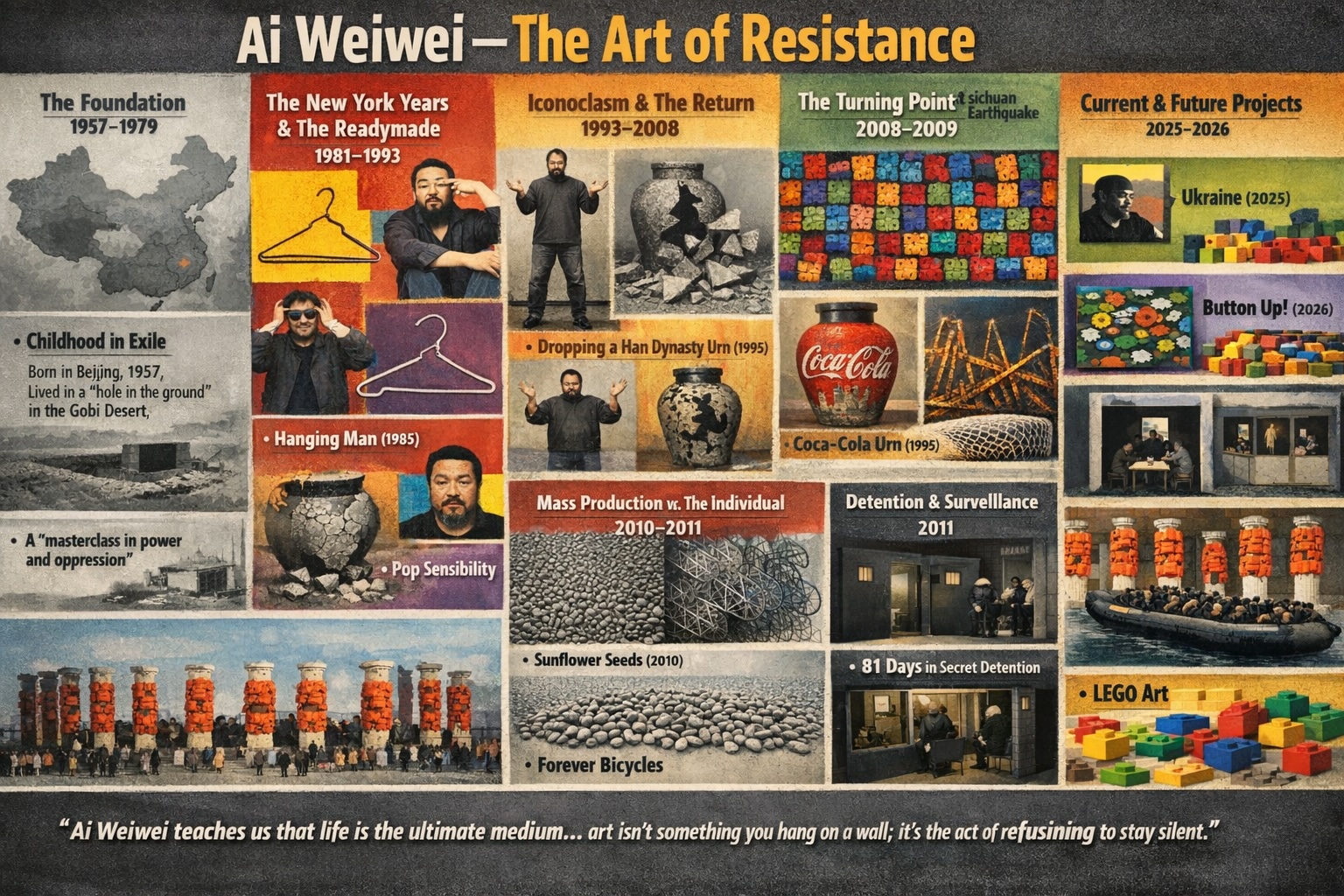
1. Introduction
Can a single individual truly challenge the monolithic gravity of a superpower? In the case of Ai Weiwei, the answer is found not in a gallery, but in a lifelong performance titled Portrait of the Artist, 1957–Present. Ai is more than a creator of objects; he is a systematic “disrupter” who treats his own biography as his primary medium. To him, art is not a decorative commodity but a fundamental “act of refusing to stay silent.” By distilling personal trauma and political conviction into provocative narratives, Ai has created a roadmap for how the creative spirit can confront absolute authority, proving that when the state attempts to erase the individual, the individual must become the art.
2. Destruction as a Masterclass in Resilience
Ai Weiwei’s understanding of power began with its brutal application. Born in 1957 to the poet laureate Ai Qing, his life opened with a “crash course in political repression.” When his father was branded an enemy of the people, the family was purged to the edge of the Gobi Desert. In this “internal exile,” one of China’s greatest literary minds was reduced to cleaning communal toilets, a visceral humiliation that Ai witnessed daily.
However, this period was also a masterclass in survival. Amidst the harsh landscape, young Ai learned to make bricks and build furniture—practical skills that would later inform his monumental installations. This “imprisonment without arrest” transformed his later work into something deeper than aesthetics; it became a testament to the resilience required to endure when the world is built on the manual labor of the oppressed.
3. The Power of the “Readymade” Middle Finger
During his years in New York City’s East Village (1983–1993), Ai’s artistic vocabulary expanded through the lens of Western avant-garde. He became obsessed with Marcel Duchamp’s “readymades,” even bending a wire coat hanger into a profile of the artist. To survive, he utilized a “gambler’s instinct” as a professional blackjack player in Atlantic City, a trait that would later define his high-stakes political maneuvers.
This period birthed the Study of Perspective series. While appearing as crude tourist snapshots, the series is a sophisticated parody of Renaissance perspective studies. By extending his middle finger toward icons of power—from Tiananmen Square to the White House—Ai makes his gesture the focal point, rendering the massive monuments and the institutions they represent secondary and submissive.
The obscene gesture is today interpreted as meaning “f-off” but it goes back to ancient Greece when the phallic symbol was used to mock someone by indicating they were submissive.
4. Why Breaking a 2,000-Year-Old Urn Was an Act of Remembrance
In 1995, Ai produced his most iconoclastic work: Dropping a Han Dynasty Urn. Captured in three clinical photographs, Ai shatters a ceremonial antiquity. This was not a spontaneous act of vandalism but a calculated performance first published in The White Book, one of his influential underground art publications. In fact, Ai broke two urns to capture the perfect shot, highlighting the intentionality of the gesture.
By destroying the urn, he commented on the “Four Olds” (old customs, habits, culture, and ideas) targeted for elimination during the Cultural Revolution. The world’s outrage over a single broken pot contrasted sharply with the state-led obliteration of thousands of temples and historical sites Ai saw during his childhood. He was forcing a world with a short memory to recognize the state’s legacy of cultural erasure.
Ai countered criticism by invoking Chairman Mao, who told people they could only build a new world by destroying the old one.
5. Turning “Made in China” into a Human Face
In 2010, Ai filled the Turbine Hall of the Tate Modern with Sunflower Seeds, an installation of 100 million handcrafted porcelain seeds. The scale was staggering: 1,600 artisans in Jingdezhen, the ancient “porcelain capital,” worked for over two years. Each seed was hand-sculpted and hand-painted before being fired at 1,300 degrees Celsius.
The work subverts the concept of “cheap mass production.” While the seeds look identical from the bridge above, close inspection reveals each is unique. The installation was eventually roped off because the friction of visitors walking on the seeds created a hazardous ceramic dust, a metaphor for the physical toll of mass labor. For Ai, the seeds evoked both the propaganda of the Mao era—where the people were sunflowers turning toward the “sun”—and his personal memory of sharing seeds as treats during his childhood poverty in Xinjiang.
6. The Citizen Investigation: Collecting Names the State Erased
Following the 2008 Sichuan earthquake, Ai moved from conceptual play to urgent activism. Outraged by the “shoddy construction” that caused schools to collapse while other buildings stood, he launched a “citizen investigation” to collect the names of the over 5,000 children the government refused to acknowledge.
This manifested in Remembering, 9,000 backpacks on the façade of the Haus der Kunst, and Straight, a somber landscape made from 150 tonnes of salvaged steel rebar. Ai’s team spent four years manually straightening each mangled bar. When viewed from above, the undulating stacks of steel resemble a seismograph reading, a literal recording of the trauma the state tried to straighten and hide.
Among the backpacks, a quote from a bereaved mother was spelled out in Chinese characters: “She lived happily for seven years in this world.”
7. Flipping the Lens on Surveillance
Ai’s activism led to his 81-day secret detention in 2011. He responded with S.A.C.R.E.D., six iron boxes containing hyper-realistic dioramas of his cell. The acronym stands for: Supper, Accusers, Cleansing, Ritual, Entropy, and Doubt. These dioramas depict Ai eating and using the toilet while two guards stand inches away, watching his every move.
When the work premiered in 2013 at the Chiesa di Sant’Antonin in Venice, the church setting deliberately evoked the “Stations of the Cross.” By forcing viewers to peer through small apertures to see the guards watching the artist, Ai “upturns the surveillance situation,” transforming the audience into complicit voyeurs and exposing the claustrophobic reality of state control.
8. The Political Power of a Toy: The LEGO Controversy
Even while under house arrest with his passport confiscated, Ai maintained a global presence. For his 2014 exhibition at Alcatraz, he created the Trace series—portraits of 176 prisoners of conscience made entirely from LEGO bricks. When LEGO initially refused to sell him bricks in bulk for “political” work, Ai turned the restriction into a global dialogue.
Supporters worldwide donated bricks, demonstrating that a “toy” could become a formidable political tool. This incident underscored his philosophy that art is found in the struggle for expression, not the materials themselves. His LEGO self-portraits, which later sold for millions, remain a testament to his ability to use the “mass-produced” to celebrate the individual.
9. From National Icon to Global Refugee Advocate
Ai Weiwei’s trajectory moved from the center of the Chinese establishment—as a consultant on the “Bird’s Nest” stadium for the 2008 Olympics—to a global humanitarian voice. After denouncing the Olympics as propaganda, he focused on the global refugee crisis, producing the feature-length documentary Human Flow (2017).
His recent work, like Safe Passage (14,000 life jackets on the Konzerthaus Berlin) and Law of the Journey (a 60-meter rubber boat), brings the “human flow” into the heart of Europe. Notably, the massive rubber boat in Law of the Journey was manufactured in a Chinese factory that produces the actual, precarious vessels used by refugees—a haunting meta-commentary on the global reach of “Made in China.”
10. Conclusion: Life as the Ultimate Medium
Ai Weiwei’s legacy is not a collection of objects to be curated, but a precedent for the artist as a citizen. For Ai, art is a way of living—a continuous self-portrait that bridges the gap between the internal exile of his youth and the global crises of the present. He reminds us that in an era of mass surveillance and institutional power, the individual has a non-negotiable responsibility to speak.
As we look at the scale of his work, from a single porcelain seed to 150 tonnes of straightened steel, we must ask ourselves: In a world designed to manipulate mass consciousness, what is our individual responsibility to break the silence?
A discussion on Ai Weiwei (created by NotebookLM from my notes):
61-13 Paulo Rego
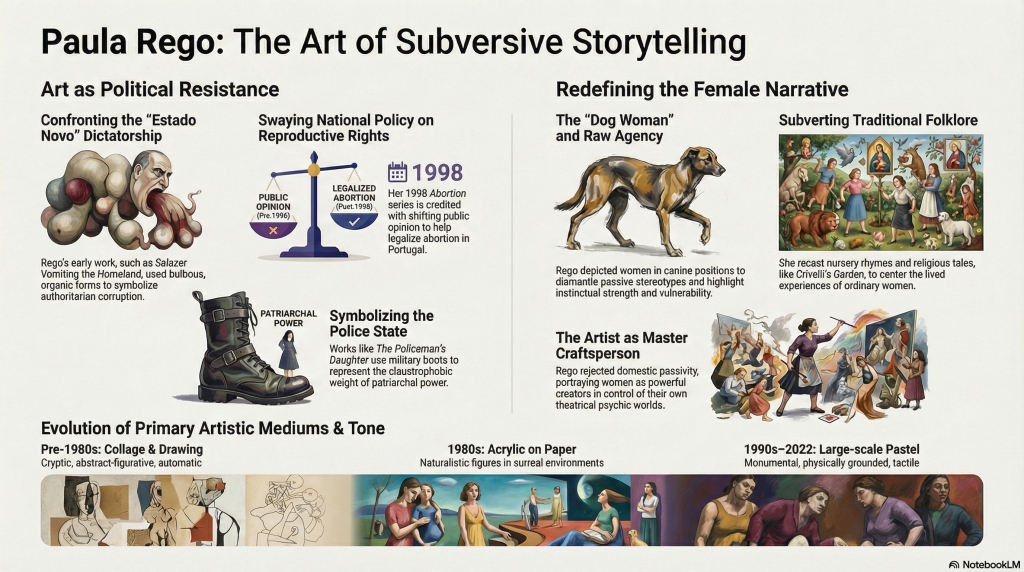
Paula Rego reshaped figurative painting. She turned it into a fiercely political, narrative art of female experience and resistance, influencing generations of artists and debates on women’s rights, from abortion to abuse, through psychologically charged, storybook‑rooted imagery that exposed power, cruelty and resilience
YouTube video (scheduled for 23 May 2026)
A discussion on Paula Rego (created by NotebookLM from my notes):
In the hushed, climate-controlled galleries of the world, art is too often treated as a polite sedative—a decorative accessory designed to harmonize with the architecture. For Dame Paula Rego, however, the canvas was never a site of comfort; it was a theater of war. Rego’s brush was a scalpel, meticulously peeling back the skin of domestic propriety to reveal the raw, pulsing nerves of a nation under siege. She famously characterized her work as “scary and terrible narratives,” transforming the “grotesque” into something human, urgent, and profoundly political.
To understand the ferocity of Rego’s vision, one must look to her roots in 1930s Portugal, a society stifled by the Salazar dictatorship. Born in 1935, Rego’s formative years were defined by a haunting sense of silence and surveillance. In 1936, her anti-fascist father was posted to Britain, leaving her with her grandmother in Portugal until 1939. This three-year separation, spent under the watchful eye of a regime that censored every book and play, instilled in her a lifelong suspicion of authority and a deep reliance on the “everyday fantastic”—the point where the mundane meets the monstrous. For Rego, art wasn’t an aesthetic pursuit; it was a weapon for social change.
The Architecture of Silence: The Abortion Series
Rego’s most tangible victory over the state came through her 1998 Abortion series. Born from a state of visceral anger following the failed referendum to legalize abortion in Portugal, these ten powerful pastels achieved what political rhetoric could not. They forced the public to confront the physical reality of female suffering, addressing two experiences Rego found almost entirely unrepresented in art: abortion and depression.
By depicting women in the lonely, cramped aftermath of illegal procedures, Rego used her art as a primary coping mechanism to process the “unconscious desires and shared malice” of a restrictive society. When these works were published in Portuguese newspapers ahead of a second referendum in 2007, they effectively shifted the national consciousness, leading to a change in the law. As Rego sharply noted, the series was a necessary testament to the “fear, pain and danger of illegal abortion, which is what desperate women have always resorted to.”
Subverting the Sacred: The Humanized Mother
In 2002, when President Jorge Sampaio invited Rego to create a cycle for the presidential chapel in Lisbon, she did not provide the ethereal, remote icons typical of Catholic tradition. Instead, she delivered a robust, humanized mother. In her Annunciation, the Virgin Mary is modeled after Rego’s own granddaughter—not a remote saint, but a vulnerable adolescent in a school uniform, visibly reeling from the shock of her revelation.
In the Nativity, the focus shifts entirely from divine light to the agonizing physical pain of childbirth. By stripping away the sentimentality of traditional religious art, Rego moved the needle of devotion from the “fear of death” to the “dignity of ordinary maternal experience.” It was a reclamation of the sacred through the lens of the female body, insisting that the miracle was not in the divinity, but in the endurance.
The Geometry of Raw Vitality: Beyond the Anatomical
Rego’s technical evolution was itself a form of rebellion. Her move to large-scale pastels in the 1990s was a direct reaction against the Slade School of Fine Art’s rigid emphasis on anatomical figure drawing. To Rego, the search for “correct” anatomy was a cage; pastels allowed for a more visceral, instinctual expression. This is nowhere more evident than in her 1994 Dog Woman series.
In these works, women are depicted in “dog-like positions”—scavenging, baying, or grooming—but they are never degraded. In Bride, a woman in a raw silk wedding dress lies “belly-up,” a posture that fuses surrender with a simmering, animalistic aggression. Crucially, Rego insisted on leaving the hands and feet uncovered, noting that “it was vital that her extremities were exposed as they are in all animals.” This exposure of the extremities highlights a “raw vitality” that refuses the voyeuristic male gaze, finding a “beauty of vulnerability” that is inherently empowering.
The Everyday Fantastic: Domesticity as Imprisonment
In the 1987 masterpiece The Policeman’s Daughter, Rego exposed the hidden violence of domestic life under the Salazar regime. A young woman in a virginal white dress is shown cleaning her father’s heavy, black jackboot. The imagery is intentionally grotesque and psychologically charged, influenced by a sexually explicit Robert Mapplethorpe photograph; Rego directed her model to “shove your hand down into it.”
The boot serves as a phallic symbol of the rigid police state, and the act of cleaning it represents the “symbolic shine” women were expected to maintain on a corrupt society. In a country where women could not travel or open bank accounts without a husband’s permission, Rego used the “everyday fantastic”—the intersection of a school uniform and a military boot—to illustrate how domestic acts were tethered to state-sponsored violence.
The Shadow Dance of Grief
Folklore, for Rego, was never for children. It was a means of psychological warfare. Her 1989 Nursery Rhymes series, created during a residency at the National Gallery, recast familiar stories as sinister moral fictions. In her etching of Little Miss Muffet, the spider bears a human face and suggestively strokes the girl’s knee, exposing the “shared malice” hidden within civilized society.
This fascination with the darkness of the psyche culminated in The Dance (1988), completed following the death of her husband, Victor Willing. The work is a universal meditation on life stages, yet it is haunted by personal ghosts. Her son Nick posed in his late father’s suit, and Willing himself appears twice: once dancing with Rego, and once with a blonde lover. This double appearance illustrates the “unconscious desires” and complexities of their marriage, turning a personal tragedy into an eerie, dreamlike reflection on continuity. Flung into her work as a coping mechanism for “palpable grief,” Rego proved that the only way to survive a nightmare is to paint it.
The Anchor of a Legacy
Paula Rego was a master craftsperson who refused every role prescribed to her—whether by the Slade, the Church, or the State. She ended her life as a Dame of the British Empire, leaving behind the Casa das Histórias in Cascais as a permanent sanctuary for her narratives. In her mural Crivelli’s Garden, she included a small seated figure she called “the reader,” describing her as the “anchor figure” who starts the whole story.
Rego was that anchor for the 20th century—a storyteller who refused to blink in the face of the grotesque. In a world increasingly obsessed with digital ephemera, her legacy challenges us with a provocative question: Can a single painting still hold the power to dismantle a dictatorship or rewrite a law? For Paula Rego, the answer was found in the ferocity of the brush.
Created by NotebookLM basde don mynotes
1. Introduction: Building a Theatre of Images
To understand Paula Rego, one must look past the “proper” expectations of mid-century Portugal, where women were framed as “little saints” of the domestic sphere. In the shadow of António de Oliveira Salazar’s “New State,” the social hierarchy was rigid: the working class was expected to do everything, while the elite—of which Rego was a member—were expected to do nothing at all. Rego, however, lived as a moral exile in her own country, eventually becoming a master craftsperson who didn’t just paint, but built a “theatre of images.”
Her early 1960 collage, Salazar Vomiting the Homeland, sets the visual palette for this subversion. Rendered in muddy browns and sickly yellows, it depicts the dictator as a bulbous, red-and-white form spewing national corruption into a landscape of animalistic regression. This was not merely art; it was a curate’s cabinet of domestic horrors, designed to dismantle the very class and regime that sought to keep her silent. Throughout her career, Rego would remain a specialist in the visceral, translating the suffocating atmosphere of a police state into a sophisticated narrative of female agency.
2. Art as Activism: The Series That Changed the Law
Rego’s 1998 Abortion series stands as perhaps the most potent example of high art functioning as a catalyst for legislative change. Following the failure of a 1998 referendum to legalize the procedure, an outcome that left Rego deeply angry, she produced a series of pastels and etchings—most notably Untitled No. 1—that gave moral authority to survivors.
These works did not shy away from the physical reality of the experience. They successfully addressed two human experiences that, despite being widespread, remained almost entirely unrepresented in the canon: abortion and depression. When these etchings were published in Portuguese newspapers leading up to the second referendum in 2007, they were credited with swaying the public conscience.
“Rego said it highlights the fear, pain and danger of illegal abortion which is what desperate women have always resorted to.”
By representing the vulnerability and resolve of these women, Rego moved the debate from abstract morality to the physical truth of suffering and survival.
3. The “Dog Woman”: Reclaiming Strength from Surrender
In the 1994 Dog Woman series, Rego dismantled the traditional “viewer’s gaze” by reimagining the bestial as a site of positive power. These large-scale pastels, often featuring her long-time model and surrogate Lila Nunes, explore the raw aggression and erotic vitality found in states of instinctual behavior.
The visual evidence is found in the muscular tension of figures crouched, baying at the moon, or scavenging. In Bride, for which Rego’s daughter Cas posed in a raw silk wedding dress, the artist subverted an initial pose on all fours to create something more psychologically complex. She turned the figure so she is:
“belly-up in an attitude of surrender and ready to have her tummy tickled.”
Rego noted that exposing the model’s hands and feet was “vital,” as the exposure of extremities is a characteristic shared by all animals. By showing women in these canine postures, Rego rejected passive beauty in favor of a hybrid form that is simultaneously obedient and resistant, foregrounding the instinctual forces underlying socially scripted female behavior.
4. Nursery Rhymes Aren’t “Twee”—They Are Terrifying
For Rego, traditional folklore was never a source of comfort, but rather a collection of “scary and terrible narratives.” In her 1989 Nursery Rhymes series, she recast mythologies of innocence into morally ambiguous fictions used to expose unconscious desires and shared malice.
Her etching of Little Miss Muffet is particularly illustrative. Rego transforms the spider into an enormous creature with a human face, shifting the tone from a childhood fright to a psychologically charged encounter. As the spider’s leg strokes the girl’s knee, the scene becomes altogether more sinister. Through these works, Rego used the illustrative idiom of the nursery to uncover the violence and rigid gender roles hidden within the “wholesome” stories we tell children, proving that even the most domestic verses carry a secret history of cruelty.
5. Domesticity as a Police State
In the seminal 1987 work The Policeman’s Daughter, Rego synthesizes the psychological claustrophobia of the Salazar years. The painting depicts a young woman in a windowless room, thrusting her arm into her father’s rigid, phallic jackboot. This pose was specifically inspired by a sexually explicit Robert Mapplethorpe photograph showing a fist thrust inside a woman—a connection that highlights the visceral subversion at play.
The painting serves as a metaphor for the domestic labor of Portuguese women, who were tasked with “painting the symbolic shine” on a society that oppressed them. Under the law, women could not travel or open bank accounts without a husband’s permission; here, the “simmering anger” of that isolation is palpable. The virginal white dress is juxtaposed against the sinful black boot, while a mistrustful cat scratches blindly at the wall, replacing a toy castle from earlier sketches to heighten the sense of domestic unease. During the sitting, Rego gave her daughter Cas a chillingly direct instruction:
“Don’t just cuddle the boot, just shove your hand down into it, just shove it in.”
6. The Beauty of the Bruise: A Final Act of Candor
Rego’s commitment to an unflinching gaze remained constant into her eighties. In her 2017 Self Portrait III, created after a physical fall, she rendered her own “deformed” likeness with her mouth wide open, echoing the raw distortion of a Francis Bacon portrait.
The work features her long-time surrogate, Lila Nunes—of whom Rego once said, “Lila is me in many of my paintings.” By choosing her bruised face as a subject, Rego found a “reason to draw” that transcended mere pain. She broke the final taboo of aging and injury, finding a new form of radiance in the physical reality of the declining body. As writer Deborah Levy observed:
“If she is stripped of the radiance of youth, she is nevertheless radiant with the force of her own taboo-breaking gaze.”
7. Conclusion: The Legacy of a Moral Witness
The journey of Paula Rego is a testament to the power of the individual voice against the machinery of silence. She began as a child drawing at age four in a country where illiteracy was high and dissidents were sent to the “Camp of Slow Death.” She ended her life as a Dame of the British Empire, recognized as the pre-eminent figurative artist of her era. Through her “theatre of images,” she forced the world to look at the parts of the human experience—abortion, domestic repression, and the indignities of aging—that society prefers to sanitize.
In a world that still seeks to curate and soften the female experience, do we have the courage to look as unflinchingly as Paula Rego did?
61-14 Joseph Beuys
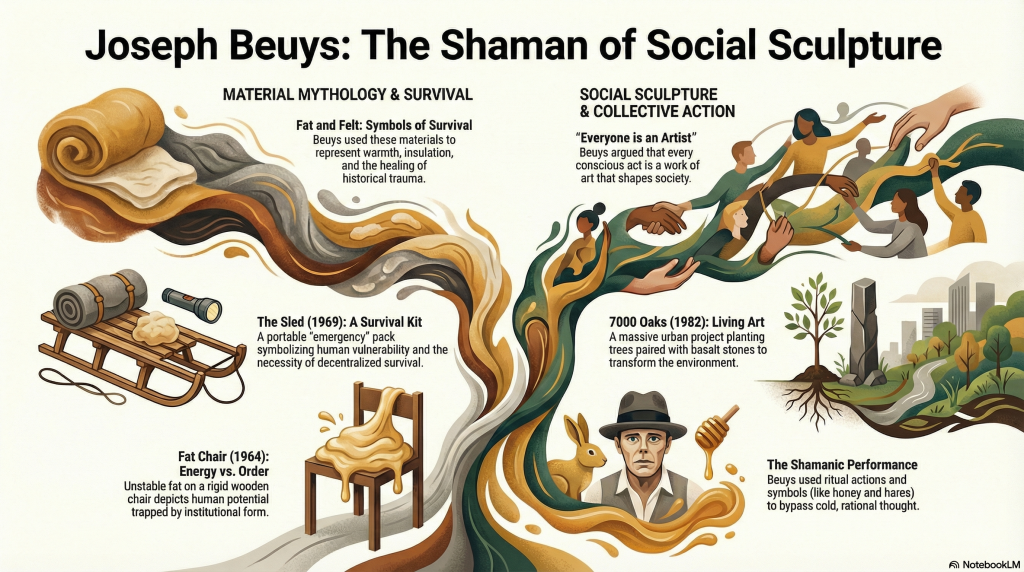
Joseph Beuys (1921–1986) was a German artist whose radical vision transformed postwar art. A professor at the Düsseldorf Academy, he pioneered social sculpture — the idea that art could reshape society itself. His performances used ritualistic materials: felt, fat, and copper, drawn from a mythologised survival story after his wartime plane crash. Works like I Like America and America Likes Me (1974) cemented his legend. Provocateur, shaman, and political activist, Beuys remains one of the twentieth century’s most challenging and influential figures.
The YouTube video will be published on 30 May 2026
A discussion on Joseph Beuys (created by NotebookLM from my notes):
In the sterilized silence of the traditional museum, “fine art” is a fossil—oil on canvas or carved marble intended for passive observation. Joseph Beuys (1921–1986), the felt-hatted provocateur of West Germany, viewed this static definition as a physiological threat. He didn’t just want to change art; he wanted to change the way the human heart beats.
Beuys famously declared that “Everyone is an artist,” a statement often misinterpreted as a hollow platitude. In reality, it was a radical demand. He argued that “Art alone makes life possible,” going so far as to claim that without it, “man is inconceivable in physiological terms.” For Beuys, the creative act was a state of consciousness, not a finished product. He synthesized this into a remarkably grounded challenge: even the act of peeling a potato could be a work of art, provided it was performed as a conscious, intentional act of living. By elevating mundane existence to a creative practice, Beuys confronted our greatest modern tragedy: the tendency to overlook the transformative power we hold within our own daily conduct.
Here are five surprising truths about the man who transformed life into “social sculpture.”
1. Your Origin Story Might Be Your Greatest Invention
Beuys was a master of the “origin myth,” a narrative he used to establish his persona as a shamanic healer. His most enduring story centered on a 1944 plane crash in the Crimea while serving as a Luftwaffe rear-gunner. Beuys claimed he was rescued by nomadic Tartar tribesmen who saved his life by wrapping his broken body in animal fat and felt to keep him warm.
While this story provided the symbolic foundation for his career, historical reality offers a colder, more conventional sequence.
“Records show he was recovered by German search party, remained conscious and stayed in hospital for three weeks.”
As a critic, one must see that the factual “lie” was a higher “truth” for his art. This myth-making allowed Beuys to adopt a shamanic uniform that was both symbolic and visceral. His trademark felt trilby hat wasn’t just a stylistic choice; it covered the two metal plates in his head—the literal medical scars of his crash. This “uniform” protected him from the “painful extremes of hot and cold” while signaling his role as a mediator between the spiritual and the material. His subsequent use of fat (signifying stored energy) and felt (signifying protection) in works like The Sled (1969) was an attempt to heal not just his own wartime trauma, but the psychic wounds of a collapsed Germany.
2. Animals Have More “Intuition” Than Some Humans
Beuys believed Western society was suffocating under a blanket of rationalism. In his 1965 performance, How to Explain Pictures to a Dead Hare, he sought to bypass the intellect entirely. With his head covered in honey (representing collective thought and labor) and gold leaf (representing spiritual transformation), he spent three hours whispering explanations of art to a dead animal.
To the critics who dismissed it as mystical nonsense, Beuys offered a biting rejoinder: “Even a dead animal has more intuitive understanding than some humans.” By cradling the hare—a symbol of rebirth and intuition—while wearing a felt-lined shoe to dampen his own steps, Beuys rejected the art market’s demand for sellable objects, offering instead a ritualized critique of museum culture.
He pushed this theme of animal intuition to its limit in 1974 with I Like America and America Likes Me. Upon arriving in New York, he refused to touch American soil, being transported by ambulance—wrapped in felt—to a gallery where he lived for three days with a live coyote. Armed with a shepherd’s staff and receiving daily deliveries of The Wall Street Journal, Beuys staged a symbolic reconciliation between “Capitalism” (the paper) and “Myth” (the coyote). He entered the country “as a wound, not a guest,” attempting to communicate with the suppressed histories of Indigenous America through the intuition of a predator.
3. Teaching is the “Greatest Work of Art”
For Beuys, the classroom was a laboratory for “social sculpture”—the idea that society itself is a work of art that can be shaped through education and speech. During his controversial tenure at the Düsseldorf Academy, he weaponized the concept of the open classroom, rejecting entrance exams and accepting any student who wished to learn. This wasn’t just a policy; it was an act of “anarchy” in the eyes of the administration.
He believed the real work of art was the transformation of the student, while the physical artifacts of his career were merely the discarded husks of that process.
“To be a teacher is my greatest work of art. The rest is the waste product, a demonstration.”
This philosophy was most evident in his Honey Pump at the Workplace (1977), where two tonnes of honey circulated through a building via plastic tubes. While the honey—representing the flow of living thought—pulsed through the infrastructure, Beuys staged daily, marathon discussions. For him, the sculpture was incomplete without speech. The “art” was the conversation itself, a metabolic process where ideas were the primary material.
4. Survival Requires a Decentralized “Pack”
In 1969, a year defined by global student protests and the crumbling of industrial authority, Beuys produced The Pack. The installation features a Volkswagen van, its rear doors open, trailing twenty-four wooden sleds. Each sled is a survival kit: a roll of felt for warmth, a wedge of fat for energy, and a torch—a literal “light in the dark” for those navigating the void of historical crisis.
The political symbolism is a sharp critique of hierarchical power:
- The Van: Represents the immobilization of state and industrial authority. It is the command structure that has stalled.
- The Sleds: Represent a decentralized “pack” of individuals moving outward.
This work moved sculpture away from personal mythology toward a model for social organization. Beuys was suggesting that when the “van” of industrial society fails, survival depends on shared responsibility and collective action. It is an image of emergency evacuation where every individual must carry their own light and warmth to ensure the pack survives.
5. A Sculpture Can Be 7,000 Trees and Five Years Long
Beuys’s final major provocation, 7000 Oaks, was a work of “sculpture without an audience” in the traditional sense. Launched in 1982 in Kassel, the project involved planting 7,000 oak trees, each paired with a vertical basalt stone. The pairing was a study in contrasts: the organic, slow-growing oak and the permanent, historical weight of the basalt.
The project was met with intense hostility and media mockery. Local politicians and citizens balked at the disruption and the cost. Yet, Beuys persisted, framing ecology as a cultural crisis rather than a technical one. The work was a direct response to the 1980s zeitgeist of acid rain and nuclear anxiety. Beuys wasn’t just planting trees; he was attempting an “irreversible transformation of urban space.” Though he died in 1986, the project was completed by his son a year later, proving that a “social sculpture” could outlive its creator and permanently alter the physical and psychological landscape of a city.
——————————————————————————–
Finding the Light in the Wound
Joseph Beuys remains the ultimate mediator, healer, and provocateur. He did not seek beauty in the pristine; he sought it in the places where we are most broken. This is best visualized in his 1974-75 installation Show Your Wound, where mortuary trolleys and surgical instruments stand as a “theatre of ethical provocation.” It is within this tableau of human vulnerability that his most famous claim resonates: “The wound is the place where the light enters you.”
Beuys’s legacy is a challenge to our passive consumption of life. If art is “social energy in action,” then our decisions, our speech, and our conduct are the materials of a massive, ongoing social sculpture. We are no longer mere observers in the museum of the world.
61-15 Anselm Kiefer
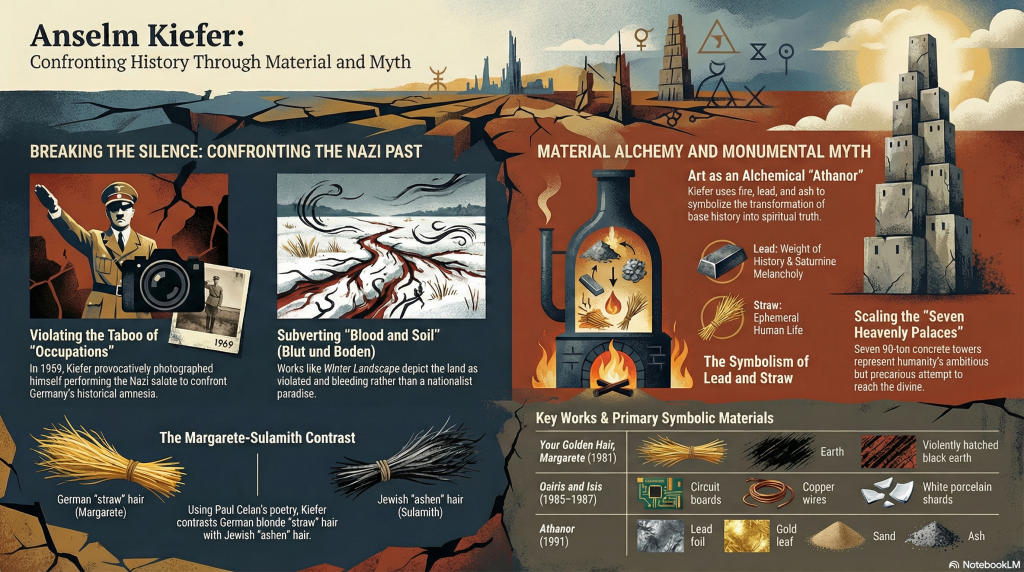
Anselm Kiefer was born in Donaueschingen, Germany, in 1945, just weeks before the end of the Second World War — a coincidence that would shape his entire artistic vision. Studying under Joseph Beuys in the early 1970s, he emerged as one of the most ambitious painters of his generation, determined to confront the darkest chapters of German history at a time when many preferred silence. His work is monumental in scale, apocalyptic in mood, and uncompromising in its demands on the viewer.
The YouTube video will be published on 6 June 2026
In the decades following 1945, West Germany was shrouded in a “collective amnesia.” For a generation born into the rubble, the Third Reich was a void—too painful for parents to recount and too dangerous for the state to fully confront. Anselm Kiefer, born in the final months of the war, refused this silence. Throughout his career, Kiefer has acted as an excavator of national trauma, using art to break the taboo of a past that many hoped would remain buried. His work suggests that the only way forward is not through forgetting, but through the scorched earth of memory
Breaking the Taboo: The Artist as a Provocateur
In 1969, a 24-year-old Kiefer performed a series of actions that many considered not only scandalous but potentially illegal. In his Occupations (Besetzungen—pronounced beh-ZET-sung-en) series, he traveled through Switzerland, France, and Italy, photographing himself in his father’s Wehrmacht uniform performing the Nazi salute.
Resurrecting Forbidden Energy These images were not a celebration of fascism, but a forced confrontation with it. By resurrecting forbidden iconography, Kiefer intended to shock his generation out of their historical slumber. The title itself carries a calculated double meaning: it refers both to a military occupation and the Freudian concept of “cathexis”—the investment of psychic energy in an object or idea. Kiefer was not just occupying land; he was investigating the unresolved psychic energy Germany still held for its dark past. Unlike the heroic propaganda of Leni Riefenstahl, Kiefer’s photographs show a diminutive, isolated figure in mundane settings, rendering the gesture absurd rather than triumphant.
“Between the summer and autumn of 1969, I occupied Switzerland, France and Italy. A few photos.”
Subverting the Sacred: When Landscape Starts to Bleed
Kiefer’s work frequently subverts the Blut und Boden (Blood and Soil) ideology, a Nazi-appropriated concept that linked national identity to the German land. In his 1970 watercolor Winter Landscape, he takes the Romantic tradition of the “sublime” German landscape and depicts it as a site of violation.
The Saturnine Romanticisation of Death In Winter Landscape, a disembodied head floats above a snow-covered, roughly ploughed field. While the Metropolitan Museum of Art identifies the figure as female, some scholars suggest a reference to Oscar Wilde; regardless, the ambiguity enhances its unsettling power. Blood-red watercolor drips from the severed neck onto the ashen landscape, a “saturnine romanticisation of death” where the land is no longer a source of pride but a martyr stained by history. Critics have noted a jarring similarity between this bleeding head and Bernini’s St Teresa in Ecstasy, suggesting a confluence of religious fervor and sacrificial horror. In later works like Varus (1976), Kiefer shows how the Teutoburg Forest—the mythical birthplace of German identity—became a dark, “unheimlich” space where the names of German intellectuals are entangled with those of the violent past.
The Sovereignty of the Individual: Living Under Your Own Dome
Despite his focus on collective history, Kiefer places a high premium on individual consciousness. This is most clearly seen in his 1970 work Everyone Stands Under His Own Dome of Heaven (Jeder Mensch steht unter seiner Himmelskuppel).
Individual Perception vs. Teleological Systems The work depicts a tiny figure in military dress—Kiefer himself—inside a transparent blue hemisphere. Created while Kiefer was studying informally under Joseph Beuys at the Kunstakademie Düsseldorf, the piece reflects Beuys’s influence on symbolic materials. The dome functions as a visual metaphor for the limits of individual perception, inspired by Robert Musil’s The Man Without Qualities. Kiefer’s pencilled inscription “Erde/Welt” (Earth/World) reinforces his conviction that no single “teleological system”—be it Christianity, Marxism, or Fascism—is appropriate for all. As Kiefer reflected on the solar system: “Each man has his own [dome]… There is no one god for all.” The salute here becomes a study of individual sovereignty of thought, isolated within the “blue eyeball” of one’s own consciousness.
Poetry in the Ash: The Ghostly Presence of Margarete and Shulamith
During the 1980s, Kiefer’s work was reoriented by the poetry of Paul Celan, a Holocaust survivor. Celan’s “Death Fugue” provided Kiefer with a powerful visual shorthand: the contrast between the blonde Aryan “Margarete” and the dark-haired Jewish “Shulamith.”
Architecture as a Memorial of Absence In Sulamith (1983), Kiefer depicts a dark, soot-covered interior inspired by Wilhelm Kreis’s “Funeral Hall for the Great German Soldier.” By re-coding Nazi architecture into a memorial for the murdered, Kiefer transforms a space of “heroic” death into a crematorium-like vault of mourning. This aesthetic of the “unheimlich” extends to his wooden structures, where the Heimatschutzstil (the rustic, patriotic building style) is stripped of its “home” connotations and transformed into the ominous imagery of concentration camp barracks. He avoids human figures, using material substitutes—straw for Margarete’s hair and ash for Shulamith’s remains—to suggest that presence is most haunting when defined by absence.
“Auschwitz demonstrated irrefutably that culture has failed.” — Theodor Adorno
The Artist as Alchemist: Can History Be Transmuted?
Kiefer views the artist as an alchemist who can take the “dross” of history and transmute it into something redemptive. In Athanor (1991), named after the alchemist’s furnace, he depicts Hitler’s Chancellery as a site of purification, literally scorching the canvas with a blowtorch.
The Materiality of Decay Kiefer’s alchemy utilizes the mundane and the monumental. In Osiris and Isis (1985–1987), he connects ancient myth to modern technology using a real printed circuit board from a television set and porcelain shards from an actual sink to represent Osiris’s scattered body. This focus on “object-ness” is seen in Bohemia Lies by the Sea (1996), where layers of oil, emulsion, shellac, and powdered paint on burlap protrude two to three inches from the canvas. Kiefer embraces a “planned randomicity” and a nonchalance toward decay; if chunks of paint fall off, they are part of the work’s passage through time. Even his “imaginary monuments to Art itself,” such as To the Unknown Painter (which set an auction record of $3.55 million in 2011), use thick applications of sand and straw to ground the redemptive power of art in the physical reality of ruins.
Conclusion: The Living Monument
From the provocative early performances to monumental works like The Seven Heavenly Palaces in Milan, Kiefer’s art serves as a permanent, living place of memory. He continues to ask whether art’s job is to soothe the living or to honor the dead.
Kiefer’s work leaves us with a final, difficult question: Can we ever truly “re-member” a shattered history, or must we accept that our memories are subject to an inevitable decay? In the ash, lead, and scorched straw of his canvases, we find no easy answers—only the persistent struggle to find light in the darkness of the past.
“Kiefer makes such work… not in order to quiet the consciences of the guilty, but in order to let justice be done to the dead, and to set an image in the stars.” — Hans Egon Holthusen
Created by NotebookLM from my notes
A discussion on Anselm Kiefer (created by NotebookLM from my notes):
61-16 Gerhard Richter
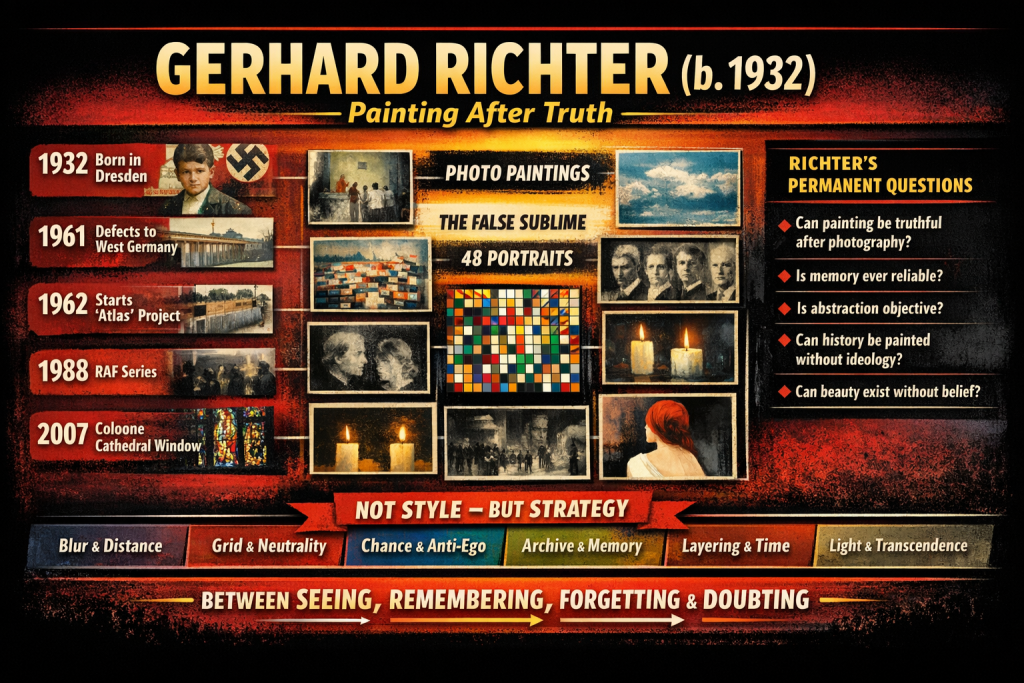
Gerhard Richter (b. 1932) is widely regarded as one of the most important German painters of the post-war era, whose work spans five decades of restless formal experimentation. Fleeing East Germany in 1961, he developed a practice that constantly interrogates the tension between photography and painting, abstraction and figuration. His photo-paintings blur photographic source images to create ghostly, unsettling works that question the nature of memory, perception, and representation. Large-scale abstract canvases produced by dragging a squeegee across layers of paint demonstrate a systematic yet unpredictable approach to abstraction. From memorial paintings of the Baader-Meinhof group to his glass and mirror works, Richter consistently challenges painting’s relationship to truth and historical reality.
YouTube video to be published 3 June 2026
A discussion on Gerhard Richter (created by NotebookLM from my notes):
In our current era of pixel-perfect surveillance and high-definition anxiety, we are pathologically addicted to the sharp edge. We demand that history be archived in 4K clarity and that our identities be rendered with clinical precision. Yet Gerhard Richter—the most influential painter of the last half-century—has spent six decades arguing that such clarity is a dangerous fiction.
In 2013, the art world was jolted when Richter’s 1968 work Domplatz, Mailand (Cathedral Square, Milan) sold for $37.1 million, then a record for a living artist. The painting is a monolithic, ghostly vision of an Italian square, but the solid stone of the cathedral appears to be vibrating, dissolving into a grey haze. It is a masterpiece of the “Richter Blur,” a technique that suggests the more we look at the world, the less we actually see. Richter, who fled East Germany in 1961 just weeks before the Berlin Wall rose, understands better than most that truth isn’t found in the HD glare of propaganda, but in the hazy margins of memory.
Here are six radical lessons from a man who mastered the art of disappearance.
- The Great Erasure: Creative Destruction as a Purgative Act
When Richter arrived in West Germany at the age of 29, he did not simply change his address; he attempted to delete his past. Trained under the rigid constraints of Socialist Realism at the Dresden Academy of Fine Arts, Richter viewed his early murals and state-sanctioned paintings as “ideological baggage.” In a sensational, almost violent act of purgation, he burned nearly every painting he had produced in the East.
Starting his official catalogue from scratch, he designated Tisch (Table, 1962) as “Number 1.” To the casual observer, it is a painting of a designer table from a newspaper clipping. But Richter’s genius lay in the broad, haptic brushstroke he used to “cancel out” the subject. By partially destroying the image, he forced the viewer to confront the paint itself rather than the consumerist furniture. This was the birth of “Capitalist Realism,” a term Richter and his peers used to mock both the Socialist propaganda they fled and the Western consumerism they now inhabited—most famously in a 1963 performance where they sat as “living sculptures” in a furniture store.
“I steer clear of every specific meaning. I don’t want my pictures to have a message.”
The Lesson: Sometimes, the most creative thing you can do is burn your resume and start over with a clean slate. - The Philosophical Blur: Distance as a Lens of Truth
Richter’s signature technique—the “blur”—is often mistaken for a mere stylistic quirk. In reality, it is a sophisticated distancing tool used to handle historical trauma. Richter’s own biography is a map of German scars: an uncle executed by the Nazis for refusing service, and an aunt, Marianne, who was starved to death in a psychiatric institution under the T4 euthanasia program.
In works like Selbstbildnis (Self-Portrait, 1996) and the iconic Ema (Akt auf einer Treppe) (Nude on a Staircase, 1966), Richter uses a dry brush to drag wet paint across the surface, softening the edges of reality until they become ethereal. While Marcel Duchamp broke the body into mechanical, fragmented shapes, Richter’s Ema—depicting his first wife—is a “secular Madonna” caught in a mysterious, glowing transition. The blur provides the distance necessary to view a painful world without being blinded by it. As one critic noted:
“Richter makes the camera seem like an imprecise tool, and the paintbrush like a lens of truth.”
The Lesson: Clarity is often a dangerous lie; distance provides the only sustainable truth. - The Beautiful Lie: Why Nature is a Simulation
Richter’s approach to the natural world is famously, chillingly counter-intuitive. In his Wolken (Cloud, 1970) series, he tackles the ultimate cliché of Romantic art. But unlike Caspar David Friedrich, who saw the divine in the sky, Richter views nature as a “beautiful void.”
These clouds are essentially “portraits of nothingness.” Richter often used his Atlas project—a massive archive of over 4,000 photos and clippings—to combine different skies into a single composition. He was “Photoshopping” with oil paint decades before the digital revolution, creating a simulation of a heaven that never actually existed. By stripping the cloud of its “soul,” he reveals that our sense of the “sublime” is often just a trick of light and technique.
“Richter’s clouds are portraits of nothingness, painted with a devotion that borders on the religious.” — Robert Storr
The Lesson: Authenticity is a construct; beauty does not require a “soul” to be effective. - The Democracy of Color: Stripping the Ego from the Swatch
In 1973, Richter produced 1024 Farben (1024 Colors), a work inspired by the industrial logic of commercial paint charts. By expanding a DIY color swatch to a monumental scale, he stripped color of its traditional emotional weight. In this grid, a red square is no more “aggressive” than a green square is “peaceful”; they are merely mathematical values.
Richter used a random number generator to determine the placement of these colors, purposefully removing his own personal taste and “artist’s soul” from the work. This machine-like precision provided a safe, neutral structure for a society still traumatized by the ideological fervor of the mid-century. It forces us to ask: Is our definition of beauty merely a system we have been trained to accept?
The Lesson: To escape the tyranny of personal taste, occasionally submit to the logic of the machine. - Painting the Unpaintable: Mourning the Dead End of Ideology
Richter has never shied away from national scandals. In his controversial 1988 series 18. Oktober 1977 (October 18, 1977), he depicted members of the Baader-Meinhof group (the Red Army Faction) following their mysterious deaths in prison. Using blurry, low-contrast greys based on gritty police photos, Richter turned these radical terrorists into objects of heavy, silent gravity.
He didn’t paint the politics; he painted the “dead end of ideology.” This heavy mourning stands in stark contrast to the quiet, flickering truth of his Zwei Kerzen (Two Candles, 1982) series. This high-art memento mori gained pop-culture immortality when it was featured on the cover of Sonic Youth’s Daydream Nation, bridging the gap between the hushed museum and the grimy rock world. Whether painting a terrorist or a candle, Richter treats them with the same shroud-like detachment.
The Lesson: The most powerful way to confront a scandal is to strip it of its glamour and paint its silence. - Squeegee Archaeology: Destruction as the Ultimate Creative Act
At the peak of his career, Richter moved toward “Free Abstraction” by abandoning the brush for a massive, rubber-tipped squeegee. He builds up 50 or more layers of paint, only to drag the squeegee across the surface, scraping away the present to reveal the “trauma” of previous layers.
This is “Painting as Archaeology.” The final image is a result of controlled chaos and physical accidents. Richter himself does not know what the work will look like until the last scrape is finished. It is a process that proves even in the act of destruction, there is a glorious, high-speed creative energy.
“Richter’s abstracts are pictures of the act of painting itself, frozen in a state of glorious, high-speed collision.” — Peter Schjeldahl
The Lesson: Growth is a process of accumulation and scraping; the accident is often the only honest architect.
Conclusion: The Fragility of the Real
Gerhard Richter’s enduring provocation lies in his refusal to grant us the comfort of a clear view. He reminds us that the “real” world is fluid, disappearing, and subject to the physics of chance. As we inhabit a world increasingly obsessed with high-definition certainty and permanent digital archives, Richter’s work offers a necessary, if haunting, question: In the end, how much of our identity is shaped by what we purposefully choose to forget?
Created by NotebookLM based on my notes and Wikipedia
61-17 Anish Kapoor
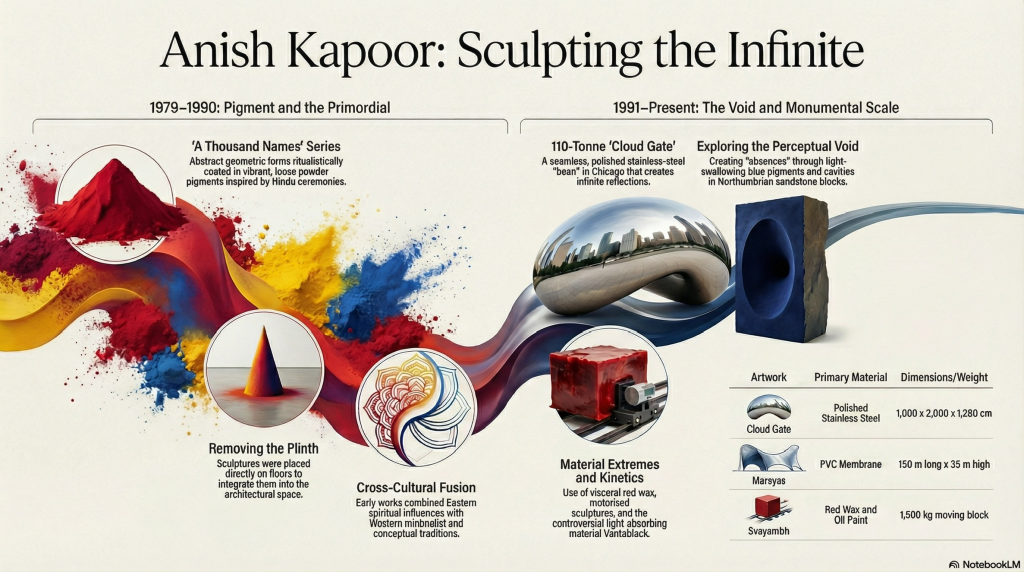
Anish Kapoor is one of the most celebrated sculptors of his generation, renowned for works that dissolve boundaries between object and void, surface and depth. Born in India and based in Britain, his monumental installations have transformed public spaces worldwide, making him a defining figure in contemporary art.
YouTube video to be published 20 June 2026
To stand before a work by Sir Anish Kapoor is to engage in a visceral, high-stakes argument with your own senses. You might find yourself leaning into a cavity that feels infinitely deep, only to realize your eyes are being lied to by a coat of pigment, or watching a twenty-tonne mass of wax inexorably scrape itself through a doorway like a slow-motion geological event. The central “problem” of Kapoor’s career is a delicious paradox: how does a sculptor make the “void”—the absolute absence of matter—feel more solid and present than the walls around it?
While the public identifies him primarily with the shimmering, selfie-ready curves of Chicago’s “Bean,” Kapoor is far more than a purveyor of urban spectacles. He is an architect of the invisible, an artist obsessed with the “self-generated” object that seems to exist independently of human hands
- The “Happy Accident” of the Red Pigment Rats
Kapoor’s flirtation with colour matured into a full-blown obsession with the abyss following a 1979 return to India. Inspired by the mounds of saturated powders used in Hindu puja rituals, he began his 1000 Names series. Working in a financially precarious studio in Camberwell, Kapoor sought to create forms that felt “un-made.”
The breakthrough came via an uninvited studio guest. One morning, Kapoor found that rats had chewed through a massive sack of crimson pigment, leaving a brilliant, “intentional spillage” across the floor. This accident catalyzed a career-long move away from the “hand of the artist” toward art that seemingly “makes itself.” Under the influence of the sculptor Anthony Caro, Kapoor made the radical decision to remove the traditional plinth—the pedestal that separates art from life—allowing his geometric cones and pyramids to emerge directly from the architecture.
The material science here is as secretive as it is sacred; Kapoor still guards the specific recipes for these pigments, which were sourced from the same suppliers used for temple rituals. As art critic William Feaver noted of the 1981 work Part of the Red, these pigment-heavy forms possessed:
“An almost unbearable intensity of presence.” - The Void That Swallows Light (and Faints Viewers)
By the 1990s, Kapoor’s investigation of color shifted toward the “The Void.” In works like Void Field (1989), he utilized deep ultramarine pigments—specifically selected after testing dozens of variants—that swallow light rather than reflect it.
Forward of the Picture Plane This light-absorbent quality creates an optical instability that Kapoor describes as being “forward of the picture plane.” Because the eye cannot detect a surface, the dark cavity doesn’t look like a hole; it looks like a solid, blue-black object protruding toward the viewer. The effect is so disorienting that it has caused vertigo and even triggered a viewer to faint. During the 1990 Venice Biennale, Italian Prime Minister Giulio Andreotti famously stuck his finger into one of these cavities, unable to believe he was touching air rather than a solid mass.
To achieve the structural rigidity required for such perfect, seamless voids, Kapoor abandoned traditional casting in favor of advanced yacht-manufacturing techniques, consulting with boat-builders to create fiberglass shells that could support the weight of the pigment without cracking. - Sculptures That “Breathe” and Bleed: The Power of Wax
Transitioning from static pigment to kinetic matter, Kapoor’s work with industrial wax represents a “performative reckoning” with history. In My Red Homeland (2003), a motorized blade slowly circulates through 20 tonnes of viscous red wax mixed with oil paint, carving a landscape that looks like raw, churned earth. The work is indifferently alive; in one instance, it slowly “consumed” a child’s toy thrown into its path, absorbing the plastic object into its meat-like ridges.
The height of this visceral exploration is Svayambh (2007)—a Sanskrit word meaning “self-generated.” A massive, 1,500-kilogram block of red wax on a motorized flatcar moves at a glacial 0.1 meters per second through museum doorframes. Because the block is larger than the openings, it is physically reshaped by the building itself, leaving “archaeological layers” of red residue on the frames.
The Weight of History This work took on a chilling cultural depth when installed at the Haus der Kunst in Munich. As the wax scraped through the doorframes, it moved through the “Führerbau,” rooms that had once hosted Nazi exhibitions. The “unbearable intensity” of the red wax became a silent, bloody record of the building’s own traumatic past. - The Art of the Visceral Explosion
If the mirrors are Kapoor’s “heaven,” Shooting into the Corner (2008-2009) is his “hell.” This work features a custom-engineered pneumatic cannon that fires 11-kilogram balls of wax at 50 kilometers per hour. The result is pure carnage; over the course of an exhibition, 30 tonnes of wax accumulate into a massive, wet “gunshot wound” against the gallery walls.
The technical sophistication required to achieve 50kph while maintaining the wax’s “splatter” consistency transformed the gallery into a site of high-pressure engineering. Kapoor himself has described the work as “very violent and deeply phallic,” turning the viewer from a passive observer into an anxious participant waiting for the next explosive impact. It is the ultimate evolution of the “self-generated” concept: the artist provides the machine, and the machine creates the carnage. - Distorting the Heavens: The “Death Ray” Mirrors
Kapoor’s transition to high-gloss materials like Sky Mirror and Chicago’s Cloud Gate (the “Bean”) moved his distortions into the public square. Cloud Gate is a staggering feat of material science, comprised of 168 stainless steel plates welded so perfectly that the seams are invisible to the naked eye.
These works “democratize” the experience of the sublime. By using a concave surface, Kapoor inverts the world: clouds appear upside down on the earth, while pedestrians find themselves reflected in the sky. When Sky Mirror was first unveiled, the focus of the sunlight was so precise it led to genuine “death ray” fears that the mirror might incinerate passing birds. While the fears were unfounded, the drama highlights Kapoor’s ability to manipulate the fundamental elements of our environment. The mirror forces us to notice the sky we usually ignore, turning the city into a liquid, shimmering dreamscape. - Conclusion: The Mystery is Essential
Today, Sir Anish Kapoor continues to weaponize material science to challenge our reality. His recent, controversial acquisition of the exclusive artistic rights to Vantablack—the world’s darkest substance, capable of absorbing 99.96% of light—shows an artist still determined to own the abyss. Whether through his permanent foundation at Palazzo Manfrin in Venice or his upcoming Hayward Gallery exhibition, he remains focused on the “essential mystery” of the object.
Ultimately, Kapoor’s career suggests that art’s true value does not lie in the physical matter of the sculpture, but in the psychological void it creates in the viewer’s mind. He has proven that the most solid things in our world are often the very things we cannot see.
A discussion on Anish Kapoor (created by NotebookLM from my notes):
61-18 Jeff Koons
Jeff Koons is one of America’s most celebrated and controversial contemporary artists, known for his large-scale, highly polished sculptures that blur the boundaries between fine art and popular culture. Drawing on advertising, kitsch, and consumer objects, his work — from inflatable balloon animals to gleaming stainless steel — explores themes of taste, desire, and innocence with a deliberately seductive, immaculate finish.
61-18 Jeff Koons lecture notes
This talk is a summary of Jeff Koons’ life, career, artistic themes, and key works, based on excerpts from a lecture series about Western art. Koons is presented as a controversial but highly influential contemporary artist who challenges traditional notions of art by blurring the lines between high art and popular culture, often through the use of consumerism, kitsch, and art historical references.
Key Themes and Ideas:
- Early Life and Education: Jeff Koons was born in 1955 in York, Pennsylvania. His father, an interior designer, encouraged his early artistic talent. He studied at the Maryland Institute College of Art and briefly at the School of the Art Institute of Chicago. He met Salvador Dalí in New York.
- “Jeff Koons, born January 21, 1955, in York, Pennsylvania, is an American artist renowned for his bold, often controversial works that blur the lines between high art and popular culture.”
- Rise to Prominence: Koons gained prominence in the mid-1980s with series like “Pre-New” and “The New,” exploring consumerism and kitsch. He worked as a commodities broker on Wall Street in the early 1980s to fund his art.
- “The mid-1980s marked Koons’ rise to prominence in the art world. He began exploring themes of consumerism, kitsch, and popular culture in his work.”
- Provocative Works and Controversy: The late 1980s and early 1990s saw Koons pushing boundaries with series like “Banality” and “Made in Heaven,” the latter featuring explicit images of Koons with Ilona Staller, sparking considerable controversy. He also created “Michael Jackson and Bubbles” during this time.
- “The late 1980s and early 1990s saw Koons pushing boundaries with provocative series like ‘Banality’ and ‘Made in Heaven’.”
- Large-Scale Production and Commercial Success: Koons employs a factory-like studio with numerous assistants, similar to Andy Warhol’s approach. His “Celebration” series, including the “Balloon Dog” sculptures, became synonymous with his work. In the 2010s, he achieved unprecedented commercial success, with his “Balloon Dog (Orange)” and “Rabbit” breaking auction records.
- “Throughout the 1990s and 2000s, Koons continued to produce large-scale works, often employing a factory-like studio with numerous assistants, reminiscent of Andy Warhol’s approach.”
- “‘Balloon Dog (Orange)’ sold for $58.4 million in 2013, setting a record for a work by a living artist. This record was broken again in 2019 when another version of ‘Rabbit’ sold for $91.1 million.”
- Artistic Themes and Philosophy: Koons’ work often challenges perceptions of art, commerce, and popular culture. He explores consumerism, childhood nostalgia, and the blurring of lines between high and low art. He aims to create art that is accessible and empowering to viewers.
- “His work, which spans painting, sculpture, and installation, continues to challenge perceptions of art, commerce, and popular culture, cementing his place as one of the most influential and controversial artists of our time.”
- “My work is a support system for people to feel good about themselves.”
- “The job of the artist is to make a gesture and really show people what their potential is. It’s not about the object, and it’s not about the image; it’s about the viewer. That’s where the art happens.”
- “I try to create work that doesn’t make viewers feel they’re being spoken down to, so they feel open participation.”
- “Art to me is a humanitarian act and I believe that there is a responsibility that art should somehow be able to effect mankind, to make the word a better place.”
- Koons’ Artistic Processes: Koons utilises techniques to explore and blur the lines between high art and low culture, often recreating existing art from his own childhood but on a mass scale, such as recreating Old Master paintings to sell at his father’s furniture store. He is know to blend minimalist styles with playfulness.
- “When he was young Koons would often recreating Old Master paintings to sell at his father’s furniture store.”
- “The sculpture combines a minimalist style with a sense of play.”
- Major Works and Series: The document references numerous series and specific works, including:
- “Early Works” (1977): Explores many elements present in his later works.
- “Inflatables” (1979): Explores kitsch and consumer culture, questioning the meaning or intention of art.
- “The New” (1980): Vacuum cleaners in plexiglass boxes, elevating everyday objects. “It’s a commercial world, and morality is based generally around economics, and that’s taking place in the art gallery.”
- “Equilibrium” (1985): Basketballs suspended in water, intersecting art and science, representing transience.
- “Luxury and Degradation” (1986): Reproductions of advertisements, critiquing status symbols.
- “Statuary” (1986): “Rabbit,” a stainless steel sculpture, becomes iconic.
- “Banality” (1988): “Michael Jackson and Bubbles,” porcelain sculpture of pop star and chimpanzee.
- “Made in Heaven” (1989-91): Explicit sexual poses with Ilona Staller, challenging boundaries.
- “Puppy” (1992): Topiary sculpture symbolizing confidence and love.
- “Celebration” (1994): “Balloon Dog” and “Hanging Heart,” exploring love, celebration, and luxury. “A very optimistic piece, it’s a balloon that a clown would maybe twist for you at a birthday party.”
- “EasyFun” (1999): Exploring childhood nostalgia and consumer culture.
- “Split-Rocker” (2000): Monumental floral sculpture combining children’s rocking toys.
- “EasyFun-Ethereal” (2000s): Complex collage-like paintings.
- “Popeye” (2002): Blending pop culture, consumerism, and art historical references.
- “Hybrids” (2004-2011): Continued exploration of childhood, luxury, and popular culture.
- “Hulk Elvis” (2007): Combines images of the Hulk with American iconography. “My work is a support system for people to feel good about themselves.”
- “Antiquity” (2008): “Balloon Venus,” combining ancient iconography with balloon-like forms.
- “Gazing Ball” (2013): Recreations of famous artworks with a blue mirrored ball. “This experience is about you, your desires, your interests, your participation, your relationship with this image.”
- “Moon Phases” (2023): Sculptures on the Moon, celebrating human creativity.
- Criticism and Controversy: Despite his success, Koons remains a polarizing figure, with critics divided on the merits of his work. He has faced copyright infringement lawsuits.
- Current Status: Koons continues to create and exhibit globally, maintaining studios in New York City and York, Pennsylvania.
Overall Impression:
The source portrays Jeff Koons as a highly successful and influential, yet controversial, artist. He is presented as a master of self-promotion and a keen observer of contemporary culture, whose work challenges viewers to question traditional notions of art and value. His art can be seen as a reflection of consumerism and celebrity culture, pushing the boundaries of what is considered art.
A discussion on Jeff Koons (created by NotebookLM from my notes):
61-19 Louise Bourgeois (to be published on 5 September 2026)
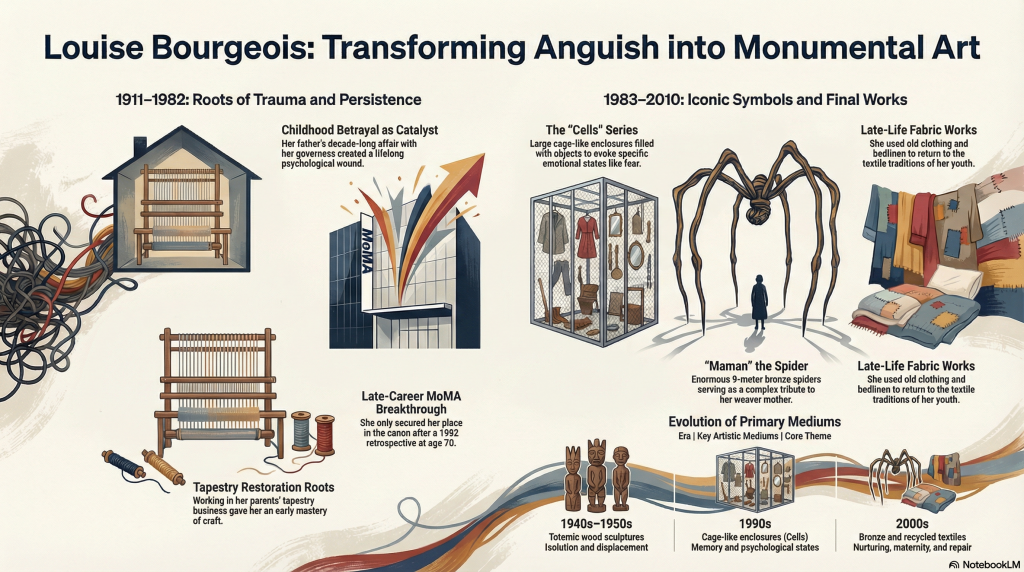
Louise Bourgeois (1911–2010) was a French-American artist whose seven-decade career transformed childhood trauma and personal memory into monumental art. Born in Paris, she moved to New York in 1938, working for decades in relative obscurity before gaining international recognition through the feminist movement in the 1970s and 1980s. Her towering bronze spider sculptures — “Maman” — memorialise her weaver mother while exploring themes of femininity, protection, and entrapment simultaneously. Working across sculpture, installation, drawing, and printmaking, she drew relentlessly on memories of a domineering father and a traumatic family dynamic to create intensely psychological, deeply personal work. Her career stands as one of the most powerful explorations of memory, sexuality, and the unconscious in twentieth-century art.
Louise Bourgeois (1911–2010) a French-American artist celebrated for her powerful sculptures and installations exploring themes of memory, trauma, sexuality, and family. Best known for her monumental spider series Maman, she drew on childhood anxieties and a troubled relationship with her father to create intensely psychological, deeply personal work.
A discussion on Louise Bourgeois (created by NotebookLM from my notes):