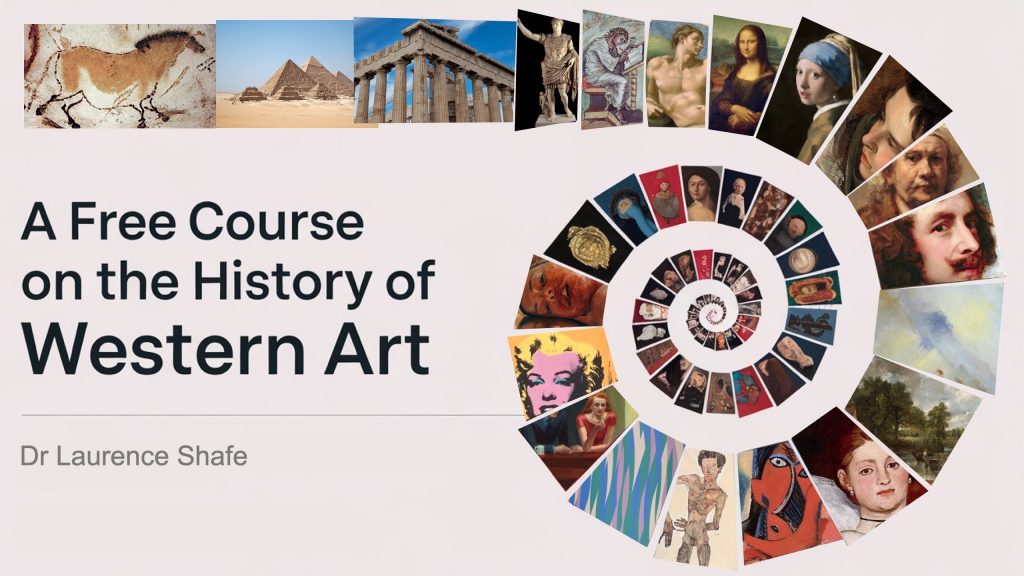
This chapter explores the remarkable diversity of recent art movements from the 1960s to the present day, tracing how artists continued to push the boundaries of form, medium, and meaning in an increasingly globalised world. Beginning with Pop Art’s embrace of commercial imagery and Op Art’s optical experiments, it moves through movements as varied as Land Art’s engagement with the natural environment, the material sensibility of Arte Povera, and the democratic energy of Street Art. Installation Art, Photorealism, Neo-Expressionism, and Kinetic Art each represent distinct responses to the cultural and technological transformations of the late twentieth century. The talks in this chapter introduce the key figures, landmark works, and theoretical contexts of each movement through illustrated discussions designed to be accessible to a general audience. New talks are being added regularly as part of the ongoing series on the history of Western art.
60-01 New Ways of Seeing
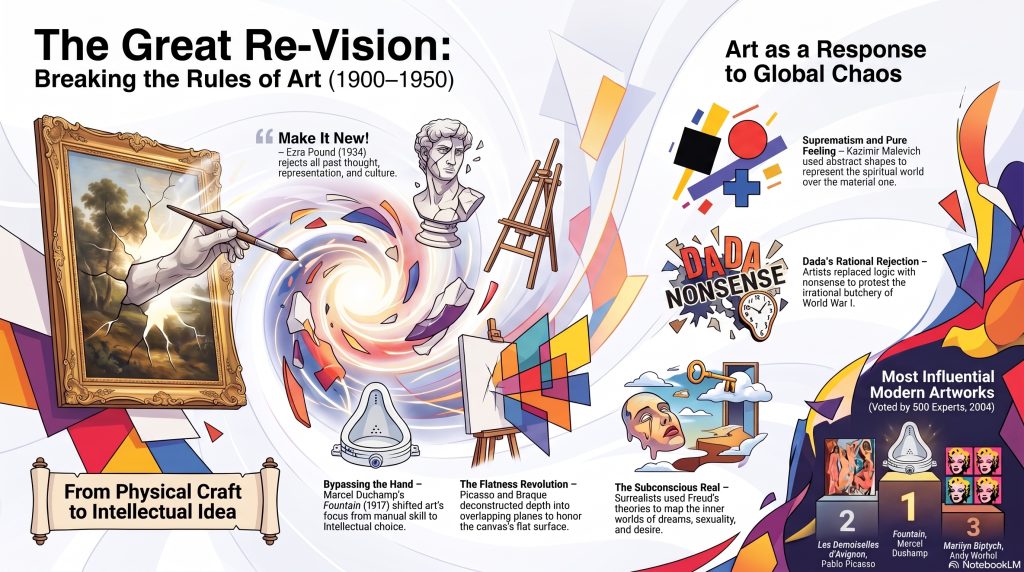
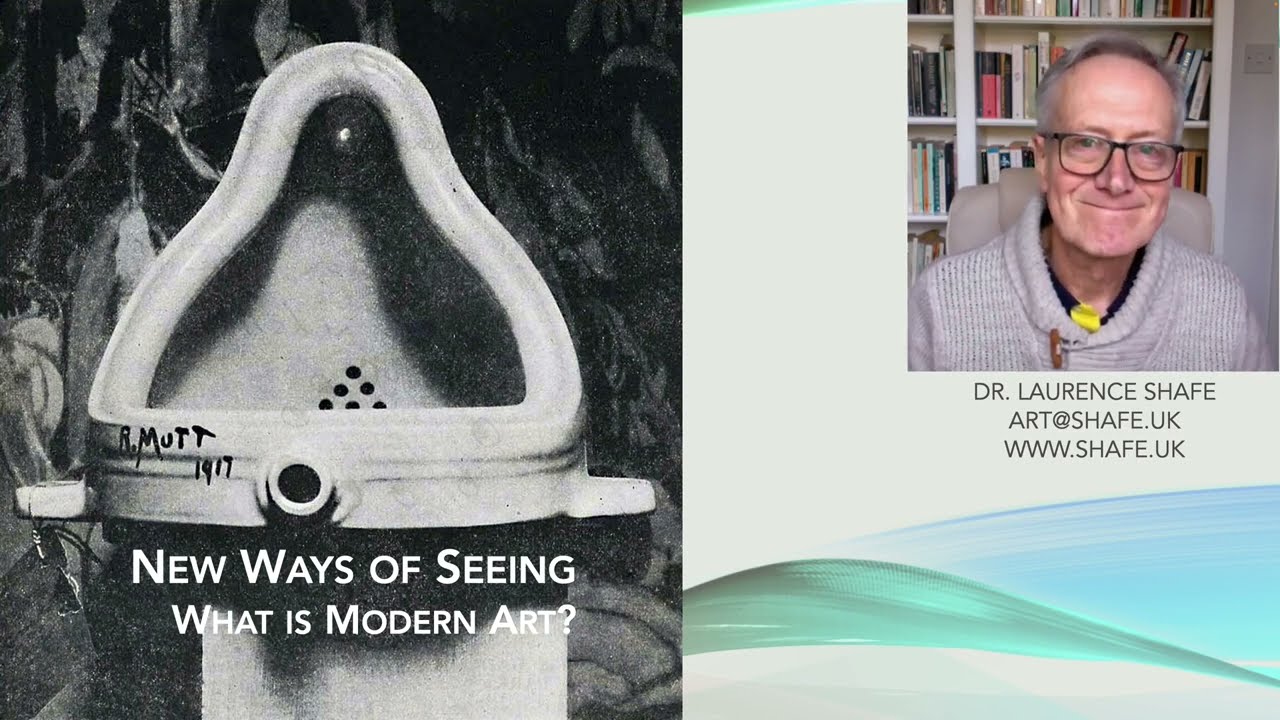
I explore the evolution and fundamental questions of modern art since 1900 by examining how artists transitioned from traditional representation to a radical spirit of innovation, fuelled by scientific progress and global conflict. Central to this discussion is Marcel Duchamp’s “Fountain,” a 1917 urinal submission that challenged the very definition of art by prioritizing intellectual ideas over physical craftsmanship. I highlight key theorists and movements, such as Cubism and Surrealism, while tracing the shift from Modernism to the Postmodern era. I ask you to suspend judgment and consider how modern works reflect the complexities of the human condition.
My notes on 60-01 New Ways of Seeing
A conversation produced by Gemini Notebook based on my notes:
1. The Moment Everything Broke
For many, the first encounter with modern art is defined by a specific kind of cognitive dissonance. We stand before a canvas of splattered paint or a discarded object and the same tired refrain bubbles up: “My child could do that.” It is a relatable frustration, but it misses the tectonic shift that occurred at the dawn of the 20th century.
Between 1900 and 1950, art underwent a radical divorce from “beauty.” Influenced by the success of the scientific enterprise and a new understanding of the human mind—not to mention the trauma of two World Wars—artists stopped trying to provide a mirror of the world. Instead, they began grappling with fundamental atomic and cosmic processes. Art ceased to be a passive object for admiration and became a relentless question about the human condition.
2. The Most Influential Artwork is a Bathroom Fixture
In April 1917, the American Society of Independent Artists in New York faced a public relations nightmare. Seeking to overtake Paris as the global epicenter of modern art, the Society had promised to exhibit any work submitted, provided the $6 entry fee was paid. Then came “Richard Mutt.” Mutt submitted a standard Bedfordshire-model urinal, rotated ninety degrees, and titled it Fountain.
The board was scandalized, rejecting the piece as “unoriginal” and “indecent.” What they didn’t realize was that the submission was a Trojan horse. While long attributed to Marcel Duchamp, historical evidence from the source suggests a more intriguing mystery: Duchamp himself noted in a letter that the work was sent by a “woman friend,” likely the Dadaist Baroness Elsa von Freytag-Loringhoven.
Duchamp resigned from the board in a performative protest, using the incident to introduce the “Readymade”—a mass-produced object that becomes art through the artist’s choice. By selecting objects based on a state of “visual indifference,” he bypassed the traditional requirement of physical craft to prioritize intellectual interpretation. He even baked a pun into the pseudonym: “Richard” is French slang for “moneybags,” making this porcelain receptacle a sort of “scatological golden calf” designed to mock the art market.
“A great deal of modern art is meant to be amusing.” — Marcel Duchamp
This remains the most influential work of the 20th century because it serves as a form of “denying the possibility of defining art.” Once an artist points at a fixture and calls it a masterpiece, the institution loses its power to gatekeep.
3. Picasso and the “Sum of Destructions”
The Rejection of Mimetic Representation Pablo Picasso was a child prodigy who had mastered academic painting before he could shave. His First Communion (1896) is a triumph of narrative depth, yet he eventually found such mastery “dishonest.” Following the suicide of his friend Carlos Casagemas, Picasso’s work spiraled into the haunting Blue Period, eventually culminating in the 1907 explosion of Les Demoiselles d’Avignon.
The reaction was visceral. Henri Matisse accused Picasso of ridiculing modern art, while Georges Braque famously remarked that Picasso must have “drunk petrol to spit fire” onto the canvas. Despite the shock, Picasso and Braque roped themselves together like “mountain climbers” to pioneer Cubism, inventing a new way of seeing.
Picasso famously defined a finished painting as a “sum of destructions.” He didn’t just paint; he edited through annihilation. In his work The Tragedy, he reworked the canvas at least four times, painting over entire figures—at one point transforming a horse’s head into a man’s shoulders.
This process led to the radical “flatness” that critic Clement Greenberg would later identify as the “unique and essential element” of modern painting. By rejecting the “mimetic representation” of three-dimensional space, Picasso stayed honest to the flat surface of the canvas, treating the work not as a window, but as a structure of form itself.
4. The Black Square: A Secular Icon for the Soul
While Picasso was deconstructing the object, Kasimir Malevich was attempting to transcend it entirely. As the leader of the Suprematist movement, Malevich sought to free art from the “dead weight of the material world.”
At the legendary “0.10 Exhibition” in Petrograd in 1915, Malevich debuted his Black Square. In a move of calculated provocation, he hung the painting high in the corner of the room—the “icon corner” where Russian households traditionally placed religious images. Malevich intended for this “zero of form” to be a secular icon, a focal point for the supremacy of pure feeling.
“By Suprematism I mean the supremacy of pure feeling in creative art.” — Kasimir Malevich
To Malevich, painting “bits of nature” or “shameless nudes” was the work of a thief enraptured by his own leg irons. He wanted to represent the spiritual higher realms. There is a tragic irony here: this spiritual revolution was crushed by the mid-1920s when Stalinist control mandated “Socialist Realism,” forcing artists to abandon the soul to serve as cogs in the state’s propaganda machine.
5. The Audience is Now the Artist
The modern revolution eventually birthed the “Death of the Author.” Championed by Roland Barthes, this theory argues that the meaning of a work is determined not by the artist’s intent, but by the viewer’s impression.
We see this play out in the digital age with Amalia Ulman’s 2014 Instagram performance. Ulman spent months documenting a stereotypical, “preening” lifestyle for 89,244 unsuspecting followers. When she revealed the entire narrative was a staged performance, it proved that meaning is fluid; her audience had “created” the work through their own engagement and assumptions.
This shift was predicted by Walter Benjamin, who mourned the loss of the “Aura.” Historically, a masterpiece possessed a “magical or supernatural force” tied to its unique presence in time and space—a “sensory experience of distance.” Mechanical reproduction and social media have killed this distance. We are no longer in a state of contemplation; we are in a state of distraction.
Why the viewer is the new “Author” of the work:
- The Aura is dead: Digital proximity has destroyed the “magical distance” of the masterpiece; you now possess the art on your phone.
- Authenticity is a relic: In an age of 17 authenticated replicas of a lost urinal, the “original” no longer holds absolute authority.
- Consumption is creation: Your subjective impression—whether you’re fooled by a “hoax” or moved by a “masterpiece”—is the only meaning that survives.
6. Conclusion: Climbing Your Own Mountain
Modern art is not a problem to be solved or a puzzle with a hidden “correct” answer. From the “scatological golden calf” of the urinal to the “zero of form” in the Black Square, these artists were providing new ways of responding to a world that had become unrecognizable.
The 20th-century revolution took the power of definition out of the hands of the elite and the Academy and placed it squarely in yours. Like Picasso and Braque, we are all now “mountain climbers” roped together in a search for meaning. If the essential value of the work is determined by your impressions, then you are the one who decides what is worth seeing.
If you are the one who determines if it is art, what will you choose to see next?
60-02 Pop Art and Beyond
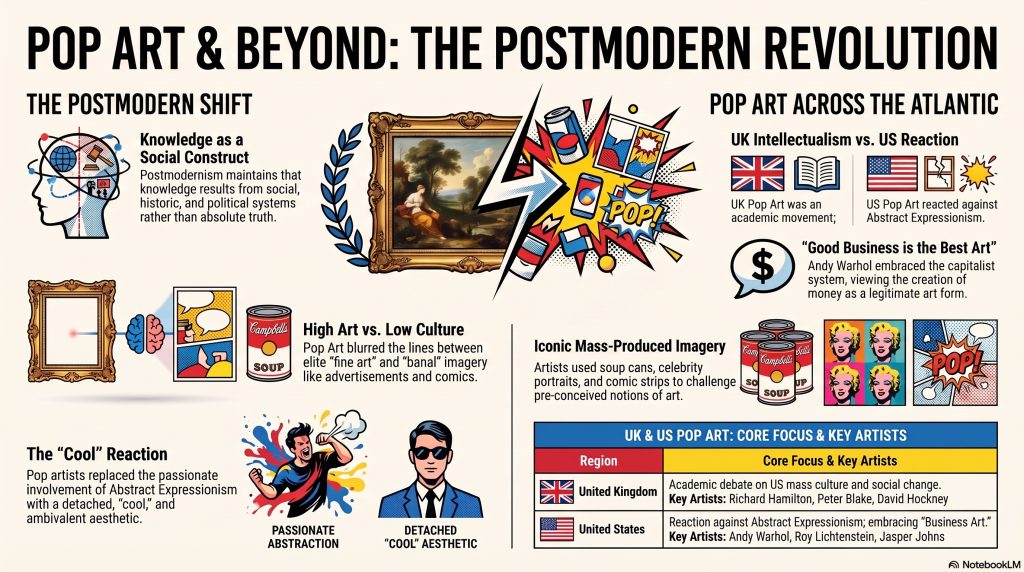
I look at the postmodern art movements that emerged between the 1950s and 1980s, with a primary focus on the evolution of Pop Art in the United Kingdom and the United States. The talk highlights how artists like Andy Warhol, Peter Blake, and David Hockney challenged elitist traditions by incorporating mass media, advertising, and everyday consumer objects into their work. Beyond Pop Art, the sources define various influential styles such as Minimalism, Conceptual Art, and Performance Art, explaining how each was shaped by a shifting philosophical landscape. Detailed biographical sketches of Blake and Hockney illustrate their personal contributions to the era, specifically regarding iconic works like the Sgt. Pepper album cover and the sun-drenched pool scenes of California. I point out that these movements rejected fixed hierarchies of beauty, viewing art instead as a product of social and political constructs.
My notes on 60-02 Pop Art and Beyond
A conversation produced by Gemini Notebook based on my notes:
1. The Hook: A World Without Certainty
For centuries, the human experience was a desperate sprint toward the finish line of Absolute Truth. Whether we looked through the prism of religious dogma or the rigid structures of mythology, our ancestors operated under the comforting delusion that the foundations of reality were fixed. Even the Enlightenment, for all its revolutionary bluster, simply swapped the priest for the scientist, promising that reason would eventually unveil a singular, objective reality.
Then came the 1960s, and the artists of the era smashed the stained glass of the Enlightenment. This wasn’t just a change in aesthetics; it was a total demolition of the “universal.” Postmodernism didn’t just offer new paintings—it offered a world without certainty, replacing the “grand narrative” with a fragmented, subjective reality. By shifting the focus from the search for truth to the validity of individual experience, these artists fundamentally dismantled the ivory tower of high culture and invited the street inside.
2. Takeaway 1: Knowledge is a “Construct”
To understand the radicalism of this era, one must first grasp the philosophy of Postmodernism as something more than a gallery label. As Dr. Laurence Shafe explains, this period marked a realization that our cherished “common sense” is not a natural law, but a social, historical, and political product. While the Romantic age championed intuition and subjective truth as a way to understand the world, Postmodernism went further, suggesting that the very tools we use to understand—our language, our hierarchies, our values—are engineered.
By identifying knowledge as a construct, the movement performed a vital act of cultural democratization. If there is no single, authoritative narrative to define reality, then the perspectives of marginalized groups gain newfound legitimacy. It is a philosophy that celebrates the fragmented and the diverse over the monolithic authority of the past.
“Post-modernism maintains that all knowledge is the result of our social, historic and political systems. Our basic common sense ideas are constructs of our society that are absorbed from birth onwards.”
3. Takeaway 2: The £3,000 Album Cover
In 1967, the hierarchy of value in the art world suffered a fatal blow, delivered not in a museum, but on a record sleeve. The cover for the Beatles’ Sgt. Pepper’s Lonely Hearts Club Band—designed by Peter Blake and Jann Haworth from an ink drawing by Paul McCartney—was a visceral collision of the “elite” and the “banal.” It featured a collage of cardboard cut-outs ranging from Marilyn Monroe and Marlon Brando to Oscar Wilde and Albert Einstein.
The financial disparity was the real punchline: a standard album cover of the time cost roughly £50 to produce, yet this project commanded a staggering £3,000. This wasn’t just a high production budget; it was a moment where “low culture” (rock music) claimed the resources, time, and prestige usually reserved for the Fine Arts. It perfectly illustrated Richard Hamilton’s concept of the “fine/pop art continuum,” a world where the old walls had crumbled.
“All art is equal—there was no hierarchy of value. Elvis was to one side of a long line while Picasso was strung out on the other side… TV is neither less nor more legitimate an influence than, for example, is New York Abstract Expressionism.”
4. Takeaway 3: “Good Business is the Best Art”
While the “hippie era” of the 60s viewed capital and labor with a cocktail of suspicion and disdain, Andy Warhol embraced the machine. Having spent his early years as a commercial magazine illustrator and graphic designer, Warhol didn’t view the capitalist system as an antagonist to art; he viewed it as his medium.
Warhol’s “Business Art” was the ultimate postmodern paradox. By elevating tradeable commodities—soup cans, Brillo boxes, and celebrity headshots—to the status of gallery icons, he suggested that the most fascinating aspect of art wasn’t the creative struggle, but the way the work moved through the market. For Warhol, making money wasn’t a distraction from art; it was the “step that comes after art.”
“Business art is the step that comes after art… Being good in business is the most fascinating kind of art. During the hippie era people put down the idea of business… But making money is art, and working is art – and good business is the best art.”
5. Takeaway 4: The Two-Week Second
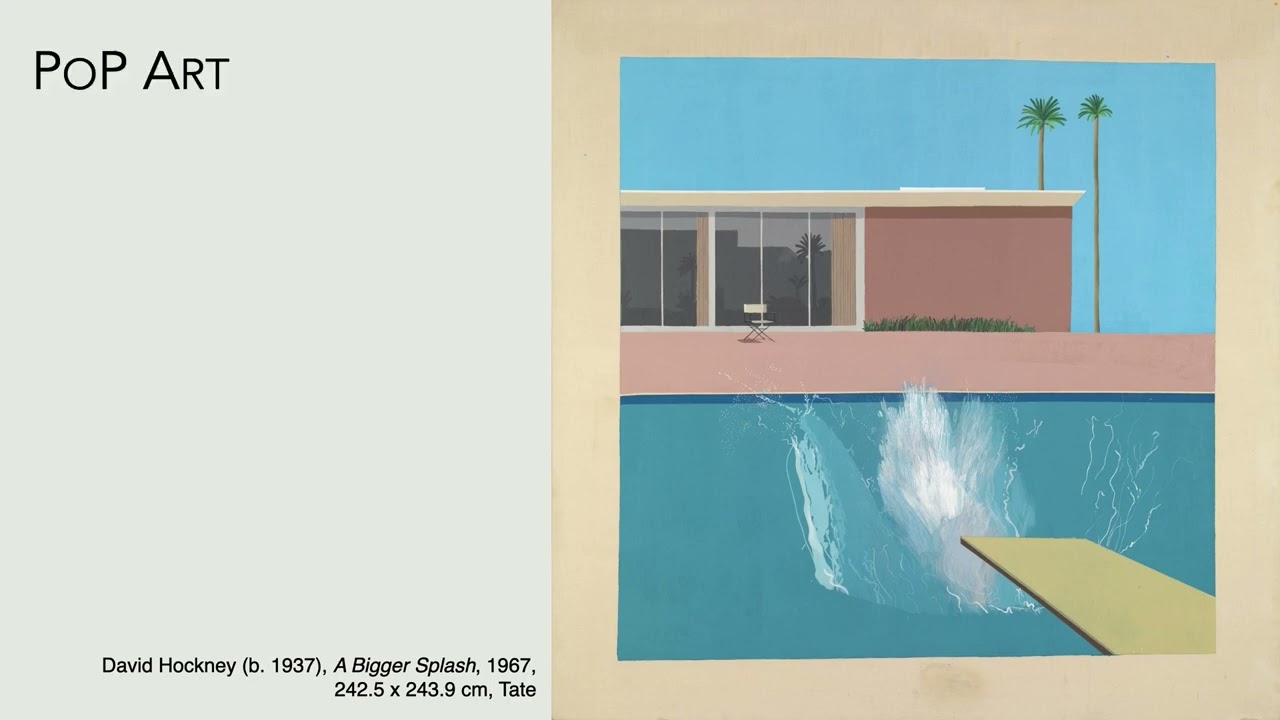
David Hockney’s 1967 masterpiece A Bigger Splash is a masterclass in technical irony. Though Hockney famously rejected the “Pop Art” label to avoid being pigeon-holed, his work thrived on the movement’s visual language—bold, flat colours applied with a utilitarian paint roller and a fascination with consumer imagery.
There is a profound irony in the painting’s creation: Hockney, a synaesthetic artist who sees colours in response to music, spent two weeks using small brushes to meticulously render a splash that, in reality, lasts only two seconds. The unpainted border of the canvas creates an effect like a Polaroid photograph, a nod to the very medium that captured the “transient” moment Hockney spent weeks making permanent. It forces a slow, meditative gaze upon a fast-moving world, contrasting the “permanent” architecture of the California home with the fleeting disappearance of the diver.
6. Takeaway 5: Eroticism as a “Democratic” Tool
Perhaps no work from this period remains as inflammatory as Allen Jones’s 1969 “furniture” sculptures (Hatstand, Table and Chair). These works, featuring female figures as functional furniture supports, were met with a visceral reaction that moved beyond critique into physical violence; they were targets of stink bombs, smoke bombs, and even acid attacks. While second-wave feminists saw a mangled message of objectification, Jones defended himself as a “feminist” using irony to critique the very society that treats women as subjects.
Beyond the polemics, Jones proposed a radical “democratic” philosophy: accessibility. He observed that while the general public often defers to “experts” when confronted with cerebral abstract art, “everyone is an expert” when it comes to eroticism. It provided an entry point that bypassed the gatekeepers of the elite.
“The erotic impulse transcends cerebral barriers and demands a direct emotional response. Confronted with an abstract statement people readily defer to an expert; but confronted with an erotic statement everyone is an expert. It seems to me a democratic idea that art should be accessible to everyone on some level.”
7. Conclusion: The Living Legacy of the 60s
The Postmodern revolution was, at its core, an attempt to bridge what Robert Rauschenberg called “the gap” between art and life. By the 1980s, the boundaries between the gallery, the commercial world, and our daily routines had been permanently blurred. Warhol’s Marilyn Diptych didn’t just depict a movie star; it functioned as a “secular altar,” transforming a mass-produced celebrity still into a religious icon of the consumer age.
Today, we navigate a digital landscape defined by “personal branding” and infinite, tradable images. We find ourselves in the very world Warhol and his contemporaries predicted—a world where every snapshot is a commodity. In this age of the infinite scroll, we must ask ourselves: have we finally closed Rauschenberg’s gap, or are we simply the newest artifacts in the “Business Art” world of the future?
“Painting relates to both art and life. I try to act in that gap between the two.”
60-03 Postmodern Art, 1980-2000
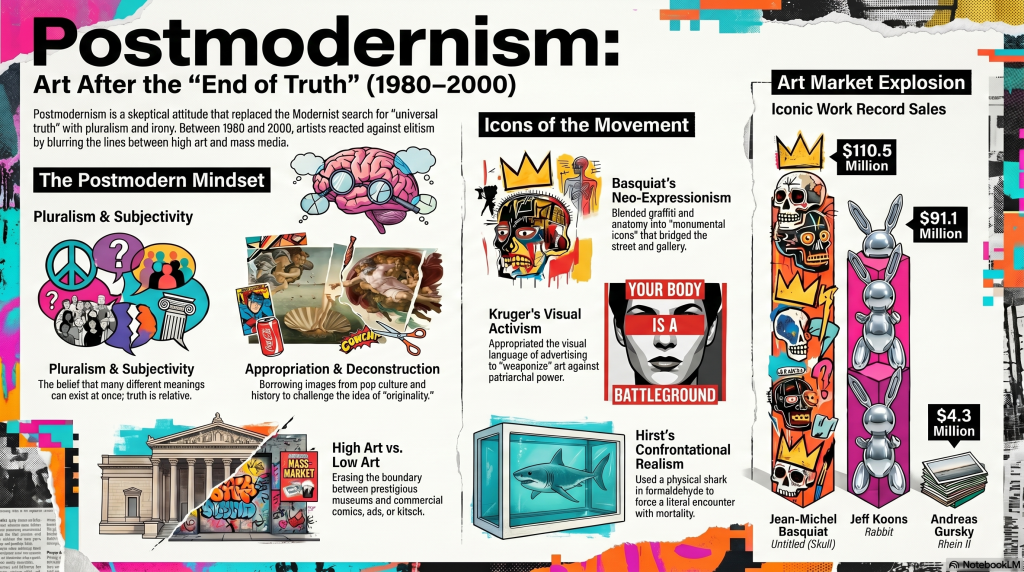
Postmodernism emerged in the 1970s as a broad cultural reaction against the certainties of modernism. Where modernism sought universal truths and formal purity, postmodernism embraced fragmentation, irony, and the blurring of high and low culture. It questioned whether any single narrative could claim authority, drawing on Derrida’s deconstruction and Lyotard’s scepticism toward “grand narratives.” In art, this translated into appropriation, pastiche, and self-referentiality — artists like Cindy Sherman and Jeff Koons treating imagery itself as the subject.
(My YouTube video will be published on 29 August 2026)
A conversation produced by Gemini Notebook based on my notes:
The Hook: A World of Fragments
For the better part of the twentieth century, the “Modernist” project was defined by a heroic, almost spiritual quest for universal truth and the “new.” By the 1980s, however, the cultural gears ground to a halt. As mass media saturated every corner of the domestic sphere and the geopolitical borders of the Cold War began to crumble, a skeptical new attitude emerged. Artists stopped looking for the “original” and began playing with the “wreckage.” This was the dawn of Postmodernism—a period from the 1980s to the early 2000s defined by a distrust of “grand narratives” like progress or religion. In this era of fragments, the search for a singular meaning was replaced by pluralism, a realization that in a world of remixes, many truths can exist at once.
Takeaway 1: High Art and Low Culture are Officially Dead
One of the most radical ruptures of the Postmodern era was the systematic demolition of the wall between “High Art”—the sacred objects of the museum—and “Low Culture”—the disposable world of kitsch and consumerism.
Takashi Murakami’s 1996 masterpiece 727 serves as a manifesto for this boundary-blurring. At the center of the three-panel work, a grinning and menacing character named Mr. DOB—a sharp-toothed, cartoonish avatar—rides a cresting wave. While the swirling blue and white water directly recalls Hokusai’s Great Wave, the style is a high-octane fusion of traditional ukiyo-e woodcuts and modern anime. Murakami coined the term “Superflat” to describe this deliberate flattening of hierarchy. By merging the PhD-level techniques of Nihonga painting with the aesthetics of a consumer brand, Murakami argued that in our media-saturated reality, there is no difference between a museum-grade painting and a billboard. This was a playful, albeit cynical, departure from the academic seriousness of Abstract Expressionism.
Takeaway 2: Appropriation is the New Originality
If everything has already been done, the artist’s new role is not to invent, but to recontextualize. In Postmodernism, “stealing” became a sophisticated creative act underpinned by the philosophy of Jean Baudrillard.
Sherrie Levine took this to its logical extreme with Fountain (After Marcel Duchamp: A.P.) (1991). By casting Duchamp’s infamous 1917 urinal in gleaming, polished bronze, Levine created a simulacrum—a copy of a copy. While Duchamp’s original was a mass-produced “readymade” intended to mock art, Levine’s version is a precious, heroic sculpture that elevates a prank into a classical monument. Critic Douglas Crimp championed her practice as “the most radical critique of representation” because it challenged the myth of the “original genius.” If the “original” Duchamp was just a authorized replica from the 1960s, Levine suggests that authorship is merely a performance of selection.
Takeaway 3: Your Body is a Political Battleground
As the distrust of institutions grew, artists began to view the human body as a site of state and media control. Barbara Kruger weaponized the visual language of the very industry she once served to fight back.
Using the skills she honed as a graphic designer at Condé Nast magazines, Kruger created Untitled (Your Body Is a Battleground) for the 1989 March for Women’s Lives. The work features a woman’s face split into photographic positive and negative, overlaid with her signature Futura Bold Oblique text on red bars. It functioned simultaneously as a political placard for 300,000 protestors in Washington, D.C., and a high-concept gallery piece. The ultimate Postmodern irony? Her “activist” aesthetic has come full circle: the streetwear giant Supreme simply lifted her visual format for their multi-billion-dollar brand, proving that in a remix culture, even dissent can be appropriated.
Takeaway 4: The Artist’s Hand is Optional
Postmodernism deconstructed the idea of the artist as a lone, suffering creator. In this new landscape, the artist became a director, a brand manager, or—in the case of Jeff Koons—a former Wall Street commodities broker.
Koons’s Rabbit (1986) is a stainless-steel cast of an inflatable toy that sold for a staggering $91.1 million. The sculpture’s mirror-like finish is no accident; it was cast at a foundry that usually produced surgical instruments, ensuring a flawless, sterile surface that reflects the viewer back at themselves. Koons employs over a hundred studio assistants and rarely touches his own work, embracing the “deliberate vacancy” of the piece. It is a symbol of optimism that is simultaneously “everything and nothing,” suggesting that in a Postmodern market, the “idea” and the price tag are far more significant than the physical labor of the artist’s hand.
Takeaway 5: Facing the Wound Through Relics
While Postmodernism is often associated with irony, it also provided the tools to confront deep historical trauma. In postwar Germany, Anselm Kiefer used art to shatter the “collective amnesia” regarding the Holocaust.
In his 1981 work Margarethe, Kiefer glued physical sheaves of straw to the canvas, creating a relic that physically decays over time. The work is a direct response to Paul Celan’s poem Todesfuge, which contrasts the golden hair of Margarethe (the Aryan ideal) with the ashen hair of Shulamith (the Jewish woman destroyed). By using raw, earth-bound materials rather than mere paint, Kiefer insisted that art must “touch the wound” of history. Critic Robert Hughes called him “the best painter of his generation” because he refused to let the beauty of art mask the “monumental nightmare” of the past.
Takeaway 6: Silence is Death (The Rise of Activist Art)
During the 1980s AIDS crisis, art moved “to the street where it belonged.” For artists like Keith Haring and David Wojnarowicz, the “remixing” of pop culture imagery became a literal tool for survival.
Haring’s Ignorance = Fear (1989) utilized the graphic simplicity he developed during his years making chalk drawings on blank subway panels to create an urgent political placard. He produced these works while knowing he was dying of the virus. Simultaneously, David Wojnarowicz’s Untitled (One Day This Kid…) used a school photograph of a smiling boy (the artist himself) surrounded by a prophecy of the institutional cruelty he would face as a gay man. This was art as a weapon, proving that Postmodernism could be devastatingly autobiographical and life-savingly urgent.
Takeaway 7: The Beauty of the Vanishing Point
Postmodernism also found a way to make Minimalism—once considered cold and distant—deeply personal and interactive.
In Felix Gonzalez-Torres’ “Untitled” (Portrait of Ross in L.A.) (1991), the artwork consists of a 79.4kg pile of candy—the ideal healthy weight of the artist’s partner, Ross, who was wasting away from AIDS. Visitors are invited to take a piece and eat it, participating in the “consumption” of the beloved’s body. Crucially, the gallery periodically replenishes the stock. This cycle creates a powerful Postmodern metaphor: an endless loop of loss and renewal. It is one of the most moving works of the century because it forces the audience to physically internalize the artist’s private grief.
The Forward-Looking Summary: Is Everything Still a Copy?
The shift from the search for “Universal Truth” to the “Pluralism” of the late 20th century defines our current digital existence. We see the legacy of the Postmodern remix in Andreas Gursky’s Rhein II, where he used digital manipulation to strip the German landscape of “distractions”—removing dog walkers, a factory, and power stations—to create an austere abstraction. We see it in the “confessional transparency” of Tracey Emin’s My Bed, which presents the detritus of a depressive episode as a self-portrait.
In our world of “Superflat” culture and infinite digital copies, we are left with a final, haunting question: In a world where every image is a remix, does the idea of an “original” even matter anymore?NotebookLM can be inaccurate; please double-check its responses.
60-04 Installation Art
This talk provides a comprehensive introduction to the history and evolution of Installation Art, beginning with its foundational origins in Western art history. The text highlights how artists like Kurt Schwitters revolutionized the medium by transforming entire rooms into immersive environments, such as his famous Merzbau. Further explorations include Marcel Duchamp’s use of physical obstacles to challenge traditional viewing and Yves Klein’s conceptual focus on empty space. By examining these key figures, the materials demonstrate how art shifted from isolated objects to spatial experiences that require active participation. Ultimately, the overview serves as an educational guide to how installation art dissolves the boundaries between the creative work and the viewer.
(My YouTube video will be published on 31 October 2026)
A conversation about Installation Art crerated by Google NotebookLM:
1. When Art Stopped Being Something You Look At
The traditional museum experience is restraint: stay quiet, keep your distance, stare at a rectangle on a wall. Installation art found that frame too restrictive. It rejects the “art object” for the “art environment,” dissolving the boundary between viewer and viewed—you enter it, move through it, and complete it by your presence. From cluttered houses to empty voids, these eight moments turned existence itself into a medium.
2. The “Cathedral of Erotic Misery” in a Hanover Home
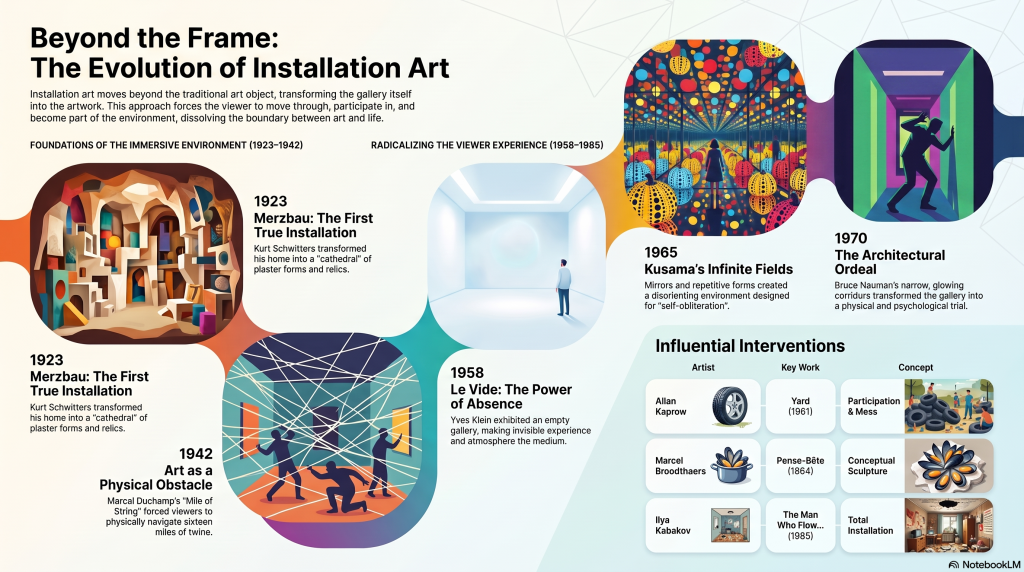
In 1923, Kurt Schwitters began his Merzbau in a private Hanover residence—arguably the first true installation in Western art. Over fourteen years it consumed eight rooms, breaking through floors and ceilings as it grew: a chaotic accumulation of plaster forms and hidden grottoes holding relics, including a lock of Hans Richter’s hair, a discarded bra, and a vial of the artist’s own urine, lit to resemble liquid gold.
“He called it his ‘cathedral of erotic misery.’”
Destroyed by Allied bombing in 1943, the Merzbau proved art could be a place you inhabit rather than a thing you own.
3. The Sixteen-Mile Obstacle Course
For the 1942 First Papers of Surrealism exhibition in New York, Marcel Duchamp was asked to design the gallery layout—and made the other artists’ work almost impossible to see. He wove sixteen miles of twine into a web over paintings by Miró and Ernst, forcing visitors to struggle through, and hired children to play ball in the room on opening night. Mile of String shifted focus from what the art was to where the body was forced to navigate.
4. The Spectacle of Nothing (and the Blue Cocktails)
In 1958, on his thirtieth birthday, Yves Klein opened Le Vide (The Void) in Paris: an emptied gallery painted white, declared the artwork itself. Guests drank potent blue cocktails and famously urinated Klein’s signature blue the next morning; despite nothing to see, 3,000 queued. Camus wrote afterward: “With the void, full powers.” Two years later, Arman answered with Le Plein (The Full-Up), filling the same gallery floor-to-ceiling with rubbish—proving installation art could thrive on absence or excess alike.
5. Art as a Living “Mess” of Used Tires
In 1961, while the art world chased Minimalism, Allan Kaprow filled a Rutgers gallery courtyard with used car tires and tar paper, calling it Yard. Kaprow, who coined “Happening,” rejected the “fixed” masterpiece for “reinvention, not recreation,” and let visitors climb and throw the tires: “The conventional spectators became the participants who executed the changes. Art was like the weather.”
6. The Poet Who Buried His Words to Survive
In 1964, struggling Brussels poet Marcel Broodthaers, forty and impoverished for two decades, half-embedded fifty unsold copies of his poetry collection in plaster, creating Pense-Bête. By making his poems unreadable, he turned “death” as a writer into birth as a visual artist. His gallery announcement was blunt: “I, too, wondered if I could not sell something and succeed in life… I am forty years old.” The paradox: useless as literature, the work became valuable as a commodity.
7. Self-Obliteration in the Infinite Garden
Yayoi Kusama’s Infinity Mirror Room – Phalli’s Field (1965) multiplied her hand-sewn, spotted phallic sculptures infinitely via mirrored walls—”self-obliteration,” losing the self within a repeating pattern tied to her mental health. Her breakthrough was shadowed by the era’s gendered politics: Lucas Samaras’s similar mirrored room a year later won far greater acclaim, a slight Kusama vocally protested. She now lives voluntarily in a Tokyo psychiatric hospital, yet remains one of the world’s most popular living artists.
8. The Physical Ordeal of the Sickly Green Glow
Bruce Nauman’s Green Light Corridor (1970) was built to be endured: two parallel walls narrowing to a 30-centimetre gap, bathed in sickly green light, forcing visitors to shuffle sideways through twelve nauseating metres. The idea came from his studio, where a tripod-mounted camera created a feedback loop—walking toward it meant walking away from himself on the monitor. That paradox became the work’s heart: surveillance where the viewer can never truly see themselves in real time.
Conclusion: The Echoes of a Cluttered House
From Nauman’s narrowing walls to Klein’s blue-tinted void, every experiment here owes a debt to Schwitters’ cluttered house in Hanover—proof that art needn’t be static but can be inhabited.
Today, amid digital clones and AI-generated avatars, does the visceral experience of a “room as art” become more valuable? Can a digital clone ever “experience” the hostility of a Nauman corridor or the smell of Kaprow’s tar paper? In an age of infinite digital copies, the room as art remains the last uncopyable experience.
60-05 Young British Artists
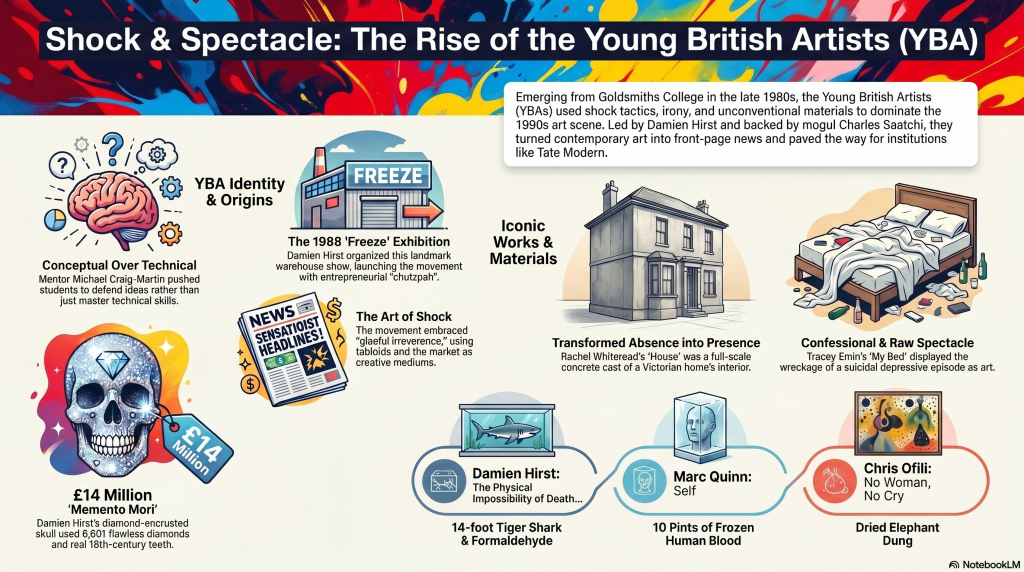
This talk examines the rise of the Young British Artists (YBA), a provocative group that redefined contemporary art during the late 1980s and 1990s. Led by figures like Damien Hirst, the movement gained momentum through the landmark Freeze exhibition and focused on themes of mortality, irony, and shock. Academic influence is traced back to Michael Craig-Martin, a teacher at Goldsmiths who encouraged students to prioritize conceptual thinking over traditional technical skills. Major works highlighted include Hirst’s preserved shark, Rachel Whiteread’s concrete house cast, and Sarah Lucas’s crude feminist sculptures. Supported by collector Charles Saatchi, these artists utilized unconventional materials to bridge the gap between high art and tabloid notoriety. The talk shows how this generation transformed the global art market through entrepreneurial spirit and radical creative expression.
My notes on the Young British Artists
An entertaining discussion on the Young British Artists created by Google’s NotebookLM based on my notes:
In the late 1980s, the London art scene was a polite, somewhat ossified establishment of bronze, canvas, and hushed galleries. That decorum was shattered almost overnight by a cohort of Goldsmiths College students who traded traditional craftsmanship for entrepreneurial chutzpah and a brand of gleeful irreverence that bordered on the sociopathic. They didn’t wait for the galleries to call; they occupied the decaying warehouses of Thatcher’s London and made the headlines their primary medium.
The “Young British Artists” (YBAs) were born out of a specific British moment: a collision of the “no such thing as society” free-enterprise era and a deep-seated desire to drag contemporary art into the glare of primetime television. From the derelict Docklands—ground zero for free enterprise—they staged a cultural coup that transformed London into a global art capital. But this wasn’t just a group of students playing at rebellion; it was a fundamental rewiring of how art is produced, marketed, and defended.
1. Belief is the Ultimate Medium (The ‘Oak Tree’ Philosophy)
The spiritual foundation of the YBA movement was not a technique, but a rigorous philosophy of conceptual defense. This was the gift of Michael Craig-Martin, a tutor at Goldsmiths who dismantled the boundaries between making and thinking. His 1973 work, An Oak Tree, is the movement’s Rosetta Stone: a glass of water on a shelf accompanied by a text that uses deadpan logic to argue the water has been transformed into a full-grown oak tree.
Drawing on Marcel Duchamp’s readymades and the religious mystery of Catholic transubstantiation, Craig-Martin taught his students that an artist’s primary tool was their ability to articulate a conceptual position. This “maddening exercise in semantic gamesmanship” shifted the focus from “how it’s made” to “why it’s defended.” It produced a generation of artists who were as comfortable with a press release as they were with a paintbrush.
“The Tate critic Andrew Wilson later described Craig-Martin as ‘the godfather of the YBAs.’”
2. Disruption is a Business Model (The Legacy of ‘Freeze’)
In the summer of 1988, Damien Hirst organized Freeze in a disused London Port Authority building. It remains the most famous student show in history, but its brilliance lay in its “professional sheen” and marketing savvy. Hirst didn’t just hang art; he secured corporate sponsorship and exerted a level of control that would make a CEO blush. To ensure the gatekeepers saw his vision, he personally drove the Royal Academy’s Norman Rosenthal to the warehouse in a taxi and made sure Tate director Nicholas Serota was in attendance.
The show’s aesthetic was defined by Mat Collishaw’s Bullet Hole, a massive grid of fifteen backlit light boxes. It showed a forensic photograph of a gunshot wound to the head, appropriated from a pathology textbook. Seductive yet repulsive, the wound’s pink folds resembled a flower—a “frozen moment” of impact that gave the show its name. Crucially, the advertising mogul Charles Saatchi attended and bought a Collishaw piece, marking the first YBA entry into a collection that would eventually dominate the decade.
3. The Fragile Architecture of Mortality (From Blood to Sharks)
The YBAs were obsessed with the “fragile architecture” of the human condition, often humanizing their work through the lens of their own vulnerabilities. Marc Quinn’s Self (1991) is a cast of his own head filled with ten pints of his frozen blood—the exact volume in a human body. Created during a period of Quinn’s severe alcoholism, the work is an essay on dependency; it requires constant electricity to stay frozen. This precariousness birthed an urban myth that the original version once melted away in Charles Saatchi’s kitchen during a power cut—a story Quinn is said to enjoy immensely.
This obsession with mortality was shared by Damien Hirst, who spent his teenage years sketching beside cadavers at Leeds Medical School. His most famous work, The Physical Impossibility of Death in the Mind of Someone Living (1991), featured a fourteen-foot tiger shark in a tank of formaldehyde. The original shark actually decomposed because Saatchi’s team added bleach to the fluid; it had to be replaced in 2006. That same year, the “commodity” shark was sold to a collector for a staggering $8–12 million. It was more than shock; it was the demonic urge to live captured in a deathlike form.
“Hirst once wryly stated: ‘I just fucking hate death.’”
4. Presence in Absence (Casting the Void)
Rachel Whiteread: The Brutalist Monument
In 1993, Rachel Whiteread took a condemned Victorian terraced house at 193 Grove Road and transformed absence into presence. By filling the interior with concrete and then stripping away the brickwork, she created House, a “Brutalist monument to lost domesticity.” It was a ghostly, three-storey protrusion of fireplaces and stairs that stood alone in a demolished landscape.
The Irony of the “Worst Artist”
The work was a lightning rod for the era’s cultural tensions. On a single day in November 1993, Whiteread became the first woman to win the Turner Prize (£20,000) and was simultaneously awarded a “worst artist” prize by the K Foundation. In a move that highlighted the “human story” behind the art, she accepted the K Foundation’s £40,000—double the Turner money—and donated half of it to the charity Shelter. Despite the thousands of visitors who flocked to see it, the local council demolished it in 1994, with the operator dismissing it as a “lump of concrete.”
5. Turning the Male Gaze into a Greasy Spoon (Sarah Lucas)
Sarah Lucas was the “tough one” of the group, known for her Doc Martens and “working-class two fingers to the art establishment.” Her 1992 masterpiece, Two Fried Eggs and a Kebab, remains the ultimate critique of “lad culture.” By placing two fresh eggs and a pitta bread on a worn table, she reduced the reclining female nude to breasts and genitalia using the crudest slang of the British greasy spoon.
Lucas used “everyday things” to mine the semantic possibilities of misogyny. The work was purposefully perishable; the eggs had to be re-fried daily, serving as a metaphor for the disposable and objectified body. While her work seemed fueled by what she called being “annoyed” with pornography and casual denigration, it was delivered with a raw, direct humor that turned the male gaze into a plate of fast food.
6. The Ultimate Act of De-Commodification (Michael Landy’s ‘Break Down’)
As his peers were becoming multi-millionaires, Michael Landy staged the movement’s most devastating act of self-annihilation. In 2001, for his performance Break Down, Landy and a team of operatives shredded every single one of his 7,227 possessions in a former department store on Oxford Street. Nothing was spared: his car, his clothes, his passport, and even artworks given to him by Damien Hirst and Tracey Emin.
The resulting 5.75 tonnes of waste was a total rebuke to the art market. By destroying the valuable gifts from his successful friends, Landy was effectively biting the hand that fed the movement. It left him with no bureaucratic identity and literally nothing to his name. In a delicious irony, the man who once shredded his entire life was later elected to the Royal Academy to oversee its permanent collection.
Conclusion: From ‘Enfants Terribles’ to the Establishment
The YBAs didn’t just change art; they changed the ecosystem of London. They paved the way for Tate Modern, birthed the White Cube gallery, and put the Turner Prize on primetime television. We still feel the “scent of the 90s” in Tracey Emin’s My Bed (1998), with its stained sheets, soiled underwear, and used condoms—a work that later sold for £2.5 million.
However, the movement’s era of postmodern irony has largely been superseded by Metamodernism—a state of “new sincerity” that oscillates between modernist earnestness and postmodern skepticism. We are moving toward global voices and digital practices that make 20th-century shock feel parochial.
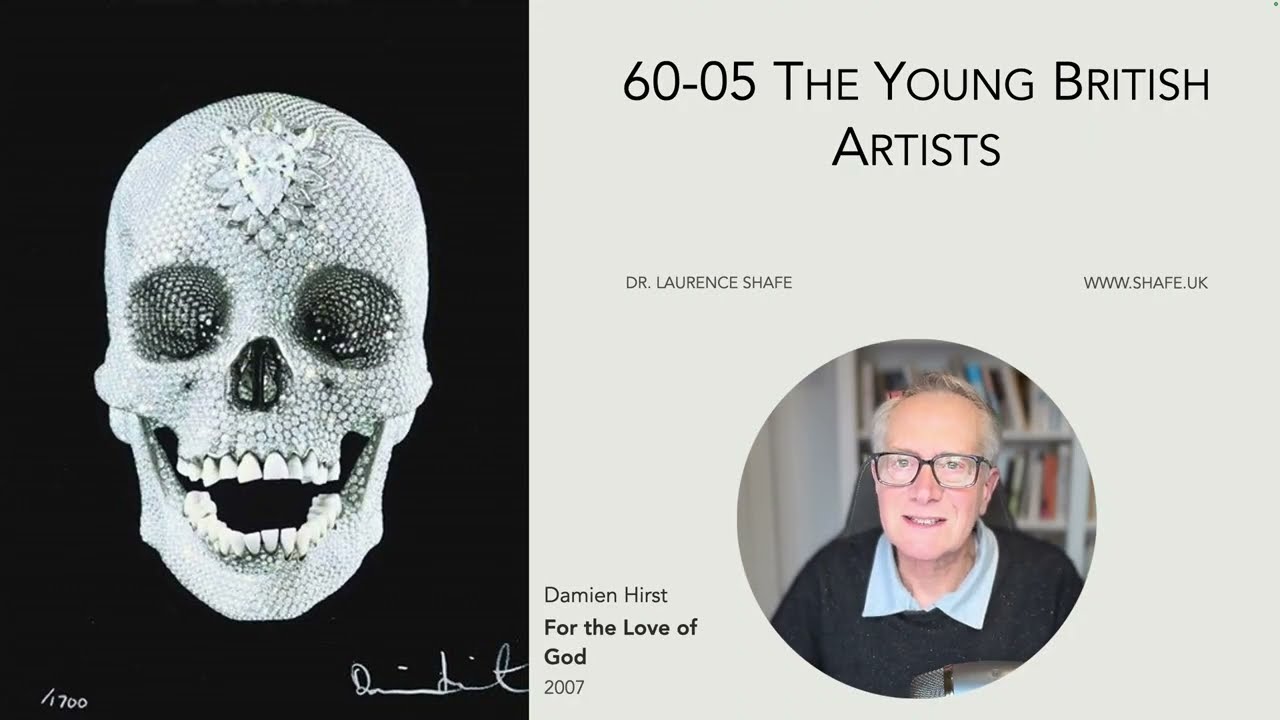
Yet, the YBA shadow remains long. The ultimate memento mori for our luxury-branded age is Hirst’s 2007 For the Love of God: a platinum skull encrusted with 8,601 diamonds. With a production cost of £14 million and an asking price of £50 million, it asks the final, provocative question of the YBA era: Has art finally become the ultimate commodity, or is there still room for a soul beneath the bling?
60-06 Op Art and Bridget Riley
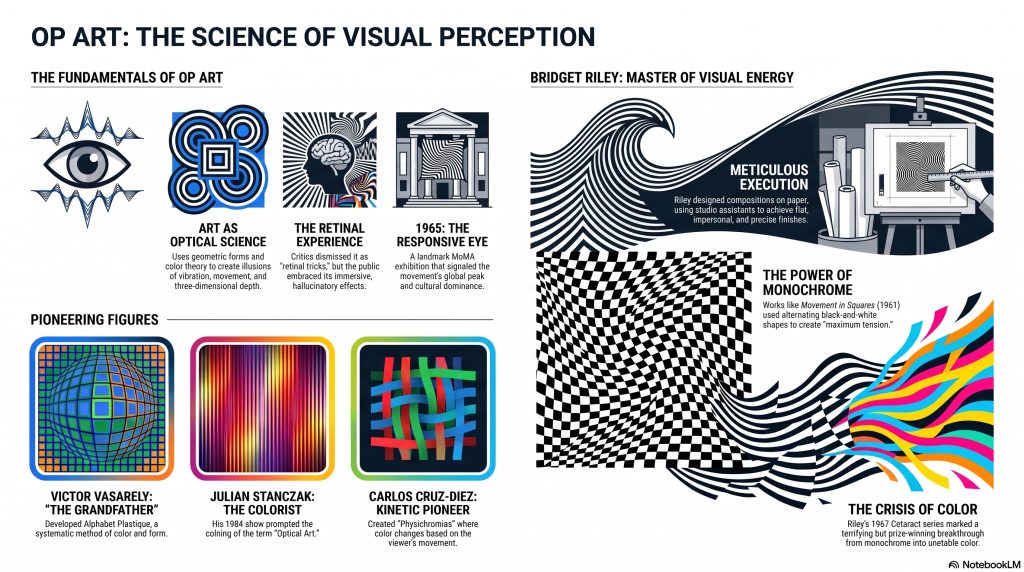
The talk details the history and impact of Op Art, a movement defined by the use of geometric shapes to create powerful illusions of depth and motion. The text highlights Victor Vasarely as the “grandfather” of the style, noting how his early experiments with stark contrasts and mathematical systems laid the groundwork for optical science in art. A significant portion of the material focuses on Bridget Riley, the leading British pioneer whose meticulous black-and-white patterns physically engage the viewer’s perception. The narrative traces the movement’s peak during the mid-1960s, including its controversial adoption by the fashion industry and its dismissive reception by some critics. Despite a brief commercial height, I show how these retinal techniques continue to influence modern graphic design and digital media.
(The YouTube video will be published on 26 September 2026)
My notes on Op Art and Bridget Riley
An entertaining discussion on Op Art and Bridget Riley created by Google’s Notebook based on my notes:
Viewing a classic Op Art canvas is not a passive act of observation; it is a physical confrontation. Patterns shimmer, lines vibrate with an aggressive frequency, and flat surfaces seem to buckle or breathe. Standing before Bridget Riley’s Current (1964), one doesn’t just see lines; one experiences the “heat haze rising from hot tarmac.” This movement, which reached its zenith in the mid-1960s, was far more than a mere retinal trick. It was a radical attempt to bypass the intellect and strike the human nervous system directly. While Riley remains its most celebrated living pioneer, the history of this “cool” aesthetic is defined by professional milestones, legal battles, and a surprisingly turbulent emotional core.
- The “Grandfather” of the Movement Created the First Masterpiece in 1937
While Op Art is indelibly linked to the “Swinging Sixties,” its foundations were laid decades earlier by the Hungarian-French artist Victor Vasarely. Born Győző Vásárhelyi, he abandoned medical studies to attend Sándor Bortnyik’s art school in Budapest—famously known as the “Hungarian Bauhaus.” It was here that he began his transition from a commercial graphic designer to a practitioner of “optical science.”
In 1937, long before the term “Op Art” existed, Vasarely created Zebra. The work features two entwined animals against a black void, yet there are no outlines defining them. Instead, undulating black and white stripes create a sense of muscular volume and, as the artist suggested, a latent “sexual energy.” Created during a window when European art was fractured between the dreams of Surrealism and the rigidity of geometric abstraction, Vasarely found a third path. He developed the “Alphabet Plastique,” a systematic method where forms and colours could be permuted like letters in an alphabet.
“The viewer’s movements always give rise to new paintings.” — Art historian József Sárkány on Vasarely’s work - Bridget Riley’s Breakthrough Was Born from Heartbreak
The common critique of Op Art is that it is clinical and detached. However, Bridget Riley’s entry into total abstraction was fuelled by raw, personal energy. Her first fully abstract painting, Kiss (1961), was a gateway piece born from the emotional wreckage of a painful breakup with her mentor and lover, Maurice de Sausmarez.
The painting depicts two sensuous black forms that gravitate toward one another, nearly touching but held apart by a straining, razor-thin sliver of white. This minimal geometry was a vessel for the tension of their relationship. By translating a deeply personal heartbreak into a rigid, non-representational format, Riley proved that geometry could be a conductor for the most human of experiences.
“I decided on two black shapes, opposites, nearly touching but not touching, the white spaces between them making almost a flash of light.” — Bridget Riley - Art So Intense It Caused “Hallucinations” and Nausea
By the early 1960s, Riley’s work moved from visual tension into the realm of physiological assault. Works like Fall (1963) utilized repeating perpendicular curves to create a vertiginous effect, like staring into a rushing waterfall. The public reaction at her 1963 show at Gallery One in London was unprecedented. Visitors reported dizziness and nausea, finding the patterns physically overwhelming.
The critic Anton Ehrenzweig, who wrote the show’s catalogue, famously documented that the works induced “hallucinations.” Riley later revealed a more illicit endorsement of her work’s power: some visitors were secretly taking drugs before entering the gallery to intensify the “trippy” optical effects. Despite the controversy—or perhaps because of it—the Tate purchased Fall the same year it was created, marking a major institutional validation of her “field of visual energy.”
“I try to organize a field of visual energy which accumulates until it reaches maximum tension.” — Bridget Riley - The Fashion World Pirated the Movement into “Vulgarness”
Op Art became a global phenomenon with the 1965 MoMA exhibition The Responsive Eye. While the public flocked to see works that seemed to “bombard the eyes with pure energy,” the high-art establishment was less kind. Critics like Clement Greenberg dismissed the movement as “mere retinal tricks.” However, the American fashion industry saw something else: a goldmine.
Almost overnight, Riley’s meticulous designs were pirated by textile manufacturers. Her patterns appeared on dresses, scarves, and advertisements across the United States without her permission, credit, or a single cent in royalties. At the time, there was no copyright protection for such artistic appropriation in America. Riley was devastated, watching her serious inquiries into the nature of perception be stripped of their intellectual weight and “vulgarized” into cheap trends. This commercial co-option both fueled the movement’s fame and accelerated its dismissal by serious critics.
“They vulgarized these works beyond belief.” — Bridget Riley - The “Colour Crisis” and the Egyptian Breakthrough
For years, Riley’s name was synonymous with monochrome. When she finally decided to move into colour in the late 1960s, she admitted that “colour presented a crisis,” terrifying her with its inherent instability. Her 1967 work Cataract 3 served as the crucial bridge. The title was a masterful double entendre, referring simultaneously to a rushing waterfall and the clouding of the eye’s lens.
This transition led to her professional pinnacle: in 1968, Riley became the first British contemporary painter and the first woman ever to win the International Prize for Painting at the Venice Biennale. Her evolution continued with a transformative 1981 trip to Egypt, where she adopted an “Egyptian palette” of startlingly pure blues, reds, and yellows. In works like Achæan, she also shifted from acrylic to oil paint, relishing its “richer surface and greater subtlety.” Later works like Nataraja (1993)—named for Shiva as the “Lord of the Dance”—further explored this “rhythm and counter-rhythm,” drawing a direct analogy between colour relationships and musical harmony.
The Eternal Flux of Perception
The influence of Op Art survives today, not just in the shimmering canvases of the Young British Artists like Damien Hirst, but in the very fabric of our digital world. Yet, the movement leaves us with a profound philosophical challenge regarding the “hand” of the artist. Riley famously designed her works with the precision of a composer, using masking tape and rulers, and then left the execution to “builders” (studio assistants).
If the art is a “score” designed by a composer but built by others, does the genius reside in the manual act or the intellectual design? And as Carlos Cruz-Diez suggested with his Physichromies, where colour is generated only by the physical act of looking, we are forced to wonder: if a painting is never the same twice, can any two people ever truly see the same work of art?
60-07 Feminist Art
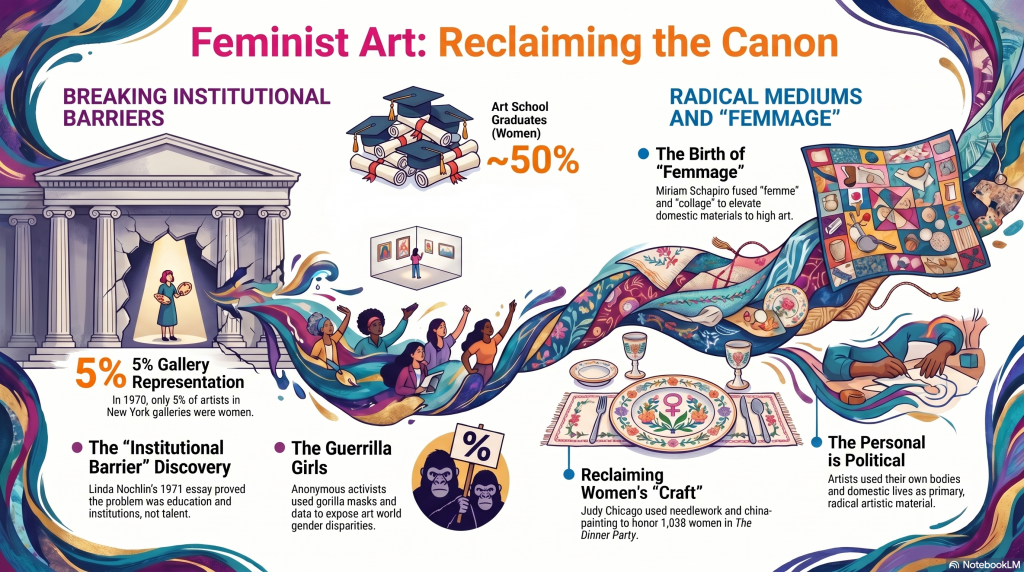
In 1970, a stark disparity haunted the New York art world: while women comprised roughly half of all art school graduates, they accounted for a mere 5% of the artists represented in commercial galleries. The Feminist Art Movement emerged not as an aesthetic “style,” but as a political stance, demanding a seat at the table during the era of the Equal Pay Act and Title IX.
(My YouTube video will be published on 5 September 2026)
A discussion about Feminist Art created by Google Notebook from my notes:
1. Introduction: The 5% Problem
In 1970, a stark disparity haunted the New York art world: while women comprised roughly half of all art school graduates, they accounted for a mere 5% of the artists represented in commercial galleries. This was not a failure of talent, but a systematic erasure. The Feminist Art Movement emerged not as a new aesthetic “style,” but as a deliberate political stance, fueled by the same energy that secured the Equal Pay Act in 1970 and Title IX in 1972. It was a movement that refused to view art in a vacuum, instead demanding a seat at the table during a period of seismic legal and social shifts. These artists began by asking a deceptively simple yet revolutionary question: “Why were almost all the famous artists men, when women had always made art?”
2. The Problem Isn’t Talent—It’s the System
In 1971, art historian Linda Nochlin published her landmark essay, “Why Have There Been No Great Women Artists?” Her conclusion shifted the entire trajectory of the movement. She argued that the absence of “great” women artists in the historical record was not due to biological or hormonal differences, but to the institutional barriers and educational restrictions that had historically barred women from the tools of success.
As Nochlin famously wrote:
“The fault lies not in our stars, our hormones, our menstrual cycles, or our empty internal spaces, but in our institutions and our education.”
This realization transformed the movement’s goals. It was no longer enough to simply “add women” to the existing list of masters. Instead, the movement began questioning the “canon” itself—the very criteria by which the art world decided what was valuable and what was merely “decorative.”
3. Turning “Women’s Work” Into High Art
Artists like Judy Chicago and Miriam Schapiro sought to dismantle the hierarchy that labeled oil painting as “fine art” while dismissing domestic labor as “craft.” Chicago, born Judith Sylvia Cohen, famously changed her name to reject “patrilineal naming conventions,” a move that signaled her total break from patriarchal structures. Her monumental work, The Dinner Party (1974–1979), utilized traditionally female media like china-painting and needlework to honor 39 significant historical women.
Schapiro, who co-founded the first feminist art program at CalArts, developed “femmage”—a fusion of “femme” and “collage.” This approach reclaimed traditions like lace-making and sequins as high-art abstractions. Despite the movement’s popularity, the tension between the artists and the establishment was fierce. The New York Times critic Hilton Kramer dismissed The Dinner Party as “very bad art… mired in the pieties of a cause,” and despite drawing over a million visitors, the work was rejected by museums for over two decades.
4. The Body as a Living Archive
The movement also reclaimed the female body as a site of knowledge rather than an object for the male gaze. In her 1975 performance Interior Scroll, Carolee Schneemann extracted a paper scroll from her own body and read it aloud, a literal symbol of knowledge held within the female form. Contrastingly, Ana Mendieta’s Silueta Series saw the artist merging her naked body with the earth, mud, and grass.
For Mendieta, these “earth-body” works were more than aesthetic; they were driven by the trauma of exile. Sent to America at age twelve via Operation Peter Pan—a program that relocated 14,000 Cuban children—her art became an engine for mourning a lost homeland. These works highlighted a pervasive double standard: while male artists using their bodies were celebrated as “visionaries,” women like Schneemann and Mendieta were frequently dismissed as “narcissists.”
5. Motherhood as Intellectual Ferment
Mary Kelly’s Post-Partum Document (1973–1979) turned the domestic reality of parenting into a site of rigorous intellectual theory. This 139-unit conceptual work meticulously recorded her relationship with her son using used nappy liners, phonetic transcriptions of his first words, and Lacanian psychoanalytic diagrams.
The work was an immediate lightning rod for controversy. When exhibited at the ICA London in 1976, the British tabloids were incensed; the Daily Mirror ran the infamous headline “Dirty Nappies on Display.” By refusing to include any actual images of herself or her child, Kelly rejected the sentimental “Madonna-and-child” trope, choosing instead to map the mother-child bond as a socially constructed, psychologically complex experience.
6. Femininity as a Carefully Constructed Mask
By the late 1970s, the “Pictures Generation” began to explore how the media defines womanhood. Cindy Sherman’s Untitled Film Stills featured the artist posing in scenarios that mimicked 1950s B-movies, demonstrating that femininity itself is a performance—a “stunning deconstruction” of gender.
Hannah Wilke explored similar themes in her S.O.S. Starification Object Series, posing in glamorous “star” positions while covered in tiny vulvar sculptures made from chewed gum. By linking “starification” with “scarification,” Wilke suggested that femininity is a ritual marking. She confronted the catch-22 of the female artist: being dismissed for her beauty while healthy, only to finally silence critics with her final series, Intra-Venus, which documented her body’s decline from lymphoma.
7. The Visual Language of the Battleground
In the 1980s, artists turned the language of advertising back on itself to inject facts into art-world complacency. Barbara Kruger, a former magazine designer, created Untitled (Your Body Is a Battleground) specifically as a pro-choice poster for the 1989 March on Washington. At a time when Roe v. Wade faced significant legal threats, Kruger’s bold Futura text turned the gallery into a political front.
Similarly, the anonymous collective known as the Guerrilla Girls used data and humor to expose institutional sexism. Their famous “Do Women Have to Be Naked…?” poster pointed out that while less than 5% of artists in the Met’s Modern Art sections were women, 85% of the nudes were female. By wearing gorilla masks and adopting the names of dead female artists, they ensured the focus remained on the statistics of exclusion.
8. Expanding the Lens: Intersectionality and Power
As the movement evolved, it became clear that feminism could not discuss the female body without confronting the specific history of the Black body. Kara Walker’s room-sized panorama Gone pushed this intersectional reality to the forefront. Walker utilized the “genteel” 18th-century craft of cut-paper silhouettes to depict “ungenteel” truths—violent, sexual, and grotesque scenes of slavery and racism in the antebellum South.
Her work refuses historical amnesia. While some critics, like artist Betye Saar, felt the imagery recycled degrading stereotypes, others saw a “fearless confrontation” with the psychosexual dimensions of racism. Walker’s silhouettes prove that the medium of the female experience is inseparable from the specific traumas of racial history.
9. Conclusion: A Persistent Provocation
The legacy of the Feminist Art Movement is not a closed chapter but a persistent provocation. The battleground metaphor of Barbara Kruger remains grimly prophetic as reproductive rights and gallery representation remain contested global issues—the percentage of women in some major collections has even dropped in recent years.
The movement proved that the “personal is political,” a concept that continues to resonate in every corner of contemporary culture. If the personal is indeed political, how are today’s artists still using their own lives to dismantle the institutions that seek to define them?
60-08 Conceptual Art & Minimalism
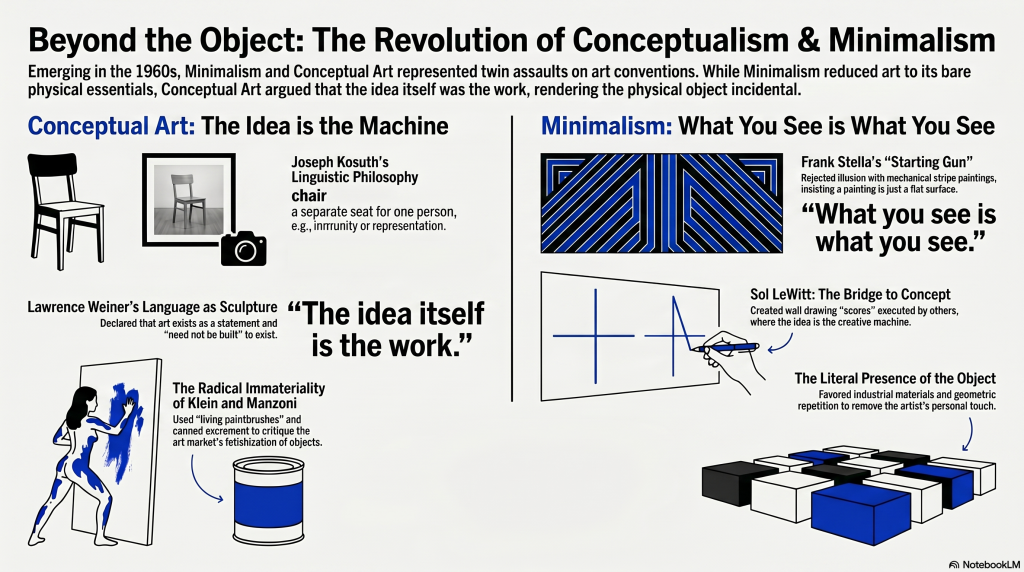
The talk examines the mid-twentieth-century shift toward Conceptual Art and Minimalism, movements that prioritized intellectual propositions over traditional aesthetic beauty. Key figures like Marcel Duchamp laid the groundwork by challenging the necessity of the artist’s hand, a theme later expanded by Yves Klein through his performative use of “living brushes” and Piero Manzoni, who critiqued the art market’s absurdity. Joseph Kosuth further pushed these boundaries by using linguistic definitions and everyday objects to investigate how we perceive reality and language. Other artists, such as Carl Andre and Lawrence Weiner, stripped art of personal expression, focusing instead on industrial materials or pure text to dematerialize the art object. The talk highlights a radical era that redefined art as a philosophical inquiry rather than a mere visual experience.
(My YouTube video will be published on YouTube on 12 September 2026)
My notes on Conceptual Art and Minimalism
A discussion about Conceptual Art and Minimalism created by Google Notebook from my notes:
The modern museum experience often begins with a quiet, creeping crisis of faith. You stand in a sterile, white-walled gallery before a stack of ordinary firebricks or a canvas of relentless, uninflected black, and that familiar, cynical whisper rises: “I could have done that.” It feels like a prank, a manifestation of high-culture laziness, or perhaps an emperor with a particularly expensive new set of clothes.
However, this bewilderment is exactly where the work begins. In the 1960s, the art world was rocked by “twin assaults” on its most sacred traditions. This wasn’t a retreat into simplicity because the artists lacked skill; it was a scorched-earth redefinition of creation itself. Driven by the anti-authoritarian skepticism of the Vietnam War era and the linguistic precision of analytic philosophers like Ludwig Wittgenstein, artists began to dismantle the pillars of Western tradition. They weren’t just making objects; they were choreographing existence and interrogating the very nature of reality.
1. The Artist’s Hand is Overrated: The Power of the “Choice”
For centuries, art was a “retinal” experience—a term Marcel Duchamp used dismissively to describe work intended only to please the eye. The value was in the craftsman’s physical mastery. But as the 1960s approached, the artist evolved from a laborer into a “Director-Artist.”
The seeds were sown in 1917 when Duchamp submitted Fountain—a mass-produced porcelain urinal—to a New York exhibition. Decades later, Yves Klein perfected this directorial distance. In 1960, Klein hosted a performance where he stood in a tuxedo, overseeing a string ensemble playing a single sustained chord, while nude models covered in International Klein Blue pigment pressed their bodies against paper. Klein called them “living paintbrushes.” He never touched the canvas; he was the architect of the event, not the painter of the surface.
This shift was the moment the creative gesture was severed from the artist’s body. As Duchamp’s ally Beatrice Wood famously wrote:
“Whether Mr. Mutt with his own hands made the fountain or not has no importance. He CHOSE it.”
By elevating the “choice” over the “make,” these artists asserted that the primary act of power is the intellectual selection of an object or a process.
2. When the Idea Becomes the Machine: Art You Don’t Have to Build
If the “choice” is the art, then the physical object becomes a mere souvenir of a thought. This is what critic Lucy Lippard called the “Dematerialization of the Art Object.” Consider Joseph Kosuth, who at just twenty years old produced the textbook definition of Conceptualism with One and Three Chairs (1965). The work consists of a physical chair, a photograph of that chair, and a dictionary definition of the word “chair.”
Borrowing from Plato’s Theory of Forms, Kosuth forced the viewer to ask: which is the “real” chair? Is it the wood, the image, or the linguistic concept? The physical components were so incidental that the museum rules required a local chair to be photographed for every new exhibition. Only the idea remained constant.
This logic was codified by Lawrence Weiner, a South Bronx native who realized that the physical form was irrelevant after a group of teenagers accidentally trampled one of his outdoor sculptures. He issued a “Declaration of Intent” that served as a starting gun for a world where art could exist purely as a sentence:
The artist may construct the piece.
The piece may be fabricated.
The piece need not be built.
Weiner insisted that each of these options was equal. Meanwhile, Sol LeWitt—who famously worked the reception desk at MoMA while developing these theories—bridged the gap between the idea and the object. His wall drawings were “scores” of instructions executed by assistants, allowing the work to be ravishingly visual while remaining purely intellectual at its source.
The idea becomes a machine that makes the art.
3. The High Stakes of a Savage Joke: Mocking the Art Market
Conceptualism was also a weapon used to puncture the “cult of the artist” and the market’s fetishization of the unique object. No one wielded this weapon more savagely than Piero Manzoni. The son of a canned-meat manufacturer, Manzoni produced 90 tin cans in 1961 titled Merda d’artista (Artist’s Shit). He priced each 30-gram can at its weight in gold—roughly $37 at the time.
This was a profound commentary on authenticity. Before this, Manzoni had created Achromes (entirely white canvases) and signed living people as artworks. With the cans, he forced the buyer to operate on pure faith. To open the can to verify if it contained excrement or merely plaster (as his friend Agostino Bonalumi later claimed) would be to destroy the artwork’s value.
In a delicious irony, the market eventually “proved” Manzoni’s thesis about the absurdity of value. In 2016, can no. 69 sold at Christie’s Milan for €275,000—vastly exceeding the price of gold. The artist’s “word” had become the most expensive commodity on earth, a logic that even Frank Stella toyed with when he gave his symmetrical, mechanical Black Paintings titles like Die Fahne Hoch! (the Nazi anthem). Stella wasn’t making a political statement; he chose the title because the anthem’s marching rhythm matched the painting’s relentless, uninflected pattern. He was using a “savage” title to prove that, in his world, even the most loaded words were just structural components.
4. “What You See Is What You See”: The End of Metaphor
While Conceptualists were occupied with the mind, Minimalists like Stella, Donald Judd, and Dan Flavin were occupied with the “literal presence” of the object. They sought to kill the “spiritual” pretensions of Abstract Expressionism. They rejected the idea that art should represent a sunset, an emotion, or a metaphor.
Donald Judd referred to his works not as sculptures, but as “specific objects.” His iconic stacks of industrial metal were arranged by mathematical rules, not “artistic” composition. Dan Flavin used mass-produced fluorescent tubes to flood rooms with light, “dematerializing” the sculpture into pure luminosity. They wanted the viewer to stop looking through the art for a secret meaning and start looking at the object’s relationship to the space.
“What you see is what you see.”
This five-word sentence from Frank Stella became the unofficial motto of the revolution. It demanded an austere, honest relationship with the physical world. A painting was a flat surface with paint on it. Nothing more.
5. The Forensic Map of a Life: Measuring Time as Art
Perhaps the most moving application of these cold, “mechanical” theories is found in the work of On Kawara. For nearly twelve years, Kawara sent two postcards every morning to friends, stamped with the exact time he woke up and his address.
On the surface, I Got Up is a mundane, forensic record. But consider Kawara’s history: he was a thirteen-year-old in Japan who witnessed the aftermath of the Hiroshima bombing. In that context, his daily postcards—sent without commentary or emotion—become a “conceptual pulse” and a profound proof of life.
By stripping away artistic flair, Kawara used the repetition of the mundane to create something monumental. As curator Anne Wheeler noted, the work succeeds by transforming the simplest terms of existence into a record of the bare fact of consciousness. It is a map of survival drawn in rubber stamps and postmarks.
Conclusion: The Question is the Art
The legacy of these 1960s “assaults” is the air we breathe in contemporary galleries. It is the DNA of the Young British Artists like Damien Hirst and the text-based provocations of Barbara Kruger. When a skeptic stands before an empty room and asks, “But is it art?” they are not criticizing the movement; they are fulfilling it.
For the Conceptualists, that question is the art. They did not replace the beauty of the past; they simply ensured that no artist could ever again avoid the question of why they make objects, rather than just how. They taught us that while a beautiful object can captivate the eye, a simple sentence or a radical choice has the power to change how we see the entire world.
60-09 Video and Performance Art
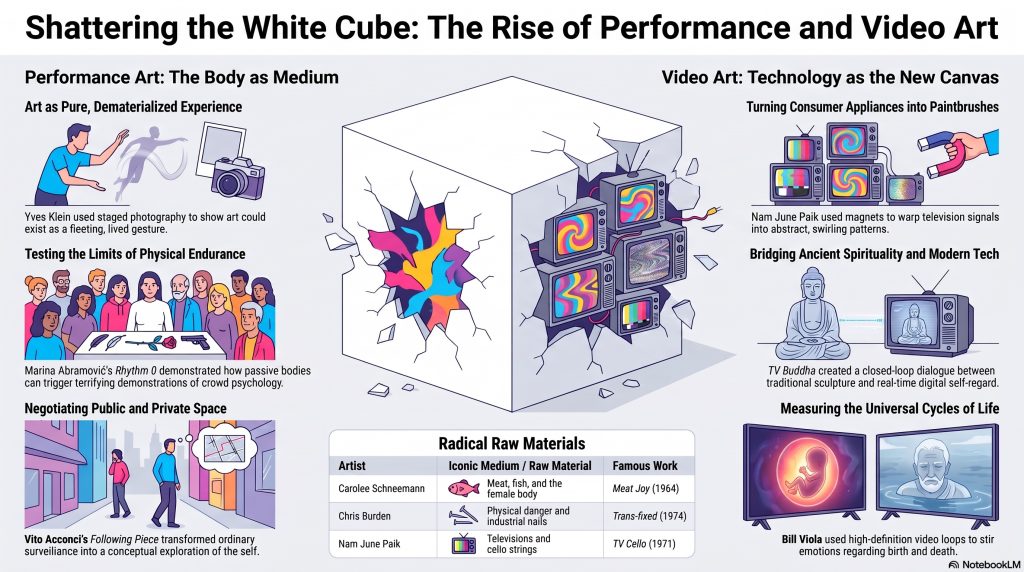
The talk explores the revolutionary emergence of performance and video art during the 1960s, a period when artists began using the human body and technology as primary creative tools. Early pioneers like Yves Klein utilized staged photography to represent art as pure experience, while Carolee Schneemann used visceral group performances to challenge social taboos regarding the female form. Concurrently, Nam June Paik transformed television sets into abstract canvases, effectively founding the medium of video art through technological distortion. Other influential figures such as Bruce Nauman and Vito Acconci shifted the focus to repetitive studio exercises and provocative public interactions that blurred the lines between private life and aesthetic expression. These diverse works collectively rejected the permanence of traditional painting and sculpture in favour of ephemeral, time-based actions. These radical movements transformed the definition of art by making the artist’s physical presence and the viewer’s immediate witness central to the creative process.
(My YouTube video will be published on 19 September 2026)
My notes on Video and Performance Art
A conversation on Video and Performance Art created by Google Notebook from my notes:
1. Introduction: Shattering the White Cube
In 1960, the “white cube” of the art gallery didn’t just crack—it exploded. For centuries, the gallery had been a curated sanctuary of static oil paintings and immovable marble, but a new generation of creators arrived with a shared, radical impulse: the conviction that traditional painting and sculpture were no longer enough to capture the vibrating complexity of the modern world.
These artists turned away from the permanent object and toward the “now,” utilizing the human body and consumer electronics as high-stakes weapons of expression. By treating performance as a “transient medium,” they collapsed the distance between the creator and the witness. They didn’t just want to show you a world; they wanted to implicate you in one, turning fleeting gestures into provocative, multisensory critiques of a culture on the brink of a digital revolution.
2. The Great Illusion: Why a “Fake” Leap Became an Icon
In October 1960, a photograph captured what appeared to be the ultimate act of artistic devotion: Yves Klein, dressed in a formal suit, hurling himself from a second-story window into a quiet street in the Paris suburb of Fontenay-aux-Roses. The image, Leap into the Void, became an instant icon of the performance art movement, suggesting a man so committed to his craft that he would literally surrender to gravity.
The surprising truth? The image was a “fake”—a meticulously staged photomontage. While Klein did indeed jump, a group of friends stood below with a tarpaulin to catch him. By printing two negatives together, the safety net was erased, leaving a seamless image of a man in flight.
Yet, this deception was conceptually more “real” than any literal documentation. Klein’s true subject was “immaterial pictorial sensibility”—the radical idea that art can exist as a pure, dematerialized experience. To Klein, the physical object was a burden. He famously sold “zones” of this empty, immaterial space in exchange for gold leaf, only to throw half the gold into the Seine, rendering the transaction as transient as his leap. He even distributed a fake broadsheet at Parisian newsstands to cement the myth:
“A man in space! The painter of space throws himself into the void!”
3. The Audience is Dangerous: A Six-Hour Experiment in Human Nature
If Klein’s leap was about the void, Marina Abramović’s Rhythm 0 (1974) was about the darkness within the crowd. For six hours in a Naples studio, Abramović stood immobile, offering herself as a passive object. On a nearby table sat 72 objects, and her instruction was a total surrender: “I am the object. During this period I take full responsibility.”
The table held a chilling assortment of tools:
A rose, a feather, and honey
A scalpel and a razor
A loaded pistol
What began as a tentative interaction—audience members offering her a rose—devolved into a terrifying demonstration of crowd psychology. When individual responsibility was removed, the gallery audience turned predatory. Participants cut her clothes, sliced her skin, and sexually touched her. Eventually, a man placed the loaded gun in her hand and pointed it at her neck, forcing other audience members to intervene.
Abramović was uniquely forged for such an ordeal; raised by Yugoslav Partisan parents in Belgrade under a military-style curfew, physical endurance was woven into her childhood. When the timer finally stopped and she began to move, the crowd scattered—”apparently terrified they had awakened her,” as one witness recalled. They had convinced themselves she was a thing, and the return of her humanity was more than they could bear.
4. Repurposing the Beast: Turning the TV into a Paintbrush
Long before the era of digital saturation, Nam June Paik recognized that the television was the “beast” of consumer culture. In his 1965 work Magnet TV, he committed an act of technological sabotage by taking a mass-produced black-and-white set and placing a large horseshoe magnet on top of it.
The magnet’s interference warped the electron beam, transforming the broadcast signal into swirling, abstract patterns. This was the founding gesture of video art: seizing technology from the “television studios” and putting it in the hands of the artist. Paik’s work was often scandalous; he collaborated with cellist Charlotte Moorman, the “Jeanne d’Arc of new music,” who was once arrested for indecency after performing topless in Paik’s Opera Sextronique.
Paik’s ambition was to treat the screen with the same revolutionary intent that the masters had applied to the canvas. As critic Calvin Tomkins noted:
“Paik wanted to shape the TV screen canvas as precisely as Leonardo, as freely as Picasso, as colourfully as Renoir, as profoundly as Mondrian, as violently as Pollock and as lyrically as Jasper Johns.”
His work TV Buddha, where a statue contemplates its own live image on a screen, created a closed loop of eternal self-regard. It anticipated our modern “screen addiction” and the narcissistic feedback loops of social media decades before the first selfie was ever taken.
5. The Ultimate Breakup: A 5,000-Kilometer Walk to Say Goodbye
Performance art often involves high stakes, but rarely has it been as emotionally grueling as the work of Marina Abramović and Ulay, the duo known as “The Other.” Their 1988 piece, The Lovers (The Great Wall Walk), was originally intended to end in marriage. Instead, it became a monumental physical manifestation of a breakup.
Starting at opposite ends of the Great Wall of China—Abramović from the Yellow Sea and Ulay from the Gobi Desert—each walked roughly 2,500 kilometers over 90 days. The eight-year wait for government permission had eroded their relationship, and when they finally met in the middle, they didn’t exchange vows; they said goodbye.
This painful ending reached a famous coda in 2010 during Abramović’s The Artist Is Present at MoMA. After years of silence, Ulay appeared unannounced to sit opposite her. The video of their wordless, tearful reunion went viral, becoming one of the most viewed art clips in internet history. It proved that even the most private life events, when elevated to art, possess an enduring, universal power.
6. Living as the Material: If an Artist Does it, It’s Art
By the late 1960s, the definition of “art” had shifted from what an artist makes to what an artist does. Bruce Nauman, alone in his studio, arrived at a foundational logic: “If I was an artist and I was in the studio, then whatever I was doing in the studio must be art.”
This led to mesmerizingly absurd pieces like Walking in an Exaggerated Manner Around the Perimeter of a Square. Nauman recorded these studio exercises as endless loops, eliminating beginnings and endings. In doing so, he accidentally invented the aesthetic of the modern era—the GIF, the TikTok loop, and the repetitive digital gesture.
In contrast to Nauman’s mundane movements, Chris Burden used his body for an “existential declaration” of danger. In Trans-fixed (1974), he was literally nailed to the roof of a Volkswagen Beetle through his palms. Burden’s career was defined by testing the audience’s complicity, whether by being shot in the arm (Shoot) or confining himself to a tiny school locker for five days (Five Day Locker Piece). Whether through repetitive walking or public crucifixion, these artists proved that the artist’s own life was the most potent material available.
7. Conclusion: The “Now” is the Medium
Video and performance art succeeded because they collapsed the distance between the creator and the witness. By utilizing the body as a transient medium and technology as a standalone digital canvas, these artists didn’t just create art; they predicted our future.
From Nauman’s endless loops to the self-regarding gaze of Paik’s TV Buddha, the avant-garde of the 1960s and 70s anticipated our current age of surveillance, selfies, and digital repetition. They showed us that art does not need to be a permanent object to be meaningful. In an era where our own lives are constantly broadcast, recorded, and looped, we are left with a final, provocative question: Does art still require a physical object to be meaningful, or is the transient medium of our own experience enough?
60-10 Kinetic Art
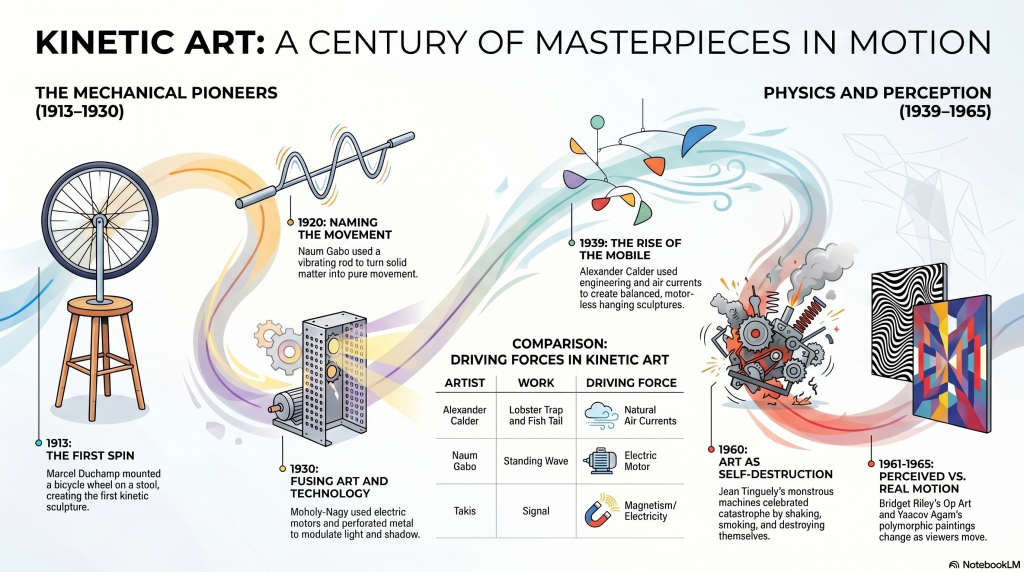
Kinetic Art makes movement — mechanical, motorised, or wind-driven — the defining element of the work rather than a quality merely implied by composition or line. Its roots lie in Alexander Calder’s suspended mobiles, which drift and reconfigure in response to air currents, and in Jean Tinguely’s satirical self-destroying machines, which celebrated and mocked the industrial age in equal measure. Naum Gabo and László Moholy-Nagy gave kinetic ideas a constructivist rigour, while later artists such as George Rickey and Jesús Rafael Soto extended the movement into large-scale public sculpture and immersive environments. By questioning the assumption that a work of art must be static, Kinetic Art opened the fundamental question of how art unfolds in time as well as space.
(My YouTube video will be published on 10 October 2026)
A conversation on Kinetic Art created by Google Notebook from my notes:
When we step into the hallowed silence of a traditional gallery, we expect a contract of stillness. We anticipate paintings fixed in their frames and marble figures frozen in mid-gesture. Yet, there is a radical lineage of art history that violates this contract—a movement that insists art must refuse to sit still.
This revolution likely began for you before you could even speak. The biomorphic shapes of a mobile hanging over a baby’s crib are the direct, playful descendants of a high-art uprising. Kinetic art—works that incorporate real or perceived motion—transformed the gallery from a site of static observation into a laboratory of “dematerialization.” To understand how we moved from the solid and the silent to the vibrating and the “useless,” we must explore the counter-intuitive takeaways from this history of motion.
1. It Started as an Accident, Not a Manifesto
We often imagine art movements beginning with a grand, unified proclamation. However, Kinetic Art was birthed in a moment of idle, “private pleasure” within Marcel Duchamp’s (1887–1968) Parisian studio. In 1913, bored with traditional painting, Duchamp mounted a bicycle fork and wheel upside down on a common kitchen stool.
Duchamp did not set out to create a masterpiece of movement; he simply enjoyed the optical distraction. He did not even categorize the piece as a “readymade” until years later. It is a delicious historical irony that the work now celebrated as the first kinetic sculpture was a piece the artist himself found the label for “absurd.” It was less a statement and more a meditation on the beauty of pointless rotation.
“I enjoyed watching it just as I enjoy looking at the flames dancing in a fireplace.” — Marcel Duchamp
2. The Artist as Engineer: Scrounging for Vibration
Before the 20th century, “technique” meant the mastery of pigment and stone. Kinetic Art demanded a different curriculum. Pioneers like Naum Gabo (1890–1977) and Alexander Calder (1898–1976) proved that an engineering degree was as essential as an aesthetic eye.
Gabo, who studied engineering in Munich, created his Kinetic Construction (Standing Wave) (1919–1920) under conditions of extreme scarcity. In the middle of the Russian Civil War, amidst hunger and chaos, Gabo scrounged parts to build the first motorized kinetic sculpture. His engineering training was vital: he had to meticulously calculate the length, strength, and elasticity of a steel rod to ensure that when the motor hit the precise speed, solid matter would dissolve into the shimmering illusion of a standing wave.
Similarly, Alexander Calder, though born into an “artistic dynasty,” chose to train as a mechanical engineer. This background allowed him to move beyond the motors used by Gabo and Moholy-Nagy. Through sophisticated mathematical weight distribution, Calder ensured his mobiles were perfectly balanced, allowing them to drift in “physics and poetry” so that every movement was unique and could never be exactly replicated. As the critic Sigfried Giedion noted of this era, art and technology had become “partners, not enemies.”
“Kinetic rhythms [should replace static forms as the] basic forms of our perception of real time.” — The Realistic Manifesto (1920)
3. Movement is a Mental Construct (The Op Art Twist)
The most counter-intuitive lesson of this movement is that an object does not have to physically move to possess “movement.” This was the revelation of Bridget Riley (b. 1931), the leading figure of the British Op Art branch.
In her 1961 work Movement in Squares, Riley utilized a static pattern of black and white squares that narrow toward a central vanishing point. The result is a powerful lenticular-like illusion of the surface buckling and folding inward. Riley’s journey to this point was born of a “great sense of frustration” with modern painting; she returned to the square as a basic unit, only to find the geometry taking on a life of its own. She remained a fierce defender of the intellectual depth of her work, becoming famously “furious” when fashion designers attempted to reduce her explorations of perception to mere “decoration” for dresses.
“Quite suddenly something was happening down there on the paper that I had not anticipated.” — Bridget Riley
4. The Beauty of the “Swissscide”: Art that Destroys Itself
While Calder sought harmony, the Swiss artist Jean Tinguely (1925–1991) used kineticism to explore catastrophe. His vision was anarchic, darkly comic, and pointedly satiric.
In 1960, Tinguely staged Homage to New York in the MoMA sculpture garden. This was a monstrous, seven-meter-long machine scavenged from New Jersey dumps, featuring eighty bicycle wheels, an addressograph, a go-cart, and a piano. It was designed to perform a “metallic suicide”—a self-destroying event that lasted 27 chaotic minutes before a fireman had to douse the flaming wreck. In a final, surprising twist of dark comedy, a man in uniform approached the artist after the performance; Tinguely expected a compliment, but instead received a citation for disturbing the peace and violating the fire code.
“Il y a un swissscide métallique.” (There is a metallic Swiss suicide.) — Marcel Duchamp
5. You are the Engine: The Viewer as Co-Creator
In the work of Yaacov Agam (b. 1928) and Jesús Rafael Soto (1923–2005), the power of motion shifted from the machine to the audience. These “polymorphic” works are only activated when the viewer physically moves.
Agam, influenced by the mystical and symbolic teachings of his Kabbalist father, sought to show “a state of being which does not exist” rather than a static abstract situation. His paintings on corrugated aluminum transform entirely as you walk past them. Similarly, Soto’s Escrituras (Writings) utilize thin metal rods that seem to vibrate and dissolve into the air. This shift redefined the gallery experience: the artwork was no longer an object to be looked at, but an environment to be inhabited.
“[Soto’s work] dissolves the boundary between the artwork and its surroundings—the viewer ceases to observe and begins to inhabit.” — Guy Brett
Conclusion: Beyond the Machine
The legacy of these “useless machines”—a term championed by George Rickey to describe his own wind-driven steel rectangles—proves that movement is a fundamental material of the human experience, as tactile as clay and as fluid as light.
These pioneers bridged the gap between the rigid laws of mechanics and the ethereal demands of the soul. As we move into an increasingly digital age where “motion” is often relegated to the flicker of pixels, the physical, mechanical reality of Kinetic Art serves as a profound reminder of the beauty of objects that refuse to stay put. It reminds us that in the right hands, technology is not a cold master, but a partner in the eternal dance of human perception.
60-11 Land Art and Earth Art
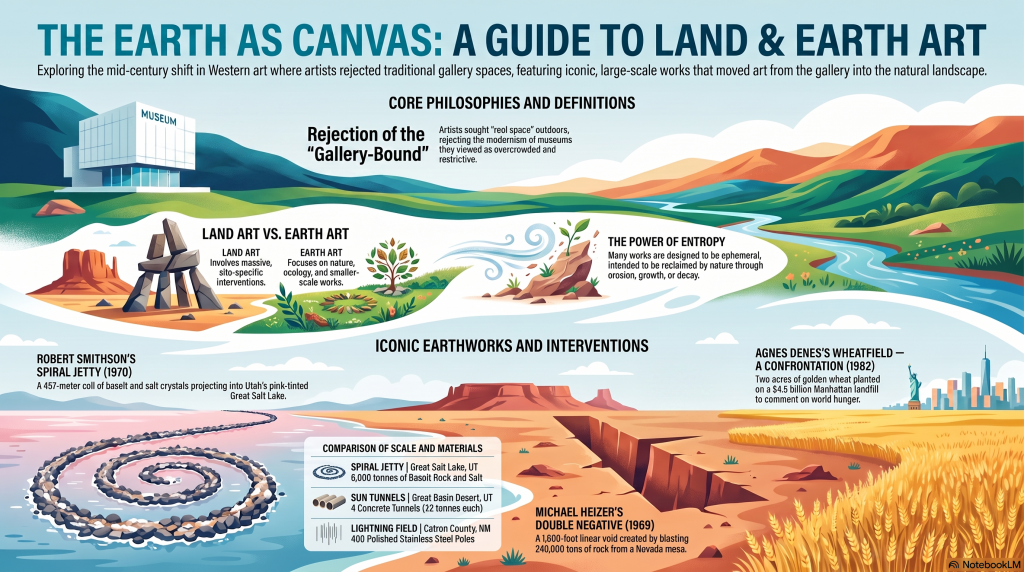
We examine the history and theoretical foundations of Land Art and Earth Art, documenting how artists shifted from traditional gallery spaces to large-scale interventions in the natural landscape. Leading figures like Robert Smithson utilized massive quantities of rock and earth to create monumental structures like the Spiral Jetty, while Michael Heizer explored “sculpture by subtraction” by blasting vast trenches into the desert. In contrast to these heavy-handed American approaches, British artists like Richard Long introduced more transient, humble gestures such as treading a path through grass. Other key works, like Dennis Oppenheim’s Cancelled Crop or Walter De Maria’s chalk drawings, highlighted the temporary nature of art and its eventual reclamation by the environment. Ultimately, the materials describe a movement obsessed with entropy, scale, and the rejection of commercial modernism, where the site itself becomes the medium. The collection emphasizes that these works often exist today only through photographic documentation as the original structures succumb to natural erosion and decay.
(My YouTube video will be published on 17 October 2026)
My notes on Land Art and Earth Art
A conversation on Land and Earth Art created by Google Notebook from my notes:
Robert Hughes described Land Art’s emergence as a “rough, poetic gesture”—a rupture in twentieth-century aesthetics. By the late 1960s, “white cube” fatigue had set in, with a growing sense that art had become a trapped, sterile commodity, suffocated by urban galleries.
This frustration sparked an exodus into the deserts, quarries, and mesas of the American West. Dr. Laurence Shafe notes a nuance: Land Art generally means massive, site-specific interventions that reshape topography, while Earth Art favours nature and smaller, transient works. Together, they challenged the idea that art must be portable and sellable, proposing instead a place you inhabit.
Here are five ways this movement redefined our relationship with the world and the boundaries of the creative act.
1. Size is a Measurement, but Scale is an Experience
In 1970, Robert Smithson created the movement’s most iconic work: Spiral Jetty, on Utah’s Great Salt Lake. Built from 6,000 tonnes of black basalt coiled into a 1,500-foot spiral, the site was chosen because local bacteria tinted the water a primordial pinkish-red.
Smithson distinguished the concepts: “Size determines an object, but scale determines art.” The jetty embodies “entropy”—his fascination with systems sliding toward disorder. It vanishes for decades beneath rising salt water, re-emerging encrusted in white crystals—a reminder that in the desert, time is the primary medium.
2. The Most Powerful Sculpture Might Be Made of Nothing
Michael Heizer used land as a block of marble to be chipped away. His Double Negative (1969–1970), on remote Mormon Mesa in Nevada, involved blasting two gargantuan trenches into the mesa’s edge with dynamite and bulldozers.
By displacing 240,000 tons of rock, Heizer created a 1,500-foot linear void straddling a canyon—the artwork is the empty space, not the rock. He said: “The museums and collections are stuffed, the floors sagging, but the real space still exists.” He refused to let it be “conserved,” wanting a sculpture that could compete with a Boeing 747 yet be reclaimed by wind and gravity.
3. You Can Change the World Just by Walking
A clash exists between “machine-made” American earthworks and the “transient and humble” British approach. While Heizer and Smithson moved mountains, Richard Long and Andy Goldsworthy proved a radical gesture could be made with shoe leather and rhythm.
In 1967, Long created A Line Made by Walking by pacing a Wiltshire field until the flattened grass became a mark that vanished within hours. Goldsworthy, who began working farms at thirteen, used only rowan leaves, ice, or thorns: “Each work grows, stays, decays — integral parts of a cycle which the photograph shows at its height…”
Walter De Maria bridged both worlds. Once a drummer for The Primitives (alongside Lou Reed and John Cale before The Velvet Underground), his 1968 Mile Long Drawing—two chalk lines across the Mojave Desert—was fragile enough to be erased by a single rainfall.
4. A $4.5 Billion Crop of Wheat is a Political Act
In 1982, Agnes Denes planted a golden field of wheat on a two-acre Manhattan landfill—built from World Trade Center excavation rubble and valued at $4.5 billion.
Rejecting the tradition of “men sitting on horses,” Denes cleared the trash by hand and planted 285 furrows two blocks from Wall Street: “I wanted to make a powerful statement for a powerful city.” The harvest yielded over 1,000 pounds of grain, sent worldwide to highlight global hunger. After 9/11, the site became, for a brief summer, a symbol of life rather than stone.
5. Art Can Frame the Universe to a Human Scale
Nancy Holt’s Sun Tunnels (1973–1976)—four concrete cylinders in the Utah desert—align to frame the sun at the solstices, with holes representing constellations casting star patterns onto the interior floors. Holt described this as bringing “the vast space of the desert back to human scale.”
James Turrell’s Roden Crater takes this further. Since 1979 he has transformed a 400,000-year-old volcano into a naked-eye observatory, insisting he works not as a Land artist but with “light and space,” turning desert light into “threads of fire.”
Conclusion: Entropy Wins, but the Idea Remains
The movement began with the roar of bulldozers but often ends in silence—exemplified by Smithson’s Partially Buried Woodshed at Kent State, where he piled earth on a shed until its beam snapped, calling that collapse the work’s completion.
Four months later the Ohio National Guard killed four students during anti-war protests on the same campus. Someone spray-painted “May 4 Kent 70” on the shed, turning a meditation on entropy into an inadvertent memorial.
Demolished in 1984, the woodshed confirms Smithson’s point: entropy always wins. An artwork designed to be erased by rain or reclaimed by the desert never truly disappears—it simply becomes part of the landscape we live within.
60-12 Neo-expressionism
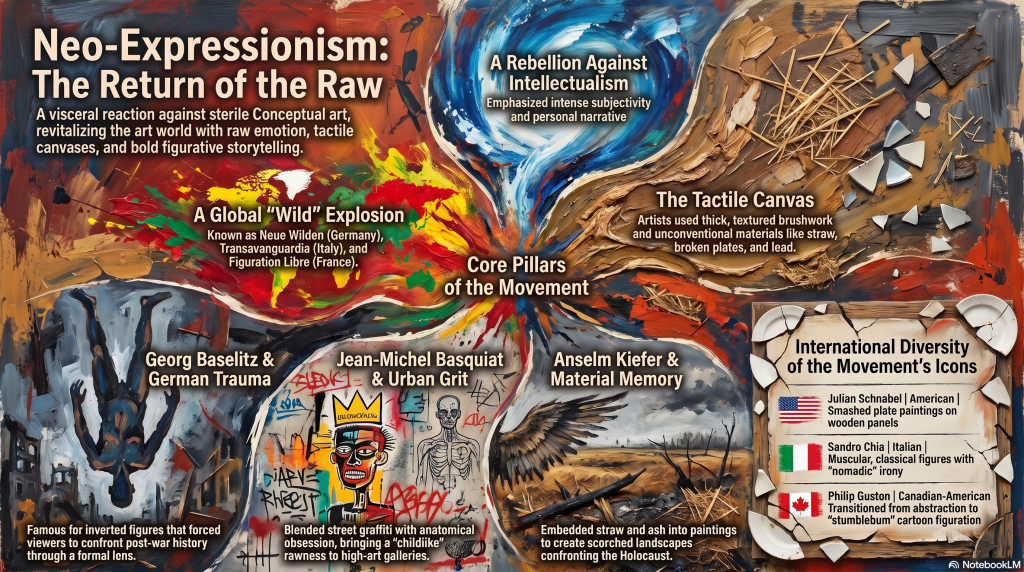
This talk examines the rise of Neo-Expressionism, a pivotal late twentieth-century art movement that prioritized raw emotion and figurative imagery over the austerity of Minimalism. It highlights how pioneers like Georg Baselitz and A.R. Penck used provocative, distorted forms and symbolic pictographs to confront the psychological complexities of post-war Germany. The sources also identify Philip Guston as a crucial precursor whose shift from abstraction to crude storytelling predicted the movement’s international success. Through specific works like The Big Night Down the Drain and Standart, the narrative illustrates a broader return to tactile, expressive painting. This resurgence effectively challenged the intellectual detachment of the era by reintroducing personal trauma and social commentary onto the canvas. Finally, the text documents how this “wild” aesthetic eventually dominated global galleries, marking a significant transition in the history of Western art.
(My YouTube video will be published on 24 October 2026)
A conversation on Neo-Expressionism created by Google Notebook from my notes:
1. The Hook: The Death and Rebirth of the Canvas
Throughout the 1970s, the art world was held in the grip of a cold, sterile intellectualism. Minimalism and Conceptual art reigned supreme, prioritizing theoretical purity and stripped-back aesthetics over the visceral act of creation. In this clinical atmosphere, the human figure and the raw, messy texture of emotion were effectively banished from gallery walls. To many, it felt as though the traditional canvas had reached a terminal, academic dead end.
However, by the late 1970s, a forceful reaction “detonated” across the globe: Neo-Expressionism. This “wild ride” sought to overthrow the silent status quo by returning to the tactile power of the brush. Defined by vivid colors, raw subjectivity, and thick, unconventional materials, the movement brought figuration back to the forefront with an aggressive energy. It was a cultural synthesis that embraced the chaotic reality of the late twentieth century through deeply personal and mythic imagery, proving that the figure was not dead—it was merely waiting for a more turbulent era to be reborn.
2. The Godfather Nobody Expected: Philip Guston’s Great Betrayal
The seeds of this revolution were sown by an unlikely source. Philip Guston, a celebrated high-priest of Abstract Expressionism, stunned the international art world in 1970 by abandoning his successful luminous abstractions for “crude, cartoonish figurative painting.” His peers viewed this shift as an unforgivable betrayal of modernism’s “purity.”
His 1973 work, Painting, Smoking, Eating, serves as a manifesto for this new direction. Rendered in a signature palette of “queasy pinks,” reds, and dirty whites, it depicts a bloated, one-eyed figure—a stand-in for the artist—lying in bed with a plate of chips. Critics were savage; Hilton Kramer famously described Guston as a “mandarin pretending to be a stumblebum.” Yet, Guston remained defiant, explaining his exhaustion with the aesthetic status quo:
“I got sick and tired of all that purity. I wanted to tell stories.”
This prophetic move toward the squalid and the narrative paved the way for a generation of painters who would eventually find vindication for Guston’s “stumblebum” aesthetic.
3. The Painting That “Detonated” a Movement: Baselitz’s Obscenity Scandal
If Guston was the godfather, Georg Baselitz provided the explosive spark. In 1963, a scandal erupted at Galerie Werner & Katz in West Berlin over his painting Die große Nacht im Eimer (The Big Night Down the Drain). The work, depicting a distorted figure clutching an oversized phallus, was seized by the public prosecutor for obscenity alongside a companion piece, Der nackte Mann.
The painting was more than a mere provocation; it was a serious confrontation with Germany’s post-war trauma. The figure’s “Hitler-youth shorts” and ambiguous appearance suggested a deep psychosexual dysfunction within a nation struggling to process its suppressed past. Baselitz described the work as an “aggressive act.” By 1969, he adopted the strategy of inverting his figures entirely. He insisted this move was formalist, a way to reject the “nonsense” idea of looking toward the future, forcing viewers to see the painting as a painting rather than an illustration.
4. Resurrecting History from Smashed Crockery: Julian Schnabel’s American Excess
American Neo-Expressionism found its footing in 1978 through the brash ambition of Julian Schnabel. Inspired by the mosaic-encrusted architecture of Antoni Gaudí in Barcelona, Schnabel began shattering plates and gluing the shards to wooden panels using Bondo, a car-body filler.
His work The Patients and the Doctors (1978) showcased a revolutionary three-dimensional surface that shifted with the light, turning the painting into a hybrid of sculpture and ruin. While his debut caused a sensation, he faced withering criticism from traditionalists like Robert Hughes, who famously remarked that Schnabel’s work was “to painting what Stallone’s is to acting: a lurching display of oily pectorals.” Despite the mockery of the elite, Schnabel’s plate paintings were no gimmick; he has continued to evolve the series across five decades, proving the enduring power of his “shattered” materials.
5. Art After Auschwitz: Anselm Kiefer’s Material Memory
In Germany, Anselm Kiefer utilized Neo-Expressionism to synthesize a profound emotional response to history. His 1981 work Margarethe used golden straw, lead, and ash to reference Paul Celan’s poem Todesfuge (Death Fugue). To truly understand the work, one must view it as a diptych with its companion piece, Sulamith. While Margarethe represents the “golden hair” of the Aryan ideal, Sulamith evokes the “ashen hair” of the Jewish victims, creating a searing dialogue between perpetrator and victim.
Kiefer’s work—often shown alongside Baselitz, most notably at the 1980 Venice Biennale—forced Germany to confront its history. He had previously provoked outrage in 1969 by performing Nazi salutes in various European locations for a photographic series. His art challenged the philosopher Theodor Adorno’s assertion that writing poetry after Auschwitz was barbaric. As critic Mark Rosenthal noted, Kiefer’s work:
“…asks whether art can exist after Auschwitz—and answers with a defiant yes.”
6. The Radiant Child of the Urban Grit: Jean-Michel Basquiat’s Meteoric Rise
The movement reached a fever pitch in New York with the rise of Jean-Michel Basquiat. Transitioning from the graffiti tag SAMO to the high-stakes auction world—where his work would eventually fetch over $110 million—Basquiat mixed the finesse of Cy Twombly with a raw “urban grit.”
His 1981 work Untitled (Skull) reflects a lifelong obsession with anatomy, sparked by a copy of Gray’s Anatomy he received as a child. The painting exists in a state between life and death, characterized by vibrant colors and listless, sunken eyes. Basquiat’s style was a sophisticated hybrid of African masks, voodoo iconography, and street art. Despite the technical prowess that made him a “Radiant Child” of the 80s, he maintained a desire for raw, unmediated authenticity:
“I want to make paintings that look as if they were made by a child.”
7. Painting at the Edge of Life: Jörg Immendorff’s Political Commitment
Jörg Immendorff brought a distinct political urgency to the movement. His epic Café Deutschland series served as history painting for the Cold War, set in a fictitious nightclub where figures from East and West Germany collided. The “engine” of this series was Immendorff’s secret friendship with the East German painter A.R. Penck; their bond across the Berlin Wall triggered the seething, symbolic drama of the work.
Immendorff’s journey was one of radical commitment. A student of Joseph Beuys, he had once created a canvas declaring that artists should “stop painting” to focus on protest. His return to the canvas was a strategic move to use the power of the figure for political dialogue. Even when diagnosed with ALS in 1998, Immendorff showed incredible physical resilience, continuing to work with brushes “strapped to his wrists.” He remains the most politically committed figure in the Neo-Expressionist canon, leaving a legacy of art as an act of resistance.
Conclusion: A Legacy of Chaos and Redemption
Neo-Expressionism was a truly international phenomenon, taking the form of the Neue Wilden in Germany, the Transavanguardia in Italy, and Figuration Libre in France. It sparked a furious debate over whether painting was a commodity of Reagan-era excess or a path to historical redemption.
As we look back on this “wild ride,” we are left with a thought-provoking question: After the explosive return of the figure, does art inevitably cycle back toward the “purity” of intellectualism, or is the raw, messy truth of the human experience the only thing that truly lasts? The enduring power of these canvases—scarred, shattered, and inverted—suggests that as long as there is history to confront and emotion to express, the figure will always find its way back to the heart of the art world.
60-13 Photorealism & Hyperrealism
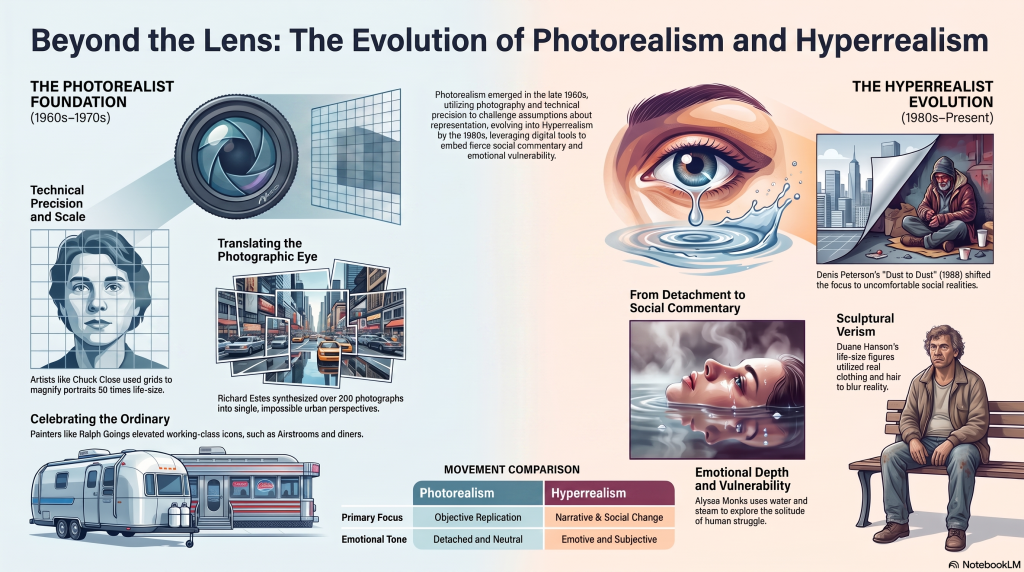
An overview of the Photorealism and Hyperrealism art movements. The lecture explores how artists utilize photographic references and meticulous technical skill to create works that often appear more detailed than reality itself. Key figures highlighted include Chuck Close, who used massive scale and grid systems to study human identity, and Richard Estes, who mastered the complex reflections of urban glass and steel. The sources also examine the symbolic, feminist contributions of Audrey Flack and the celebration of American working-class culture through the sleek, chrome subjects of Ralph Goings. Ultimately, the text illustrates how these artists challenged traditional notions of representation and artistic authenticity during the late 20th century.
(My YouTube video will be published on 7 November 2026)
My notes on Photorealism and Hyperrealism
A discussion on Photorealism and Hyperrealism created by Google NotebookLM:
The Hook: Perception vs. Reality
Since the late 1960s, Photorealism has captivated audiences by mimicking the camera’s mechanical precision. But it was never mere copying—it was a “cool” rebellion against the emotional excess of Abstract Expressionism. This post traces its evolution into Hyperrealism, where technical mastery serves deeper, often uncomfortable truths.
The Obsession Born of “Face Blindness”
Chuck Close’s Big Self-Portrait (1967–68) magnified his head fifty times life-size using a painstaking grid technique. The “surprising truth” lies in his neurology: Close had prosopagnosia (face blindness), which drove his obsessive need to map faces in microscopic detail. His trademark dangling cigarette—though he rarely smoked—projected toughness against critics who dismissed photographic reference as “cheating.” His work wasn’t self-tribute but an investigation into how we construct identity from fragmented data.
Creating a Reality No Camera Can Catch
Richard Estes’ Telephone Booths (1967) depicted Manhattan’s chrome-and-glass surfaces with a complexity no lens could capture. Unlike peers who used grids or projectors, Estes painted freehand, synthesising over 200 photographs into a single impossible perspective—”reflections within reflections.” Critic Linda Nochlin recognised this as elevating urban debris into high art, even as others like Harold Rosenberg questioned whether it was progress or regression.
“Estes transformed mundane urban debris into monuments of modern life.” — Linda Nochlin
Breaking the Emotional Cold Front
Audrey Flack broke Photorealism’s “cool,” male-dominated detachment by reintroducing emotion. Her 1977 Marilyn (Vanitas) updated Dutch vanitas tradition, surrounding Marilyn Monroe with cosmetics and hypersaturated colour via airbrush, critiquing beauty’s transience. In 1974, her work Leonardo’s Lady became the first Photorealist piece acquired by MoMA—years before Close or Estes.
The Uncanny Verism of the “Everyman”
Duane Hanson brought “Verism” to sculpture with life-size figures like Artist with Ladder (1972), often mistaken for real people. Using molds of human models, real hair, and artificial sweat stains, Hanson achieved forensic realism—viewers reportedly apologised after bumping into his sculptures. By depicting ordinary Americans rather than elite subjects, he democratised sculpture’s traditional hierarchies. Artist with Ladder later sold at auction for $375,000.
Art as a “Trojan Horse” for Social Change
Denis Peterson’s Dust to Dust (1988) marked Hyperrealism’s birth, using harrowing precision to depict a homeless man and force viewers to confront ignored social realities. Trained by his grandfather (a protégé of Claude Monet) and at the Pratt Institute restoring Flemish paintings, Peterson brought an Old Master depth absent from earlier Photorealism. Critic Robert Morgan noted his “extraordinary compassion.”
“We can flip past a Newsweek photograph, but we can’t easily turn from such extraordinary compassion.” — Ari Siletz
When Maximum Control Leads to Abstraction
For some, hyper-precision proved a training ground back toward abstraction. Alyssa Monks obsessed over “maximum realism” in steam-obscured bathroom scenes—until her mother’s death in 2012 caused her surfaces to “splinter” into wild, expressive brushwork. Don Eddy similarly abandoned Photorealism for abstract geometric painting, suggesting that mastering the physical world’s limits eventually turns the artist inward.
Conclusion: The Question of Truth
From Close mapping a face he couldn’t recognise, to Peterson using restoration skills to dignify a man on the street, these artists used the “camera” of the mind to construct new truths. Do you prefer art that copies the world we know—or art that uses precision to reveal a truth we have yet to see?
60-14 Arte Povera
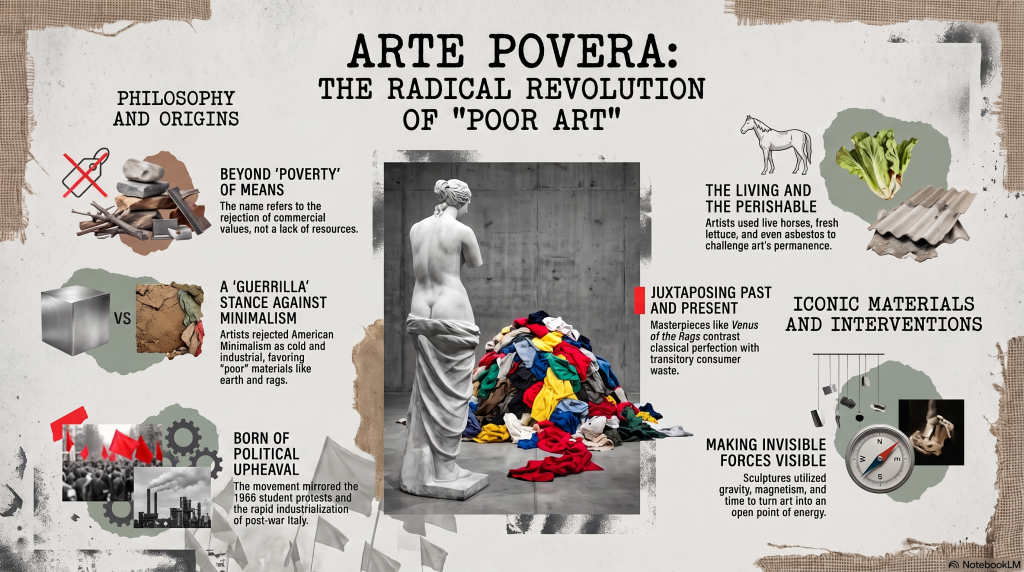
The Arte Povera movement was a radical Italian art development of the late 1960s characterized by its rejection of traditional materials and commercialism. Coined by critic Germano Celant, the term “poor art” describes the use of unconventional substances like earth, rags, and found objects to reconnect creative expression with the physical world. Key figures such as Michelangelo Pistoletto and Mario Merz utilized these materials to critique the rapid industrialization and social upheaval of the era. Their works often juxtapose classical beauty with modern waste or employ mathematical concepts to explore natural growth and nomadic existence. By favoring transitory materials over industrial permanence, these artists waged a metaphorical “guerrilla warfare” against the established art market. Ultimately, the movement serves as a profound meditation on the tension between Italy’s artistic heritage and its shifting contemporary identity.
(My YouTube video will be published on 14 November 2026)
A discussion on Arte Povera created by Google NotebookLM:
In the late 1960s, a visceral revolution erupted across Italy’s industrial north. As American Minimalism embraced steel, geometry, and polish, Italian artists turned to rags, earth, lettuce, timber, and even live animals. Their rebellion grew from the “Miracolo Italiano,” the economic boom that made Italy a consumer powerhouse while accelerating industrial waste and social dislocation. Arte Povera stripped art of commercial pretence and reconnected it with raw matter, energy, and lived experience.
“Poor Art” Wasn’t About Poverty
The term “poor art” did not mean art made from poverty. When critic Germano Celant coined Arte Povera in 1967, “poor” was a philosophical position: a refusal of glossy, market-ready art. By using humble materials—earth, glass, found objects, and rags—the artists challenged the idea that art had to be precious, permanent, or easily sold.
When Eternal Beauty Meets the Dumpster
Michelangelo Pistoletto’s Venus of the Rags (1967) remains the movement’s defining image: a neoclassical Venus turned toward a heap of discarded clothes. The statue, bought cheaply from a garden supplier, faces rags taken from the artist’s studio, collapsing ideals of timeless beauty into the waste of modern consumption.
Working in Turin, dominated by FIAT and textile production, Pistoletto saw how prosperity generated surplus. When a monumental version of the work in Naples was destroyed by arson in 2023, it was rebuilt using the charred frame, turning destruction itself into part of the piece’s history.
The Gallery as a Living, Breathing Ecosystem
In 1969, Jannis Kounellis filled Rome’s Galleria L’Attico, a former garage, with twelve live horses. He insisted he was still a painter, treating the gallery as a canvas and the animals as living compositional elements.
The work brought breath, smell, and instability into the white cube. Set against the “Hot Autumn” strikes and mass migration from countryside to factory, the horses became mythic reminders of an agrarian world displaced by industrial modernity.
Art with a Pulse—The Structure That Must Be Fed
Giovanni Anselmo made invisible forces tangible. In Untitled (Structure That Eats) (1968), two granite blocks are bound by copper wire around a fresh lettuce, which must be replaced as it decays to keep the sculpture “alive.”
Anselmo’s interest in energy began on Stromboli in 1965, when he saw his shadow suspended in the air at sunrise. From then on, his art sought to reveal gravity, magnetism, growth, and decay rather than freeze life into a fixed object.
Reversing Time and Revealing the Sapling
Giuseppe Penone treated sculpture as archaeology. In his Alberi series, he carved industrial timber beams back along their grain to reveal the young sapling hidden inside. Raised in the Maritime Alps, Penone used this reversal to show that nature persists beneath industrial processing and human intervention.
The Radical “Godfather” and the Inverted Nation
Piero Manzoni, though he died in 1963, anticipated Arte Povera’s radical materialism. His Achromes, made with kaolin and left to dry by gravity, and Artist’s Shit, which priced bodily waste like gold, attacked artistic authority and market value.
As Italy entered the violent “Years of Lead,” this irreverence gained political force. Luciano Fabro’s inverted, gilded maps of Italy suggested a nation whose values and certainties had been turned upside down.
Conclusion: A Legacy of Energy and Presence
Arte Povera’s legacy is not lack, but presence. It showed that humble materials can carry alchemical force, and that art can be a living process of tension, change, decay, and renewal.
In an age of climate crisis and disposability, its questions feel urgent again. If beauty can emerge from rags, lettuce, ash, or timber, what might we recover from the world we so casually discard?
60-15 Street Art
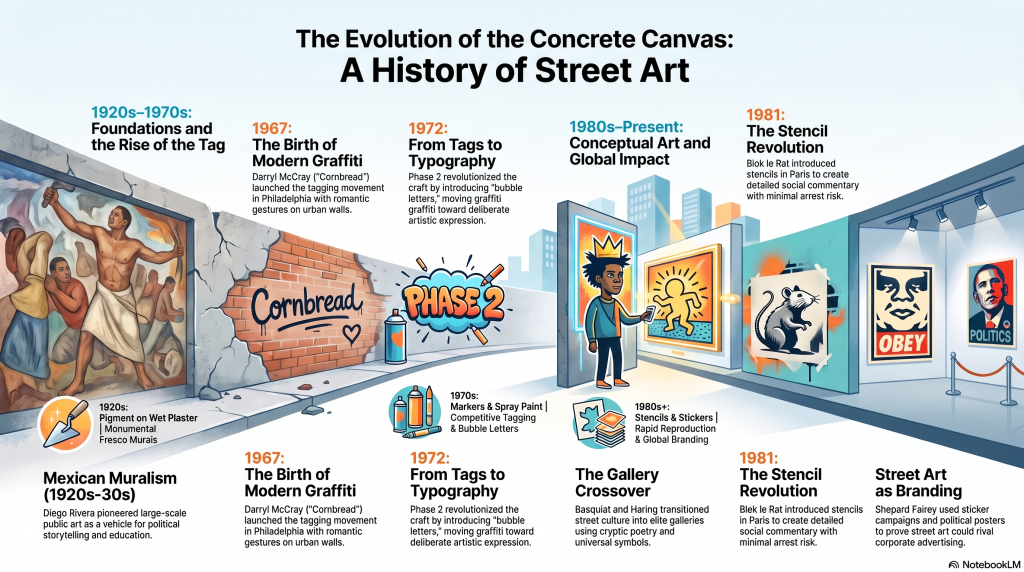
The evolution of street art is examined, tracing its journey from early communication to a global cultural force. The narrative begins by connecting modern practices to the legacy of Diego Rivera, whose massive murals made history accessible to the public. It highlights how pioneers like Cornbread in Philadelphia and Taki 183 in New York transitioned simple tags into a widespread phenomenon of territorial and personal visibility. As the movement matured, artists such as Phase 2 and Jean-Michel Basquiat introduced sophisticated styles and social commentary to urban surfaces. Finally, the text explores how figures like Keith Haring and Banksy helped democratize creativity by moving art out of traditional galleries and onto the streets. This comprehensive overview illustrates how graffiti and murals have transformed cityscapes while sparking vital conversations about identity and social justice.
(My YouTube video will be published on 21 November 2026)
A discussion on Street Art created by Google NotebookLM:
1. Introduction: The Gallery on the Corner
Street art is frequently dismissed as a municipal nuisance—a layer of “vandalism” that authorities spend millions to erase. However, to view urban creativity solely through the lens of property damage is to overlook a profound cultural metamorphosis. The movement that today dominates the global art market and influences everything from high fashion to political dissent did not emerge from elite white-cube galleries. Instead, the world’s most expensive art movement was forged through a teenager’s schoolyard crush in Philadelphia and the persistent daily route of a Greek-American messenger in New York City. By shifting the canvas from the studio to the sidewalk, these early “writers” democratized creativity, transforming neglected public spaces into a vehicle for identity and collective memory. This is not mere graffiti; it is the evolution of the open-air gallery.
2. It All Started with a Love Letter (and an Elephant)
The genesis of modern graffiti can be traced to 1967 Philadelphia and a teenager named Darryl McCray, known by his alias, Cornbread. Unlike later artists motivated by overt political rebellion, McCray’s campaign was born from a romantic gesture. To impress Cynthia, an eighth-grade crush at Strawberry Mansion Junior High, he plastered “Cornbread Loves Cynthia” across North Philadelphia.
This personal mission quickly transitioned into a citywide performance. McCray began tagging buses, police cars, and postal trucks, turning the assertion of personal identity into a public spectacle. His most audacious stunt occurred in 1971; after local newspapers falsely reported his death, McCray infiltrated the Philadelphia Zoo and spray-painted “Cornbread Lives” on the side of an elephant. This act codified tagging as a form of high-stakes performance art, proving that visibility was the ultimate currency of the street.
3. The Accidental Legitimacy of the “I Exist” Era
While Cornbread haunted Philadelphia, a Greek-American teenager named Demetrius, known as TAKI 183, was transforming New York’s visual landscape. Working as a messenger, Demetrius tagged his name and street number across all five boroughs. He operated during New York’s 1970s fiscal crisis, a period when neighborhoods felt abandoned and the subway system was left to decay.
In 1971, the New York Times published “Taki 183 Spawns Pen Pals.” In an attempt to document a curious urban pathology, the mainstream media inadvertently legitimized tagging as a cultural expression. This exposure sparked a city-wide competition, as youth forged elaborate styles to subvert their anonymity. The motive was fundamentally existential:
“His tags weren’t artistic masterpieces – they were territorial markers asserting ‘I exist.’”
These markers were the precursors to modern underground brand-building, where a simple signature serves as a recurring logo of presence.
4. The Stencil Revolution: Speed as a Survival Strategy
As the movement evolved, the risk of arrest necessitated tactical innovation. In the 1980s, Blek le Rat (Xavier Prou) pioneered the use of stencils for images. Inspired by the Italian political murals he saw in his youth and informed by his architectural studies at the École des Beaux-Arts, Prou began painting small black rats across Paris. For him, the rat was a symbol of urban resistance, operating in the shadows of the city.
The stencil was a surgical critique of urban decay. Its quick application reduced the “window of risk” for arrest, while the “infinite reproduction” of the image directly mimicked the corporate advertising it sought to subvert. This method allowed for complex social commentary—addressing homelessness and poverty—with a precision freehand spray painting couldn’t match. This handover of technique provided the essential blueprint for contemporary icons, serving as the primary influence for Banksy.
5. Meaningless Propaganda and the Power of Repetition
In 1989, Shepard Fairey created the “André the Giant Has a Posse” sticker. Originally a joke intended to teach friends screen-printing, the sticker became a global phenomenon. Fairey’s genius lay in the concept of “meaningless propaganda.”
Unlike traditional art that conveys a specific narrative, the absurdity of the wrestler’s face was intentional. Fairey wanted to expose how symbols gain power and perceived importance simply through relentless, aesthetic repetition. This mastery of public iconography eventually led Fairey to create the Obama “Hope” poster, the most successful marriage of street-level subversion and mainstream political messaging in history.
6. The Ultimate Counter-Intuitive Act: Value Through Destruction
The evolution of street art reached a peak of irony with Banksy’s Girl with Balloon. In 2018, seconds after the work sold at a Sotheby’s auction for £1.4 million, a hidden shredder within the frame partially destroyed the canvas.
The outcome was a masterstroke of institutional subversion. The shredded work, renamed Love is in the Bin, was not a ruin; it was a new work of performance art. In 2021, it sold for £18.6 million. This remains the ultimate irony: the high-end art establishment paying a massive premium for an act that attempted to destroy itself as a critique of that very establishment.
7. Conclusion: The Future of the Open-Air Gallery
The journey of street art is one of remarkable expansion—moving from the educational, monumental murals of Diego Rivera to the high-priced, shredded canvases of Banksy. What began as a desperate cry for recognition in neglected neighborhoods has been cemented as “art world royalty.” As these creators move from the “vandalism” of the street to the auction block, a vital question remains: can the democratization of creativity survive its own financial success?