Neo-Dada was a loosely defined tendency in American and European art of the 1950s and early 1960s that revived the spirit of the original Dada movement — its embrace of chance, contradiction, and the blurring of art and life — in response to the perceived heroic earnestness and market success of Abstract Expressionism. Artists including Robert Rauschenberg, Jasper Johns, John Cage, and Merce Cunningham in America, and Yves Klein, Jean Tinguely, and Piero Manzoni in Europe, challenged the distinction between art and life, the primacy of the unique hand-made object, and the romantic mythology of the artist as solitary genius. Rauschenberg’s “Combines” — works that incorporated everyday objects, newspaper clippings, and found materials into painted surfaces — proposed an art as messy, contingent, and inclusive as life itself. Neo-Dada laid the conceptual groundwork for Pop Art, Fluxus, Minimalism, and Conceptual Art, making it one of the most generative moments in postwar art history.
Against Abstract Expressionism — The Rebellion Against Rebellion: By the early 1950s, Abstract Expressionism had become the establishment against which a new generation had to define itself. Its emphasis on personal gesture, existential authenticity, and the tragic sublimity of the creative act seemed to a younger generation to have become a new academic convention — as restricting in its way as the academic realism it had replaced. Neo-Dada rejected the heroic self-dramatisation of de Kooning and Pollock in favour of a different kind of engagement with the real world.
Rauschenberg’s Combines — Art as Accumulation: Robert Rauschenberg (1925–2008) developed in the mid-1950s a form he called the “Combine” — works that fused painting with three-dimensional objects taken from everyday life: a stuffed goat with a tyre around its middle, a quilt attached to a canvas, a radio embedded in a painting. These works proposed that art could include anything — could be as varied, contradictory, and surprising as experience itself — and that the artist’s role was accumulation and arrangement rather than personal expression.
John Cage — Silence, Chance, and the Theatre of Everyday Sound: The composer John Cage (1912–1992) was the crucial intellectual figure linking Neo-Dada with the broader culture of postwar experiment. His famous silent piece 4’33” (1952) — in which a pianist sits at a piano for four minutes and thirty-three seconds without playing a note, inviting the audience to listen to the ambient sounds of the environment — was the most radical artistic gesture of the decade. Cage’s ideas about chance, indeterminacy, and the music of everyday life permeated the entire Neo-Dada circle.
Yves Klein — Immaterial Art and the Void: The French artist Yves Klein (1928–1962) compressed an enormous amount of artistic invention into a career of barely five years. His monochromes — canvases painted in a single, intense, proprietary blue (International Klein Blue) — explored the possibility of an art of pure colour sensation stripped of all representational or expressive content. His “Anthropometries” — performances in which blue-painted female models were dragged across canvases — and his “Zone of Immaterial Pictorial Sensibility” — conceptual works sold for gold leaf and then thrown into the Seine — pushed art towards the purely conceptual.
Piero Manzoni — The Artist’s Body as Medium: The Italian artist Piero Manzoni (1933–1963) produced in his brief life a series of works whose calculated outrageousness continues to generate controversy. His canned “Artist’s Shit” (1961) — ninety tins labelled in four languages, each claiming to contain thirty grams of the artist’s faeces, sold at the price of gold — made explicit the question that Neo-Dada posed to the art market: what exactly are you buying when you buy a work of art? The tins now sell at auction for hundreds of thousands of pounds.
Legacy — The Conceptual Turn: Neo-Dada’s decisive legacy was to shift the centre of gravity in art from the made object to the idea — to establish that what mattered in art was not the quality of the object produced but the quality of the thought that generated it. This was the foundation of Conceptual Art, which would emerge in the mid-1960s to pursue this logic to its conclusion. In this sense, Neo-Dada was the hinge between the art of the first half of the twentieth century and the art of the second — the moment at which the terms of the debate fundamentally changed.
59-01 Jasper Johns
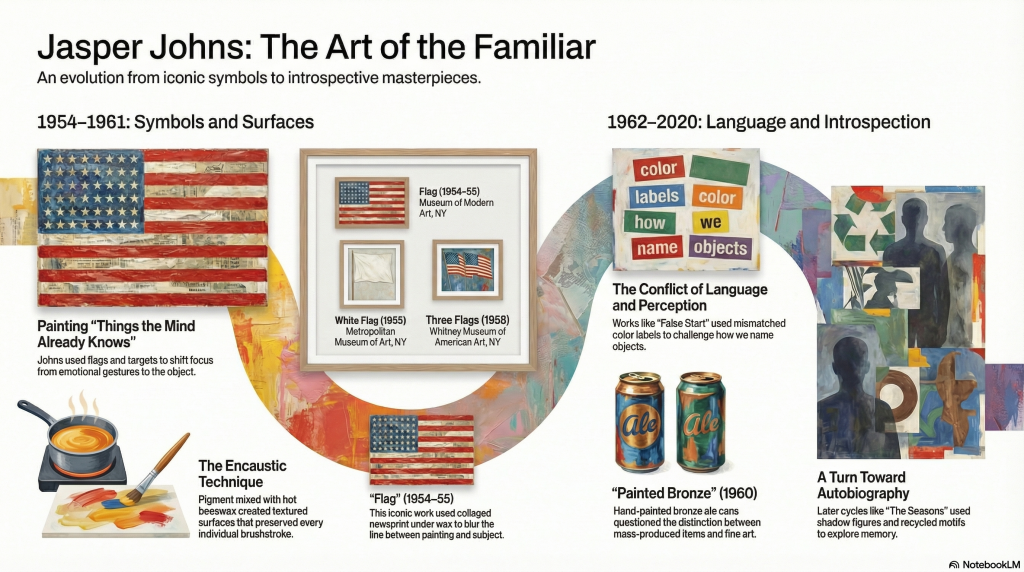
Jasper Johns revolutionised 20th-century art by bridging Abstract Expressionism and Pop Art. By depicting “things the mind already knows”—flags, targets, and maps—he shifted focus from emotional gesture to the philosophy of perception. His mastery of encaustic and printmaking redefined the artwork as a physical object, profoundly influencing Minimalism and Conceptualism.
The YouTube video will be published on 1 August 2026
A discussion on Jasper Johns (created by NotebookLM from my notes):
Jasper Johns grew up in a landscape he once described as having “no artists and no art.” Raised in the rural stretches of South Carolina after his parents’ marriage splintered, his childhood was an aesthetic vacuum. He wasn’t surrounded by the masterpieces of the past, but by the quiet, overlooked textures of a life lived far from the cultural centers of the world.
When he arrived in New York in the early 1950s, the atmosphere was thick with the “heroic gestures” of the Abstract Expressionists. It was an era of high-octane angst, where the drips of Jackson Pollock and the luminous voids of Mark Rothko demanded a total emotional surrender. For a young artist seeking a path forward, the problem was existential: how do you find something new to say when the prevailing mode is a shouting match of the inner psyche?
Johns’s solution was a radical pivot toward the mundane. He didn’t look inward for a private mythology; he looked at the most common, overlooked objects in the American landscape. By choosing to paint things that were already “done”—flags, targets, and numbers—Johns detonated the art world’s obsession with invention. He shifted the focus from the emotion of the painter to the physical reality of the object itself, effectively bridging the gap between the expressive past and the Pop and Minimalist future.
I. The Masterpiece that Started with a Dream
In 1954, at the age of twenty-four, Johns had a vision that would alter the trajectory of twentieth-century art. He didn’t labor over sketches or hunt for a profound political statement; he simply went to sleep.
“One night I dreamed that I painted a large American flag, and the next morning I got up and I went out and bought the materials to begin it.”
The resulting work, Flag (1954–55), was shocking not because of its subject, but because of its identity. In an era where paintings were expected to be “pictures” of something else, Johns created an object that simply was a flag. By collapsing the distance between the image and the object, he forced viewers into a conceptual corner. This ambiguity challenged the very definition of art, leading curator Kirk Varnedoe to later call it “one of the most important works of art made in the twentieth century.”
II. Embracing “Things the Mind Already Knows”
Johns famously sought out what he called “things the mind already knows”—symbols so ubiquitous they had become invisible. By choosing pre-existing designs like the alphabet in Gray Alphabets or the concentric circles of a target, he effectively escaped the angst-ridden vacuum of the blank canvas.
He freed himself from the “burden of composition.”
The design was already “given.”
This created a sophisticated irony.
By painting something everyone recognized, he forced the audience to actually look at the work for the first time. When the “what” of a painting is settled, the viewer is left to grapple with the “how”—the texture, the drips, and the sheer physicality of the medium.
III. The Beeswax Revolution
To achieve the haunting, tactile surfaces of works like White Flag, Johns revived the ancient technique of encaustic. This involved mixing pigment with hot beeswax, a medium that mummifies the news of the day in a semi-translucent skin. Unlike oil paint, which can take days to dry, wax sets almost instantly. This allowed Johns to “build” a surface, preserving every individual brushstroke and embedding fragments of newspaper and fabric—collaged onto plywood—just beneath the skin of the paint.
This deliberate, physical construction stood in stark contrast to the “splashy” emotionalism of the generation that preceded him. The newspaper clippings, peeking through the wax, create a sense of “buried time,” preserving a physical record of 1954 New York beneath the medium. It is a forensic approach to beauty, where the history of the work’s making is trapped forever in the material itself.
IV. The Joke that Became a Sculpture
The story behind Painted Bronze (Ale Cans) is a masterclass in artistic wit. Legend has it that Willem de Kooning, frustrated by the success of art dealer Leo Castelli, remarked that the dealer was so persuasive he could “sell beer cans as art.” Johns took the challenge literally, but with a twist that reversed the logic of the “readymade.”
Instead of simply placing real cans on a pedestal, Johns painstakingly hand-painted cast bronze to look like mass-produced Ballantine Ale cans. One can is “open” while the other is “sealed.” Look closer, and the hand of the artist is revealed: one can is painted more smoothly than its partner, creating a tension between the mass-produced and the unique. It is a riddle in metal that asks where the “real” object ends and “art” begins.
“The wittiest sculpture of the twentieth century.” — Critic Barbara Rose
V. The Body as a Hidden Map
While Johns’s early work felt “cool” and detached, a more personal, encoded layer eventually emerged. In Target with Plaster Casts, he used nine wooden compartments to house fragmented body parts—a hand, a foot, even a green-painted penis—taken from plaster casts of his acquaintances. These fragments suggest a “reliquary” of identity, perhaps encoding a queer identity during an era when homosexuality was criminalized.
As his career moved through seven decades, the “blankness” of the targets gave way to what critics called “anguish.” In the monumental Diver (1962), inspired by the suicide of poet Hart Crane, we see the forensic imprint of arms in a downward arc. Even at ninety, Johns remained a ferocious interrogator of new sources. In his 2020 work Slice, he adapted a skeletal figure from the Grünewald/Isenheim Altarpiece. Originally a meditation on the “plague saint,” the image gained an unintended, haunting resonance during the 2020 pandemic.
Conclusion: A Legacy of Productive Doubt
From his emergence in the 1950s Neo-Dada movement to his status as one of the world’s most expensive living artists, Jasper Johns has spent seventy years in a state of productive doubt. His career has been a constant, restless shift between “looking” and “reading”—between the image we recognize and the material we can touch.
He moved from the breakthrough flags of his twenties to the layered, introspective meditations of his tenth decade, always interrogating the boundary between art and life. Ultimately, his work leaves us with a profound question: If we stop looking for a hidden “meaning” in an image, are we finally able to see the object for what it truly is? By painting the things we already knew, he taught us how to see them for the very first time.
59-02 Robert Rauschenberg
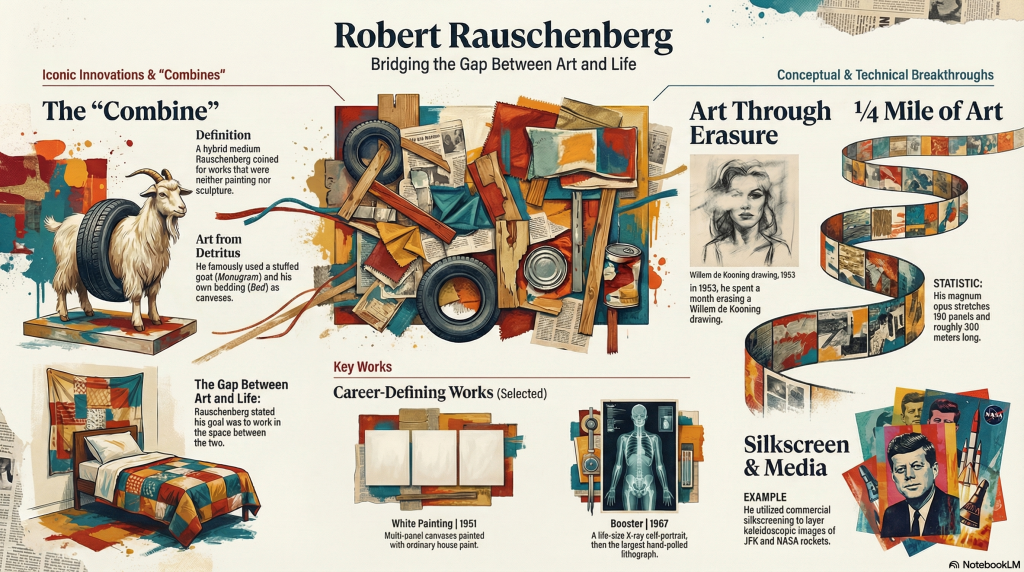
Robert Rauschenberg was a trailblazing American artist who bridged the gap between Abstract Expressionism and Pop Art. He is best known for his “Combines,” innovative works that blurred the line between painting and sculpture by incorporating everyday objects like tires, clocks, and taxidermy.
Throughout his career, Rauschenberg championed the use of non-traditional materials and silk-screen printing to explore contemporary culture. His multidisciplinary approach and restless experimentation redefined the boundaries of modern art, making him a central figure of the twentieth-century avant-garde.
The youTube video will be published on 8 August 2026
My notes on the talk about Robert Rauschenberg
A discussion of Robert Rauschenberg (created by NotebookLM from my notes):
What if the objects we dismiss as detritus—the grease-stained quilts, the discarded tires, the literal contents of a Seventh Avenue skip-bin—are actually the building blocks of high art? For Robert Rauschenberg, the “junk” of the everyday was never just material; it was a bridge. He famously operated in what he called “the gap between art and life,” challenging a mid-century art world to see the aesthetic weight in the mundane.
Before he was the titan of Neo-Dada, he was Milton Rauschenberg, a boy from Port Arthur, Texas—a gritty oil-refinery town where his mother, Dora, famously made the family’s clothes from fabric scraps. A poor student who struggled with undiagnosed dyslexia, Rauschenberg had no idea art existed as a profession until he stumbled into the Huntington Art Gallery while on leave from the U.S. Navy. That chance encounter launched a career defined by an ironic, rebellious, and relentlessly human-centric spirit.
Here are five lessons from the man who broke the rules to find the masterpiece in the mess.
- Sometimes, Creation Requires Destruction
In 1953, a 27-year-old Rauschenberg committed an act of “Oedipal patricide” that still reverberates through art history. He decided that if art could be made by applying marks, it could also be made by removing them. To prove it, he didn’t want to erase just any drawing; he wanted to erase a “masterpiece” to ensure the act carried the weight of a conceptual shift rather than mere vandalism.
He nervously approached Willem de Kooning, the reigning king of Abstract Expressionism, armed with a bottle of Jack Daniel’s as a peace offering. De Kooning understood the audacity of the challenge. “I’m going to make it so hard for you to erase this,” he warned, deliberately choosing a densely worked drawing of charcoal, pencil, and oil paint. It took Rauschenberg a full month and dozens of erasers to complete the task.
While the resulting surface appears almost blank, SFMOMA used advanced digital imaging in 2010 to reveal the “ghost” of de Kooning’s original: several figures, including a female nude. The act wasn’t an ending, but a new beginning.
ERASED DE KOONING DRAWING / ROBERT RAUSCHENBERG / 1953. — Inscription added by Jasper Johns - Your Bed is a Canvas, and a Goat is a Masterpiece
Rauschenberg’s greatest contribution to the visual lexicon was the “Combine.”
Combine: A hybrid of painting and sculpture that inhabits the space between the two, integrating 3D objects into the 2D plane.
His 1955 work Bed was born of necessity; he was so broke he had no canvas, so he used his own patchwork quilt and pillow, splattering them with oil paint and hanging them vertically. At the time, Rauschenberg and his creative partner Jasper Johns were surviving by designing window displays for Tiffany & Co. under the pseudonym “Matson Jones.” When Bed was first exhibited in Italy, authorities were so unsettled by its visceral, messy intimacy they reportedly believed it was evidence of a murder scene.
Then came Monogram (1955–1959). Rauschenberg found a stuffed Angora goat in a secondhand office furniture store on Seventh Avenue and bought it for his last fifteen dollars. The work went through three iterations and only reached its iconic form—the goat standing on a horizontal platform with a tire around its middle—at the suggestion of Jasper Johns. While critic Robert Hughes famously interpreted the work as an image of “anal intercourse,” Rauschenberg preferred the literal: a collision of the pastoral and the industrial. - Spontaneity is Often a Performance
In 1957, Rauschenberg pulled a devastating “prank” on the “heroic” posturing of the Abstract Expressionists. At the time, the art world worshipped the “spontaneous” brushstroke as a direct window into the artist’s soul. Rauschenberg challenged this myth with Factum I and Factum II.
He created two paintings that appear identical, meticulously copying every “instinctive” drip and smudge from the first onto the second. It was a masterful demonstration that apparent spontaneity could be faked. Critic Leo Steinberg coined the term “flatbed picture plane” to describe this: Rauschenberg’s canvases were no longer windows into emotional depths, but horizontal surfaces of accumulation—like a tabletop or a bulletin board.
In a final twist of irony, the “twins” are now permanently separated: Factum I resides in Los Angeles and Factum II in New York, a poetic echo of the eventual end of the Rauschenberg-Johns relationship. - Art Can Be a Legal Nightmare
The intersection of art and reality reached a peak of absurdity with the 1959 Combine Canyon. The work features a taxidermied bald eagle—originally found in a hallway and allegedly stuffed by one of Theodore Roosevelt’s Rough Riders—jutting out from a canvas of collaged photographs.
The work belonged to legendary gallerist Ileana Sonnabend. Upon her death, the IRS valued Canyon at a staggering $65 million for estate tax purposes. However, because the Bald Eagle Protection Act of 1940 makes it a federal felony to sell the bird, appraisers argued its market value was effectively zero. This art-law standoff lasted for years: the government claimed it was worth millions, yet the law forbade it from ever being sold. Eventually, the heirs donated the “zero-dollar” masterpiece to the Museum of Modern Art, a permanent reminder that the physical reality of an object can collide head-on with the structures of power. - True Self-Portraits Are More Than Skin Deep
In 1967, Rauschenberg collaborated with Kenneth Tyler at the legendary Los Angeles workshop Gemini G.E.L. to redefine the “self-portrait.” The result was Booster, a work that pushed printmaking to a monumental scale. At over six feet tall, it was the largest hand-pulled lithograph of its time.
Rather than painting his face, Rauschenberg used a life-size, full-body X-ray of himself, positioning his transparent skeleton within an astronomical chart.
“Airports for lights, shadows, and particles.” — John Cage, describing the “silence” and receptivity of Rauschenberg’s surfaces.
There is an eerie, clinical intimacy to Booster. By stripping himself bare—exposing his bones and organs to the viewer—Rauschenberg suggested that our true identity isn’t found in the “mask” of our skin, but in the internal structures and the cosmic context we inhabit.
The Living Legacy of the Gap
Rauschenberg’s career was a relentless evolution that refused to be boxed in. In his later years, he launched the ROCI (Rauschenberg Overseas Culture Interchange), traveling to twelve countries—including China and Cuba—to foster global dialogue through art. Even after a stroke in 2002 left his right hand paralyzed, he continued to create with his left hand until his death in 2008.
His magnum opus, The 1/4 Mile (1981–1998), stretches nearly 300 meters—roughly the distance between his home and his studio on Captiva Island. It stands as a self-contained retrospective of a life spent walking that thin line between the world and the gallery.
Rauschenberg found art in skip-bins, old quilts, and discarded tires. He proved that the gap between art and life is as thin as a coat of paint. If that is true, what masterpieces are we walking past in the streets every day?