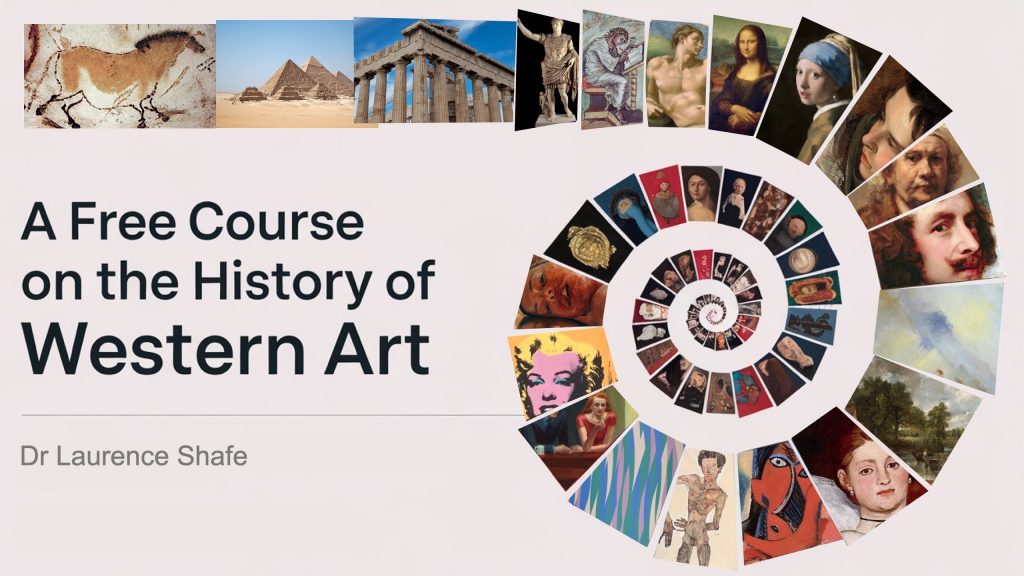
Pop Art emerged simultaneously in Britain and America in the mid-1950s as a provocative embrace of the visual language of mass consumer culture — advertising, comic strips, cinema, television, and the supermarket — as legitimate and even privileged subject matter for fine art. In Britain, the Independent Group at the Institute of Contemporary Arts in London — including Richard Hamilton, Eduardo Paolozzi, and the critic Lawrence Alloway who coined the term “pop art” — explored American mass culture with the fascinated anthropological curiosity of people encountering it from a distance. In America, Andy Warhol, Roy Lichtenstein, Jasper Johns, and Robert Rauschenberg produced work that was both a celebration of consumer culture and, in its serial repetition and emotional flatness, a searching critique of it. Pop Art challenged the boundary between high and low culture, the distinction between art and commerce, and the modernist dogma that art must be wholly original. Its legacy extends through every subsequent movement that has engaged with mass media, celebrity, and the commodity.
The Independent Group — Britain Discovers America: The Pop Art story begins not in New York but in London, where the Independent Group at the ICA gathered in the early 1950s to discuss American mass culture — Hollywood movies, Detroit automobile design, glossy advertising imagery — with a mixture of envy, excitement, and critical intelligence. Richard Hamilton’s collage Just what is it that makes today’s homes so different, so appealing? (1956) is generally regarded as the first Pop Art work, its gleaming consumer goods and bodybuilder figure parodying the American dream with English irony.
Andy Warhol — Fame, Death, and the Campbell’s Soup Can: Andy Warhol (1928–1987) is the central figure of American Pop Art and one of the most influential artists of the twentieth century. His Campbell’s Soup Cans (1962) — thirty-two canvases showing the full range of the product line, painted with deadpan precision — raised fundamental questions about originality, repetition, and the relationship between art and commerce. His silk-screen portraits of Marilyn Monroe, Elvis Presley, and Mao Zedong transformed celebrity into a form of icon-making as systematic as any medieval altarpiece.
Lichtenstein and the Comic Strip: Roy Lichtenstein (1923–1997) took the visual language of American comic strips and advertising — the Ben-Day dots, the bold outlines, the speech bubbles — and enlarged them to monumental scale on canvas. His images of crying girls, fighter pilots, and explosions (“WHAAM!”) made visible the visual conventions we normally consume without noticing, turning the throwaway imagery of popular culture into objects of formal contemplation. Like Warhol, he was accused of simply reproducing existing images; like Warhol, he insisted on the transformation that scale and context produced.
Jasper Johns — Flags, Targets, and the Object: Jasper Johns (born 1930) occupies a transitional position between Abstract Expressionism and Pop Art. His paintings of American flags, targets, and numbers — executed in encaustic with extraordinary physical richness — raise fundamental philosophical questions: is a painting of a flag a flag? Is a picture of a target a target? By choosing objects that are themselves already flat patterns, Johns interrogated the relationship between representation and the represented thing in ways that anticipated both Pop Art and Conceptual Art.
The Supermarket as Cathedral: Pop Art was inseparable from the postwar consumer boom and its visual landscape — the supermarket shelves, the roadside billboard, the television commercial, the movie magazine. Artists like Claes Oldenburg, who made giant soft sculptures of hamburgers and electric fans, and Tom Wesselmann, whose Great American Nude series placed the female body in the context of consumer goods, found in this landscape an inexhaustible source of imagery that was simultaneously seductive and alienating.
Legacy — The Democratisation of Art’s Subject Matter: Pop Art’s most lasting legacy was its demolition of the hierarchy that had kept popular and commercial imagery out of serious art. After Warhol and Lichtenstein, no visual subject could be dismissed as too lowly for artistic treatment. This democratisation of subject matter — carried through by subsequent movements from Neo-Expressionism to street art to digital art — is Pop Art’s most transformative contribution to the history of culture.
58-01 Pop Art- World War II and After
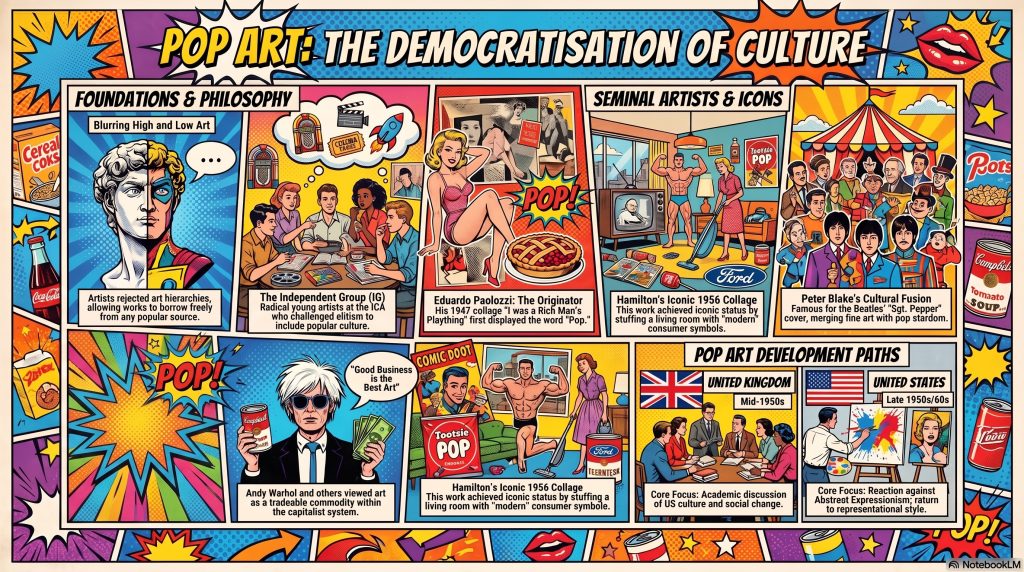
I examine the emergence and evolution of Pop Art, highlighting its distinct development in both Great Britain and the United States. While American artists like Andy Warhol reacted against abstract expressionism by embracing commercial imagery, British groups such as the Independent Group analyzed popular culture through an academic lens. The talk provides a detailed backdrop of life in the 1950s, noting how the era’s social austerity and technological shifts influenced creative output. Significant focus is placed on pioneers like Eduardo Paolozzi, credited with the first use of the word “pop,” and Richard Hamilton, whose iconic collages challenged the hierarchy between high and low art. Key exhibitions, specifically “This is Tomorrow” in 1956, are identified as seminal moments that integrated art, architecture, and mass-market symbolism. I show how Pop Art functioned as a postmodern response to the capitalist system and the changing domestic landscape.
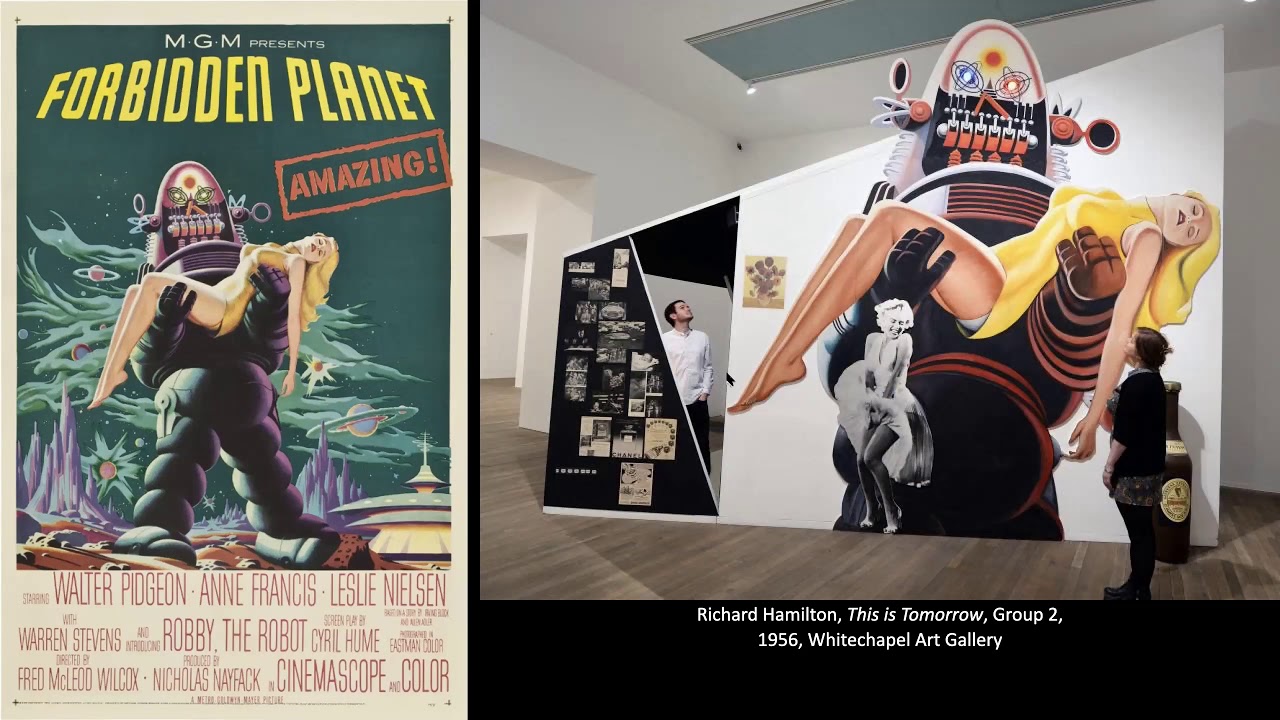
My notes on Pop Art – World War II and After
An interesting conversation about Pop Art created by Gemini Notebook from my notes:
1. Introduction: More Than Just Soup Cans
The popular imagination of Pop Art is a neon-saturated postcard of 1960s Manhattan—the silk-screened smiles of Marilyn Monroe, the mass-produced banality of Campbell’s Soup cans, and the comic-book bravado of Roy Lichtenstein. Yet, to treat Pop Art as a purely American export is a historical oversight. Years before the movement took root in the lofts of New York, it was quietly germinating in the bomb-cratered streets of post-war London. This was not a movement born of plenty, but of lack. It was a gritty, academic, and deeply cerebral reaction to British austerity, fueled by a distance-blurred fascination with an American “neon” lifestyle that felt like a transmissions from a different galaxy.
2. The “Pop” Word Was Born in 1947, Not 1962
The movement’s standard-bearer was not a factory-dwelling New Yorker, but Eduardo Paolozzi, a Scottish-Italian artist who first emblazoned the word “POP” into art history in 1947. His seminal collage, I was a Rich Man’s Plaything, was a product of his time as an undergraduate at the Slade School of Art. While the work’s use of pulp-fiction scraps and pin-ups feels playful, the psyche behind it was forged in genuine trauma.
Paolozzi, the son of Italian immigrants, had been interned at the start of the war; his release came only after his father, grandfather, and uncle drowned when their ship was sunk by a German U-boat. This proximity to senseless tragedy informed the “Bunk!” (nonsense) mindset of his 1952 lecture at the Independent Group. There is a deep irony in Paolozzi’s legacy: while he effectively claimed the title of originator, he later refused to show his early 1946–48 works. He remained ambivalent about the label, fearing that being seen as the “creator of Pop Art” would flatten the complexity of his broader career.
3. From Pea-Soupers to Neon: The Bleak Reality Behind the Bright Colors
To understand why British Pop artists obsessed over American consumerism, one must visualize the drab, ice-grey reality of 1950s Britain. This was a world of “pea-soupers”—thick, lethal layers of pollution that claimed 12,000 lives in 1952 alone. Rationing persisted until 1954, meaning sweets were a luxury and meals were a repetitive cycle of roasts and Monday “bubble and squeak.”
Life was visceral and unvarnished. Many homes still relied on outdoor toilets; families wore knitted bathing costumes on holidays and huddled in bedrooms where ice formed on the inside of the windows. Pop Art wasn’t just “fun”; it was a necessary psychological counter-point to this landscape of bomb sites and the imminent threat of nuclear disaster during the Cold War. The vibrant aesthetic was an intellectual escape from a world where one-third of a pint of free school milk often curdled in the summer heat.
4. The Lost Queen of Pop: The Tragic Legacy of Pauline Boty
Among the founders of British Pop, Pauline Boty remains its most poignant and overlooked figure. As the only female founder of the movement, her portraits of Marilyn Monroe—such as The Only Blonde in the World (1962)—offered an informal, less overtly sexualized perspective than the “cool” detachment of her male peers.
Boty was a cultural catalyst; she personally brought Bob Dylan to England, collecting him from the airport and hosting him in her apartment while he recorded. However, her life was defined by a brutal, selfless tragedy. Diagnosed with a rare form of leukemia while pregnant, she refused chemotherapy to save her child. She died at just 28, four months after her daughter, Katy, was born. In a final, grim coda, Katy later took her own life with a heroin overdose. Boty’s work was largely hidden in a barn until the 1990s, leaving only a ghost-like reputation in the London art scene.
“Even now, grown men with grey hair in dark houses in Notting Hill cry at the sound of Pauline Boty’s name.” — Sabine Durrent, 1993.
5. Business is the Best Art: Warhol’s Counter-Intuitive Philosophy
As Pop Art matured, it rejected the “involved” passion of the Abstract Expressionists, who sought to represent deep human traumas. Pop artists were “ambivalent and cool,” recognizing that in a capitalist system, art was a tradeable commodity. This philosophy was grounded in their own professional origins; many, including Andy Warhol, began as commercial artists. Warhol, a former magazine illustrator and graphic designer, saw no shame in the counting house.
“Business art is the step that comes after art. I started as a commercial artist, and I want to finish as a business artist. Being good in business is the most fascinating kind of art… making money is art, and working is art – and good business is the best art.” — Andy Warhol.
6. The £200 Masterpiece: The Hidden Economics of an Icon
The intersection of Pop and commerce reached its zenith with the cover of the Beatles’ Sgt. Pepper’s Lonely Hearts Club Band (1967). Designed by Peter Blake and Jann Haworth, the production cost was a staggering £3,000 at a time when standard covers cost £50. Despite the album’s iconic status, Blake received a mere £200 for his contribution.
This explosion of “Business Art” was fueled by a demographic shift: by the mid-60s, 40% of the population was under 25. This “baby boom” generation was the first to be free from the requirement of National Service after 1960. With newfound disposable income and a rebellious streak, they transformed the “Swinging City” into a market where art, music, and fashion were indistinguishable from industry.
7. Conclusion: The Democratization of Taste
Ultimately, British Pop Art was the intellectual conclusion of a debate regarding the value of mass culture. It successfully blurred the hierarchy between “high” and “low” art, recognizing that in a connected world, everything has value—from a Tootsie Pop to a Gainsborough.
The movement proved that art does not have to stand outside the system to critique it; it can exist, profitably and provocatively, at the very center. As we navigate today’s digital landscape of influencers and virtual commodities, we must ask: are we simply living in the final, realized evolution of the Pop Art dream? The revolution didn’t start with a bang in New York; it began with a revolver’s “POP” in the smog of 1947 London, reminding us that even the brightest dreams are often born in the grayest of times.
58-02 Pop Art – Andy Warhol and David Hockney
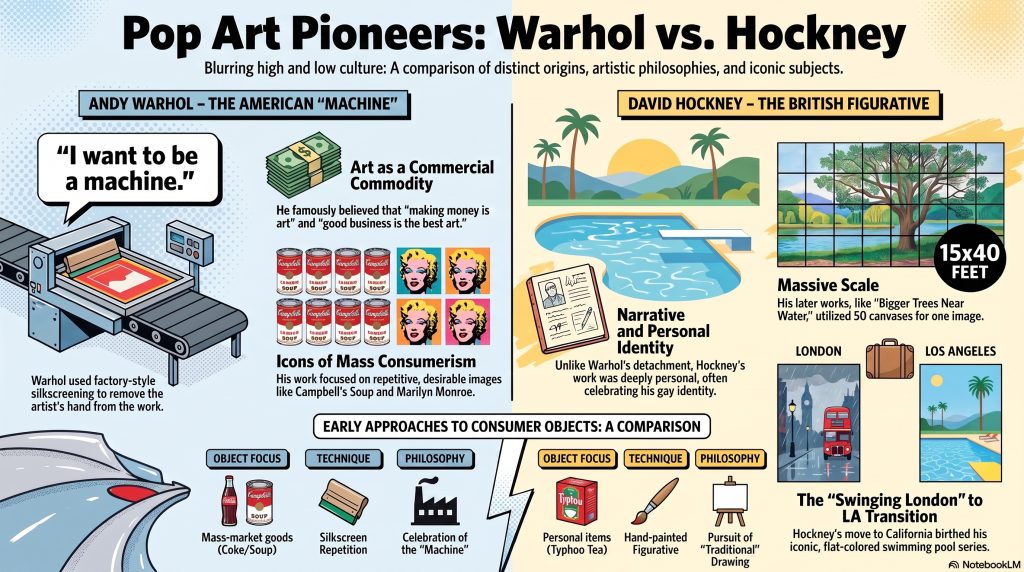
I analyze the evolution of Pop Art through the lives and creative output of Andy Warhol and David Hockney. While the movement emerged in both the United Kingdom and the United States, it developed distinct characteristics in each region, ranging from academic cultural analysis to a critique of blossoming consumerism. The talk explores how both artists transitioned from commercial illustration to fine art, eventually blurring the traditional boundaries between high and low culture. Andy Warhol is presented as a mysterious figure who transformed mass-produced goods and celebrity imagery into iconic brands. In contrast, David Hockney is depicted as a technically skilled painter who used figurative styles to explore personal themes, such as his identity as a gay man. Together, these materials provide a comprehensive look at how these two masters redefined the significance of everyday objects within the modern art world.
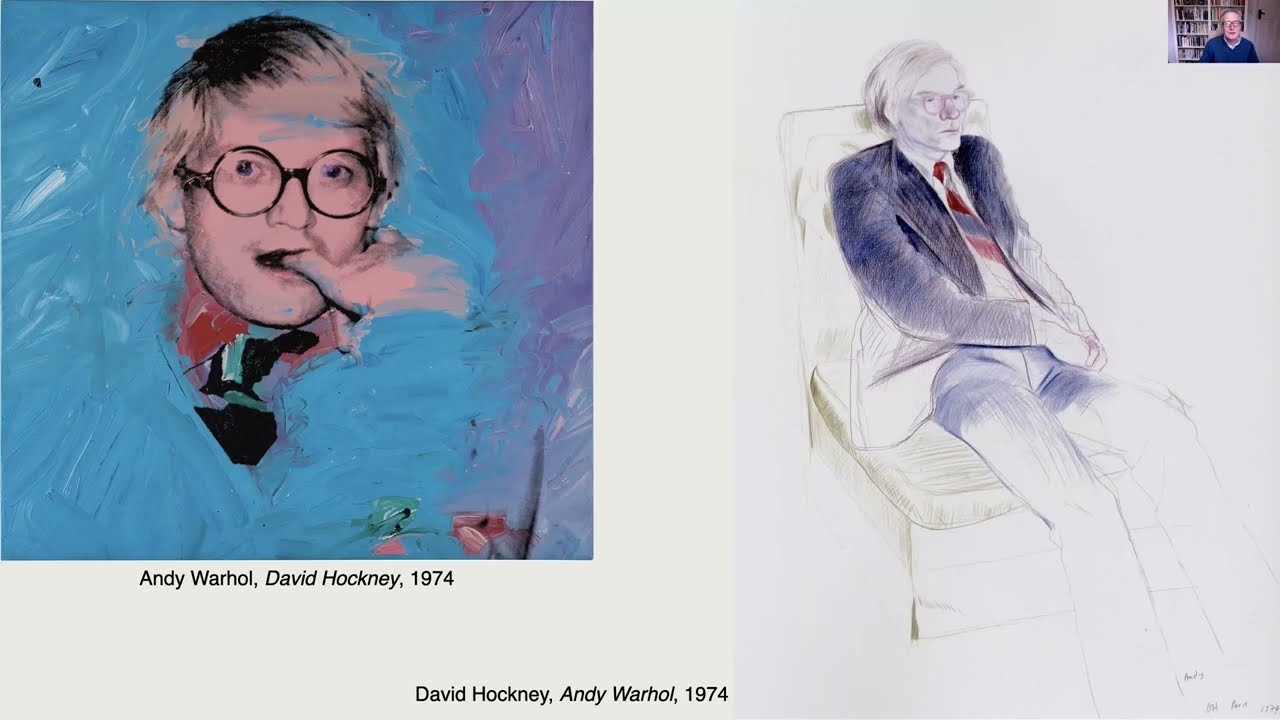
My notes on Andy Warhol and David Hockney
An interesting conversation about Andy Warhol and David Hockney created by Gemini Notebook from my notes:
The Hook: More Than Just Soup Cans
The 1960s did not arrive as a whisper; they erupted as a neon-drenched explosion that shattered the existing galleries of the mind. Before the advent of Pop, the art world was the fiefdom of Abstract Expressionism—a movement of “passionate and direct” intensity. The canvas was treated as a psychic battlefield where tortured souls like Jackson Pollock sought to represent the deepest human traumas through the violent, visceral application of paint.
Then came the “cool” observers. Suddenly, the artistic gaze shifted from the internal abyss to the supermarket shelf. This was Pop Art: an aesthetic that was ambivalent, detached, and unapologetically fascinated by the glossy surface of modern existence. At the helm of this revolution stood two figures who redefined the very geography of the “fine arts”: the enigmatic Andy Warhol and the technically legendary David Hockney. While their work is often dismissed as mere bright-colored frippery, the philosophies driving their brushes were far more complex—and frequently darker—than the primary colors suggest.
Takeaway 1: Pop Art Started as a British Academic Movement
We tend to view Pop Art as a quintessentially American invention, a product of the mid-century consumerist frenzy in New York. However, the movement’s roots were actually deeply scholarly and firmly planted in British soil. The term “Pop Art” was first coined by the English critic Lawrence Alloway in a 1958 issue of Architectural Digest to describe paintings that celebrated post-war consumerism and defied the heavy-handed psychology of the Abstract Expressionists.
The movement began in the mid-1950s as an intellectual endeavor within the “Independent Group” at the Institute of Contemporary Arts (ICA) in London. While the United States was already awash in the “abundance and excess” of new goods—epitomized by the massive GE50-S refrigerators of the era—the British were still catching up financially. Consequently, for figures like Richard Hamilton and Eduardo Paolozzi, Pop began as an analysis of U.S. culture from a distance. It was an academic conclusion about the relevance of mass culture, whereas for the Americans, it was an immersion. It is a delicious historical irony that the “low-brow” aesthetic we associate with Madison Avenue advertising actually began as a high-minded British academic exercise.
Takeaway 2: The Radical Rejection of Art Hierarchies
The most transgressive act of Pop Art was its deliberate erasure of the line between “high” and “low” culture. For centuries, art had maintained a strict hierarchy: “epic” classical subjects occupied the summit, while the imagery of everyday commerce was strictly excluded. Pop Art rejected this elitism, choosing instead to worship at the “altar of materialism.”
The movement shifted the focus from the individual artist’s “traumas” to a “cool” observation of the mundane. By affording mass-produced objects the same significance as classical history paintings, Pop artists signaled that in an interconnected capitalist world, the “pure, naked” object of society is a valid source for creation.
“Pop Art brought art back to the material realities of everyday life, in which ordinary people derived most of their visual pleasure from television, magazines or comics.”
Takeaway 3: David Hockney’s Reluctant Relationship with the “Pop” Label
David Hockney achieved instant notoriety at The Young Contemporaries exhibition in 1961, an event that announced the arrival of British Pop Art. Yet, Hockney famously rejected the label. While his early work utilized popular imagery, his motivations were often far more personal and radical than a mere critique of consumerism.
When Hockney moved to Los Angeles in 1964, he fell in love with the sun-drenched “artifice” of California. His iconic swimming pool series, such as Peter Getting Out of Nick’s Pool (1966), served as an unabashed celebration of the male nude. This was a profoundly brave act; Hockney was openly gay and depicting homosexual love during a period when it remained illegal in England (a status that didn’t change until the Sexual Offences Act of 1967). To capture the “smooth, flat and brilliant colours” of this sensual lifestyle, Hockney transitioned from traditional oils to the new medium of acrylics, using masking tape and rollers to achieve a clinical, modern perfection that mirrored the L.A. sky.
Takeaway 4: Warhol’s “Business Art” was the Ultimate Performance
Before he was a fine art icon, Andy Warhol was the “Leonardo da Vinci of the shoe trade”—a wildly successful commercial illustrator who, by the early 1960s, was already earning the equivalent of $1 million a year. This background birthed his radical philosophy of “Business Art.” Warhol didn’t just paint products; he turned the process of creation into a product itself.
His studio, “The Factory,” functioned exactly as its name implies, utilizing “machine-like” production methods to churn out art. He defied the “hippie era” disdain for wealth, asserting that “good business is the best art.” The ultimate wit of Warhol’s performance lay in the paradox of his personal life: he was a millionaire “Business Artist” who cultivated a shy, mystery-shrouded persona, yet he still lived with his mother and ate Campbell’s soup for lunch every day. His obsession with materialism was literal; he was an obsessive hoarder who left behind over 100,000 items, including his famous “Time Capsules”—600 cardboard boxes filled with the ephemeral debris of everyday life that most would simply throw away.
“Making money is art, and working is art – and good business is the best art.”
Takeaway 5: Repetition as a Commentary on Mortality
Perhaps Warhol’s most profound tool was repetition. In his Marilyn Diptych (1962), created shortly after Marilyn Monroe’s suicide, he used the silkscreen process to commodify her fame. The title was a deliberate nod to religious history, framing the work as a “secular altar” to a fallen star.
The repetition across the panels packages the celebrity’s face as a standardized product, reminding us that the public only knows the image, never the person. On the right panel, the ink blurs and fades—a haunting commentary on the star’s mortality and the ephemeral nature of celebrity. This darker current flowed through his Death and Disaster series, which featured car crashes and the electric chair from Sing Sing, proving that the “bright” world of Pop was frequently, and inextricably, associated with violence.
Takeaway 6: The “Machine” vs. The Hand-Painted Reality
Warhol famously claimed, “I think everybody should be a machine,” yet his early work betrays a lingering human touch. His 1962 Campbell’s Soup Cans were actually hand-painted and slightly different from one another. We see a similar evolution in his Coca-Cola bottles: in 1961, he “defaced” the bottle with painterly, Abstract Expressionist marks. He was soon advised to move to a “pure object” style because the naked, unadorned representation was a more powerful mirror of society.
Similarly, Hockney’s Tea Painting (1961) demonstrated a sophisticated technical execution that predated the movement’s most famous milestones. By utilizing a shaped canvas that departed from the traditional rectangle, Hockney preceded Warhol’s 3D box sculptures by three years. This reveals the irony at the heart of the movement: while these artists strove to make their work look “mass-produced” and “low-cost,” they were utilizing Hockney’s “legendary drawing skill” and complex technical innovations to achieve that very flatness.
Closing: The Enduring Mirror of Materialism
Pop Art’s enduring legacy is not that it sold out to advertising, but that it captured the “mood of society” and held it up for examination. It recognized that we are all parts of a capitalist system where art is a tradeable commodity, yet it used that status to ask difficult questions about our values and our mortality.
As we navigate a digital age of instant branding, we must ask: are we still living in the “Business Art” era Warhol predicted? In a world of social media influencers and 24-hour self-packaging, his most famous prophecy feels less like a prediction and more like a daily requirement:
“In the future, everyone will be world-famous for 15 minutes.”