54-01 Maurits Escher (to be published on 4 July 2026)
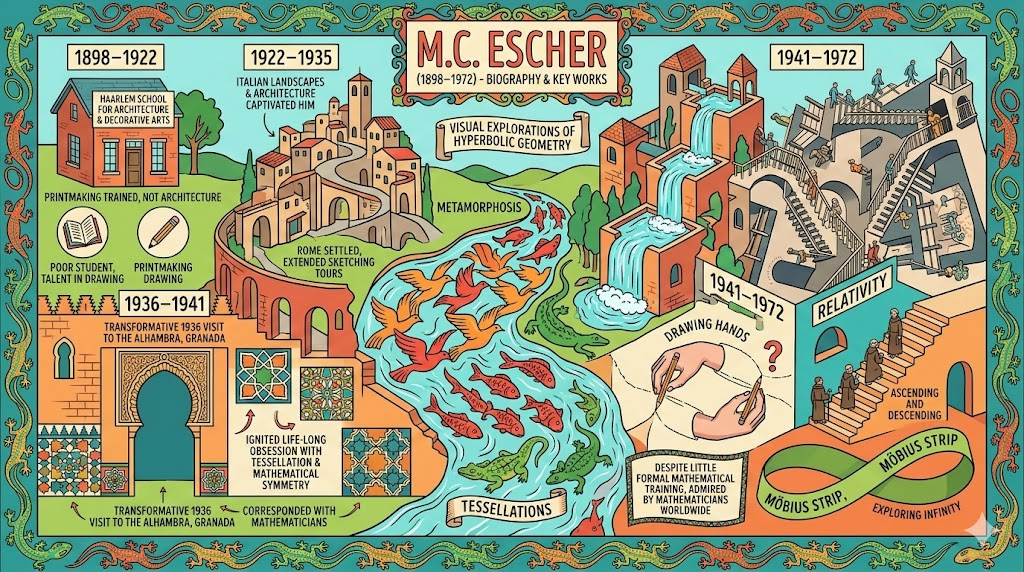
This presentation provides a comprehensive biographical and artistic overview of the Dutch printmaker Maurits Cornelis Escher. It traces his journey from a struggling student to a world-renowned master of graphic arts, highlighting how his travels in Italy and Spain sparked a deep obsession with mathematical symmetry. The text examines his most famous masterpieces, such as Hand with Reflecting Sphere and Metamorphosis, explaining his technical mastery of lithography and woodcuts. Key themes explored include his use of tessellation, impossible architectures, and the seamless transition between positive and negative space. Furthermore, the source notes his unique ability to bridge the gap between fine art and complex geometry, earning him the enduring respect of both critics and mathematicians.
The YouTube video will be published on 4 July 2026.
My notes of the talk on Maurits Escher.
A discussion on Maurits Escher (created by NotebookLM based on my notes):
The visual syntax of M.C. Escher is so deeply woven into the fabric of the modern consciousness that we often navigate his world without realizing we have crossed the threshold. From the shifting, gravity-defying staircases in Jim Henson’s Labyrinth to the recursive, folding cityscapes of Christopher Nolan’s Inception, Escher’s “impossible architectures” have become the definitive lexicon for the surreal. Yet, for a man whose name is synonymous with psychedelic distortion, Maurits Cornelis Escher (1898–1972) was a remarkably disciplined, almost clinical figure. He did not view himself as a mystic or a traditional artist, but as a methodical researcher of the “logic” of space—a man who considered himself more of a scientist than a printmaker.
Escher’s journey began not in a burst of creative inspiration, but in the quiet frustration of a struggling architecture student. At the School for Architecture and Decorative Arts in Haarlem, he was a “mediocre pupil” who failed his high school exams. It was only through the intervention of his mentor, Samuel Jessurun de Mesquita, who recognized a singular talent for the woodcut, that Escher pivoted from building structures to deconstructing the very nature of perception.
1. The Intuitive Mathematician and the 47-Year Void
It is a profound irony of art history that Escher achieved a level of mathematical sophistication that stunned Nobel laureates, despite having no formal training. Relying on what he called “pure visual imagination,” he pioneered a form of topological dissonance that preceded modern computer modeling. His ability to intuit complex concepts—the Möbius strip, hyperbolic geometry, and non-Euclidean space—earned him the admiration of intellectuals like George Pólya and H.S.M. Coxeter. As physicist Roger Penrose famously observed, Escher “intuited principles of general relativity through pure visual imagination, achieving what equations could only describe.”
This intuitive genius is most palpable in his 1956 work Print Gallery, a masterpiece of the “Droste effect”—where an image contains a smaller version of itself ad infinitum. The work depicts a young man viewing a print that curves around to contain the very gallery where he stands. Yet, at the center of this recursive loop, Escher encountered a mathematical “void” he could not resolve. He intuitively understood that the architecture required an impossible logarithmic expansion to close the circuit, but lacking the tools, he left the center blank, masking the failure with his signature.
This mystery remained unsolved for nearly half a century. In 2003, a team of mathematicians at Leiden University utilized advanced algorithms to finally fill the void, publishing their findings in the Notices of the American Mathematical Society. They discovered that Escher had “accidentally” constructed a complex mathematical transformation decades before the tools existed to calculate it.
2. Symmetry as a Cognitive Anchor in the “Hongerwinter”
The perfect order of Escher’s tessellations—where birds, fish, and reptiles interlock in infinite, perfect symmetry—was often forged in the crucible of absolute chaos. The decisive turning point in his career was his 1936 visit to the Alhambra in Granada. He became “addicted” to the Moorish tilework, describing his obsession with the regular division of the plane as a “real mania.”
However, this mania took on a profound psychological dimension during the Nazi occupation of the Netherlands. During the “Hongerwinter” (the Dutch famine of 1944–1945), Escher’s world was a disintegrating mess of starvation and violence. In this context, his pursuit of perfect symmetry was not merely aesthetic; it was a form of neurological resistance. When the external world is erratic and lethal, the rigid, predictable logic of a four-meter woodcut like Metamorphosis II serves as a cognitive anchor—a way to impose a “sublime order” on a reality that has lost its mind.
During this period, the artist endured:
- Systemic Deprivation: Extreme malnutrition that claimed thousands of Dutch lives.
- Survival Rations: A diet reduced to the desperate consumption of tulip bulbs and sugar beets.
- Art as Barter: The necessity of trading his meticulous prints directly for food to keep his family alive.
3. The Domestic Origins of Transcendental Geometries
While Escher’s worlds feel otherworldly, his props were decidedly mundane. He translated the “mathematical precision” of his mind through a quiet, disciplined observation of ordinary objects. For his iconic Hand with Reflecting Sphere (1935), he did not gaze into a mystical crystal ball; he used actual mirrored Christmas tree ornaments of various sizes to study the convex distortions of his studio.
A close phenomenological examination of his work reveals startling technical truths:
- The Mirrored Self: In Hand with Reflecting Sphere, the lithograph process reverses the image, meaning the hand we see is actually a reflection of his right hand appearing as his left.
- Cultural Artifacts: Behind the artist in the reflection, one can see Indonesian shadow puppets hanging on the studio walls, a nod to his family’s civil engineering roots in the East Indies.
- The Physical Model: Escher owned a physical dodecahedron that sat on his desk for decades as a reference for his “strange loops,” an object that now resides in the Escher Museum.
Furthermore, Escher was left-handed—a trait he shared with masters like Da Vinci and Michelangelo—which perhaps granted him a unique perspective on the bilateral symmetry and mirroring that define his oeuvre.
4. Reconciliation Through a Handshake: The Duality of the Human Condition
Escher’s work serves as a meditation on the reconciliation of opposites, a theme most poignantly realized in Encounter (1944). In this composition, “optimistic” white figures and “pessimistic” black figures emerge from the same tessellated source, eventually circling a central void to meet in a handshake.
Created during the height of the war, the handshake is not a resolution of conflict, but an acknowledgment of a fundamental duality. It suggests that joy and despair, light and dark, are not separate entities but different expressions of the same underlying topological reality. As art critic Gillo Dorfles noted, Escher captured “the fundamental human condition—permanently divided yet seeking connection.” The circularity of the work reinforces the sense of a perpetual cycle; in Escher’s world, you cannot have the bird without the fish that defines its borders.
5. Topographies of the Impossible
The culmination of Escher’s life work—masterpieces like Waterfall (1961) and Ascending and Descending (1960)—represents the final fusion of architecture and topological insight. In Waterfall, he utilized the Penrose triangle to create a perpetual motion machine that defies the laws of thermodynamics. Perched atop the towers of this impossible structure are “stellated dodecahedrons,” complex polyhedra that ground the fantastic vision in geometric reality.
These works represent the final “strange loop” of his career. He turned the flat, polder landscapes of the Netherlands into infinite patterns of flight and transformed the three-dimensional world into a sublime visual experience that our brains are hard-wired to accept, even when our logic knows better.
Conclusion: The Final Strange Loop
Escher remains the man who turned non-Euclidean geometry into a relatable human experience. His legacy is a haunting reminder of the limits of our own perception. Physicist Richard Feynman famously kept a copy of Waterfall in his office as a memento mori for the intellect, noting that it reminded him that “intuition can be systematically wrong.”
If our brains are so easily seduced by the local logic of a Penrose staircase or a warped gallery, what other “impossible” truths are we failing to see in the world around us? We are, as the figures in Inception or Relativity suggest, often convinced we are ascending when we are merely circling the same floor—forever trapped in the beautiful, systematic errors of our own minds.