Surrealism, founded by the poet André Breton in Paris in 1924, was the most ambitious attempt in the history of art to liberate human creativity from the constraints of rational thought, exploring the irrational territory of dreams, desire, and the unconscious as revealed by Freudian psychoanalysis. It was simultaneously an artistic movement, a political project (aligned at various points with communism), and a comprehensive theory of human liberation. Visual artists including Salvador Dalí, René Magritte, Max Ernst, Joan Miró, Yves Tanguy, and Meret Oppenheim developed two broad strategies: the dreamlike, illusionistic technique of Dalí and Magritte, in which impossible things are painted with photographic precision; and the more automatic, abstract approach of Miró and Ernst, in which the unconscious is accessed through improvisation and chance. Surrealism proved extraordinarily influential far beyond its original Parisian context — on film, literature, advertising, fashion, and the visual arts — and its legacy extends to the present day.
Freud, Dreams, and the Unconscious — The Intellectual Foundation: Surrealism drew its intellectual energy from Sigmund Freud’s revelation that beneath the rational surface of human behaviour lay an unconscious mind seething with suppressed desires, fears, and fantasies. The Surrealists believed that conventional art — tied to rational consciousness and accepted social values — was a kind of censorship. By accessing the unconscious — through dreams, automatic writing, and deliberate disorientation — art could achieve a deeper truth.
The Two Faces of Surrealism — Automatism and Illusion: Surrealist visual art took two broad forms. The first — associated with Joan Miró, André Masson, and early Max Ernst — used automatic drawing and improvisation to allow the unconscious to shape the image without the intervention of conscious intention. The second — associated with Dalí, Magritte, and Tanguy — used technically accomplished illusionist painting to depict impossible, dreamlike scenes with the precision of photographic reality. Both approaches aimed to bypass rational control.
Dalí — Genius, Showman, and the Persistence of Memory: Salvador Dalí (1904–1989) is the most famous Surrealist, his drooping watches, melting forms, and meticulously painted dream landscapes having achieved a level of popular recognition unique among twentieth-century art. But Dalí was also a skilled self-promoter whose deliberate outrageousness eventually led Breton to expel him from the movement (coining the anagram “Avida Dollars”). His collaboration with Luis Buñuel on the films Un Chien Andalou (1929) and L’Age d’Or (1930) produced two of the most disturbing works in cinema history.
Magritte and the Treachery of Images: René Magritte (1898–1967) is the most philosophically rigorous of the Surrealists, his paintings posing fundamental questions about the relationship between images, words, and things. His famous painting of a pipe beneath the words “Ceci n’est pas une pipe” (“This is not a pipe”) — The Treachery of Images (1929) — encapsulates his project: to reveal the gap between representation and reality that we normally take for granted. Magritte’s influence on Conceptual Art and postmodern visual culture has been immense.
Max Ernst and the Invention of New Techniques: Max Ernst (1891–1976) was the most technically inventive of the Surrealists, developing a series of new techniques for bypassing rational control: frottage (rubbing pencil over textured surfaces), grattage (scraping paint from canvas), and collage combining disparate found images. His collage novels — La Femme 100 Têtes, Une Semaine de Bonté — are sustained exercises in dreamlike narrative montage that anticipate much subsequent visual storytelling.
Legacy — Surrealism’s Lasting Influence: Surrealism’s influence has been extraordinarily wide and deep. It transformed the possibilities of cinema — from Buñuel to Lynch. It shaped advertising and fashion photography’s embrace of the uncanny. It influenced the Abstract Expressionists, who adopted automatism as a means of accessing the unconscious. And in the broader culture, its dream logic and juxtaposition of incongruous elements has become so thoroughly absorbed that we see its traces everywhere — in music videos, in digital art, in the imagery of contemporary film.
53-01 Women Surrealists
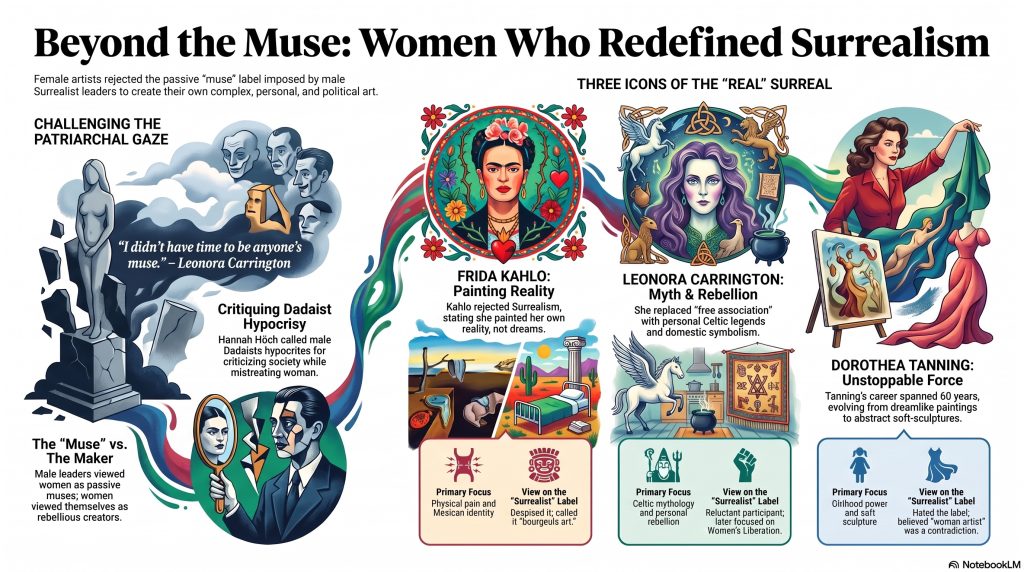
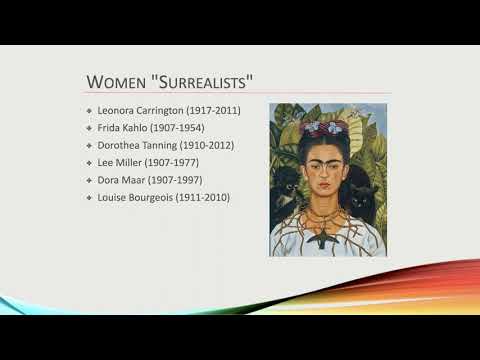
This talk is an overview of women’s contributions to the Surrealist movement, a topic that was historically overlooked by a male-dominated establishment. I highlight how many female artists, such as Frida Kahlo and Leonora Carrington, rejected the “Surrealist” label because they prioritized personal and political reality over the purely unconscious dreamscapes favored by men. The talk explores the life of Carrington in detail, tracing her journey from a rebellious English debutante to a significant figure in the Mexican art scene and women’s liberation. Her work is distinguished from that of her male peers by its roots in domesticity, Celtic folklore, and personal symbolism rather than free association. Brief biographical sketches are also provided for other influential figures, including Dorothea Tanning, Lee Miller, Dora Maar, and Louise Bourgeois. Ultimately, the materials aim to redefine these women as independent creators rather than mere muses for famous men like Max Ernst or Pablo Picasso.
A conversation about Women Surrealists created by Google Notebook from my note:
In the grand, hallucinatory tapestry of 20th-century art, names like Salvador Dalí, René Magritte, and André Breton are the golden threads. We recognize them as the architects of a revolution that sought to dismantle reason in favor of the unconscious. Yet, historically, the women of this era were relegated to the decorative borders, often cast as “muses,” “seducers,” or the “femme-enfant”—passive inspirations for the male gaze rather than intellectual peers.
The relatable curiosity of the modern viewer asks: why were these brilliant creators—who weaponized their own realities to dismantle the status quo—denied a seat at the head of the table? As a cultural historian, I find the answer lies in the very label of “Surrealism” itself. For many of these artists, the movement was not a playground for dreams, but a battlefield for survival.
1. To the Artists, the “Surrealist” Label Was a Trap
When discussing the women of this era, the term “Surrealists” belongs in inverted commas. This is not a slight against their talent, but a reflection of their own resistance. For artists like Louise Bourgeois and Frida Kahlo, the movement’s preoccupation with the “unconscious” was a bourgeois intellectual luxury they could rarely afford.
While André Breton’s 1924 manifesto called for a “super-reality” that resolved the conflict between dream and wakefulness, these women prioritized a visceral, often political, reality. They found the Parisian circle’s penchant for “free association” and “intellectual games” to be rotten and exclusionary. To them, the label was a patriarchal hegemony that attempted to categorize their lived experiences as mere “feminine” mysteries.
“I never painted dreams. I painted my own reality.” — Frida Kahlo
2. The Irony of the “Anti-Everything” Dadaist Hypocrisy
The roots of Surrealism lie in Dada—a movement that was, in theory, “anti-everything”: anti-beauty, anti-reason, and anti-convention. Born from the trauma of World War I, Dadaists believed social conventions had led to global carnage and thus sought to overthrow them all. However, as the German pioneer Hannah Höch pointed out, this revolutionary spirit had a blind spot: the treatment of women.
The internal conflict was stark. These men sought to liberate the human spirit while keeping their female peers in the role of the “inspiring muse.” Höch, who invented the revolutionary medium of photomontage, used her work to cut through this beer-belly cultural epoch. Her masterpiece, Cut with the Dada Kitchen Knife through the Last Weimar Beer-Belly Cultural Epoch in Germany, was a literal and symbolic act of domestic-sorcery, slicing through the patriarchal hypocrisy of a movement that claimed to be radical but refused to recognize its own chauvinism.
“The Dadaists were hypocrites. They criticised the way society treated women but refused to recognise the same faults in themselves.” — Hannah Höch
3. “Madness” was a Gritty Prison, Not a Poetic Metaphor
While the male Surrealists romanticized “hysteria” as a gateway to the divine unconscious, Leonora Carrington knew it as a house of horrors. After the internment of her lover, Max Ernst, during World War II, Carrington suffered a breakdown and was institutionalized in a Spanish asylum. Her experience was devoid of “surreal” beauty; she was subjected to agonizing Cardiozal injections to induce seizures, strapped naked to her bed, and left to lie in her own excrement.
She later used her art to reject the male circle’s tendency to view women as “powerless and at the mercy of the unconscious.” Carrington’s rebellion was total. In her short story The Debutante, she critiques the stifling debutante culture of her upper-class upbringing by sending a hyena to take her place at the Ritz. In a visceral detail often sanitized in history books, the hyena kills a housemaid and rips off the woman’s face to wear as a disguise. This was Carrington’s mode: a refusal to be a silent “powerless” muse, opting instead for a fierce, insatiable curiosity.
Even her personal life defied the movement’s neat narratives. In 1941, she met Max Ernst again in Lisbon—a “very weird” reunion where Ernst arrived with Peggy Guggenheim and a chaotic entourage. Rather than falling back into his shadow, she secured a marriage of convenience with a Mexican diplomat to forge her own path in Mexico City, where she became a founder of the Women’s Liberation Movement.
“I didn’t have time to be anyone’s muse… I was too busy rebelling against my family and learning to be an artist.” — Leonora Carrington
4. Frida Kahlo: The Ribbon Around a Bomb
André Breton, the “Pope of Surrealism,” famously claimed Frida Kahlo, describing her as a “young woman endowed with all the gifts of seduction, one accustomed to the company of men of genius.” It was a condescending framing of an artist who arguably possessed more genius than the entire Bretonian circle combined.
Kahlo’s work was not a surrealist exercise; it was a map of physical and spiritual agony. In The Broken Column (1944), we see the antithesis of the “dreamscape.” Nails pierce her skin, her torso is split open to reveal a crumbling lonic column, and a surgical corset serves as the only thing holding her shattered body together. This was the result of over 30 surgeries and a life of chronic pain, not a “crazy intellectual” game. She detested the Parisian Surrealists, finding them “so rotten that I can’t even stand them anymore.” For Kahlo, art was a tool for the people, a “true art” that utilized Mexican traditions and “Magical Realism” to navigate the brutal reality of being alive.
“A ribbon around a bomb.” — André Breton’s description of Kahlo’s work
5. Splintering the Mirror: The Choice to Be an Artist
If the early era of Surrealism was about being “labeled,” Dorothea Tanning spent her 101-year life fighting to peel that label off. After discovering the movement at the 1936 New York exhibition, Tanning’s breakthrough came in 1943 during Peggy Guggenheim’s Exhibition by 31 Women. It was Max Ernst who persuaded Guggenheim to include her after seeing her self-portrait, Birthday. Ernst actually named the painting, viewing it as her “birth” as a Surrealist.
However, Tanning’s career—which spanned over 60 years—refused to remain stagnant. In 1955, her style underwent a radical transformation. Her canvases became fragmented and prismatic, a phase she called her “prism paintings.” As she famously put it, “My canvases literally splintered… I broke the mirror.” This was her way of shattering the “Surrealist” reflection that the art world insisted on holding up to her. She fiercely rejected the gendered pigeonhole of the “woman artist,” arguing that gender is a biological given, but artistry is a sovereign choice.
“Women artists. There is no such thing—or person. It’s just as much a contradiction in terms as ‘man artist’ or ‘elephant artist.’” — Dorothea Tanning
Conclusion: Beyond the Dreamscape
These women did not merely “participate” in Surrealism; they dismantled it from the inside out. They rejected the role of the passive muse, using their canvases to process the nails in their skin, the cardboard-box eyes of their trauma, and the literal filth of the asylum. For them, art was never an intellectual hobby—it was, in Tanning’s words, “the raft onto which we climb to save our sanity.”
As they “broke the mirror” of the movement, they forced the world to see them as they truly were: creators whose work was fueled by a reality far more terrifying and beautiful than any dream André Breton could have conjured. In a world that still loves to label creators by their gender or their “muse” status, we must ask: can we finally see these artists for the power of their work alone?
53-02 René Magritte
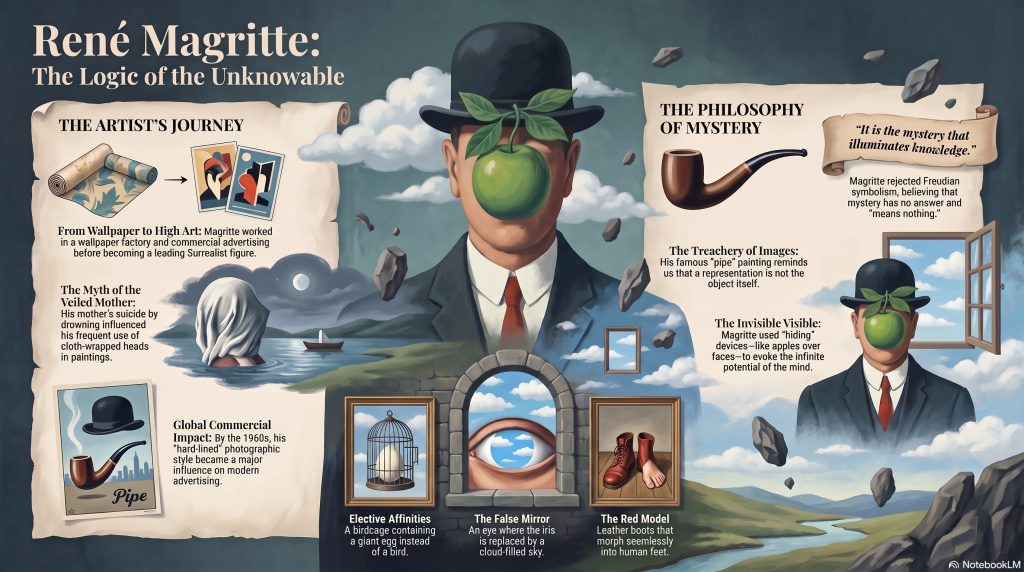
This talk explores the obsession of the Belgian surrealist René Magritte with mystery and the unknowable, highlighting how his paintings utilize ordinary objects to challenge our perception of reality. Key biographical details are included, such as his difficult childhood, his long-standing partnership with his wife Georgette, and his various stylistic periods ranging from Cubism to his iconic Surrealist works. The talk features his most famous paintings and personal quotes that reveal his rejection of traditional symbolism in favour of poetic, thought-provoking imagery. Furthermore, the material discusses his artistic influences, such as Giorgio de Chirico and popular crime fiction, which helped shape his unique visual language. The talk illustrates how Magritte’s work continues to impact modern advertising and art by blurring the lines between the visible and the hidden.
An interesting conversation about René Magritte created by Google Notebook from my notes:
In the annals of art history, few phrases are as iconic—or as frequently misinterpreted—as “This is not a pipe.” Rendered in careful script beneath a photorealistic tobacco pipe, these words transformed the Belgian painter René Magritte into a household name. Yet, we often do Magritte a disservice by treating his work as a series of clever visual puns or “puzzles” waiting to be solved.
Magritte was not merely a painter; he was a philosopher of the visible. He understood that our eyes often play tricks on us, not because they are weak, but because our minds are conditioned to demand “meaning” where there is only mystery. To truly see Magritte is to look past the bowler hats and green apples to the unsettling paradoxes beneath. Here are five surprising truths about the man who spent his life making thoughts visible.
1. The Myth of the Veiled Face
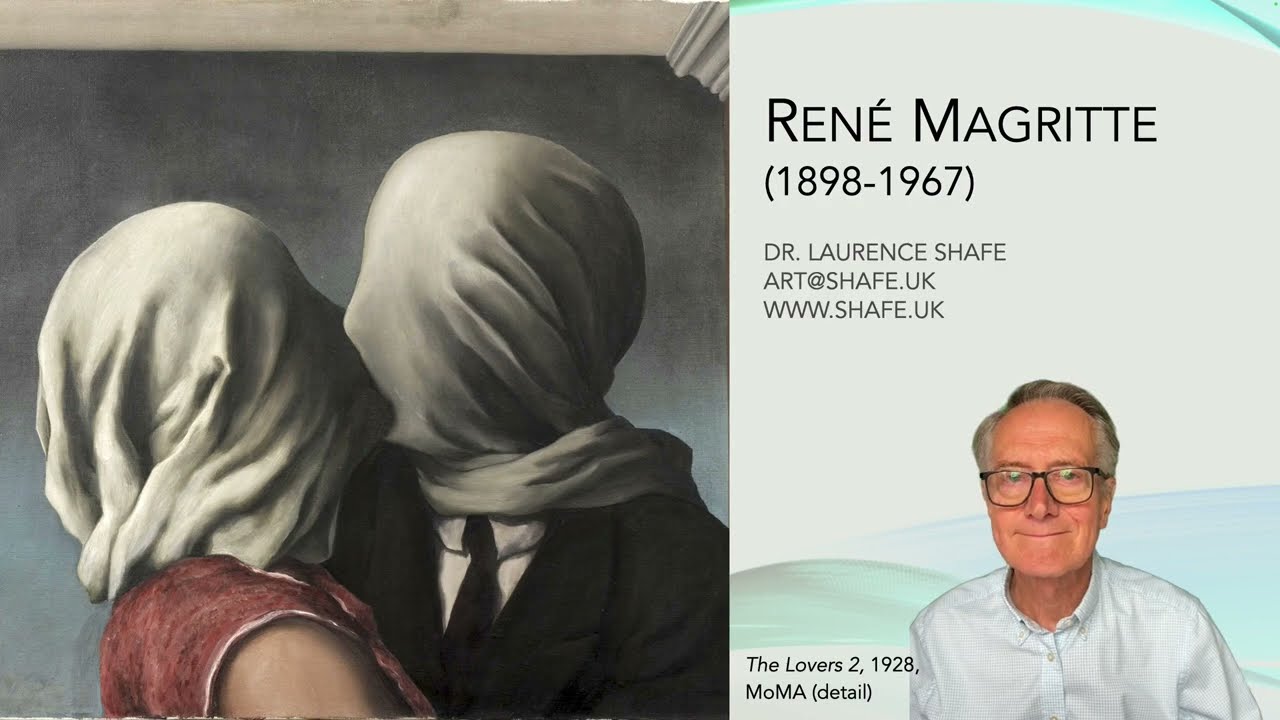
One of the most enduring stories in art history concerns Magritte’s mother, Régina, who committed suicide by drowning when the artist was only 13. The legend claims that when her body was recovered from the river, her nightdress was wrapped around her face—an image supposedly echoed in the shrouded figures of Magritte’s famous work, The Lovers.
While this makes for a compelling psychological narrative, the truth is far more mundane: the story of the veiled face was likely an invention of his nurse. Magritte himself was famously skeptical of psychoanalysis, totally refuting Freud’s attempts to link artistic output to childhood trauma.
Regardless of the story’s veracity, Magritte used these veiled figures to explore much deeper themes than personal grief. By covering the faces of his subjects, he highlighted a profound sense of isolation and the elusive nature of identity. He forces us to ask: do we ever truly know anyone, or are their identities always hidden behind a “curtain of semblance”?
2. Mystery is the Goal, Not the Puzzle
Modern viewers are often conditioned to “solve” art as if it were a crossword puzzle. We look at a giant apple in a room or a train emerging from a fireplace and ask, “What does this mean?” Magritte’s response was characteristically direct: it means nothing.
He actively resisted interpretation, insisting that his paintings were “visible images which conceal nothing.” For Magritte, the point of art was not to hide a secret message but to evoke the inherent mystery of existence. As he famously stated:
“It is the mystery that illuminates knowledge.”
By presenting everyday objects in unsolvable scenes, Magritte was not trying to be incomprehensible for the sake of it. Rather, he believed that looking for “meaning” prevents us from actually seeing the object itself. He wanted us to acknowledge that we live in an enigmatic universe where the most familiar things are, in fact, the most unknowable.
3. The “Great Error” of the Egg and the Cage
Early in his career, Magritte followed the traditional Surrealist path of juxtaposing completely unrelated objects—a sewing machine and an umbrella, for instance—to create a sense of shock. However, a specific moment of “poetic discovery” changed his style forever.
One night, Magritte woke up and looked at a birdcage in his room. In a state of half-slumber, he experienced what he called a “magnificent error”: he saw an egg in the cage instead of a bird. This led to his 1933 painting Elective Affinities, a title he borrowed from Johann Wolfgang von Goethe’s 1809 novel. Magritte reflected:
“A magnificent error caused me to see an egg in the cage… I then grasped a new and astonishing poetic secret.”
By placing an egg—a “pre-bird”—inside a cage, he created a deeper, more resonant paradox than random surrealism could achieve. It highlighted the tension between potential and confinement, suggesting that even before we are born, we are already shaped by the structures that will eventually cage us.
4. Why “Ceci n’est pas une pipe” is Actually Fact
The Treachery of Images remains Magritte’s most deconstructed work. While it is often cited as a masterpiece of semiotic theory, Magritte’s defense of the painting was surprisingly literal. He pointed out that if he had written “This is a pipe,” he would have been lying. You cannot fill a painting with tobacco; therefore, it is not a pipe.
This literalism was informed by his own life. Magritte was a dedicated chainsmoker who famously claimed his works were “made from cigarettes.” His heavy habit made him acutely aware of the difference between the physical object he held and the painted representation on the canvas.
He pushed this semiotic deconstruction further in The Interpretation of Dreams, where he paired objects with seemingly incorrect labels—a horse was called “The door,” a clock was “The wind.” However, he added a layer of cognitive dissonance by correctly labeling one object: the valise. By making one connection “right” while the others were “wrong,” he proved that the names we give things are arbitrary, exposing the “treachery” of representation.
5. The Double Life: Advertising and the “Vache” Period
Before he was a celebrated artist, Magritte spent years in the “hard-lined, photographic” world of commercial advertising and once worked in a wallpaper factory painting flowers. This background is exactly what made his Surrealist work so iconic. His paintings possess a graphically linear, clear quality that captures the mind’s eye instantly—which is precisely why his style remains so widely used in modern media.
Yet, Magritte possessed a gritty, rebellious streak. He found “surrealism in everyday life” not just in high art, but in the mundane and the vulgar. His biographer noted his lifelong interest in pornography, even attending screenings of pornographic films in his dentist’s attic. This subversive spirit exploded in 1948 during his “Vache” (Cow) period. Immediately after his break with the dogmatic André Breton in 1946, Magritte produced a series of works featuring vulgar subjects and crude coloring. It was a thumb in the eye of the art establishment, proving he refused to be the “careerist” he so despised.
Conclusion: The Curtains of Reality
René Magritte believed that we are surrounded by “curtains of semblance,” perceiving the world only through the frames of our own conditioning. His mission was to use the “poetically disciplined image” to render our internal thoughts visible, forcing us to confront the certainty that we belong to an enigmatic universe.
He didn’t want to explain the world to us; he wanted us to wake up to it. As we navigate our own increasingly curated and filtered realities, we might do well to ask: If everything we see hides another thing, what are we choosing not to see in our own lives today?
To look at the world through Magritte’s eyes is to accept that the most familiar objects are the most profound mysteries, and that the mind’s greatest adventure lies in the unknown.
53-03 Salvador Dalí
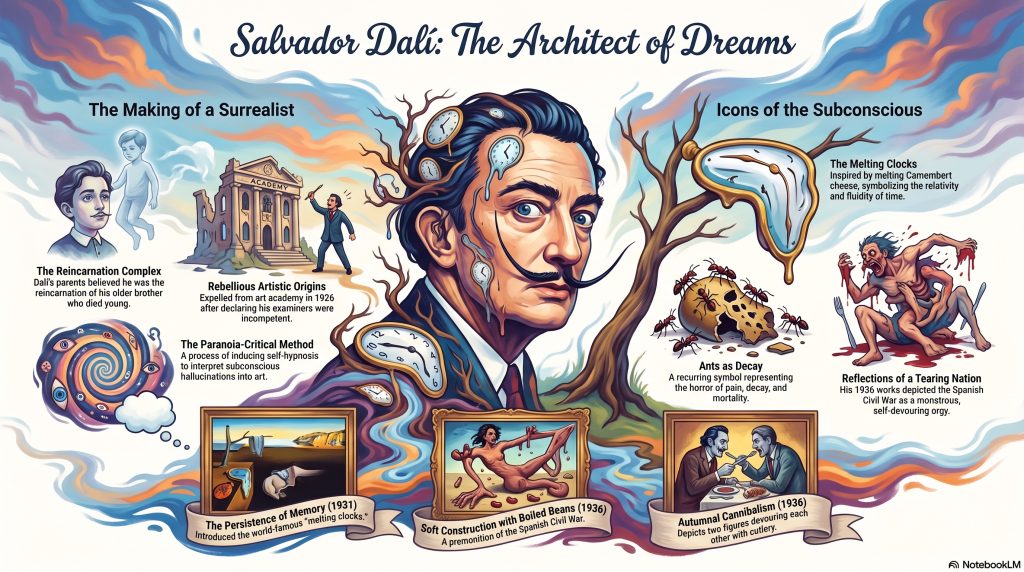
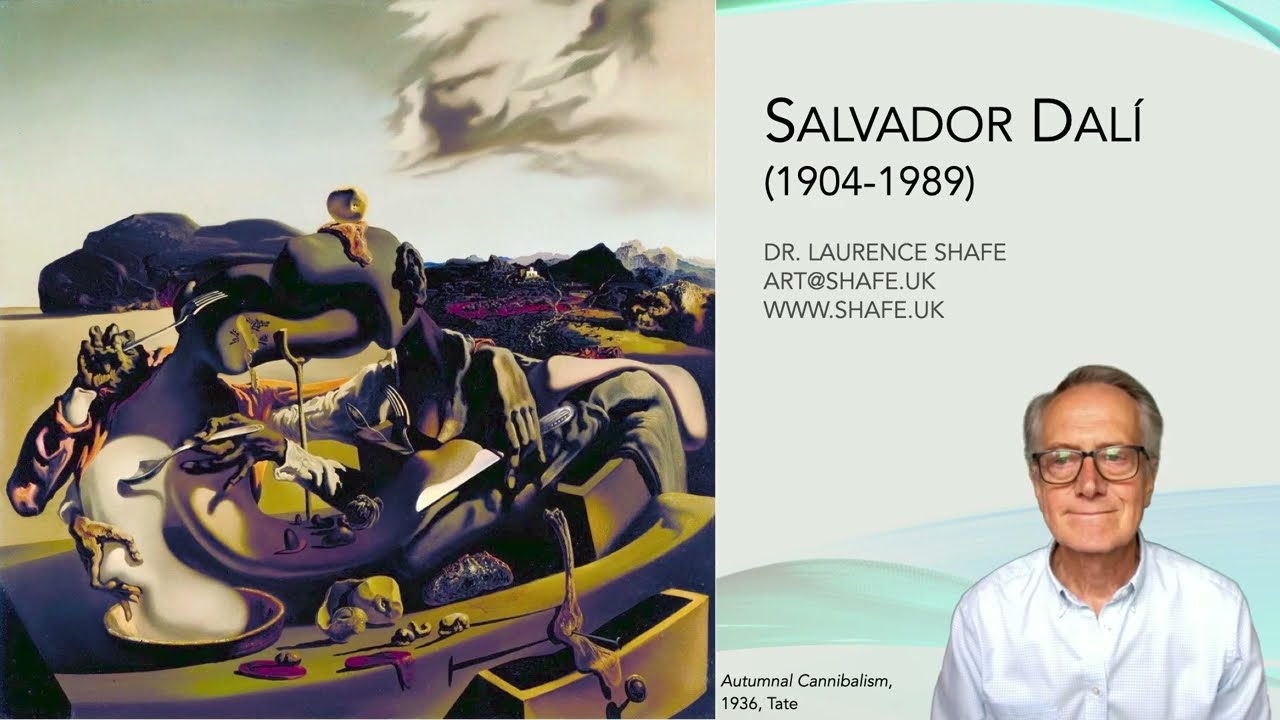
This talk provides a biographical and artistic portrait of Salvador Dalí, the prominent 20th-century Surrealist icon known for his flamboyant persona and technical mastery. It traces his development from a gifted child in Spain through his rebellious years at the Royal Academy in Madrid, highlighting early influences like Cubism and his lifelong obsession with Johannes Vermeer. Key life events are examined, including the profound impact of his brother’s death, his collaboration with Luis Buñuel on avant-garde film, and the essential role of his wife and muse, Gala. You will learn about his specialized “paranoia-critical method” and his most famous masterpieces, such as the melting clocks in The Persistence of Memory. I also discuss his later fascination with nuclear physics and religion, culminating in the creation of his own museum and his enduring legacy as a master of the subconscious.
The following is a conversation about Salvador Dalí was generated by Google’s NotebookLM. The voices and the conversation are completely AI generated.
Salvador Dalí was the 20th century’s ultimate showman, a man whose flamboyant mustache and theatrical self-promotion were less an affectation and more a defensive perimeter. Whether he was strolling through the streets of Paris with a pet anteater on a leash or arriving at a lecture in a car filled with five hundred kilograms of cauliflower, Dalí understood a fundamental truth of the modern era: in a world of noise, the artist must be his own loudest broadcast. Yet, beneath the calculated absurdities of the man who famously seduced a statue was a deeply fractured psyche. To view Dalí merely as a clown is to miss the profound, often terrifying psychological intensity of his work—a map of the subconscious drawn by a man who spent his life trying to prove he wasn’t a ghost.
To truly deconstruct the master of Surrealism, one must look past the performance and into the trauma. Here are five counter-intuitive truths that reveal the erratic genius behind the myth.
1. The Reincarnation Dilemma: Living in a Dead Brother’s Shadow
Dalí’s obsession with identity was not born in a studio, but in a graveyard. Born in 1904 in Figueres, Spain, he was given the name Salvador—the same name as his older brother, who had died just nine months before the artist’s birth. His parents, paralyzed by grief, harbored the bizarre belief that the young Dalí was the literal reincarnation of his deceased sibling. Throughout his childhood, he was dressed in his brother’s clothes and taken to his brother’s grave, a psychological haunting that fostered a lifelong obsession with the fluidity of the self.
This burden of being a “replacement” child nurtured his interest in psychoanalysis. When his mother died of uterine cancer when he was sixteen, the blow was existential. Dalí later reflected that her passing “was the greatest blow I had experienced in my life. I worshipped her… I could not resign myself to the loss of a being on whom I counted to make invisible the unavoidable blemishes of my soul.” This vacuum was eventually filled by his wife and muse, Gala, who replaced his mother as the essential manager of his “erratic genius,” protecting the man while commodifying the artist.
2. The Diving Suit Disaster: The High Price of Subconscious Exploration
In 1936, Dalí’s commitment to the “performance” of art nearly achieved the ultimate surrealist act: a public death. At the International Surrealist Exhibition in London, he arrived to deliver a lecture wearing a full deep-sea diving suit, wielding a billiard cue, and leading two live dogs. His intent was a literal metaphor: he was descending into the “depths of the subconscious.”
The lecture quickly spiraled into a high-stakes tragedy. The helmet had been bolted shut, and Dalí—having neglected to include an oxygen supply—began to suffocate. As he gestured wildly and gasped for air behind the glass, the audience assumed his distress was a masterful bit of mime and responded with thunderous applause. The situation turned farcical when it was discovered that the engineer with the spanner had disappeared. Dalí was only saved when a bystander (and Gala) used a hammer to beat the nuts off the helmet. It was the quintessential Dalí moment: a profound philosophical gesture rescued from the brink of death by a blunt instrument and a missing mechanic.
3. It’s Not Einstein—It’s Cheese: The Mundane Origin of Melting Clocks
Critics and historians have long attempted to link The Persistence of Memory (1931) to Einstein’s Theory of Relativity, framing the melting clocks as a high-concept meditation on the curvature of space-time. Dalí, however, delighted in a much “lower” truth. He claimed the inspiration was a Camembert cheese melting in the sun.
The setting for this “melancholy twilight” was the very real landscape of his home in Port Lligat and the jagged cliffs of the Cap de Creus peninsula. By applying his “paranoiac-critical method”—a state of self-induced hallucinations—he used what he called “the usual paralysing tricks of eye-fooling” to turn a soft dairy product into a global icon of temporal decay. He referred to these works as “hand-painted dream photographs,” proving that a genius is simply a man who looks at a snack and sees the end of time. As he famously quipped, “The difference between a madman and me is that I am not mad.”
4. The “Avida Dollars” Scandal: When the Artist Became the Commodity
Dalí’s relationship with the Surrealist movement was defined by a mutual, visceral loathing. His blatant fascination with wealth and his controversial sympathies for figures like Francisco Franco earned him the biting nickname “Avida Dollars”—a perfect anagram of his name coined by André Breton. In 1934, the “Pope of Surrealism” officially expelled Dalí, citing behavior “contrary to Surrealism.”
The rift was more than political; it was a clash over the soul of art. Breton viewed Dalí’s commercialism—his Hollywood dream sequences for Alfred Hitchcock and his Time magazine covers—as a betrayal. Dalí’s response remains the ultimate statement of artistic ego: “The only difference between me and the Surrealists is that I am a Surrealist.” He recognized that in the 20th century, the artist’s brand was the art. By the time he was designing jewelry and appearing on game shows, he had successfully transformed the “Surrealist” title from a collective movement into a personal, marketable identity.
5. From Horror to Art: How a Dead Bat Created the Iconography of Ants
Perhaps the most unsettling symbol in the Dalí lexicon is the swarming ants, which serve as a recurring emblem of decay, death, and repressed sexual desire. This motif was forged through a synthesis of childhood traumas. The primary catalyst was a “frightful spectacle” described in his autobiography, The Secret Life of Salvador Dalí: finding an injured bat he had tried to save covered in “frenzied ants,” its face “tortured… like an old woman’s.” In a moment of hysterical pity, the young Dalí bit the ant-covered bat.
However, the “New Art History” perspective reveals a deeper, more clinical layer to this horror. To “educate” his son, Dalí’s father had shown him photographs of genitalia ravaged by advanced untreated venereal disease. These images forever linked the idea of sex with the visceral reality of biological rot. When Dalí observed the “Iberian beings mutually devouring each other” during the Spanish Civil War, he viewed the carnage through this same lens—seeing human conflict as a “pure phenomenon of natural history,” no different from the ants swarming a piece of “unconscious meat.”
The Legacy of a Rational Madman
To understand Salvador Dalí’s career, one must look at its bookends: the technical mastery of his youth and the scientific obsessions of his old age. Before his expulsion from the Academy, he painted The Basket of Bread (1926) specifically to prove he could match the intense realism of his role model, Johannes Vermeer. This technical foundation allowed him to later pivot toward nuclear physics and atomic theory, creating works like Galatea of the Spheres that explored the “nuclear mysticism” of a post-Hiroshima world.
He spent his final years in Figueres, designing his own Dalí Theatre-Museum, a labyrinthine masterwork that serves as his final statement on the dreamscape. In the end, Dalí’s most enduring creation was likely his own existence—a life lived at the intersection of science, psychosis, and showmanship. He leaves us with a lingering, uncomfortable question: Was Salvador Dalí’s entire life his greatest piece of performance art?