British art in the first half of the twentieth century occupies an ambivalent position in the history of modernism — influenced by but never fully committed to the European avant-garde, producing artists of genuine greatness while the dominant culture remained attached to a realist tradition that Continental artists had long since abandoned. The Camden Town Group around Walter Sickert applied Post-Impressionist lessons to the unglamorous interiors and streets of London; Vorticism offered a brief moment of radical ambition before the First World War destroyed its possibilities. Between the wars, Paul Nash, Ben Nicholson, Barbara Hepworth, and Henry Moore each developed forms of modernism that were distinctly English in their relationship to landscape and organic form. The Second World War produced in Graham Sutherland, John Piper, and Henry Moore’s shelter drawings some of the most powerful responses to catastrophe in British artistic history. By 1950, Britain was poised for the emergence of a new generation — Bacon, Freud, the Kitchen Sink painters — who would finally establish British art’s place in the international conversation.
Sickert and the Camden Town Group — English Post-Impressionism: Walter Sickert (1860–1942), who had known Degas and absorbed the lessons of French painting, gathered around him a group of painters who applied Post-Impressionist colour and technique to the subject matter of North London — music halls, bedsitters, street markets, and the lives of ordinary people. The Camden Town Group, founded in 1911, represented a distinctly English form of modernism: engaged with the real world, suspicious of abstraction, and committed to the unglamorous reality of the everyday.
Paul Nash — Landscape, War, and the English Surreal: Paul Nash (1889–1946) is among the most interesting and distinctive British artists of the century, his work oscillating between a deep love of the English landscape and an openness to modernist experiment that culminated in his engagement with Surrealism in the 1930s. His First World War paintings — We Are Making a New World (1918) — remain among the most powerful responses to industrial warfare in art history; his Second World War paintings of crashed German aircraft are equally remarkable.
Ben Nicholson, Hepworth, and English Abstraction: In the 1930s, a small but significant group of British artists — Ben Nicholson, Barbara Hepworth, and their associates at St Ives in Cornwall — developed a form of pure abstraction influenced by Mondrian (who visited London in the 1930s) and by their engagement with the granite coastlines and clear light of Cornwall. Nicholson’s white reliefs and Hepworth’s organic abstract sculptures represent Britain’s most sustained engagement with the international abstract movement.
Henry Moore — The Human Figure and the Earth: Henry Moore (1898–1986) is the dominant figure of twentieth-century British sculpture, his reclining figures and mother-and-child groups combining a deep engagement with archaic sculpture — Cycladic, pre-Columbian, African — with a formal vocabulary that was unmistakably modern. His wartime drawings of Londoners sheltering in the Underground during the Blitz are among the most moving documents of the Second World War, combining sculptural solidity with an almost Michelangelesque grandeur.
War Artists — Art in the Face of Catastrophe: Both world wars produced outstanding work by official British war artists. Nash, Sickert, Orpen, and Nevinson responded to the First World War; Sutherland, Piper, Moore, and Ardizzone to the Second. The War Artists Advisory Committee, chaired by Kenneth Clark, commissioned work of genuine quality from a wide range of artists, ensuring that Britain’s experience of total war was recorded not merely by photographers and journalists but by painters and draughtsmen of the first rank.
The Foundation for Post-War British Art: By 1950, British art was at a turning point. The realist tradition remained strong, but a new generation was beginning to emerge: Lucian Freud’s unsparing figurative paintings, Francis Bacon’s screaming popes and distorted figures, the Kitchen Sink realists’s working-class subjects. The story of British art in the first half of the century — its dialogue between tradition and modernism, its engagement with landscape and the human figure, its response to two world wars — provides the essential context for understanding everything that followed.
52-01 British Art 1900-50 British Art 1900-1950
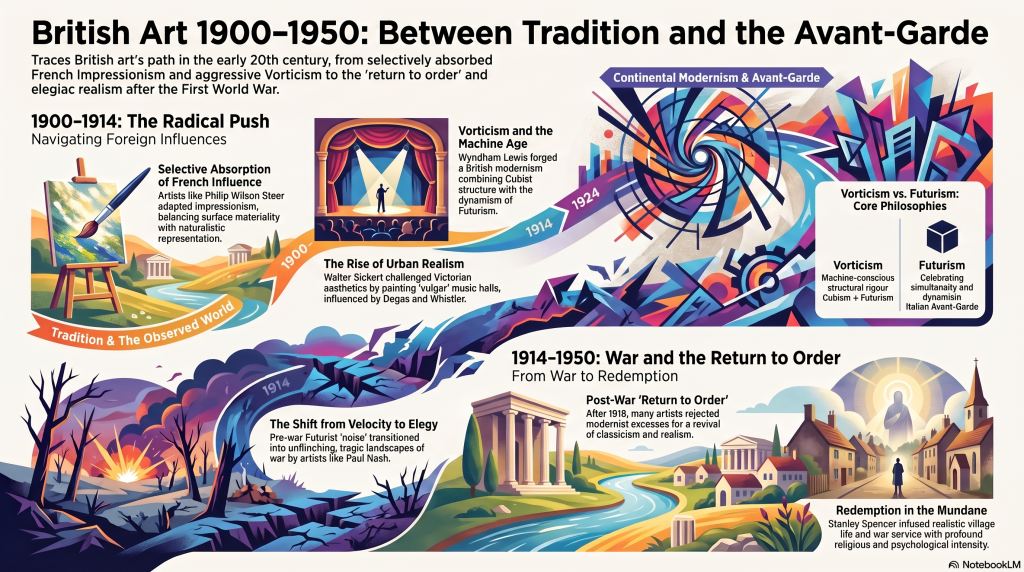
This talk surveys British art from 1900 to 1950, tracing how painters and sculptors absorbed Continental modernism selectively while remaining anchored to observed reality. Beginning with Steer’s Impressionism and Sickert’s provocative music-hall scenes, it moves through Gwen John’s quiet interiority, the combative energy of Lewis’s Vorticism and Nevinson’s Futurism, wartime responses by Nash and Spencer, Bomberg’s restless expressionism, and Epstein’s sculptural radicalism. Moore and Hepworth reshape three-dimensional form, while Lowry, Knight, and Piper demonstrate British art’s persistent social rootedness, concluding with Piper’s devastating record of Coventry Cathedral’s wartime destruction.
(My YouTube talk will be published on 03 July 2027)
My notes on British Art 1900-1950
An entertaining conversation about British Art 1900-1950 created by Google NotebookLM from my notes:
Most people assume British art spent the first half of the twentieth century politely ignoring everything happening in Paris. The reality is stranger, more combative, and far more interesting. Here are the takeaways that genuinely surprised me.
A Celebrated Painting Was Called “Evil” at Debut
Philip Wilson Steer’s Girls Running, Walberswick Pier looks radiant at first glance — sunlight, movement, warmth. Look closer and the mood destabilises: three shadows crowd the foreground, the girls have separated, and the long evening light carries an unmistakable intimation of ending. One contemporary critic condemned it as outright “evil.” That reaction tells us exactly how threatening its formal ambition felt.
Painting a Music Hall Singer Was a Moral Offence
When Sickert exhibited Katie Lawrence at Gatti’s in 1888, the Builder called it “the lowest degradation of which the art of painting is capable.” British music halls were understood as sites of prostitution and bawdry. Degas painted the same subject in Paris to respectful interest. The identical act, two cities apart, produced opposite receptions.
A Sibling Predicted His Own Artistic Eclipse
Gwen John spent her career overshadowed by her far more famous brother Augustus. He saw it coming.
“In fifty years’ time I shall be known as the brother of Gwen John.”
Critical consensus has settled exactly where he predicted. She is now widely regarded as the finer painter.
The Most Terrifying British Sculpture Was Deliberately Destroyed by Its Own Maker
Jacob Epstein’s The Rock Drill — a visored, mechanical figure mounted atop a real pneumatic drill, standing over three metres tall — announced itself as “the armed, sinister figure of today and tomorrow.” Then the Somme happened. Epstein dismantled it, discarded the drill, and cast only the mutilated torso. The gesture of self-censorship transformed aggression into something far more haunting.
Spencer’s War Painting Wasn’t About Horror — It Was About Redemption
Stanley Spencer refused the War Memorials Committee’s suggestion of a religious service for his commission. He wanted a real event: wounded men queuing outside a converted Greek church.
“I meant it not a scene of horror but a scene of redemption.”
The surgeons are his secular Christs. The broken men are their congregation.
A Sculpture About Abstraction Was Actually About a Child Shot Dead
Barbara Hepworth’s Figure (Nyanga) looks like pure formal abstraction — an elm head, a pierced void, a whitened interior. The title anchors it in something devastating. South African police had killed 69 demonstrators at Sharpeville. Weeks later, in Nyanga, a young child was shot in her mother’s arms. Nelson Mandela read the poem Hepworth’s sculpture mourns at the opening of South Africa’s first democratic Parliament in 1994.
Lowry’s “Naïve” Matchstick People Were a Deliberate Formal Choice
L. S. Lowry is routinely condescended to as an untrained primitive. He was nothing of the kind. He collected rent by day and painted through the night, and he was entirely clear about his method:
“Natural figures would have broken the spell of it, so I made my figures half unreal.”
That’s not naïvety. That’s a sophisticated decision about pictorial reality.
The Most Effective Propaganda Used Heroism Without Sentiment
Laura Knight’s A Balloon Site, Coventry was commissioned specifically to recruit women into Balloon Command. It shows women hauling a barrage balloon skyward against Coventry’s industrial skyline. The WAAC wanted heroism and glamour. Knight delivered both — without a trace of the sentimentality that could easily have destroyed it. She had become the first woman elected to the Royal Academy in its 168-year history just six years earlier.
What strikes me most across this entire period is how consistently British artists were forced to negotiate between radical formal ambition and the pull of recognisable human experience. The question worth sitting with: is that tension a limitation — or precisely what gives this work its lasting power?
52-02 British Art 1900-50 – British Sculpture

This talk traces how four sculptors — Epstein, Gill, Moore, and Hepworth — fundamentally remade British sculpture between 1900 and 1975. Beginning with Epstein’s scandalous public commissions and Vorticist Rock Drill, it follows Moore’s journey from Yorkshire coalfields through wartime shelter drawings to international monument-maker. Gill’s controversial religious carvings and deeply troubling private life complicate his institutional legacy. Hepworth’s parallel career — pioneering pierced forms, introducing colour and strings, culminating in the United Nations Single Form — confirms that this transformation was never one man’s achievement alone, but a collective, contentious, and historically decisive project.
(My YouTube talk will be published on 10 July 2027)
My notes on British Sculpture and Henry Moore
An entertaining conversation about British Sculpture and Henry Moore created by Google NotebookLM from my notes:
Most of us walk past public sculptures without a second glance. A bronze figure on a plinth, worn smooth by decades of weather — easy to overlook. But the story behind British sculpture in the first half of the twentieth century is anything but quiet. It is a story of institutional vandalism, gas attacks, genitals chiselled off under public pressure, and a single charged gap between two points that almost — but never quite — touch.
Here are the moments that stopped me cold.
Scandal Was the Commission
Jacob Epstein’s first major public work — eighteen nude figures for a London medical building in 1908 — caused such outrage that the Evening Standard warned no careful father would let his daughter see them. Decades later, when acid rain dislodged a fragment, authorities simply hacked off every protruding part on all the figures. That mutilated facade still stands on the Strand today. Public art, it turns out, has always been a negotiation with public fury.
A War Destroyed a Masterpiece — Deliberately
Epstein’s The Rock Drill was over three metres tall: a visor-headed mechanical figure astride a real pneumatic drill, cradling an embryo in its abdomen. Pure machine-age menace. Then the Somme happened. Epstein dismantled it himself, discarded the drill, and cast only the truncated upper torso in gun metal.
“Here is the armed, sinister figure of today and tomorrow. No Humanity, only the terrible Frankenstein’s monster we have made ourselves into.”
What began as a symbol of mechanical virility became, by his own hand, something amputated and diminished.
The Hole Changed Everything
In 1931, Barbara Hepworth pierced a stone form for the first time — not for realism, but for pure abstract space. Henry Moore later called 1932 “the year of the hole.” Between them, they transformed emptiness into sculpture’s most powerful element.
“I felt the most intense pleasure in piercing the stone in order to make an abstract form and space; quite a different sensation from doing it for the purpose of realism.”
Quantum physics, it turns out, agrees: matter is mostly void. Hepworth and Moore understood this before most physicists made it common knowledge.
The Gap Is the Work
Moore’s Three Points looks simple — three bronze tips almost touching. But Moore was explicit about what that near-contact meant: the entire emotional charge lives in the space between, not the metal itself. He pointed to Michelangelo’s Sistine ceiling, where God’s finger reaches toward Adam without making contact, and to a sixteenth-century French painting where one sister’s fingers hover at the other’s breast.
The gap, he insisted, is not an absence. It is the work’s active centre.
The Shelter Drawings Made Moore Famous — Not the Sculptures
When the Blitz destroyed Moore’s London home, he began descending into Underground shelters — without a sketchbook, out of respect for the shelterers, jotting notes on the back of an envelope instead. The resulting drawings of pale, swathed, recumbent figures did more for his international reputation than any sculpture had. They travelled widely and built his American audience almost from scratch.
The irony is sharp: Britain’s greatest sculptor became globally known through drawings made in the dark, from memory.
Hepworth’s Final Statement Was Political
Hepworth’s Figure (Nyanga) was carved in direct response to the 1960 Sharpeville Massacre, where South African police killed sixty-nine demonstrators. The title refers to a township near Cape Town where, weeks later, a child was shot dead in her mother’s arms. Nelson Mandela later read the poem written about that child at the opening of South Africa’s first democratic parliament.
An abstract oval of elm wood, it carries the weight of a specific atrocity — and the universality of suffering.
Institutions Nearly Killed Everything They Later Celebrated
Frank Pick, the London Underground’s managing director, was personally told the sculpture was not to his taste. He offered his resignation rather than remove Epstein’s work. Moore was forced out of the Royal College by a press campaign backed by colleagues. Epstein’s religious carvings were exhibited at fairgrounds alongside diseased body parts in jars.
Every figure in this story was first rejected by the structures that later claimed them.
What strikes me most is how provisional greatness looks in its own moment. The sculptures now displayed reverently in national collections were once called nightmares in stone, monuments to vandalism, or worse. Which raises an uncomfortable question: what are we dismissing today that we will one day queue to see?
52-03 British Art 1900-50 – The Great War and After, 1910-1930
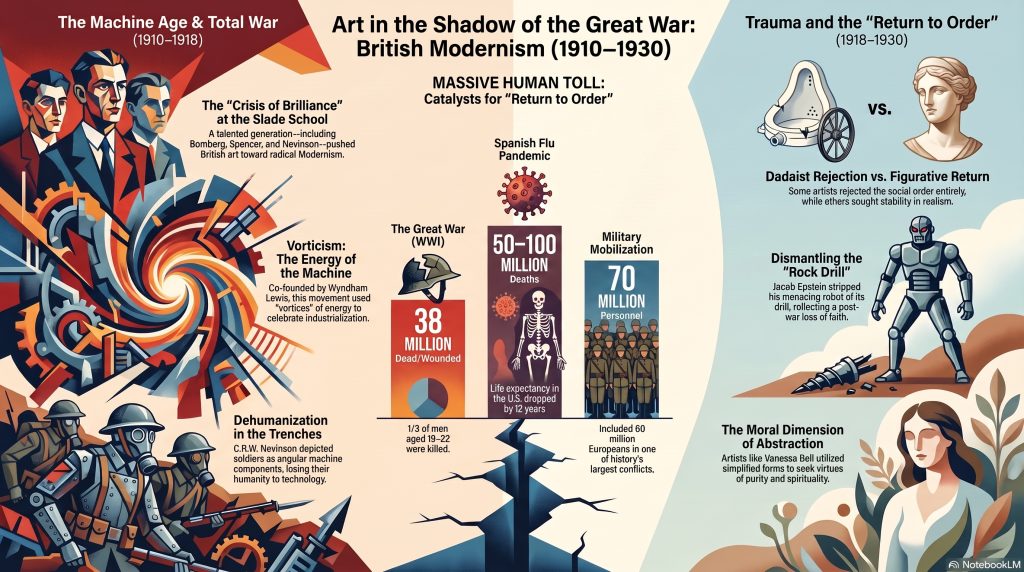
This talk focuses on the transformative period between 1910 and 1930, highlighting how the First World War and the 1918 flu pandemic influenced creative expression. The text details a shift from traditional academic styles to modernist movements, including the rise of abstract art and the contrasting “return to order” among postwar painters. Key figures such as David Bomberg, Stanley Spencer, and C.R.W. Nevinson are featured for their contributions to what was described as a “crisis of brilliance” at the Slade School of Art. The talk mentions specific paintings and sculptures housed at the Tate, providing historical context for their creation and acquisition.
My notes on The Great War and After, 1910-1930
A conversation on British Art during and afterthe First World War, 1910 to 1930 created by Google Notebook from my notes:
1. Introduction: The World on Fire
The years 1910–1930 weren’t just a transition; they were a total demolition of the Victorian soul. While the history books usually fixate on the tactical mud of the trenches, the true story of this era is written in the psychological wreckage of its art. Society was a pressure cooker of militant suffragettes, crippling strikes, and the birth of a welfare state, all colliding with a war that left 38 million dead or wounded.
As a cultural critic, I find the most haunting truths aren’t in the casualty lists, but in how artists reacted to this industrial carnage. They began the decade worshipping the “machine age” and ended it desperately clawing back toward the safety of the natural world. This was the moment the avant-garde looked into the abyss of modern progress and blinked.
2. The “Spanish” Flu Was a Product of Wartime Fake News
The 1918 flu pandemic was a biological catastrophe that dwarfed the war, killing between 50 and 100 million people globally. Yet, its name is a monument to wartime propaganda rather than medical fact. To keep morale from collapsing, censors in Britain, France, and the US systematically suppressed news of the mounting death toll.
Because Spain remained neutral, its press was the only one reporting the nightmare freely, creating a “reporting dichotomy” that made the world believe the virus started there. This naming convention is a chilling reminder of how political narratives can hijack historical reality. It shows that even in the face of a natural disaster, the “truth” is often whatever the censors allow to survive.
3. The “Crisis of Brilliance” at the Slade School
Just before the Great War, the Slade School of Art became a volatile nursery for genius. Under the watchful eye of drawing teacher Henry Tonks, a cohort including C.R.W. Nevinson, David Bomberg, Dora Carrington, Mark Gertler, Paul Nash, and Stanley Spencer formed what Tonks called a “crisis of brilliance.” It was an exciting, demanding time where movements like Vorticism and Futurism fought for dominance in a creative arms race.
These artists were being refined for peak aesthetic performance at the exact moment the world was preparing for peak industrial slaughter. The irony is staggering: they were trained to capture the dynamism of the modern city just as that same technology was being repurposed to kill one-third of all men aged 19 to 22. Their “brilliance” was the last flare of a world that was about to be extinguished.
4. From Phallic Power to Emasculated Metal: Epstein’s “Rock Drill”
Jacob Epstein’s The Rock Drill is the ultimate symbol of this era’s shattered optimism. In 1913, it was a menacing, three-meter-tall machine-beast—a robot mounted on an actual industrial drill with the American manufacturer’s name emblazoned on its side. It was a terrifying display of “phallic power,” complete with an embryonic form protected within its armored ribs.
By 1916, as the industrial meat-grinder of the Somme and Verdun turned men into scrap, Epstein couldn’t look at the machine the same way. He dismantled the sculpture, discarded the drill, and left only a haunted, one-armed torso. He took a symbol of aggressive masculinity and effectively emasculated it, turning a celebration of the machine into a memorial for its victims.
“Here is the armed, sinister figure of today and tomorrow. No Humanity, only the terrible Frankenstein’s monster we have made ourselves into… later I lost my interest in machinery and discarded the drill. I cast only the upper part of the figure.”
5. Why the Pioneers of British Abstraction Quit
In 1914, Vanessa Bell was at the bleeding edge of the avant-garde, experimenting with “significant form”—a concept championed by her husband Clive Bell and friend Roger Fry. Her Abstract Painting was a radical departure from reality, yet she abandoned the movement almost instantly. Her retreat signaled a wider “Return to Order,” a desperate psychological pivot where artists rejected radicalism to find solace in the familiar.
This created a fascinating dichotomy in the post-war world. While the Dadaists completely rejected the old social order as a failure that led to millions of deaths, Bell and the “Return to Order” group sought healing in figurative art. For Bell and the Bloomsbury set, the purity of abstraction was no match for the emotional grounding of the natural world after so much chaos.
“Having done it, there seemed nothing else to do… and then one discovered that one was, after all, in love with nature.”
6. The Great War as a “Catastrophic Mistake”
There is a growing historical argument that Britain’s entry into the war was a “catastrophic mistake” that bled the Empire dry. By entering unprepared, Britain suffered an irreplaceable loss of skilled manpower and a mountain of debt that forever weakened its global standing. This hollowed out the nation, leaving institutions that were often too timid for the radicalism of the pre-war years.
We see this reflected in the fate of David Bomberg. He was the most “audacious” of his generation, so radical that he was expelled from the Slade in 1913 for breaching conventional style. Though he was a brilliant draughtsman, his pre-war radicalism was silenced by his experiences as a soldier. Like Britain itself, he moved toward a figurative style in the 1920s, a metaphor for a generation whose faith in the “machine age” had been utterly shattered.
7. Conclusion: A Legacy of Order and Chaos
The decade between 1910 and 1930 fundamentally shifted the moral compass of British art. It began with a roar of machines and ended with a quiet search for spirituality and order in nudes and landscapes. The trauma of the trenches didn’t just kill men; it killed the early 20th-century belief that technical progress was inherently good.
As we navigate our own era of runaway technical development and global instability, we have to ask: are we headed for our own “Return to Order”? Will we, like the artists of the 1920s, eventually find ourselves retreating from the digital abyss in a desperate search for something human to hold onto?Gemini Notebook can be inaccurate; please double-check its responses.
52-04 British Art 1900-50 – British Realists in the 1920s and 30s
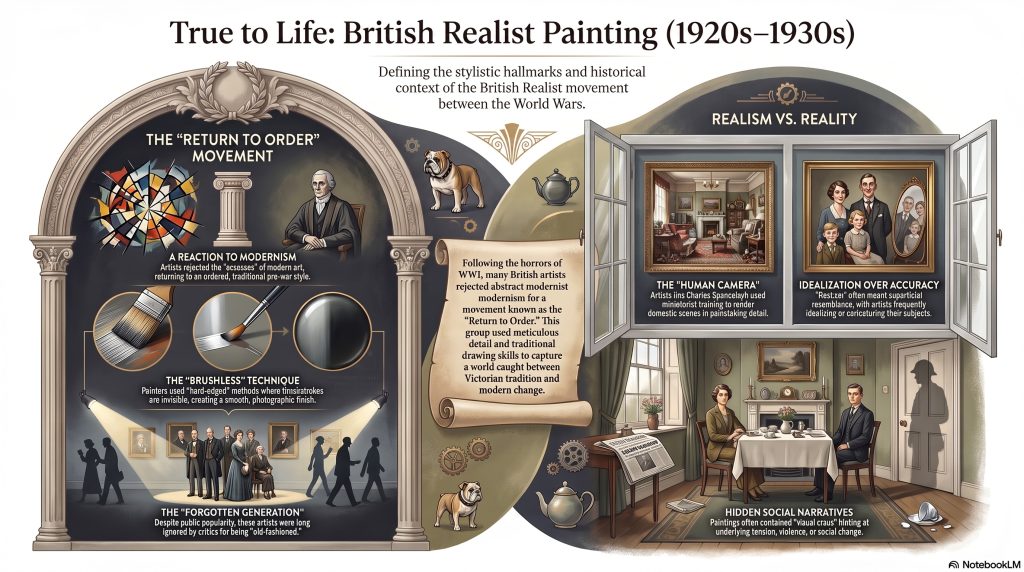
This talk is an overview of British Realist painting during the inter-war period, specifically focusing on an “almost forgotten” generation of artists active in the 1920s and 30s. This movement, often termed the “Return to Order,” rejected abstract trends in favour of a “hard-edged” technique characterized by meticulous detail and invisible brushstrokes. Featured artists like Gerald Leslie Brockhurst and Meredith Frampton gained fame for their highly polished portraits of society figures, while others like Edward Burra used realism to explore darker, surreal social themes. Despite their technical virtuosity and popularity at the Royal Academy, many of these painters were later overlooked by historians until a major 2017 exhibition at the Scottish National Gallery of Modern Art revived interest in their work. The collection highlights how these artists balanced traditional values with modern sensibilities, ranging from Charles Spencelayh’s photographic domestic scenes to Winifred Knights’ classically inspired compositions. The talk argues that this era of British art was defined by a diverse group of highly skilled draughtsmen who sought to capture a “true to life” reality amidst global instability.
My notes on British Realists in the 1920s and 30s
A conversation about British realists in the 1920s and 30s created by Google Notebook from my notes:
In the interwar years, a peculiar brand of magic took hold of the British canvas. It was a movement of scrupulous detail, where the surface of a painting was so “hard-edged” and “brushless” that the human hand seemed entirely absent. These artists were the undisputed superstars of their day—voted “Picture of the Year” by a captivated public and collected with fervor by Queen Mary—yet they were eventually swept into the dustbin of history by the mid-century tide of Abstraction.
For decades, the narrative of British art skipped from the Post-Impressionists directly to the radical experiments of Ben Nicholson. However, the 2017 exhibition True to Life ignited a vital rediscovery of the “Return to Order.” This movement was far more than an aesthetic choice; it was a psychological anchor. Born from the trauma of the Great War, it was a deliberate rejection of avant-garde fragmentation in favor of a disciplined, traditional stability. After the liquid chaos of the trenches, these artists sought a world they could control with a fine-tipped brush and an unwavering gaze.
Realism is Not a Photograph (and That’s the Point)
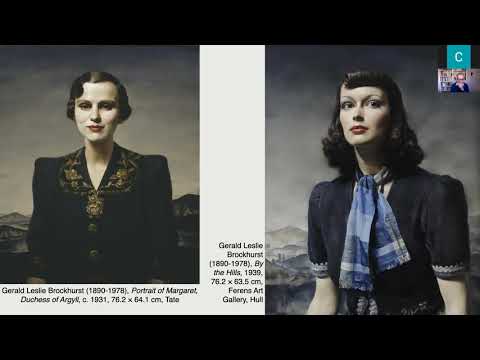
To the uninitiated, the works of this era—particularly those of Gerald Leslie Brockhurst—look deceptively like high-definition photography. But look closer, and the artifice begins to shimmer. Brockhurst was not a documentarian; he was a master of the “idealized real.”
While his technique was invisible, his intent was transformative. In his portraits of icons like Merle Oberon, Brockhurst practiced a 1930s equivalent of the modern beauty filter: thinning faces, lengthening necks, and enlarging eyes until his subjects reached a state of cartoon-like perfection. This wasn’t “realism” in the sense of objective truth, but rather a pursuit of traditional artistic values masked by a photographic veneer. As the provocative Wyndham Lewis once noted:
“Realism is a fine, manly, practical word that appeals to everyone as safe and satisfactory.”
Charles Spencelayh: The “Human Camera” and His Room of Junk
If the critics turned their noses up at those who resisted the march toward Modernism, the public found an obsessive hero in Charles Spencelayh. Dubbed “The Human Camera,” Spencelayh was a man for whom the Victorian genre tradition never truly died.
His process was a testament to the “junk-crammed interiors” he so famously depicted. To achieve his level of detail, he built literal sets in his studio using wooden frames and real wallpaper, populating them with treasures from a dedicated “room of junk.” His 1939 masterpiece, Why War?, captured the national mood with such precision that it was voted “Picture of the Year” at the Royal Academy. The canvas pulsates with quiet stoicism: an old veteran sits amid a sea of possessions, a gas mask resting incongruously among his tea things. On the table lies a copy of the Daily Sketch with the chilling headline, “Premiere Flying to Hitler.” For the modern social historian, Spencelayh’s work is less a painting and more a preserved room, a meticulous forensic record of a world on the brink.
The Dark Underbelly of the Everyday: Edward Burra
While Spencelayh offered a cluttered comfort, Edward Burra was the movement’s shadow-side—a voyeur of the subterranean who found beauty in the grotesque. Burra was a reclusive figure, plagued by acute rheumatoid arthritis, who famously guarded his inner world with the mantra: “I never tell anyone anything.”
His 1930 work, The Snack Bar, is a masterclass in suppressed violence and “shady pleasure.” Set in a Soho haunt on Shaftesbury Avenue, the scene is thick with sexual tension. The barman, with his protruding lower lip and oversized hands, was a deliberate nod to the 19th-century theories of criminality championed by Cesare Lombroso and Johann Kaspar Lavater—marking him as a “degenerate” or potential “strangler.” As he carves meat (a slang reference to a “meat house” or brothel), a woman—likely a prostitute—distractedly eats what critic George Melly called a “phallic sandwich.” In Burra’s hands, the everyday snack bar becomes a theater of the Macabre.
The Scandalous “Young Botticelli” and the Socialite
The movement was equally defined by the collision of high society and raw talent. Gerald Leslie Brockhurst, the son of a Birmingham coal merchant, possessed such prodigious technical skill that his headmaster hailed him as “a young Botticelli.” He eventually became the era’s most sought-after portraitist, specializing in independent, high-profile women.
Brockhurst’s sitters were the celebrities of the age, including a young Margaret Whigham—then a famed society beauty and debutante who would later become the notorious Margaret, Duchess of Argyll. Brockhurst’s own life, however, eclipsed the scandals of his sitters. In 1929, he met a 17-year-old model named Kathleen “Dorette” Woodward. The 39-year-old artist was so captivated that he rechristened her Dorette and eloped with her to America, sparking an enormous social scandal. Dorette became his primary muse, embodying his vision of young womanhood in works like Adolescence (1932), an etching that balances sensual vulnerability with a rare, haunting sexual yearning.
The “Garçonne” and the Sleeping Goddess
As these artists documented the elite, they were also chronicling the emergence of the “New Woman”—a figure who bridged the gap between classical grace and 20th-century independence. This transition is most visible in the evolution of fashion and the female form.
| Style Element | Marguerite Kelsey (Meredith Frampton) | The Young Rower (Lancelot Myles Glasson) |
|---|---|---|
| Aesthetic | The “Garçonne style” (boyish, uncorseted). | “Sexless outdoor femininity.” |
| Fashion | Pale tunic dress, low-heeled shoes, bobbed hair. | Black shorts and rowing socks. |
| Tone | Graceful, modern, and deliberately unposed. | Lithe vitality; “chaste, but quite sexy.” |
A recurring visual leitmotif of the period was the “Sleeping Ariadne” pose—a classical, Cleopatra-like silhouette that offered a sense of monumental solidity. This influence is starkly present in Lancelot Myles Glasson’s Repose and Dod Procter’s Morning (1926). In Morning, Procter used a limited palette of stone colors and heavy shadows to invent what critics called a “twentieth-century style,” lending a fragment of everyday life the weight of an eternal goddess.
Pioneers and Prodigies: The Women Who Broke the Mold
The realist movement was not merely a boys’ club; it was the stage for several groundbreaking women who shattered professional glass ceilings:
- Laura Knight: The first woman elected as a Royal Academician (1936) and a Dame of the British Empire. She was the only British artist (of any gender) commissioned to cover the Nuremberg Trials in 1946, a task she undertook at the age of 69.
- Winifred Knights: A “genius” who, in 1920, became the first woman to win the prestigious Rome Scholarship with The Deluge. Her work combined the structural rigor of the Italian Quattrocento with the dynamic, fractured energy of Futurism.
- Gluck: Born Hannah Gluckstein to the wealthy J. Lyons & Co. dynasty, she rejected her family name and gendered titles to live a fiercely independent, androgynous life, often appearing in men’s tailoring and producing exquisite, highly detailed flower paintings.
- Pamela Bianco: A self-taught child prodigy who held solo exhibitions in London and Turin by age 11. Unlike many child stars, she navigated the pressures of early fame to maintain a successful, lifelong career in New York.
Conclusion: A Timeless Order
These artists, born into the Victorian twilight, lived to see the rise of Jackson Pollock and Andy Warhol. They stood at the crossroads of history, maintaining a “scrupulously detailed” tradition that anchored a changing world. They remind us that the pursuit of the “real” is rarely about the objective truth; it is about the way we choose to order the world around us.
As we look at their work a century later, the parallel to our own age is inescapable. In our modern era of high-definition digital filters and AI-generated perfections, are we not simply practicing a high-tech version of the “idealized realism” that Brockhurst and Spencelayh pioneered? Their renaissance may have been forgotten, but their impulse to refine reality into something more “safe and satisfactory” remains as human as ever.Gemini Notebook can be inaccurate; please double-check its responses.
52-05 British Art 1900-50 – Aftermath WWI Art
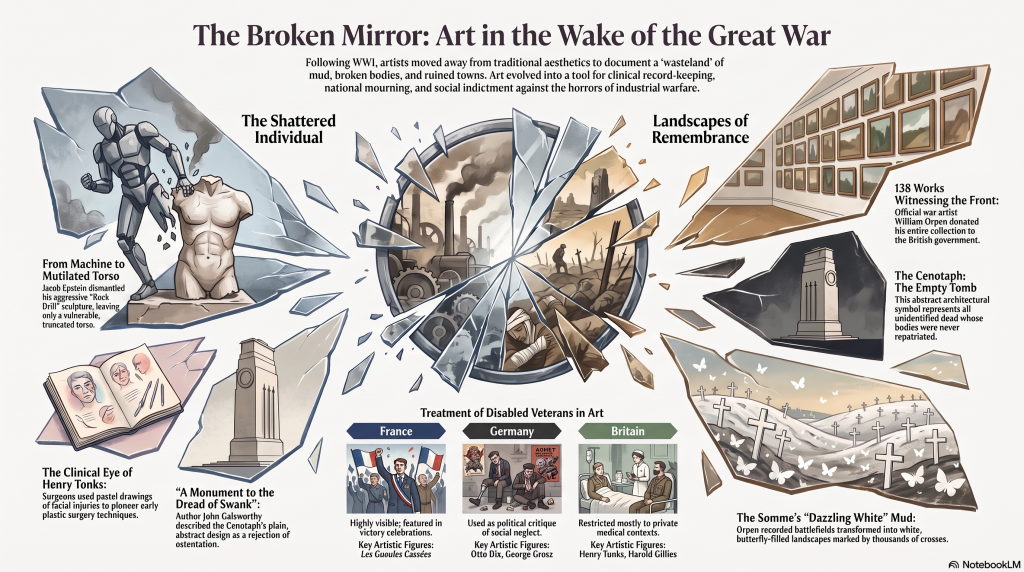
This talk traces European and British artistic responses to the First World War and its violent aftermath. Beginning with Epstein’s dismembered Rock Drill and Lehmbruck’s prostrate fallen soldier, it moves through Orpen’s transformed Somme landscape and Barlach’s hovering memorial angel. Tonks’s clinical pastels of facial injuries, Grosz and Dix’s merciless anatomies of Weimar social collapse, and Höch’s photomontage assault on the Republic follow. The talk concludes with Masson’s surrealist trauma, Dix’s Old Master triptych, and the return to order in Léger, Knights, Procter and Nevinson — artists collectively refusing to look away from what industrial war had done to humanity.
(My YouTube talk will be published on 17 July 2027)
An entertaining conversation about Aftermath WWI Art created by Google NotebookLM from my notes:
We think we know what First World War art looks like: mud, poppies, solemn ceremony. What we don’t expect is a robot with an embryo in its stomach, a surgeon who refused to show his work in public, or a woman who dismantled the Weimar Republic with a pair of scissors. These artists didn’t just document catastrophe — they used it to indict governments, expose hypocrisy, and invent entirely new visual languages.
**A War Machine Was Literally Dismembered at the Battle of the Somme**
Jacob Epstein’s Rock Drill began as a three-metre plaster figure mounted on a real industrial drill — phallic, armoured, carrying a tiny embryo in its abdomen. Then, in 1916, Epstein took it apart. He cut the figure in half, discarded the drill, and cast only the torso in gunmetal.
“Here is the armed, sinister figure of today and tomorrow. No humanity, only the terrible Frankenstein’s monster we have made ourselves into.”
The sculpture’s mutilation was the statement. The moment of dismemberment coincided with the Somme.
**The Most Powerful Anti-War Sculpture Was Melted Down by the Nazis**
Wilhelm Lehmbruck’s Fallen Man — a figure on hands and knees, head bowed — was reviled by the German press as anti-military and later destroyed. Lehmbruck, who’d served as a paramedic, never recovered psychologically. He took his own life in 1919, weeks after being elected to the Prussian Academy.
“What a heart-stopping sculpture this is… Fallen Man deserves to be recognised as one of the great 20th-century sculptures.” (The Guardian)
The piece is not commentary. It is consequence.
**A Surgeon-Artist Made Haunting Portraits He Refused to Exhibit**
Henry Tonks was both a trained surgeon and the most formidable art teacher of his generation. Working with pioneering plastic surgeon Harold Gillies, he produced pastel drawings of soldiers’ facial injuries — not as art, but as surgical records. He then refused all exhibition requests, insisting they would attract “a bloodthirsty public seeking vicarious gratification.”
They spent most of the 20th century unseen. Now they are among the most requested loans in the Royal College of Surgeons’ collection.
**Otto Dix Painted the War in Old Master Technique as a Deliberate Act of Grief**
Dix’s War Triptych — painted 1929–32 after years of recurring nightmares — echoes Grünewald’s 16th-century Isenheim Altarpiece. Where Grünewald offered Christ’s suffering as a path to salvation, Dix’s predella shows soldiers laid in a dugout that reads as a tomb. No resurrection follows.
“I did not paint war pictures in order to prevent war. I would never have been so arrogant. I painted them to exorcise the experience of war.”
The Nazis called it unpatriotic and removed him from his teaching post.
**A Woman Used Scissors to Dismantle an Entire Republic**
Hannah Höch’s 1919 photomontage Cut with the Kitchen Knife Dada through the Beer-Belly of the Weimar Republic is one of the densest political images ever made. Politicians sit on dancers’ bodies; generals jostle with artists; Höch pasted herself over a map showing which countries had granted women the vote.
The form enacts the argument: if war shattered society into fragments, her scissors made fragmentation both method and message. Yet within Berlin Dada, her male colleagues pressured her to find “a real job.” One later credited her contribution as providing sandwiches.
**Fernand Léger Was Gassed at Verdun — and Emerged More Optimistic About Machines**
Most artists recoiled from industrialism after experiencing it as a weapon. Léger doubled down. Gassed in 1916, he emerged convinced that the machine age belonged to the common worker. The Mechanic (1920) shows a muscle-bound labourer elevated into something close to a civic ideal.
Where Dix saw wreckage, Léger saw possibility. Both were looking at the same world.
These artists disagreed on almost everything — classicism versus rupture, hope versus indictment, witness versus exorcism. But none of them looked away. The harder question, a century on: when the next catastrophe arrives, which response do we reach for?
52-06 British Art 1900-50 – Return to Order Stanley Spencer
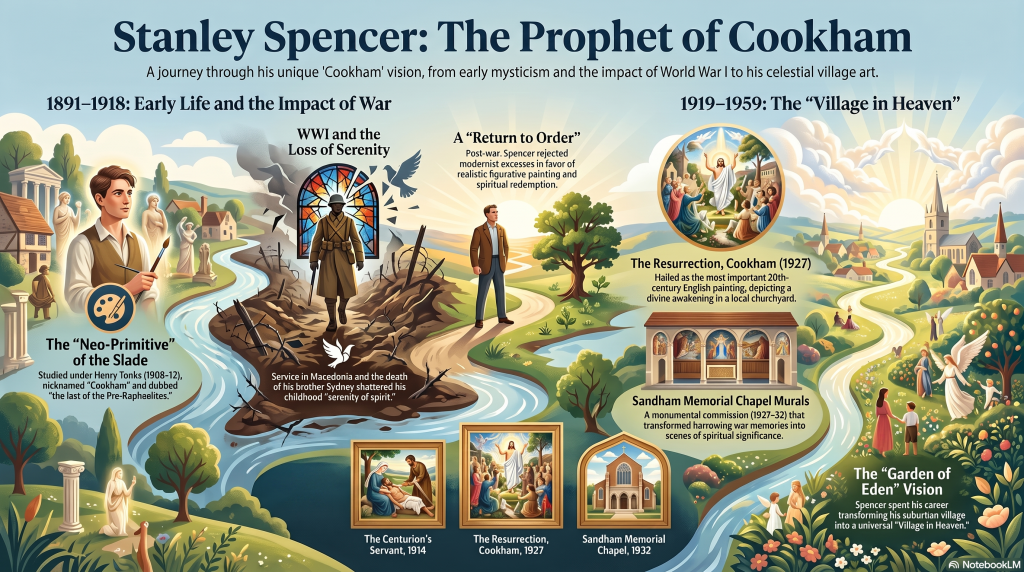
This talk provides a biographical and artistic analysis of the English painter Stanley Spencer, highlighting his unique ability to merge religious mysticism with the quiet reality of village life in Cookham. The sources detail his early development at the Slade School of Art and the profound impact of his service during the First World War, which influenced major works like the Sandham Memorial Chapel murals. His career was marked by both professional triumphs, such as his celebrated resurrection paintings, and personal turmoil involving two complicated marriages. The text emphasizes Spencer’s role as an idiosyncratic outsider whose style blended modernist techniques with a deep reverence for Early Renaissance masters. Ultimately, the materials present Spencer as a visionary figure who transformed his hometown into a “Village in Heaven” through his spiritually intense and highly detailed art.
(My YouTube talk will be published on 9 December 2026)
A conversation about Stanley Spencer created by Google NotebookLM:
To the casual observer in the 1920s, Stanley Spencer seemed less like a titan of British Modernism than a local eccentric: five-foot-two, pudding-basin haircut, and strangely detached from the world around him. Yet Spencer saw what others missed. To him, Cookham was not simply a Berkshire village, but a “Village in Heaven,” where pavements, gardens, kitchens, and churchyards could reveal the divine.
1. The Omen of the Chimney Crow
Spencer’s birth on 30 June 1891 came with a family omen: a crow fell down the chimney at Fernlea, flapped around the parlour, and escaped just before he was born. His family treated the moment as a sign.
The eighth surviving child of William “Pa” Spencer, he grew up in a remarkable household of musicians, academics, and performers. Educated partly by his sisters in a garden shed, he absorbed the idea that ordinary domestic life could be sacred.
2. The Art Student Who Missed Class for Tea
At the Slade School of Art from 1908, Spencer’s difference was obvious. His classmates nicknamed him “Cookham” because he remained so attached to home, often leaving London early to return for tea.
He endured mockery, including being put upside down in a sack, but his artistic direction stayed firm. While others looked to Picasso, Spencer admired Giotto, Mantegna, and Piero della Francesca. Paul Nash later called him “the last of the Pre-Raphaelites.”
3. Seeing Redemption on the Macedonian Front
The First World War deeply marked Spencer. Serving first with the Royal Army Medical Corps in Macedonia and later in the infantry, he lost his brother Sydney shortly before the Armistice. Yet in the Sandham Memorial Chapel, his great war memorial, he focused not on battle but on chores: scrubbing floors, making beds, and filling tea urns.
For Spencer, even military hospitals could suggest resurrection rather than despair.
Reflecting on Travoys Arriving with Wounded, he said he meant it “not a scene of horror but a scene of redemption.”
4. The Resurrection: A Pre-Raphaelite Shakes Hands with a Cubist
In 1926, Spencer completed The Resurrection, Cookham, setting the miracle of the dead rising in his local churchyard. Christ appears in the church porch, while villagers and strangers alike return to life in a mood of calm joy.
The Times praised it as one of the century’s most important English paintings, noting its blend of careful detail and modern freedom. For Spencer, it proved that heaven could be found in the familiar streets of Cookham.
5. A Marriage More Surreal Than His Art
Spencer’s private life was as strange as his art. In 1937, he divorced Hilda Carline and married Patricia Preece three days later. The marriage was never consummated, and Patricia soon left on “honeymoon” with her partner, Dorothy Hepworth.
The episode left Spencer financially and emotionally damaged. He remained devoted to Hilda, writing to her even after her death, as if the boundary between life and death were only another garden fence.
The Legacy of a Suburban Mystic
Knighted in 1959, Spencer became a major artist who still resisted easy classification. His genius lay in showing that the miraculous need not be distant or grand. It might be waiting in the streets, gardens, and kitchens we already know.
52-07 British Art 1900-50 – The Interwar Years,1930s
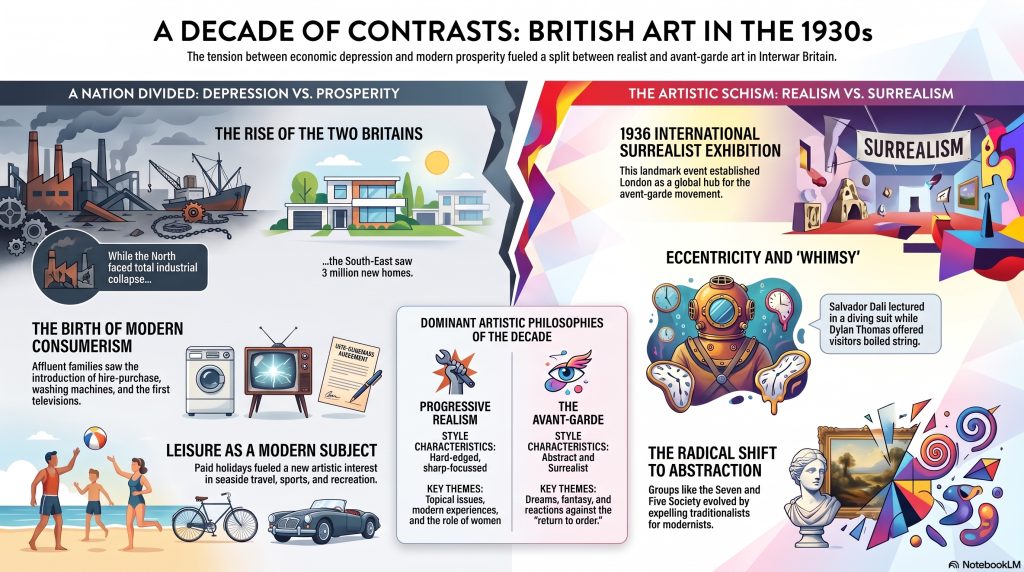
This talk specifically highlights British art during the 1930s. It examines how artists navigated a decade of contrasts, balancing traditional realist painting with the emergence of avant-garde movements like Surrealism and abstraction. The material provides a broader socioeconomic context, linking artistic shifts to the Great Depression, the rise of global Fascism, and improved leisure time for the affluent. Detailed biographical sketches of figures such as Harold Williamson and Dora Gordine illustrate the diverse personal histories of creators during this era. Additionally, the source documents the impact of the 1936 International Surrealist Exhibition, which briefly transformed London into a hub for European modernism. The talk serves as a historical overview of the evolving styles and political tensions that defined the UK’s interwar art scene.
My notes on British Art during the Interwar Years
A conversation on British art during the inter-war years created by Google Notebook from my notes:
The 1930s in Britain was a decade of jarring, schizophrenic duality. To the North, the landscape was one of industrial rot and “out-of-date practices”; the closure of Palmer’s shipyard in Jarrow left every man in the town redundant, prompting the desperate, rain-soaked march on London. Yet, in the South-East, a new modern affluence was being born. For those with a paycheck, the decade was an era of vacuum cleaners, car ownership, and the seductive novelty of hire-purchase. While the public laughed at Punch cartoons mocking the “British Character” and its “tendency to keep out of foreign politics,” the nation’s artists were locked in a radical internal revolution, one that mirrored the decade’s volatile social instability.
The Great Art Coup: How the “Seven & Five” Went Rogue
Just as the Northern shipyards were being cannibalized by economic shifts, the British art world was undergoing its own ruthless modernization. The Seven and Five Society, formed in 1919, began as a bastion of the “conservative” and “traditional.” Their initial 1919 manifesto was a masterclass in artistic timidity, stating that the group:
“[We] feel that there has of late been too much pioneering along too many lines in altogether too much of a hurry.”
By 1934, however, Ben Nicholson—who had joined a decade earlier—decided that the time for hurry had finally arrived. Nicholson, along with Henry Moore and Barbara Hepworth, staged a cold-blooded coup. They purged the society of its non-modernist members, rebranding themselves in 1935 as the “Seven and Five Abstract Group.” Their exhibition at the Zwemmer Gallery marked the first entirely abstract show in Britain, signaling a scorched-earth policy toward tradition. This shift suggests that in times of global tension, artists often feel they can no longer afford the luxury of a slow evolution; they must pioneer in a hurry or face irrelevance.
Salvador Dalí and the Deep-Sea Suffocation
While Nicholson was refining the hard edges of abstraction, Surrealism arrived in London like an “exploding rocket.” The 1936 International Surrealist Exhibition at the New Burlington Galleries was more than a mere showcase; it was an eccentric circus that established Britain as a center for the avant-garde.
The event was famously punctuated by Salvador Dalí attempting to deliver a lecture while wearing a full deep-sea diving suit and holding two hounds on a leash. The performance nearly ended in a very literal suffocation; Dalí began to gasp for air inside the helmet and had to be rescued by a poet wielding a spanner. Meanwhile, the Welsh poet Dylan Thomas wandered the halls with a cup of “boiled string,” politely asking visitors if they preferred it “weak or strong.” Even the authorities felt the tension; Danish artist Wilhelm Freddie’s works were impounded by British Customs as “pornographic.” The police nearly destroyed them under the obscenity laws of the day before they were narrowly saved and deported back to Denmark. Though some critics dismissed these artists as “immature boys,” the exhibition caused the first-ever traffic jams in Piccadilly, proving that Surrealism—while brief—had permanently shifted the boundaries of British taste.
The “Girl Sculptor Genius” Who Invented Herself
If the 1930s was a decade of shifting borders, Dora Gordine proved that an artist could sculpt their own biography with as much precision as their bronze. Born in Latvia to Jewish parents, Gordine spent the decade fabricating a grand mythology. She transformed her father into a Tsarist General and her mother into a Princess, added an “e” to her name for exotic flair, and shaved eleven years off her age.
Her rise was meteoric. Hailed by the press as a “Girl Sculptor Genius,” she built “Dorich House”—a residence valued at roughly £25 million in today’s currency—and socialized with the likes of Noel Coward and Cole Porter.
“A girl sculptor genius… her bronze heads are most sensitively seen and they are also more like real sculpture than anything I have seen at the Royal Academy.” — The Evening Standard
Behind the glamour, however, lay a chilling indifference. While Gordine was dining at the Ritz and cementing her status as the “Honourable Mrs. Richard Hare,” she appeared to show no interest in the fate of her brother and sister in Estonia, both of whom were likely being murdered by the Nazis. Her life serves as a haunting reminder that in an era of fluid identities, “exoticism” was a powerful currency that could buy a seat at the highest tables, even as the world burned.
Artistic PR: The School That Cold-Called Every “Mr. Brown”
In stark opposition to the “whimsical” abstractions of the South, the late 1930s saw the rise of the Euston Road School. These “progressive realists,” led by William Coldstream and Victor Pasmore, were often committed Communists who viewed naturalism as a tool for the masses. In a desperate attempt to bridge the gap between the gallery and the street, they sent exhibition invitations to every person named “Brown” in the London telephone directory.
There is a poignant irony in this middle-class preoccupation with the “common man.” Coldstream traveled to Bolton to paint local factories, but his efforts were met with shrugs from the workers themselves, who were far more interested in their dinners than in his naturalism. These artists were essentially trying to force a sense of relevancy onto a public that hadn’t asked for it, a mission that only ended when the brushes were traded for uniforms at the outbreak of the war.
The “Accidental” End of the Greatest Painter Who Ever Lived
No figure captures the decade’s manic intensity better than Christopher Wood. Wood’s drive was obsessive, fueled by the fashionable salons of Paris and a deepening opium addiction. He was a man in a desperate rush, once painting an incredible 60 canvases in just 40 days during a stay in Brittany. His ambition was naked and haunting; he famously wrote to his mother:
“[I intend] to try and be the greatest painter that has ever lived.”
Wood’s work eventually leaned toward “pastoral” subjects—scenes of Breton fishing communities that offered a quiet, primitive escape from the lingering trauma of the First World War. But the pressure of his own genius and his withdrawal from opium proved fatal. In 1930, believing himself pursued, he threw himself under a train at Salisbury. In a final, heartbreaking act of social preservation, the death was officially labeled “accidental” to protect his mother’s feelings.
Conclusion: The “Tendency to Keep Out”
The 1930s in British art was a period defined by a “tendency to keep out” of foreign politics while simultaneously engaging in a fierce internal struggle. The scene was split between the “hard-edged realism” of sports and leisure and the “suffocating” experiments of the Surrealists.
By 1939, as the members of the Euston Road School headed to the front, the British art scene felt as fragile as Alberto Giacometti’s The Palace at 4am—described by the artist as a “fantastical palace in the night—a very fragile palace of matches.” At the least false movement, the whole section would collapse. We are left to wonder: in times of global chaos, does art serve us best as a “pastoral escape” into the quiet churches of Christopher Wood, or as a “surrealist mirror” that forces us to look at the suffocating suit we are all wearing? One thing is certain: the 1930s proved that even when we try to keep out of the storm, the storm has a way of finding us in the gallery.Gemini Notebook can be inaccurate; please double-check its responses.
52-08a British Figurative Art Part 1
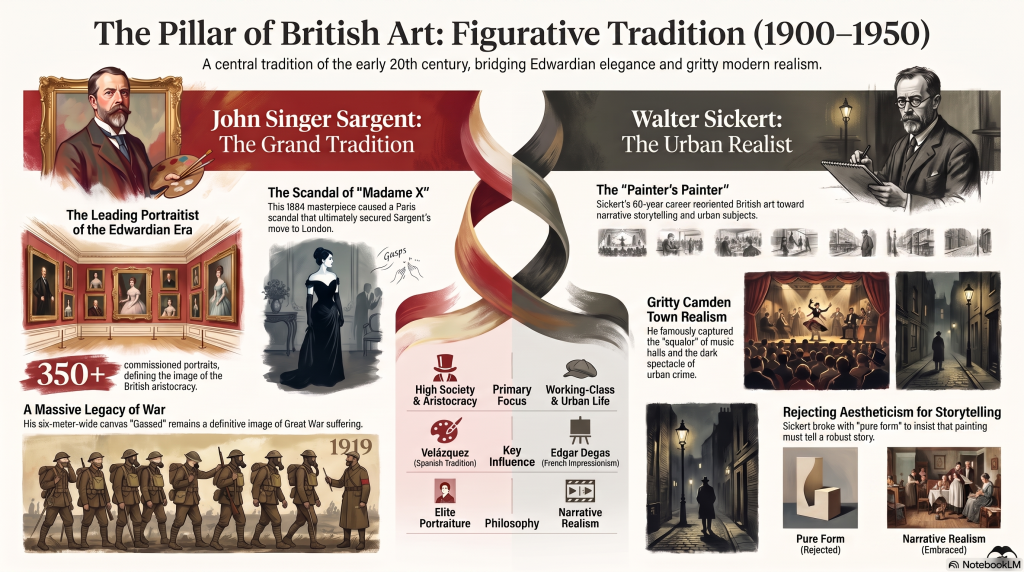
This lecture surveys British figurative art from 1900 to 1950 through five artists. Sargent, American-born but London-based, defined Edwardian portraiture before abandoning commissions as a degrading trade. Sickert, shaped by Whistler and Degas, became the central nervous system of British figurative painting, provoking scandal with music-hall subjects and Camden Town nudes. Gwen John worked in quiet Parisian isolation, her tiny output now rated above her celebrated brother Augustus, whose society portraits could be mercilessly revealing. Laura Knight fought institutionalised exclusion to become the first woman elected Royal Academician since 1768, producing wartime canvases that made individual women visible against overwhelming historical circumstance.
(My YouTube talk will be published on 24 July 2027)
My notes on British Figurative Art Part 1
An entertaining conversation about British Figurative Art Part 1 created by Google NotebookLM from my notes:
We tend to think of modern art as a story of abstraction — Cubism sweeping away the old world, figuration retreating into irrelevance. But look closely at British art from 1900 to 1950 and you find something far more interesting: a figurative tradition that was radical, provocative, politically charged, and utterly alive. Here are the most striking revelations from Dr. Laurence Shafe’s survey of nine painters who defined that tradition.
The “Society Portraitist” Who Called His Own Work a Pimp’s Profession
John Singer Sargent painted roughly 350 commissioned portraits between 1886 and 1907, becoming the defining face of Edwardian prestige. Then he stopped — abruptly, deliberately — declaring the whole enterprise “a pimp’s profession.” His final Uffizi self-portrait hides his hands entirely, suppressing every sign he was a painter at all. The man who built his career on visibility ended it with an act of studied concealment.
A Single Painting Triggered Britain’s Most Heated Art Scandal of the 19th Century
When Sickert exhibited a music hall singer at the New English Art Club in 1888, the response was volcanic. Critics called it “the lowest degradation of which the art of painting is capable.” Why such fury? London’s music halls were understood as places where prostitutes solicited openly. Painting a female performer was, to many eyes, painting a kept woman — a moral charge Degas never faced in Paris for nearly identical subjects.
Sickert Weaponised a Real Murder to Provoke Victorian Britain
After a prostitute named Emily Dimmock was murdered in Camden Town in 1907, Sickert deliberately renamed several existing paintings of female nudes The Camden Town Murder — paintings he had made years earlier with entirely different titles. As art historian Lisa Tickner argues, Sickert was the first artist to combine the nude, prostitution, and murder in a single pictorial framework — raising stakes that even Manet’s Olympia had never dared touch.
Gwen John’s Brother Predicted His Own Irrelevance
Augustus John was the most famous British portraitist of his generation. His sister Gwen worked in near-total obscurity in a Paris suburb, producing just 158 oil paintings in her lifetime. Yet Augustus himself said:
“In fifty years I shall be known as the brother of Gwen John.”
He was right, and it happened faster than he expected. Her total output is smaller than many artists produce in a single decade — and yet that restraint is the point. The force of her work comes precisely from what she refused to do.
The Painting That Answered a Century of Institutional Exclusion
Laura Knight’s Self-Portrait with Nude (1913) looks, at first glance, like a studio scene. It is actually a direct act of protest. As an art student, Knight had been refused access to life classes — women were permitted only to draw plaster casts. The Slade’s own first principal had acknowledged in 1871 that women were “debarred from the same complete study of the model.” Knight painted her answer. The Daily Telegraph called it vulgar. The National Portrait Gallery eventually bought it.
The War’s Most Powerful Propaganda Was Also Its Most Accurate Portrait
When the War Artists’ Advisory Committee needed to boost female recruitment to munitions factories, they sent Laura Knight to Newport to paint Ruby Loftus — a 21-year-old operating machinery that normally required eight to nine years of training. The resulting canvas, first shown at the Royal Academy on 30 April 1943, was reproduced in eight newspapers the next morning. It is the largest single-figure portrait in the entire wartime WAAC collection.
The Nuremberg Painting That “Snobs” Dismissed for the Wrong Reasons
Knight secured a place in the broadcasting box directly above the Nuremberg defendants, close enough to sketch Hermann Goering. Her final painting opens the courtroom walls to show the rubble of the city floating above the men who ordered its destruction — a structural choice of real conceptual daring. Kenneth Clark dismissed the work as mere “commonplaceness.” According to Shafe, that verdict owed less to looking than to snobbery: Knight had trained in Nottingham, not London, and Clark never forgave her for it.
British figurative painting wasn’t retreating from modernity — it was grappling with it more honestly than almost any other tradition of its time. The question worth sitting with: if institutions had been more open to women, to the working class, to artists trained outside London, how many more Gwen Johns might we have lost to obscurity?
52-08b British Figurative Art Part 2
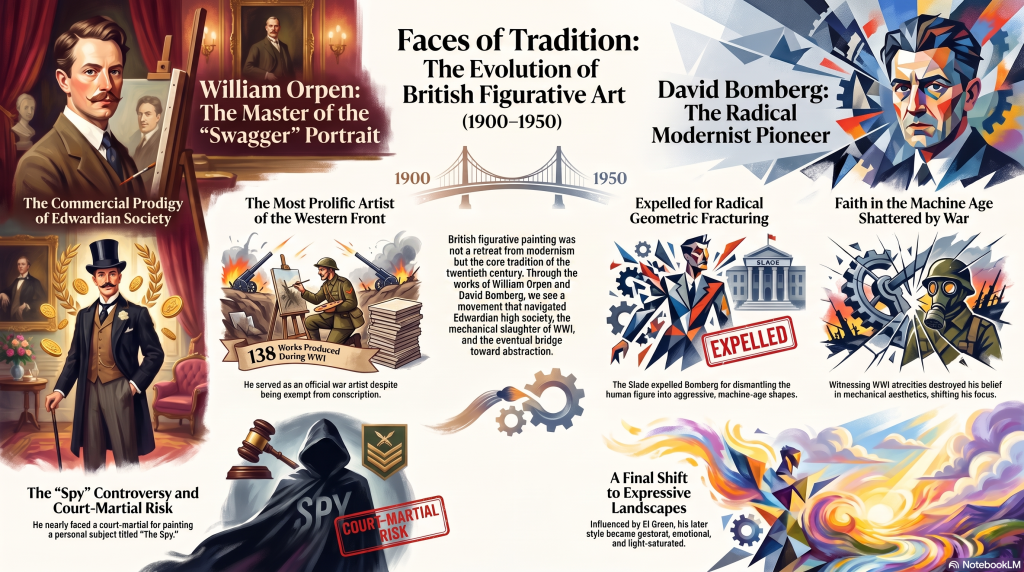
This talk, the second part of a survey of British figurative art, covers four artists. William Orpen, the most prolific official artist on the Western Front, combined Edwardian swagger portraiture with genuine moral seriousness. David Bomberg, brilliant Slade-trained radical and East End Jewish outsider, died near-obscure despite profound influence on Auerbach and Kossoff. Stanley Spencer’s unflinching self-portraits span a lifetime of fierce refusal to flatter. Victor Pasmore completes the arc, moving from Euston Road realism and intimate Thames-side painting to a total conversion to abstraction that Herbert Read called the most revolutionary event in postwar British art.
(My YouTube talk will be published on 31 July 2027)
My notes on British Figurative Art Part 2
An entertaining conversation about British Figurative Art Part 2 created by Google NotebookLM from my notes:
Most people assume British art spent the twentieth century politely ignoring modernism — a provincial tradition clinging to likeness while Paris and New York made history. The real story is far stranger, more contentious, and considerably more interesting.
Here are the most surprising things a deep dive into British figurative painting actually reveals.
A War Artist Nearly Faced Court-Martial Over a Nude — Then Engineered His Own Escape
William Orpen, the most prolific official artist on the Western Front, submitted portraits of his lover to military censors — titling them A Spy, just weeks after the executions of Edith Cavell and Mata Hari. Facing court-martial, he invented a story about a German spy disrobing before a firing squad. When that failed, he simply arranged for a phone call from Field Marshal Haig’s private office — audible to Army Intelligence — inviting him to dinner. The censors backed down immediately. The paintings were quietly renamed The Refugee.
Access to powerful men was, for Orpen, a medium he had been working in for years.
The Artist Who Shocked With Geometry Was Destroyed by the War That Proved Him Right
David Bomberg was expelled from the Slade in 1913 for fracturing the human figure into violent geometric forms. Both Wyndham Lewis and Marinetti wanted to claim him. He refused them both. Then the Western Front — mechanised slaughter, exactly the kind of industrial destruction his pre-war aesthetic had somehow anticipated — broke his faith in the machine age entirely.
“I want to translate the life of a great city into art that shall not be photographic, but expressive.”
He died in 1957 in near poverty. The institution that refused to buy his work in 1937 would eventually recognise what it had overlooked — too late for him to know it.
A Painting’s Power Can Be Premonitory
Bomberg’s Bomb Store paintings (1942) depicted an underground munitions depot with dense, pressured urgency. Two years later, the depot was destroyed in an explosion that killed 68 people. The paintings carry what can only be called a premonitory gravity — and the War Artists’ Advisory Committee had rejected his commission applications twice.
The Churchill Portrait You’ve Never Seen Tells the Truth
Orpen painted Winston Churchill in 1916, when Churchill was 42 and bearing institutional responsibility for the deaths of over 46,000 men at Gallipoli. He looks decades older. The portrait refuses consolation entirely.
“Orpen’s portrait of Churchill is stamped with an unmistakeable and deeply affecting veracity of feeling. And that, for me, is one of the hallmarks of great art.” — Paul Moorhouse, National Portrait Gallery
Bomberg’s Greatest Legacy Was What He Taught, Not What He Made
From 1945 to 1953, Bomberg taught at Borough Polytechnic in near-total obscurity. His students included Frank Auerbach and Leon Kossoff — two of the defining figures of late twentieth-century British painting. His insistence on “the search for the spirit in the mass” passed directly into their work. His vision didn’t end with him; it multiplied.
The Most Radical Conversion in British Art History Came From the Most Conventional Direction
Victor Pasmore spent the 1930s and 40s making intimate Thames-side scenes and candlelit interiors in the tradition of Vermeer. Then, in 1948, he walked away from figuration entirely — not gradually, but in a single decisive break. By 1957 he was suspending transparent Perspex sheets from gallery ceilings threaded with painted wooden blocks.
Herbert Read called it “the most revolutionary event in post-war British art.”
The man who made it had spent eleven years as a London County Council clerk before anyone took his painting seriously.
The tradition these artists share isn’t stylistic — it’s a refusal to flatter. Whether Orpen’s shattered Churchill, Bomberg’s dying self-portrait painted without a mirror, or Spencer’s lifelong unflinching record of his own face, the central commitment of British figurative painting turns out to be honesty.
Which raises a question worth sitting with: if the artists most committed to truth were the ones their institutions most consistently ignored, what does that tell us about what institutions are actually for?
52-09 British Art 1900-50 – Gwen John
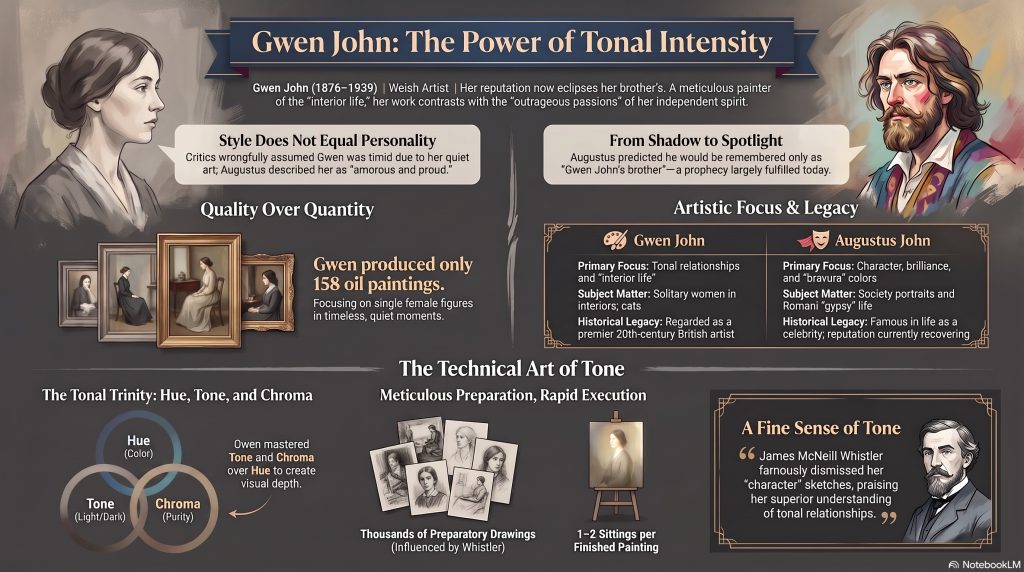
This talk explores the life and artistic legacy of Gwen John, challenging the common tendency to compare her work with her brother Augustus’s work based on simple personality traits. While Augustus was often viewed as a boisterous extrovert and Gwen as a timid recluse, the sources reveal a more nuanced reality where Gwen was actually a woman of fierce passions and fierce independence. Both siblings attended the Slade School of Art, yet they forged distinct paths; Augustus achieved early fame as a society portraitist, whereas Gwen’s reputation has steadily grown to surpass his. The materials detail Gwen’s meticulous tonal technique, her challenging years working as a model in Paris, and her complex relationship with the sculptor Auguste Rodin. Ultimately, the sources highlight Gwen’s significance as a major twentieth-century artist whose small-scale, quiet interior paintings are now recognized for their profound emotional depth. I hope this talk will act as a corrective to historical stereotypes, presenting a sophisticated look at their shared origins and divergent careers.
A conversation on Gwen John created by Google Notebook from my notes:
In the annals of 20th-century British art, few contrasts appear as stark as that between the John siblings. Augustus John was the quintessential “wild” celebrity—a bearded, bohemian society portraitist who lived with a “bravura” style and was rumored to have fathered over a hundred children. His sister, Gwen John, has long been cast as his inverse: a “quiet” recluse who painted small, subdued interiors in a muted palette of mauves and greys.
It is a tempting narrative, fueled by the common misconception that an artist’s style must be a direct mirror of their personality. We see a minimal, reticent canvas and assume a submissive soul. However, as an art historian, one finds the reality of Gwen John’s life far more counter-intuitive. Behind the still, silent figures of her paintings lived a woman of “outrageous” passions and a fiercely untamed spirit that her brother Augustus described as anything but retiring.
The “Quiet Introvert” Myth vs. the “Outrageous” Reality
The public perception of Gwen as a shrinking violet ignores the testimony of those who shared her life. While critics often mistake her “haughty independence” for humility, Gwen was a woman of hard, even irrational, intensity. This “hardness” was not merely a rumor; it was a lived experience for those close to her. In 1904, during a grueling walking tour toward Toulouse, the supposedly frail Gwen insisted that her companion, Dorelia McNeill, carry all the heavy equipment. She argued that she needed to protect her “artist’s hands”—a demand that led Dorelia to later describe her as “extremely strange and hard.”
Augustus John, who famously peer-obsessed over her “little pictures,” was under no illusions about his sister’s temperament. He understood that she did not lack energy, but rather possessed a “self-scrutinising intensity” that could be terrifying. He provided a vivid synthesis of her true character:
“She wasn’t chaste or subdued, but amorous and proud. She didn’t steal through life, but preserved a haughty independence which some people mistook for humility. Her passions for both men and women were outrageous and irrational. She was never ‘unnoticed’ by those who had access to her.”
We must ask why society—and art criticism—is so quick to equate a minimalist painting style with a passive personality. For Gwen, the “quiet” of her canvases was not a sign of submission, but a deliberate, powerful container for a life that was often exuberantly tragic and intensely felt.
The Prophet of Her Own Eclipse
For much of their early careers, Augustus was the star and Gwen was a footnote. While Augustus was a leading figure in the art world, Gwen’s work was largely ignored by the public until her first solo exhibition in 1926. However, her financial independence was secured much earlier by the American patron John Quinn, who purchased the majority of her works between 1910 and 1924, freeing her from the need to please society critics.
Augustus possessed a remarkable, almost prophetic insight into the enduring quality of his sister’s genius compared to his own. He described her work as “staggering” and “painfully charged with feeling,” famously predicting:
“Fifty years after my death I shall be remembered as Gwen John’s brother.”
History has proven him correct. Augustus died in 1961; by 2011, Gwen was firmly established as one of the most important British artists of the 20th century. While Augustus’s reputation faded into that of a fashionable but dated society painter, Gwen’s reputation grew into a timeless monument of British Modernism.
A Secret Language of Tone and Volume
Gwen’s artistic detachment was born from a rigorous technical philosophy influenced by James McNeill Whistler. When Whistler met Augustus in the Louvre and was asked if Gwen had a knack for “character,” he retorted: “Character? What’s that? Your sister has a fine sense of tone.”
To Gwen, a painting was an arrangement of tonal relationships rather than a narrative. She viewed the world through three technical dimensions: Hue (the color itself), Tone (the value of light and dark), and Chroma (the saturation). By adding grey of the same tone to a hue, she reduced the chroma to create her signature “feel.” This meticulous preparation often took a “long time of a quiet mind,” though she believed the final painting should be finished in just one or two sittings.
This technical obsession led her to develop a complex, highly personal numerical system for describing tones—a code so intricate that modern scholars have still not fully deciphered it. For Gwen, the identity of the sitter was secondary to the architectural arrangement of the canvas. She famously remarked:
“…a cat or a man, it’s the same thing … it’s an affair of volumes … the object is of no importance.”
Survival in the “Nursery” and Ex-Brothels
Gwen’s autonomy was forged in the harsh, bohemian environments of her student years. At the Slade School of Art (1895–1898), she lived with Augustus and a circle of friends at 21 Fitzroy Street—an ex-brothel where the landlady was an eccentric mature student. Subsisting on a meager diet of fruit and nuts, Gwen even lived as a squatter in a derelict building in 1900–01, neglecting her health for her craft.
She was part of a circle of female students known as the “nursery,” who gave each other Jungle Book nicknames. Yet beneath this childlike veneer lay a grim reality. As women in a male-dominated field, their respectability was constantly in jeopardy. They were forced to draw each other in secret because the “respectability” of middle-class women would be ruined if they admitted to studying their own bodies rather than working-class models.
When Gwen moved to Paris, she survived by posing as a model, an experience rife with harassment. She recounted in her diaries how one woman artist client kissed a man all afternoon in front of her, then threatened Gwen’s employment if she ever spoke of it. Such experiences, where she was treated as a child or an object, only deepened her “haughty independence” and her retreat into a private, self-scrutinizing world.
The Obsessive “Little Wife” of Rodin
In 1904, Gwen’s search for intensity led her to the 64-year-old sculptor Auguste Rodin. Gwen, then 28, became his model and mistress, embarking on a relationship defined by a staggering, lopsided obsession. She wrote thousands of letters to him, identifying herself as his “little wife.” The passion was so “outrageous” that Rodin eventually grew overwhelmed, using his secretaries and assistants to avoid seeing her.
Heartbroken but resolute, Gwen’s search for an “interior life” eventually took a spiritual turn. She converted to Catholicism and moved to the Paris suburb of Meudon, living as “God’s little artist.” This period is often characterized as one of lonely reclusion, but Gwen saw it as the ultimate autonomy. She craved the solitude necessary for her work, writing to a friend:
“I may never have anything to express except this desire for a more interior life.”
Conclusion: The Still Point of the Turning World
Gwen John’s life was a paradox of “haughty independence” and tragic neglect. After years of reclusion, she died in Dieppe in 1939 while fleeing the onset of another war; she was buried as a pauper in an unmarked grave. It was a stark end for a woman who achieved a level of artistic “sincerity” that few of her peers could match.
Her work is frequently compared to that of Vermeer for its timelessness. Critics have noted that while an Augustus John painting feels as though something is “about to happen,” in a Gwen John, “it all happened long ago.” She captured what T.S. Eliot, in his poem Burnt Norton, described as “the still point of the turning world”—a moment where past and future are gathered into a single, breathless “dance” of volume and tone.
Does knowing the “outrageous” passion and “hard” intensity behind the quiet canvas change how we see her work? Perhaps. Or perhaps the art was always screaming in its own silent way, and we are only now developing a “quiet mind” enough to listen.Gemini Notebook can be inaccurate; please double-check its responses.
52-10 British Art 1900-50 – Augustus John
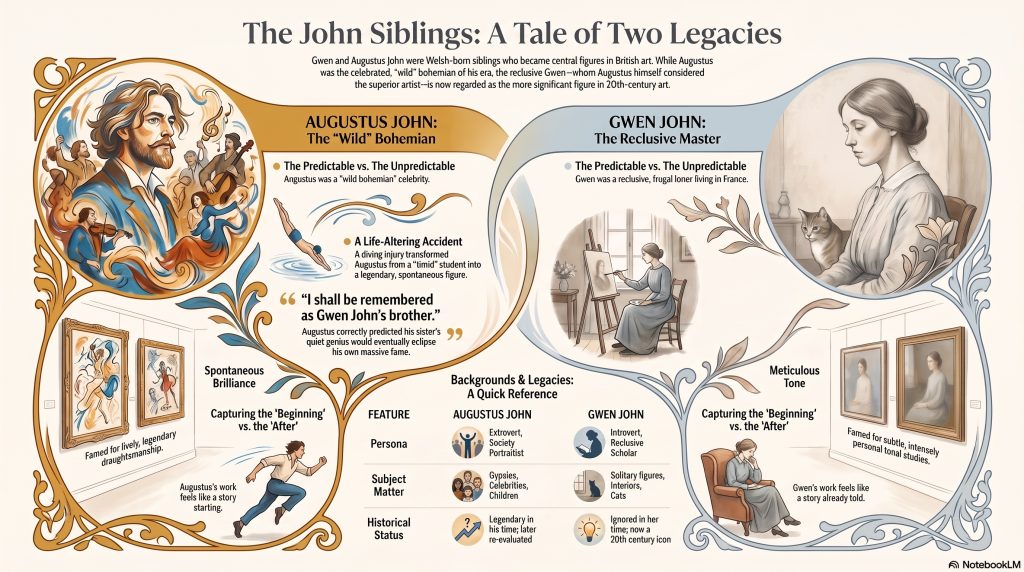
The talk explores the lives and artistic legacies of Augustus John who was initially celebrated as a legendary, wildly bohemian talent whose drawing skills were compared to the Old Masters, he personally believed his sister’s work was superior. Gwen John led a more reclusive and quiet life in France, often struggling for recognition in a male-dominated field while maintaining an intense, methodical approach to her painting. The sources detail their shared history at the Slade School of Art, their complex romantic entanglements—including Gwen’s obsession with Auguste Rodin—and Augustus’s fascination with the Romani lifestyle. Ultimately, the text notes a historical shift where Gwen’s reputation has eclipsed her brother’s, with her work now regarded as some of the most significant of the twentieth century. Through biographical notes and exhibition references, the material underscores how their different attitudes toward art and life shaped their enduring contributions to the art world.
A conversation on Augustus john created by Google Notebook based on my notes:
To look at the self-portraits of Gwen and Augustus John is to witness a profound psychological schism captured in oil and ink. In her 1902 Self-Portrait, Gwen appears buttoned-up, serene, and hauntingly self-contained—a woman existing within the fortress of her own mind. Contrast this with Augustus’s etching, Tete Farouche (“Wild Head”), where a red-bearded, wild-eyed youth stares back with an intensity that borders on the predatory. When these “Welsh foreigners” arrived at the Slade School of Art in the late 1890s, the art world saw only the flash of Augustus’s brilliance. Yet, in a moment of startling clarity, the most famous artist of his generation issued a prophecy that would take a century to fulfill: he predicted that he would eventually be remembered only as his sister’s brother.
1. The Diving Accident That Created a Bohemian Icon
The “Augustus John” that would come to define British bohemia—the gold-earringed, unpredictable giant with legendary draughtsmanship—was almost a historical accident. The neat, methodical student who entered the Slade was obliterated in the surf off Tenby in 1897. During a summer vacation, Augustus dived into shallow water and suffered a serious head injury.
Before this “strange event,” his tutor Henry Tonks described his work as merely “methodical” and his personality as “timid.” He emerged from a long convalescence a dramatically changed figure, as if the trauma had cracked open a latent, volcanic persona. He grew his hair and beard, traded his unremarkable student garb for a flamboyant costume, and watched his art shift from careful study to lively, spontaneous brilliance.
“A great man of action into whose hands the fairies had placed a paintbrush instead of a sword.” — Wyndham Lewis
2. The Prophecy: “I Shall Be Remembered as Gwen John’s Brother”
By twenty-five, Augustus was a colossus, compared by critics to Michelangelo and Matisse. He eventually replaced John Singer Sargent as the nation’s preeminent portraitist, capturing the “cruel psychological truth” of sitters like Dylan Thomas and T.E. Lawrence. Gwen, meanwhile, lived in what many saw as squalor in France, an “obsessively reticent” recluse whose work was largely ignored.
Yet Augustus was his sister’s most devoted and haunted admirer. He would stand before her “little pictures” at exhibitions, staring obsessively while other critics walked past. He recognized that while his work was filled with bravura, hers was “painfully charged with feeling.” He saw a technical mastery in her quietude that made the works of his contemporaries—and perhaps his own—seem empty by comparison.
“Fifty years after my death [2011] I shall be remembered as Gwen John’s brother.” — Augustus John
3. The Curated “Gypsy” Identity of Dorelia McNeill
Augustus John’s lifelong obsession with the Romani people was a calculated escape from a childhood he described as a “mortuary.” His father, a “revolting” and “cold” solicitor, had once used the Romani as a bogeyman, threatening to have Augustus “kidnapped by gypsies” if he misbehaved. His father never realized that Augustus secretly longed for that kidnapping, wishing for an exit from a home defined by “frozen immobility.”
This fantasy found its physical form in “Dorelia,” his greatest muse. She was actually Dorothy McNeill, a typist from Camberwell. Augustus was so taken by her taste for “artistic” dress that he renamed her and fantasized about her Romani ancestry. He curated her identity, dressing her in the costumes seen in Woman Smiling to suit his needs. For Augustus, becoming President of the Gypsy Lore Society and living in a caravan wasn’t just a lifestyle; it was a defiant reversal of his father’s threats into a sanctuary of freedom.
4. The “Nursery” and the Hidden Struggles of Women Artists
At the Slade, a brilliant circle of women known as “The Nursery”—including Gwen, Ida Nettleship, and Edna Waugh—navigated a minefield of Victorian respectability. They adopted names from The Jungle Book, a childlike shielding against a world that hindered their professional growth. Because of the era’s “respectability” crisis, these women were forced into secrecy; drawing from their own bodies was a scandalous necessity they could never acknowledge to their middle-class peers.
The cost of this environment was often total. Ida Nettleship, a star pupil, sacrificed her career to manage a chaotic ménage à trois with Augustus and Dorelia, eventually dying of puerperal fever after her fifth child. Even more harrowing was the case of Edna Waugh, arguably the most imaginative of them all. Her husband forbid her from painting, leading to a nervous breakdown; she only returned to her studio after he relented, eventually living to 100. Their stories provide the tragic answer to the era’s dismissive question: “Why are there no great women artists?” The greatness was there; the permission was not.
5. Static vs. Story: The Fundamental Difference in Their Art
The siblings’ divergent philosophies are best viewed through their portraits of Dorelia. In 1903, Gwen and Dorelia “eloped” on a 150-mile walking tour to Toulouse, sleeping in barns and eating almost nothing. In Gwen’s resulting portrait, The Student, Dorelia’s face is visibly thinner from the grueling journey. She is surrounded by books, depicted as a contemplative, intellectual equal—a story “already told” in the timeless manner of Vermeer.
Augustus’s version, Woman Smiling, presents a “plumper” and “fierce” Dorelia. To him, she was an accessory to his genius, a “gypsy Gioconda” captured at the “beginning of a story,” vibrant and about to speak. While Augustus relied on bravura, Gwen was developing a complex numerical system for describing tones—a technique so precise it has still not been fully decoded. This technical obsession was what the master James McNeill Whistler recognized when Augustus asked him if Gwen captured “character.”
“Character? What’s that? Your sister has a fine sense of tone.” — James McNeill Whistler
Conclusion: The Shadow and the Substance
The tides of history have turned exactly as Augustus feared—or perhaps, as he hoped. Gwen John is now revered as a titan of 20th-century British art, her reputation growing in the silence of her “frugal solitude.” Augustus, long dismissed as a “flashy” relic of his own celebrity, is only now undergoing a modern re-evaluation.
The legend of his “100 children” and his boisterous caravans now seems a frantic distraction that thinned the substance of his later work. We are left with a haunting question about the nature of the creative spirit: Is the most enduring art forged in the roar of celebrity and the heat of many lives, or is it found in the “obsessive reticence” of a closed room?Gemini Notebook can be inaccurate; please double-check its responses.
52-11 British Art 1900-50 – Laura Knight
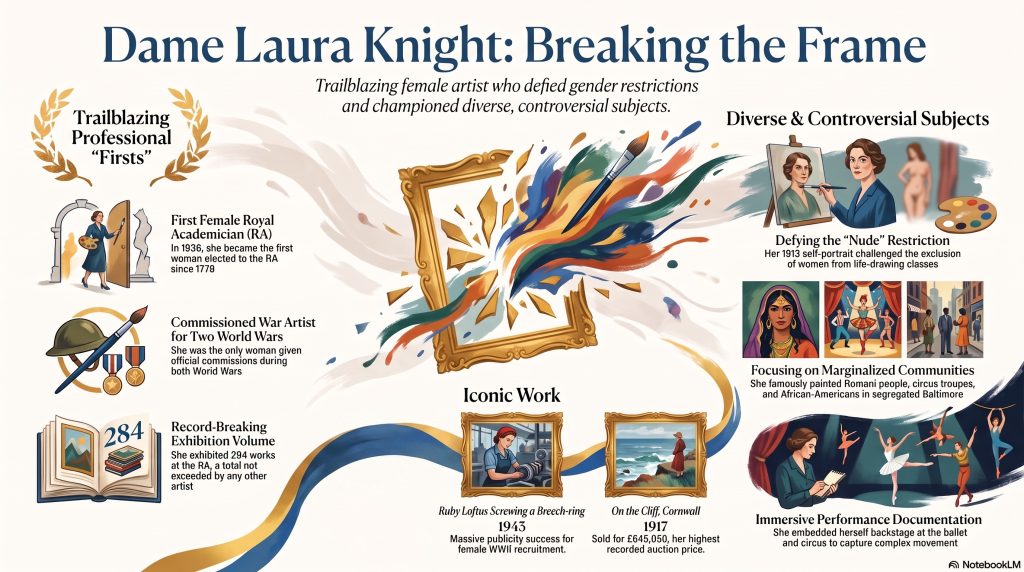
This talk is on Dame Laura Knight, one of Britain’s most prominent and successful figurative painters of the twentieth century. It details her evolution from a financially struggling student at the Nottingham School of Art to becoming the first woman elected as a full Royal Academician in 1936. The sources explore her diverse subject matter, including her controversial nudes, vibrant scenes of the circus and ballet, and her historic role as a commissioned war artist. Specific attention is given to her technical shift toward English Impressionism during her time with the Newlyn and Lamorna artist colonies in Cornwall. Additionally, the talk highlights her defiant professional spirit as she navigated the institutional barriers and gender biases of the contemporary art world. Overall, I celebrate Knight’s artistic legacy and her symbolic importance in the history of female emancipation.

A conversation on Laura Knight created by Google Notebook from my notes:
Long before the “glass ceiling” was named, Laura Knight was methodically dismantling it with a paintbrush. While history often frames her as a pillar of the British establishment—a Dame Commander of the Order of the British Empire and a titan of the Royal Academy—her journey to those heights was defined by a radical, often scandalous defiance. Born into an impoverished household and orphaned in her late teens, Knight was a woman who was repeatedly told where she did not belong.
Her life is a masterclass in creative grit, demonstrating how an artist can transform “stuttering, laboured” beginnings into a legendary career by refusing to remain confined. Perhaps the ultimate irony of her career lies in her relationship with the institutions she conquered: though she was a Royal Academician for three decades, she was barred from attending the Academy’s annual dinner until 1967, just three years before her death. Here are five surprising lessons from the life of an artist who chose the “savagery and wildness” of the world over the safety of the studio.
1. The Scandal of the “Vulgar” Self-Portrait
In 1913, Knight produced her most revolutionary work: Self-Portrait with Nude. To a contemporary eye, it is a striking study of artist and model; to the Edwardian establishment, it was an act of war. During the nineteenth century, women were systematically excluded from life classes, forced instead to sketch from “wooden,” static plaster casts—a practice Knight loathed for the “woodenness” it forced into her early work.
By using mirrors to capture herself in profile while painting the nude artist Ella Naper, Knight staged a “personal emancipation.” Technically, the work was a rejection of the “lady” amateur; she abandoned the timid, stuttering wrist-work expected of women for a bold, physical technique, drawing from the shoulder with thick, “manly” outlines. The Daily Telegraph labeled the work “vulgar,” suggesting it should have stayed in the studio. Yet, the palette itself signaled her growth; she had moved from the dark, sombre tones of her early Yorkshire period to a bright Impressionistic style birthed in the light of Newlyn.
“In 2015 Simon Schama described the painting as a ‘masterpiece’ and ‘incomparably, her greatest work, all at once conceptually complex, heroically independent, formally ingenious and lovingly sensual.’”
2. The Olympic Medalist of the Art World
One of the most improbable entries on Knight’s curriculum vitae is her status as an Olympic silver medalist. During the 1928 Amsterdam Summer Olympics—back when the Games included “Art Competitions”—Knight won silver for her painting Boxer.
The lesson here is one of creative adaptation. Denied the chance to study the nude in traditional academic settings, Knight turned her eye toward the raw movement and semi-naked male forms of the boxing ring. The painting Boxer was actually produced in 1917, a decade before its Olympic glory, proving that her early “rebellious” studies of bantam-weight champions were not merely peripheral interests, but essential training that eventually commanded establishment accolades.
3. The Rolls-Royce Easel: A Gaze Without Borders
Knight possessed a deep, enduring fascination with communities existing on the margins. Her “female gaze” was never one of detached observation; she sought a level of immersion that her male peers rarely achieved. This was most evident in her 1926 trip to Baltimore, where she documented the racially segregated wards of the Johns Hopkins Hospital.
Through her friendship with Pearl Zelma Johnson—an energetic campaigner against segregation and an assistant to the surgeons—Knight was introduced to the early Civil Rights movement, attending concerts and lectures that informed her “timeless” portraits of African-American patients and staff. Her commitment to her subjects often required eccentric logistics. When painting the Romani community at the Epsom races, she famously worked from the back of her antique Rolls-Royce. The car served as a mobile studio, large enough to house her easel and providing a sheltered vantage point that allowed her to be accepted by the community while she captured their lives on canvas.
4. “Making the Pencil Speak”: The Circus and the Ballet
Knight did not believe in the artificiality of the posed model; she demanded the “perfection of balance and line” found only in reality. In 1919, she obtained a backstage pass to work in any theatre where the ballet was playing, forming a close friendship with the Russian ballerina Lydia Lopokova. She later applied this same technique to the circus, touring with the Bertram Mills and Great Carmo troupes.
This behind-the-scenes immersion was a rejection of domesticity—Knight famously joked she “couldn’t boil an egg,” preferring the rigour of the road to the comforts of home. This access allowed her to master two distinct creative challenges:
- The Ballet: She sought to capture the “infinite possibilities” of movement, pushing herself, in her own words, to “make the pencil speak in a language of its own.”
- The Circus: By becoming “Circus—accepted in Circus for good and all,” she learned to paint at great speed directly onto the canvas, capturing “quiet moments” of performers unaware of her presence.
5. Witnessing the Unspeakable: Nuremberg at 69
In 1946, at the age of 69, Knight undertook the most somber assignment of her life: documenting the Nuremberg Trials. Though she was the only British artist present in the courtroom, she went under her own cognisance rather than a formal commission, though her work was ultimately purchased by the Imperial War Museum.
It was a daunting task, yet a life spent documenting the “savagery” of the Yorkshire coast and the grit of marginalized lives had prepared her. She brought the same eye for “austerity and wildness” she had discovered in the fishing community of Staithes to the courtroom in Germany. Her ability to bear witness to the “unspeakable” at nearly 70 years old proved that her realist tradition was not a relic of the past, but a powerful tool for recording the most harrowing moments of human history.
Conclusion: The Legacy of a “Freak”
Laura Knight’s impact culminated in her 1965 solo retrospective at the Royal Academy—the first ever granted to a woman. Even then, she remained a subversive spirit. For her 1937 Summer Exhibition poster, she chose to feature a plaster cast of the Venus de Milo—a subtle “jib” at the very institutions that had forced her to study “wooden” casts for years. In her autobiography, The Magic of a Line, she reflected with characteristic bluntness:
“Even today, a female artist is considered more or less a freak… Now that womankind are no longer born to hold a needle in one hand and a scrubbing brush in the other, what great things may not happen?”
Knight’s journey from “stuttering, laboured” starts to the “joy of line for its own sake” reminds us that creative mastery is not found in the places where we are told we belong. It is found in the “wildness” of the world, for those defiant enough to seek it. What “stuttering” start in your own life might be waiting for the courage of a bold, physical line?Gemini Notebook can be inaccurate; please double-check its responses.
52-12 British Art 1900-50 – World War 2 Art
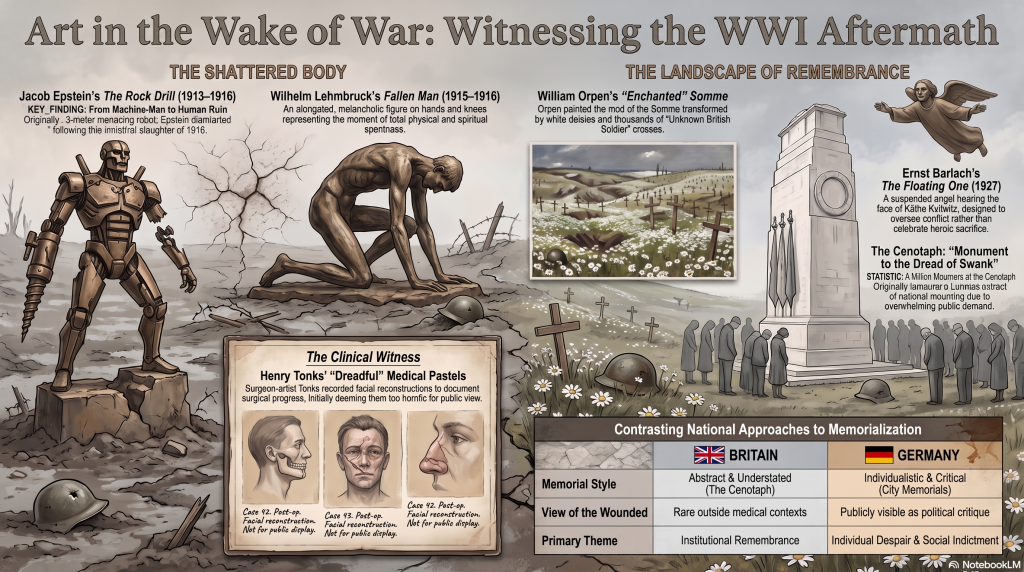
This talk examines how European and British artists used their work to process the horrific violence and social collapse following the First World War. Through a collection of lectures assisted by AI, Shafe highlights how traditional art forms evolved into visceral tools for witness, grief, and indictment. Key examples include Jacob Epstein’s “The Rock Drill,” which was physically dismantled to mirror the emasculation of industrial warfare, and Wilhelm Lehmbruck’s “Fallen Man,” a sculpture capturing total human abjection. The sources also describe the work of official war artists like William Orpen, who documented the eerie transformation of battlefields into landscapes of white crosses and wildflowers. Ultimately, the collection illustrates how the conflict’s massive scale of destruction fundamentally reshaped artistic traditions and forced creators to confront unimaginable loss.
(My YouTube talk will be published on 07 August 2027)
An entertaining conversation about World War 2 Art created by Google NotebookLM from my notes:
To walk through a gallery of early 20th-century art is to witness a profound, stuttering silence where a scream used to be. We are often taught history as a sequence of clinical markers—treaties signed in gilded halls, borders redrawn with the stroke of a pen—but the history books rarely capture the psychic rupture of 1914. While the maps were being rearranged, the human imagination was being systematically dismantled. It fell to the artists, those sensitive barometers of the soul, to find a language for the “previously unimaginable death tolls” and the cold, automated violence of the industrial age.
Before the Great War, the Western world was intoxicated by the Machine. We worshipped the speed of the engine and the precision of the piston. But as the conflict ground on, the machine turned on its creator. The artists who witnessed this were tasked with a heavy burden: they had to translate the “abomination of desolation” into something a civilian audience could endure, moving past the decorative traditions of the Victorian era into a raw, uncompromising witness.
This exploration of “Remembrance” looks through the eyes of those who stood in the mud of the Somme and the antiseptic wards of Sidcup. It is a journey from the celebration of industrial power to a haunting, rough-hewn realism. Below are five pivotal takeaways that illustrate how the war’s destruction reshaped the creative tradition, forcing art to confront the trauma of a broken world.
1. The Literal Emasculation of the Machine: Jacob Epstein’s The Rock Drill
Before the slaughter began, the Vorticism movement briefly celebrated the hard-edged, mechanical vitality of the modern age. Jacob Epstein’s The Rock Drill (1913–15) was the movement’s most unsettling icon. In its original form, it was a terrifying, three-meter-tall plaster figure mounted atop a real, American-made industrial rock drill—the manufacturer’s name still brazenly visible. With its armored, beak-like visage and its position of phallic dominance, it was a “machine-like robot” representing the aggressive, masculine energy of global industrialism.
However, by the summer of 1916—as the mechanical meat-grinders of the Somme and Verdun consumed a generation—Epstein’s fascination turned to horror. He dismantled the work, discarding the drill and cutting the figure in half. He removed the arms and cast only the truncated torso in gun metal and bronze. The once-towering symbol of masculine aggression was literally emasculated, reduced to a one-armed, vulnerable trunk that seemed to recoil from its own nature.
Epstein later provided the ultimate indictment of this transformation:
“No Humanity, only the terrible Frankenstein’s monster we have made ourselves into.”
2. The Art the Public Was Never Meant to See: Henry Tonks’ Surgical Pastels
In the public square, memorials were being built to a “clean” sacrifice, but in the surgical wards, the reality was “rather dreadful.” Henry Tonks was a man of two worlds: the formidable Slade Professor who taught a generation of modernists, and a trained surgeon who resumed medical work as a lieutenant in the Royal Army Medical Corps. At the Queen’s Hospital in Sidcup, he was recruited by the pioneering plastic surgeon Harold Gillies to document the faces destroyed by shrapnel.
Gillies understood that a draughtsman’s hand could capture a truth the camera flattened. Tonks produced a series of pastel drawings of soldiers like Private Walter Ashworth, who was wounded on the first day of the Somme. These were not works for a gallery, but clinical records of agonizing reconstruction. The human cost was total; upon Ashworth’s return, his injury was too much for his fiancée and employer to accept, though he eventually found solace in marriage to a more supportive friend.
Tonks refused to exhibit these pastels during his lifetime, fearing a “bloodthirsty public seeking vicarious gratification.” These works remained hidden for decades, a private testament to the fact that while the hand of the artist could attempt to mend the face, it could never fully erase the marks of the machine.
3. The Enchanted Land of White Crosses: William Orpen’s Somme
For William Orpen, the trauma of the war was best articulated through the landscape as a monument. A brilliant draughtsman who had built a lucrative practice painting the Edwardian elite, Orpen insisted on serving as an official war artist. He initially experienced the Somme as a “gloomy, dreary abomination” of grey mud and silence. But when he returned in the summer of 1917, he found the battlefield transformed into a surreal, “dazzling white” landscape of baked chalk and mud, blanketed by poppies and white butterflies.
This “enchanted land” was a mask for mass death. Orpen’s commitment to witnessing this landscape—and his refusal to sanitize it—eventually cost him his health and his social standing in Britain. Critics were dismissive of his work for years, yet his dedication was so absolute that he donated all 138 of his war works to the government. He famously reflected:
“It was like an enchanted land; but in the place of fairies there were thousands of little white crosses, marked ‘Unknown British Soldier.’”
4. The Sculpture as a Suicide Note: Lehmbruck’s Fallen Man
In Germany, the response to the war often descended into a profound sense of abjection. Wilhelm Lehmbruck, a miner’s son who served as a medical orderly in a Berlin hospital, channeled the systematic destruction of bodies into his 1915–16 masterpiece, Fallen Man.
The sculpture is a devastating rejection of heroic military posture. It depicts a figure on hands and knees, head bowed, an image of extreme vulnerability. Visceral and unflinching, the figure’s inverted face looks back between his legs at his own drooping anatomy—a body rendered incomplete and spent. The German art press reviled the work for its lack of patriotism, seeing it as anti-military rather than a commentary on grief.
Lehmbruck’s depression, fueled by the misery he witnessed, never lifted. Though elected to the Prussian Academy in 1919, he took his own life just weeks later. The Guardian correctly identified the work as a heart-stopping record of “the last moment of a man trying to move and finding he cannot.”
5. The “Degenerate” Angel of Witness: Barlach’s The Floating One
Ernst Barlach’s The Floating One (1927) represents the shift toward a spiritual form of remembrance that refused to participate in state-sponsored myths. Barlach, a veteran who returned from service a committed pacifist, moved away from his early Art Nouveau style toward a vision defined by Gothic drapery, focusing on hands and faces as the carriers of human feeling.
The sculpture, created for Güstrow Cathedral, features a bronze angel hovering over the carnage of the past. The angel does not intervene; it bears witness with the face of Barlach’s friend, the artist Käthe Kollwitz. This honesty was dangerous. The Nazi Party, seeking a “cleaner myth” of heroic sacrifice, labeled Barlach’s work “degenerate,” confiscated his memorials, and melted down the original sculpture.
The work only survived because Barlach hid the mould, allowing for new casts after the Second World War. It stands as a testament to the “horror, pain and desperation” that political authorities often try to erase from history in favor of a more palatable lie.
Conclusion: A Monument to the Dread of Swank
The First World War effectively ended the era of “pretty, decorative art,” replacing it with a “rough-hewn realism” born of necessity. This evolution in the language of grief reached its zenith in the Cenotaph in London. Originally a temporary structure of wood and plaster, its “naked beauty” and abstraction were so resonant that the public demanded it be made permanent in Portland stone.
The power of the Cenotaph lies in its name: empty tomb. It is a monument that honors the absent and the unidentified, those whose bodies were never repatriated. John Galsworthy famously described it as a “monument to the dread of swank.” This restraint was deliberate; after a tragedy of this scale, any ostentation or decorative “swank” would have been an insult to the millions of ordinary soldiers who died in the mud.
In our modern age of instant, flickering images, we must ask: Does the deliberate, slow witness of the artist still hold the power to help us grieve what we cannot name? Perhaps, in the silence of the empty tomb and the truncated torso, we find the only honest way to remember a world that was broken and never truly mended.