47-01 Constructivism and Suprematism
My notes on Constructivism and Suprematism
A discussion on Constructivism and Suprematism 1917-1921 (created by NotebookLM from my notes):
Geometry as Revolution: 5 Surprising Takeaways from the Russian Avant-Garde
- Introduction: The Moment Art Went “Ground Zero”
In the frost-bitten, blood-soaked landscape of early 20th-century Russia, art was not a pastime; it was a weapon. Between the meat-grinder of World War I and the seismic shockwaves of the 1917 Revolution, a radicalized collective of artists decided that the old world—and the representational art that mirrored it—had to be razed. They didn’t just want to paint a new society; they wanted to dismantle the very concept of “the image” and rebuild reality using nothing but squares, triangles, and the raw industrial materials of a burgeoning machine age.
This was art at “ground zero.” The stakes were so existential that when Kazimir Malevich completed his seminal Black Square, he found himself in the grip of a psychological and physical crisis, reportedly unable to eat, sleep, or drink for a full week. These weren’t mere decorations; they were the blueprints for a new human consciousness, born in a moment when the future felt like a blank, terrifying, and exhilarating void. - The Black Square Was Never “Just a Square”
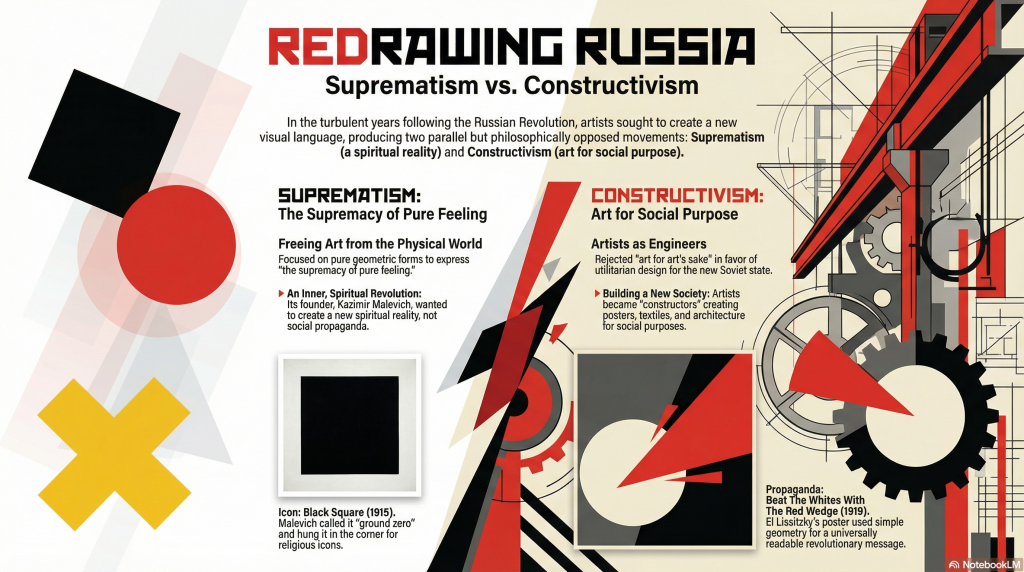
When Kazimir Malevich debuted his Black Suprematist Square at The Last Futurist Exhibition 0.10 in Petrograd in 1915, he wasn’t just showing a painting; he was launching an “inner revolution.” Malevich called his movement Suprematism, seeking “the supremacy of pure feeling” by liberating art from the “burden” of the physical world—the trees, the kings, and the bowls of fruit that had tethered the human spirit to the earth for centuries.
To the insider, the Black Square reveals several layers of hidden history that complicate its “pure” geometry:
- The Sacrilegious Placement: Malevich hung the square high in the “Red Corner” of the exhibition room—the specific architectural space where Russian Orthodox families traditionally placed religious icons. He was signaling that the old God was dead, replaced by the non-objective void of the square.
- The Precedence Scandal: Though the work was painted for the 1915 exhibition, Malevich backdated the canvas to 1913 on its reverse. This was a calculated move of ego and legacy, intended to claim historical precedence over rival artists also racing toward the first “pure” abstract work.
- The Hidden Joke: In 2015, advanced imaging revealed a layer of text beneath the black paint. It refers to an 1897 French comic titled “Battle of negroes in a dark cave.” This discovery forces us to confront how even the most “transcendental” modernism was often built atop the casual, embedded prejudices of its time.
“I sought refuge in the square whilst desperately trying to free art from representation.” — Kazimir Malevich
- The Great Schism: Spiritual Idealism vs. Industrial Materialism
The Russian Avant-Garde was never a monolith. It was defined by a fierce philosophical divide between Suprematism and Constructivism—a rivalry that would dictate the trajectory of modern design for decades.
At the heart of this schism was the distinction between “Composition” and “Construction.” Malevich and the Suprematists believed in Composition: an intuitive, spiritual process that used geometry to explore a mystical reality. Conversely, the Constructivists (led by Vladimir Tatlin and Aleksandr Rodchenko) rejected this as “self-indulgent mysticism.” They demanded Construction: a rational, materialist approach where the artist functioned as an engineer or “constructor.”
The bridge between these warring factions was El Lissitzky. His Prouns—an acronym for “Project for the Affirmation of the New”—represented the moment, in his words, “where one changes from painting to architecture.” He utilized the geometric vocabulary of Suprematism but gave it the “architectural solidity” and material weight required by the Constructivists. - The Tower That Would Have Dwarfed the Eiffel
The ultimate symbol of Constructivist ambition was Vladimir Tatlin’s Monument to the Third International (1919). This spiraling behemoth of iron, glass, and steel was designed to stand 400 meters tall—shattering the records of the Eiffel Tower and the Great Pyramid of Giza.
The tower was a masterpiece of symbolic engineering, featuring four rotating geometric volumes, each turning at a different speed to align the new state with the cosmos:
- A Cube (Base): Housing the legislature, rotating once a year.
- A Pyramid (Middle): Housing executive offices, rotating once a month.
- A Cylinder (Upper): Housing the press bureau, rotating once a day.
- A Hemisphere (Top): Housing a radio station, rotating once an hour.
Tatlin’s utopian vision ultimately exceeded the technological and resource-starved realities of post-war Russia, and the tower was never built. Yet, its impact was global. Upon seeing the model, the German Expressionist George Grosz famously held a placard declaring: “Art is dead—Long live Tatlin’s Machine Art!” It remained, as critic Viktor Shklovsky noted, a mythic structure “made of iron, glass, and revolution.”
- From “Easel Painting” to Revolutionary Sportswear
By 1921, the movement reached a terminal point: the “death of painting.” At the 5×5=25 exhibition, a group known as the Productivists—including Rodchenko, Varvara Stepanova, and Aleksei Gan—declared the easel picture a “bourgeois indulgence” and moved their operations from the studio to the factory.
This transition was spearheaded by female pioneers like Stepanova and Lyubov Popova, who brought the concept of faktura—the tactile, material quality of a surface—into the everyday lives of the proletariat. They didn’t just design art; they designed the infrastructure of a new life:
- Mass-Produced Textiles: Geometric fabrics designed to move away from decorative stylization toward industrial utility.
- Biomechanical Theater: Stepanova designed “functional apparatus” costumes for director Vsevolod Meyerhold, using geometric patterns to emphasize the actors’ physical movements on stage.
- Prozodezhda: Functional sportswear and work uniforms designed specifically for the mechanics of the human body in motion.
- The “Photo-Eye”: Why the Future Was Best Seen at an Angle
As the 1920s progressed, Aleksandr Rodchenko traded his brush for a Leica camera. He pioneered a philosophy called the “Photo-Eye,” rejecting the “standard” eye-level view as a remnant of old-world perspective.
Rodchenko used extreme vertical angles—shooting from the dizzying heights of the Shukhov Radio Tower or looking up from the street—to make the familiar “strange.” He believed that a single viewpoint was a limitation of truth, famously arguing: “One has to take several shots from different points of view as if one examined it in the round.”
This formalist innovation eventually met a tragic end. As Stalin rose to power, the state demanded “Socialist Realism”—straightforward, celebratory images of workers that the masses could easily digest. Rodchenko’s experimental “Photo-Eye” was branded as “bourgeois deviation,” and by 1931, the revolutionary angle was officially suppressed. - Conclusion: The Utopian Legacy and the Final Question
The Russian Avant-Garde was a brief, brilliant explosion that fundamentally recoded the DNA of modern life, shaping the Bauhaus, De Stijl, and the very foundations of contemporary graphic design.
However, the human cost was staggering. The movement’s end was not a fade-out, but a purge. Artists like Gustav Klutsis—who had personally guarded Lenin during the Revolution and pioneered photomontage to celebrate Soviet progress—were swept up in Stalin’s Great Terror. In a tragic irony, Klutsis was executed by the state he spent his life visualizing.
Today, we live in a world saturated with complex, high-definition digital images. Looking back at the stark, uncompromising geometry of the Russian radicals, we must ask: In a world saturated with images, can a single, pure geometric shape still represent a “ground zero” for our own inner revolutions?