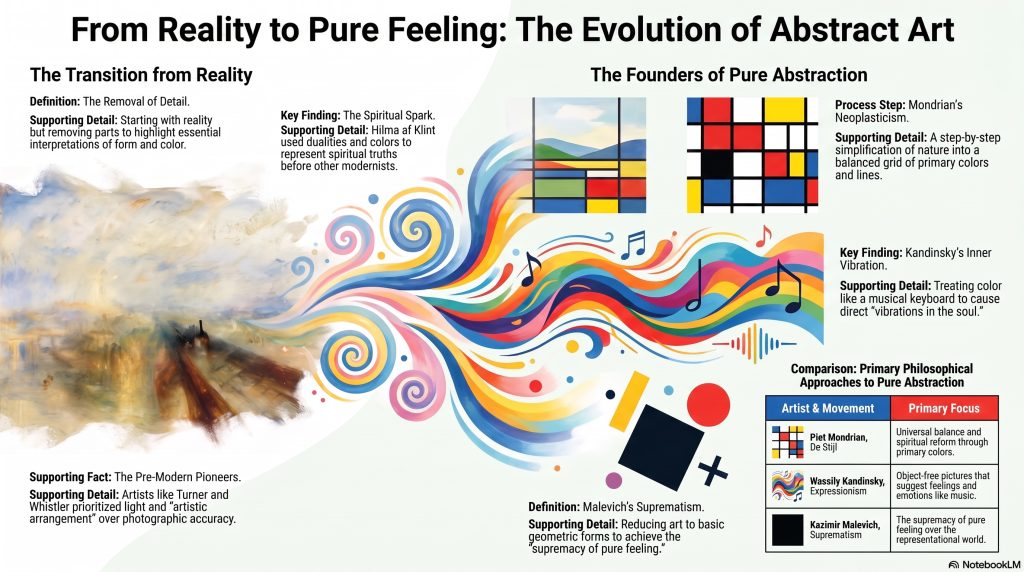
Abstract art — art that makes no reference to the visual world — emerged in the second decade of the twentieth century as the logical conclusion of a series of developments in Post-Impressionism, Cubism, and Expressionism, in which the representation of the visible world had been progressively subordinated to formal and expressive concerns. Kandinsky, Mondrian, and Malevich each arrived at non-objective art independently and from very different philosophical starting points: Kandinsky through a spiritualist conviction that colour and line could directly evoke inner experience; Mondrian through a theosophical belief in universal harmonies underlying surface appearance; Malevich through a mystical aspiration towards pure feeling liberated from all earthly reference. The period from 1915 to 1940 saw these impulses develop into rich and varied traditions — geometric abstraction, lyrical abstraction, Constructivism — that would shape art for the rest of the century. Abstract art remains one of the most debated and misunderstood forms of visual expression.
Why Go Abstract? The Philosophical Case: Abstract artists were not simply refusing to paint the world; they were making a philosophical argument about what art could achieve. Kandinsky believed that colour had a direct spiritual effect on the viewer, bypassing the intellect to reach the soul — just as music did. Mondrian believed that the grid of horizontal and vertical lines expressed the deepest structure of reality. Malevich believed that a black square on white could embody pure spiritual sensation. These were serious, even visionary, claims.
Kandinsky — Painting as Spiritual Music: Wassily Kandinsky (1866–1944) is generally credited as the first artist to produce a fully non-objective work, around 1910–11. His early abstractions — he called them “compositions”, “improvisations”, and “impressions”, using musical terminology — are turbulent, colourful, emotionally urgent. His treatise Concerning the Spiritual in Art (1911) articulated the theoretical basis for abstract painting and became one of the most influential texts in the history of modern art.
Mondrian and the Grid of the Universal: Piet Mondrian (1872–1944) arrived at his characteristic style — red, yellow, and blue rectangles separated by black lines on a white ground — through a long process of progressive reduction, moving from Post-Impressionist landscapes through Cubism to the pure geometric abstraction he called Neo-Plasticism. For Mondrian, the right angle was the meeting point of the two fundamental forces of nature; primary colours were the purest expression of colour itself. His work aspires to a universal harmony beneath all surface variety.
Constructivism — Abstraction in Service of Society: Not all abstract artists sought spiritual transcendence. The Russian Constructivists — Rodchenko, El Lissitzky, Stepanova — believed that geometric abstraction should be deployed in service of the revolutionary project, designing posters, books, textiles, and buildings that would help build a new kind of society. For them, abstraction was not a retreat from the world but a new tool for transforming it.
The Bauhaus and Abstract Design Education: When Walter Gropius founded the Bauhaus in Weimar in 1919, he brought together abstract painters — Kandinsky, Klee, Moholy-Nagy — as teachers alongside craftspeople and designers. The Bauhaus curriculum used abstract formal exercises — studies in colour, texture, and spatial organisation — as the foundation for practical design training. This integration of abstract art theory with design practice was enormously influential, shaping design education worldwide for the rest of the century.
Abstract Art Comes to America: The rise of fascism in Europe drove many of the leading figures of European abstraction to the United States: Mondrian came to New York in 1940, where his grid paintings acquired a new jazzy energy; Moholy-Nagy founded the New Bauhaus in Chicago; Albers taught at Black Mountain College. These transplanted European modernists fertilised American artistic culture, helping to create the conditions for the Abstract Expressionist explosion of the late 1940s.
45-01 Abstract Art in Britain
This talk explores the origins and development of abstract art, specifically focusing on the British perspective while acknowledging international influences. It defines abstraction as the process of simplifying reality into formal properties like line, shape, and color, distinguishing it from concrete art, which lacks any connection to the physical world. The text highlights historical precursors to modernism, such as the late, atmospheric landscapes of J.M.W. Turner and the controversial “nocturnes” of James Whistler. It also identifies Hilma af Klint as the first truly abstract artist, noting how her work was deeply rooted in spiritualism and Theosophy. Finally, the materials examine early British modernists like Wyndham Lewis and David Bomberg, who translated the energy of the modern city into geometric compositions. Through these examples, the source illustrates the transition from representational art to a style focused on internal harmony and the expression of higher realities.
My notes on 45-01 Abstract Art in Britain
An entertaining conversation on Abstract Art in Britain created by Google Notebook:
1. Introduction: The Art World’s “Cup of Tea” Problem
For many, walking into a gallery of abstract art feels less like an aesthetic experience and more like a personal affront. The common refrain—”I could do that”—suggests that abstraction is often viewed as a hollow trick or a barrier to entry. Writing in The Guardian in 2019, critic Jonathan Jones captured this friction perfectly, noting that in Britain, abstract art is “rarely the public’s cup of tea.”
Yet, the “difficulty” of abstraction evaporates when you stop looking for what the painting is of and start looking at what it is. At its core, “abstraction” is the surgical removal of extraneous parts. Imagine a painter observing a tree: to abstract it is to strip away the distracting bark and leaves until the trunk becomes a pure cylinder and the foliage transforms into a cluster of geometric diamonds. Far from being cold or mathematical, this shift in perception was born from high-court scandals, secret séances, and a radical quest to find a “higher reality.”
2. The Master of the “Unfinished” Sunrise
Long before the term “modernism” existed, J.M.W. Turner was already testing the limits of human sight. In his late work, Turner simplified form so radically that his contemporaries feared he had lost his mind. His Norham Castle, Sunrise (c. 1845) is a masterclass in this “subtraction.” Here, a medieval fortress is reduced to a ghostly blue specter against the fireball of a glowing sun. A cow appears suspended in the umber haze, an ethereal weightless form that only reveals itself as a reflection once the viewer’s eye adjusts to the “corpse-like” light.
This work remained hidden for decades, only “rediscovered” in 1906. The reaction was a battleground of interpretation: was it a modernist prophecy or the “wreck of a great mind”? While critic Edward Lear famously used the “wreck” insult, he also found a haunting beauty in the works, calling them “the glorious setting of a glorious sun.” Turner’s vision of the sun was far from idyllic; to him, it was often a “cruel and terrible God.” This visceral power resonated deeply with future giants. In 1966, the abstract expressionist Mark Rothko looked at the painting and quipped:
“This man Turner, he learnt a lot from me.”
The joke masked a profound debt. Rothko so revered Turner’s ability to let landscape merge into pure light that he bequeathed his own paintings to the Tate with a strict proviso: they were to be hung in a dimmed room, specifically positioned next to Turner’s masterworks.
3. The Trial of the “Pot of Paint”
In 1878, the British art world was rocked by a libel trial that read like a Victorian comedy of errors. James Abbott McNeill Whistler had exhibited Nocturne in Black and Gold, a painting that prioritized “artistic arrangement” over the era’s obsession with photographic accuracy. Whistler’s technique was a chaotic performance; he used a thinned mixture of copal, turpentine, and oil—his “sauce”—applying it in such watery layers that he often had to throw the canvas on the floor to stop the paint from running off.
The legendary critic John Ruskin was repulsed, accusing Whistler of “wilful imposture.” His review remains the gold standard for art-world vitriol:
“…never expected to hear a coxcomb ask two hundred guineas for flinging a pot of paint in the public’s face.”
The resulting trial was a circus of ego and absurdity. At one point, the painting was displayed upside down to a confused judge. Whistler, ever the arrogant dandy, used the stand to champion the “harmony of color” over the literal view. His sharp wit was legendary; when a young Oscar Wilde once praised one of Whistler’s dinner-party quips by saying, “I wish I’d said that,” Whistler famously riposted, “You will, Oscar, you will!” Though Whistler won the trial, he was awarded only a farthing in damages and ended up financially ruined—but the precedent for “semi-abstract” art had been set in blood and ink.
4. The Secret Pioneer Who Predated the Giants
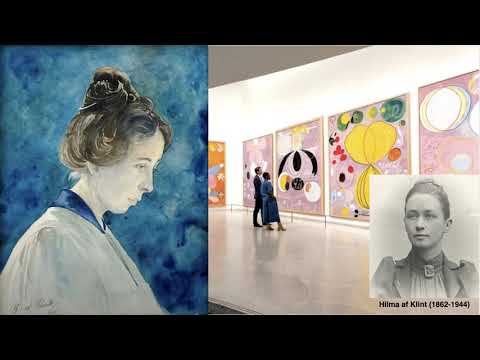
While the history books often crown Kandinsky or Mondrian as the “first” abstract artists, the real pioneer was a Swedish mystic working in total isolation. Hilma af Klint was the daughter of a naval commander—a background of rigid discipline that contrasts sharply with the spiritual séances she would later lead. By 1906, years before her male counterparts made their “breakthroughs,” she was producing massive, vibrant, radically abstract works.
Af Klint was deeply embedded in “The Five,” a group of women who practiced automatic drawing to channel spirits. Influenced by Theosophy, she sought to depict the “divine Absolute,” using a color-coded language where yellow represented the male spirit, blue the female, and green the unity of the two. Convinced that the public “wasn’t ready” for her visions, she kept her 1,200 paintings secret, stipulating they be hidden for 20 years after her death.
“The pictures were painted directly through me… I had no idea what the paintings were supposed to depict,” she wrote in her notebook.
5. The Traffic-Stopping Geometry of David Bomberg
In the early 20th century, a “rebel” class at the Slade School of Art—including Paul Nash and Stanley Spencer—created what their teacher Henry Tonks called a “crisis of brilliance.” Among them, David Bomberg was the most explosive. Bomberg rejected the pastoral in favor of the “motion and machinery” of the modern city.
His 1914 work The Mud Bath is a triumph of British abstraction. While it appears to be a jagged, geometric dance of red and blue, its heart is surprisingly local: it was based on the steam baths used by the Jewish population in East London. When it was hung outside the Chenil Gallery in Chelsea, the radical, machine-age energy of the piece literally stopped the traffic. Despite this early fire, Bomberg eventually became a “neglected artist,” though his legacy survived through his students, including future legends like Frank Auerbach.
6. Mondrian’s Dance Toward the Absolute
Piet Mondrian’s grids are often dismissed as cold, mathematical exercises, but his journey to the grid was an emotional upheaval. In 1911, at age 39, he underwent a radical rebirth: he left his stable career and his fiancée to move to Paris. He even changed his name—from the Dutch “Mondriaan” to the French “Mondrian”—to symbolize a total break from his old life.
Mondrian was an “ardent dancer” who loved jazz and believed art would eventually “replace religion” as a beacon for humanity. He evolved from the representational Red Tree (1908) to the structural Gray Tree (1911), eventually eliminating all diagonal lines to reach “dynamic equilibrium.” To Mondrian, his paintings weren’t static like a pair of scales; they were a site of “energy and confrontation” between opposing forces. He believed he was painting the “stillness of the soul.”
7. Conclusion: A New Way of Seeing
The history of abstraction represents a seismic shift from the “photographic” to the “expressive.” This movement reached its logical conclusion in the concept of “Concrete Art,” pioneered by Theo van Doesburg. He argued that there was nothing more “real” than a line, a color, or a plane. In this worldview, a painting of a tree is merely an imitation—a “shell”—whereas a pure line is a concrete fact.
These pioneers didn’t just want to create a new style; they wanted to capture the “spirit” of the world. As we stand before a simple wash of color or a hard-edged grid, we must ask: If the goal of art is to capture the essence of a thing rather than its outer shell, can a simple line ever be more “real” than a photograph?NotebookLM can be inaccurate; please double-check its responses.