A discussion on Vorticism 1913-1915 (created by NotebookLM from my notes):
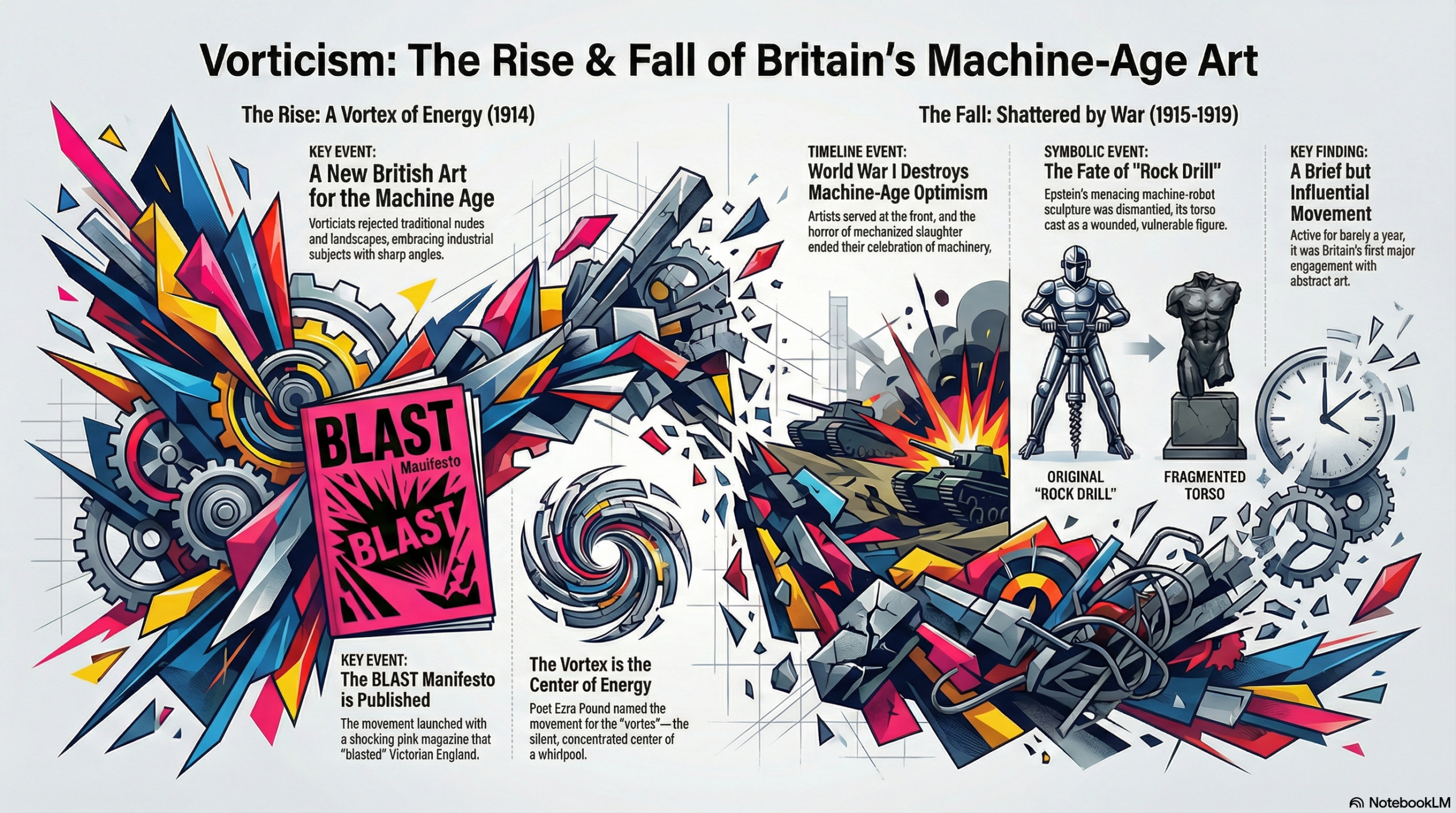
A slide show created by NLM based on my notes
Vorticism was Britain’s only contribution to the pre-war European avant-garde, launched in 1914 by the painter and writer Wyndham Lewis through the magnificently aggressive journal BLAST, which “blasted” and “blessed” selected aspects of English culture with polemical ferocity. It drew on Cubism and Futurism but rejected the Italian movement’s romantic celebration of the machine in favour of a harsher, more angular visual language that seemed to express the violence and dynamism of modernity without sentimentalising it. The group included Lewis, the sculptor Henri Gaudier-Brzeska, the painter Edward Wadsworth, and — controversially — the American poet Ezra Pound, who coined the name. The movement was effectively destroyed by the First World War: Gaudier-Brzeska was killed at Neuville-Saint-Vaast in 1915; Lewis and Wadsworth served and were transformed by their experience; the second issue of BLAST (1915) carried a sombre “War Number” tone utterly different from its opening bravado. Vorticism lasted barely two years but produced some of the most powerful images of the pre-war moment.
BLAST — The Most Aggressive Art Manifesto in English: When BLAST: Review of the Great English Vortex appeared in June 1914, its shocking pink cover and typographically violent contents made it immediately notorious. Lewis blasted Victorian sentimentalism, English weather, and the “sentimental” Futurists; he blessed the sea and the ports, the engineers, and the cold northern light. The tone was combative, witty, and deliberately provocative — a declaration that England too could produce a radical avant-garde.
The Vorticist Aesthetic — Angular, Cold, Mechanical: Where Futurism celebrated the speed and energy of the machine with a kind of romantic excitement, Vorticism was colder and more angular. Its images — like Lewis’s The Crowd (1915) — show jagged, crystalline forms that seem to be in tension rather than harmonious motion. The machine is not celebrated but confronted: Vorticism looks at modernity without flinching, without illusion, and without sentiment.
Henri Gaudier-Brzeska — Sculpture and Sacrifice: The young French sculptor Henri Gaudier-Brzeska (1891–1915) was among the most gifted members of the Vorticist group. His direct carvings in stone and brass, influenced by African and Polynesian sculpture, had an energy and directness entirely unlike the academic tradition. He was killed at the age of twenty-three on the Western Front, his death symbolic of everything the war destroyed. Ezra Pound’s memoir Gaudier-Brzeska (1916) served as both a tribute and a manifesto.
The War and the End of the Vortex: The First World War ended Vorticism before it could develop into a mature movement. Lewis and Wadsworth both served as war artists, their experiences of industrial slaughter transforming their work — Lewis’s war paintings have a bleakness and gravity entirely absent from pre-war Vorticism. The confidence that had animated BLAST evaporated in the mud of the Somme. There was no third issue.
Legacy — Britain’s Moment of Modernist Radicalism: Vorticism remains a fascinating and somewhat melancholy episode in the history of British art: a genuine moment of modernist radicalism, cut short by historical catastrophe before it could determine its own direction. Lewis went on to produce some remarkable work in the 1920s and 1930s, but Vorticism as a collective movement was finished. Its brief existence raises the question of what British art might have become if the war had not intervened.