Page Contents
40-01 Fauvism
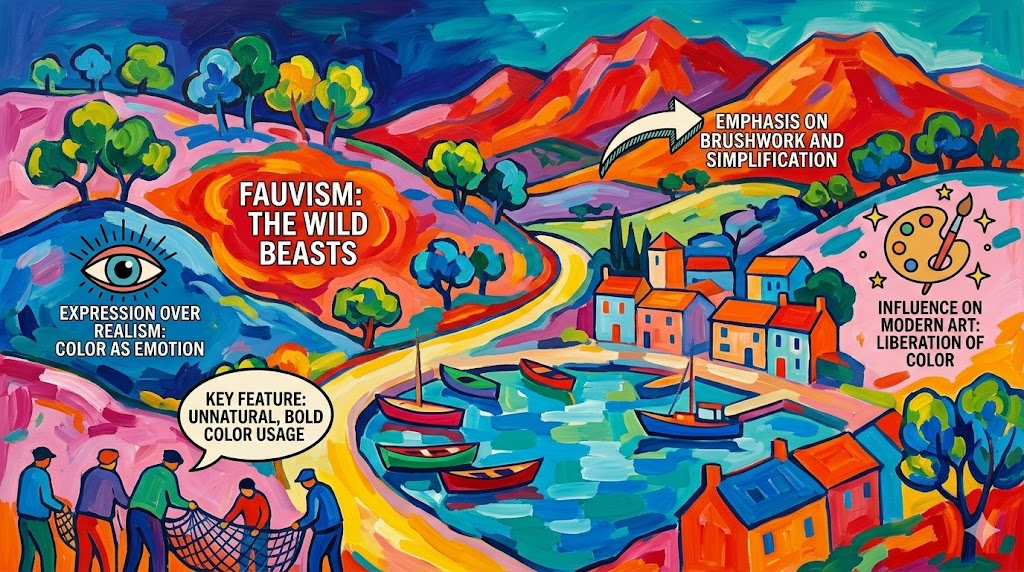
Les Fauves—the Wild Beasts—burst onto the art world at the 1905 Salon d’Automne in Paris with canvases of unprecedented chromatic violence, using pure, unmixed colour applied in bold strokes to create images of ferocious expressive intensity. Led by Henri Matisse and including André Derain, Maurice de Vlaminck, Raoul Dufy, and Georges Braque in his early career, the Fauves shared a liberation of colour from its descriptive function, using it instead as an autonomous force for emotional and decorative effect. Critics coined the name les fauves—the wild beasts—in mock horror at canvases where a face might be green, a sky red, and shadows pure violet, but the artists embraced the challenge of pushing colour to its expressive limit. The movement was brief—by 1907 most members had moved in different directions, with Braque turning toward Cubism and Matisse developing his singular decorative style—but its impact was decisive. By permanently severing the link between colour and naturalistic description, Fauvism opened the door to the full spectrum of twentieth-century abstract and expressionist painting.
The talk below is a guide to Fauvism, a brief yet revolutionary art movement that emerged in early 20th-century France. I explore how artists like Henri Matisse, André Derain, and Maurice de Vlaminck shocked the public by using vibrant, non-naturalistic colors and bold brushwork. The material highlights iconic works such as Woman with a Hat and The Dance, explaining how these “Wild Beasts” moved away from traditional styles to prioritize emotional expression. Detailed biographical sketches provide context on the artists’ personal struggles, their unique creative philosophies, and their influential collaborations. Ultimately, the source illustrates how this movement’s liberation of color fundamentally altered the trajectory of modern art.
A chat about Fauvism based on my notes and created by Google NotebookLM:
Five Shocking Stories Behind Art’s First Colour Revolution
The Colour Revolution That Exploded Out of Nowhere
When we think of modern art, we often picture bold, expressive, and even shocking uses of colour. Canvases with acidic green skies, bright orange faces, and electric blue rivers don’t surprise us anymore; they define much of the art of the 20th century. But where did this radical freedom to paint with pure, unadulterated emotion come from? It all started with an explosion.
That explosion was Fauvism, a short-lived but foundational art movement that erupted in Paris in the early 1900s. Led by a small group of artists who were dubbed the “Wild Beasts,” this movement fundamentally changed the rules of painting. But the story of Fauvism isn’t just about paint on a canvas; it’s a tale of insults, financial desperation, chance encounters, and revolutionary spirit. Here are five surprising stories that reveal the wild origins of modern art’s first colour revolution.
Five Surprising Stories from the “Wild Beasts” of Modern Art
The Name “Wild Beasts” Was Originally an Insult
At the 1905 Salon d’Automne exhibition in Paris, the art world got its first major dose of this radical new style. The paintings, with their clashing, non-naturalistic colours, were a shock to the system. Placed amidst the canvases of raw reds and vibrant greens stood a lone, classical sculpture in the Renaissance style. Upon seeing this juxtaposition, the critic Louis Vauxcelles exclaimed that it was like seeing “Donatello amongst the wild beasts.”
The insult—les fauves in French—perfectly captured the public and critical outrage, and it stuck. In a perfect twist of fate, a critic’s jab accidentally gave one of modern art’s most important movements its unforgettable name.
A Scandalous Painting Saved Its Creator from Financial Ruin
One of the most scandalous works at that 1905 exhibition was Henri Matisse’s Woman with a Hat. A portrait of his wife, Amélie Parayre, it was a riot of clashing colours—acid greens, oranges, and purples smeared across her face and the background. At the time, Matisse was 35 years old, struggling financially, and trying to support a wife and three children. His career was at a critical juncture.
The painting caused a sensation, but the “shocking sale” of this very work turned his life around. American expatriate writers Gertrude and Leo Stein, who were early champions of the avant-garde, purchased the painting. This was Matisse’s first major financial and psychological breakthrough. The public scandal ironically fueled the painting’s fame, proving the resilience of an artist who was determined to forge a new path, no matter the cost.
“An artist must never be a prisoner. Prisoner? An artist should never be a prisoner of himself, prisoner of style, prisoner of reputation, prisoner of success, etc.”
A Train Wreck Sparked a Revolutionary Partnership
Sometimes, the most important collaborations are born from chaos. The most significant event in André Derain’s early career was his encounter with fellow artist Maurice de Vlaminck in 1900. Their meeting wasn’t in a Parisian café or a formal art class—it was a train derailment that brought the two young men together.
This chance encounter led them to immediately begin sharing a studio in the Parisian suburb of Chatou. This shared space, which they affectionately dubbed the “School of Chatou,” quickly became a hotbed of early Fauvism, where they experimented with the raw, instinctive use of colour that would come to define the movement. A near-disaster on the tracks was the improbable spark that forged one of the key partnerships of modern art.
The Movement’s Fiercest Rebel Wanted to Burn Down Art School
Maurice de Vlaminck was the untamed heart of the Fauvist group. A self-taught anarchist who had been a cyclist, violinist, and writer, he prided himself on his lack of academic training. He didn’t just dislike the art establishment; he saw his work as a revolutionary act against its bourgeois tastes and rigid rules, directly inspired by the intensity of his idol, Vincent van Gogh.
His anti-establishment spirit was legendary, captured perfectly by his aggressive and famous declaration:
“I wanted to burn down the École des Beaux-Arts.”
Vlaminck’s philosophy was to paint directly from the gut, using colour with a violent energy that matched his tempestuous personality. He believed in the power of raw feeling over intellectual theory, a view he summed up with unapologetic pride:
“I exalted everything that was pure instinct, which was an affront to culture.”
The Revolution Was Over in a Flash
For a movement that had such a monumental impact, Fauvism was incredibly short-lived. Its core period of influence peaked between 1905 and 1907, lasting barely two years before its key figures began to move in different artistic directions.
Despite this brevity, its impact was seismic. The Fauves’ core legacy was revolutionary: they decoupled colour from its traditional, descriptive role. No longer did a tree have to be green and brown, or a sky blue. Colour became an independent force for emotional and decorative expression, proving that pure chromatic force could carry the entire weight of a subject. This liberation of colour was a critical breakthrough that paved the way for later movements like German Expressionism and the eventual rise of abstract art.
A Legacy of Freedom
The story of Fauvism, born from insults and scandals, is a reminder that art history is often messy, accidental, and intensely human. More than anything, the movement’s most enduring legacy was the absolute freedom it granted artists—the freedom to prioritize subjective feeling over objective reality. The Wild Beasts may have only roared for a short time, but their echoes are still heard in every artist who dares to paint the world not just as it is, but as they feel it.
What can the explosive, short-lived rebellion of the Fauves teach us about the nature of creative breakthroughs today?
40-02 Henri Matisse
A chat about Henri Matisse based on my notes and created by Google NotebookLM: with an audio player on the next line:
Joyful colour is the first thing that comes to mind with Henri Matisse—sun-drenched rooms, dancing figures, and an almost spiritual sense of calm. He is the undisputed master of vibrant expression. But behind these masterpieces of serenity was a life of radical struggle, surprising contradictions, and incredible resilience. The man who brought so much uncomplicated joy to the walls of our museums had a far more complex story than his canvases let on.
Here are six surprising truths that reveal the complex man behind the celebrated artist
Blog produced by Google NotebookLM based on my notes