Edvard Munch is the most significant Scandinavian artist of the modern era and one of the founding figures of Expressionism, whose exploration of anxiety, desire, mortality, and psychological torment gave visual form to the inner life in ways that had never previously been attempted with such raw directness. Born in Norway in 1863, he spent crucial years in Paris and Berlin absorbing the lessons of Post-Impressionism and Symbolism, but transformed what he learned into something wholly personal and Nordic. His life’s work, which he conceived as a single interconnected series called the Frieze of Life, traced the experiences of love, longing, jealousy, fear, and death through a set of recurring figures and charged natural settings. The Scream (1893), his most famous work, has become one of the iconic images of modern culture — a figure reduced to an anguished cry against a landscape of blood-red sky and writhing fjord. Despite his long periods of mental breakdown and isolation, Munch remained extraordinarily productive, living until 1944 and bequeathing his entire remaining work to the city of Oslo.
37-01 Edvard Munch
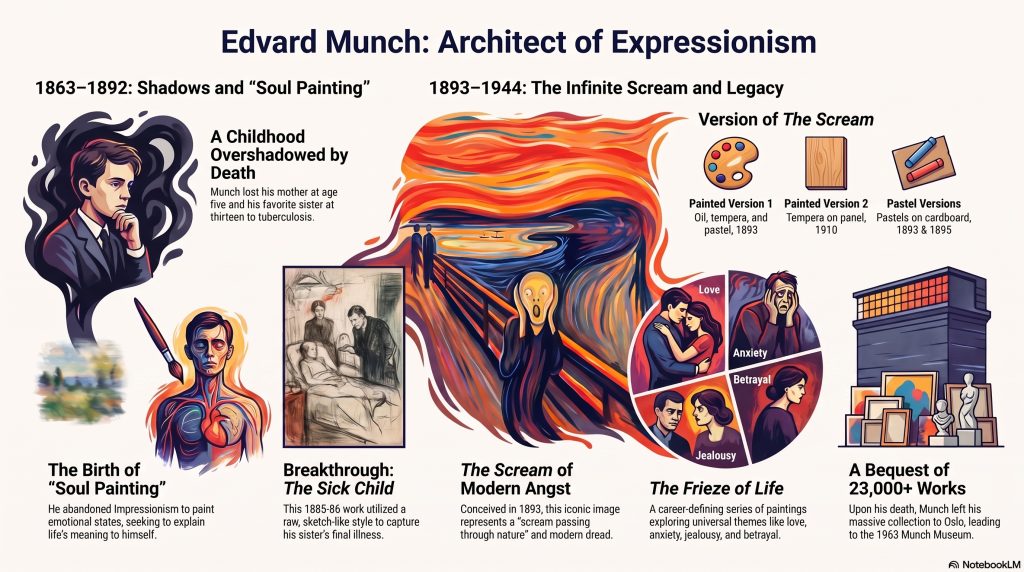
The talk provides a biographical and artistic analysis of the iconic Norwegian painter Edvard Munch, primarily focusing on how his personal trauma shaped the Expressionist movement. His life was defined by a childhood shadowed by death and illness, leading to a lifelong struggle with anxiety and mental instability that he channeled directly into his “soul paintings.” The talk track his evolution from Impressionist beginnings to his mature, symbolic style, famously encapsulated in his legendary masterpiece, The Scream. Significant attention is given to his troubled relationship with his religious father, his formative travels to Paris and Berlin, and the development of his emotive series, The Frieze of Life. I also document his later years of solitude near Oslo, the posthumous preservation of his massive collection, and a major 2019 British Museum exhibition dedicated to his legacy of love and angst. Throughout the materials, Munch’s own words serve as a manifesto for art intended to explain the innermost experiences of the human spirit.
A conversation on Edvard Munch created by Google Notebook from my notes:
A Life Shaped by Loss and Illness: Munch’s art cannot be separated from his biography. His mother died of tuberculosis when he was five; his favourite sister Sophie died of the same disease when he was fourteen; his father was a man of intense religious anxiety who transmitted his fears of sin and damnation to his children. “Illness, insanity, and death were the black angels that guarded my cradle and accompanied me throughout my life,” Munch wrote. His art was, from its beginning, an attempt to externalise these inner demons.
The Frieze of Life — Art as Autobiography: Munch conceived his life’s work as a single great project: the Frieze of Life, a cycle of paintings tracing the full arc of human emotional experience from the awakening of love through the anguish of jealousy and anxiety to the final acceptance of death. Individual works — The Kiss, Ashes, Madonna, The Scream — were conceived as panels in this larger whole. The Frieze was never completed in the form Munch envisaged, but the concept shaped his entire production.
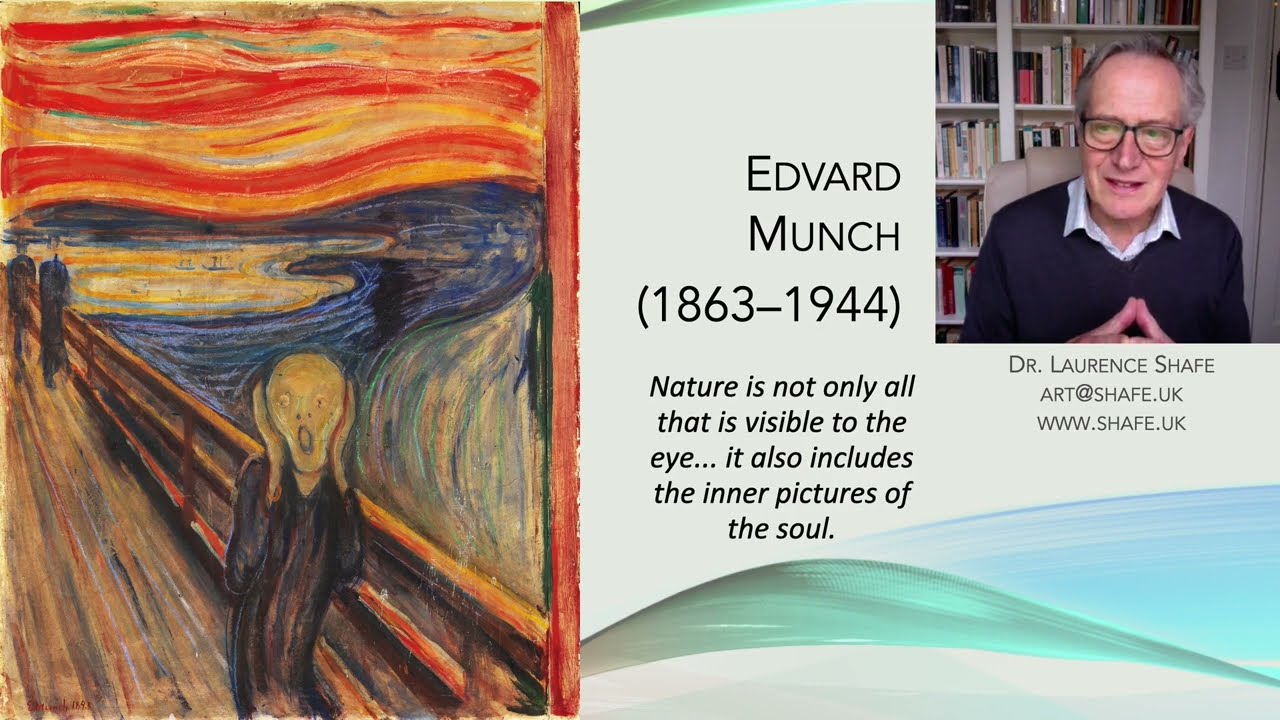
The Scream — An Icon of Modern Anxiety: The Scream (1893) exists in four versions — two paintings, a pastel, and a lithograph — and is one of the most recognisable images in the history of art. Munch’s own account of its inspiration describes a walk at sunset when he suddenly felt “an infinite scream passing through nature.” The agonised figure on the bridge, the blood-red sky, the writhing fjord — all express a state of anxiety so acute that it threatens to dissolve the boundary between self and world. The image has never ceased to speak directly to modern experience.
Paris, Berlin, and the Formation of Expressionism: Munch’s influence on German Expressionism was decisive. His exhibitions in Berlin in the 1890s — which scandalized audiences but inspired artists — showed a generation of German painters that art could be a direct expression of psychological states, that the distortion of form and colour could be a vehicle for inner truth. The artists of Die Brücke and Der Blaue Reiter acknowledged his importance explicitly. Without Munch, German Expressionism would have taken a very different shape.
The Nervous Breakdown and Recovery: In 1908, after years of heavy drinking and emotional crisis, Munch suffered a complete nervous breakdown and spent eight months in a Copenhagen clinic. The experience transformed him: he emerged calmer, more stable, and with a new appetite for life. His later paintings show a warmth and even a joy that is quite different from the anguished intensity of his great Symbolist works, though they never quite matched those works in artistic power.
Legacy — The Father of Expressionism: Munch lived until 1944, surviving the Nazi occupation of Norway and bequeathing his remaining works — over a thousand paintings, fifteen thousand prints, and thousands of drawings — to the City of Oslo. The Munch Museum now holds the largest single collection of his work in the world. His legacy is enormous: as the explorer of the unconscious life, the pioneer of psychological portraiture, and the inspiration of the Expressionist tradition, he is one of the defining figures of modern art.