Art Nouveau was the first truly international decorative style of the modern era, flourishing from approximately 1890 to 1914 and known under different names in different countries — Jugendstil in Germany, Stile Liberty in Italy, Modernisme in Catalonia, and Style Moderne in France. It was characterised above all by its embrace of organic, flowing line — inspired by the sinuous forms of plants, tendrils, waves, and the female figure — and its determination to dissolve the traditional hierarchy between fine art and decorative design. In architecture, the style found its supreme expression in the work of Victor Horta in Brussels, Hector Guimard in Paris, and above all Antoni Gaudí in Barcelona, whose buildings push organic form to the limits of structural possibility. The great poster artists of the period — Mucha, Toulouse-Lautrec, Privat-Livemont — brought the Art Nouveau aesthetic into the streets through the new medium of colour lithography. The style’s demise was effectively sealed by the First World War, whose industrial horror made its ornamental luxuriance seem grotesquely inappropriate.
The Organic Line — Nature as the Model for Design: The defining visual characteristic of Art Nouveau is its embrace of the undulating organic line — the curve that never quite repeats itself, drawn from the world of plants, water, and the female body. Where industrial design imposed mechanical regularity and historical revival imposed borrowed motifs, Art Nouveau sought forms that seemed to grow from within, obeying the laws of life rather than geometry. This was simultaneously an aesthetic and a philosophical position: nature as the source of authentic beauty.
Victor Horta and the Brussels Revolution: The Belgian architect Victor Horta (1861–1947) was the first to apply Art Nouveau principles fully to architecture. His Hôtel Tassel in Brussels (1892–93) is generally regarded as the first Art Nouveau building — its interior a complete environment of swirling ironwork, mosaic floors, and painted walls in which every element is organically related. Horta proved that a structural material as inherently rectilinear as iron could be made to flow like a plant.
Gaudí — Beyond Style, Into Vision: Antoni Gaudí (1852–1926) stands apart from every other architect of his era. Working in Barcelona with an intensity that became increasingly religious in motivation, he created buildings that seem less designed than grown — the Sagrada Família, Casa Batlló, Park Güell. Gaudí used natural forms not merely as decorative references but as structural principles, studying the branching logic of trees, the load-bearing geometry of hanging chains, and the self-supporting properties of the catenary arch.
The Poster — Art Nouveau in the Streets: The Art Nouveau period coincided with the technological maturity of colour lithography, which made it possible to print large, vivid, multi-coloured images cheaply. The result was the modern poster — and Art Nouveau artists seized it with enthusiasm. Alphonse Mucha’s advertising posters for Sarah Bernhardt made his sinuous, jewel-encrusted female figures the defining image of the age. Toulouse-Lautrec’s posters for the Moulin Rouge had an entirely different character — flat, bold, and graphic — but equally transformed the streets of Paris into an art gallery.
Gustav Klimt and the Vienna Secession: In Vienna, Art Nouveau took a more cerebral and psychological direction under the influence of Gustav Klimt (1862–1918) and the Vienna Secession group he helped found in 1897. Klimt’s paintings — encrusted with gold leaf and ornamental pattern, their subjects often frankly erotic — represent a uniquely Viennese synthesis of decorative splendour and Freudian psychological depth. The Secession’s journal Ver Sacrum and its exhibition building (still standing in Vienna) were monuments of the movement.
The Decline of Art Nouveau and Its Legacy: Art Nouveau was already beginning to seem overwrought by 1910, its organic extravagance giving way to the cleaner geometry of early modernism. The First World War effectively ended it: the ornamental richness that had seemed to celebrate modern civilisation now appeared frivolous in the face of industrial slaughter. But Art Nouveau’s insistence that everyday objects should be beautiful, its celebration of craftsmanship, and its synthesis of art and design left a lasting legacy in the design movements of the twentieth century.
35-01 Art Nouveau – Gustav Klimt
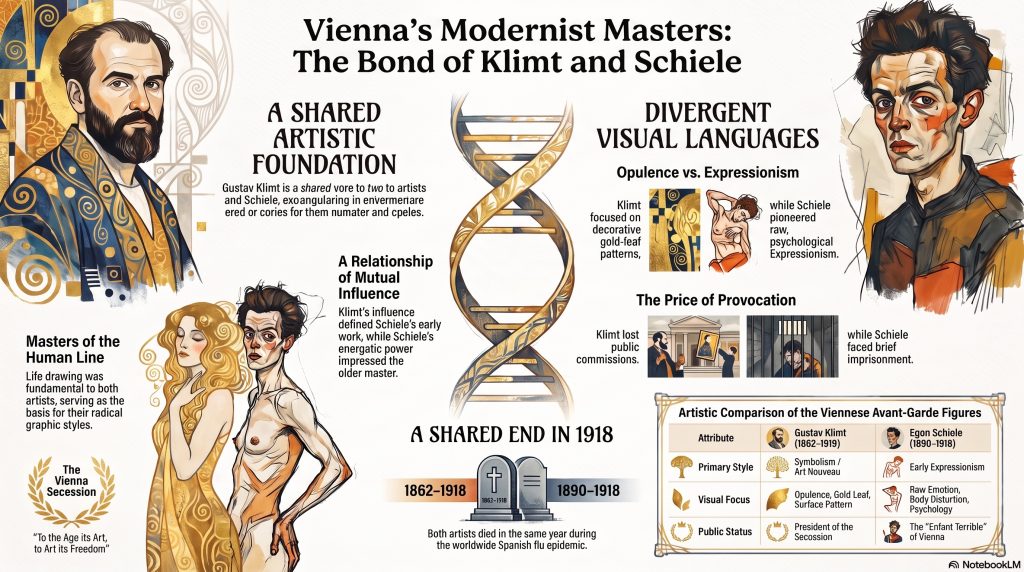
The talk examines the intertwined lives and professional trajectories of Gustav Klimt and Egon Schiele, the two most prominent figures of Viennese Modernism. Despite their significant age gap, the sources highlight a profound artistic relationship centered on a shared devotion to life drawing and the exploration of the human form. Gustav Klimt is portrayed as the established leader of the Vienna Secession, whose opulent, symbolic style eventually gave way to the raw, expressionistic intensity of his protégé, Schiele. I describe their personal struggles, including Klimt’s public scandals regarding erotic murals and Schiele’s brief imprisonment for “public immorality.” Both men were ultimately claimed by the 1918 Spanish flu pandemic, marking a tragic conclusion to a transformative era in art history. Their legacy is framed through their revolutionary impact on the art world, transitioning from rigid academic traditions to unconventional modern practices.
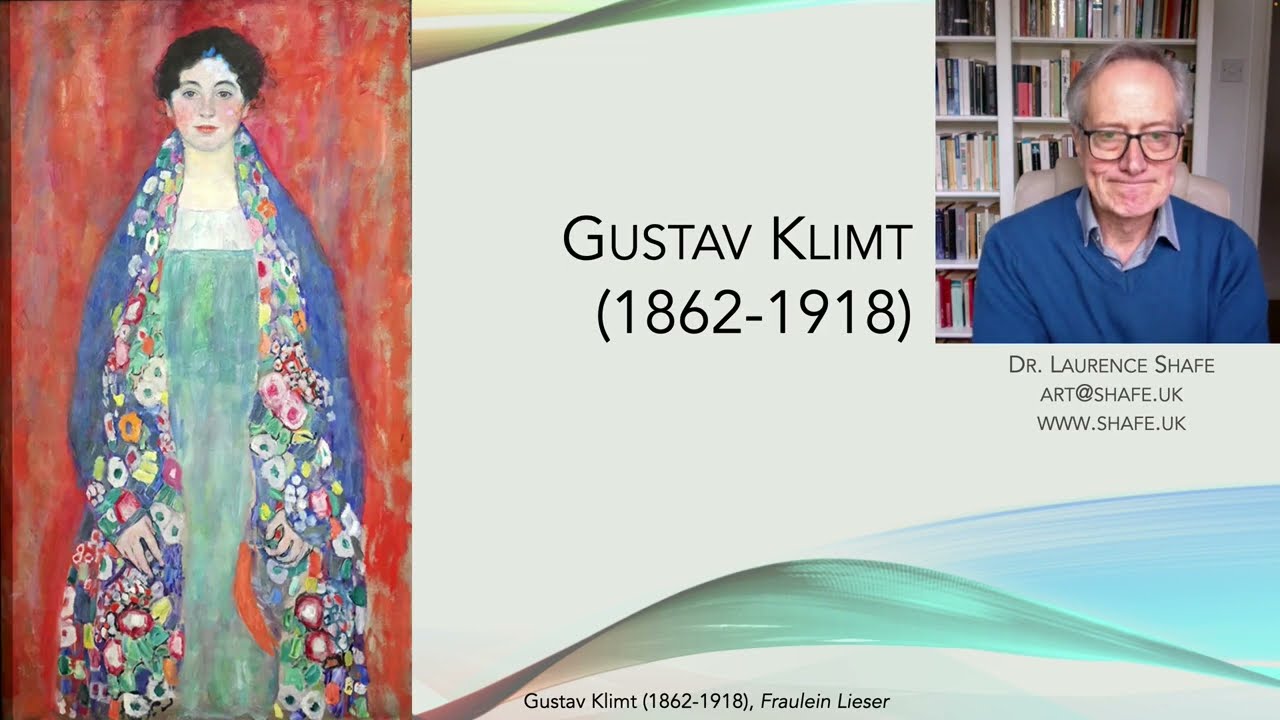
An interesting conversation on Gustav Klimt created by Google Notebook from my notes:
At the dawn of the twentieth century, Vienna was less a city and more a pressure cooker of the human soul. Pulsating with the nervous energy of a fragmenting Austro-Hungarian Empire, it was a volatile melting pot where transcendent innovation and virulent hatred occupied the same narrow coffee houses. This was the era of the “raw nerve,” where the psychological depths plumbed by Sigmund Freud found their musical counterpart in the dissonant symphonies of Gustav Mahler and Arnold Schoenberg. It was also the era that birthed Zionism, populism, and the dark seeds of Fascism—embodied by a young, twice-rejected art student named Adolf Hitler, who wandered the Ringstraße in poverty, unable to tear his eyes from the city’s imperial grandeur.
Navigating this explosive landscape were Gustav Klimt and Egon Schiele. They were not merely painters; they were the iconoclastic prophets of early Modernism. While the world around them clung to the “fine trappings” of a dying empire, Klimt and Schiele tore away the lace to reveal the trembling, erotic, and often terrified reality beneath.
1. The Mentor Who Never Taught: Parallel Lines and Sacred Gold
The relationship between Gustav Klimt and Egon Schiele is frequently romanticized as a standard apprenticeship, but the truth is far more nuanced. Despite a twenty-eight-year age gap, they shared an “artistic understanding” built on mutual respect rather than a traditional hierarchy. Klimt never formally taught Schiele; instead, their bond was forged through an exchange of ideas.
While the younger Schiele was initially entranced by Klimt’s decorative liturgy, his own “energetic power of line” and raw Expressionism—a movement officially coined in 1910 as the visceral opposite of Impressionism—soon began to impress the older master. Klimt was a generous champion, introducing Schiele to patrons and models, but he allowed Schiele to find his own angular, often grotesque voice.
It was Klimt who introduced the “sacred” into the secular through his legendary “Golden Phase.” Inspired by his trips to Venice and Ravenna, Klimt adapted the Byzantine mosaic techniques of ancient churches to create a shimmering, golden veil for his often scandalous subjects. This use of gold leaf was a way to elevate the erotic to the divine, creating a hallowed space for the human figure. Schiele, recognizing this elevation, famously remarked:
“His art is sacred.”
2. When “Academic” Art Became Pornography: The University Scandal
In 1894, Klimt was commissioned to create three ceiling paintings—Philosophy, Medicine, and Jurisprudence—for the Great Hall of the University of Vienna. It was intended to be the crowning achievement of his public career. Instead, it became the most high-profile scandal in Austrian art history.
Influenced by the pessimistic philosophy of Arthur Schopenhauer, Klimt rejected traditional, dignified allegories. He rendered humanity not as the master of knowledge, but as being in bondage to “the Will”—an inescapable force impelling us from the cradle to the grave through desire and grief. The faculty was horrified by his radical, overtly sexualized visions, labeling them “pornographic.” Stung by the relentless censorship, Klimt eventually returned his fees in 1905, vowing never to work for the state again. “Enough of this censorship,” he declared, “I want to make my escape.”
The tragedy of this loss is absolute. Though Philosophy won a gold medal at the 1900 Paris World’s Fair, we can no longer judge these masterpieces for ourselves. In May 1945, retreating SS forces set fire to Schloss Immendorf, and these titans of Modernism were reduced to ash.
3. The Hidden Self vs. the Ruthless Exposure
Klimt and Schiele handled their public and private images in diametrically opposed ways. Klimt was a discreet, almost monastic recluse. He lived with his mother and sister, working eight or nine hours a day while humming Schubert’s “Der Lindenbaum.” At home, he wore sandals and a long, flowing robe with no undergarments, guarding his privacy so fiercely that a sign on his door read: “No point in knocking, the door will not be opened.”
Klimt famously claimed to be a man of no interest:
“I have never painted a self-portrait… There is nothing special about me… Who ever wants to know something about me… ought to look carefully at my pictures.”
Yet, a fascinating irony exists: Klimt’s “missing” self-image is a myth. In his 1886 mural of Romeo and Juliet at the Burgtheater, a bearded man in a ruff collar sits in the audience. This is the only known self-portrait of Klimt, a secret image of the artist tucked away into a Shakespearean tragedy.
Where Klimt sought the veil of anonymity, Schiele practiced a ruthless, almost clinical exposure. An “enfant terrible” obsessed with self-documentation, Schiele’s Self-Portrait with Physalis (1912) represents the zenith of his creativity—a man sensitive, confident, and intensely focused on the “gaze and blindness.” His life was as exposed as his art; in 1912, he spent 24 days in prison on charges of immorality. In a final, dramatic gesture of establishment hatred, the judge at his trial burned one of his drawings in open court.
4. The “Naked Truth”: Art as a Mirror to a Crumbling Empire
In 1897, Klimt led a group of rebels to break away from the conservative Künstlerhaus to form the Vienna Secession. Their sanctuary featured a crowning gilt iron cupola and a motto that defined a generation: “To the Age its Art, to Art its Freedom.”
The movement’s most potent symbol was Klimt’s Nuda Veritas (Naked Truth). The painting depicts a nude woman holding a mirror to the observer, a direct challenge to a Habsburg society that preferred to ignore its own decay. It forced the public to confront their “naked self” with honesty, signaling a definitive shift toward unconventional explorations of the human figure. This was the visual birth of the modern psyche, moving away from the Ringstraße’s “historicist aesthetic” and toward a fragmented, honest portrayal of the human condition.
5. The Centenary Tragedy: 1918 and the Decapitation of the Avant-Garde
The legend of Klimt and Schiele reached a visceral and haunting conclusion in the centenary year of 1918. As the Austro-Hungarian Empire finally collapsed, a worldwide influenza epidemic swept through Vienna, claiming the lives of both artists.
Klimt died in February at age 55, following a stroke and pneumonia. The loss was a seismic shift for Schiele, who had been widely acknowledged as Klimt’s successor. In a haunting act of devotion, Schiele entered the morgue to make three final drawings of his mentor.
The epidemic was not finished. In October, Schiele’s wife, Edith, who was six months pregnant, succumbed to the flu. Devastated, Schiele followed her just three days later, dying at the age of only 28. It was the decapitation of the Viennese avant-garde; the master had passed, and the protégé was taken before his mature potential could be fully realized.
Conclusion: A Legacy Worth Millions
Today, the work of Klimt and Schiele has transcended the provincial scandals of their era to become some of the most coveted art in human history. Their enduring power is reflected in staggering auction prices—such as the $150 million sale of Adele Bloch-Bauer II—and their status as pioneers of twentieth-century Modernism.
Their legend leaves us with a final, provocative challenge. Inscribed atop the Nuda Veritas is a quote by the poet Friedrich Schiller that serves as a liturgy for the avant-garde:
“Kannst du nicht allen gefallen durch deine That und dein Kunstwerk mache es wenigen recht. Vielen gefallen ist schlimm.”
(“If you can’t please everybody with your actions and your art, please only few. To please many is bad.”)
In our modern world of algorithmic consensus and the pursuit of the “many,” do we still have the courage to look into the mirror and find the “few” who value the naked truth?
35-02 Egon Schiele
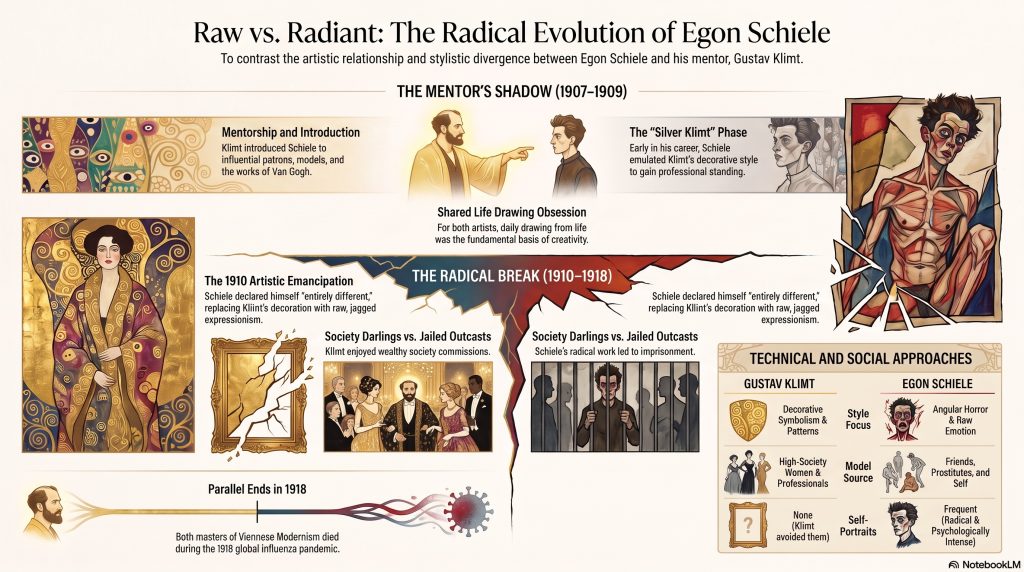
This talk looks at the lives and creative intersections of Gustav Klimt and Egon Schiele, the two most influential figures of Viennese Modernism. The text chronicles how Klimt broke away from traditional academic standards to lead the Secession movement, eventually becoming a mentor to the much younger Schiele. While Schiele initially emulated his mentor’s decorative style, he soon achieved artistic emancipation by developing a raw, angular, and often sexually explicit aesthetic that redefined the human form. The sources also highlight the legal and social controversies both men faced, specifically regarding eroticism in art and their defiance of conservative social norms. Their shared narrative concludes in 1918, a tragic year for the art world when both masters died within months of each other during the Spanish flu pandemic. It is a study of how these two men transitioned art from traditional historicism into the visceral territory of Expressionism.
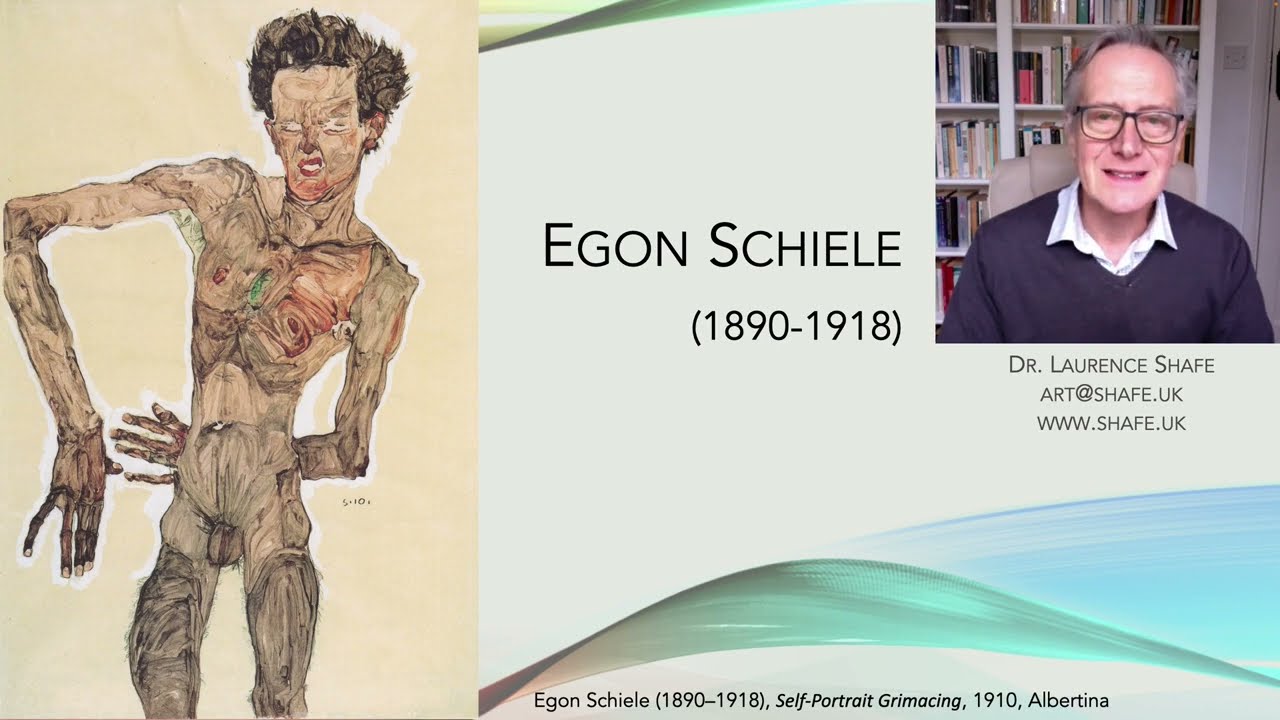
A conversation on Egon Schiele created by Google Notebook from my notes:
Why does the work of Egon Schiele continue to feel “raw” and “uncomfortable” over a century after its creation? When placed alongside the golden, symphonic masterworks of his mentor, Gustav Klimt, Schiele’s art serves as a jagged, visceral counterpoint. While Klimt pursued the Gesamtkunstwerk—the “total work of art” where beauty and architecture functioned in harmony—Schiele peeled back the skin to reveal “psychologically tormented moods.”
In an explosive career that matured only between 1909 and 1918, Schiele became an early exponent of Expressionism, a movement he effectively defined as the “opposite of Impressionism.” He didn’t just paint bodies; he mapped the angst of the modern soul. Here are five surprising truths about the artist who remains one of the most haunting figures in cultural history.
1. The Prodigy of the Rails and the Shadow of the Father
Long before his obsession with the human form, Egon Schiele was a “prodigy of the rails.” Born in 1890 in Tulln, where his father, Adolf, was a stationmaster, Schiele’s first artistic fixation was locomotives. He spent hours sketching steam engines, a preoccupation so intense that his father eventually destroyed his sketchbooks in a fit of concern.
Schiele was a shy, reserved child who performed poorly in school, yet his brilliance was undeniable. At age 15, he became the youngest student ever to enroll at the Vienna School of Arts and Crafts, moving to the Academy of Fine Arts at 16. However, his childhood was shadowed by a darker reality: the decline of his father, who suffered from syphilis and died when Schiele was only 14. This early exposure to “sickness, insanity, and death” fundamentally shaped his aesthetic.
Most provocative, however, were the “incestuous tendencies” Schiele displayed toward his sister, Gertrude. Beyond the famous incident where his father smashed down a locked door while the siblings were alone (Schiele claimed they were merely developing film), the artist took his 12-year-old sister to a hotel in Trieste for a night when he was only 16. These disturbing domestic foundations would later bleed into the “psychological moods” of his most controversial work.
2. The Failed “Silver Klimt” and the Market of the Soul
Initially, Schiele’s relationship with Gustav Klimt was one of deep reverence. Klimt, 28 years his senior, was the titan of the Art Nouveau movement and the favored choice of society women. At the time, photography had caused portraiture to decline in most European capitals, but in Vienna, it was in vogue. The architect Otto Wagner even advised the young Schiele to “paint portraits of famous Viennese personalities” to gain fame.
Attempting to follow this conventional path, Schiele briefly marketed himself as “The Silver Klimt” to secure wealthy patrons. The plan failed. While Klimt’s flat, decorative spaces and gold leaf provided a symbolic buffer for the viewer, Schiele’s “raw emotion” and “jagged contours” were deemed unacceptable to the middle class. His 1910 artistic “emancipation” was simply too radical for society clients. Schiele finally declared his independence that year:
“I went through Klimt until March. Today I think I am entirely different.”
3. The 1912 Prison Scandal: Art on Trial
The defining trauma of Schiele’s life occurred in Neulengbach. Schiele and his partner, Wally Neuzil, had given refuge to a 13-year-old runaway. He was arrested on severe charges of “child abduction, seduction, and immorality.” While the investigation eventually saw the abduction and rape charges dismissed, Schiele was not spared.
He spent 21 days in prison waiting for trial, followed by an additional 3-day sentence for “public immorality”—specifically, for allowing erotic drawings to be visible to a minor in his studio. In a dramatic show of condemnation, the judge burned one of his drawings in open court. While incarcerated, he produced the haunting sketch “The One Orange Was The Only Light.” This 24-day ordeal left him permanently scarred; after his release, children rarely appeared as models in his work, and the sexual explicitness of his adult subjects intensified as a defiant reaction to his trauma.
4. The Javanese Influence and the Quest for the “Aura”
Schiele’s technical evolution was driven by a quest to provoke a visceral reaction. He frequently used white gouache to create a heightened outline around his figures, a technique he described as an “aura.” This was linked to his interest in theosophy and the exploration of a spiritual dimension beyond the flesh.
A major, often overlooked catalyst for his signature style was the gift of Javanese shadow puppets from the critic Arthur Roessler. Playing with these puppets helped Schiele move away from Klimt’s decorative patterns toward his own “angular, grotesque” contours. By isolating his figures in the “void of the blank paper” and using dramatic cropping, he forced the viewer to confront the “fierceness and tension” of the individual. Schiele’s mission was never comfort; as he stated:
“I shall go so far that people will be seized with terror at the sight of each of my works of ‘living’ art.”
5. A Tragic Peak: The Spanish Flu and the Final Three Days
The end of Schiele’s life is a masterpiece of cruel irony. By 1918, he had finally achieved the success that had eluded him. Following Klimt’s death in February, Schiele organized the 49th Secession exhibition, where 50 of his works were accepted. He was finally becoming the acclaimed portrait painter for the very society that once rejected him.
His wife, Edith, added a layer of respectability to his life. Convent educated and often “embarrassed about posing” for her husband, she represented his transition into the middle-class elite. However, this peak coincided with the arrival of the Spanish Flu. Edith, six months pregnant, died on October 28, 1918. Schiele succumbed to the virus just three days later. He died at age 28, at the precise moment he was finally being heard by the world.
Conclusion: The Beholder’s Burden
Schiele remained a steadfast defender of his provocations until the end. He maintained that art is “primordially eternal” and famously argued that the “erotic” only becomes “filth” if the beholder is “filthy.” He placed the burden of meaning squarely on the viewer.
In an age where we are saturated with imagery, does Schiele’s “raw, angular horror” still have the power to seize us with terror, or have we finally caught up to his vision of the human soul?
35-03 Art Nouveau Charles Rennie Mackintosh
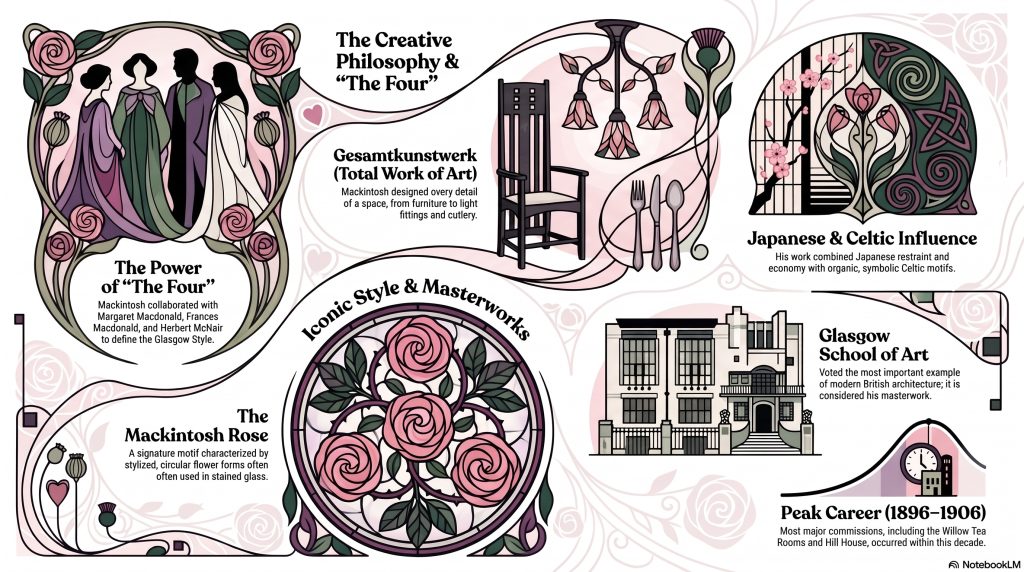
The talk examines the life and collaborative legacy of the Scottish architect Charles Rennie Mackintosh and his wife, the artist Margaret Macdonald. As central figures of “The Four,” they pioneered the Glasgow Style, a unique aesthetic that merged Art Nouveau with Japanese restraint and Celtic symbolism. The talk details their most significant projects, including the Glasgow School of Art and various innovative tea rooms, while highlighting Macdonald’s essential role in interior design and gesso work. Despite achieving international acclaim in cities like Vienna, the couple faced professional decline and personal hardship in their later years. Ultimately, the material reflects on their enduring status as modernist pioneers whose influence was rediscovered long after their deaths.
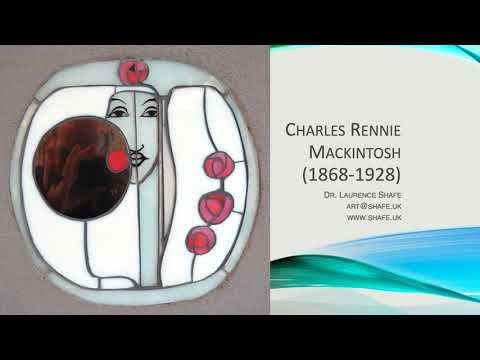
My notes on Charles Rennie Mackintosh
A conversation on Charles Rennie Mackintosh created by Google Notebook from my notes:
1. The Architect Who Walked with a Limp and a Legend
Long before he was a titan of British modernism, Charles Rennie Mackintosh—affectionately known to his inner circle as “Toshie”—was a man who struggled simply to fit in. Born in 1868 as the fourth of eleven children to a Glasgow police clerk, his early life was defined by a series of physical and academic hurdles that might have sidelined a lesser spirit. He walked with a pronounced limp from a contracted sinew, possessed a distinctive drooping right eye, and suffered from persistent difficulties with reading, writing, and spelling.
Yet, history has a way of smoothing over the jagged edges of its icons. We often view Mackintosh as a solitary, brooding master of the drawing board, forgetting the shy man who, according to friends, was a “tremendous lover of beauty” who only became an untiring talker when his interests were truly roused. Perhaps his greatest interest, however, was not his own fame, but the creative brilliance of the woman standing beside him. The central curiosity of the Glasgow Style lies in a counter-intuitive truth: the man credited as the father of modern architecture believed he was merely the apprentice to his wife’s genius.
2. The “Talent vs. Genius” Paradox
In the grand narrative of Art History, Margaret Macdonald is often relegated to the role of the supportive spouse. Mackintosh himself would have found this historical marginalization offensive. He was unwavering in his conviction that Margaret was the superior artist, a sentiment he immortalized in a letter to her.
“Margaret has genius,” he famously wrote. “I have only talent.”
This was not the hyperbole of a man in love; it was a professional acknowledgment. He quantified her contribution with startling precision, telling her: “Remember, you are half if not three-quarters in all my architectural work.” While Mackintosh handled the structural skeleton, Macdonald was the soul, providing the imaginative gesso panels, graphics, and textiles that transformed a building from a shell into a Gesamtkunstwerk—a total work of art. Introduced by the headmaster of the Glasgow School of Art, Francis Newbery, because he saw a “similarity in their work,” the pair forged a partnership where the lines of authorship became beautifully, inextricably blurred.
3. From “The Spook School” to Global Icons
Before they were the darlings of the European avant-garde, the core group of the Glasgow Style—Charles, Margaret, her sister Frances Macdonald, and Herbert McNair—occupied a strange space on the fringe of the art world. Within the halls of the Glasgow School of Art, they were known by the bold, self-assured name of “The Immortals.” Outside those walls, however, the reception was far colder.
Contemporary critics, unsettled by their linear forms and symbolic, organic themes influenced by the decadent style of Aubrey Beardsley, dismissed their work as “ghoulish.”
“Their linear forms were seen as influenced by Beardsley and were called ‘ghoulish’ and they were referred to as ‘The Spook School’.”
This “Spook School” was a slur intended to mock their willowy human forms and “pagan overtones” of seeds, buds, and roots. Yet, where critics saw decay, others saw the future. The pivotal patron Catherine (Kate) Cranston, the formidable leader of Glasgow’s tea room movement, became their staunchest supporter. She provided the canvas for what would eventually be championed as the “Modern Style” by London’s Liberty department store, proving that the avant-garde is often just a “Spook School” waiting for its first brave patron.
4. Predicting Art Deco a Decade Early
To study Mackintosh’s timeline is to witness a form of stylistic time travel. His aesthetic roots lay in the restraint and economy of Japanese ukiyo-e prints, yet he consistently leapt over his contemporaries. The iconic “Mackintosh Rose”—a motif so ubiquitous today that it was once mockingly called “cabbages” by detractors—appeared in his designs for the House for an Art Lover in 1901. This was ten years before Art Deco officially emerged in France.
His technical foresight was equally sharp. In 1894, he designed the Glasgow Herald Building (now The Lighthouse), incorporating cutting-edge fire-resistant diatomite concrete flooring and a massive tower holding an 8,000-gallon water tank for fire protection.
Perhaps the most startling leap occurred in 1916. For years, Mackintosh had been famous for his “White Rooms”—the light, ethereal spaces of 120 Mains Street that felt worlds away from heavy Victorian clutter. But in his design for 78 Derngate, he abandoned the light. He created a psychological foil: a room of dark, aggressive diagonals and black surfaces. It was a visual vindication, predicting the high-contrast glamour of the late 1920s while the rest of the world was still recovering from the Edwardian era.
5. The Vienna “Rockstar” Moment
While the Mackintoshes endured what friend Hermann Muthesius called an “unrewarded struggle” in Glasgow, they were treated like royalty in Austria. Their appearance at the 1900 Vienna Secession exhibition was the zenith of their careers. They were the bridge to the 20th century that the Viennese masters had been seeking.
The reception was nothing short of a “rockstar” moment. The couple was famously carried through the streets in a rose-bedecked wagon, with flowers strewn at their feet by admirers who saw them as the “spiritual leaders” of the Secessionstil. This “total design” approach deeply influenced Gustav Klimt—whose Beethoven Frieze echoes the Macdonald sisters’ linear elegance—and Josef Hoffmann, who considered Mackintosh a “spiritual brother.” In the cafes of Vienna, the toast was “to our master,” a stark contrast to the “penniless” years that would eventually follow in their homeland.
6. The Spy, the Flower, and the Fire
The twilight of the Mackintoshes is a narrative of modern tragedy. By 1914, the man who had been the toast of Vienna was considered “old-fashioned” by a changing British industry. Seeking a quiet retreat, they moved to the coastal village of Walberswick. However, Mackintosh’s eccentric silhouette—the limp, the deerstalker hat, the ever-present pipe, and his habit of late-night walks near the coast—struck a suspicious chord during wartime. In 1915, he was arrested under suspicion of being a German spy.
Disillusioned, they fled to southern France to save money, where Mackintosh abandoned architecture for watercolor painting. Despite his brilliance, he spent his final years earning “less than a navvy.” The end was physically cruel; he developed cancer of the tongue, which was eventually removed, forcing him to wear a heavy radium collar. He died in 1928, unable to speak, leaving Margaret to return to France alone, never mentioning “Toshie” again.
This personal heartbreak is mirrored by the architectural tragedy of his masterwork, the Glasgow School of Art. Affectionately called “The Mac” and described as “the only art school in the world where the building is worthy of the subject,” it was gutted by fire in 2014 and again in 2018. The library, a “forest of timber” largely designed by Margaret, was lost to the flames, leaving only a skeletal reminder of their shared vision.
7. Conclusion: A Legacy Carved in Light
Fifty years after his death, the architectural world finally caught up to Mackintosh’s “talent,” voting him the most important British architect of the last century and a half. But his legacy is a hollow one if viewed through his eyes alone.
We are left with a compelling question: would the sleek lines of modern design even exist without the symbiotic friction of this pair? It was a collaboration that proved that art is not a solitary act of construction, but a living partnership. As the rebels of the Glasgow Style knew better than anyone, “The Immortals” only truly live when the structure and the soul are one. Or, as Toshie himself once wrote:
“Art is the flower, life is the green leaf.”Gemini Notebook can be inaccurate; please double-check its responses.