Pointillism, also called Divisionism or Neo-Impressionism, was developed in the 1880s by Georges Seurat and Paul Signac as a systematic method of applying small dots of pure, unmixed colour to the canvas so that they would optically blend in the viewer’s eye, producing luminosity more scientifically precise than the intuitive mixing of the Impressionists. Seurat’s monumental Sunday on La Grande Jatte announced the movement with its startling combination of classical stillness and scientific rigour, each figure reduced to a hieratic silhouette amid thousands of meticulously placed colour dots. Signac became the principal theorist, publishing his influential D’Eugène Delacroix au Néo-Impressionnisme in 1899 and spreading the method through luminous Mediterranean harbour scenes that demonstrated its expressive range. Although followed strictly by relatively few artists, Pointillism’s insistence on the optical interaction of pure colour had a profound effect on subsequent movements, particularly the Fauves and Orphism. Henri Matisse and other future modernists passed through a Divisionist phase that taught them the emotional and decorative potential of colour freed from descriptive duty.
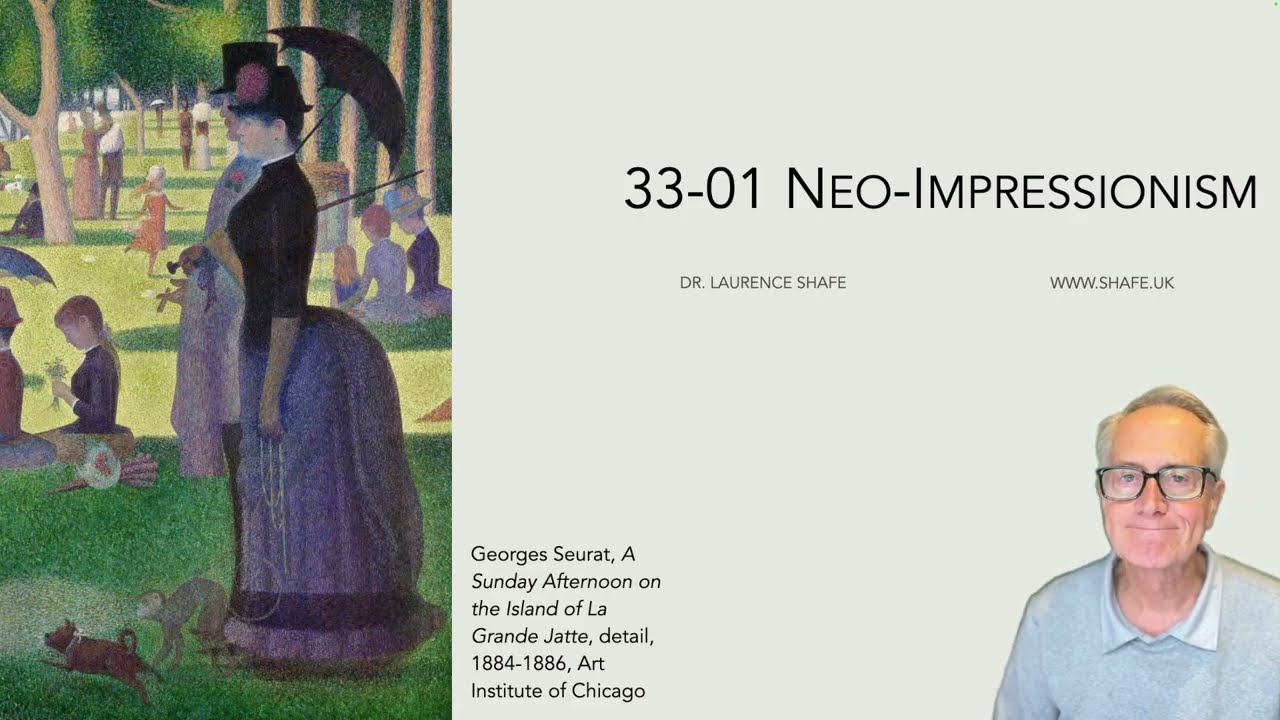
33-01 Neo-Impressionism
This talk provides a comprehensive look at Neo-Impressionism, focusing on its primary innovators, Georges Seurat and Paul Signac. It shows how these artists utilized scientific theories of optics and colour to move beyond the spontaneous nature of Impressionism. Key concepts explained include Divisionism, the theoretical separation of colours, and Pointillism, the actual application of tiny dots to a canvas. Notable masterpieces like A Sunday Afternoon on the Island of La Grande Jatte and The Dining Room serve as examples of this rigorous technique. Additionally, the talk offers biographical insights into Seurat’s life, including his training at the École des Beaux-Arts and his early death and through his work tracing the movement’s evolution from academic traditions to a modern, methodical approach to light.
My notes on Neo-Impressionism, Pointillism, Divisionism, Georges Seurat and Paul Signac
A chat about Neo-Impressionism based on my notes and created by Google NotebookLM:
This was Neo-Impressionism, a movement pioneered by Georges Seurat and his contemporary, Paul Signac. They were not simply refining the work of the Impressionists; they were actively challenging it. Armed with scientific theories of optics and color, they sought to replace the spontaneous, fleeting moments captured by artists like Monet with something more permanent, more luminous, and more intellectually rigorous. They were methodical rebels, trading the romantic flourish of the brush for the precise application of the dot.
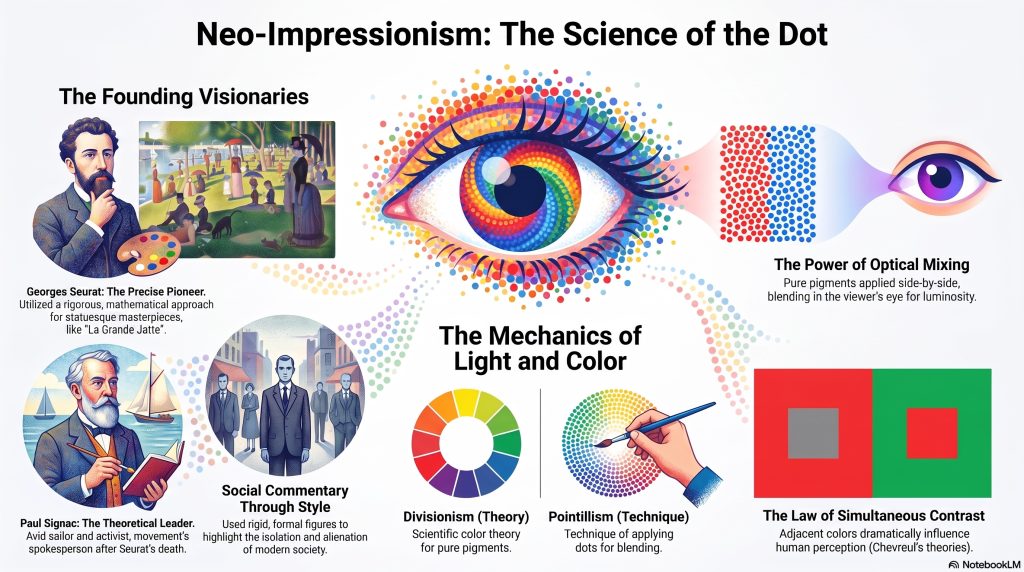
Neo-Impressionism was not an evolution of Impressionism but a direct and deliberate reaction against its spontaneous style. Where the Impressionists relied on instinct and rapid brushwork to capture a fleeting moment, the Neo-Impressionists built their art on a foundation of scientific theory and methodical precision. The movement was defined by two core components:
This scientific approach is surprising because it fundamentally transformed the act of painting. It moved from a spontaneous, romantic gesture to a precise, calculated, and intellectually demanding process. For the Neo-Impressionists, the artist’s studio became as much a laboratory as a creative space.
But for all its scientific rigidity, the movement was still practiced by artists with human frailties, a fact Seurat himself accidentally—and then deliberately—concealed. Seurat was known for his quiet, intensely focused, and almost mathematical approach to his work. He left behind no known formal self-portrait, leaving us with few clues to the man behind the masterpieces. However, his only self-portrait once existed, hidden in one of his most famous paintings.
The work, Young Woman Powdering Herself, depicts his mistress, Madeleine Knobloch. Recent scans of the canvas have revealed a fascinating secret. Originally, Seurat had included his own self-portrait, painting himself at his easel as a reflection in a mirror on the wall behind Madeleine. But after a friend ridiculed the tiny portrait, Seurat painted over his own image, replacing it with the simple vase of flowers we see today. This anecdote offers a rare and humanizing glimpse into the life of a notoriously private artist, revealing a moment of vulnerability behind the methodical genius.
Behind the calm, idyllic scenes of leisure and landscape, many Neo-Impressionists held radical political beliefs. Paul Signac, in particular, was a politically engaged anarchist who envisioned a utopian future free from the constraints of capitalism and government.
This utopian vision becomes even more radical when you consider its context: France in the 1890s was a nation reeling from anarchist bombings and the deep social divisions of the Dreyfus Affair. In this turbulent climate, Signac created his monumental canvas, In the Time of Harmony. It is not just a peaceful scene but a political manifesto, depicting an ideal anarchist community on the sun-drenched coast of St. Tropez—a future golden age where people live in cooperative harmony without factories, police, or clergy. The painting was such a serene vision of a radical ideal that it prompted the critic Émile Verhaeren to remark:
“Signac has given anarchy the serenity of Poussin.”
Seurat’s work, too, was infused with social commentary. The “stiffness and emotional emptiness of the upper-middle-class society” is palpable in A Sunday on La Grande Jatte, while his earlier painting, Bathers at Asnières, captures a “modern sense of isolation and alienation” among the working-class men. This political undercurrent is impactful because it reveals that this highly structured art form was also a powerful vehicle for promoting utopian ideals and critiquing the inequalities of modern society.
The scientific precision of Neo-Impressionism intrigued many of the era’s greatest painters. Vincent van Gogh was one of them. During his time in Paris from 1886 to 1888, he explored the principles of optical mixing, applying short, thick brushstrokes of pure color in works like his Self-Portrait with a Straw Hat.
He ultimately found the strict methodology “too constraining and unemotional for his expressive aims,” preferring the raw power he could convey through bolder brushwork. But he didn’t simply reject it. Another master, Camille Pissarro, adopted the method for several years but returned to his Impressionist style after finding it too “labour-intensive.”
Van Gogh’s story, however, reveals something more profound than the limits of a “perfect” system. He never completely abandoned the principles he learned; instead, he absorbed them. As the source text notes, he “merged it with his personal, dynamic brushwork to pioneer a uniquely expressive style.” This is the true, surprising legacy of their interaction: the story isn’t about the failure of a system, but about how a master artist can take a rigid methodology and transform it into a powerful tool for raw, personal expression, forever changing the course of art.
Neo-Impressionism was far more than just a technique of painting with dots. It was a complex and revolutionary movement that fused cutting-edge science with radical politics, personal stories with grand artistic debates. The serene surfaces of these paintings conceal a world of intellectual rigor and utopian passion. The artists who pioneered it were not just creating beautiful images; they were proposing a new, more methodical, and more luminous way of seeing the world.
Now that you know the science and secrets behind the dots, does it change the way you see these iconic paintings?
(Written by Google NotebookLM based on my PDF notes)