Post-Impressionism is a term for the diverse artists who built upon and reacted against Impressionism in the 1880s and 1890s, each pushing beyond its concern with fleeting visual sensation toward deeper structure, symbolism, or emotional intensity. Paul Cézanne analysed the underlying geometric structure of landscape and still life with painstaking rigour, laying the foundation for Cubism and all subsequent abstract art, while Georges Seurat developed Pointillism as a scientific systematisation of Impressionist colour theory. Paul Gauguin fled Europe for Tahiti in search of a more primal, spiritually charged form of art, and Vincent van Gogh channelled overwhelming emotion into swirling, vividly coloured canvases that were barely noticed in his lifetime but became the most beloved images in the history of art. Together these painters transformed painting’s expressive possibilities so completely that the entire trajectory of twentieth-century modernism can be read as a response to their combined legacy. This chapter explores the Post-Impressionist movement through illustrated talks on its four principal masters and their far-reaching influence.
30-01 Paul Cézanne
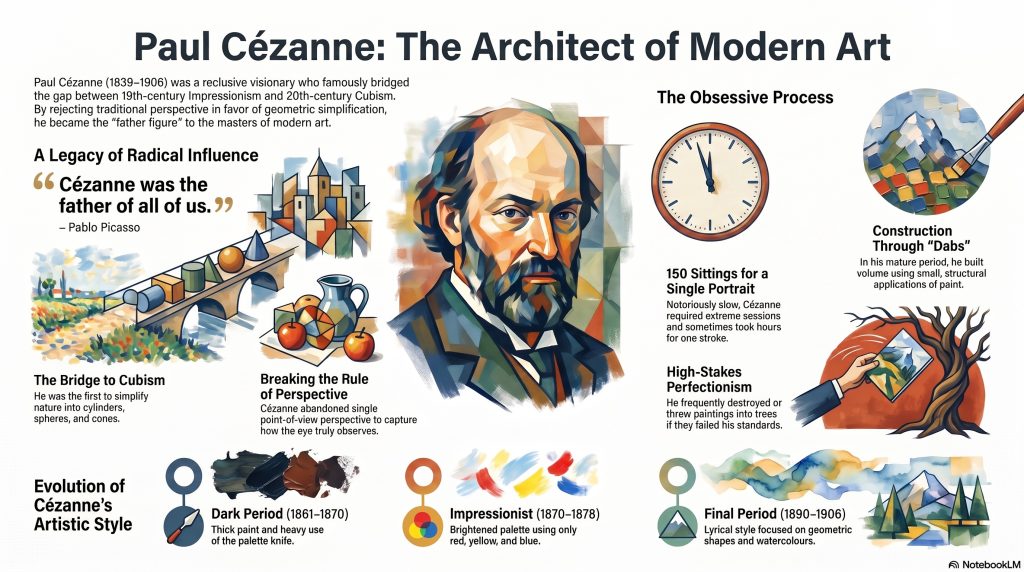
Paul Cézanne was a pivotal figure often hailed as the father of modern art for bridging the gap between Impressionism and Cubism. Born into a wealthy banking family in Aix-en-Provence, Cézanne initially studied law to please his father before moving to Paris to pursue a career in painting alongside lifelong friend Émile Zola. His artistic journey was defined by a rejection of traditional perspective and a commitment to representing nature through geometric forms and personal sensation. Despite battling extreme social anxiety, self-doubt, and public ridicule, he developed a unique style characterized by slow, deliberate brushwork and structural complexity. His evolution is categorized into distinct phases, including a dark period, an Impressionist stage, and a mature period focused on balancing composition. Ultimately, his radical approach to colour and volume deeply influenced 20th-century masters like Picasso and Matisse, securing his reputation as a monumental force in art history.
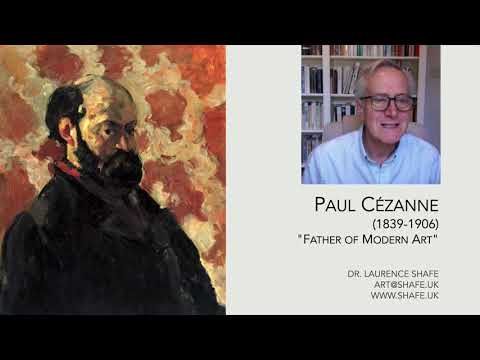
A conversation about Paul Cézanne created by Google Notebook from my notes:
Paul Cézanne didn’t just paint; he wrestled with reality—and when reality won, the canvases went flying. In his hometown of Aix-en-Provence, locals largely considered him a “lunatic,” a volatile hermit who couldn’t be bothered with social graces. He was an isolated figure, a man who withdrew from a world that didn’t understand him so he could invent an entirely new way of seeing.
His creative process was as violent as it was obsessive. It was not uncommon for Cézanne to reach a breaking point of frustration and hurl his unfinished canvases out of his studio window. Passersby would often find these masterpieces-in-the-making festooned in the branches of the olive trees below, hanging like strange, festive decorations until the artist cooled off enough to retrieve them.
Today, we hail him as the “Father of Modern Art,” the essential bridge between the fleeting light of Impressionism and the fractured logic of Cubism. But to understand how a man rejected by the establishment for decades became the most influential painter of the 20th century, we have to look at the bizarre, “ballsy,” and often heartbreaking reality of his life.
1. The Shield: Why Picasso and Matisse Called Him “God”
The lineage of modern art doesn’t just pass through Cézanne; it begins with him. He was the “stepping stone” that allowed the next generation to leap into abstraction. His radical decision to dismantle traditional perspective provided the blueprint for everything that followed.
Both Pablo Picasso and Henri Matisse—the two titans of 20th-century modernism—unanimously claimed him as their primary master. For them, Cézanne wasn’t just a predecessor; he was a protector.
Picasso said: “Cézanne! Cézanne was the father of all of us.” He later added, “He was the only master for me… he was a father figure to us: it was he who offered us protection.”
Henri Matisse described him as: “A kind of dear god of painting,” noting at age eighty that he still owed the most to the art of Cézanne.
By “protection,” Picasso meant that Cézanne had taken the initial, most brutal brunt of public and critical scorn. By breaking the mold and enduring decades of mockery, he created a safe harbor where later artists could innovate without being immediately crushed by academic tradition.
Reflection: It is profoundly rare for two artists as diametrically opposed as Picasso and Matisse to share a single idol. Picasso found the structural bones of Cubism in Cézanne’s work, while Matisse found the emotional soul of color. That Cézanne could master both structure and emotion is why he remains the undisputed architect of the modern era.
2. The “Hooks” of Fear: A Pathological Horror of Human Touch
Cézanne’s social awkwardness wasn’t just shyness—it was “haphephobia,” an uncanny horror of physical contact. This was rooted in a childhood trauma: a schoolmate sliding down a banister gave little Paul a “vicious kick in the rear” so strong and unexpected that it left him permanently scarred.
This fear made him a social nightmare. He famously refused to shake hands with the sophisticated Édouard Manet, bluntly declaring, “I won’t offer you my hand, Monsieur Manet. I haven’t washed in eight days.” He was a man who screamed, “I won’t let anybody get his hooks into me!” when a friend tried to steady him after a stumble. For Cézanne, “hooks” weren’t just physical hands; they were the existing styles and mental blockages that kept artists from seeing nature clearly.
Yet, this wasn’t mere misanthropy. When the sculptor Auguste Rodin—a man Cézanne deeply admired—actually shook his hand, the encounter was so overwhelming that Cézanne knelt in the middle of a dusty road just to thank him. He was a man of intense humility, hidden beneath a prickly, “ill-mannered rustic” shell.
3. The 150-Sitting Portrait: When Sight Becomes Touch
While Cézanne was incredibly prolific—producing over 1,300 works, including 900 oils and 400 watercolours—his individual pace was agonizing. He was a perfectionist who believed a single brushstroke was a monumental responsibility. To Cézanne, painting was not about “copying” an object; it was about “realising sensations.”
He believed each stroke needed to contain “the air, the light, the object, the composition, the character, the outline, and the style.”
This made him a terror for his models. A single portrait could require 150 sittings, during which the subject was forbidden to move. If a sitter dozed off or even turned their head at a joke, Cézanne would curse, throw his brushes, and abandon the canvas. Even a still life of apples could take 100 sessions.
Reflection: There is a fascinating irony in his work: Cézanne wouldn’t touch people, so he made his paintings things you could almost feel with your eyes. As he once said, he wanted to reach a point where “sight” was also “touch.” By using dabs of paint to build volume, he gave “plastic form” to nature, making the flat canvas feel as solid and tactile as the earth itself.
4. “Ballsy” Beginnings: Crashing the Party in Dirty Boots
Before the bright, structured landscapes that made him famous, there was the “Dark Period” (1861–1870). These early works were “demonic-erotic,” thick with violent and brooding subjects like The Murder. During this time, he adopted what he called the manière couillarde—the “ballsy” technique.
Influenced by the realism of Gustave Courbet, Cézanne used a palette knife to apply thick, “gutsy” layers of paint. He modeled himself after Courbet’s “savage” persona to scandalize the Parisian art establishment. Historians have described this aesthetic as an “upstart in dirty boots crashing a genteel party.”
Cézanne intentionally used this unrefined, aggressive style to signal his status as an outsider. He wasn’t interested in the “prejudice” of the polite Paris Salon; he wanted to bring “high art” down to the raw truth of everyday life, using the palette knife to literally carve his emotions onto the canvas.
5. The King of Rejection and the Ultimate Friend Betrayal
Cézanne’s career was a 19-year marathon of failure. The official Salon de Paris rejected him annually until he was 43. The low point came during the 1863 “Salon des Refusés,” an exhibition of rejects where the public didn’t come to admire the art—they came to have laughing fits in front of his work.
Despite the “lunatic” label and threatening letters from his own townsfolk, he was sustained by a tiny circle:
- The Three Inseparables: His childhood bond with Baptistin Baille and the writer Émile Zola.
- Camille Pissarro: The Impressionist mentor who taught him to lighten his palette.
- The Collectors: Visionaries like Victor Chocquet and the merchant “Père” Tanguy, who traded paint and canvas for masterpieces.
The most crushing blow, however, came from Zola. The man who had encouraged Cézanne to move to Paris eventually decided his friend was a failure. Zola wrote a novel about a failed painter who commits suicide, a character clearly modeled on Cézanne. To be written off as a “suicide-case hack” by his best friend was a betrayal that effectively ended their relationship.
Reflection: Cézanne’s life proves that true genius often requires a degree of withdrawal. He once said, “I don’t understand the world and the world doesn’t understand me, so I withdrew.” By being an outsider, he could ignore the “voices of prejudice” and become a “perfect echo” for nature.
Conclusion: The Man the World Eventually Understood
Cézanne died exactly as he lived: obsessed. In 1906, he was caught in a storm while painting in a field. He worked for two hours in the downpour until he fainted. He was carried home, regained consciousness, and immediately began a final portrait of his gardener, Vallier, before collapsing again. He died of pneumonia days later, just as he claimed to be becoming “clairvoyant to nature.”
His friend Pissarro was right when he said:
“I think it will be centuries before we get an account of it.”
Paul Cézanne was the man who taught us that painting isn’t about imitating an object—it’s about the “lived perspective” of the human eye. He remained an outsider so that he could see the world differently, proving that sometimes, you have to be willing to be misunderstood by everyone in your own time to be understood by everyone in the future.Gemini Notebook can be inaccurate; please double-check its responses.
30-02 Van Gogh and Britain
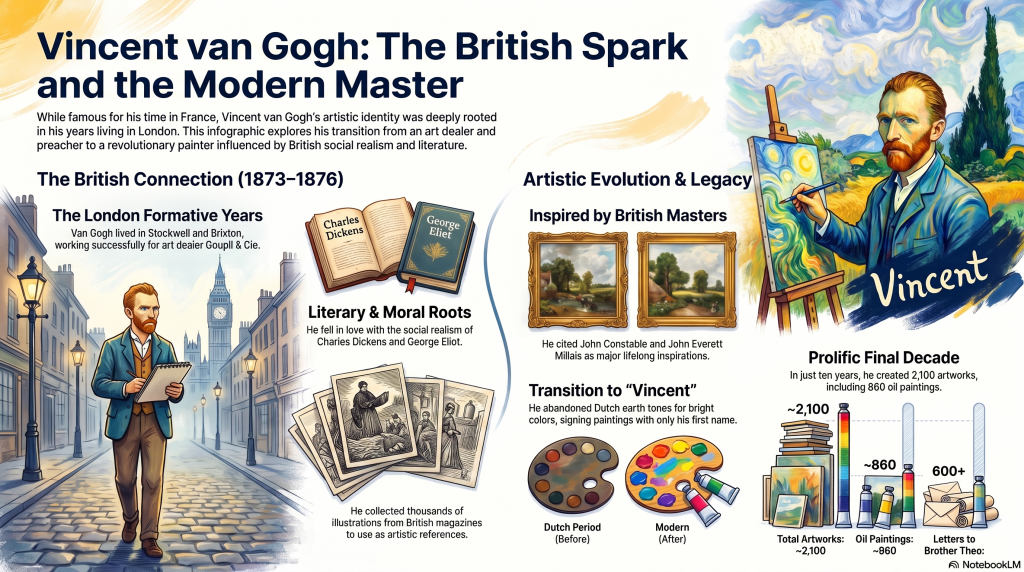
My talk looks at the life and artistic evolution of Vincent van Gogh, specifically examining his relationship with Britain and his broader influence on Western art. The material traces his biography from his early days as an art dealer and preacher to his prolific final years, highlighting how his expressive brushwork and bold colors helped establish the foundations of modernism. Key topics include his extensive correspondence with his brother Theo, his struggles with mental illness, and the various theories surrounding his tragic death. Additionally, the text chronicles his artistic transitions through Paris, Arles, and Saint-Rémy, noting his fascination with Japanese prints and his interactions with peers like Gauguin. Ultimately, the source illustrates how Van Gogh’s legacy was preserved by his family and continues to inspire British artists such as Francis Bacon and Walter Sickert.
(My YouTube video of van Gogh will be published on 12 December 2026)
My notes on Van Gogh and Britain
A conversation about van Gogh created by Google Notebook from my notes:
1. Introduction: Beyond the Myth of the Isolated Genius
We are all captive to the “tortured artist” archetype: the man who severed his own ear in a fit of lunacy and painted vibrant sunflowers in a state of feverish, lonely isolation. This popular image of Vincent van Gogh suggests a “romantic genius” born fully formed, detached from the reality of the world.
However, the historical record reveals a far more nuanced figure. Vincent was not an isolated phenomenon; he was a man traversing a series of failed vocations that would eventually form the bedrock of his empathy for the working class. By looking past the myths, we find an intellectual fueled as much by a rigorous Protestant work ethic and a scholarly devotion to British culture as by his inner turmoil.
2. The Replacement Child: A Birthday Shared with a Ghost
Vincent’s entry into the world was marked by a profound psychological weight. Born on March 30, 1853, in Groot-Zundert, he was given the name of his grandfather—but also that of a brother stillborn exactly one year to the day before his birth.
Growing up in the shadow of this “ghost” brother meant Vincent was raised in a family where “love was in short supply.” This was no mere conceptual haunting; as the son of the village minister, Vincent would have regularly passed the literal grave of the first Vincent. This shared identity likely fueled his moody, strongly opinionated temperament, as he sought to carve a singular existence out of a shared name.
3. The Late Bloomer: A Career Built on a Foundation of Failure
The masterpiece-laden final decade of Vincent’s life obscures the fact that he was a “late bloomer” who did not begin practicing art seriously until age 27. His career was built on a series of professional collapses:
- He was an apprentice art dealer at Goupil & Cie but was sacked after becoming dissatisfied with how they commodified art.
- He served as an unpaid supply teacher in Ramsgate and Isleworth, England.
- He failed the ministry entrance exam and was later dismissed as an evangelist preacher in the Borinage mining district.
Rather than a “romantic genius” relying on divine spark, Vincent was a self-didactic worker. He refused the academy, choosing instead to rigorously train himself. He was a “formidable walker” who claimed to enjoy “suffering hours of it” and a habitual smoker who regarded his pipe as an “old friend.” It is a staggering irony that a man who failed at every commercial endeavor in life is now a pillar of the global art market.
4. The Hidden Anglophile: 2,000 Woodcuts and a Love for Dickens
One of the most transformative influences on Vincent was his time at 87 Hackford Road in London. He became a deep admirer of English culture, specifically the socially conscious novels of Charles Dickens and George Eliot.
Vincent was not merely a consumer of art; he was a scholarly collector. He amassed an archive of over 1,400 (and perhaps 2,000) woodcut prints from The London Illustrated News and The Graphic. Demonstrating his professional rigor, he meticulously sorted these by subject matter—workers, farmers, factory people—to serve as a reference for his own paintings. As he famously wrote to his brother Theo:
“I, for my part, always keep thinking about some English paintings — for instance, Chill October by Millais.”
5. The “Vincent” Signature: Channeling Rembrandt
Vincent famously signed his canvases “Vincent” rather than “Van Gogh.” This was a deliberate choice inspired by his admiration for Rembrandt, who similarly used only his first name.
Linguistically, “Van” is a tussenvoegsel (a prefix), and “Van Gogh” means “from Goch,” a town on the border. While the surname was relatively rare—only 792 people held it in the Netherlands as recently as 2007—Vincent sought to transcend the commonality of the prefix. By signing only his first name, he established a singular, personal identity alongside the Old Masters he revered.
6. The Cowboy Theory: Was It Really Suicide?
While the prevailing narrative is that Vincent shot himself, biographers Naifeh and Smith presented a compelling alternative in 2019. They suggest he was accidentally shot by René Secrétan, a rowdy teenager in a “cowboy costume” who often bullied the artist.
Key evidentiary points support this: the unusual angle of the wound, the disappearance of the gun (likely sourced from a local innkeeper), and the improbable fact that Vincent survived a 1.5-mile walk home with a fatal chest injury. Vincent, who viewed suicide as “moral cowardice,” may have accepted death to protect the boys. Naifeh and Smith attribute his behavior to “mental epilepsy”:
“A seizing up of the mind: a collapse of thought, perception, reason, and emotion that manifested itself entirely in the brain…”
7. Conclusion: The Persistence of “Vincent”
These truths reveal a Vincent who was more than a tragic icon; he was a methodical intellectual of immense grit. We owe this nuanced understanding to his sister-in-law, “Jo” van Gogh-Bonger. Without her editorial eye and her recognition of the value of his letters, the intellectual depth of his life would remain obscured by the myth of his madness.
As we reflect on his journey, we must ask if our obsession with his “madness” blinds us to the sheer labor of his craft. As Vincent himself observed: “Art is long and life is short.”
30-03 Paul Gauguin
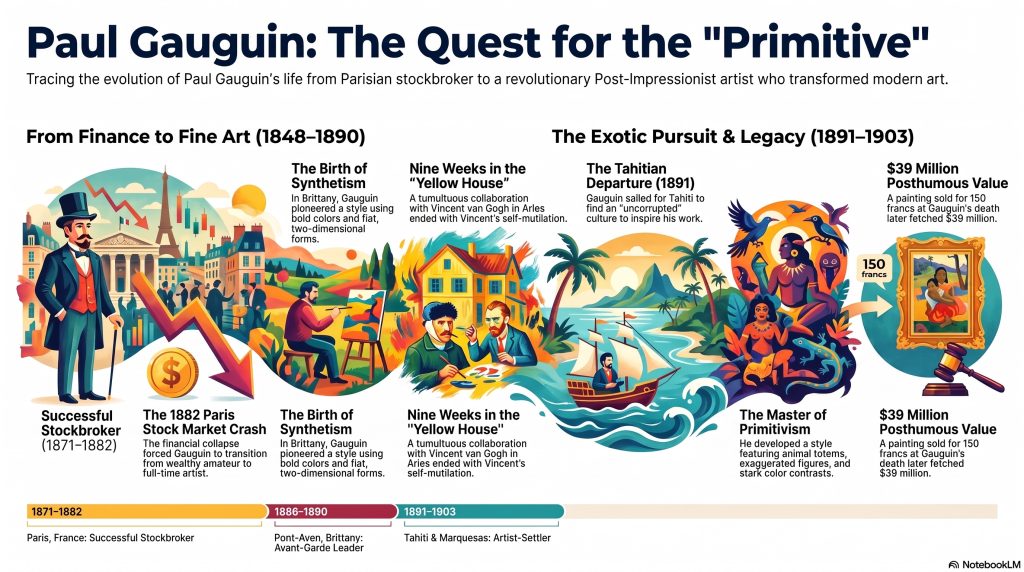
This talk provides a comprehensive biographical and artistic account of the post-Impressionist painter Paul Gauguin, tracing his life from his 1848 birth in Paris to his 1903 death in the Marquesas Islands. It explores his unconventional career path, highlighting his transition from a prosperous stockbroker to a full-time artist following the 1882 French financial collapse. It details his complex personal relationships, including his marriage to Mette Gad and his famously turbulent association with Vincent van Gogh. It emphasizes Gauguin’s search for an exotic, “primitive” aesthetic, which led him away from traditional European styles toward his celebrated work in Tahiti and Martinique. Beyond his artistic contributions like Synthetism and Cloisonnism, the talk also addresses the darker aspects of his legacy, such as his failing health and controversial interactions with young Polynesian women. Ultimately, it illustrates how his posthumous recognition was secured by influential dealers and exhibitions that showcased his revolutionary use of color and symbolism.
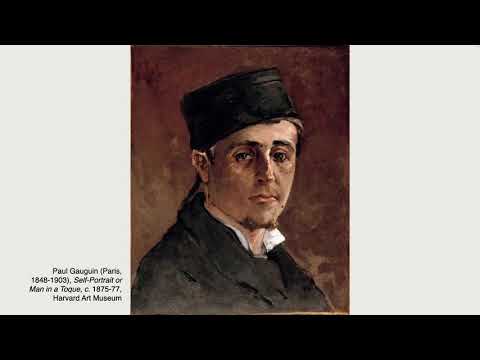
My Notes on Paul Gauguin: His Life and Work
A conversation about Paul Gauguin created by Google Notebook from my notes:
To the casual museum-goer, Paul Gauguin is the patron saint of the tropical getaway—the man who traded a stuffy Parisian suit for a sarong and a paintbrush. We’ve been sold a narrative of a “noble savage” seeking a lost Eden in the South Seas. But the truth is far less romantic and infinitely more calculating. Paul Gauguin didn’t just find a new style in Tahiti; he aggressively manufactured a brand, built on a foundation of colonial entitlement, the appropriation of his peers’ innovations, and a personal life that reads less like an artistic odyssey and more like a rap sheet. He wasn’t just a painter; he was a master of the pivot, treating his human relationships like bad debts to be liquidated in favor of his own myth-making.
From the Bourse to the Brush: The Regressive Radical
One of the great ironies of “Primitivism” is that its architect was a high-functioning creature of European capitalism. In 1871, Gauguin began an 11-year streak as a top-tier stockbroker, pulling in an annual income equivalent to £200,000 today. He wasn’t just watching the ticker; he was an insider, a successful businessman who doubled his fortune by dealing in the very art market he would later claim to despise.
His later obsession with the “primitive” wasn’t a forward-looking revolution but a regressive attempt to reclaim his lost status. Born into revolutionary chaos in 1848, Gauguin spent his first six years in Peru, living a life of servants and nursemaids among aristocratic relatives—an experience he admitted “haunted him the rest of his life.” When the Paris Bourse collapsed in 1882, the loss of his job and savings wasn’t a spiritual awakening; it was a financial catastrophe that forced him to turn his “Sunday painter” hobby into a desperate career. Gauguin didn’t leave the stock market to find his soul; he was evicted from it.
The “Imagination” Manifesto: Marketing the Flat Surface
Gauguin’s stylistic break from his mentor, Camille Pissarro, was as much about ego as it was about aesthetics. He grew bored with the Impressionist obsession with light and nature, pivotally adopting “Cloisonnism”—a style of flat planes and dark outlines. However, art history often ignores that he essentially appropriated this style from the younger, less aggressive Émile Bernard and then out-marketed him to the Parisian elite.
His 1888 Vision After the Sermon was the ultimate middle finger to the Western tradition of 3D perspective. By placing Breton women on a field of flat, non-naturalistic red as they envision Jacob wrestling an angel, Gauguin moved the battlefield from the eye to the mind. He wasn’t interested in what he saw, but in the “raw power” he could project. As Maurice Denis famously summarized the shift in 1890:
“It is well to remember that a picture before being a battle horse, a nude woman, or some anecdote, is essentially a flat surface covered with colours assembled in a certain order.”
Nine Weeks in Arles: The Subsidized Tragedy
The legendary 1888 stay in the “Yellow House” with Vincent van Gogh is often framed as a meeting of two tortured souls. In reality, it was a subsidized business arrangement. Gauguin was paid an allowance by Theo van Gogh to stay there, essentially acting as a paid companion to a volatile Vincent. The nine weeks they spent together were a collision of fundamentalisms: Vincent’s insistence on nature versus Gauguin’s insistence on the imagination.
The end was predictably bloody. According to Gauguin’s own self-aggrandizing account, he thwarted a razor attack from Vincent with a single “powerful look” before the latter famously mutilated his own ear. Gauguin fled Arles immediately, leaving a broken man behind. While they corresponded until Vincent’s death, Gauguin used the encounter to further his own narrative of the misunderstood genius, indifferent to the wreckage he left in the South of France.
The Manufactured Paradise: Selling the Tahitian Lie
In 1891, Gauguin fled to Tahiti to escape “everything artificial,” only to find that the “pure” world he sought was a ghost. Papeete was a Europeanized colonial capital he couldn’t afford. Even when he moved to a bamboo hut, he found a culture already sanitized by missionaries.
Undeterred by reality, Gauguin simply invented the world he wanted to sell. He read books on old Tahitian customs and painted a “lost” world of animal totems and exaggerated figures that no longer existed. He even wrote a travelogue, Noa Noa, a largely fictionalized narrative designed to lure Parisian buyers into believing he had found a sensuous, untouched paradise. He wasn’t documenting a culture; he was colonizing it for his canvas, creating a “mysterious and sensuous” brand to export back to the very European civilization he claimed to loathe.
The Calculated Cruelty of the Master
Modern audiences struggle to separate the vibrant colors from the dark reality of Gauguin’s personal life. He abandoned his wife, Mette, and their five children, effectively leaving her to work as a translator and teacher to support them. When he inherited 13,000 francs from an uncle, he sent his family a insulting 1,500, liquidating his domestic responsibilities like a bad investment. He even left a mistress in Paris, Juliette Huet, pregnant and alone when he set sail.
In the South Pacific, his behavior crossed from neglect to predation. He maintained a 23-year facade of connection to Mette through letters while “marrying” a series of children: Teha’amana at 13, Pahura at 14, and Vaeoho at 14. He viewed these girls as raw materials for his “Sun-Drenched” masterpieces. To discuss his art today without acknowledging the misogyny, racism, and pedophilia is to complicitly accept the “noble savage” mask he wore to hide a legacy of exploitation.
Conclusion: The $39 Million Postscript
Paul Gauguin died in the Marquesas in 1903 at 54, a man in physical and legal decay. He was suffering from failing sight and painful sores he called “eczema,” though they were almost certainly the progress of syphilis. At the moment of his heart attack, he was facing three months in prison for a libel conviction.
Even his final testament, the monumental Where Do We Come From? What Are We? Where Are We Going?, was a throwback to the Catholic catechism he learned at a seminary at age 11—a bourgeois root he could never quite pull up. Posthumously, his dealer Ambroise Vollard transformed Gauguin from a penniless controversialist into a Modernist icon, directly influencing the likes of Pablo Picasso.
The ultimate irony remains the market value of his cruelty: a small painting of his teenage mistress Pahura, sold for 150 francs at his death, fetched $39 million in 2004. Gauguin revolutionized art by proving that the imagination is more powerful than reality—but he also proved that a brilliant brand can be built on a graveyard of discarded lives. We are left to wonder: can any amount of artistic influence ever truly justify the human cost left in its wake?Gemini Notebook can be inaccurate; please double-check its responses.
30-04 Pierre Bonnard
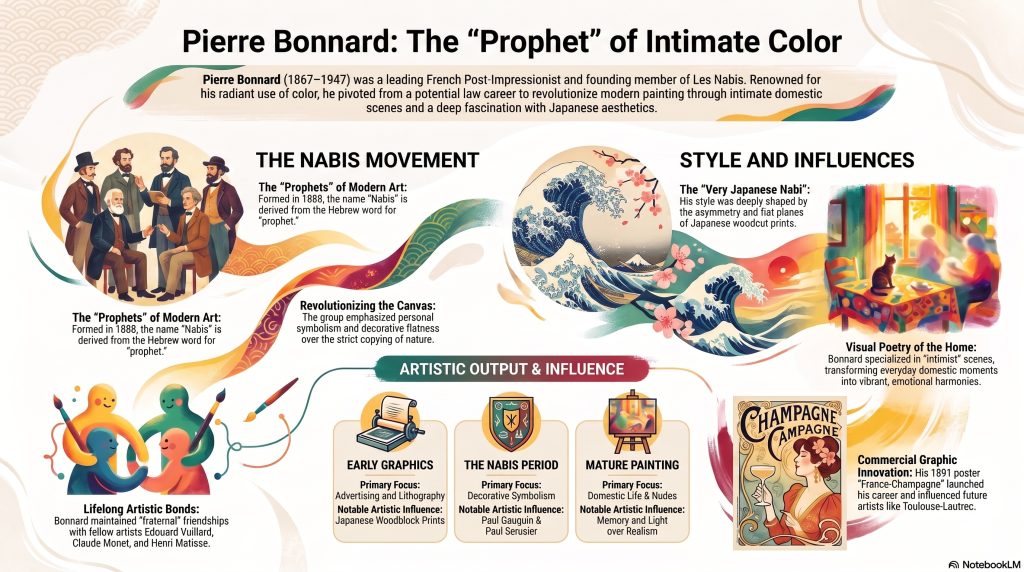
This talk provides a biographical and artistic examination of Pierre Bonnard, a significant French painter and founding member of the Nabis. It tracks his transition from a law student to a leading figure in the Post-Impressionist movement, highlighting his mastery of color, light, and domestic intimacy. Key details include his relationships with contemporary masters like Monet and Matisse, as well as the profound influence of his wife and frequent subject, Marthe de Méligny. Beyond his canvases, the text explores Bonnard’s influential work in lithography and poster design, which helped bridge the gap between fine art and popular culture. Finally, the talk illustrates how his unique aesthetic, characterized by flat planes and vibrant tones, evolved from decorative symbolism toward a deeply personal, emotional style.
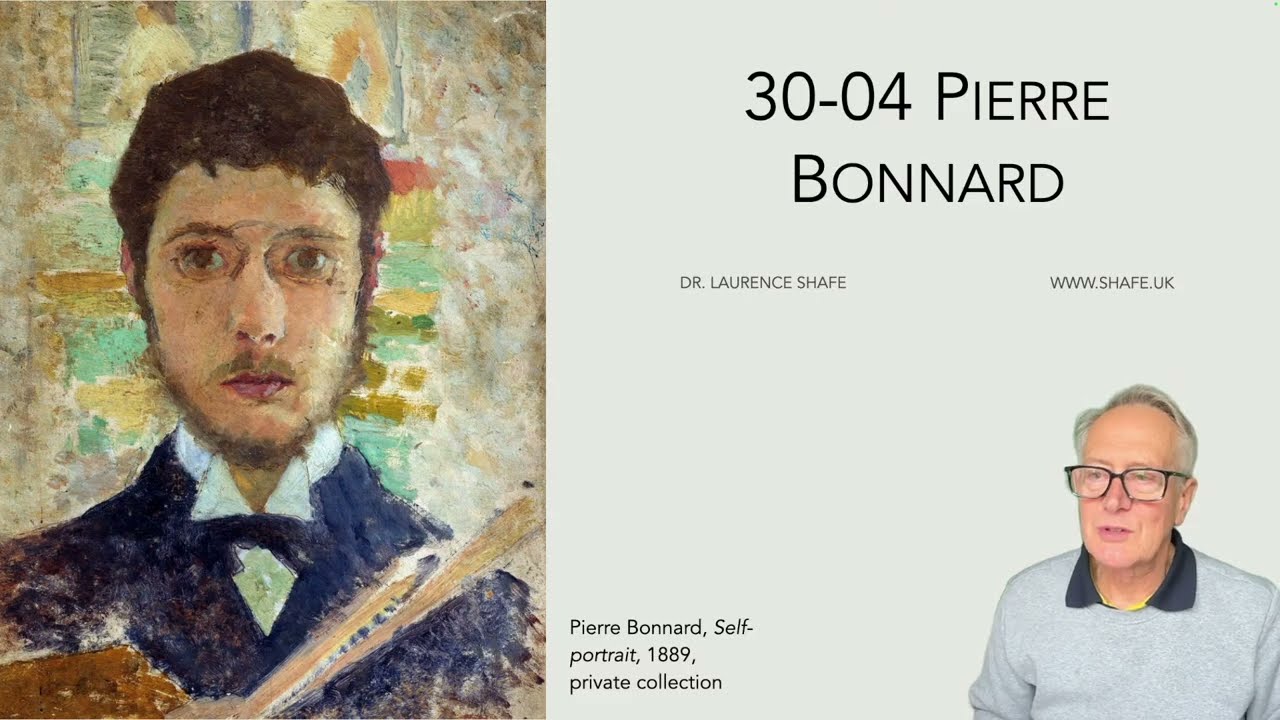
A discussion on Post Impressionism 1880-1905 created by Google Notebook from my notes:
Beyond the Canvas: 5 Surprising Truths About the Painter of Joy, Pierre Bonnard
Introduction: The Painter You Thought You Knew
Pierre Bonnard is celebrated as a master of radiant color and light, an artist who captured the serene joys of French bourgeois life with unparalleled intimacy. His canvases are sun-drenched interiors, quiet moments at the breakfast table, and lush, blossoming gardens. We think of him as the painter of domestic tranquility, a world where every view from a window seems bathed in a warm, perpetual summer glow.
But behind these seemingly simple depictions of a comfortable life lies a world of surprising complexity. Bonnard’s artistic process was counter-intuitive, his personal life was shrouded in secrets, and his most famous subjects hide layers of profound, often sorrowful, meaning. The painter of joy was also a painter of memory, obsession, and hidden truths. To truly appreciate his work is to look beyond the dazzling surface and understand the unconventional realities that shaped it.
Here are five of the most impactful and unexpected facts about Pierre Bonnard, each one a key to unlocking a deeper understanding of his art.
1. He Began His Career as a Lawyer, Not an Artist
It may be hard to imagine the creator of such emotionally rich and visually inventive canvases in a courtroom, but Pierre Bonnard’s first career path was in law. Encouraged by his father, a senior official in the Ministry of War who desired a secure profession for his son, Bonnard studied at the Sorbonne and qualified as a lawyer in 1888.
Even while pursuing his legal studies, however, his true passion was simmering. Bonnard simultaneously attended art classes at the Académie Julian, where he fell in with a group of avant-garde artists who would become known as Les Nabis. The name, meaning “prophets” in Hebrew, reflected their revolutionary ambition to create a new artistic vision, emphasizing color and symbolism over realism. They saw themselves as the “prophets of modern art,” and Bonnard was one of their own. He only fully committed to this life after the commercial success of a poster he designed helped convince his family that his creative talents could provide a viable living.
This early detour from art into the structured world of law highlights a quiet determination. Bonnard chose the uncertainty of the studio over the security of a legal practice, a decision that underscores the powerful creative drive that would define his entire life.
2. His Lifelong Muse Kept a Profound Secret for 30 Years
Marthe de Méligny is the face and figure that appears in hundreds of Bonnard’s paintings, his constant muse and lifelong partner. But the woman he painted with such intimacy was not who she claimed to be. When they met in 1893, she told Bonnard she was an orphan of 16. It was not until they married, over 30 years later, that he discovered the truth: her real name was Maria Boursin, and she had actually been 24 years old when they met.
This lifelong deception was just one facet of a deeply private and troubled personality that would come to define their shared existence. Marthe was a reclusive and anxious figure, a “compulsive washer” who was “completely anti-social.” Their life together grew intensely isolated. In a letter to a friend, Bonnard captured the extent of their seclusion:
‘For quite some time now I have been living a very secluded life as Marthe has become completely anti-social and I am obliged to avoid all contact with other people.’
This hidden history, however, was further complicated by Bonnard’s own affairs with Renée Monchaty and Lucienne Dupuy de Frenelle. The relationship with Monchaty ended in tragedy; shortly after Bonnard finally married Marthe in 1925, Monchaty committed suicide, a loss that haunted the artist for years. Knowing this casts his paintings in a new light. The quiet domestic scenes are not just portraits of a secret world, but artifacts of a life filled with enduring love, profound sorrow, and irresolvable conflict.
3. His Vivid Scenes Were Painted Entirely From Memory
Looking at a Bonnard painting, with its seemingly spontaneous capture of light and atmosphere, it is natural to assume he worked directly from life, with an easel set up in the corner of a room. The reality is the complete opposite. Bonnard worked almost exclusively from memory.
His method was unique. He would observe a scene, make quick drawings or sketches, sometimes take amateur photographs, and jot down notes about the colors. He would then retreat to his studio to reconstruct the scene on canvas. He was not interested in creating a factual record of a moment, but in capturing the feeling of it. As he explained his process:
‘I take notes. Then I go home. And before I start painting I reflect, I dream.’
This is a crucial insight into his work. A perfect example is his 1908 painting, The Bathroom. At first glance, it is a simple domestic scene. But a closer look reveals the strange magic of his method: the reflection of Marthe in the mirror shows her both frontally and turned, as if captured in different moments at once, while a chair reflected in the same mirror doesn’t even exist in the room itself. Bonnard’s paintings are not snapshots of reality. They are subjective reconstructions of sensation, memory, and emotion, where perspective shifts and time bends to serve the heart, not the eye.
4. A Champagne Advertisement Launched His Career
Bonnard’s entry into the Parisian art world wasn’t through a grand salon painting, but through a popular and commercial medium: the advertising poster. In 1891, his color lithograph France-Champagne, commissioned by a champagne company, became a sensation on the streets of Paris. This vibrant, eye-catching work, with its bold outlines and flat planes of color, showed the clear influence of Japanese woodcut prints—a hallmark of the “Japonism” movement—and launched his career.
The innovation and artistic flair of his poster designs had an immediate and powerful impact. In fact, his work in this medium directly inspired another legendary artist, Henri de Toulouse-Lautrec, to begin creating posters himself.
This intersection of commerce and fine art was vital to Bonnard’s development. By working in a popular medium, he helped democratize his art, bringing his unique vision out of the exclusive gallery and into the public sphere, proving that great art could be found in the most unexpected places.
5. His Famous Bathing Nudes Hide a Private Struggle
Among Bonnard’s most iconic works are the numerous paintings of Marthe in her bath. These luminous, intimate scenes are often seen as celebrations of the female form and quiet domesticity. However, they are rooted in a private and obsessive ritual born of suffering.
This obsessive, hours-long bathing ritual was no simple indulgence; it was rooted in a profound struggle with chronic ailments, possibly tuberculosis (for which water therapy was a common treatment) or a severe obsessive neurosis. Bonnard took this deeply personal, near-ritualistic obsession and transformed it into a central theme of his art.
While many of these paintings are beautiful, some carry a profound sense of sorrow. In his 1925 work, The Bath, he paints Marthe—then in her mid-fifties—with the body of a young woman, filtering her present suffering through the lens of his own idealized memory. The effect is haunting, as described in one analysis:
The effect is strangely lifeless, and almost tomb-like; as if the painting were a silent expression of sorrow for Marthe’s plight.
These famous works are therefore far more than simple nudes. They are complex meditations on fragility, ritual, and a deep, complicated love that endured through decades of physical and psychological struggle.
Conclusion: A More Complex Radiance
The familiar, joyful surface of Pierre Bonnard’s art is immeasurably enriched by understanding the complex and sometimes sorrowful realities of his life and methods. His radiant interiors were not painted from life but dreamed up from memory; his greatest muse harbored a lifelong secret within a relationship scarred by tragedy; and his most serene images often conceal a private pain. Knowing the hidden stories behind the canvas, does the light in his paintings now shine with a different, more profound, and perhaps even more human, glow?
30-05 The Short Life of Amedeo Modigliani
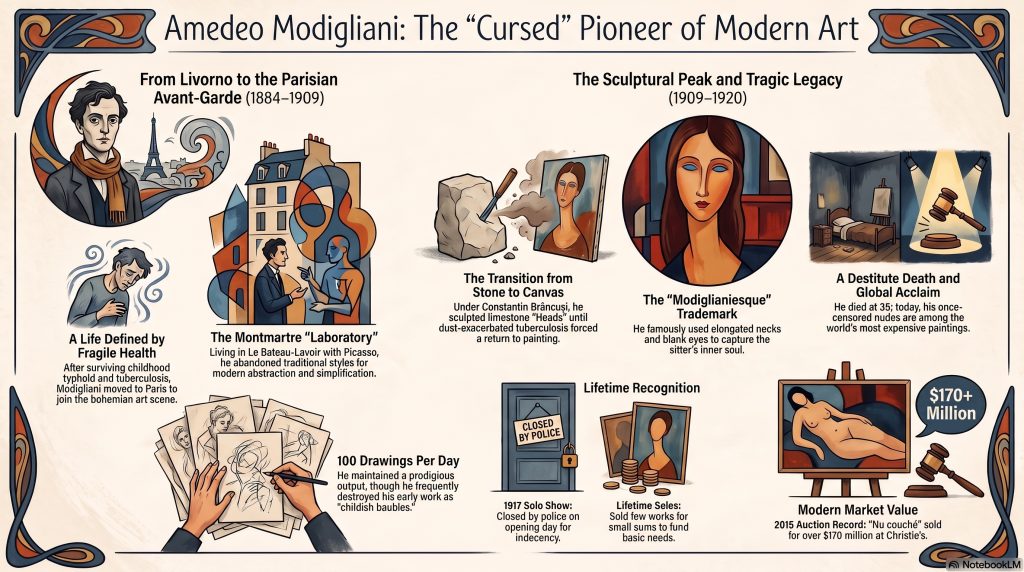
This talk provides a biographical and artistic study of Amedeo Modigliani, a pivotal figure in twentieth-century modern art. The materials chronicle his early life in Italy, his struggles with chronic illness, and his eventual move to the bohemian districts of Paris. Readers can explore how he evolved from a classically trained student into a distinguished figurative artist, influenced by peers like Picasso and Cézanne. The talk also details his notorious lifestyle, including his battles with addiction and his tragic death at thirty-five. The talk highlight his creative legacy, specifically his iconic nudes and the unique, elongated style that defines his portraiture. Modigliani’s story is presented as a blend of artistic genius and personal hardship within the vibrant avant-garde community.

A conversation about Amedeo Modigliani created by Google Notebook from my notes:
The Hook: The Legend of “Modi”
In the high-stakes world of modern art auctions, the name Amedeo Modigliani is a hallmark of staggering wealth. In 2015, his masterpiece Nu couché realized over $170 million, an amount that would have been unimaginable to the man who once lived in the ramshackle, “beehive” studios of La Ruche. To his contemporaries, he was known as “Modi”—a dark pun on the French peintre maudit, or “cursed painter.” He lived as a destitute, drug-fueled vagabond in the streets of Paris, driven by a philosophy of systematic disorder. Yet, behind the elongated necks and blank eyes of his portraits lies a story of a man who chose a life of defiance not out of mere rebellion, but as a prerequisite for his art.
A Miraculous Entrance: The Ancient Law and the Bed That Saved a Family
Modigliani’s dramatic existence began with a literal act of preservation. Born in 1884 in Livorno, Italy, he arrived just as his father’s business collapsed into bankruptcy. His family was saved from total ruin by an ancient Italian law that prohibited creditors from seizing the bed of a pregnant woman or a mother with a newborn child. As bailiffs entered the home to claim their debts, the resourceful Modigliani family piled their most valuable assets onto his mother Eugenia’s bed while she was in labor. This striking entry into the world foreshadowed a life where art, survival, and the constant threat of loss were inextricably linked.
The Intellectual Rebel: Nietzsche’s “Superman” and the Rejection of the Bourgeoisie
Modigliani was far more than a simple bohemian; he was a deeply intellectual rebel who wore his heritage as a badge of outsider status. When the painter Nina Hamnett first met him in 1914 at the Café de la Rotonde, he introduced himself with a proud, defiant simplicity: “Modigliani, painter and Jew.”
This sense of identity was shaped by his Sephardic Jewish roots and his obsession with Friedrich Nietzsche’s Thus Spoke Zarathustra. As a young student, his teacher nicknamed him “Superman” for his constant quoting of Nietzsche. Modigliani believed the artist was a higher being exempt from common morality, a “chrysalis” for a creator who had to shed his past to emerge. Upon moving to Paris, he systematically destroyed his early work, dismissing it as “childish baubles, done when I was a dirty bourgeois.” His mother had sensed this transformation years earlier, writing in her diary when he was eleven:
“We shall have to wait and see what is inside this chrysalis. Perhaps an artist?”
A Cloak of Excess: Hiding the Stigma of the “White Plague”
There was a tragic, counter-intuitive reason behind Modigliani’s legendary substance abuse. He suffered from tuberculosis—the “white plague”—from the age of sixteen. In early 20th-century Paris, the disease carried a devastating social stigma; because it was contagious and incurable, sufferers were often pitied and ostracized.
Modigliani used alcohol and drugs, including absinthe, hashish, and cocaine, as palliatives to dull his physical pain and, crucially, to mask his symptoms. By maintaining an “appearance of vitality” through intoxication, he avoided being shunned as an invalid. The irony was fatal: the very substances he used to stay connected to his social world accelerated his early death. As one contemporary observed:
“He was a pedestrian when sober but a master of living art when drunk.”
Carving the “Temple of Beauty”: Stolen Stone and the Sculptural Spirit
Before he became the painter we recognize today, Modigliani was a sculptor. Encouraged by the ambitious dealer Paul Guillaume, who introduced him to Constantin Brâncuși, Modigliani sought to create a new sculptural language influenced by African and Egyptian forms. He envisioned his carved heads as “columns of tenderness” for a never-realized “temple of beauty.”
His dedication to the stone was obsessive and eerie. The sculptor Jacob Epstein recounted how Modigliani would “find” (steal) limestone from building sites and, at night, place candles on top of his carved heads, affectionately embracing them while under the influence of hashish. By 1914, however, he abandoned sculpture. The stone dust was lethal to his failing lungs, and materials were scarce due to the war. Yet, the sculptural influence remained; the elongated faces and swan-like necks of his carvings became the “Modiglianiesque” hallmark of his later paintings.
The Gaze Inward: The Pierrot and the Philosophy of the “One Eye”
Modigliani’s portrait style is instantly recognizable for its simplification and its use of blank or single eyes. He famously struggled with the “all-embracing light” of Paris, which his “Italian eyes” found difficult to adapt to, leading him to adopt a specific palette of violet, deep orange, and ochre.
He often saw himself as a tragic, theatrical figure, most notably in his self-portrait as a Pierrot clown. Rather than seeking photographic realism, he sought an “essential likeness” of the inner soul. When a sitter once asked why he had only painted one eye, Modigliani offered his defining artistic philosophy:
“Because with one eye you look at the world, with the other you look into yourself.”
The Final Sacrifice: The Devotion of Jeanne Hébuterne
The most haunting chapter of Modigliani’s life is its end. In 1917, he met 19-year-old art student Jeanne Hébuterne. Despite her Roman Catholic family’s fierce objections, she became his devoted companion and the mother of his daughter, also named Jeanne.
Modigliani died on January 24, 1920, at the age of 35 from tubercular meningitis. He died destitute, but his funeral was a massive event attended by the entire artistic community of Paris. The tragedy did not end there; Jeanne Hébuterne, eight months pregnant with their second child, threw herself from a fifth-floor window the following day. It took a decade for her family to allow her body to rest beside his. Their shared grave in Père Lachaise carries two epitaphs:
- His: “Struck down by Death at the moment of glory.”
- Hers: “Devoted companion to the extreme sacrifice.”
The couple’s daughter, Jeanne Modigliani, was later adopted by the artist’s sister and eventually wrote the definitive biography, Modigliani: Man and Myth, finally closing the loop on her parents’ turbulent history.
Conclusion: Struck Down at the Moment of Glory
Since his death, Amedeo Modigliani’s reputation has undergone a total metamorphosis, transitioning him from a “cursed painter” to one of the most significant figurative artists of the 20th century. His life has been the subject of nine novels and multiple films, while his work fetches record-shattering prices in the very galleries that once would have shunned him.
As we view his “columns of tenderness” in museums today, we are left to wonder: Could Modigliani’s art have achieved such heights of emotional intensity without the “defiance and disorder” that both defined his genius and demanded his life?