Aestheticism was the dominant avant-garde tendency in British art and culture of the 1870s and 1880s, united by the conviction that art’s only purpose was the creation of beauty and that moral, social, or narrative content was an irrelevance or a distraction. Its slogan — “Art for Art’s Sake” — was borrowed from French critics and championed in England by Walter Pater, James McNeill Whistler, and Oscar Wilde. Whistler’s “arrangements” and “nocturnes” — paintings named after musical forms rather than their subjects — pushed the idea of pure aesthetic experience to its limit, reducing painting to a harmony of tone and colour with almost no literary content. The movement had strong connections to Japanese art, whose formal qualities — flatness, asymmetry, decorative refinement — offered an alternative to the representational conventions of western painting. Aestheticism established principles — the autonomy of art, the primacy of formal beauty, the irrelevance of narrative — that would prove foundational to the art of the twentieth century.
“Art for Art’s Sake” — A New Philosophy of Beauty: The Aesthetic movement rejected the prevailing Victorian belief that art existed to instruct, improve, or moralise. Beauty, argued its champions, was its own justification: a work of art needed no purpose beyond the pleasure it gave to the senses. This was a radical idea in an age of earnest social purpose, and it generated fierce controversy — most famously in Whistler’s libel trial against John Ruskin in 1878.
Whistler and the Art of Pure Tone: James McNeill Whistler (1834–1903) was the movement’s most radical visual practitioner. His Nocturne in Black and Gold: The Falling Rocket (c. 1875) — a shimmering impression of fireworks over the Thames — provoked Ruskin’s famous accusation that Whistler was “flinging a pot of paint in the public’s face.” In Whistler’s work, subject matter retreats entirely: what remains is pure tone, atmosphere, and the act of seeing.
Japanese Influence and the Peacock Room: The Aesthetic movement was deeply influenced by Japanese art, which had become widely available in Europe after the opening of Japan to trade in 1854. Japanese woodblock prints, ceramics, and lacquerwork offered a model of formal sophistication utterly different from the Western tradition — flat, asymmetrical, decorative, with no interest in the illusion of depth. Whistler’s famous Peacock Room, created for a London merchant’s house in 1876–77, is a supreme example of this japoniste aesthetic.
Oscar Wilde and the Aesthete as Performance: Oscar Wilde made himself the public face of Aestheticism, his carefully cultivated persona — long hair, velvet jacket, lilies and sunflowers — a performance of aesthetic refinement designed to shock bourgeois respectability. His lecture tour of America in 1882 spread Aesthetic ideas across the Atlantic. His plays and essays articulated the movement’s philosophy with devastating wit: “The only excuse for making a useless thing is that one admires it intensely.”
Albert Moore and Decorative Harmony: Albert Moore (1841–1893) was perhaps the purest exponent of Aestheticism in British painting. His canvases showed groups of loosely draped women arranged in subtle harmonies of colour, absorbed in doing almost nothing — sleeping, fanning themselves, reading. Subject matter is entirely suppressed in favour of formal and chromatic arrangement. Moore’s work is the visual equivalent of Pater’s famous statement that all art constantly aspires to the condition of music.
Legacy — The Roots of Modernism: Aestheticism’s insistence on the autonomy of art from social function, its emphasis on formal qualities over narrative content, and its openness to non-Western visual traditions all became foundational principles of twentieth-century modernism. Whistler’s influence on Impressionism, Post-Impressionism, and eventually abstract painting is clear. In arguing that beauty needed no justification beyond itself, Aestheticism prepared the ground for the entire modern movement.
28-01 Aesthetic Movement to Degeneration Part 1
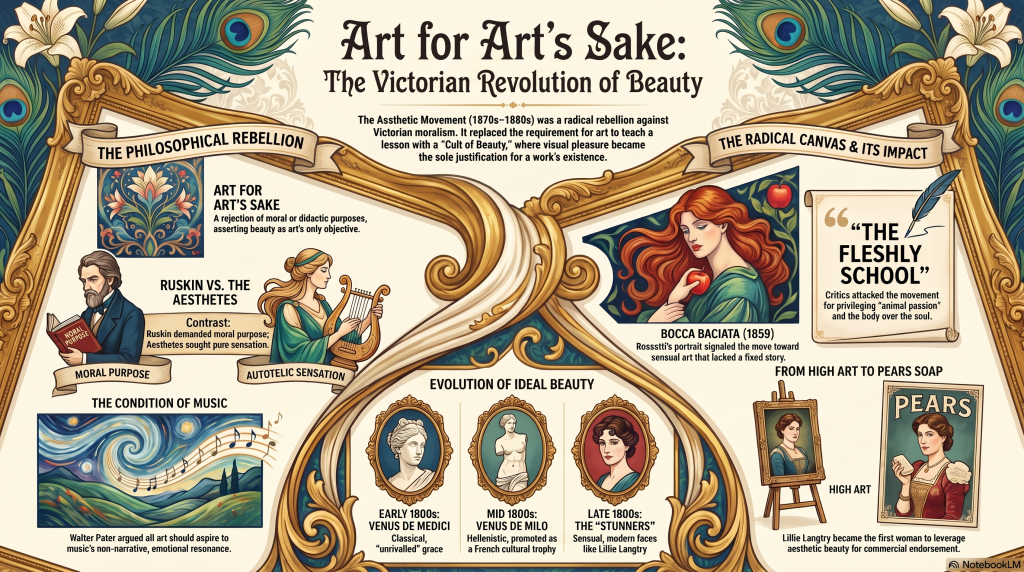
This lecture traces the Victorian obsession with beauty from the acquisition of the Venus de Milo through the Aesthetic Movement’s core conviction that art needs no moral justification beyond itself. Beginning with how France cynically promoted its new marble trophy after losing the Medici Venus, the talk follows beauty’s migration into drawing rooms and shop windows, then into the studios of Rossetti, Albert Moore, and Leighton. Pater’s prose, Swinburne’s criticism, and Whistler’s manifestos supplied the philosophical scaffolding, while Buchanan’s attacks and Nordau’s theory of degeneration remind us that beauty in Victorian culture was always a battleground, never a refuge.
(My YouTube talk will be published on 05 June 2027)
My notes on Aesthetic Movement to Degeneration Part 1
An entertaining conversation about Aesthetic Movement to Degeneration Part 1 created by Google NotebookLM from my notes:
We tend to think of the Victorians as buttoned-up moralists. But dig into the art world of the 1870s and 1880s and you find something far stranger: a fierce, scandalous, surprisingly modern battle over whether beauty needs to justify itself at all.
Here are the most counter-intuitive takeaways from Dr. Laurence Shafe’s lecture on the Aesthetic Movement.
The Venus de Milo Was a Political Stunt
When a new statue turned up on the island of Milos in 1820, French authorities declared it a superior masterpiece — before they had properly examined it. When they did, they found an inscription identifying the sculptor as Alexandros of Antioch, not the celebrated Praxiteles. The plinth quietly disappeared and has never resurfaced.
“France needed a trophy, and beauty was declared accordingly.”
Beauty, even in marble, is partly a press release.
“Art for Art’s Sake” Was Once Radical — Then Reactionary
The slogan entered English in 1868 as a deliberate rejection of Ruskin’s insistence that art must serve moral ends. A century later, Marxist art historians condemned the same idea as politically reactionary. The identical phrase had flipped its ideological charge entirely depending on which establishment it was challenging.
Rossetti’s Most “Aesthetic” Painting Is Full of Hidden Symbolism
Bocca Baciata (1859) is often called the first painting of the Aesthetic Movement — celebrated for making no moral argument. Yet Rossetti loaded it with marigolds (grief), an apple (the Fall), and a sitter whose averted expression reads less like passive object and more like a woman with agency.
A painting supposedly about nothing turns out to be about everything.
Acceptable Nudity Followed Strict Unwritten Rules
Victorian nudes required classical framing, marble-like skin, passive posture, and no identifying marks. Albert Moore painted on coarse canvas so his figures read as pigment, not flesh — ensuring the image looked like the picture of a woman rather than a woman herself.
When Manet broke every rule with Olympia, critics called his model “a female gorilla.” Watts painted equally thin figures in London and faced no fury — his social reputation protected him.
The Peacock Was Darwin’s Problem Too
The peacock feather became the emblem of Aestheticism, but it carried scientific weight: critics repeatedly cited the tail as evidence against natural selection. Meanwhile, Ruskin — experiencing acute mental episodes by 1878 — was hallucinating the peacock as the Devil incarnate.
“I heard the voice of the Demon — that is, the peacock — give forth a loud croak of triumph.”
The bird Aestheticism revered, Ruskin’s fractured mind condemned.
The Man Who Coined “Degenerate Art” Was Fighting Antisemitism
Max Nordau’s 1892 Degeneration diagnosed the Pre-Raphaelites as the original degenerate artists. Yet Nordau was also a co-founder of the World Zionist Organisation who explicitly condemned antisemitism. His framework was later appropriated by the very movements he opposed.
The vocabulary of moral panic rarely stays where its inventors intended.
*Flaming June* Sold for $1,000 Because Nobody Wanted It
In 1963, Puerto Rican industrialist Luis Ferré found Leighton’s masterpiece abandoned in an Amsterdam gallery. The owner said it was too old-fashioned. Ferré spent a sleepless night worrying the owner wouldn’t keep his word, wired the money, and took it to the Museo de Arte de Ponce, where it remains.
A Final Question Worth Sitting With
The Aesthetic Movement insisted beauty needs no justification. Its critics insisted beauty without moral purpose corrupts. Neither side fully won.
If beauty truly is its own justification — what does that say about what we choose to find beautiful?
28-02 Aesthetic Movement to Degeneration Part 2

This talk traces the Aesthetic Movement through its most combative personalities and darkest anxieties. Whistler’s etchings, nocturnes, and libel trial against Ruskin redrew Victorian critical authority, while the Peacock Room embodied his doctrine of artistic autonomy pursued at personal cost. The Grosvenor Gallery challenged Royal Academy dominance, championing women and avant-garde artists. Burne-Jones absorbed Pater’s musical ideal in monumental canvases. Punch cartoons and Gilbert and Sullivan’s Patience savaged aesthetic pretension. Finally, Beardsley, Wilde’s prosecution, and Max Nordau’s degeneration theory reveal how evolutionary anxiety and cultural conservatism ultimately overwhelmed a movement that had made beauty its sole justification.
(My YouTube talk will be published on 12 June 2027)
My notes on Aesthetic Movement to Degeneration Part 2
An entertaining conversation about Aesthetic Movement to Degeneration Part 2 created by Google NotebookLM from my notes:
We imagine the Victorians as buttoned-up and conventional. But scratch the surface of their art world and you find feuding egos, courtroom theatre, a teapot that quotes Darwin, and a room repainted without permission that now sits in Washington D.C. Here are the most counter-intuitive takeaways from the Aesthetic Movement’s combative second act.
Whistler’s Most Famous Trial Was Really About Who Gets to Define Art
When John Ruskin accused Whistler of “flinging a pot of paint in the public’s face” over a nocturne priced at 200 guineas, Whistler didn’t shrug it off — he sued for libel. At trial, Ruskin’s side argued price should reflect hours worked. Whistler’s reply became one of art history’s most quoted lines:
“No, I ask it for the knowledge I have gained in the work of a lifetime.”
Victorian convention previously meant critics simply ignored work they disliked. Whistler forced them into the open — and permanently changed the rules of engagement between artists and critics.
The Peacock Room Was Painted Without Permission — and the Architect Went Insane
Whistler was asked to make minor adjustments to shipping magnate Frederick Leyland’s dining room. Instead, he repainted the entire interior in iridescent blue-green and gold leaf, covering priceless 16th-century leather wall hangings brought to England as part of Catherine of Aragon’s dowry. Leyland paid him half the agreed fee. Whistler retaliated by painting two fighting peacocks on the shutters, labelling it Art and Money: or, The Story of the Room. The original architect, Thomas Jeckyll, was so shocked by the sight of his destroyed scheme that he never recovered and died insane three years later.
A Teapot Connected Oscar Wilde to Charles Darwin
A Royal Worcester novelty teapot from 1882, cashing in on Gilbert and Sullivan’s Patience, bears this inscription on its base: “Fearful Consequences Through the Laws of Natural Selection and Evolution of Living Up to One’s Teapot.” The “living up to one’s teapot” references Wilde’s Oxford boast about his blue china. The Darwin graft reveals how thoroughly evolutionary thinking had entered popular culture — and hints at the darker “degeneration” anxieties that would consume the decade’s end.
The Grosvenor Gallery Was Destroyed by an Affair
Sir Coutts Lindsay founded the Grosvenor Gallery in 1877 as a radical alternative to the Royal Academy — hanging works individually with breathing space, championing women artists, and launching Burne-Jones, Whistler, and Watts to fame overnight. A quarter of its 1,028 exhibitors over fourteen years were women. But Lady Blanche Lindsay had known of her husband’s mistress since 1869. She finally acted in 1882, withdrawing her money and reputation. The gallery closed in 1890, leaving Coutts with an overdraft of £110,000.
Burne-Jones’s Greatest Painting Was Catastrophically Damaged at Christie’s — and Secretly Repainted
The Last Sleep of Arthur in Avalon, over six metres wide, occupied Burne-Jones for seventeen years. He was still painting it the day before he died. When Christie’s offered it for sale in 1963, the unrolling went disastrously wrong: the heavy canvas tore, shed paint flakes across the floor, and briefly engulfed Christie’s chairman. Critic Brian Sewell spent thirty hours secretly repainting the flowers alongside a restorer before the sale proceeded — without disclosure. When Sewell saw it again in 2009, he could not determine whose hand had painted what.
“Degeneration” Was Theorised by a Zionist Jew — Then Weaponised by the Nazis
Max Nordau’s 1892 book Entartung attacked the Aesthetic Movement and the Impressionists as products of mental illness and racial decline, drawing on criminologist Cesare Lombroso’s pseudo-science. Nordau was himself Jewish and a co-founder of Zionism. His framework was later adopted wholesale by the Nazis as Entartete Kunst — degenerate art — to justify book-burning and the dismissal of artists from teaching posts. The same theory used to attack Whistler and Rossetti became the engine of fascist cultural purging.
The Aesthetic Movement began as a declaration that beauty needed no justification. It ended with a libel trial, a bankruptcy, an imprisonment, and a word — degenerate — weaponised beyond anything its original theorists imagined. Which raises the question worth sitting with: when a culture grows afraid of its own avant-garde, what does that fear actually reveal about itself?
28-03 The Aesthetic Movement 1860-1890
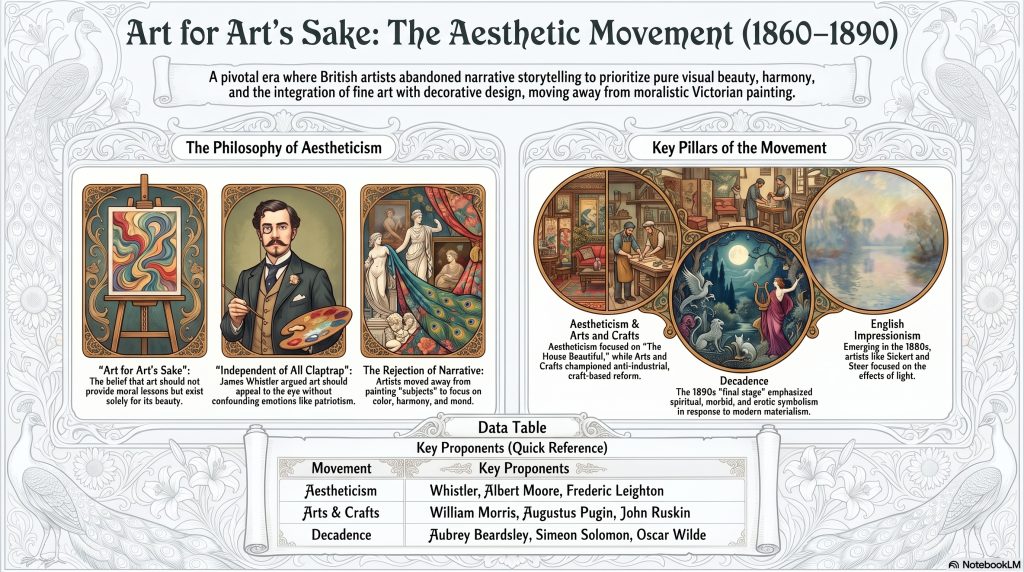
The talk is an overview of the Aesthetic Movement and its associated styles in Britain between 1860 and 1890. Central to this period was the concept of “art for art’s sake,” a philosophy that prioritized the creation of beauty over the traditional delivery of moral or narrative lessons. The text details how this movement diverged from the didactic views of John Ruskin and eventually evolved into the Decadent phase of the 1890s. Furthermore, the material explores the significant cross-cultural influence between French and British artists, highlighting the rise of English Impressionism and Naturalism. Key figures such as James McNeill Whistler, Albert Moore, and Jules Bastien-Lepage are showcased to illustrate these shifting artistic values. Finally, the collection highlights the role of institutions like the Tate Britain and the New English Art Club in preserving and promoting these diverse aesthetic transitions.
My notes on The Aesthetic Movement 1860-1890
An entertaining conversation about the Aesthetic Movement created by Google Notebook from my notes:
Why Must Art Have a Message?
When we stand before a canvas in a modern gallery, our first instinct is often to play the detective. We search for a hidden narrative, a social commentary, or a moral lesson. What is the artist trying to teach us? This impulse is a heavy inheritance from the Victorian era. Under the stern guidance of John Ruskin, the mid-19th century viewed art as a primary tool for moral instruction. Ruskin even championed the “Theoretic” faculty—a way of seeing beauty not as a sensual pleasure, but as something moral and transcendental.
However, between 1860 and 1890, a radical disruption occurred. The Aesthetic Movement—famously known as the “Cult of Beauty”—dared to suggest that art had no duty to improve our souls. It boldly asserted that art’s sole justification was its own beauty. To the Victorian establishment, this was more than a change in style; it was a revolution of the senses.
1. Art for Art’s Sake: The Radical Act of “Doing Nothing”
The core philosophy of the movement, “Art for Art’s Sake,” was not merely a tagline; it was a shared view of the role of art in society. In an age that demanded every painting tell a story or champion a virtue, the refusal to “mean” anything was a radical act. This shift stripped away what James McNeill Whistler called “claptrap”—the emotional and patriotic hooks used to manipulate the viewer’s feelings.
“Art should be independent of all claptrap —should stand alone […] and appeal to the artistic sense of eye or ear, without confounding this with emotions entirely foreign to it, as devotion, pity, love, patriotism and the like.” — James McNeill Whistler
This rejection of narrative explains why artists like Albert Moore remain relatively obscure today. Moore was a pioneer who painted “without a subject,” focusing on decorative arrangements of figures and harmony of color. Because his work lacked a clear “point,” contemporary critics often dismissed it as “trite.” They could not grasp that the absence of a moral lesson was, in itself, the movement’s most defiant statement.
2. When Fine Art Met the Teapot: The Birth of the “House Beautiful”
Aestheticism successfully demolished the wall between “high art” and interior design by championing the “autotelic” object—an item complete in itself, referring to no external story. This was the foundation of the “House Beautiful” movement. If a painting was a decorative object, then a teapot could be a work of art.
No one embodied this shift more than Christopher Dresser, the “father of industrial design.” While figures like William Morris looked backward to medieval crafts, Dresser looked toward a radical, abstract future. Influenced by “English Japanese” aesthetics, his metalwork was strikingly angular and prioritized plain, unadorned surfaces. This was a direct assault on the suffocating clutter of traditional Victorian decor. Dresser’s designs were so far ahead of their time—prioritizing geometry over organic flourish—that many were deemed impossible for mass production.
The poet Algernon Charles Swinburne, a perennial Nobel Prize nominee, captured this spirit perfectly when describing Moore’s work, a sentiment that applied to the entire Aesthetic home:
“Their reason for being is simply to be.”
3. The “Sly Trickster” Who Made Impressionism Palatable
While the movement conquered the home through the “House Beautiful,” it still had to win the battle of public opinion in the galleries. The bridge to modernism was built by an unlikely figure: Jules Bastien-Lepage. As the public recoiled from the “audacious humbug” of Claude Monet’s Impressionism, Bastien-Lepage offered a juste milieu—a middle way.
He combined the gritty realism of Jean-François Millet with the fleeting, scientific light of the Impressionists. He was so successful that one critic noted with a hint of exasperation: “The whole world paints so much today like Mr. Bastien-Lepage that Mr. Bastien-Lepage seems to paint like the whole world.”
To the purists, however, he was a “sly trickster who fakes naturalism in order to please.” By making a radical style ubiquitous and “safe,” he was accused of diluting the avant-garde. Yet, as the critic Roger Fry later noted, he provided the public with a “more acceptable route to Impressionism,” essentially tricking the Victorian eye into accepting the modern world.
4. From Radical to Reactionary: The Political Journey of Beauty
The Aesthetic Movement followed a curious political trajectory. In the 1870s, the “autonomy of art” was a radical demand for freedom from state and religious oversight. To choose beauty over a moral lecture was a claim to personal and artistic sovereignty.
However, the lens of history is fickle. By the 1970s, Marxist historians had rebranded the movement as “reactionary.” They argued that art always possesses a political role, and that the refusal to take a side is, in itself, a privileged political stance.
This journey concluded in the “Decadent” phase of the 1890s, led by figures like Aubrey Beardsley and Oscar Wilde. For them, the “autotelic” beauty of the previous decades became a weapon against “rampant materialism.” The beautiful object—be it a teapot or a poem—was no longer just an ornament; it was a spiritual escape from a modern world they found morally bankrupt.
5. The “Evil” Sunshine of Philip Wilson Steer
Perhaps the most startling truth is that a painting of pure sunshine could be labeled “evil.” This was the fate of Philip Wilson Steer’s Girls Running, Walberswick Pier (1888-94). To the casual observer, it is a carefree beach scene, but Steer’s Post-Impressionist technique created a deep psychological discomfort.
Steer utilized a “heavily worked paint surface” and a flat perspective that forced the viewer to confront the work as “paint on a flat surface” rather than a comfortable story. But the true unease lay in the details. Beneath the warmth of the afternoon light, there is a sense of claustrophobia. We see the two girls in the foreground, their hands parting in the shadow—a subtle, heartbreaking suggestion of a friendship breaking apart.
The long shadows stretching across the pier are not merely atmospheric; they suggest night falling and, metaphorically, death. By balancing precariously “between abstract pattern and profound meaning,” Steer proved that art doesn’t need a moral lesson to be haunting.
A Legacy of Pure Aestheticism
The Aesthetic Movement fundamentally altered the DNA of Western culture. By prioritizing the “artistic sense of eye or ear” over the didactic lecture, these artists paved the way for the total abstraction of the 20th century. They taught us that beauty is not a luxury or a mask for a message; it is its own excuse for being.
In our current age, where we are relentlessly bombarded by images designed to sell us a product, a lifestyle, or a political ideology, perhaps the movement’s most radical question remains: Is there still room in our lives for art that exists “simply to be”?
28-04 James McNeill Whistler
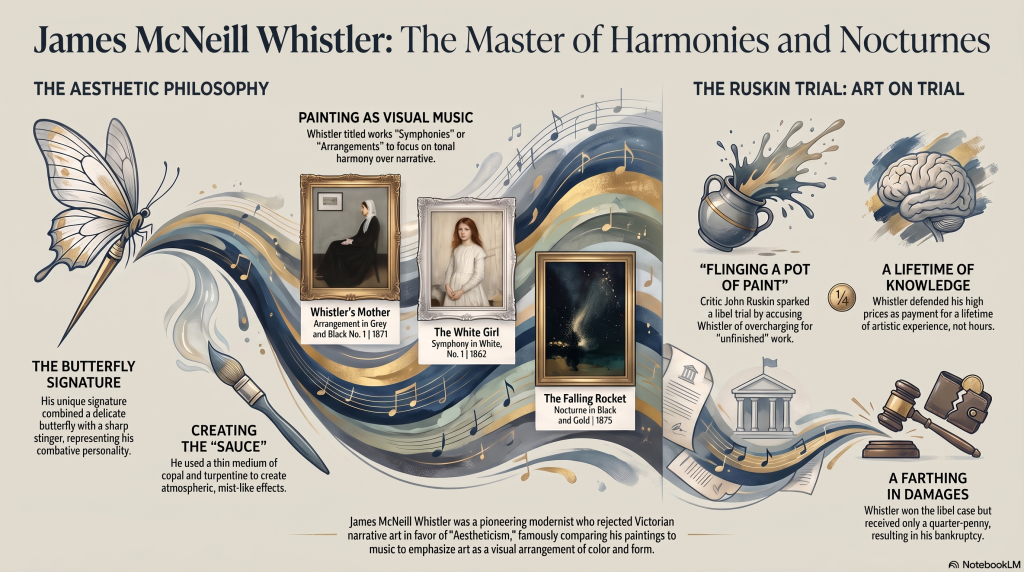
This talk provides a biographical and artistic overview of the American modernist James McNeill Whistler. The text highlights his leading role in the Aesthetic movement, where he prioritized “art for art’s sake” by emphasizing tonal harmonies and formal arrangements over traditional storytelling. Detailed descriptions of his most famous works, such as “Whistler’s Mother” and “The White Girl,” illustrate his radical use of near-monochromatic palettes and musical titling. The materials also recount his contentious personality, including his bankruptcy following a famous libel trial and his difficult relationships with critics and family. Collectively, these documents trace his journey from a rebellious student to a pioneering figure who fundamentally transformed nineteenth-century art.
(My YouTube video will be published 2 December 2026)
A discussion about Whistler created by Google NotebookLM:
For the modern viewer, the primary frustration with a gallery visit is the gnawing feeling of “not getting it.” We approach a canvas like a detective, hunting for a narrative, a moral, or a historical hook. When we find none, we feel cheated.
James McNeill Whistler—the original rebel of the Victorian art world—wanted to cure us of this habit. A Massachusetts-born dandy who traded West Point for the ateliers of Paris, Whistler spent his life on an aggressive aesthetic crusade to prove that art owes the viewer nothing but visual pleasure. The supreme irony, of course, is that the man who insisted paintings shouldn’t have “stories” led the most storied life of his era—a dramatic soap opera of bankruptcy, libel trials, and carefully curated bohemian dandyism.
Here are five lessons from the man who prioritized “harmonies” over “history.”
1. Paintings are Symphonies, Not Stories
Whistler revolutionized the gaze by treating his canvas “as musicians treat their instruments.” He famously rejected descriptive titles, opting instead for “arrangements,” “harmonies,” and “nocturnes.” This wasn’t a quirk; it was a radical attempt to prioritize tonal relationships over the anecdotal.
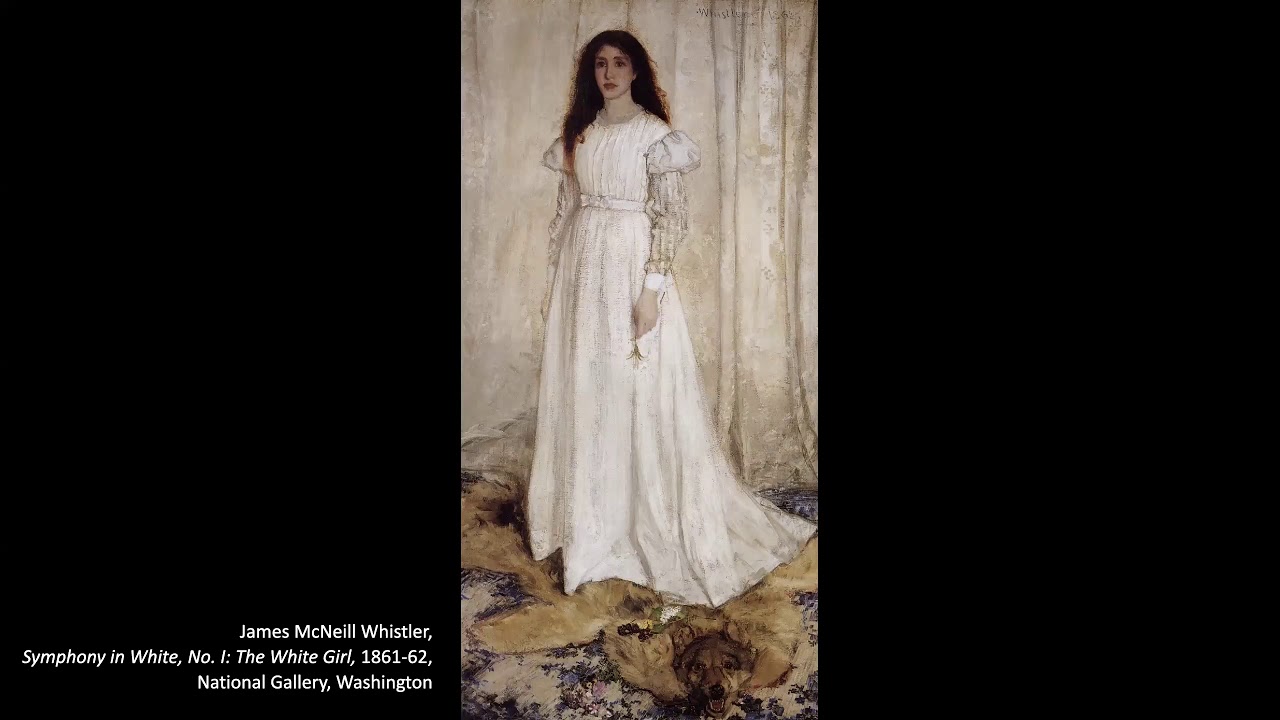
When he unveiled Symphony in White, No. 1: The White Girl, the confused Victorian gatekeepers searched frantically for a story of lost innocence in the model’s blank expression. Whistler was unmoved. He had specifically instructed his mistress, Joanna Hiffernan, to keep her face empty. To him, she wasn’t a person; she was a shade of white.
“By using the word ‘nocturne’ I wish to indicate an artistic interest alone, divesting the picture of any outside anecdotal interest. My aim is pure aesthetic experience—art for art’s sake.”
2. The Value of a Lifetime: Knowledge vs. Manual Labor
In 1878, Whistler engaged in a legendary libel trial against John Ruskin, the most powerful critic of the day. Ruskin had accused Whistler of “flinging a pot of paint in the public’s face” with his near-abstract Nocturne in Black and Gold: The Falling Rocket.
During the trial, Whistler even brought Nocturne: Blue and Gold – Old Battersea Bridge into court as evidence of his intent. When the opposition attorney mockingly asked if 200 guineas was a fair price for “two days’ work,” Whistler delivered the ultimate defense of the creative professional:
“I ask it for the knowledge I have gained in the work of a lifetime.”
His obsessive perfectionism proved this wasn’t mere talk. While he argued for the “spirit” of the work, his process was punishing. For his portrait of eight-year-old Cicely Alexander, he demanded over 70 sittings, each lasting several hours, until the child’s frustration was frozen into her expression forever.
3. Beyond Sentiment: The Geometry of “Whistler’s Mother”
We know it as a sentimental icon of motherhood, but Whistler titled it Arrangement in Grey and Black No. 1. His mother, Anna, was actually a last-minute replacement for a model who failed to show. Whistler was famously annoyed by the public’s emotional attachment to the sitter, viewing the work instead as a “composition of rectangles”—a radical formalist approach that anticipated the abstract modernism of Mondrian.
He didn’t care if the subject was his mother; he cared that the wall, the frame, and the footstool created a perfect geometric balance. His vision was eventually vindicated when the French government purchased the work for 4,000 francs in 1891, cementing it as a masterpiece of aesthetic theory.
4. The Butterfly with a Stinger: Branding the Ego
Whistler understood personal branding long before the digital age. His signature was a stylized butterfly, but a closer look reveals a sharp stinger. This symbol captured his dual nature: the extreme delicacy of his art versus his “stinging” personality. He once famously pushed his brother-in-law, Francis Seymour Haden, through a plate-glass window during a quarrel.
Interestingly, this famous “brand” was born from rejection. After a patron was offended by Whistler’s large, traditional signature on La Princesse du pays de la porcelaine, the artist evolved his mark into the subtle butterfly. It allowed him to maintain his presence without disrupting the “arrangement” of the canvas.
5. Bankruptcy as a Creative Lifeline
Whistler’s legal victory over Ruskin was a disaster. He was awarded a derisory “one farthing” in damages, and the legal costs forced him into bankruptcy. He was a broken man, losing his home and possessions at public auction.
Yet, this ruin forced him to Venice, where he revolutionized printmaking. Commissioned to produce just 12 etchings to save his finances, he stayed 14 months and produced over 50. Working with a special “sauce” medium of copal, turpentine, and linseed oil, he captured crumbling backstreets rather than grand monuments. He proved that the “sketchy” and “unfinished” could be the highest standard of brilliance, re-establishing his reputation through the sheer beauty of atmospheric decay.
Conclusion: The Birth of the Modern Gaze
James McNeill Whistler taught us that art does not owe the viewer a moral lesson or a clear plot. By stripping away the “story,” he forced us to finally look at the paint itself—the texture, the tone, and the harmony. He invented the modern gaze.
Today, as we stand before a canvas, we should remember Whistler’s courage. He stood his ground against critics and bankruptcy alike to defend a simple truth: that beauty is its own excuse for being. Can we finally look at a nocturne and be satisfied with the atmosphere alone?