Impressionism emerged in Paris in the 1860s when a group of young painters, rejecting the rigid conventions of the official Salon, began to paint outdoor scenes with rapid, visible brushstrokes that captured the fleeting effects of light and atmosphere. Led by Claude Monet, Édouard Manet, Pierre-Auguste Renoir, Camille Pissarro, and Edgar Degas, the Impressionists sought to record immediate visual sensation rather than carefully finished, idealised compositions constructed in the studio. Their landmark 1874 independent exhibition was met with ridicule—the very name Impressionism was coined as a sneer—but within two decades the movement had transformed the course of Western art. By breaking the tyranny of outline, dark shadow, and narrative subject matter, the Impressionists opened painting to the direct experience of light, colour, and modern urban and suburban life. This chapter introduces the major Impressionist painters through illustrated talks that explore their revolutionary techniques, key works, and enduring legacy.
27-01 Edouard Manet
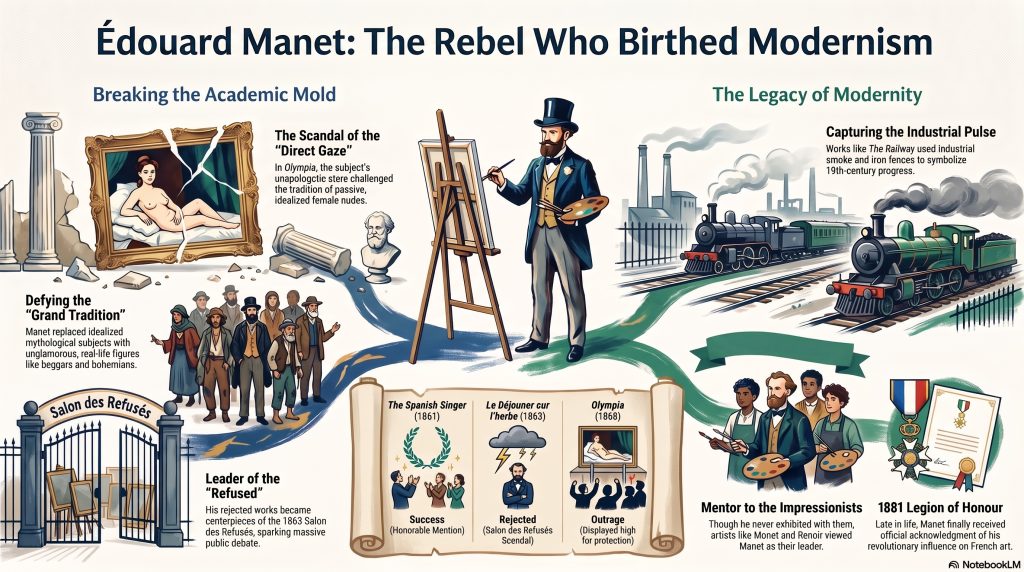
The talk examines the life and career of Édouard Manet, a pivotal 19th-century French artist celebrated as the father of modernism. Despite his wealthy upbringing and formal training under Thomas Couture, Manet broke from academic traditions to capture contemporary Parisian life with a bold, unidealized style influenced by Spanish masters like Velázquez. The sources detail his most significant and controversial masterpieces, including The Absinthe Drinker, The Spanish Singer, and Music in the Tuileries, while also addressing the scandals surrounding his famous nudes. Though he acted as a mentor to the Impressionists, Manet maintained a unique position in the art world by continuing to seek validation from the official Paris Salon rather than joining independent group exhibitions. The talk concludes by reflecting on his personal struggles with health, his secret family life with Suzanne Leenhoff, and his final artistic contributions before his death in 1883.
My notes on the talk about Édouard Manet
A conversation about Édouard Manet created by Google Notebook from my notes:
Édouard Manet occupies a paradoxical throne in art history. Widely regarded as the “Father of Modernism,” he was the man who effectively dragged French painting out of the stuffy, idealized past and into the grit of the 19th century. Yet, for all his radicalism, Manet was no self-styled anarchist. Born into a wealthy, well-connected Parisian family to a high-ranking civil servant, he spent his entire career desperately seeking the one thing that eluded him: the approval of the traditional art establishment.
His journey into the avant-garde was almost accidental, born of a stubborn commitment to depict “modern life” as it actually appeared. This commitment made him the most hated man in the Parisian art world for nearly a decade. When his masterpiece Olympia was finally displayed at the official Salon in 1865, the public’s vitriol was so physical and intense that the painting had to be hung high on the wall, out of arm’s reach, simply to protect the canvas from being attacked by outraged viewers.
Manet did not set out to destroy the rules; he simply insisted on looking the present directly in the eye. In doing so, he became a reluctant revolutionary—a man who wore a silk hat and sought the Legion of Honour while simultaneously painting the very scenes that would dismantle centuries of academic tradition.
The Shell-Shocked Mentor: Why the Avant-Garde Bowed to a Non-Joiner
It is a common misconception that Manet was an Impressionist. While he was the primary influence and mentor to young firebrands like Claude Monet and Pierre-Auguste Renoir, Manet never once exhibited at any of the independent Impressionist exhibitions. To his peers, he was the elder statesman who took the “hits” at the official Salon so they wouldn’t have to. He was a man who preferred the battleground of the Académie des Beaux-Arts, believing that true recognition could only be found within the establishment he was disrupting.
Stylistically, he also remained an “insider-outsider.” While he admired the Impressionists’ innovative use of light, his own work never fully abandoned the structure of the past. Manet’s paintings retained a strong attachment to classical composition and formal techniques, a choice that set him apart from the more experimental drift of his students. He was the bridge—using the bold brushwork of the future to frame the structured elegance of the past.
The Green Fairy and the Gritty Street: Making a King of a Beggar
To understand how Manet became the lightning rod for such vitriol, one must look back to 1859 and his first major strike against tradition, The Absinthe Drinker. At a time when “high art” was reserved for grand historical or mythological themes, Manet chose a subject from the margins: a well-known Parisian street character named Collardet. By painting a beggar alongside a glass of absinthe—the “green fairy” associated with the darker, bohemian side of Parisian life—Manet committed a radical subversion of decorum.
But the real “insider” scandal was in the composition. Manet wasn’t just painting a drunk; he was subverting the grand tradition of Spanish portraiture. By using the kingly, dramatic lighting and large-scale format usually reserved for Velázquez’s court figures, Manet gave the beggar a “quiet dignity” that the Salon found utterly inappropriate. Set against a plain, dark background, the figure’s isolation is palpable. Manet refused to sensationalize the madness of the drink; instead, he used a minimalist composition to emphasize modern isolation, proving that the street was as worthy of art as any Greek god.
The “Dirty Hands” of Olympia: A Trail of Scandalous Breadcrumbs
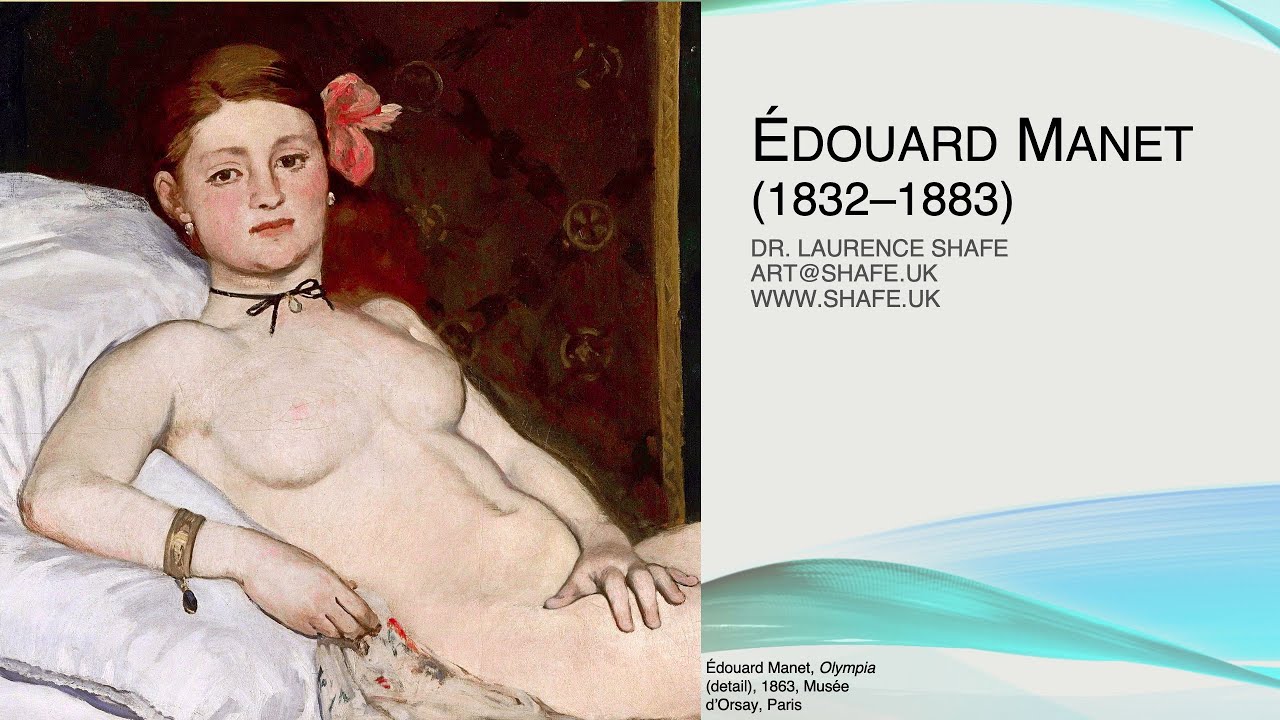
If the beggar was a nudge, the 1863/1865 period was a frontal assault. This was the era of the Salon des Refusés, an alternative exhibition created by Napoleon III to manage the sheer volume of artists rejected by the official Salon. It was here that Manet’s Le Déjeuner sur l’herbe first shook the public, but Olympia (1863) truly broke the world. Reinterpreting the classical reclining nude seen in Titian’s Venus of Urbino, Manet replaced the idealized goddess with a modern Parisian woman—the model Victorine Meurent, an artist in her own right—who looked back at the viewer with a cold, transactional stare.
The critics were ruthless, focusing on the perceived vulgarity of the subject.
“A courtesan with dirty hands and wrinkled feet lying on a bed between the sheets, looking like she’s about to invite you in.” — Paul de Saint-Victor
Manet laid a trail of breadcrumbs for the savvy Parisian viewer, using symbols that were coded signals for 19th-century sex workers: the ribbon around her neck, the flower in her hair, and a black cat with its back arched—a defiant, apprehensive replacement for the traditional dog of loyalty. Despite the scandal, the painting had its defenders, including Émile Zola, who recognized it as a bold, honest depiction of the contemporary world.
A Soap Opera in the Studio: The Piano Teacher and the Invented Father
Behind Manet’s public scandals lay a private life that would make a soap opera writer blush. In 1851, Manet’s domineering father hired a Dutch piano teacher named Suzanne Leenhoff to teach both Manet and his brother. In a move of incredible stealth, Manet maintained a secret romance with Suzanne under his father’s nose for an entire decade. It was only after his father’s death in 1862 that Manet finally married her.
The plot thickened with the birth of a son, Léon. Officially, Léon was introduced as Suzanne’s younger brother. The paternity was a minefield of rumor: while some believed the boy was Manet’s, a scandalous theory suggested he might have been the son of Manet’s own father. Tellingly, the father named on Léon’s birth certificate is thought to have been entirely invented. This personal history adds a layer of depth to works like Surprised Nymph (1861), which was modeled by Suzanne and inspired by Rembrandt’s Susanna and the Elders—a nod to her Dutch heritage and the hidden nature of their bond.
The Virtual War Correspondent: Painting an Unmistakable Accusation
Manet’s fascination with the modern didn’t stop at the cafe; he was a “virtual” war correspondent who painted battles from the headlines. He documented The Battle of the Kearsarge and the Alabama (1864) and The Execution of Emperor Maximilian (1868–1869) without ever leaving France, relying entirely on newspaper reports and engravings.
In his depiction of Maximilian’s execution, Manet took a sharp, unmistakable political jab at Napoleon III. Though the executioners were Mexican, Manet painted them wearing French uniforms—a direct accusation that French foreign policy was responsible for the Emperor’s death. While Goya’s The Third of May influenced the scene, Manet’s approach was fundamentally different. He eschewed Goya’s heroic drama for a “mechanical precision” and a cool, detached style that felt chillingly modern. It was the birth of the “objective” gaze in political art.
Conclusion: The Defiant Direct Gaze
Édouard Manet’s legacy is defined by his ability to fuse the technical mastery of the old world with the messy complexity of modern urban life. Even in his final years—battling partial paralysis and the late stages of syphilis—he produced masterpieces like A Bar at the Folies-Bergère, capturing the shifting fashions of Paris until the end.
When he died in 1883 at age 51, having finally received the Legion of Honour in 1879, he left behind an art world forever changed. He proved that being modern was not about abandoning the past, but about having the courage to apply the lessons of history to the unfiltered present.
If Manet were alive today, which “unfashionable” parts of our modern lives would he insist we look at until we found the beauty in them?
27-02 Claude Monet
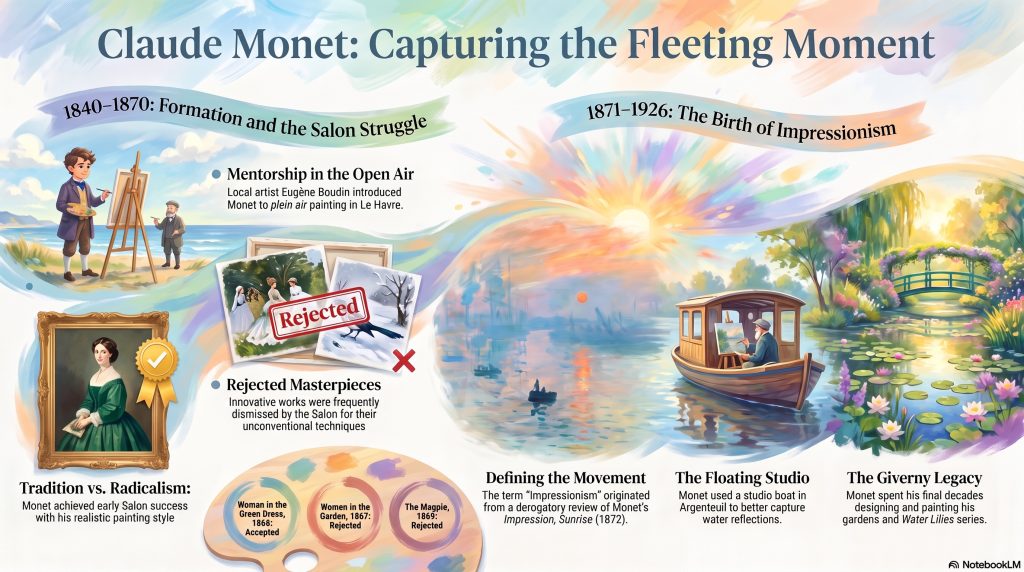
Claude Monet, a central figure of the Impressionist movement, is presented through a detailed exploration of his personal history and evolving artistic techniques. The talk highlight his early mentorship under Eugène Boudin, who introduced him to en plein air painting, and his subsequent relationships with fellow artists like Renoir and Pissarro. Significant early works such as The Woman in the Green Dress and Women in the Garden illustrate his transition from academic realism to a more radical focus on natural light and atmosphere. The text also examines the artist’s personal challenges, including financial instability and the loss of his first wife, Camille Doncieux, who served as his primary muse. Ultimately, these documents trace Monet’s journey from a struggling portraitist to a legendary master celebrated for his iconic landscapes and garden scenes at Giverny.
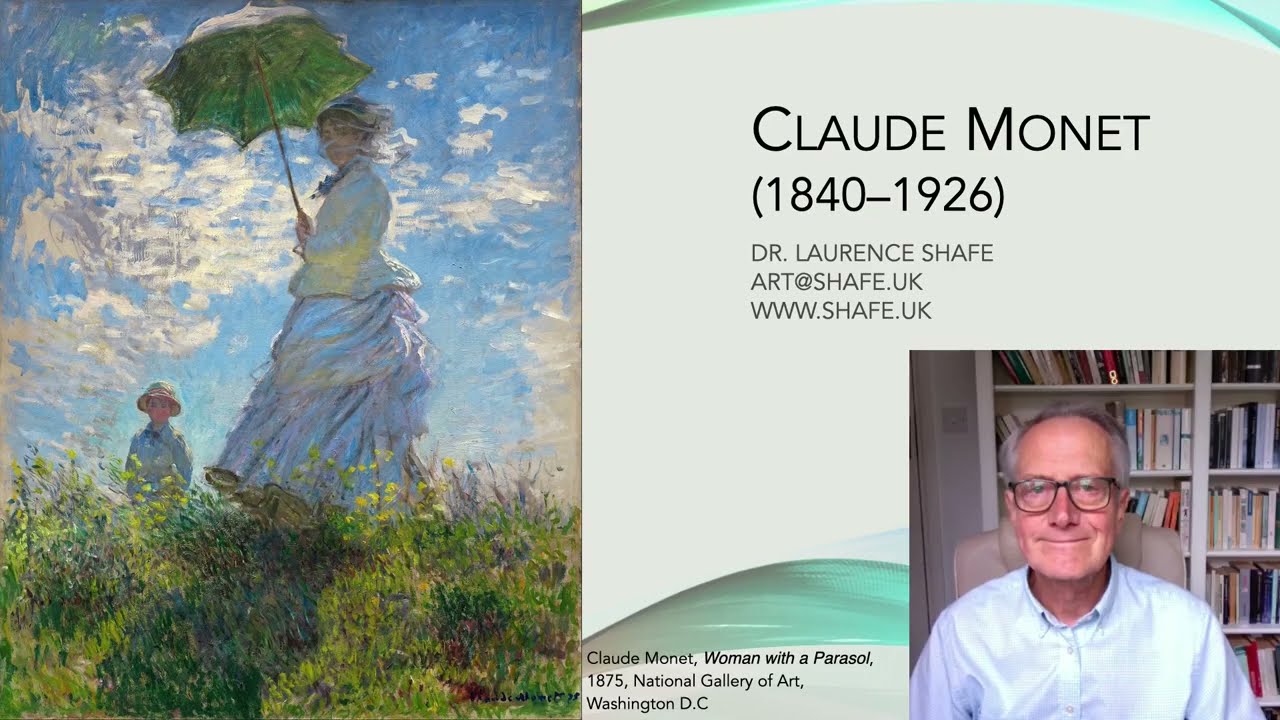
A conversation about Claude Monet created by Google Notebook from my notes:
To the casual observer, the name Claude Monet conjures a world of tranquil elegance: the dappled sunlight of Giverny, the hazy serenity of water lilies, and the image of a peaceful patriarch of French art. We have boxed him in as a painter of “pretty flowers.” Yet, to look only at the shimmer of his later canvases is to miss the grit of the man who painted them. Before he was a national treasure, Monet was a radical insurgent who spent decades in the trenches of financial ruin, social scandal, and relentless physical labor. His journey was not a quiet stroll through a meadow, but a fierce, often desperate battle against an artistic establishment that viewed his very brushstrokes as an act of war.
1. From Sharp Satire to Shimmering Light
Long before he revolutionized our perception of light, Oscar-Claude Monet was a teenage sensation in the port city of Le Havre—not for landscapes, but for biting wit. At fifteen, he was already “adept at caricatures,” selling sharp, satirical sketches of locals for twenty francs a piece. It was these early successes that caught the eye of his mentor, Eugène Boudin.
There is a profound irony in this beginning. Caricature requires an artist to strip away the secondary to find the “essential” character through exaggeration. When Boudin eventually coaxed him into plein air painting, Monet didn’t lose that instinct; he simply shifted his focus. Instead of exaggerating a nose or a chin, he began to exaggerate the “essence” of a moment—the way light hit water or the vibration of a shadow. The sharp, satirical lines of his youth eventually dissolved into the fluid, atmospheric “impressions” that would change the world.
2. The 4-Day Masterpiece Born of Desperation
In the spring of 1866, Monet was a man on the edge. He had abandoned an overambitious project for the Paris Salon and needed a replacement fast. In a breathtaking display of technical velocity, he painted the massive The Woman in the Green Dress—a canvas standing 231 cm tall—in a mere four days.
The painting is a masterclass in texture; the heavy, luxurious silk of the gown seems to rustle as Camille Doncieux, his muse and future wife, turns her back to the viewer. But the “luxury” was a lie. Monet was so destitute he had to borrow money from his friend Frédéric Bazille just to buy the fabric for the dress. This was a strategic gambit: by showcasing a more traditional, academic mastery of realism, he secured his place in the Salon of 1866. It was a Trojan horse of a painting, gaining him the critical credibility he would later use to dismantle the very system that welcomed him.
3. Engineering the Art: Digging Trenches for Light
Monet’s commitment to capturing the natural world was less an artistic preference and more a physical ordeal. While working on the monumental Women in the Garden (1866–1867), he insisted on painting the entire 255 cm canvas en plein air. Because the work was too tall to reach while standing in the forest, he literally “dug a trench” in the earth and used a pulley system to lower the canvas into the ground.
He spent months chasing the sun, waiting for the light to hit the white gowns of the models—all modeled by Camille—with the exact “shimmering effect” he craved. The irony is poignant: despite the Herculean physical labor and the ingenuity of his trench-and-pulley system, the aging Monet looked back on this period with “disdain.” As his style evolved toward the loose, spontaneous poetry of his later years, he came to view the “rigidity” of these early, labor-intensive works as a relic of a style he had outgrown.
4. The Heartbreak of the Sliced Masterpiece
One of the most tragic losses in art history is the original version of Le Déjeuner sur l’herbe. Conceived as a colossal 4.5-meter-wide response to Édouard Manet’s controversial work, it was meant to be Monet’s definitive statement. Instead, it became a victim of his perfectionism and a collapsing bank account.
Struggling with technical hurdles and a total lack of funding, Monet was forced to abandon the project. Because he was unable to pay his mounting debts, the massive canvas was eventually “cut into pieces.” Only fragments survive today, ghosts of an ambition that outstripped his resources. As the records of the time noted:
“His work was considered too radical and ‘discouraged at all official levels’.”
This destruction highlights the brutal reality of the 19th-century art market: even a masterpiece-in-the-making could be sacrificed to the immediate needs of survival.
5. A Secret Family and a Bourgeois Lie
At first glance, Garden at Sainte-Adresse (1867) is the picture of affluent domesticity. The sun is bright, the flowers are vivid, and well-dressed figures enjoy a terrace overlooking the sea. But look closer at the man in the foreground wearing the straw hat: that is Adolphe Monet, the artist’s father.
At the moment this was painted, the scene was a carefully constructed lie. Monet was living a double life. His father violently disapproved of his “mistress” Camille and their newborn son, Jean. To secure a modest inheritance and keep the peace, Monet spent that summer convincing his family he had broken off relations with Camille. In reality, he was hiding them, eventually returning to a cold, one-room apartment in Paris to be with the family he had just publicly denied. The “bourgeois” tranquility of the painting masks a heart-wrenching tension between the life he was expected to lead and the avant-garde reality he chose.
6. Impressionism: The Insult That Stuck
It is one of the great punchlines of history that the world’s most beloved art movement began as a slur. The term “Impressionism” was coined by critic Louis Leroy in 1874 as a derogatory jab at Monet’s Impression, Sunrise. Leroy intended to mock the “unfinished quality” of the work, suggesting that a mere “impression” of a harbor was not a real painting.
Monet, along with Renoir, Pissarro, and Degas, didn’t fight the label—they wore it as a badge of honor. They leaned into the “unfinished,” using short, choppy brushstrokes and a palette that replaced muddy shadows with vibrant “blue and lavender tones.” What Leroy meant as a dismissal of Monet’s “laziness” was actually a celebration of the fleeting sensory experience. One of history’s most significant artistic revolutions began not with a bang, but with a critic’s laugh.
Conclusion: The Physicality of Painting
Claude Monet’s legacy is often reduced to his “vision,” but his work was an act of physical immersion. He was a man who literally embedded himself in his environment. In his painting La Plage de Trouville, painted during his honeymoon, actual grains of sand remain trapped in the paint to this day—a tactile record of an artist standing on a windswept beach, refusing to retreat to a comfortable studio.
Monet’s life raises a provocative question for the modern audience: does great art require the level of personal and financial sacrifice he endured? From hiding his son for an inheritance to digging holes in the dirt for a single beam of light, Monet proved that beauty is rarely found without a struggle. His philosophy of life and art is perhaps best captured in his reflection on the English capital:
“Without the fog, London would not be a beautiful city. It’s the fog that gives it its magnificent breadth.”
Just as he found the “magnificent” within the mist, we find the true depth of Monet’s genius not in the flowers themselves, but in the grit, the scandal, and the unyielding persistence required to see them.
27-03 Claude Monet and Architecture
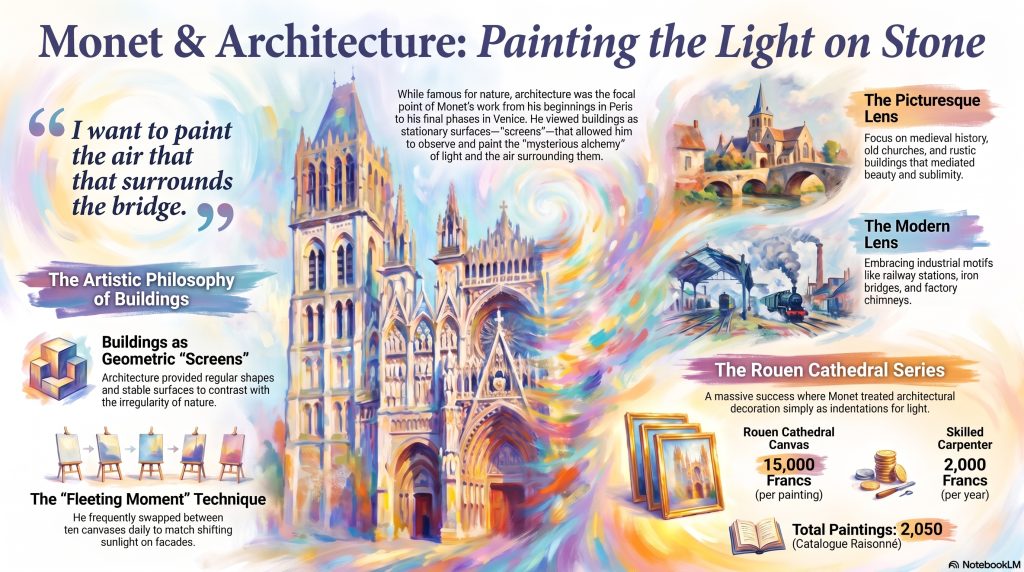
This talk examines Claude Monet’s artistic relationship with architecture, tracing his evolution from early works in Normandy to his final series in Venice and London. It highlights how buildings served as essential subjects, providing the structural “screens” upon which Monet could study the ephemeral play of light and atmospheric conditions. Beyond the purely aesthetic, the talk explores the dual influences of the picturesque tradition and modern industrialization, noting his depictions of both medieval cathedrals and contemporary engineering marvels like the Gare Saint-Lazare. Biographical details are woven throughout, illustrating how financial struggles and personal hardships shaped his transitions between urban and rural settings. Ultimately, the talk present Monet as an artist who utilized rigid architectural forms to capture the fleeting “beauty of the light” in which they existed.
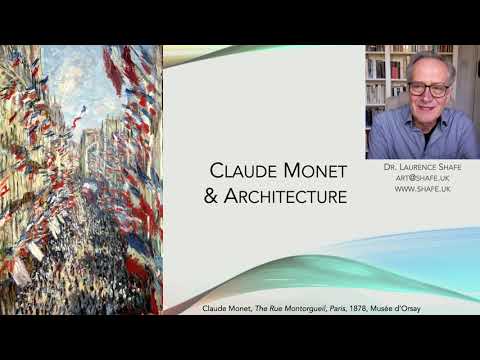
My notes on Monet and Architecture
A conversation about Monet and Architecture created by Google Notebook from my notes:
When we think of Claude Monet, we usually envision the dappled sunlight of a Giverny garden or the gentle ripples of a pond filled with water lilies. We see him as the ultimate painter of nature—an artist who abandoned the rigidity of the studio to capture the shifting soul of the outdoors.
Yet, there is a radical contradiction at the heart of his career. This master of the “fleeting moment” spent decades obsessing over the most immovable, heavy, and permanent structures imaginable. He fixated on the “complicated facades” of stone cathedrals, “grand portals” with their “layers of statues,” and the rigid geometry of iron bridges. Why would an artist so dedicated to motion choose such a static muse?
The answers reveal a side of Monet that was far more tactical, scandalous, and human than his peaceful landscapes suggest.
1. Architecture as a Canvas for the Air
For Monet, a building was never just a building. Whether he was painting the bustling railway stations of Paris or the towering facade of the Rouen Cathedral, he viewed these structures as “screens”—vast, textured surfaces designed to catch and reflect the light.
This approach was profoundly counter-intuitive. While traditional painters focused on the architectural details—the statues, the rose windows, the gothic carvings—Monet largely ignored them as historical markers. Instead, he treated the stone like a natural cliffside, searching for the “indents” and “crevices” where shadows pooled and light shattered. Crucially, buildings offered Monet a benefit that nature could not: they did not move. This stability allowed him to focus entirely on the “envelope” of the air.
“Other painters paint a bridge, a house, a boat … I want to paint the air that surrounds the bridge, the house, the boat – the beauty of the light in which they exist.” (1895 Interview)
2. The “Picturesque” Was a Marketable Trap
Monet’s interest in old buildings wasn’t always purely aesthetic; often, it was a matter of cold, hard survival. He grew up influenced by the concept of the “picturesque,” an aesthetic theory developed by William Gilpin that favored “pretty and quaint” scenes of old buildings in rustic settings. This style was catnip for the rising middle-class market.
This created a lifelong tension. During periods of extreme financial hardship, Monet leaned into the picturesque because it sold. His views of the church at Vétheuil in the late 1870s, for instance, were a desperate bid for marketability while he lived in poverty. However, as a cultural critic would note, Monet was playing the game while simultaneously changing the rules. Even when painting for a paycheck, his depictions were “never conventionally polished or charming.” He used the “regular shapes” of a red roof or a village spire as a structural anchor, but his execution remained defiantly radical.
3. Monet Embraced the “Ugly” Modern World
While he understood the value of the picturesque, Monet was a pioneer of modernité. This term, championed by Charles Baudelaire, described the beauty of the “fugitive” and the “contingent”—the fleeting, often harsh reality of contemporary life.
Monet didn’t shy away from the industrial scars appearing on the French landscape; he found an “epic quality” in them. This was scandalous to the traditionalists of the Salon. Consider his subjects:
- Haussmannization: He captured the raw energy of Baron Haussmann’s massive modernization of Paris—a project that demolished old neighborhoods and displaced 350,000 people to create grand boulevards like the Rue Montorgueil (pronounced roo mon-tor-gur-ee).
- Industrial Suburbs: In Argenteuil, he painted the “ugly” chimneys of iron-works and brick factories alongside middle-class villas.
- The Iron Spire: When painting the Rouen Cathedral, he included the iron spire added in 1822—a piece of “new technology” that many of his contemporaries considered an eyesore.
To Monet, these were not marks of ugliness, but the very essence of the “poetry within history.”
4. The Chaos Behind the Masterpieces
The “affluent domesticity” projected in Monet’s paintings—like the sun-drenched Terrace at Sainte-Adresse (pronounced sant address)—was frequently a fiction. Behind the scenes, his life was a drama of secret families and creditors.
In the late 1860s, Monet lived a double life with his mistress, Camille Doncieux (pronounced camy don-see-er), and their son, Jean, hiding their existence from his disapproving father to keep a small allowance flowing. The pressure was so suffocating that in 1868, he attempted suicide by throwing himself into the Seine.
His architectural works were often born of this desperation. When he couldn’t afford a studio, he used hotel rooms as makeshift workspaces. These windows provided “sheltered access” to views he couldn’t otherwise reach. There is a biting irony here: while painting the elegant beachfront of Trouville, Monet and his family were tucked away in the humble Hotel Tivoli, where he ran up a large bill that he very possibly skipped out on to stay one step ahead of his debts.
5. The Method Was a Race Against the Sun
Monet’s technical process for painting architecture was a feat of high-speed endurance. To capture the “fleeting moment,” he developed a system of rapidly swapping between nine or ten canvases throughout the day. He would work on a specific facade for as little as fifteen minutes until the sun moved, then immediately switch to a different canvas to match the new lighting.
This created a strange paradox: he was trying to capture a single second of light, but the physical process of building up the thick, “crevice”-like texture on the canvas took weeks or even months.
By 1895, this revolutionary method had made him a superstar. He was charging 15,000 francs per canvas—a staggering sum when you consider that a skilled carpenter of the era earned only 2,000 francs in an entire year. This success was a direct response to the rise of photography. If a camera could catch every fine detail of Saint-Germain-l’Auxerrois (pronounced urs-err-wha) in an instant, Monet realized the artist’s only path forward was to prioritize “emotion and intellectual intent” over technical accuracy.
Conclusion: The Eternal in the Transitory
From his early days in Paris to his concluding phases in Venice, architecture was the anchor of Monet’s career. Buildings provided the “regular shapes” necessary to ground the “irregularity of nature.” They were the static focal points that allowed him to explore the most elusive elements of our existence: fog, pollution, and the shifting angles of the sun.
Monet’s work challenges our perception of the “solid.” If a master could look at a massive stone cathedral and see it as nothing more than a screen for the air, it forces us to ask: What “solid” things in our own lives are we failing to see the light around?
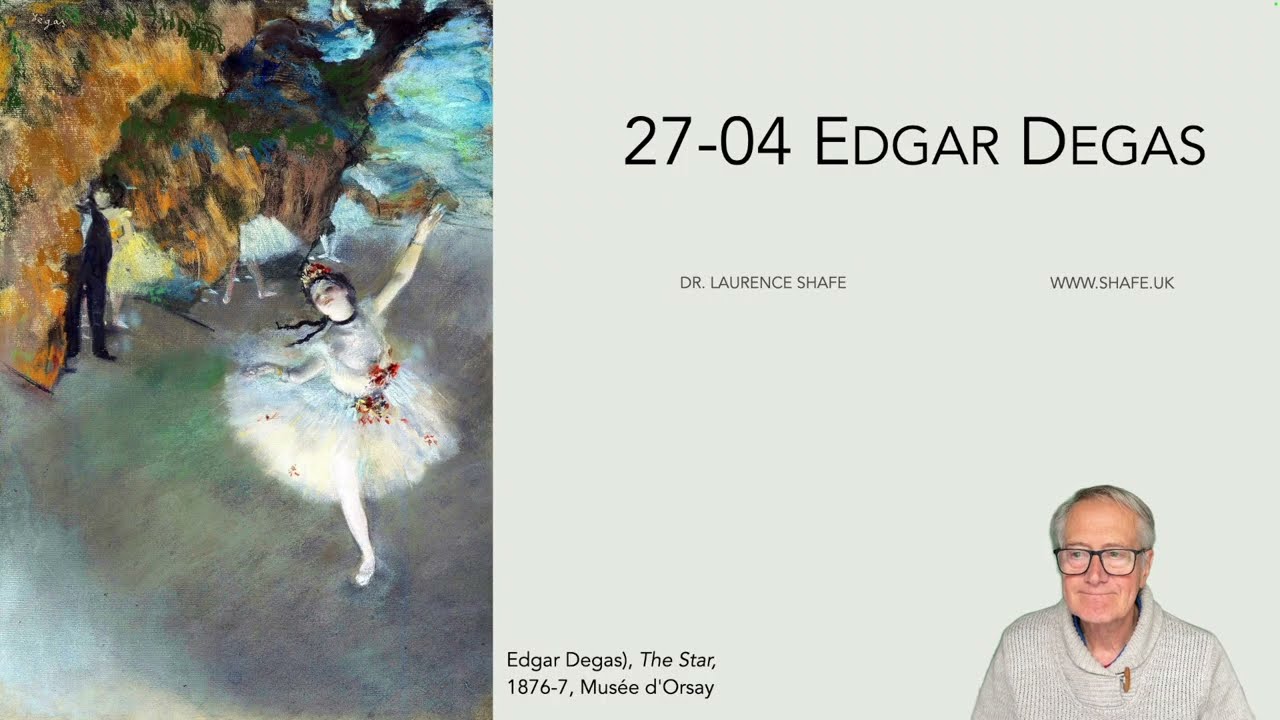
27-04 Edgar Degas
The talk provides a biographical and artistic analysis of the French artist Edgar Degas, spanning from his early education to his later years in Paris. It highlights his rejection of the “Impressionist” label, noting his preference for the term “realist” and his reliance on meticulous studio work rather than outdoor painting. Key details discuss his innovative use of sculpture and photography, the financial struggles that forced him to sell his art to pay family debts, and the deterioration of his eyesight. The talk also examines his complex personal character, including his social isolation and controversial political views during the Dreyfus Affair. Furthermore, it analyzes specific masterpieces like “The Bellelli Family” to illustrate his technical mastery of composition and psychological depth.
A conversation about Edgar Degas created by Google Notebook from my notes:
Most art lovers recognize Edgar Degas as the definitive “painter of dancers,” the man who captured the diaphanous grace of the Paris Opéra. He is routinely celebrated as a pillar of the Impressionist movement, a master of light and fleeting movement. However, the reality of the man was far harsher: Degas was an argumentative, nearly blind artist who spent his final years in total isolation and loathed the very label “Impressionist.” To understand his genius, one must look past the soft muslin of his tutus to find a man who even changed his own identity—simplifying his name from the aristocratic “De Gas” to the less pretentious “Degas” in an effort to shed the noble image his family prized.
- The Impressionist Who Hated the Outdoors
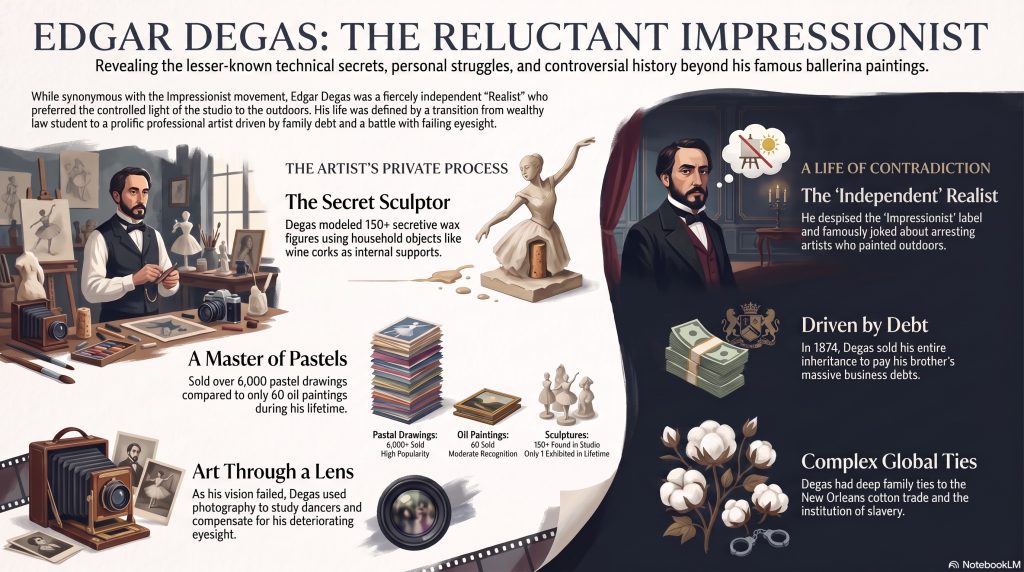
Despite being a founding member of the group, Degas rejected the “Impressionist” label, preferring to be called a “realist” or an “independent.” His primary point of contention was the hallmark of the movement: en plein air (outdoor) painting. Degas disdained the idea of painting in nature, believing that art required meticulous studio effort rather than spontaneous observation. To Degas, daylight was “too easy,” and he famously preferred the atmospheric challenges of artificial light.
“If I were the government, I would have a special brigade of gendarmes to keep an eye on landscape artists.”
- The Secret Sculptor and the Wine Cork Armatures
Degas was a prolific but secretive sculptor, modeling hundreds of figures in wax and clay that were never intended for public viewing. After his death, over 150 sculptures were discovered in his studio. X-rays taken a century later revealed that Degas was an unorthodox tinkerer; he used everyday household objects to bulk out his figures and build armatures, specifically:
- Wine bottle corks and old floorboards
- Used paintbrushes and wax fillers
The only sculpture he ever exhibited, Little Dancer Aged Fourteen, caused a scandal in 1881. Modeled on 14-year-old ballerina-in-training Marie van Goethem, the work was reviled by critics for its “startling realism,” which included a real tulle skirt and a wig made of human hair. One critic, projecting his own prejudice onto the young girl, described her face as “marked by the hateful promise of every vice.”
- A Career Fueled by a Brother’s Financial Disaster
For much of his early life, Degas was a “gentleman artist” of independent means. This changed abruptly in 1874 following the death of his father. Degas discovered that his brother René had accumulated massive debts in the family’s cotton brokerage business. To save the family’s reputation and “preserve the honor” of the name, Degas took the extreme measure of selling his inherited house and his vast personal art collection—which included works by Ingres and Delacroix. This financial catastrophe transformed him into a professional who had to sell his work to survive, necessitating the high-volume production of the decade that followed.
- The Pastel King: 6,000 Drawings vs. 60 Oil Paintings
While modern audiences often focus on his large-scale oils, Degas’s pastels were far more popular and highly regarded during his lifetime. The pastel medium allowed for the soft, atmospheric light and vibrant effects seen in masterpieces like The Star (L’Etoile). His output in this medium was staggering compared to his oils:
- Pastel drawings sold: over 6,000
- Oil paintings sold: only 60
- The “Cotton Office” and the Legitimacy of a Movement
In 1872, Degas traveled to New Orleans to visit his maternal family, resulting in his famous work The Cotton Office (1873). This painting, depicting his uncle Michel Musson examining raw cotton, was more than just a family portrait; it was a turning point for the avant-garde. When the work was acquired by the Musée des Beaux-Arts de Pau, it became the first Impressionist work ever purchased by a public museum. This acquisition was a massive victory for the movement’s legitimacy and provided Degas with much-needed financial stability.
- Dark Ties: New Orleans and the Shadow of Slavery
The New Orleans trip highlights a darker side of the artist’s history. His family was directly involved in the cotton trade and the institution of slavery; his mother’s dowry had been partially funded by the sale of an enslaved young girl. While staying with his relatives, who were members of the white supremacist elite, Degas wrote letters describing the city’s “black world” in explicitly racist and dehumanizing terms. There is a profound historical irony here: unbeknownst to the prejudiced Degas, his maternal grandfather’s family had a mixed-race relative who was a prominent inventor, a fact only uncovered by scholars a century later.
- Art as a Substitute for Life
Degas’s artistic choices were often dictated by his deteriorating health. Failing eyesight began to plague him at age 36, a condition that eventually drove him toward the tactile nature of sculpture. He also turned to photography to aid his failing vision, specifically using it to capture images by lamplight to avoid the harsh “too easy” daylight he loathed. He became increasingly isolated, never married, and believed that a true artist should have “no personal life.” His eccentricities were well-documented, including a famous and intense hatred of dogs; he insisted they be locked away before he would enter a home.
- The Bitter End: The Dreyfus Affair and Total Isolation
The end of Degas’s life was marked by social and political bitterness. During the Dreyfus Affair, his virulent anti-Semitism came to the forefront, causing him to break ties with all his Jewish friends. His argumentative nature eventually drove away even his closest colleagues, including Pierre-Auguste Renoir. Nearly blind and finding “little comfort” in his growing fame, Degas spent his final years restlessly wandering the streets of Paris before his death in 1917.
A Legacy of Complexity
Degas’s body of work was never about simple beauty; it was about psychological realism. We see this in his obsessive reworking of Young Spartans; originally modeled on ideal Greek beauty, he repainted the figures until they resembled the “street urchins of Montmartre.” In his quest for the perfect composition, he left behind a jarring “anatomical impossibility” in the painting—ten legs among only four bodies. Even his more domestic scenes, like the “sexual menace” of Interior, show his depth; many art historians believe the work was inspired by the traumatic wedding night in Émile Zola’s novel Thérèse Raquin.
Ultimately, his work remains a testament to the power of the studio over the field. Yet, it leaves us with an enduring question: Can we truly separate the grace of the dancer on the canvas from the grit and prejudice of the man who held the brush?
27-05 Camille Pissarro
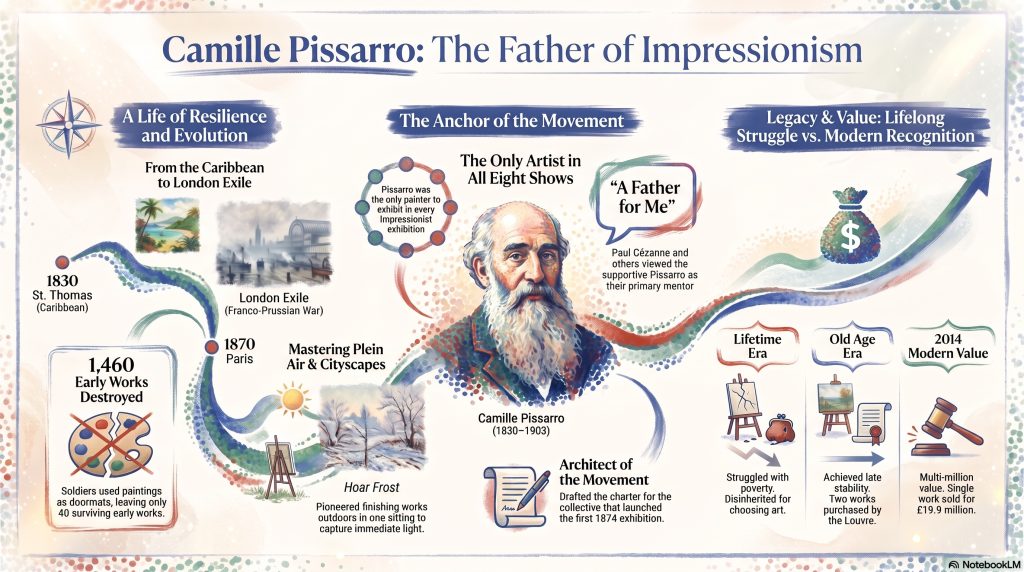
This talk provides a biography of Camille Pissarro, the influential Danish-French artist frequently hailed as the “Father of Impressionism.” Born in the US Virgin Islands, Pissarro moved to Paris in 1855, where he pioneered en plein air techniques and mentored younger icons like Cézanne and Gauguin. The talk chronicles his persistent financial struggles, the tragic loss of most of his early work during the Franco-Prussian War, and his brief experimentation with pointillism. Notably, he was the only member of the original group to showcase his work in all eight Impressionist exhibitions. The talk also highlights his empathy for working-class subjects and his later years spent painting urban cityscapes from hotel windows due to a recurring eye infection. These records underscore Pissarro’s role as the unifying spiritual guide who held the often-fractured Impressionist movement together through his kindness and unwavering artistic conviction.
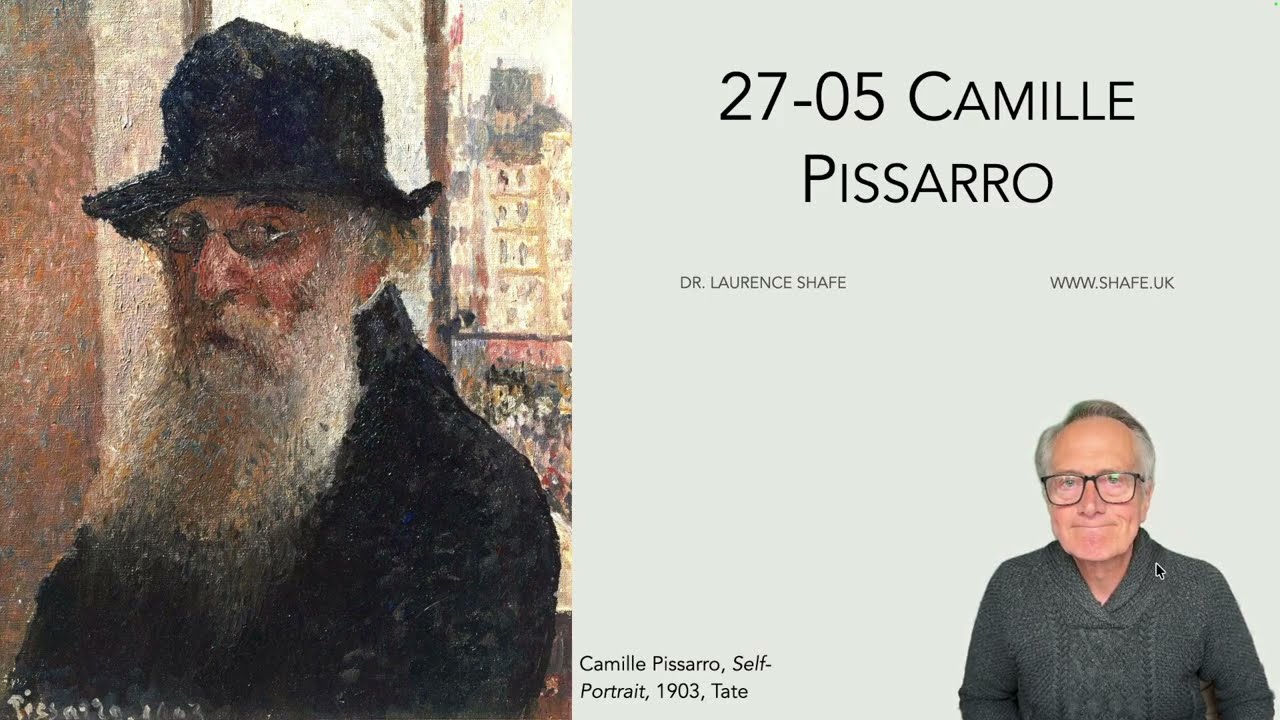
A conversation about Camille Pissarro created by Google Notebook from my notes:
1. The Hook: An Unlikely Revolutionary
In the hallowed halls of the Musée d’Orsay, the names of Claude Monet and Pierre-Auguste Renoir resonate with a rock-star magnetism. Their sun-dappled haystacks and vibrant dance halls are the undisputed icons of Impressionism. Yet, behind the scenes of this radical movement stood a man who was often its most essential, albeit quieter, architect. While his colleagues were frequently blinded by their own brilliance or fractured by volatile egos, Camille Pissarro was the steady, “prematurely greying father figure” who provided the movement’s spiritual and intellectual guidance.
Why is it that the man who held the Impressionist revolution together often stands in the shadow of his more famous protégés? Pissarro was the only artist to exhibit in all eight of the official exhibitions, yet his legacy is a complex tapestry of staggering personal loss, social marginalization, and an uncanny ability to reinvent himself. This is the story of the “Father of Impressionism”—a radical outsider whose quiet dignity and empathy for the working class forever altered the trajectory of Western art.
2. The Great Erasure: 1,500 Masterpieces Lost to History
One of the most heart-wrenching “what ifs” in art history occurred during the Franco-Prussian War of 1870–71. Pissarro, a Danish national, was forced to flee his home in Louveciennes for the safety of London. Upon his return, he was met with a scene of absolute desecration. Prussian soldiers had used his home as stables and his studio as a workshop.
Of the approximately 1,500 canvases Pissarro had meticulously painted over the previous twenty years—capturing the evolution of his early style and the “misty suburban landscapes” of his travels—only 40 remained. The soldiers had used his oil paintings as door mats to wipe the mud from their boots, effectively walking over two decades of artistic innovation. This erasure likely robbed Pissarro of his rightful place as the primary pioneer of the movement.
“It is possible that those early paintings would have shown Pissarro as the inventor of the Impressionist style but it is now Monet who is seen as the group’s guiding force.”
3. From St. Thomas to “Pizarro”: A Radical Outsider’s Heritage
Pissarro’s perspective as a social and political radical was forged by his status as a perpetual outsider. Born in 1830 on the island of St. Thomas in the Danish West Indies, he was named Jacob Abraham Camille Pizarro. His heritage was Sephardic Jewish, and his family was embroiled in a local scandal: his father had married his widowed aunt, a union forbidden by Jewish law. As a result, the family was marginalized, and the young Camille was barred from the local Jewish school, instead attending an all-black primary school.
This early exposure to a diverse, working-class community stayed with him. He later abandoned the family import-export business to pursue art, even spending two formative years in Venezuela with Danish artist Fritz Melbye. His early works, such as Two Women Chatting by the Sea (1856) and Donkey in Front of a Farm (1859), are signed with the original “Pizarro” spelling. These pieces already show a curator’s eye for the “warm West Indian sunlight” and a deep empathy for rural labor—themes that would inform his anarchist political leanings and his rejection of the “vulgar” academic standards of the Paris Salon.
4. The Glue of the Avant-Garde: A Mentor to Giants
Pissarro was the movement’s constant, providing a “youthful exuberance” that masked his role as the elder statesman. His task was unenviable: managing a group that included the atheist republican Claude Monet, the reactionary Pierre-Auguste Renoir, and the “bad-tempered anti-Semite” Edgar Degas. Despite these volatile personalities, Pissarro’s “gentle” authority kept the group from splintering.
He was a vital bridge between generations, mentoring younger artists like Paul Cézanne and Paul Gauguin during their difficult transition away from the Salon system. He even briefly taught a young Vincent van Gogh in 1884. His ability to nurture was not just professional but deeply personal; he comforted Cézanne when the latter was mocked by critics, fostering a bond so strong that Cézanne would later refer to himself as Pissarro’s pupil and the “first Impressionist.”
“Mary Cassatt described how the ‘gentle’ Pissarro, ‘could have taught the stones to draw correctly.’ Paul Cézanne referred to him simply as ‘a father for me.’”
5. Innovation Born of Infirmity: The Window View Series
Perhaps the most remarkable aspect of Pissarro’s career was his late-stage reinvention. In the mid-1880s, at an age when most artists settle into a signature style, he met Georges Seurat and Paul Signac. Fascinated by their “scientific” approach to color, Pissarro spent three years (1885–1888) adopting the painstaking technique of Pointillism.
In his final years, a recurring eye infection limited his ability to paint en plein air (outdoors), as the wind and dust became unbearable. Ever the innovator, he retreated indoors, renting apartments such as his residence in the Place Dauphine, overlooking the Pont Neuf. From these high-angle perspectives, he developed the “dabbing brushstroke” that defined his famous urban scenes. Physical limitation forced a new perspective, resulting in a series of bustling Parisian cityscapes that finally brought him the official recognition and financial security he had lacked for decades.
6. The Poverty of a Millionaire: A Legacy of Sincerity
Pissarro lived a life of “utmost sincerity” but profound financial struggle. Disinherited by his parents for choosing art over the family business, he further alienated them by entering a relationship with his mother’s maid, Julie Vellay. They lived in poverty for years, raising children—including his first and much-beloved daughter Jeanne-Rachel (“Minette”), who died tragically at age nine—long before they finally married in 1871.
The contrast between Pissarro’s lived experience and his modern-day value is a poignant irony. Described as the “most real and most naïve member” of the group, he once wrote to a friend, “my painting doesn’t catch on, not at all.” Today, his “quiet dignity” is valued in the tens of millions; in 2014, a single work sold for £19.9 million.
7. Conclusion: The Persistent Impression
Camille Pissarro proves that a revolution does not always require a loud, singular leader; sometimes, it requires a “gentle” authority who is willing to stand in the breach. He was the bridge between the old world and the new, sacrificing his own historical primacy to the destructions of war and the nurturing of others’ genius.
As we look at the masterpieces of the 19th century, we must ask: Which modern-day “fathers” or “mothers” of movements are currently standing in the shadows of their more famous protégés, quietly providing the spiritual guidance that makes a revolution possible?
27-06 Auguste Renoir
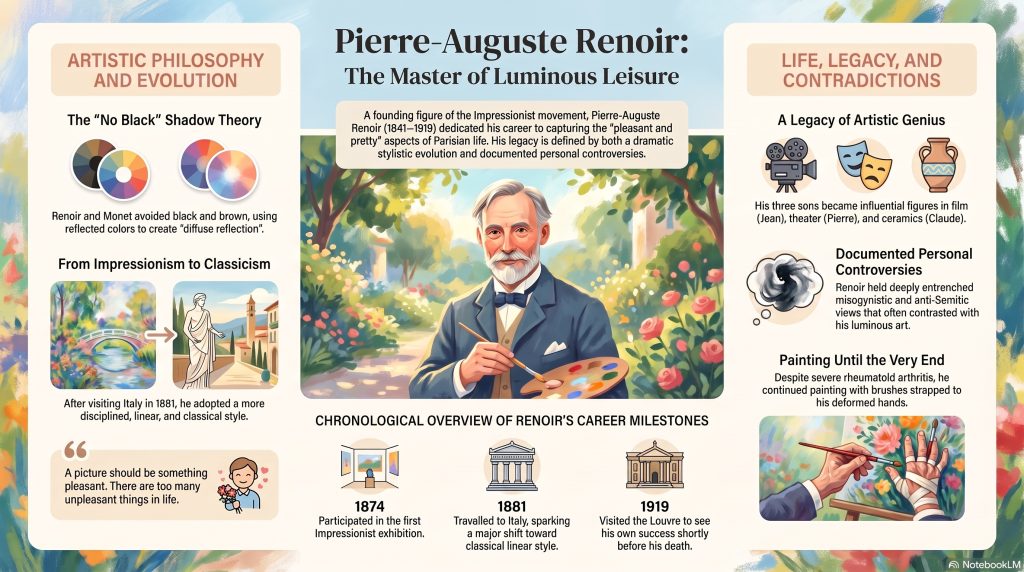
This talk looks at the life and career of the famous Impressionist painter Pierre-Auguste Renoir, tracing his journey from a porcelain factory apprentice to a world-renowned artist. It highlights his technical evolution, noting how he moved from spontaneous light effects to a more structured, classical style later in life. Beyond his professional achievements, the material explores his complex personal character, documenting his documented anti-Semitic and misogynistic views alongside his immense physical resilience while battling rheumatoid arthritis. It also details his close family ties, including his three sons who achieved their own fame in film and the arts. Specific masterpieces like La Loge and Lise with a Parasol are examined to illustrate his early struggles and eventual rise to success. Ultimately, the biography presents a balanced portrait of a man who viewed art as a medium for pleasant and cheerful emotion despite significant personal and societal controversies.
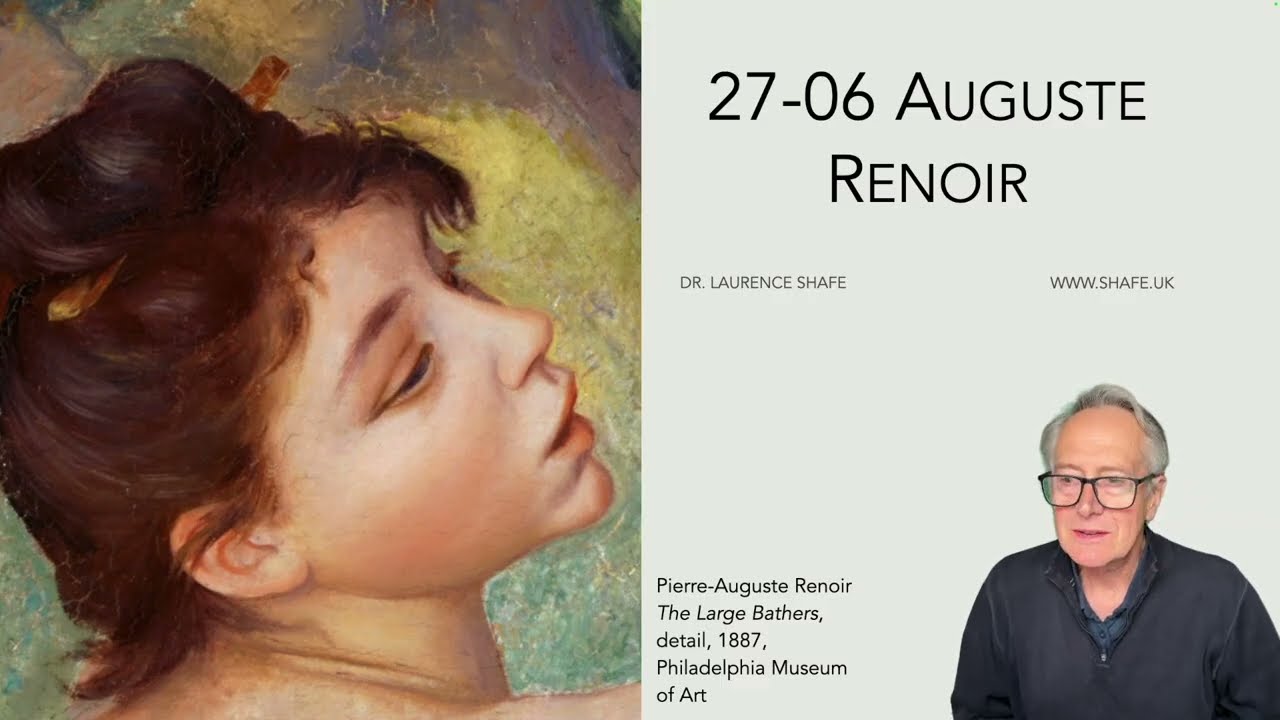
A conversation about Auguste Renoir created by Google Notebook from my notes:
To the casual observer, the name Pierre-Auguste Renoir conjures a world of sedative luxury: sun-drenched picnics, café-concerts, and the iridescent skin of bathers. His work is so relentlessly cheerful that it has become a lightning rod for modern cynicism, culminating in the bizarre 2015 “Renoir Sucks at Painting” protests outside Boston’s Museum of Fine Arts. Yet, to dismiss Renoir as a mere merchant of “prettiness” is to overlook a biography forged in the fires of a city eating itself alive. Beneath the saccharine glaze of his canvases lies a narrative of financial desperation, a brush with a firing squad, and a technical revolution born from a deep-seated hatred of the industrial machine.
1. The Choirboy Who Traded Music for Porcelain
Before he was the patriarch of Impressionism, Renoir was a child of the Parisian working class whose future was measured in octaves, not brushstrokes. Under the tutelage of the composer Charles Gounod at the Church of Saint-Roch, the young Renoir was hailed as a vocal prodigy. Gounod, recognizing a rare talent, lobbied for a scholarship to provide the boy a formal musical education.
Fate, however, was dictated by the loom and the kiln. At age 13, financial necessity drove Renoir into an apprenticeship at a porcelain factory. It was here, painting delicate floral motifs on china, that he developed a distinctive sensitivity to the translucency of light—a quality that would become the spiritual ancestor of his Impressionist style. But the true catalyst for his artistic philosophy was a moment of industrial trauma: in 1858, the factory switched to mechanical reproduction. Renoir was made redundant, displaced by the very uniformity he would spend his life resisting. This early encounter with the cold efficiency of machines solidified his belief that art must be human, flawed, and, above all, irregular.
2. The Artist Who Was Almost Executed as a Spy
The luminous escapism of Renoir’s art was not born of ignorance, but of survival. In 1871, during the blood-soaked paranoia of the Paris Commune, Renoir was sketching along the banks of the Seine. To the Communard officials, a man meticulously recording the landscape was not an artist, but a spy.
The situation turned lethal within moments. Renoir was seized and led toward the river to be executed. His life was saved by a staggering, cinematic coincidence: Raoul Rigault, a high-ranking leader of the Commune, happened to be present. Rigault recognized the artist as the man who had saved his own life during a previous encounter. He intervened, sparing Renoir from a nameless death in the Seine. This brush with the firing squad underscores the precariousness of the artist’s life during political upheaval—a reality Renoir would later choose to bury under layers of joyful pigment.
“Art is about emotion; if art needs to be explained it is no longer art.”
3. The Color of Darkness: Banishing Black from the Palette
In the summer of 1869, while painting at the floating café of La Grenouillère, Renoir and Claude Monet enacted a technical coup d’état against the art establishment. They developed the theory of “diffuse reflection,” observing that shadows were not the muddy blacks and browns mandated by academic tradition, but vibrant patchworks of reflected color.
This was more than a stylistic choice; it was an intellectual rebellion. By banishing black from his palette, Renoir leaned into his porcelain-painting roots, treating the canvas as a translucent surface where light was filtered rather than absorbed. This rejection of traditional “finish” in favor of broken brushstrokes captured the energy of a fleeting moment, directly contradicting the mechanical uniformity that had cost him his first job. For Renoir, the “principle of irregularity” was the only way to safeguard the soul of the work against the encroaching industrial age.
“One can thus state, without fear of being wrong, that every truly artistic production has been conceived and executed according to the principle of irregularity.”
4. The Art of Agony: Brushes Strapped to a Wheelchair
In his twilight years, the “joy” in Renoir’s paintings became a calculated act of defiance against a body in revolt. Suffering from severe rheumatoid arthritis that eventually confined him to a wheelchair, Renoir moved to the warmer climate of Cagnes-sur-Mer in 1907. His hands were so crippled and clenched that he could no longer grip a tool.
Undeterred, he had his paintbrushes strapped to his hands with bandages to prevent the skin from tearing against the wood. His creative will remained so potent that he continued to paint until his final days in 1919. Even as his physical world contracted, he encouraged his youngest son, Claude (nicknamed “Coco”), to pursue the tactile art of ceramics. It is a testament to the man’s dedication that shortly before his death, he visited the Louvre to see his own work hanging among the masters, yet remained convinced his education was incomplete.
“I am just now learning to paint.”
5. The Complicated Legacy: Beauty vs. Belief
As a cultural historian, one must confront the “unpleasant” reality that the man who painted such gentle scenes harbored a visceral intolerance. Reconciling Renoir’s aesthetic of grace with his documented prejudices is a difficult task for the modern intellect. Despite a professional life sustained by Jewish art dealers like Paul Durand-Ruel and Ambroise Vollard, Renoir was a vocal anti-Semite. During the Dreyfus Affair, he dismissed Émile Zola’s legendary defense of the wrongfully accused officer as “idiocy,” and his son Jean later recalled his father’s “visceral dislike” of Jews and the intellectuals he felt undermined traditional French values.
His views on women were equally regressive. Renoir saw femininity as a purely decorative, domestic ideal, famously declaring that “painting is not for women.” He viewed the burgeoning “emancipated” woman as a “monster” of social engineering. To Renoir, the models he captured with such soft, reverent light were not autonomous individuals, but fixed symbols of a lost, pre-industrial grace.
“To my mind, a picture should be something pleasant, cheerful, and pretty, yes pretty! There are too many unpleasant things in life as it is without creating still more of them.”
Conclusion: The Final Gaze
Pierre-Auguste Renoir remains an enigma of contradictions: the porcelain apprentice displaced by machines, the near-victim of a revolutionary purge, and the technical radical who harbored deeply reactionary beliefs. He was a craftsman who rose from a tailor’s shop to the halls of the Louvre, clinging to his brushes even as his body failed him.
As we stand before his sun-dappled gardens, we are forced to ask a provocative question: Does the undeniable beauty of his canvases become tainted by our knowledge of the man? Or is the “pretty” nature of his work actually a profound, desperate refusal to acknowledge the darkness he knew all too well? Ultimately, we must decide if we can separate the light on the canvas from the shadow in the artist’s soul.
27-07 American Impressionism

This talk examines the evolution and key figures of American Impressionism, a movement that adapted French techniques to reflect domestic realism and idealized landscapes. The sources highlight influential artists like James McNeill Whistler, who prioritized color harmony over literal form, and Mary Cassatt, who masterfully captured the private rituals of women. Notable figures such as John Singer Sargent and William Merritt Chase are discussed for their technical brilliance in depicting light and leisure among the American upper class. The narrative also details the formation of “The Ten,” a group of painters who established a distinct, genteel style that diverged from more radical European trends. Finally, the material tracks the movement’s decline following the 1913 Armory Show, where the rise of modernism and fragmented abstraction began to overshadow Impressionist aesthetics.
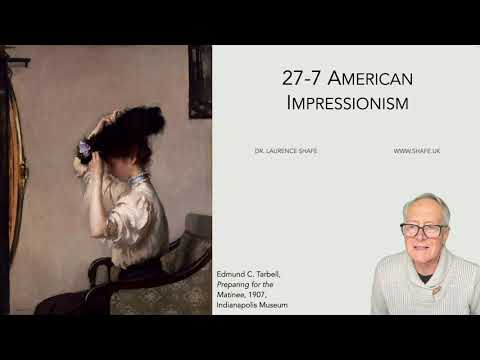
My notes on American Impressionism
An entertaining conversation on American Impressionism created by Google Notebook based on my notes:
When we think of Impressionism, our minds often conjure images of serene, sun-dappled landscapes, elegant domestic scenes, and pleasant afternoons captured in soft, luminous color. The movement seems to represent a world of tranquility and beauty, a gentle escape from the harsh realities of modern life. It’s easy to look at these paintings and see only their calm, harmonious surfaces.
But beneath this veneer of placid beauty lies a dramatic and often turbulent history. The story of American Impressionism is not just one of pretty pictures; it is a tale filled with intense personal rivalries, painstaking artistic labor that bordered on obsession, and radical ideas that challenged the very definition of art. These are the stories of artists who fought critics in court, spent years on a single canvas to capture a few perfect minutes of twilight, and synthesized global influences to create something entirely new.
This article will pull back the curtain on the idyllic scenes to uncover some of the most surprising and impactful stories from this transformative era in American art.
It Wasn’t Just a Copy of the French Original
A common misconception is that American Impressionism was simply a delayed imitation of its French predecessor. But while its revolutionary techniques were born in France, the movement in America developed a distinct and independent character, adapting the new visual language to explore subjects and themes that were profoundly its own.
The American style was deeply rooted in the nation’s own artistic traditions, specifically “realism, a love of landscape, and middle-class domestic life.” Where French Impressionists were fascinated by the dizzying pace and “fleeting urban modernity” of Paris, American artists often sought to express a sense of “harmony and idealism.” This distinction is crucial. It allows us to appreciate American Impressionism not as a derivative echo, but as a unique artistic dialogue—a deliberate choice to forge a modern American identity on the canvas.
An Artist Sued a Critic for “Flinging a Pot of Paint in the Public’s Face”
The Victorian era was a battleground over the purpose of art, and no event captured this conflict more dramatically than the infamous trial between the artist James McNeill Whistler and the critic John Ruskin. Whistler, a self-confident American dandy known for his monocle and biting wit, had developed a radical painting technique. He created a thinned-down “sauce” of paint that he applied in thin, transparent layers, sometimes throwing the canvas to the floor to manage the running colors.
In 1877, he exhibited Nocturne in Black and Gold: The Falling Rocket, an atmospheric depiction of a fireworks display. The influential art critic John Ruskin, a champion of traditional, highly detailed art, was appalled. He published a scathing review:
For Mr. Whistler’s own sake, no less than for the protection of the purchaser, Sir Coutts Lindsay ought not to have admitted works into the gallery in which the ill-educated conceit of the artist so nearly approached the aspect of wilful imposture. I have seen, and heard, much of Cockney impudence before now; but never expected to hear a coxcomb ask two hundred guineas for flinging a pot of paint in the public’s face.
Outraged, Whistler sued Ruskin for libel. The ensuing trial became a public spectacle, pitting the old guard’s demand for realism against the modern artist’s claim to aesthetic freedom. While Whistler ultimately won the case, the court awarded him only a single farthing in damages, and the legal costs left him financially ruined. The trial, however, remains a landmark moment, a fierce debate over artistic value that echoes in today’s conversations about abstract art and the role of the critic.
A Seemingly Spontaneous Masterpiece Took Two Years to Paint—In 25-Minute Bursts
John Singer Sargent’s Carnation, Lily, Lily, Rose appears to be the epitome of Impressionist spontaneity—a fleeting moment captured as two young girls light paper lanterns in a garden at dusk. The brushwork looks quick and effortless. The reality was the complete opposite. A nomadic, multilingual artist born to American parents in Florence after a family tragedy, Sargent’s process was a grueling exercise in patience.
To capture the perfect quality of twilight, he worked on the large canvas over the course of two years, but only painted for a very short period each evening, between 6:35 and 7:00, when the light was just right. He would often scrape all the paint off the canvas after a session if he was not satisfied. As the seasons changed and the flowers died, he replaced them with artificial ones. Sargent himself described it as a “fearfully difficult subject … Paints are not bright enough & then the effect only lasts ten minutes.”
Even after this painstaking effort, the painting proved controversial. Many English critics thought it was too “Frenchified,” and in a poll, readers of one paper voted it one of the “Pictures You Would Least Like to Live With.” The story of its creation challenges the myth of effortless inspiration, revealing the immense labor that can hide behind a seemingly spontaneous surface.
The Leading American Impressionist Was a Woman Who Found Inspiration in Japanese Design
In a field dominated by men, Mary Cassatt emerged as the “leading American in the Impressionist circle,” a testament to her immense talent and determination. Born into a prosperous Pennsylvania family, Cassatt faced significant barriers. In the 1860s, a serious artistic education was “denied to most women in America,” forcing her to move to Europe to pursue her calling. Her skill was undeniable, catching the attention of Edgar Degas, who invited her to exhibit with the Impressionists.
A pivotal moment in her career came after she attended a major exhibition of Japanese woodblock prints in Paris in 1890. This art form profoundly influenced her work, as seen in her 1893 masterpiece, The Child’s Bath. The painting incorporates key elements of Japanese design, including a “flattened perspective, high viewpoint and strong outlines.”
Crucially, while Cassatt adopted the daring compositional techniques of her mentor Degas, she applied them to her own ends. She used them “not to convey voyeuristic observation—as Degas sometimes did—but intimacy and empathy.” By synthesizing French modernism with the aesthetics of Japanese art, Cassatt created a style that was uniquely her own—intimate, modern, and deeply human.
The Movement Was Derailed by an “Explosion in a Shingle Factory”
By the early 20th century, Impressionism was the established face of modern art in America. But its dominance was about to be shaken by a single, explosive event: the 1913 Armory Show in New York City. The exhibition was designed to introduce the American public to the latest trends in European art, and it succeeded beyond anyone’s imagination.
The “most controversial work” was Marcel Duchamp’s Nude Descending a Staircase, No. 2. A dizzying combination of Cubism and Futurism, the painting depicted a fragmented, machine-like figure in motion. It confused, angered, and mesmerized audiences who could not see a traditional “nude” in its abstract forms. One critic famously—and dismissively—described the painting as:
…an “explosion in a shingle factory”.
Other viewers were equally baffled, with some suggesting the work was a sign of the artist having a “brain malfunction.” Overnight, Duchamp’s painting became a symbol for a new, radical modernism that made Impressionism seem almost quaint by comparison. It sparked a furious, nationwide debate and signaled that Impressionism’s reign as the avant-garde was over.
The Ever-Changing Canvas
The seemingly tranquil world of American Impressionism was, in reality, a dynamic stage for artistic struggle, intellectual debate, and relentless innovation. Behind the serene landscapes are stories of artists who fought for their vision, labored for years to capture fleeting moments, and looked across cultures to forge a new visual language.
But the arrival of radical new works like Duchamp’s Nude was not a final curtain call. American Impressionism didn’t vanish; it evolved. It continued to influence American visual culture well into the 1930s, its principles of light and color adapting alongside the very movements that once seemed so shocking. The controversies that met these artists remind us that what is radical in one generation can become conventional in the next. Looking at the art that challenges us today, one has to wonder: which “explosion in a shingle factory” will become tomorrow’s masterpiece?Gemini Notebook can be inaccurate; please double-check its responses.
27-08 Impressionism in London
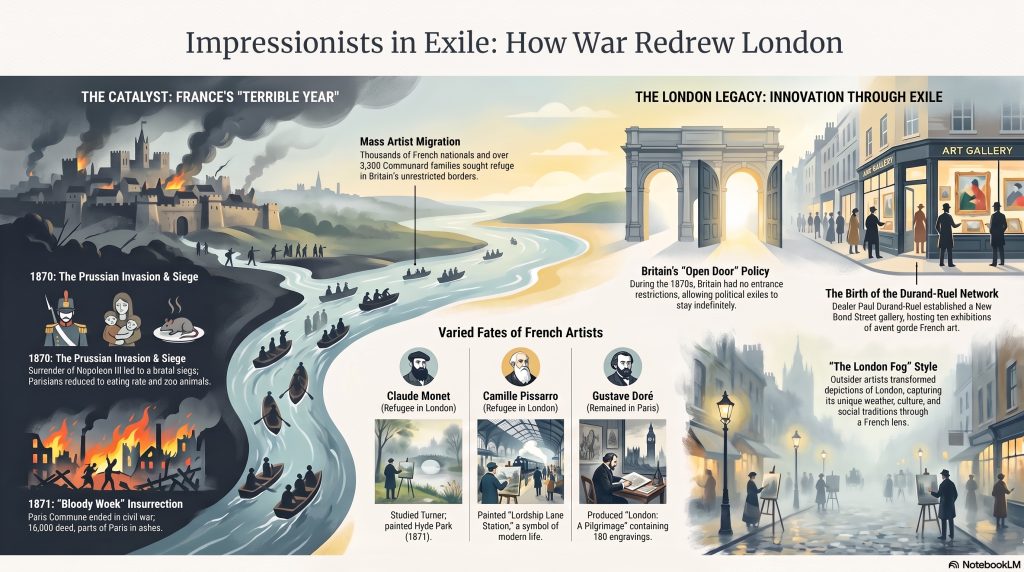
Following the Prussian invasion of France in 1870 and the subsequent chaos of the Paris Commune, numerous French artists moved to London to find safety and work. This talk examines how creators like Claude Monet, Camille Pissarro, and Gustave Doré adapted to their new environment, often documenting the unique atmosphere of British life and weather. While some painters like Edgar Degas and Édouard Manet stayed to defend Paris, those in exile utilized Britain’s open borders to form influential creative networks. The talk highlights specific masterpieces, such as Gustave Doré’s haunting depictions of the siege and his later engravings of London’s impoverished neighborhoods. Ultimately, it illustrates a transformative period where displaced French masters reimagined the landscape and social fabric of the British capital.
My notes on Impressionism in London
A conversation about Impressionism in London created by Google Notebook from my notes:
1. The ‘Terrible Year’ That Changed Art History
In 1870, the sun-drenched world of the Parisian avant-garde was violently eclipsed. As Prussia invaded France, the artists who had spent their careers chasing the light of modern life were suddenly thrust into a brutal landscape of falling empires and bloody insurrections. This was the “Terrible Year”—a period of trauma that saw the collapse of the Second Empire and the eventual carnage of the Paris Commune.
For artists like Claude Monet and Camille Pissarro, the choice was simple: flight or potential death. London became their accidental sanctuary. We see the toll of this period in the intimate portraits of the time, such as Monet’s wife, Camille, captured sitting on a sofa in deep mourning dress—a somber reflection of the loss of Monet’s father and the crumbling of their old world. What began as a desperate escape from the “fake news” of Bismarck and the Prussian shells would eventually ignite an unexpected creative explosion in the British capital.
2. The “Fake News” Trigger: How an Edited Telegram Started a War
The displacement of the Impressionist masters wasn’t just a casualty of geography; it was the direct result of a surprisingly modern political deception. Prussian Chancellor Otto von Bismarck, seeking to bait France into a conflict that would cement Prussian dominance, utilized a tactic we would today call “fake news.”
Bismarck took a report known as the Ems Telegram and edited it with surgical precision. By condensing the text, he made it appear as though the Prussian king and the French ambassador had traded unforgivable insults. The manipulation worked perfectly. Baiting a French government that arrogantly believed its army was invincible, Bismarck secured a declaration of war on July 16, 1870. The fallout was catastrophic: within seven weeks, 100,000 men were killed on each side, Napoleon III was captured, and the Impressionist movement—the very definition of “modern” art—was physically uprooted by a very modern lie.
3. London: The 19th-Century Sanctuary with “No Restrictions”
While Paris was being pounded by artillery, London offered a remarkably liberal—if foggy—embrace. During the 1870s, Britain maintained a “no entrance restrictions” policy. Anyone, regardless of their nationality or the radical nature of their politics, could arrive and stay indefinitely. This open-door policy was the lifeline for approximately 3,300 Communard refugees and a handful of struggling painters.
In a delicious twist of Victorian irony, even the ultra-conservative pages of The Times showed a surprising friendliness toward these foreign exiles. For Camille Pissarro, his status was unique; holding a Danish passport, he had a level of mobility many of his compatriots lacked. Yet the necessity of this sanctuary was grimly underscored by the critic Théodore Duret, who wrote to Pissarro in May 1871:
“The horror and terror are still everywhere…. Paris is empty and will become even emptier…. Anyone would think there never were any painters and artists in Paris.”
4. Culinary Desperation: Dining on Rats and Zoo Animals
For those left behind in the “Terrible Year,” the lifestyle of the “City of Light” vanished, replaced by a struggle for basic survival. During the Prussian siege, a bitterly cold winter gripped the city, and with supply lines severed, the population was reduced to eating pets, rats, and eventually the exotic animals in the city zoo.
The harrowing nature of the siege is immortalized in Gustave Doré’s Sister of Charity Saving a Child. Set on the rue Gay-Lussac, the painting is a masterpiece of dark shadows and blood-spattered snow. Doré captures a nun—who normally lived a secluded, contemplative life—stepping into the brutal role of a fallen civic guard to rescue a child as Paris burns in the distance. To emphasize the nightmare, Doré utilized a strong, dark shadow projected against the convent wall, intended to represent a ghostly, threatening presence looming over the innocent.
5. The “Doormat” Tragedy: Pissarro’s Devastating Loss
While the exiles in London were safe, their legacies back in France were being literally walked upon. When Camille Pissarro finally returned to his home in Louveciennes, he was met with a professional heartbreak that remains one of the great tragedies of art history. His house had been requisitioned by Prussian soldiers and used as a stable.
The scale of the destruction was staggering: out of 1,500 paintings Pissarro had completed over twenty years, only 40 remained. The other 1,460 canvases—representing two decades of genius—had been used as doormats by soldiers to keep their boots clean of the stable mud. This wasn’t just a loss of property; it was a potential rewrite of art history. Scholars today suggest that if those early works had survived, they might have proven that Pissarro, rather than Monet, was the true inventor of the Impressionist style.
6. The Professor Who Never Spoke English: The Success of Alphonse Legros
Not every Frenchman in London was a penniless refugee. Alphonse Legros, who moved to the city in 1863, became the “darling of high society” and a favorite of “young British girls” who were, as Whistler put it, “mad about him.” Despite becoming a British citizen in 1881 and serving as the Slade Professor at University College for 17 years, Legros was famously unable or unwilling to speak a word of English.
Legros taught his “Slade Girls” through the pure language of art—drawing rather than speaking. More importantly, he became the “main port of call” for the influx of refugees. He provided a vital social and professional network for Monet and Pissarro and was instrumental in supporting the sculptor Jules Dalou, a convicted Communard. Though he was once ranked alongside giants like Whistler and Burne-Jones, Legros remains a largely forgotten pillar of the London sanctuary today.
7. Conclusion: A Legacy Forged in Exile
The London exile fundamentally redirected the trajectory of modern art. It was in the British capital that Monet studied Turner’s atmospheric sunlight and Pissarro painted Lordship Lane Station, the first significant depiction of a train in Impressionism—the ultimate symbol of modern life.
The experience also provided the ultimate “lifestyle” pivot. While Monet began his exile in such poverty that he couldn’t pay for his lodgings, the death of his father in January 1871 provided an inheritance that changed everything. By 1872, the former refugee was employing two servants and a gardener.
Ultimately, we must ask: if not for the “fake news” and the trauma of 1870, would the Impressionist movement have ever found the unity and “brilliance” that eventually conquered the world? It leaves us to wonder how today’s global conflicts are silently shaping the next generation of masterpieces, hidden in the shadows of modern exile.
27-09 English Impressionism
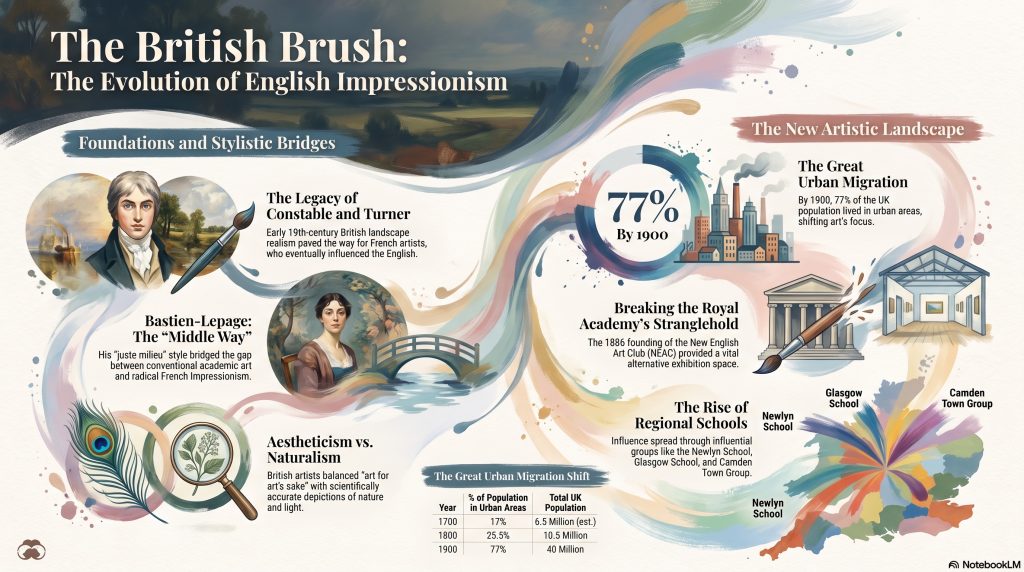
English Impressionism emerged as a diverse and loosely defined movement during the late Victorian era, coinciding with the decline of the Royal Academy’s traditional influence. While French Impressionism focused on capturing light and outdoor scenes through unmixed colours, the British variant was shaped by a complex mix of social changes, economic shifts, and eclectic interests ranging from Orientalism to fairy painting. Significant precursors like John Constable and J.M.W. Turner laid the groundwork by experimenting with natural light and realism, profoundly affecting French artists who would later inspire British painters in return. The rise of alternative institutions, such as the Grosvenor Gallery and the New English Art Club, allowed for the flourishing of various regional groups and modernist styles. Despite initial resistance from conservative critics who viewed these trends as subversive foreign influences, the movement eventually integrated into the fabric of British art. Ultimately, this period represents a transitional vanguard that bridged the gap between traditional academic painting and the burgeoning modern art movement.
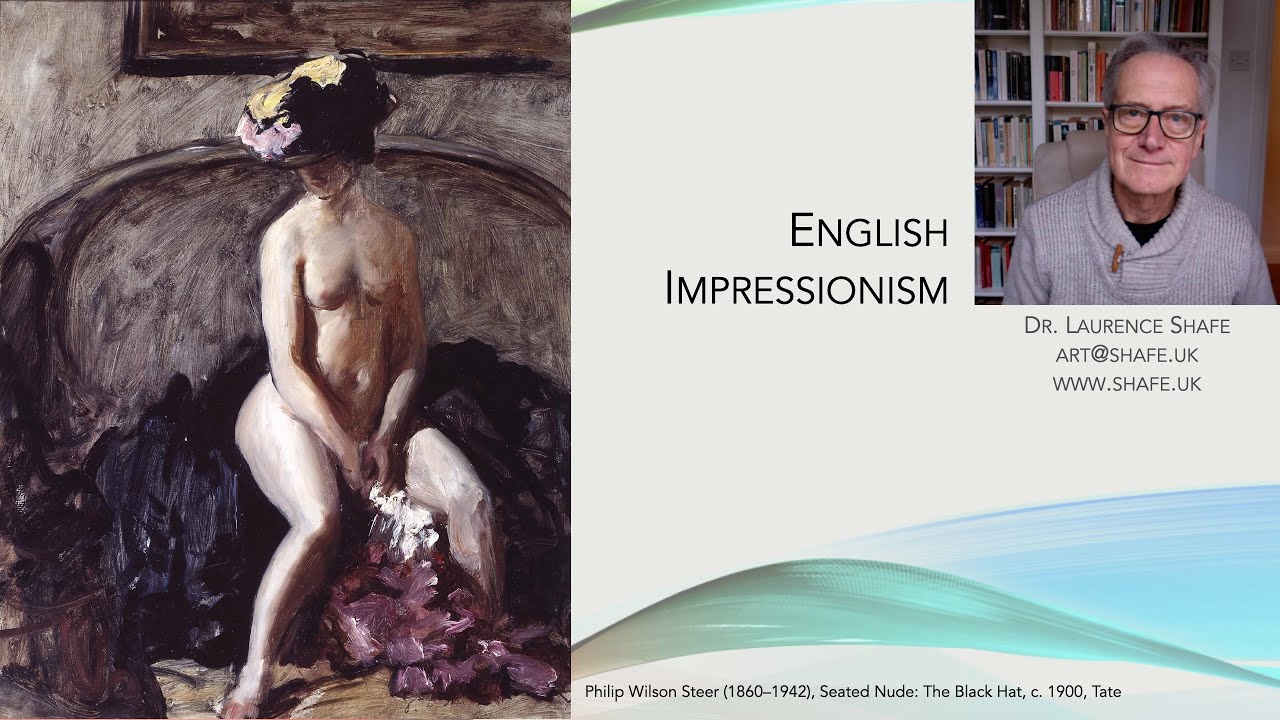
My notes on English Impressionism
A conversation about English Impressionism created by Google Notebook from my notes:
We often imagine the birth of Modernism as a purely Parisian affair—flickering light captured by radicals in berets amidst the chatter of Montmartre cafés. Yet, this narrative ignores a more complex truth: the DNA of modern art was significantly spliced in the damp fields of the English countryside and the foggy courtrooms of London.
By the late Victorian era, the Royal Academy had become an ossified institution—epitomized by the later appointment of the unmistakably traditional Frank Dicksee as President—clinging to an academic style that felt increasingly detached from a rapidly changing world. To the traditionalists of the day, the art we now celebrate as “chocolate box” pretty was viewed with genuine alarm. They didn’t see beauty; they saw a “diseased” threat to the very foundations of civilization. To understand how we moved from the rigid hegemony of the establishment to the radical honesty of the modern era, we must look beyond the Seine to the revolutionary experiments of the English vanguard.
1. The “Violin” Scandal—When Green Grass Was Subversive
Long before Monet, John Constable was fighting a lonely war for realism. Today, works like The Hay Wain (1821) are staples of traditional English landscape, but in their time, they were acts of aesthetic rebellion. Constable’s crime was an insistence on painting the world as it actually appeared, rather than how the Academy dictated it should look.
The conflict is best captured in a legendary exchange between Constable and his patron, Sir George Beaumont. Beaumont, wedded to the “Old Master” style, complained that Constable’s grass was too vibrant; he insisted that nature should be the “mellow brown of an old violin.” In a move of brilliant literalism, Constable placed a real violin on the grass to demonstrate the jarring difference.
Establishment critics were appalled by his “white spots”—the flickering highlights used to represent light on water—and his habit of scattering what they called “chopped hay” over the surface. Constable’s realism was a technical assault; he famously used a “flash of red” on a fisherman’s hat or a horse’s harness to intensify the surrounding greens through the juxtaposition of complementary colors. To the old guard, this was a disfigurement of nature.
“…an execrable taste, having no resemblance to any appearance in Nature.” — Gentlemen’s Magazine (1829)
2. The “Stunned” French—How a British Painter Launched the Salon
In a striking irony, Constable found his greatest validation not in London, but in Paris. When The Hay Wain (originally titled Landscape: Noon) failed to find a buyer at the Royal Academy in 1821, it was eventually purchased by the Anglo-French dealer John Arrowsmith and exhibited at the 1824 Paris Salon.
The impact was seismic. The French artist Théodore Géricault returned home “quite stunned” by Constable’s technique, while Eugène Delacroix was so moved that he reportedly repainted the background of his Massacre de Scio after seeing the Englishman’s work. While English critics grumbled, French artists immediately grasped the revolutionary potential of basing color on direct observation. This led to the rise of the Barbizon School, the direct ancestors of Impressionism.
Despite selling more paintings in France in just a few years (about twenty) than he did in his entire life in England (also twenty), Constable remained a stubborn patriot. He refused all invitations to travel abroad to promote his work, famously declaring: “I would rather be a poor man [in England] than a rich man abroad.”
3. Turner’s Ghostly Battles—Years Ahead of Its Time
If Constable provided the color, J.M.W. Turner provided the dissolution of form. His late work, particularly Norham Castle, Sunrise (c. 1845), represents a radical shift where the subject begins to melt into pure atmosphere. In this painting, an umber cow appears ethereal and suspended between air and water—a ghostly presence until the viewer realizes they are looking at its reflection in the river.
The reception of these late works was polarized. Edward Lear called them the “wreck of a great mind,” yet they are now seen as the “forerunner of the whole of modern art.” However, this modernism remained a secret for decades; Norham Castle, Sunrise was never seen by the public until a 1906 exhibition at the Tate. The connection to the future was so palpable that in 1966, the abstract expressionist Mark Rothko famously joked: “This man Turner, he learnt a lot from me.”
Yet, beneath the beauty, Turner saw a “bloody background.” Norham Castle was the site of more Scottish border battles than any other location. Some critics view his late light not as idyllic, but as “corpse-like,” suggesting Turner saw the sun as a “cruel and terrible God” overlooking a landscape of perpetual conflict.
4. The 200-Guinea “Pot of Paint”—The Lawsuit that Defined Modernism
The tension between the old guard and the new reached a breaking point in 1877 with the opening of the Grosvenor Gallery, an institution that promoted “modern” art and further weakened the Academy’s stranglehold. James Abbot McNeil Whistler, a dandy who settled in London in 1863, became the face of Aestheticism—”Art for Art’s Sake.”
Whistler’s “Nocturnes” focused on “harmony of colour” over subject matter. He used a thinned-down paint he called his “sauce,” which he applied in such fluid layers that he often had to throw the canvas on the floor to stop the paint from running off. This radical technique invited a scathing attack from John Ruskin, the titan of Victorian criticism.
“…never expected to hear a coxcomb ask two hundred guineas for flinging a pot of paint in the public’s face.” — John Ruskin
Ruskin’s insult was aimed at the price for what he perceived as a lack of labor. During the subsequent 1878 libel trial, the judge asked Whistler if his painting was intended to represent a barge. Whistler’s reply—”They are just what you like”—signaled a pivotal shift. The artist was no longer a reporter of facts, but a creator of harmonies.
5. The “Gateway Drug” to Modernism—Bastien-Lepage’s Middle Way
While radical Impressionism was initially dismissed as a “subversive foreign influence,” Jules Bastien-Lepage provided a bridge. He championed the juste milieu (the middle way), a style that combined the “scientific accuracy” of realism with the lightness of Impressionism.
For the British public, Bastien-Lepage made radical honesty palatable. The influential critic Roger Fry noted that while the public saw Monet’s sincerity as “pure humbug,” they accepted Bastien-Lepage as a “stepping stone.” This approach profoundly influenced the “Glasgow Boys” and the New English Art Club (NEAC), founded in 1885 by artists who saw themselves as “Anglo-French” and sought to bypass the “ossified” Academy.
6. The “Diseased Mind” Theory—Art as a Cultural Symptom
This artistic shift was deeply intertwined with social anxieties. As urbanization exploded—with the UK population living in urban areas rising from 25.5% in 1800 to a staggering 77% by 1900—intellectuals like Max Nordau expressed a sense of impending doom. In his book Decadence, Nordau made the shocking claim that modern art, starting specifically with the Pre-Raphaelites, was the product of “diseased minds” suffering from mysticism and irrational thinking.
These aesthetic fears were compounded by the physical reality of the Boer War (1899-1902), which revealed a crisis in national health; in some towns, 90% of conscripts were rejected for poor health. In response, artists of the Newlyn School, such as Stanhope Forbes, retreated to “primitive” fishing villages. This was an attempt to “improve the health of the nation” both physically and mentally, using rural naturalism as a cure for the perceived decay of urban life.
A Final Thought
The journey from the Royal Academy to the radical “London Impressionists” was paved with scandal, lawsuits, and a fundamental reassessment of sight. What we now call “English Impressionism” was a vibrant, loose movement that married French light with a distinctly British documentary impulse.
As we look at the art of our own time, we might wonder: what radical “greens” are we currently rejecting? How will our current definitions of “modern” be viewed 100 years from now? Perhaps, in our own backyard, there is a “Constable” whose work we currently dismiss as “execrable,” simply because we have yet to learn how to see through their eyes.
27-10 Impressionism Post-Impressionism and Fauvism
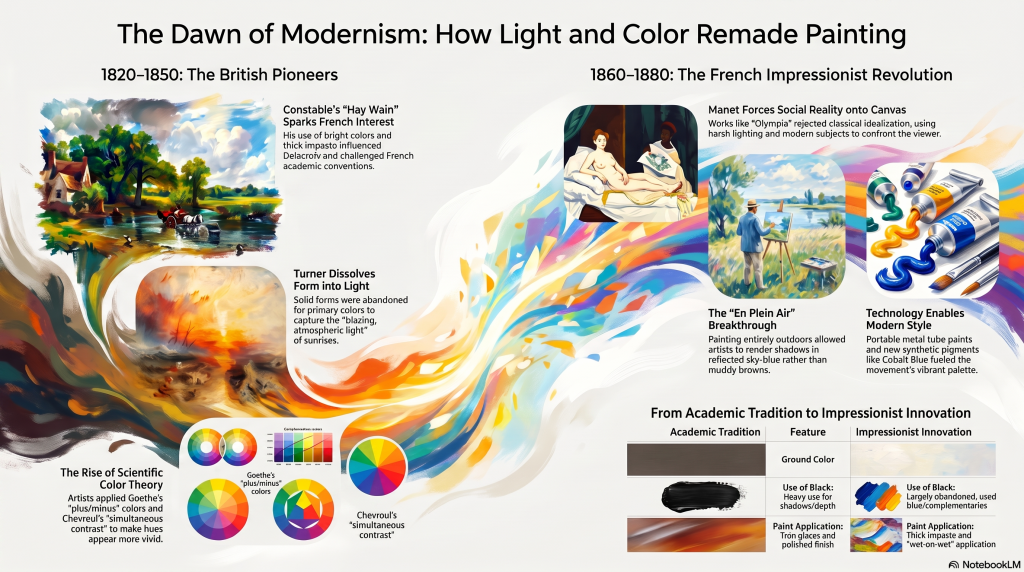
This talk traces Western painting’s transformation from Constable and Turner’s innovations in colour and light, through their influence on French Romanticism, Impressionism, and Post-Impressionism, to the chromatic explosions of Fauvism. Constable’s Hay Wain electrified Paris in 1824; Turner pushed paint toward pure atmospheric abstraction. The Impressionists revolutionised technique and subject matter, while Cézanne, Seurat, van Gogh, and Gauguin each drove painting further. Matisse and Picasso ultimately shattered convention entirely. Roger Fry’s landmark 1910 London exhibition, Manet and the Post-Impressionists, brought these seismic developments to British audiences, confirming that Western painting had permanently changed course.
(My YouTube talk will be published on 29 May 2027)
My notes on Impressionism Post-Impressionism and Fauvism
An entertaining conversation about Impressionism Post-Impressionism and Fauvism created by Google NotebookLM from my notes:
Most of us learned that modern art “just happened” — some painters got bored, threw out the rules, and started making weird things. The real story is far stranger, more competitive, and more politically charged than that. Here are the takeaways that genuinely surprised me.
A British Landscape Painting Started the French Revolution in Art
John Constable’s The Hay Wain was mocked in England for its flecks of white paint — critics called them “snow” or “distemper.” French audiences gave it a gold medal at the 1824 Paris Salon. Eugène Delacroix was so struck he repainted passages of his own Salon entry that same year. The irony? The scene depicted — labourers hand-cutting corn — was already 20 years obsolete when Constable painted it. Radical technique, nostalgic sentiment.
Turner Was Doing Colour Theory, Not Just Pretty Sunsets
Turner owned Goethe’s Theory of Colours and structured two companion paintings directly around its oppositions. Meanwhile in Paris, Michel Chevreul was proving mathematically that colours change appearance depending on their neighbours — a discovery that would directly shape Impressionism, Neo-Impressionism, and Orphism. These painters weren’t following instinct. They were running experiments.
“Impressionism” Was an Insult That Stuck
The name came from a sarcastic review. Critic Louis LeRoy mocked Monet’s Impression, Sunrise in a satirical magazine. The artists didn’t adopt the term until their third exhibition, in 1877. Before that, they called themselves the Anonymous Society of Painters, Sculptors, Engravers. Not exactly a rallying cry.
Manet Led a Revolution He Refused to Join
Manet is routinely called the father of Impressionism. He never exhibited at a single one of their eight group shows. He socialised with them, inspired them, and his work provoked the same outrage — but he kept his distance from the movement he effectively midwifed.
“The whole of modern art is sometimes traced back to Olympia because of the way it confronts the viewer with the reality of prostitution.”
Every detail — the orchid, the black cat, the discarded slipper, even the name Olympia — was a coded announcement. Nothing was accidental.
Picasso Made *Les Demoiselles* to Beat Matisse
When Gertrude Stein hung Matisse’s Joy of Life in her Paris dining room — the weekly gathering point for the avant-garde — a then-unknown Picasso saw it repeatedly.
“By all accounts the painting’s fame was too much for the terribly competitive young Spaniard. He determined to outdo Matisse.”
The result was Les Demoiselles d’Avignon, 1907. Newsweek later called it the most influential artwork of the previous hundred years. Rivalry built modernism.
Cézanne Worked in a Rainstorm Until He Collapsed
He painted alone near Aix, indifferent to critics, resistant to influence. At 67, caught in a storm while working in a field, he continued for two hours in the rain before collapsing on the way home. He died days later of pneumonia — still searching for new ways to represent reality. Both Picasso and Matisse studied his Bathers closely. It fed directly into Cubism.
Virginia Woolf Said Human Character Changed in December 1910
She wasn’t being metaphorical about politics or suffrage. She meant Roger Fry’s exhibition Manet and the Post-Impressionists at London’s Grafton Galleries — the show that introduced British audiences to Gauguin, Van Gogh, Matisse, and Cézanne at scale. Kenneth Clark later judged Fry “incomparably the greatest influence on taste since Ruskin.” One exhibition rewired a culture.
A century of painting upended by rivalry, scientific obsession, critical insults, and one very rainy afternoon in Provence. Which raises a question worth sitting with: if the artists who changed everything were mostly ignored or mocked in their own time, what are we dismissing today that future generations will call revolutionary?
27-11 Sorolla – Spanish Master of Light
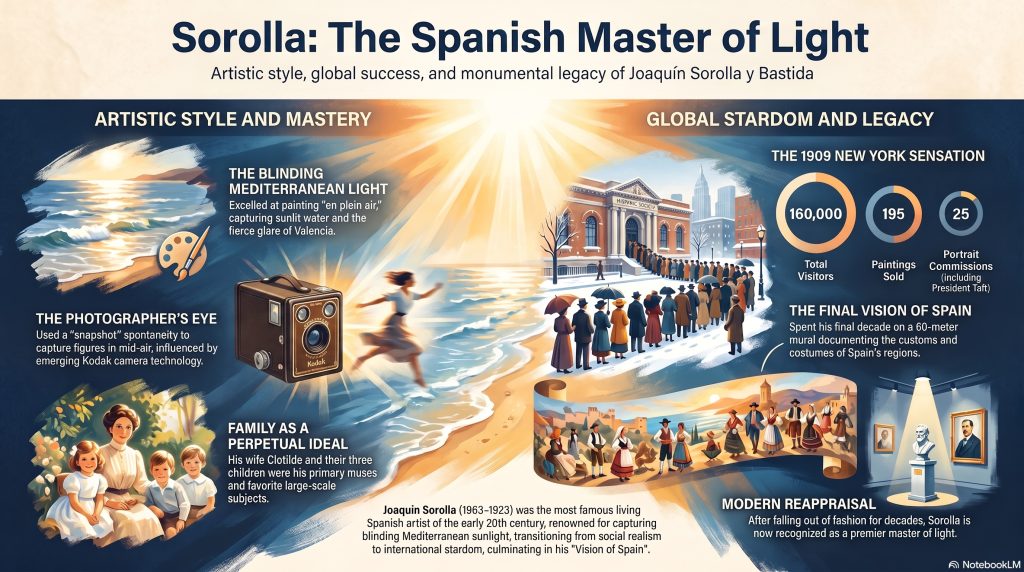
Joaquín Sorolla y Bastida was a prominent Spanish painter of the early twentieth century, celebrated for his exceptional ability to capture vibrant Mediterranean light and social themes. Rising from a modest background in Valencia, he achieved global fame through ambitious canvases that depicted everything from seaside landscapes and intimate family portraits to poignant scenes of human suffering. This talk highlights his technical mastery, noting how he blended a photographer’s precision with an impressionistic touch to document the customs and people of Spain. Sorolla’s career culminated in a massive mural commission for the Hispanic Society of America, an intensive project that defined his final active years. Despite a period of declining popularity after his death in 1923, recent major exhibitions have restored his reputation as a master of light and a central figure in modern Spanish art history. This overview serves as a comprehensive look at his artistic evolution, his devotion to his family, and his enduring legacy.
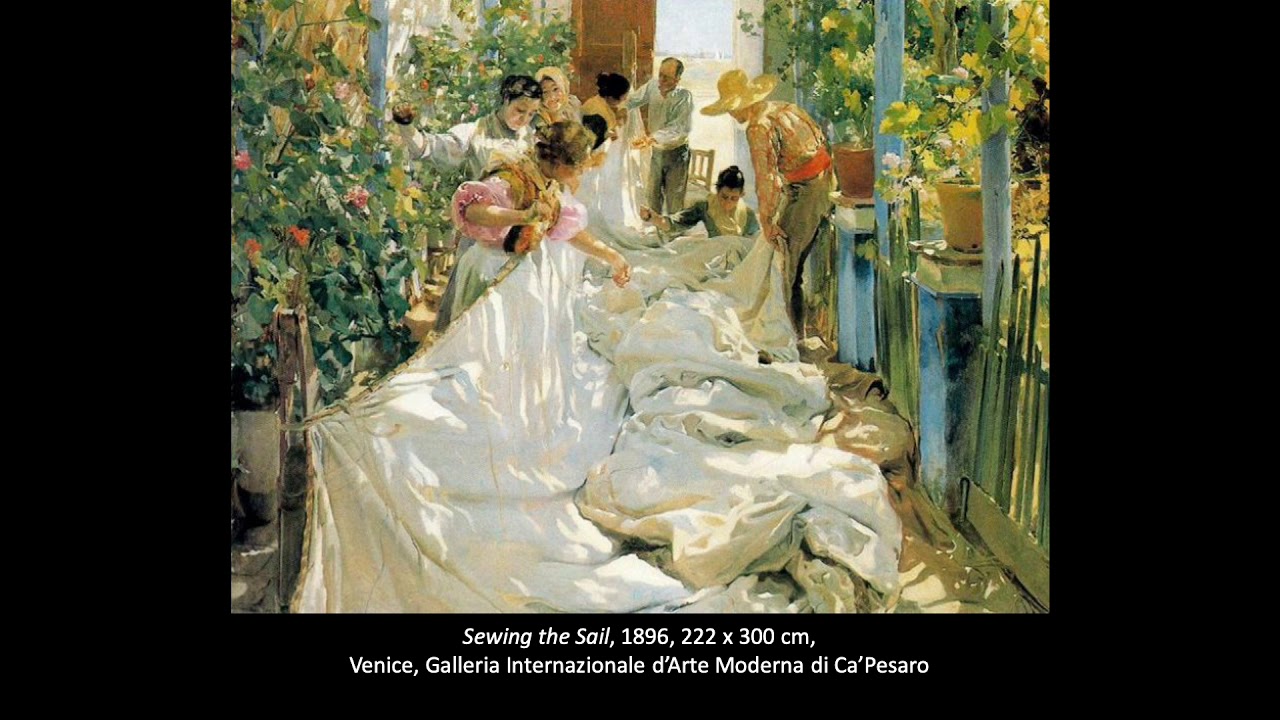
A conversation about Joaquin Sorolla created by Google Notebook from my notes:
The Forgotten Superstar
In the biting winter of 1909, a cultural phenomenon occurred in New York City that remains almost inconceivable in the modern art world. Thousands of people queued around the block, standing patiently in the snow outside the Hispanic Society of America, for a glimpse into a world that felt like the very antithesis of a Manhattan winter. They were there to see the work of Joaquín Sorolla y Bastida. In a single month, 160,000 visitors flooded the galleries, captivated by a Mediterranean light so visceral it seemed to radiate heat from the canvases.
Yet, despite this staggering global celebrity—a fame that saw him conquer Paris, Madrid, and Chicago—Sorolla’s name largely evaporated from the international consciousness following his death in 1923. The “Master of Light” was cast into the long shadows of history as the art world’s fickle gaze shifted toward the cool, cerebral avant-garde of Surrealism and the burgeoning abstractions of Dalí and Miró. Sorolla’s sun-drenched naturalism was suddenly dismissed as a relic of a bygone century.
How could an artist of such technical ferocity and public appeal be relegated to a footnote for nearly a hundred years? A recent, major reappraisal at the National Gallery in London has finally begun to pull him back into the light, inviting us to rediscover an artist who was not merely a painter of “pretty” beach scenes, but a technical titan who captured the Spanish soul with a photographer’s precision and an Old Master’s soul.
The World’s Greatest Living Painter (And Then He Wasn’t)
At the turn of the twentieth century, Sorolla’s career was less a climb and more a vertical ascent. He was a “prince” of painting, showered with gold medals in every major European capital and received in Chicago as an international icon. By the time he reached London’s Grafton Galleries in 1908, he was unabashedly advertised as “The World’s Greatest Living Painter.” His New York triumph was the most successful exhibition ever given by a foreign artist in America; he sold 195 paintings in weeks and was even invited to the White House to paint President William Howard Taft.
As one contemporary critic noted, “By 1900 he was considered the most famous of all living Spanish artists… regarded as the leading modern Spanish painter.” However, Sorolla’s legacy eventually succumbed to what art historians often call the “biographer’s curse.” Unlike the tortured, scandalous geniuses who dominated the headlines of the 1920s, Sorolla led a remarkably stable, “hugely happy” life. He was a devoted husband and father, devoid of the tragic eccentricities that fueled the legends of his successors. When the art world pivoted toward the experimental and the abstract, Sorolla’s domestic stability and commitment to naturalism were misread as a lack of depth, leaving his work largely confined to his former home—now the Museo Sorolla—in Madrid.
The Secret is in the Sand: A Bravura Physicality
To understand Sorolla, one must understand the sheer physicality of his plein air technique. He did not merely observe the Valencian coast; he embedded himself within it. He was known to position massive canvases directly at the water’s edge, battling the wind and the glare to capture the fleeting “tonal relations” of the Mediterranean. This was a “bravura performance” of paint: his strokes were not merely applied, but dashed, smeared, and scrawled onto the canvas, sometimes straight from the tube.
The commitment to authenticity was literal. To this day, the thick impasto of many of his original canvases contains actual grains of sand from the beach, forever trapped in the dried oil. This wasn’t just visual representation; it was a sensory capture of a moment. He possessed an extraordinary technical ability to represent the weight of light on water and the complex “diffraction of light” through wet skin, showing bodies under water with a clarity that still defies photographic imitation. As he once wrote to a friend, he sought to approach the “truth” of sunlight, echoing Monet’s sentiment that painters can never truly reproduce it, only approximate its brilliance.
The “Kodak” Influence and the Mid-Air Snapshot
Sorolla possessed what many described as a “photographer’s eye.” He was deeply influenced by the advent of the Kodak camera and the “snapshot,” which revolutionized the visual imagination of the early 1900s. While he always painted direct from nature rather than from stills, the camera gave him the courage to attempt what had once been unthinkable.
In his 1907 work Skipping Rope, La Granja, painted at the royal palace’s “Fountain of the Snail,” he captured his daughter Elena suspended in mid-air. Before the high-speed shutter, such a depiction of motion was nearly inconceivable for a painter. Sorolla achieved this with a spontaneous, high-energy brushwork that functioned like a mechanical shutter. This speed was his competitive edge; he was known to capture the full essence of a sitter in a portrait in just two hours—a “spontaneous approach” intended to compete with the legendary technical speed of Velázquez.
A Muse Named “Treasury Minister”
The bedrock of this relentless output was his wife, Clotilde García del Castillo. She was his “perpetual ideal,” serving as muse, confidant, and—in Sorolla’s own affectionate terms—his “Treasury Minister.” Their correspondence was a lifelong dialogue of passion; even when apart, he wrote to her daily, often enclosing a flower. In one powerful letter, he confessed:
“All my love is focused on you. Despite my great love for our children, you are more, much more than them for so many reasons that there is no need to mention. You are my body, my life, my mind, my perpetual ideal.”
Clotilde’s image permeates his oeuvre. In the tender, monumental Mother, Sorolla experimented with a “symphony in white,” perhaps inspired by Whistler’s famous compositions, to signify purity and domestic peace. This happy foundation allowed him to avoid the distractions of scandal, focusing his entire being on the technical mastery of his craft.
The “Vision of Spain” That Cost Him Everything
The peak of Sorolla’s career arrived when Archer Huntington commissioned him for a monumental project for the Hispanic Society: a 60-meter mural series titled Vision of Spain. It was intended to be his legacy—a definitive capture of the authentic costumes and customs of the various Spanish regions.
But the project became a grueling, decade-long odyssey that physically consumed him. Sorolla traveled tirelessly across the peninsula, often forcing locals to pose in ancestral headdresses and costumes that were already vanishing from daily life. The intensity of the work and the constant travel drained him of his vitality. He lacked the stoic temperament of his heroes, famously reflecting on his own psychological decline:
“Anxiety is what most consumes me in life. I don’t have Velázquez’s phlegm, maybe that [is] where his perfection and my lack of it lies.”
The “great project” eventually claimed his health. In 1920, while at home, he suffered a debilitating stroke that ended his career. He died three years later and was buried with the honors of a state hero, but the world had already moved on. When the murals were finally installed in 1926, they were greeted with indifference by a generation now obsessed with the avant-garde.
Beyond the Beach: The Dark Power of Social Realism
It is a common mistake to view Sorolla only through his sun-drenched beach scenes. His rise to fame was actually built on a foundation of “dark power” and social realism. Before he mastered the Mediterranean light, he established his technical dominance through harrowing examinations of Spanish life, such as Sad Inheritance!—which depicted disabled children being led to the sea—and Another Marguerite!, a striking image of a woman in shackles.
In works like And They Still Say Fish is Expensive!, inspired by the “wretched lives of fishermen” described by novelist Vicente Blasco Ibáñez, Sorolla proved his mastery of the “formal rigors of naturalism.” These early, heavy-themed works were not outliers; they were the grueling technical flexes that allowed him to eventually handle the complex tonal relations of his later beach scenes. He had to master the shadows of the fishing hold before he could truly own the sun on the shore.
Conclusion: Reimagining the Master
Joaquín Sorolla was a rare bridge between the tradition of the Spanish Old Masters and the modern visual language of the twentieth century. He saw the world with the spontaneity of a photographer but executed it with a technical soul that reached back to Goya and Velázquez. He captured the brilliance of the Mediterranean with an audacity that remains unrivaled, yet he never lost the gritty, social authenticity of his Spanish roots.
As we reimagine his place in art history, Sorolla stands as a vital reminder of how artistic “fashion” can obscure true genius. His return to the spotlight prompts a final, provocative question: in our current age of fleeting, digital images, what other masters are currently waiting in the shadows for their own moment of rediscovery?