24-01 Photography – The Art of Victorian Photography
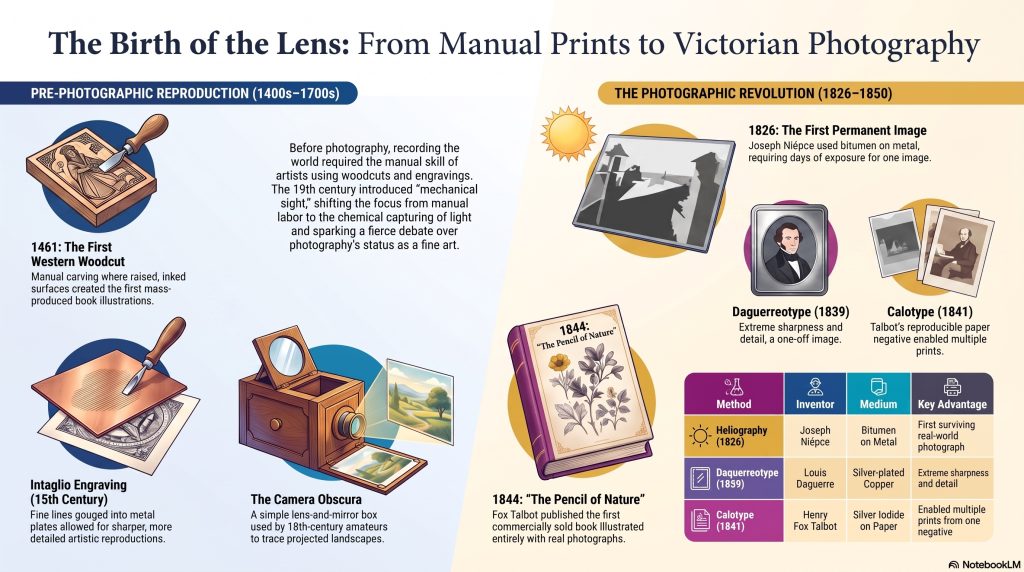
Photography was invented simultaneously in France and Britain in 1839, with Louis Daguerre’s daguerreotype and William Henry Fox Talbot’s calotype offering radically different but equally revolutionary methods of fixing a light image on a surface. From the outset, the new medium posed urgent questions about its relationship to art: was photography merely mechanical recording, or could it embody aesthetic vision and emotional truth? Pioneer photographers quickly demonstrated its expressive range, from the documentary portraits of Julia Margaret Cameron to the landscape studies of Carleton Watkins and the haunting Civil War records of Mathew Brady. By the early twentieth century, Alfred Stieglitz championed straight photography—sharp, unmanipulated images that embraced the medium’s unique properties—and promoted it as a fine art through his galleries and publications. This chapter traces the history of photography as an art form through illustrated talks spanning its invention to the digital age.
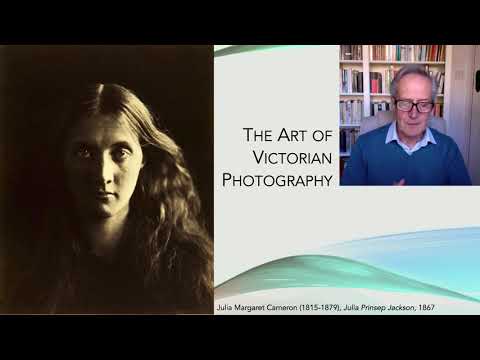
My notes on Victorian Photography and art
A conversation on the Art of Victorian Photography created by Google Notebook from my notes:
1. Introduction: The Magic of the “Fixed” Shadow
In our contemporary age of digital saturation, where the democratization of the image allows for the capturing of a thousand “perfect” moments in a single afternoon, it is difficult to fathom a world where reality could only be preserved by the human hand. Before the mid-19th century, the recording of our existence was a laborious endeavor, tethered entirely to the skill of the artist, the engraver, and the woodblock cutter. To possess a likeness was to command a person’s hand to translate the world onto a surface.
The arrival of the photographic revolution shattered this monopoly. What began as an alchemical mystery in the chemist’s crucible quickly became an enormous influence on how Victorians perceived the very fabric of their reality. It was a medium that promised the “sun’s agency,” yet its birth was mired in hostility, chemical struggle, and accidental erasures. Beneath the sepia-toned surface of Victorian history lie five surprising truths about the “fixed shadow” that forever altered the discerning eye of the connoisseur.
2. The Invisible City: Why the First Photo of a Person was an Accident
To look upon Louis Daguerre’s Boulevard du Temple (1838) is to witness a paradox: a bustling Parisian thoroughfare rendered as a silent ghost town. The streets appear strangely deserted, the architecture standing in eerie, solitary grandeur. This was not a city emptied by plague or protest, but a city erased by the limitations of early actinic rays.
Capturing a daguerreotype required a staggering ten-minute exposure time. In the heart of a metropolitan center, the moving traffic and the sea of pedestrians flowed too quickly for the silver salts to record; they became mere phantoms, invisible to the camera’s slow eye.
The Surprising Twist: Amidst this accidental erasure, two figures remain. Near the bottom left corner, a man stands with one foot raised, having his boots polished by another. Because the man and his polisher stayed in one place long enough—the duration of the shine matching the camera’s sluggish requirements—they became the first humans ever recorded for posterity. It is a striking irony that a medium intended to capture the absolute truth of reality began its life by vanishing almost everything that lived and breathed within the frame.
3. Bitumen and Patience: The Photograph That Took Days to Create
While history often crowns Louis Daguerre as the “father of photography,” the title is a matter of fierce debate among historians. The true genesis lay with Joseph Nicéphore Niépce (pronounced ‘nee-say-four nee-eps’), whose View from the Window at Le Gras (1826/27) is the earliest surviving permanent photograph of a real-world scene.
The Physical Artifact: Unlike the sharp, mirrored surfaces we associate with later eras, Niépce’s image was a temperamental object. He used thinned bitumen painted on a metal plate, which acted as a form of automatic engraving when hardened by the sun. The process was so insensitive to light that the image took several days to record. Most remarkably, this pioneer image was not a clear window into the past; it was an artifact that could only be seen by holding the metal plate at a specific angle, tilting it toward the light to reveal the ghostly outlines of the estate.
Upon eventually refining the process into the daguerreotype, Louis Daguerre famously exclaimed:
“I have seized the light – I have arrested its flight!”
He spoke these words upon seeing the success of his own silver-salt refinements, yet the foundational struggle belonged to Niépce, whose bitumen plates remain the true, albeit difficult-to-view, ancestors of every image we see today.
4. The Blue Revolution: Reclaiming Science from Titillation
At a time when many viewed photography as a tool for mere novelty, or worse, as a means of bringing “erotica and titillation” into the Victorian home, one woman used the medium to mount a scientific rebellion. Anna Atkins, a brilliant English botanist, bypassed the standard silver-based methods of her male contemporaries to embrace the cyanotype.
In 1843, Atkins published Photographs of British Algae: Cyanotype Impressions, the first book composed entirely of photographic images.
Analysis: By using this “blueprint” process—invented by John Herschel—Atkins created a series of groundbreaking photograms. Her work was a reclamation of the medium for serious science. At a time when the camera was often dismissed as a toy for producing cheap “novels” in pictures, Atkins demonstrated that photography could document nature with a fidelity that no “artist’s pencil” could ever hope to replicate. It was a “Blue Revolution” that bridged the gap between scientific education and the burgeoning new art.
5. The Hostile Debate: Was it Art or Just a “Machine”?
The emergence of the “fixed shadow” ignited a fierce Victorian conflict: Is photography art? While we view the question as settled today, the critics of the 1850s were armed with formidable intellects and deep-seated prejudices against the mechanical.
The Counter-Argument: The most potent critique came from Lady Eastlake (Elizabeth Rigby) in 1857. Her words carried immense biographical weight; as a pioneer of female journalism and the first woman to write regularly for the Quarterly Review, she was married to Sir Charles Lock Eastlake, the President of the Royal Academy and the first Director of the National Gallery. Lady Eastlake argued that:
- The Absence of Will: The photographer merely “obeys the machine,” lacking the “free-will of the intelligent being” that defines a true artist.
- The Question of Commodity: Because the photographer produces multiple prints, the result is a “commodity” rather than a unique work of fine art.
- Practicality: Photography served practical ends, whereas art should be pursued “mainly for its own sake.”
The Artistic Response: Photographers like Julia Margaret Cameron fought to “ennoble” the medium. To prove the photographer’s mind was in control, she utilized artistic costumes, dramatic lighting, and intentional blurring to add a sense of mystery and romance, directly challenging the notion that the camera was merely a mindless duplicator of facts.
6. The “Pencil” That Required No Lead
In Britain, William Henry Fox Talbot developed the negative/positive process—the “calotype”—which allowed for the infinite reproduction of images. In 1844, he published The Pencil of Nature, a work intended to prove the camera’s utility as both a tool for the virtuoso collector and a legitimate art form.
The Surprising Failure: Though we now revere it as a masterpiece, the book was a commercial failure. Talbot planned a vast number of installments but was forced to terminate the project early due to lack of public interest. Skepticism was so rampant that Talbot felt the need to include a defensive disclaimer to convince readers his “sun-pictures” weren’t just clever engravings in imitation:
“The plates of the present work are impressed by the agency of Light alone, without any aid whatever from the artist’s pencil. They are the sun-pictures themselves, and not, as some persons have imagined, engravings in imitation.”
Talbot had to explicitly explain what seems obvious today: that the camera depicts entire groups of figures “all at once,” regardless of their number, by the power of light alone.
7. Conclusion: From the Inaccessible to the Home
The Victorian photographic revolution did more than record faces; it dismantled the old order of the visual arts. It put traditional portrait painters out of business and brought the “exotic and erotic” landscapes of the world into the average parlor. Yet, as Lady Eastlake astutely noted, photography ultimately served to “free painting from slavish imitation,” allowing the brush to explore the abstract and the emotional while the camera took over the burden of the “fact.”
As we stand in our own era, grappling with the rise of AI-generated imagery, we are essentially reliving the same rebellion that Niépce, Talbot, and Atkins started. We ask once more: Is it art if a machine assists the hand? History suggests that while the “machine” may take a step forward, the definition of art merely expands to find the human spirit hidden within the new alchemies of the age.Gemini Notebook can be inaccurate; please double-check its responses.
24-02 Pictorialism and Late Victorian Photography

During the mid-nineteenth century, photography underwent rapid commercial and technological growth, evolving from an expensive luxury for the elite into a popular medium for the masses. The introduction of the wet-plate collodion process significantly reduced exposure times, though it required photographers to transport heavy equipment and portable darkrooms to every location. Notable figures like Charles Dodgson and J.J.E. Mayall excelled in portraiture, capturing famous families and British royalty, while the carte-de-visite sparked a global collecting craze known as “cardomania.” Photography also served more somber purposes, such as commemorating deceased children, and fueled a new era of armchair tourism through the distribution of exotic travel landscapes. From the scientific advancements of Frederick Scott Archer to the massive publishing efforts of Francis Frith, these sources illustrate how the medium transformed Victorian social life and historical documentation.
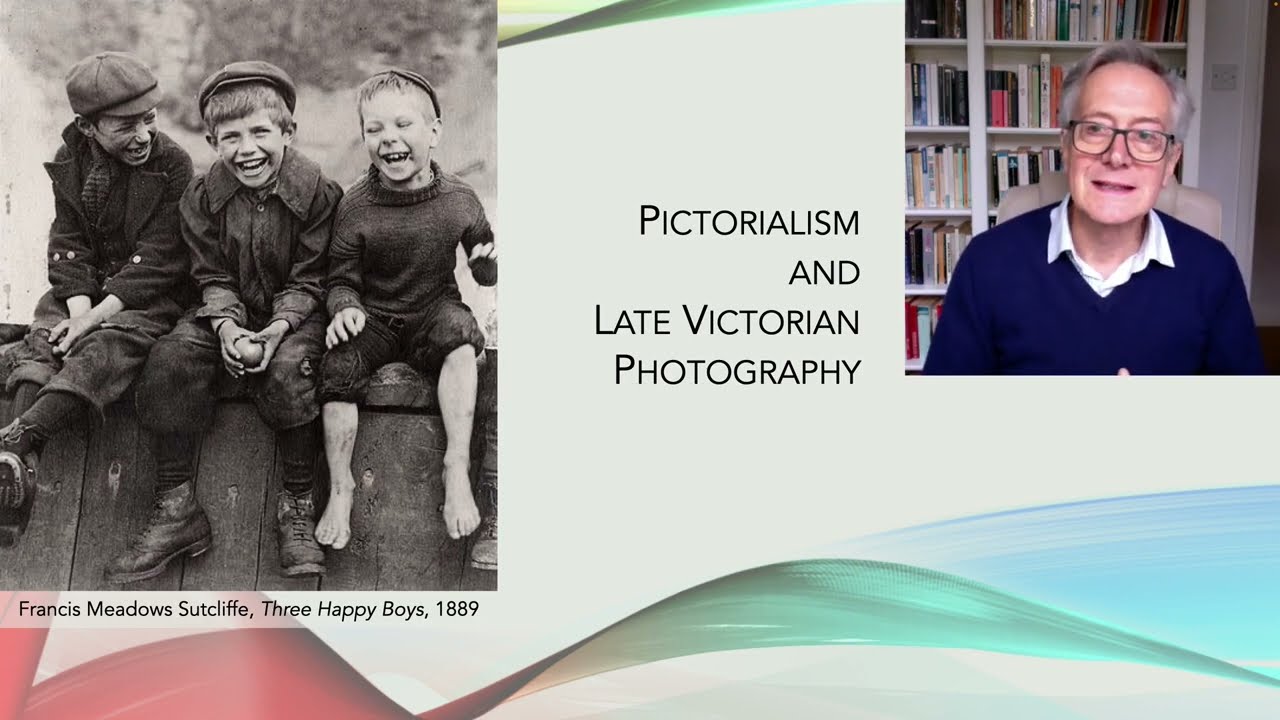
My notes on Late Victorian Photography
A conversation on Late Victorian Photography created by Google Notebook from my notes:
Introduction: The Ghost in the Machine
We are accustomed to viewing the Victorians through a veil of sepia-toned solemnity—a race of stiff-collared, humorless figures frozen in time. Yet, the reality of the 19th-century darkroom was a place of feverish, dangerous alchemy. To obtain a “likeness,” the Victorian subject entered a space that smelled of ether and risk. Photographers handled substances like potassium cyanide to fix their fleeting images; a mere 200-300mg was a fatal dose, a whisper of mortality inherent in the pursuit of immortality. This was not a passive hobby but a visceral engagement with a machine that demanded absolute stillness, often enforced by the cold bite of an iron head clamp. Beneath the rigid exteriors lay a society captivated by the “magic” of the lens, driven by a relatable, human hunger to be remembered.
The “Selfie” is a 19th-Century Obsession
The modern digital self-portrait is often decried as a symptom of contemporary vanity, yet the “selfie” has deep roots in the Victorian high street. As the 1850s progressed, a proliferation of photographic shops democratized the image, snatching portraiture from the exclusive grasp of the aristocracy and placing it in the hands of the masses. For the first time, a shopkeeper or a clerk could “obtain a likeness” for a few shillings, bypassing the expensive, slow-moving brush of the portrait painter.
This sudden accessibility triggered a cultural backlash that mirrors our own modern anxieties. The French poet Charles Baudelaire famously recoiled at the sight of a society rushing toward the daguerreotype, fearing that the soul of art was being traded for mere mechanical reproduction.
“Our squalid society has rushed, Narcissus to a man, to gloat at its trivial image on a scrap of metal.”
This Narcissus impulse is not a byproduct of the smartphone; it is a fundamental human trait. The Victorian “scrap of metal” was simply the first mirror that allowed the common man to gloat at his own permanence.
The “Torture” of the Early Portrait Studio
Stepping into a portrait studio in the 1840s and early 1850s was less an artistic session and more an endurance test. Before Frederick Scott Archer’s 1851 wet-plate collodion process reduced exposure times to a few seconds, the earlier daguerreotype and calotype methods required subjects to remain motionless for several grueling minutes. To combat the inevitable “valuable result” of a blurred face or the loss of fine detail in a lace collar, studios utilized physical restraints. The head clamp, a heavy iron stand hidden behind the sitter, was a cold necessity used to bolt the human form into place.
The satirical magazine Punch delighted in mocking this discomfort. An 1855 cartoon titled “Interesting Group Posed for a Daguerreotype” showed a family in rigid anticipation; the second panel, “Interesting and Valuable Result,” depicted a terrifying, ghostly smudge—the consequence of a single involuntary twitch. The irony was profound: to achieve a lifelike image, one had to mimic the stillness of the grave. Yet, despite the physical “torture,” the demand never wavered. The Victorian family prized the record of their existence far above the temporary pain of the clamp.
“Cardomania” and the First Viral Celebrity Culture
In 1854, André-Adolphe-Eugène Disdéri patented a method for taking eight separate photographs on a single glass plate. This innovation gave birth to the carte-de-visite, a small photographic visiting card that became the 19th century’s first viral medium. The trend exploded in 1859 after portraits of Napoleon III were distributed in this format, followed closely by the British Royal Family.
When John Jabez Edwin Mayall produced his 1860 portraits of Queen Victoria and Prince Albert, he ignited a craze known as “cardomania.” The scale of this industry was staggering:
- Economic Might: Mayall, a chemist by training, produced over half a million “cartes” annually, generating an income of £12,000 a year—a fortune for the era.
- Social Following: Victorian households curated elaborate albums, trading cards of friends and family alongside purchased portraits of celebrities like Charles Dickens.
This was the nineteenth-century “follow.” Collecting these scraps of cardstock allowed the middle class to participate in a shared visual culture, building a network of images that connected the domestic parlor to the steps of the palace.
Memento Mori—The Poignant Necessity of Death Photography
To modern sensibilities, the Victorian practice of post-mortem photography—photographing the dead—seems morbid, even macabre. However, this practice was a sacred necessity in a society suffused with death. Statista data reveals a harrowing reality: in the mid-19th century, child mortality was so high that approximately one in three children did not reach their fifth birthday.
In a world where many families had no other image of their child, the camera offered a final, desperate chance to capture a “likeness” before the earth claimed it. These “memento mori” images often involved propping a deceased infant against a stand or arranging them to appear as if in a deep sleep. While unsettling to us, these portraits were intended to “blunt the sharpness of grief.” In an era of fashionable mourning, made iconic by the bereaved Queen Victoria, these photographs served as vital relics, turning a technical record into a permanent vessel for love and loss.
The “Sin” of Commercialism and the Birth of Pictorialism
As photography became a lucrative high-street trade, a schism formed between those who viewed the camera as a tool and those who claimed it for art. Roger Fenton, a founding father of the Photographic Society, eventually recoiled from the medium’s commercial success. As the son of a wealthy banker and Member of Parliament, Fenton’s elite status allowed him a luxury his peers did not have: the ability to prioritize “purity” over profit. He believed a true artist should not “soil” himself with the “sin of exploiting talent commercially.”
This tension reached a boiling point in 1862 when the International Exhibition in London categorized photography with “machinery and tools” rather than fine art. Disillusioned, Fenton sold his equipment and returned to the law. This perceived “slighting” of the medium gave rise to the Pictorialism movement and groups like “The Linked Ring.” These artists sought to reclaim photography by intentionally manipulating their images—using soft focus and textured papers to convey “emotional intent” rather than a straightforward record. They were the first to argue that the photographer’s vision mattered more than the machine’s precision.
Conclusion: A Mirror Held to the Past
The Victorian era established the visual language of the digital age. From Francis Frith, who hauled 20×16 inch glass plates across the Nile Valley to provide “armchair tourism” for a curious public, to John Thomson’s pioneering social documentary, the 19th century used the lens to map the world’s beauty and its burdens. Thomson’s poignant 1877 study of London’s “Crawlers”—impoverished women, many of them former middle-class citizens fallen on hard times—demonstrated that photography could be a powerful catalyst for empathy, showing a woman minding a baby all day just for the hope of a cup of tea.
We are not so different from the subjects of those early studios. We remain a society obsessed with our own reflections and the curated lives of others, though we now trade our “likenesses” on scraps of silicon rather than metal or cardstock. We are still, as Baudelaire feared, “Narcissus to a man,” staring into the machine and hoping it will grant us a version of ourselves that never fades. Are we any less bolting ourselves into place, seeking immortality through the flicker of a lens?Gemini Notebook can be inaccurate; please double-check its responses.
24-03 Moving Images
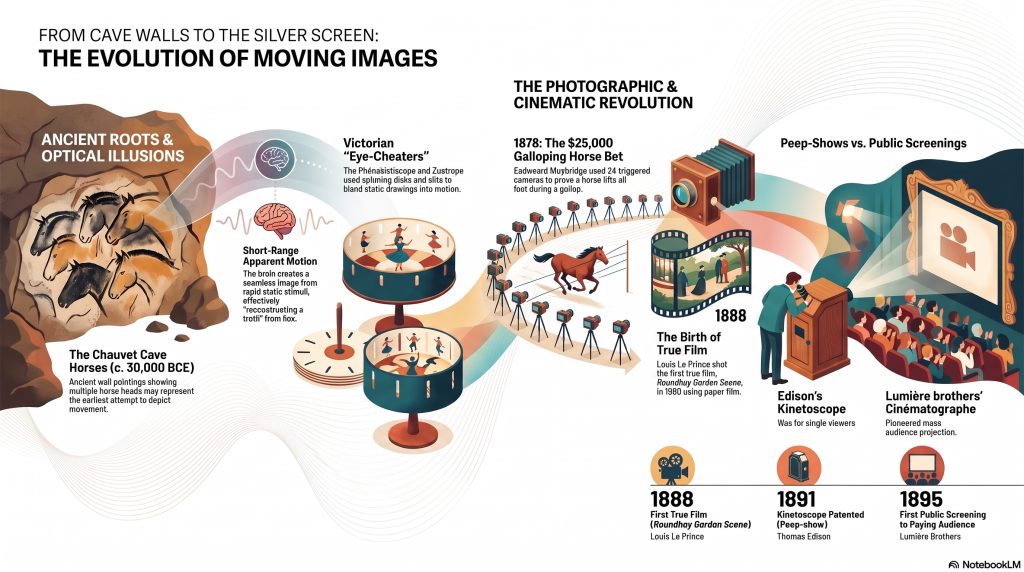
This talk chronicles the evolution of moving images, beginning with ancient attempts to depict motion, such as the paleolithic cave paintings in France and a 5,200-year-old Iranian bowl. It explores how nineteenth-century inventions like the zoetrope and phenakistiscope used a sequence of static drawings to deceive the human brain into perceiving seamless movement. A pivotal moment occurred when Eadweard Muybridge utilized high-speed photography to settle a bet regarding whether a galloping horse ever lifts all four hooves simultaneously. By refining automatic shutters and sensitive emulsions, Muybridge captured thousands of chronological frames that eventually led to the creation of the zoopraxiscope, an early precursor to the movie projector. This historical progression illustrates the transition from static photography to the complex visual systems that define the modern film industry. Ultimately, the talk highlights how the exploitation of short-range apparent motion transformed scientific study and entertainment into a global phenomenon.
A conversation on the birth and devolpment of moving images created by Google Notebook from my notes:
Introduction: The Universal Illusion
We live in an age of constant visual motion. From the flickering screens in our pockets to the massive digital displays looming over our cities, we consume hours of video every day, rarely pausing to consider the fundamental “cheating” taking place. The reality is that we are never actually seeing movement on a screen. Instead, we are being deceived by a sophisticated lie—a series of static images presented with such speed that our minds refuse to see them as anything other than a continuous truth. The history of cinema is not just a history of cameras and projectors, but a narrative of how we learned to exploit a specific cognitive gap in the human experience. We believe we are seeing life in motion, but we are actually being brilliantly cheated.
- Your Brain is the Real Movie Projector
For decades, the popular explanation for the cinematic illusion was “persistence of vision”—the idea that the eye simply blends static images together if they appear quickly enough. However, modern science has corrected this view. It is not the eye that creates the movie; it is the visual system of the brain.
This process is now understood as “short-range apparent motion.” Our brains do not merely blur frames; they actively reconstruct an apparent world view from a rapid sequence of still moments. This phenomenon is closely related to the “Phi phenomenon,” the same illusion of movement created when a series of light bulbs are switched on and off in sequence. We are so hardwired for this reconstruction that we even experience “induced motion,” a curiosity first described by the Greek mathematician Euclid, wherein we perceive ourselves to be moving while sitting on a stationary train because a neighboring train has begun to pull away.
“We now know that it is not the eye but the visual system of the brain that creates an apparently seamlessly moving image from a series of static images as the best analysis of a complex sequence of changing stimuli.” - The $1.1 Million Bet That Froze Time
The leap from hand-drawn “toys” like the zoetrope to the photographic reality of cinema began with a high-stakes wager. In 1872, Governor Leland Stanford of California bet $25,000 that a galloping horse lifts all four feet off the ground simultaneously. To prove it, he hired the eccentric photographer Eadweard Muybridge.
The quest was a technical nightmare. Muybridge initially failed to convince anyone because exposure times were too long, forcing him to have artists redraw his blurry images. He spent years struggling to develop a more sensitive emulsion to “stop” the motion. Even then, he couldn’t solve the problem of triggering multiple cameras in sequence. It was only when Stanford hired a young engineer named John B. Isaacs that the breakthrough occurred. Isaacs implemented a complex setup of 24 (and later 48) cameras triggered by strings.
The endeavor was a financial odyssey; it ultimately cost Stanford $40,000—approximately $1.1 million today—to win his $25,000 bet. The resulting 1878 photographic series, The Horse in Motion, provided the definitive proof. It revealed that horses do indeed lift all four feet, but only when their legs are gathered inward under the body. For centuries, artists like Théodore Géricault had been painting horses “wrong,” depicting them with legs stretched outward in a “flying gallop” that was physically impossible. - The Murderous “Father” of Motion
The man who helped settle Stanford’s bet, Eadweard Muybridge, was a figure of profound contradictions. Born Edward James Muggeridge in Kingston-upon-Thames, he emigrated to America at age 20 and initially found fame not for motion, but for his breathtaking, large-scale photographs of Yosemite Park.
However, his professional heights were frequently shadowed by personal volatility. In 1874, Muybridge tracked down and shot Major Harry Larkyns, his wife’s lover. In a trial that gripped the public, he was acquitted by a jury on the grounds of “justifiable homicide.” This dark chapter did not halt his obsession with the mechanics of life. He eventually moved to the University of Pennsylvania, where he produced a staggering output of over 100,000 images detailing humans—clothed and naked—and animals in motion. He was no longer just a photographer; he was a scientist cataloging the precise, second-by-second positions of the physical world. - The Genius Who Disappeared and the Brothers Who Didn’t Believe
The path to modern cinema is littered with tragic figures and surprising skeptics. Louis Le Prince, a French inventor working in Leeds, shot what is regarded as the first true film, Roundhay Garden Scene, in 1888. Unlike earlier experiments that used multiple lenses, this was captured with a single-lens camera on paper film. Yet Le Prince never achieved the fame he deserved; he vanished mysteriously in 1890, just days before his first public demonstration. Theories for his disappearance range from suicide over debts to a targeted murder orchestrated by his rival, Thomas Edison.
This void allowed the Lumière brothers, Auguste and Louis, to take center stage. In 1895, they presented their Cinématographe—a brilliant 3-in-1 device that functioned as a camera, projector, and printer—to paying audiences. Paradoxically, the very men who launched the global film industry had no faith in its future. They viewed cinema as a mere “novelty” compared to their true passion: color photography.
“The cinema is an invention without any future.” — The Lumière Brothers
By 1905, the Lumières famously dropped out of the film business entirely to concentrate on their “Autochrome” color process, preferring the perfection of a still color plate to the “lie” of the moving image. - The Bloody Dawn of the Newsreel
As the novelty of the Cinématographe wore off, the medium pivoted toward reality, capturing the first news events. This transition immediately revealed cinema’s ability to document the darkest aspects of human history.
In 1896, film crews captured the coronation of Czar Nicholas II in Russia. Four days later, during a public celebration at Khodynka Field, a massive stampede occurred. The crowds, numbering in the hundreds of thousands, rushed for commemorative imperial gifts: a bread roll, a piece of sausage, pretzels, and gingerbread. Rumors had spread that some gift bags contained a cup with a gold coin. In the ensuing chaos, 1,389 people were killed and another 1,300 were injured. When the Czar continued with a scheduled gala at the French Embassy that evening, his reputation was irreparably tarnished. The moving images of the coronation, juxtaposed with the reality of the “Khodynka Tragedy,” contributed to his lasting moniker: “Nicholas the Bloody.” - Conclusion: The Future of the Illusion
This era marked the moment when film moved beyond mere diversion to become a permanent, unflinching witness to the human condition. Yet, this impulse to capture the flow of life—whether in its grandest ceremonies or its most horrific tragedies—did not begin with the flash of a shutter; it is a primal urge that predates the modern world by millennia.
The human desire to represent movement is ancient, stretching back 15,000 years to the flickering horse heads painted on the walls of the Chauvet Cave. It is visible on 5,200-year-old Iranian bowls from the “Burnt City,” which depict a goat jumping toward a tree to eat its leaves when the vessel is rotated. By the 1920s, this ancient impulse had been industrialized, with nearly 4,000 cinemas operating in Britain alone.
From the jumping goat of antiquity to the advanced digital captures of today, the technology has evolved, but the “cheat” remains the same. We are still a species that seeks meaning in a sequence of still moments. The power of the moving image has never resided solely in the lens of the camera, but in the profound willingness of the human brain to turn a series of lies into a singular, moving truth.
Gemini Notebook can be inaccurate; please double-check its responses.
24-04 Straight Photography 1907-1940

This talk provides a look at the historical progression of photography as an art form, specifically contrasting the movements of Pictorialism and Straight Photography. Early practitioners of Pictorialism, such as Gertrude Käsebier, utilized soft focus and manual darkroom manipulation to create painterly, symbolic images that emulated traditional fine art. In contrast, the Straight Photography movement emerged as a rejection of these techniques, championing sharp focus, high contrast, and an honest, unmanipulated depiction of reality. Key figures like Alfred Stieglitz and Paul Strand spearheaded this transition, moving away from romanticized aesthetics toward modernist clarity and social realism. The text further categorizes subsequent styles, including documentary, street, and digital photography, illustrating how technological shifts continue to redefine the medium. Ultimately, these sources serve as an educational guide to the diverse philosophical and technical approaches that have shaped photographic history from the late 19th century to the present.
My Notes on Straight Photography
A discussion on Photography (created by NotebookLM from my notes):
The Rise and Influence of Straight Photography
Executive Summary
Straight Photography emerged in the early 20th century as a direct rejection of the preceding Pictorialist movement. While Pictorialism sought to emulate painting through soft focus, staged scenes, and extensive darkroom manipulation, Straight Photography championed an honest, unmanipulated, and sharply focused representation of the world. Its core principle was to leverage the unique capabilities of the camera—clarity, detail, and realism—to create art, rather than imitate other art forms.
The movement was spearheaded by pivotal figures who defined its trajectory. Alfred Stieglitz marked the transition with his 1907 photograph, “The Steerage,” which abandoned painterly effects for geometric composition and social content. Paul Strand further solidified the aesthetic with his sharply focused, abstract, and documentary-style images. The movement reached its zenith with the formation of Group f/64 in 1932, a collective including Edward Weston, Ansel Adams, and Imogen Cunningham, who advocated for “pure” photography characterized by maximum sharpness and depth of field.
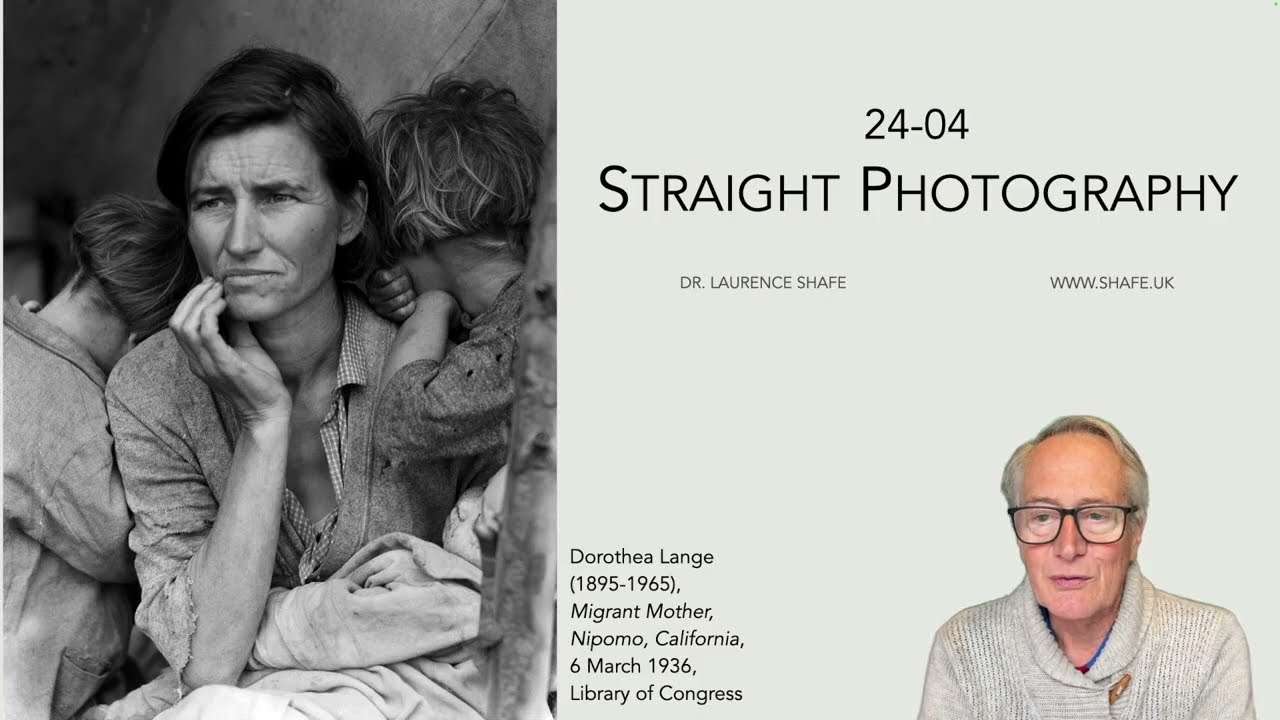
By the mid-1930s, the principles of Straight Photography were adapted for documentary social realism, powerfully exemplified by Dorothea Lange’s “Migrant Mother.” This evolution paved the way for the rise of Street Photography, pioneered by Henri Cartier-Bresson and his influential concept of capturing the “decisive moment.” The legacy of Straight Photography is its successful establishment of photography as a fine art form on its own terms, fundamentally shaping the course of 20th-century visual culture.
——————————————————————————–
1. Defining the Movement: A Reaction to Pictorialism
Straight Photography developed around 1907 as a direct repudiation of Pictorialism, the dominant photographic style of the late 19th and early 20th centuries. The movement’s ethos was founded on creating a work of art through the “direct and honest portrayal of the world,” using photographs that had not been manipulated in the darkroom.
1.1 The Pictorialist Precedent
Pictorialism sought to establish photography as a fine art by emulating the aesthetics of painting and drawing. Its practitioners intentionally created images that were not sharp, objective records of reality.
1.2 The Tenets of Straight Photography
In direct contrast, Straight Photography embraced the camera’s intrinsic ability to capture the world with clarity and precision.
2. The Pioneers and Their Foundational Works
The shift from Pictorialism to Straight Photography was led by visionary artists who redefined the medium’s potential.
2.1 Alfred Stieglitz: The Figure of Transition
Alfred Stieglitz (1864–1946) was a central figure whose career embodied the evolution of photographic styles. Initially a leading Pictorialist, he grew critical of its “decorative softness,” believing it obscured photography’s unique power.
2.2 Paul Strand: Champion of Pure Photography
Paul Strand (1890–1976) was a key pioneer who helped establish the core aesthetic of the movement, advocating for sharp focus and realistic representation.
3. The Apex: Group f/64 and Its Masters
The height of the Straight Photography movement was formalized with the creation of Group f/64, a collective of San Francisco Bay Area photographers founded in 1932. The group’s mission was to promote a modernist aesthetic that rejected Pictorialism and embraced the camera’s ability to capture the world with unparalleled clarity.
The group’s name, f/64, refers to the smallest aperture setting on a large-format camera, which produces the maximum depth of field and sharpness. The group, which included founders Ansel Adams, Edward Weston, and Imogen Cunningham, held meetings and organized exhibitions to advance their vision of “pure” photography. Though it officially disbanded by 1935, its influence was profound.
3.1 Edward Weston (1886–1958)
Weston was a central figure in Group f/64, renowned for his precise, sharply focused images of natural forms, nudes, and landscapes.
3.2 Imogen Cunningham (1883–1976)
A co-founder of Group f/64, Cunningham was renowned for her botanical studies, nudes, and incisive portraits. Her career spanned seven decades, shifting from an early Pictorialist style to the sharp modernism of her peers.
3.3 Ansel Adams (1902–1984)
Ansel Adams became one of the world’s most influential photographers, known for his masterful black-and-white images of the American West. He was a co-founder of Group f/64 and co-developed the Zone System, a methodical approach to achieving precise tonal control.
4. Evolution and Legacy
In the mid-1930s, the principles of Straight Photography were applied to new genres, expanding the movement’s influence and securing its legacy.
4.1 Documentary Social Realism
The Great Depression prompted photographers to use the direct, unmanipulated style to document social issues with stark reality.
4.2 The Birth of Street Photography
The aesthetic of capturing reality directly and spontaneously led to the development of street photography.
5. Straight Photography in the Context of Art History
Straight Photography was a pivotal movement in a long evolution of photographic styles. It established the medium’s artistic legitimacy based on its own unique qualities and paved the way for subsequent developments in documentary, conceptual, and contemporary photography.
The following table summarizes the main art photography styles of the 20th and 21st centuries, placing Straight Photography within its broader historical context.
24-05 Modern Photography
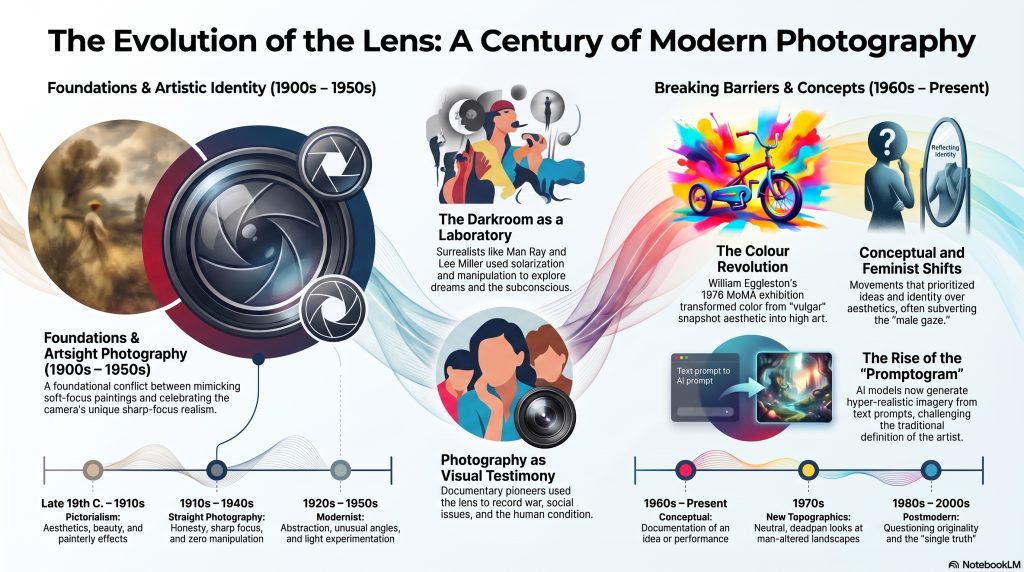
This talk provides a comprehensive chronological overview of modern photography, detailing the evolution of major artistic styles from the late 19th century to the present day. It explores early movements like Pictorialism, which mimicked painting, and Straight Photography, which favored unmanipulated realism, before transitioning into avant-garde approaches like Modernism and Surrealism. The talk further examines specialized genres including Documentary, Street, and Feminist photography, highlighting how these styles address social issues and identity. Technical shifts are also noted, tracing the rise of color photography, the impact of digital manipulation, and the recent emergence of AI-generated imagery. Throughout the talk, key figures such as Man Ray and Dorothea Lange are featured to illustrate how specific artists shaped the medium’s history. Finally, the collection functions as an educational resource, citing a wide range of academic and institutional references to ground its historical analysis.
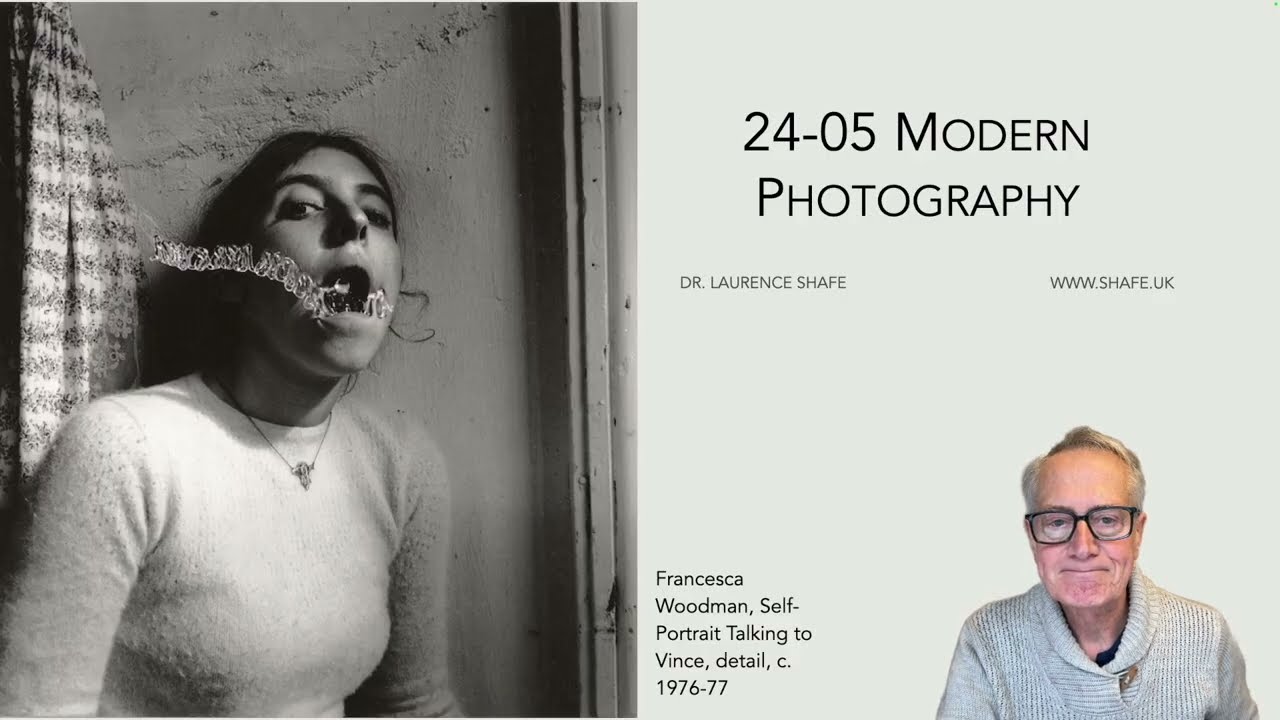
My notes on Modern Photography
A conversation on Modern Photography created by Google Notebook from my notes:
In our current age of the “Instagram aesthetic,” we are drowning in a sea of filtered, mobile, and hyper-curated imagery. It is easy to succumb to the illusion that photography has always enjoyed its status as a high-art form. Yet, for much of the last century, the medium was embroiled in a desperate struggle for legitimacy, caught in a purgatory between being a mere mechanical recorder of reality and an insecure imitator of painting.
Guided by the scholarly insights of Dr. Laurence Shafe, we will trace the evolution of the lens through six pivotal movements. This journey reveals how photography finally broke its chains to the “snapshot” and emerged as a radical laboratory for the human spirit.
1. The Mouse That Invented Surrealism
In 1929, the formidable American model Lee Miller stepped into the Paris studio of Man Ray and changed the course of art history by simply declaring, “I’m your new student.” What followed was a serendipitous collision of biology and chemistry. Darkroom legend holds that while Miller was developing plates, a mouse scurried across her foot. Her startled scream preceded a frantic reach for the light switch, briefly exposing the developing negatives to the glare of the room.
Man Ray acted quickly to save the plates, but the “damage” was a revelation. This accidental exposure birthed the refinement of the solarization technique, transforming the darkroom from a place of mere processing into a site of creative manipulation.
“The brief exposure to light during the development stage results in a tone reversal that gives prints this striking, silvery halo and sooty outline, perfect for the dreamlike quality of Surrealism.”
This breakthrough signaled a fundamental shift: the camera was no longer restricted to recording the world as it appeared. It had become a tool for exploring the subconscious, the irrational, and the dreamscape, proving that the artist’s intervention was more powerful than the camera’s mechanics.
2. The Vogue Model Who Commanded the Truth
Lee Miller’s trajectory represents perhaps the most radical life shift in the medium’s history—moving from the subject of the “male gaze” in fashion spreads to a primary witness of 20th-century barbarism. By 1945, Miller had abandoned the glitz of Vogue for the mud of the front lines, serving as an official war correspondent.
Her work reached its harrowing zenith on April 30, 1945, when she arrived at the Dachau concentration camp. In a brilliant and brutal subversion, Miller applied the principles of “Straight Photography”—a movement defined by sharp focus and a rejection of darkroom trickery—to the horrors of the “Death Train.” While photographers like Ansel Adams used these principles to capture the sublime beauty of nature, Miller turned the sharp, unblinking focus of the lens into a weapon of social realism. Her composition of US medics staring at a dead prisoner forces the viewer to confront the systematic reality of the Holocaust without the softening of artistic artifice.
Miller’s demand to her editor was a command for the ages: “I IMPLORE YOU TO BELIEVE THIS IS TRUE.” Her subsequent act of staging a photograph in Adolf Hitler’s bathtub in Munich, where she pointedly left the dirt of Dachau on the dictator’s bathmat, remains one of the most visceral symbols of political defeat and visual testimony in history.
3. The Secret Life of the “Mary Poppins” Nanny
If Lee Miller commanded our attention, Vivian Maier redefined the medium through her refusal of it. The discovery of Maier’s work is a modern paradox: in 2007, a historian named John Maloof purchased the contents of an abandoned storage locker, only to find a staggering archive of over 150,000 photographs.
To those who knew her in Chicago, Maier was an eccentric, fiercely private nanny—a “real, live Mary Poppins.” Yet, she spent her life with a Rolleiflex around her neck, documenting the “absurdity and dignity of city life” with a master’s eye for composition and humanistic warmth. Maier is the literal antithesis of the modern influencer; she captured the human condition entirely for herself, never seeking an audience. Her posthumous fame serves as a reminder that the most profound observations of the urban vernacular often happen in total secrecy, far from the desire for public validation.
4. Why a Red Ceiling Changed Fine Art Forever
For decades, a rigid hierarchy dictated that black-and-white was for “Art,” while color was the “vulgar” province of advertising and family snapshots. William Eggleston, a hard-partying maverick who famously possessed the “attitude that he was right” even when he occasionally slept through his own exhibition openings, shattered this color barrier in the 1970s.
His 1973 masterpiece, Untitled, Greenwood, Mississippi, 1973 (widely known as “The Red Ceiling”), focuses on a bare lightbulb against an intensely crimson guest room. To achieve this saturation, Eggleston utilized the technically demanding dye-transfer process. This method allows for total control over individual color layers, resulting in hues that are extraordinarily rich and permanent.
“When you look at the dye it is like red blood that’s wet on the wall.”
Eggleston’s “democratic” approach—treating a supermarket aisle or a tricycle with the same reverence as a cathedral—shocked the establishment. When MoMA granted him a solo show in 1976, critics were hostile, yet he had successfully elevated the banal to the level of fine art, proving that color was not just for the commerce of the eye, but for the soul of the image.
5. The Art of the “Deadpan” Landscape
In the mid-20th century, landscape photography was synonymous with the romantic, majestic wilderness popularized by Ansel Adams. However, by the 1970s, the “New Topographics” movement challenged this heroic tradition. Robert Adams became a central figure by turning his lens away from the pristine and toward the “man-altered landscape.”
Documenting the suburban sprawl of Colorado, Adams adopted a “deadpan” style—a neutral, quiet, and dispassionate gaze. By photographing rows of trailers against flat, overexposed skies, Adams exposed the tragedy of the modern West: a landscape once celebrated for its limitless grandeur had been parcelled into uniform, banal lots. This transition from the majestic to the sober documentation of reality forced viewers to look at the geometry of our own settlement and the environmental cost of the “American Dream.”
6. When a Photograph Isn’t About the Subject
By the 1960s, Conceptualism arrived to challenge the very nature of the image, suggesting that the most important part of a photograph is the question it asks, not its technical quality. Joseph Kosuth’s One and Three Chairs (1965) is the definitive example of this shift.
The work juxtaposes a physical wooden chair, a photograph of that chair, and an enlarged photographic print of the dictionary definition of “chair.” Influenced heavily by the philosophy of Ludwig Wittgenstein, Kosuth used the photograph as a vehicle for an idea rather than an aesthetic object. The piece questions whether the “truth” of the chair lies in the object, the image, or the language used to describe it. In this movement, photography became an epistemological tool, prioritizing the concept over the craft.
The Democratic Lens and the Future of the Image
The journey from the soft-focus romanticism of Pictorialism to the cold, conceptual questions of the 1960s shows a medium in constant flux. Today, we stand on the precipice of a new era: the “promptogram.” These are images generated by AI in response to text, presenting a final, radical challenge to our understanding of authorship.
In a machine-learning model, the “artist” is a collective entity—developers, dataset contributors, and the prompt engineer. As we enter this world of hyper-photorealistic, algorithmically constructed realities, we must ask ourselves a difficult question: Does Henri Cartier-Bresson’s “decisive moment”—the act of capturing a fleeting event at the perfect instant—still hold meaning when an image can be summoned from a machine without a human ever having to witness the event? The lens is more democratic than ever, but the “truth” behind the shutter has never been more elusive.Gemini Notebook can be inaccurate; please double-check its responses.