22-01 Nineteenth-Century American Art
Nineteenth-century American art reflects the young nation’s twin obsessions with vast, untouched wilderness and the idea of providential destiny, producing landscape painting of extraordinary ambition and originality. The Hudson River School, led by Thomas Cole and later Frederic Edwin Church, depicted the American landscape as a sublime theatre of divine purpose, with panoramic compositions whose sheer scale was designed to inspire awe and national pride. Winslow Homer brought a harder, more unsentimental eye to American rural and coastal life, while Thomas Eakins applied a rigorous realism to portraiture and scenes of sport and surgery, insisting on anatomical truth over flattering convention. American genre painters such as George Caleb Bingham documented frontier life, river commerce, and electoral politics with lively detail and democratic sympathy. By the end of the century, artists were increasingly drawn to Paris and the Impressionist influences visible in the work of Mary Cassatt and John Singer Sargent announced that American art had joined the international mainstream.
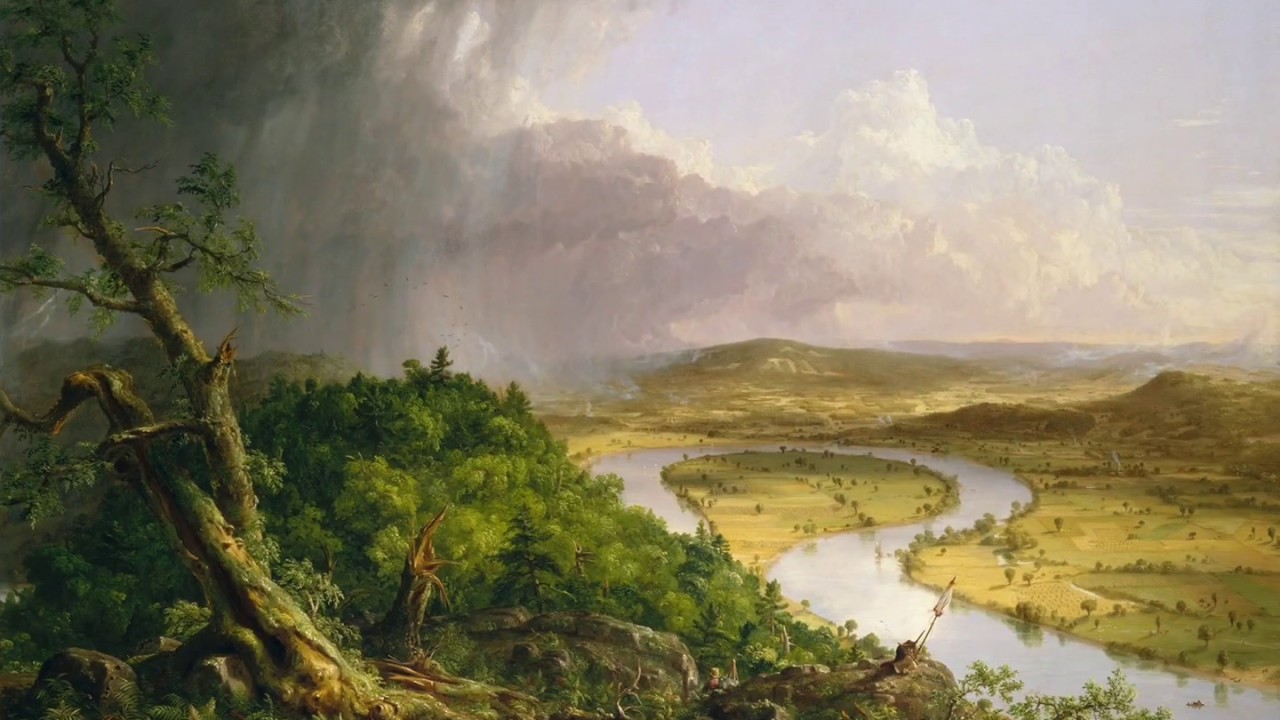
My notes on 19thC American Art
A conversation about nineteenth-century American art created by Google Notebook from my notes:
To the casual observer, the 19th-century galleries of the National Gallery of Art (NGA) can seem like bastions of quietude—places where dignified statesmen and serene landscapes exist in a state of permanent, “stuffy” repose. However, the records preserved in the NGA’s systematic catalogues tell a different story. When we look past the gilded frames and into the technical notes and provenance, we find a chaotic, high-stakes reality where artists balanced scientific ambition with the raw necessity of survival.
By examining the “secret life” of these paintings, we discover that the history of American art is as vibrant and occasionally desperate as the paint itself.
1. The Four-Hour Masterpiece: John James Audubon’s “Cursory” Oils
We often associate John James Audubon with the painstaking, scientific precision of his watercolors. However, the legendary naturalist occasionally traded his precision for “breakneck speed” purely to keep his projects solvent.
A prime example is the oil painting Farmyard Fowls. According to a family legend recorded by his granddaughter, Maria Rebecca Audubon, the piece was painted in a single morning before a 1:00 PM lunch at Minnie’s Land in 1841. Audubon supposedly took up the challenge to prove to a guest that such rapid work was possible. However, the curatorial reality is more complex. While the family lore points to 1841, technical analysis suggests Audubon was likely not painting in oil that late in his life; the work far more closely resembles his “cursory” style of the late 1820s. Today, the painting is in poor condition, its surface “cracked like old china,” yet it remains a testament to his versatility.
While Audubon mingled with the likes of President Andrew Jackson, his relationship with oil painting was fueled by economic pressure. He produced nearly one hundred oils—often at a “breakneck” pace—to secure the funds necessary to support the massive printing costs of the double elephant folio edition of The Birds of America. As he wrote in his journal in 1827:
“I do anything for money now a days.”
2. From Fire Buckets to Bank Presidents: The Blue-Collar Roots of Ezra Ames
In the early 19th century, the line between “high art” and “utility” was often non-existent, blurred by the necessity of the trade. Ezra Ames, who eventually dominated portraiture in Albany, New York, began his career as a literal “jack-of-all-trades” painter.
Before rising to national recognition, Ames accepted nearly any painting job that came his way. His early ledgers include commissions for painting and lettering fire buckets, carriages, fences, mirror frames, and even ear trumpets. This “craftsman” origin did not hinder his rise; rather, it provided the foundation for a career that eventually saw him paint Vice President George Clinton—the first work ever purchased by the Pennsylvania Academy of the Fine Arts.
Ames’ life represents the ultimate “craftsman-to-citizen” arc. He did not merely transition into high art; he became a pillar of the establishment, eventually serving as the President of the Mechanics and Farmers’ Bank of Albany. His career reminds us that the 19th-century American artist was often a shrewd businessman as much as a creative visionary.
3. The Ghost in the Gallery: The Mystery of the “Attributed” Portrait
Art history is rarely a settled science, and “attribution” is a landscape of shifting expert opinions. Even in a collection as prestigious as the NGA’s, some of the most striking images are subjects of intense debate. Consider the portrait of George Southward (?), currently attributed to Joseph Alexander Ames.
This work is a classic case of potential mistaken identity. Scholars such as William Sawitzky and William Davidson rejected the attribution, questioning if the ages of the artist and the sitter truly aligned. Adding to the “ghostly” nature of the work is the confusion with another Massachusetts artist, Nathan Southworth, who shared nearly identical biographical ties to Ames and also traveled to Italy with him in 1847.
The complexity of these cases often stems from the stylistic emulation common in 19th-century studios. Pupils frequently adopted the “Titianesque” color and the “successive glazes” of masters like Joseph Alexander Ames, making it exceedingly difficult for modern curators to distinguish the hand of the master from that of a talented student. These mysteries serve as a reminder that the authorship of a masterpiece can be as elusive as the subject’s expression.
4. High-Tech Time Travel: Seeing Through the Paint
Modern technology allows curators to travel back in time, revealing the “pentimenti”—those hidden changes and abandoned concepts—that lie beneath a finished surface. Using sophisticated tools, the NGA’s conservation department can see through the upper layers of a painting to reveal the artist’s initial struggles.
The Gallery employs specialized equipment for this detective work, including a unit containing a Eureka Emerald 125 MT tube for X-rays. For infrared reflectography, they have utilized Hamamatsu cameras fitted with N214 or N606-10 lead sulphide tubes to find underdrawings. A fascinating bridge between 19th-century art and 21st-century technology is found in Winslow Homer’s Breezing Up (A Fair Wind). The famous infrared reflectogram of this work—which shows Homer’s significant compositional revisions—is actually a composite of frame-averaged sub-images meticulously assembled with Adobe Photoshop. These technical revelations change our relationship with the artist, exposing the “failures” and second thoughts that were originally meant to remain hidden forever.
5. A “Young” Collection with the Deepest Roots
While the National Gallery of Art is a world-class institution, its 19th-century American collection is relatively “young” compared to peers like the Metropolitan Museum of Art. Much of its current strength was built through high-stakes rediscoveries and judicious acquisitions in the mid-to-late 20th century.
A landmark moment occurred in 1971, when the Gallery acquired the second version of Thomas Cole’s famous four-part cycle, The Voyage of Life, which had been rediscovered only a few years prior. Under the guidance of curators like William P. Campbell, the collection grew from a few hundred works to a formidable archive. Today, despite its relative youth, the NGA’s 19th-century American collection represents the single largest holding of any national school in the museum’s entire collection. It is not just a gallery of pictures, but the primary document of the American school’s most vital period.
A Final Thought for the Modern Viewer
The next time you stand before a 19th-century portrait, will you see only a finished, static image? Or will you wonder about the “jack-of-all-trades” who painted it, the technological secrets hidden beneath the imprimatura, and the survival-driven haste of the artist? 19th-century American art is not a collection of silent objects, but a dynamic and richly textured record of national history—one that continues to reveal itself to those willing to look closer.
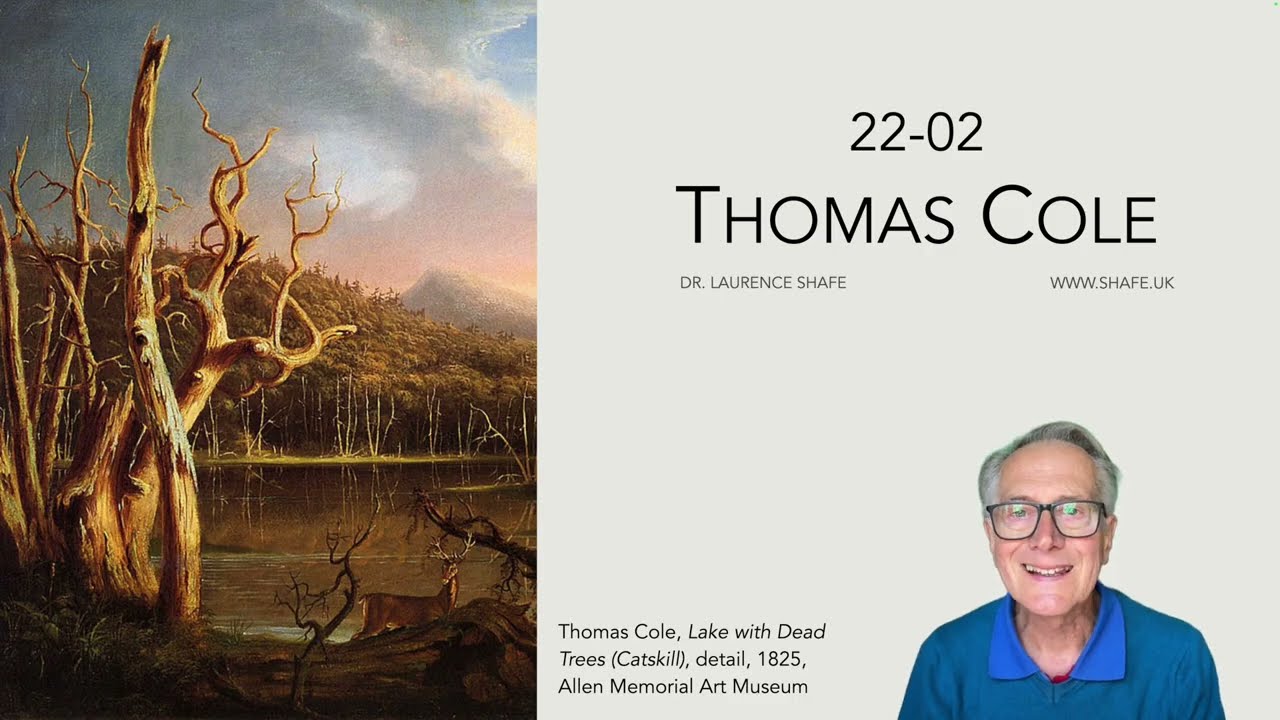
22-02 Thomas Cole
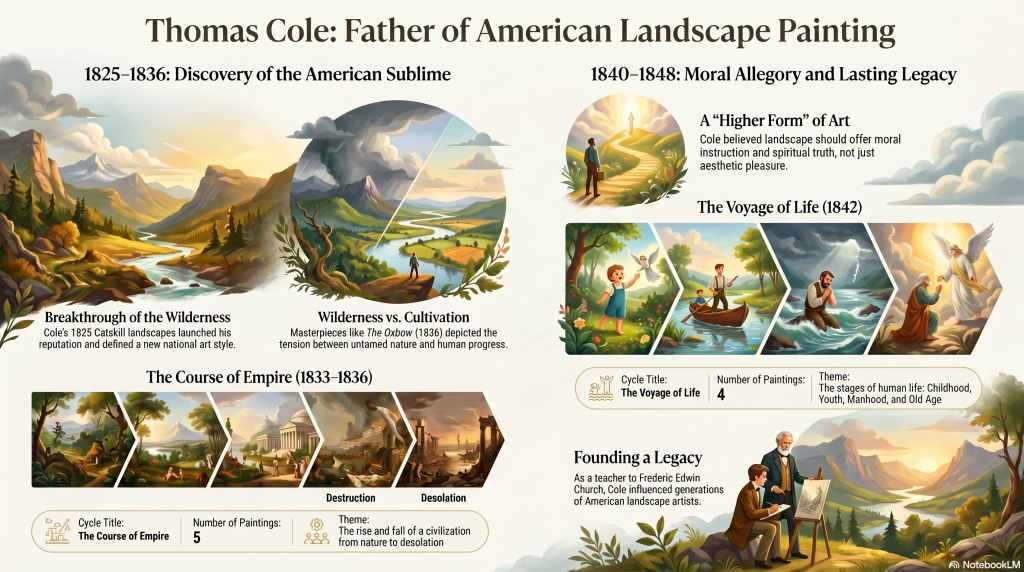
Thomas Cole (1801–1848), English-born founder of the Hudson River School, transformed American landscape painting into a vehicle for national and moral expression. Largely self-taught, he moved from Lancashire to the United States in 1818, finding in the American wilderness an inexhaustible subject. He championed what he called a “higher style of landscape painting,” combining sublime scenery with allegorical ambition. His great series — The Course of Empire and The Voyage of Life — remain among the most ambitious achievements in nineteenth-century American art.
A discussion on Nineteenth-Century American Art (created by NotebookLM from my notes):
Beyond Pretty Landscapes: 4 Surprising Truths About the Man Who Painted America’s Soul
When we think of the Hudson River School, the mind often conjures images of serene, majestic paintings of the American wilderness. These canvases depict a nation in its infancy, a seemingly untouched landscape of sublime mountains and tranquil valleys that has been called a “new Eden.” The artist credited as the founder of this movement, and the visionary behind this powerful image of America, was Thomas Cole.
But behind these beautiful canvases lies the story of an outsider who, precisely because he was an immigrant from industrial England, saw both the divine promise and the inherent dangers of the American experiment with a clarity his native-born contemporaries often lacked. Cole was far more than a painter of idyllic scenery; he was a moral philosopher, a worried proto-environmentalist, and a sharp critic of the very “progress” his young nation so eagerly celebrated. To truly understand his work is to see past the pretty landscapes and recognize the urgent questions he was asking about art, nature, and America’s destiny. Here are four surprising truths that reveal the man who painted America’s soul.
1. He Wasn’t Just Painting Landscapes; He Was Preaching Sermons
Thomas Cole had an ambition that went far beyond simply capturing scenery. He believed landscape painting could be elevated to a “higher form” capable of carrying profound “moral and spiritual depth.” For Cole, a canvas was not just a window onto nature, but a stage for grand ideas about humanity.
His most ambitious works are testaments to this vision. In The Course of Empire, he unleashed a sweeping, five-act drama on canvas, chronicling an entire civilization’s journey from savage nature to decadent glory and, finally, to ruinous decay. Similarly, his four-part series The Voyage of Lifeuses symbolic landscapes to trace the journey of a single human life from the innocence of childhood to the trials of manhood and the peaceful resolution of old age. This was a deliberate effort to transform art into a powerful tool for moral instruction, using the American landscape as his pulpit. His allegorical series The Voyage of Life was praised for this very quality.
As a contemporary New York review of the 1840 exhibition noted:
Mr. Cole has given us more than landscape. He has elevated the art by wedding it to moral instruction.
2. America’s First Great Nature Painter Was an Immigrant Worried About “Progress”
It is a striking irony that the artist who defined the quintessential American landscape was not born in America. Thomas Cole was born in Bolton le Moors, a town in industrial Lancashire, England. In 1818, at the age of 18, he immigrated with his family, settling first in Steubenville, Ohio. He was immediately captivated by the American wilderness, a world away from the soot-stained “industrial towns of northern England” he had left behind.
This deep love for his new home’s untamed beauty fueled a growing anxiety about the impact of industrial progress. Cole was deeply distressed by the construction of the Canajoharie & Catskill Railroad through his cherished valley, a project he lamented as a “ruthless sacrifice” of the landscape. He embedded this concern directly into his art. In his 1836-37 painting View on the Catskill—Early Autumn, the idyllic pastoral scene is quietly disrupted by a symbolic detail: a felled-tree stump in the left foreground. This was no accidental inclusion; it serves as a quiet but firm warning about the encroachment of civilization and the dangers of deforestation.
Cole’s unease with America’s trajectory wasn’t just confined to the physical landscape; it also shaped his artistic ambitions, pushing him toward a “higher style” that patrons weren’t always ready to embrace.
3. Some of His Most Ambitious Paintings Were Failures at First
While Thomas Cole is celebrated today as a master of American art, his visionary “higher style” of painting was not always a commercial or critical success. Patrons and critics, accustomed to more traditional landscapes, were sometimes puzzled by his allegorical ambitions.
A prime example is The Architect’s Dream (1840). Commissioned by the prominent architect Ithiel Town, the painting is a grand fantasy compiling Egyptian, Greek, Roman, and Gothic styles. But Town rejected the finished piece. He had hoped for a landscape where architecture was a pleasing ornament, but in Cole’s vision, the architecture dominates the scene, which Town felt should be “subservient” to the landscape. While some praised its genius, other critics found it “too full of poetry.” The painting remained unsold in Cole’s family until 1949. Similarly, when Cole exhibited his mythological work Prometheus Bound in 1847 as part of a competition to decorate the Houses of Parliament in London, it was deemed unsuitable. Organizers “skied” the painting—placing it high on the wall, limiting its visibility and impact.
4. His Art Was a Grand Dialogue on America’s Destiny
More than anything, Thomas Cole’s work was a profound reflection on the central question facing the young United States: the tension between its untamed wilderness and its cultivated civilization. His art became a grand dialogue on which path the nation should take.
This conflict is most famously visualized in his masterpiece, View from Mount Holyoke, Northampton, Massachusetts, after a Thunderstorm—The Oxbow (1836). The painting is dramatically split into two distinct halves. The left side depicts a wild, storm-lashed wilderness of dark clouds and broken trees. In stark contrast, the right side opens into a serene, sunlit river valley dotted with cultivated farms. This composition is an allegory for the nation’s future, and Cole places himself at the very center of the debate. At the hinge between the two halves, he included a tiny self-portrait, complete with his easel and umbrella, positioning the artist as a mediator between nature and culture.
This theme also underpins his five-part series The Course of Empire, which served as a moral warning to the America of Andrew Jackson. In the nation’s rapid expansion and commercial ambition, Cole saw a dangerous parallel to Rome’s trajectory from glory to ruin.
Conclusion: An Enduring Question
Thomas Cole’s legacy is far more intricate than that of a simple painter of pretty scenery. He was a moralist who embedded sermons in his canvases, a proto-environmentalist who grieved the destruction of the wilderness, and a thoughtful critic of an era defined by unbridled ambition. He used the landscape not just to show what America was, but to ask what it should become.
In his art, Cole asked a question we are still grappling with nearly two centuries later: How do we build a future without destroying the beauty that defines us?
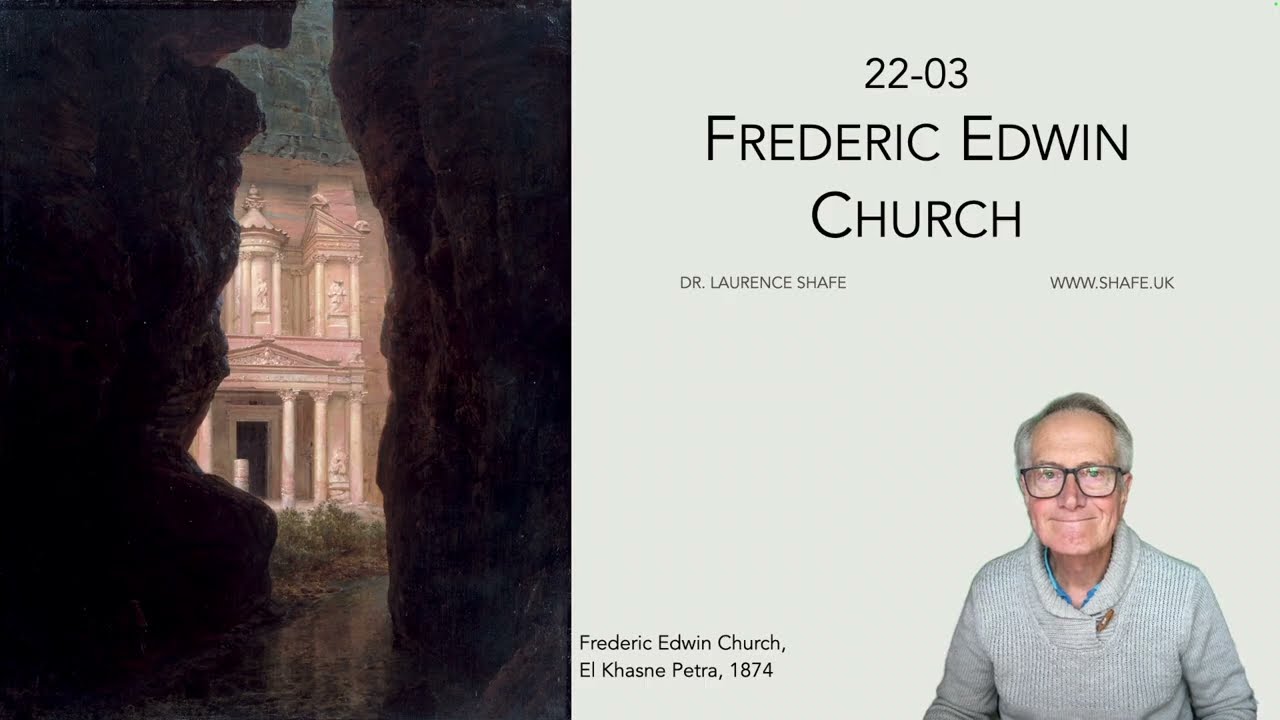
22-03 Frederic Edwin Church

This talk details the life and career of Frederic Edwin Church, a central figure of the Hudson River School who studied under the movement’s founder, Thomas Cole. Born into a wealthy Connecticut family, Church achieved national fame for his monumental, naturalistic canvases of Niagara Falls and vast South American landscapes. His artistic journey included extensive travel throughout the Middle East and Europe, leading to famous depictions of ancient sites like Petra and the Parthenon. Later in life, he designed and resided at Olana, a Persian-inspired estate overlooking the Hudson River, where he continued to paint despite battling rheumatoid arthritis. These documents include a chronological timeline of his most significant works and provide a comprehensive biographical account of his legacy in American art.
My Notes on Frederic Edwin Church
A conversation about Frederic Edwin Church produced by Google Notebook from my notes:
More Than Just Landscapes: 5 Surprising Truths About America’s First Superstar Artist
What did it mean to be a “superstar artist” in the mid-19th century, long before social media, viral marketing, and the 24-hour news cycle? Before artists became brands, fame was built on a different kind of spectacle—one that required showmanship, ambition, and a touch of genius. In an era of American optimism and exploration, one painter rose above all others to become the nation’s first true art celebrity: Frederic Edwin Church. He was, in many ways, the prototype of the modern creative entrepreneur.
Church is celebrated as a master of the Hudson River School, known for his epic, breathtaking landscapes that seemed to capture the very soul of the American wilderness and the exotic grandeur of distant lands. His paintings like Niagara and The Heart of the Andes were more than just art; they were blockbuster cultural events that drew crowds by the tens of thousands, who paid for the privilege of seeing a single canvas.
But behind the serene, meticulously detailed paintings lies the story of a far more complex and modern figure. The real Frederic Edwin Church was a brilliant marketer, a masterful illusionist, and a man whose guiding star was as much science as it was art. His life and methods challenge our assumptions about what it means to be an artist, then and now. Here are five things you probably didn’t know about the 19th-century’s biggest art star.
1. He Marketed His Art Like a Hollywood Blockbuster
Long before movie premieres and red carpets, Frederic Edwin Church pioneered the art of the blockbuster exhibition. He understood that a masterpiece deserved a grand debut, and he revolutionized how the public experienced art by turning his exhibitions into must-see theatrical events.
Instead of showing his major works in crowded salons, Church debuted paintings like Niagara (1857) and The Heart of the Andes (1859) in dramatic, single-painting shows. He charged admission—a novel concept at the time—and the public flocked to see them. Tens of thousands of visitors, from New York to London, paid to witness his creations, often bringing opera glasses to scrutinize the incredible level of detail packed into the enormous canvases.
For The Heart of the Andes, the presentation was pure theater. The painting was displayed in a darkened room, dramatically illuminated by hidden gaslights. It was set within a massive, ornate frame designed to look like a window, complete with curtains. Imagine the gasps from the audience as the curtains were drawn, revealing not a painting, but what felt like a portal to another world. This showmanship wasn’t just selling a painting; it was selling an immersive experience. The frame acted as a proscenium arch for his masterful illusion, transforming art viewing into a major public spectacle and cementing his status as a wealthy celebrity.
2. His Hyper-Realistic Landscapes Were Masterful Illusions
Church was praised by critics and the public alike for his scientific accuracy and painstaking realism. Viewers felt they could step directly into his scenes. But here lies one of the central contradictions of his work: many of his most famous paintings are not faithful records of a single place, but idealized “composite” landscapes.
Church was a master of synthesis. For works like New England Scenery(1851), The Andes of Ecuador (1855), and The Aegean Sea (1877), he combined sketches and studies from various locations to construct a single, perfect panoramic view that never actually existed in reality. He would assemble mountains, waterfalls, architectural ruins, and diverse flora into one harmonious, imaginary scene. This wasn’t just artistic license; it was a direct application of his guiding philosophy.
He even used this technique for symbolic effect. In his 1855 painting Cotopaxi, which depicts an Ecuadorian volcano, he included lush palm trees in the foreground. These palms do not naturally grow at that altitude near the volcano; Church added them to evoke a sense of paradise—a reference to the Garden of Eden. This is what makes his work so compelling: he was a master of realistic detail who used his skill not just to record the world, but to build a more meaningful, sublime version of it.
3. Science, Not Just Art, Was His Guiding Star
One of the greatest influences on Church was not another painter, but the renowned Prussian naturalist and explorer Alexander von Humboldt. Church owned and avidly read Humboldt’s multi-volume work, Kosmos, which presented a radical new vision of nature as a vast, interconnected system where every element, from the smallest plant to the largest volcano, played a part.
Inspired by Humboldt’s challenge for artists to scientifically portray the “physiognomy” of the Andes, Church made two expeditions to South America. He wasn’t just seeking beautiful scenery; he was on a scientific quest to capture the precise geological and botanical details of different climate zones. His “composite” landscapes were an attempt to paint Kosmos on a single canvas—to show nature not as a snapshot of one place, but as a living, interconnected system.
This analytical, observational approach set him apart from his teacher, Thomas Cole, the founder of the Hudson River School, whose work often leaned more towards moral allegory. Cole, however, recognized his student’s unique gift from the start, once remarking that Church had:
…the finest eye for drawing in the world.
This powerful fusion of art and science was perfectly timed. For a 19th-century American audience captivated by exploration and discovery, Church’s paintings offered more than just a pretty picture—they were a thrilling, seemingly scientific window into the grand machinery of the natural world.
4. He Was a Forgotten Master, Saved by a Lost Masterpiece
Despite being the most renowned American artist of his time, Church’s fame did not last. As artistic tastes shifted towards the end of the 19th century, his highly detailed style was considered old-fashioned and sentimental. By the time of his death in 1900, his work was largely forgotten by the art world.
His legacy may have remained in obscurity if not for the dramatic rediscovery of a lost masterpiece. His 1861 painting, The Icebergs, had disappeared from public view shortly after its creation when it was sold to a private collector in Britain. For over a century, its whereabouts were unknown.
Then, in 1979, the painting was found hanging in a home in Manchester, England. Its subsequent sale at auction for $2.5 million was a stunning event, setting a new record price for a painting by an American artist at the time. This single sale was the catalyst that reignited interest in Church’s work. It prompted museums and scholars to re-evaluate his career, leading to major exhibitions and solidifying his position as a central and indispensable figure in American art history.
5. His Greatest Work of Art Might Be a House
In his later years, as debilitating rheumatoid arthritis made painting on a grand scale increasingly difficult, Church channeled his creative energies into a new, monumental project: his home. Perched on a hill with magnificent views of the Hudson River, Olana is a unique, Persian-inspired mansion that remains his most personal and ambitious creation.
Church was not merely the client; he was the lead designer. Working with architect Calvert Vaux, he was deeply involved in every aspect of the mansion’s creation, from architectural sketches to the elaborate interior stenciling. He treated the entire 250-acre estate as a three-dimensional artistic composition, carefully landscaping the grounds and creating miles of carriage roads to frame perfect, painterly views. He saw this work as a direct extension of his painting, once writing:
“I have made about 1 3/4 miles of road this season, opening entirely new and beautiful views. I can make more and better landscapes in this way than by tampering with canvas and paint in the studio.”
For Church, the act of shaping the earth, framing vistas, and designing a space to live within became the ultimate expression of his artistic vision—a final, living masterpiece.
A Final Thought
Frederic Edwin Church was a showman, a scientist, an illusionist, and an architect—a far more complex figure than his tranquil landscapes might suggest. His genius was not just in painting, but in creating and controlling the entire artistic experience. He meticulously constructed his images with both scientific rigor and artistic illusion (Takeaways 2 & 3), presented them as blockbuster theatrical events (Takeaway 1), and ultimately extended his vision to shape the very land he lived on (Takeaway 5). His fall and dramatic revival (Takeaway 4) complete the picture of a man who was a true world-builder, a prototype for the modern creative who curates every facet of their work and legacy.
It makes you wonder: which of today’s creators are the forgotten masters of tomorrow, waiting for a single rediscovery to reframe their entire legacy?