19-01 Spanish Art – Velázquez & the Spanish Golden Age
Spain produced some of the most psychologically intense and technically brilliant painters in the history of Western art, shaped by a unique combination of Habsburg patronage, Counter-Reformation piety, and a harsh, luminous Mediterranean light. Diego Velázquez, court painter to Philip IV, achieved an unrivalled command of atmospheric perspective and naturalistic observation, influencing painters as diverse as Manet and Picasso centuries later. Francisco de Zurbarán brought a severe, almost sculptural stillness to his religious paintings, while Francisco Goya moves from sparkling tapestry cartoons to the nightmarish Black Paintings that anticipate modern expressionism, making him arguably the most prophetic artist of the nineteenth century. The tradition continues into the twentieth century with Pablo Picasso, Joan Miró, and Salvador Dalí, ensuring that Spanish art remains one of the most vital and original strands in the Western canon. This chapter introduces the great masters of Spanish painting through illustrated talks spanning five centuries of extraordinary artistic achievement.
My notes on Spanish Art – Velázquez & the Spanish Golden Age
An interesting conversation on Spanish Art – Velázquez & the Spanish Golden Age created by Google Notebook from my notes:
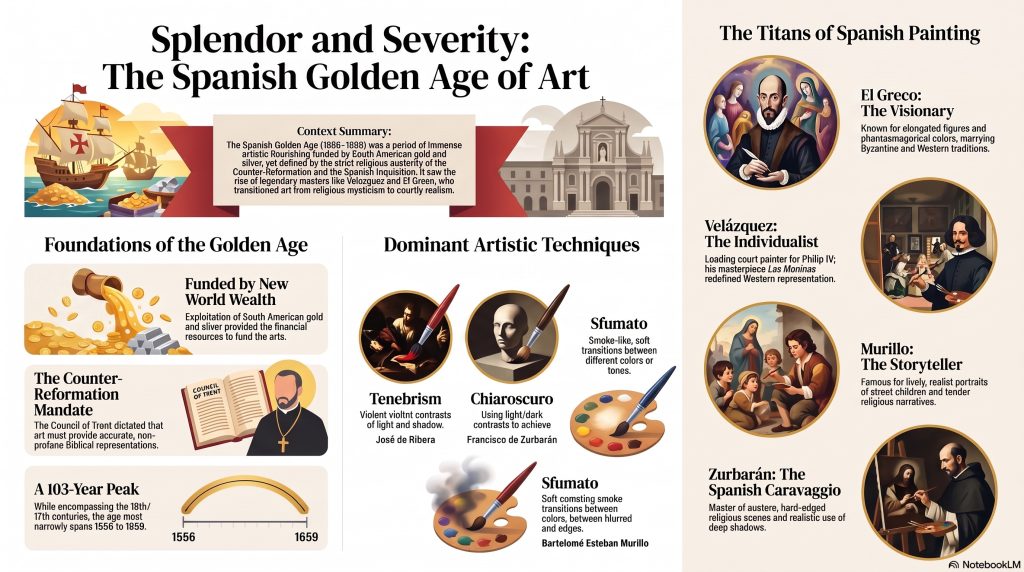
The air in a 16th-century Spanish cathedral was thick with the scent of heavy incense and the weight of a staggering paradox. Under the “icy reserve” of the Habsburg court, a society defined by formal severity and a “strict control of the emotions” was simultaneously underwriting the most expressive, phantasmagorical, and avant-garde art the world had ever seen. Between 1556 and 1659—the heart of the Spanish Golden Age—the “spectral price of the silver fleets” from the Americas funded a cultural explosion that occurred in the very shadow of the stake. It is the great irony of art history: a regime dedicated to the suppression of the soul inadvertently created the pressure cooker for modern genius.
The Bloody Currency of the Arts
The magnificent canvases of this era were fueled by a dark, volatile engine: the exploitation of South American mineral wealth. This “exhaustible wealth” was treated as an infinite spring, yet the human cost was absolute—tens of millions perished in the colonies within the first century of rule due to mistreatment and disease. While this constant stream of gold and silver triggered rampant inflation that would eventually cause Spain to lag behind the Industrial Revolution, it initially funded a massive supply of religious masterpieces.
The wealthiest institutions in the land—the Catholic Church and the Crown—commissioned these works while the Spanish Inquisition conducted public heresy trials. There is a haunting dissonance in the fact that the same hands that funded the heights of humanities, law, and theology also directed the brutal burning of “heretics” in the streets. This systemic violence was not merely a backdrop to the art; it was the very soil from which it grew.
The Original “Cancel Culture”: Art Under the Council of Trent
During the Counter-Reformation, art was weaponized. The Council of Trent (1545–1563) established a rigid aesthetic framework, demanding that art provide an “accurate representation” of the Bible to renew the Church’s spiritual authority. The mandate was uncompromising:
“…every superstition shall be removed … all lasciviousness be avoided; in such wise that figures shall not be painted or adorned with a beauty exciting to lust… there be nothing seen that is disorderly, or that is unbecomingly or confusedly arranged, nothing that is profane, nothing indecorous, seeing that holiness becometh the house of God.”
Paintings like El Greco’s repeated treatments of The Purification of the Temple became more than just biblical scenes; they were symbols of the Church’s urgent need to “cleanse itself” through the condemnation of heresy and internal reform. Yet, within this “disorderly-free” framework, artists did not merely obey—they found a way to translate these restrictions into a seething “spiritual energy” and a deep “mystical communion” that felt entirely new.
The Rebel Who Invented the Cityscape (By Accident)
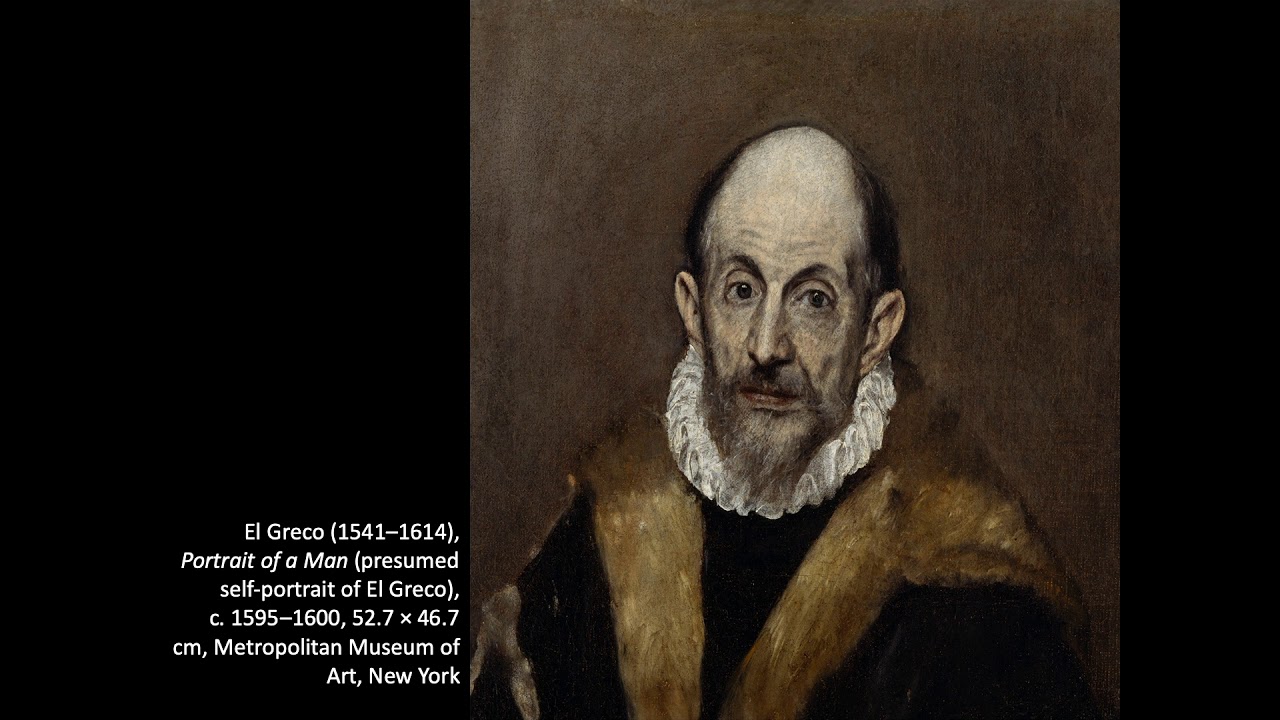
No artist tested these boundaries more than El Greco. In his masterpiece, View of Toledo, he committed a revolutionary act of defiance. At the time, religious dictates effectively banned landscapes as a suitable subject for serious painting. El Greco bypassed this by creating what is now regarded as the first Spanish landscape, though it was anything but a documentary record.
In the 16th century, the genre of the cityscape did not exist. El Greco literally invented it by rejecting topographical accuracy in favor of an apocalyptic mood. He imaginatively moved the Cathedral to the left of the Alcázar (the royal palace) to create a more emblematic, stormy vision of his adopted home. By prioritizing emotional truth over the “accurate representation” demanded by his patrons, he proved that even under the most restrictive regimes, the artist’s eye remains sovereign.
The 16th-Century Roots of Pablo Picasso
Though El Greco’s tortuously elongated figures and “expressionistic angularity” met with “puzzlement” from his contemporaries, he is now recognized as a vital “precursor of modernism.” The most striking evidence of this is the direct link between his The Opening of the Fifth Seal and Pablo Picasso’s Les Demoiselles d’Avignon.
Picasso famously studied this specific El Greco painting in the studio of the artist Ignacio Zuloaga, mirroring its jagged, chaotic energy in his own breakthrough work. As the scholar J. Richardson observed in his work Picasso’s Apocalyptic Whorehouse:
“[El Greco showed Picasso how to] harness the spiritual energy of a great religious artist to his own demonic ends.”
While 16th-century Spain attempted to control the mind by banning the import of books to stifle Protestantism, it could not control the “demonic” and revolutionary influence its religious art would have on the 20th century.
The Titans of the Shadow: From Zurbarán to Ribera
The Golden Age was defined by Chiaroscuro—the use of strong contrasts between light and dark to achieve volume—and its more violent extreme, Tenebrism, where darkness becomes a dominating feature, spotlighting the subject in a “dark, gloomy, mysterious” illumination. Francisco de Zurbarán, often called the “Spanish Caravaggio,” was the master of this austere, hard-edged style.
Though he was once named “King of Painters” by Philip IV, Zurbarán’s fortunes shifted after 1640 as tastes turned toward the “sentimental religiosity” of Murillo. Yet, Zurbarán was no tragic pauper. He pivoted his workshop to export paintings to the very South American colonies that funded the Crown. Despite the popular myth of him dying in poverty, he left an estate of 20,000 reales—roughly 2,500 “pieces of eight” or Spanish Dollars—a significant sum for the time.
He was part of a triumvirate of titans that included José de Ribera, the master of the “Art of Violence” who combined mysticism with shocking physical reality, and Diego Velázquez, the courtly individualist whose portraits of the royal family managed to maintain a sense of profound human autonomy within the rigid Habsburg court.
A Legacy of Contradiction
The Spanish Golden Age stands as a monument to formal severity and individualistic genius. It was a period when a global empire attempted to freeze time and thought, only to produce artists like Ribera, Velázquez, and El Greco, who paved the road for Expressionism and Cubism.
Ultimately, Spain’s effort to suppress ideas through censorship and the Inquisition led to its eventual decline, leaving it to lag behind the scientific and technological shifts of the 18th century. Yet, the art of this era survived the empire that commissioned it. It forces us to ask: Can truly great art only flourish when pushed against the walls of strict limitation? In the tension between the gold of the Americas and the fire of the Inquisition, Spain found an answer that still haunts the galleries of the world today.Gemini Notebook can be inaccurate; please double-check its responses.
19-02 Spanish Art – A 10-Minute Guide to Velazquez
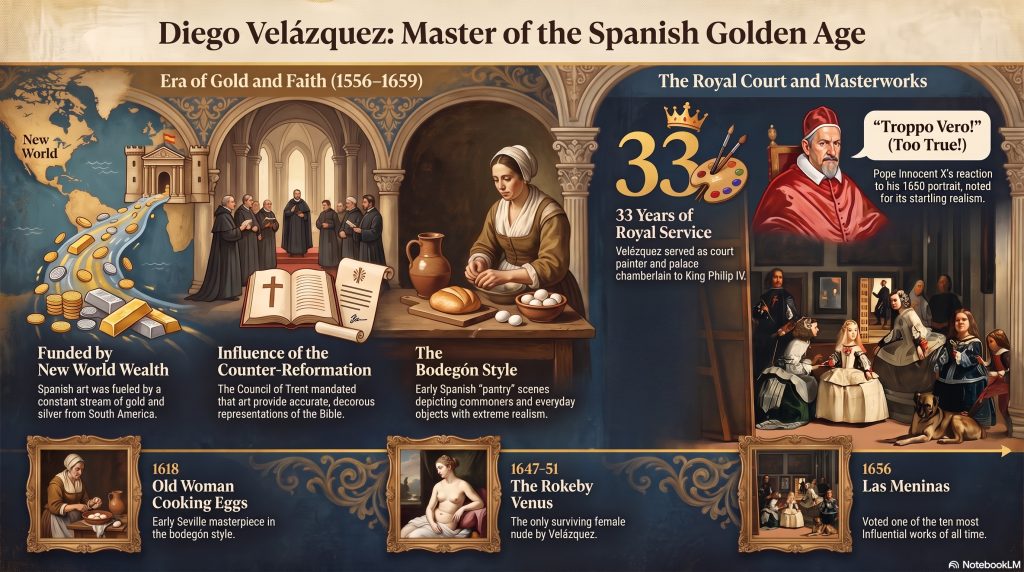
This talk outlines the life and career of Diego Velázquez within the historical context of the Spanish Golden Age, a period of immense cultural wealth funded by American silver. It details how the Habsburg court and the Catholic Counter-Reformation shaped the era’s artistic demands, enforcing strict religious standards while fostering legendary masterpieces. As a favored court painter to Philip IV, Velázquez transcended his humble beginnings to manage the royal collection and innovate within genres like the bodegón and formal portraiture. The source highlights his technical brilliance in works such as The Rokeby Venus and the Portrait of Innocent X, noting his ability to capture both psychological depth and physical realism. A significant portion of the text is dedicated to Las Meninas, analyzing its complex play with illusion, perspective, and the changing social status of the artist. Ultimately, the overview portrays Velázquez as a foundational figure whose “all too true” depictions continue to influence Western art history.

A conversation about Diego Velázquez created by Google Notebook from my notes:
1. Introduction: The Gilded Paradox
Imagine the Spanish Habsburg court of the 17th century: a world of suffocating etiquette, where gold galleons from the Americas arrived in Seville while the fires of the Inquisition burned in the plazas. This was the “Gilded Paradox.” While tens of millions were dying in the colonies from mistreatment and disease, and rampant inflation destabilized the continent, the Spanish court retreated into a shell of “icy reserve” and “strict control.”
In the center of this tension lived a ghost. Diego Velázquez was a man of profound mystery who navigated the most restrictive regime in history to become the most influential painter in Western art. He was the King’s personal confidant—Philip IV would often sit for hours in silence just to watch him paint—yet Velázquez remained an enigma. Perhaps his “icy reserve” was a survival tactic; modern research into his “Converso” roots suggests his grandparents were Jewish converts, a dangerous secret to hold in a land where a single “heretical” thought could lead to the stake. Velázquez didn’t just paint the court; he haunted it, hiding his subversions in plain sight.
2. The Art Connoisseurs Hated His First Masterpieces
Before he was the darling of the palace, Velázquez was a young rebel in Seville, perfecting the bodegón (pronounced body-gone). These scenes of “pantry” or “tavern” life featured commoners and everyday objects—eggs, water jugs, and copper pots—rendered with a startling, almost supernatural clarity.
To the elites of the 1600s, this was a scandal. Painting was considered a noble pursuit, and focusing on a “peasant” was seen as a waste of talent. One contemporary critic sneered that such works were the product of:
“workmen of scant knowledge or reflection, who debase the noble art to vulgar notions, as we see today, in so many pictures of bodegones.”
Velázquez was essentially trolling the establishment. In masterpieces like Old Woman Cooking Eggs, he wasn’t trying to “fool” the eye with simple realism. He was using “low” subjects to prove his virtuosity, making a common ceramic pot radiate light as if self-illuminated. He proved that mystery and mastery didn’t require a saint or a king; they only required the gaze of a genius.
3. The Pope Who Was Terrified of His Own Reflection
During a trip to Italy in 1649, Velázquez was commissioned to paint the Portrait of Innocent X. The Pope, born Giovanni Battista Pamphilj, was a shrewd and formidable leader who was initially “wary” of the Spanish painter’s reputation for honesty. He only relented after Velázquez proved his skill with other portraits.
When the work was unveiled, it was a psychological earthquake. Velázquez had captured the Pope’s piercing intelligence and aging, suspicious nature so accurately that it bordered on the voyeuristic. Looking at the painting, the Pope reportedly recoiled, exclaiming:
“Troppo vero!” (All too true!)
The portrait was “too true” for comfort; it revealed the man behind the office. The Pamphilj family kept the painting hidden from public view for nearly two centuries, as if the canvas held too much of the Pope’s actual soul.
4. Smuggling Beauty Past the Spanish Inquisition
In the 17th century, the female nude was a forbidden fruit. The Council of Trent had issued a decree stating that “all lasciviousness be avoided” and nothing “profane” or “indecorous” should be seen. In Spain, the Inquisition enforced this with terrifying zeal.
Yet, tucked away in the private chambers of the Marqués del Carpio—the son of the King’s First Minister—hung The Rokeby Venus. It is the only surviving female nude by Velázquez. This masterpiece survived because of a “hush-hush” subculture among the high nobility. By displaying it privately, the Marqués could bypass the public censors. The painting is a daring act of defiance; Venus looks into a mirror, but the reflection is blurred, suggesting that beauty—and the artist’s intent—is always just out of reach of the moral police.
5. The Masterpiece That Broke the Fourth Wall
If Velázquez was a ghost, then Las Meninas (1656) is his manifest. This isn’t just a painting of a five-year-old princess; it is a complex web of gazes that fundamentally changed how we see the world. Michel Foucault famously argued that this work represents the birth of modernity. In the “Classical” era, the artist was an invisible craftsman; in Las Meninas, the “representer” (Velázquez himself) steps into the frame, asserting his status as the star of the show.
The painting creates a dizzying “ghostly” effect through its subjects:
- The King and Queen: They appear only as a reflection in a distant mirror. Are they standing where we are standing?
- The Artist: Velázquez stares directly at us, paintbrush poised, as if he is painting us into existence.
- The Infanta: The young Margaret Theresa and her attendants seem frozen, caught in a moment of palace life that feels eerily permanent.
- The Viewer: By standing in front of the canvas, you become the missing piece of the puzzle—the subject the artist is actually watching.
6. Conclusion: A Dream within a Dream
Velázquez’s life was an incredible ascent from a tradesman’s grandson to the “Palace Chamberlain,” a high-ranking courtier. He spent his final years as a knight of the Order of Santiago, a status he fought for to prove his “purity” against the whispers of his ancestry. In Las Meninas, the red cross of the Order is emblazoned on his chest—a final touch reportedly added by King Philip IV himself after the artist’s death, as if the King wanted to ensure his friend’s ghost was properly honored.
His work reminds us that in a world of strict control, art is the only place where truth can hide. As the contemporary playwright Pedro Calderón de la Barca wrote:
“What is a life? A frenzy. What is life? A shadow, an illusion, and a sham. The greatest good is small; all life, it seems, is just a dream, and even dreams are dreams.”
When you look at a Velázquez, you aren’t just looking at paint on a canvas. You are looking into the eyes of a man who mastered the art of being invisible while being seen by everyone. The question remains: are you the one observing the masterpiece, or are you just another shadow in Velázquez’s dream?Gemini Notebook can be inaccurate; please double-check its responses.
19-03 Spanish Art – Goya 1746-1828
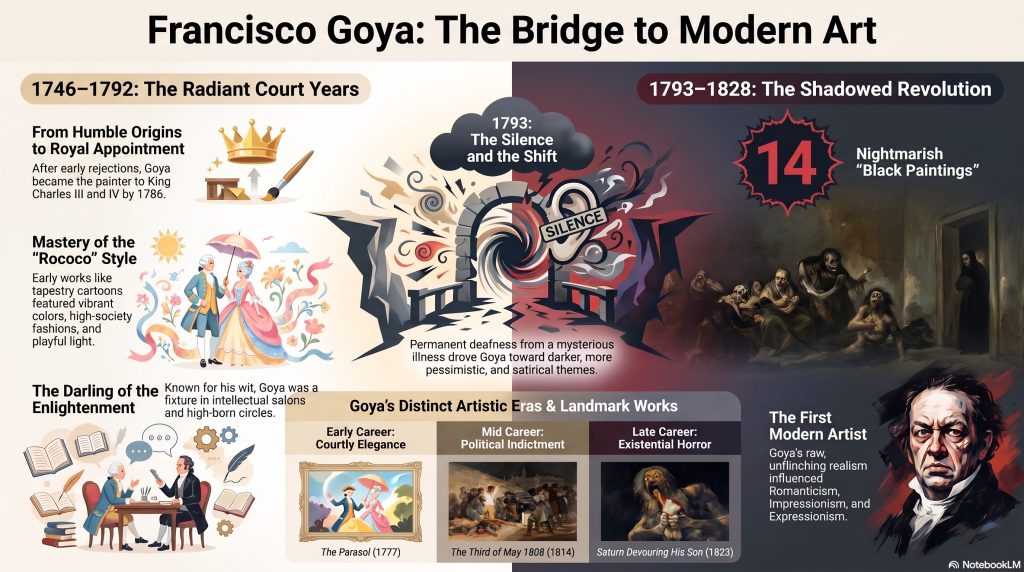
This biographical overview examines the life and artistic evolution of Francisco Goya, a transformative figure who bridged the gap between the Old Masters and modern art. The text details his professional ascent from a modest upbringing to his prestigious appointment as a Spanish court painter, where he gained fame for his realistic portraits and royal tapestry designs. A pivotal shift occurred in 1793 when a mysterious illness left him completely deaf, triggering a transition toward darker, more pessimistic themes and innovative psychological depth. The sources highlight his visceral response to the Napoleonic occupation through works like The Third of May 1808 and the haunting Disasters of War etchings. Goya’s later years were marked by the creation of the nightmarish Black Paintings, private murals that explored themes of madness and existential dread. Ultimately, his legacy is defined by an unflinching realism and visionary style that profoundly influenced later movements such as Romanticism and Expressionism.
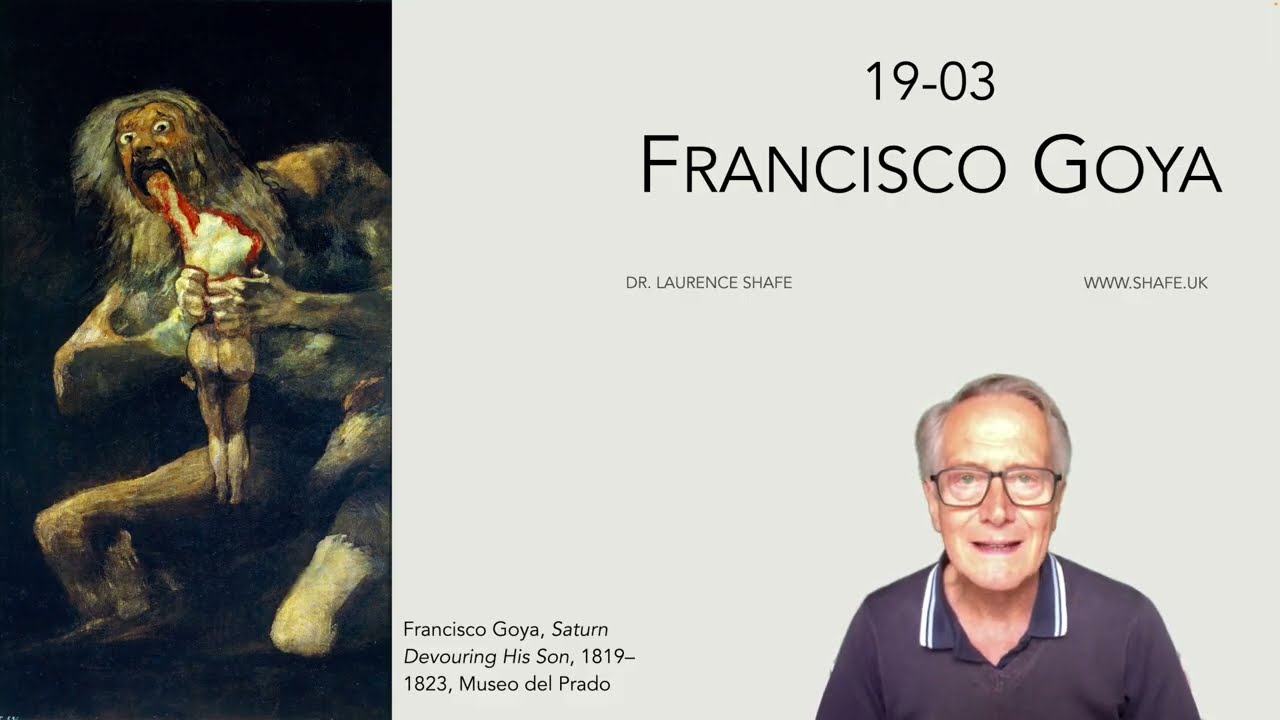
19-03 My Notes on Francisco Goya
A Podcast Produced by Google NotebookLM on Francisco Goya (based on my notes)
Source: Excerpts from “19-03 Francisco Goya.pdf” by Dr. Laurence Shafe (www.shafe.uk)
Main Themes & Most Important Ideas/Facts:
This briefing document outlines the life, artistic evolution, and profound impact of Francisco Goya (1746–1828), a groundbreaking Spanish artist. It highlights his journey from humble beginnings to court painter, his pivotal transformation after an illness, and his lasting influence on modern art.
Francisco Goya was born in Fuendetodos, a small village in Aragón, Spain, to a gilder father. His early talent for drawing was evident, with family legend stating he “deface[d] a wall in the family home with stick figures.” Despite “humble beginnings,” his ambition led him to Zaragoza and then to Madrid.
A profound turning point in Goya’s life and art occurred in 1792. A “mysterious fever—now thought to be either lead poisoning or viral encephalitis—left him permanently deaf.” This affliction, “far from diminishing his productivity, seemed to fan the fires of creativity.” His style subsequently “grew darker and more psychologically intense, reflecting his physical and mental suffering.”
The Napoleonic occupation of Spain (1808) profoundly impacted Goya, who “witnessed appalling violence firsthand.” This experience led to some of his most powerful and unsettling works, which serve as searing indictments of conflict.
In his final years, Goya voluntarily exiled himself to Bordeaux, France, due to political repression. Despite waning health, he continued to produce significant works, pushing artistic boundaries until his death.
Conclusion:
Francisco Goya’s career demonstrates a remarkable evolution from a skilled court painter to a visionary artist who unflinchingly confronted the darkest aspects of human nature and society. His personal suffering, particularly his deafness, deepened his artistic expression, leading to intensely psychological and socially critical works. Goya’s willingness to break with academic conventions and depict the raw realities of his time cemented his legacy as a transitional figure, bridging the gap between the Old Masters and the dawn of modern art.