17-01 18thC British Art – The Georgian Period, 1730-1780

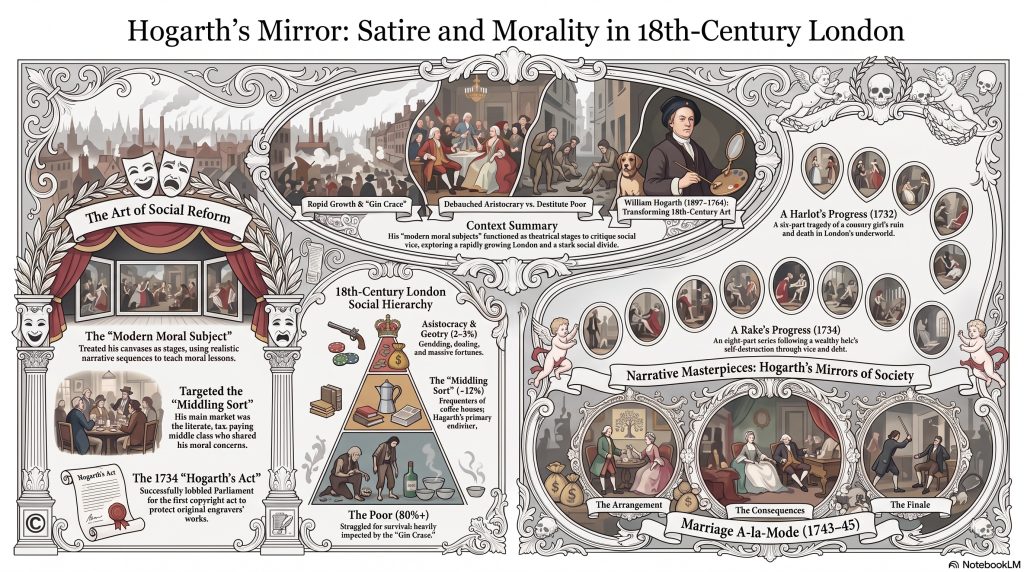
In the above infographic “Harlat” should be “Harlot”
This talk provides an overview of 18th-century British art during the Georgian period, spanning from 1730 to 1780. The text highlights a pivotal era where painting evolved from a minor trade into a national movement led by influential figures such as William Hogarth, Allan Ramsay, and Joseph Highmore. Through detailed examinations of specific works like “The Beggar’s Opera” and the “Pamela” series, the material illustrates how art began to reflect social satire, theatrical performances, and contemporary literature. The documents also provide biographical insights into the artists’ lives, noting their technical innovations, such as Ramsay’s use of red underpainting and Hogarth’s “Line of Beauty” theory. Ultimately, the collection serves as a guide to the cultural shifts, institutional milestones like the founding of the Royal Academy, and the diverse personalities that defined British visual identity in this century.
(My YouTube talk will be published on 23 January 2027)
My notes on 17-01 18thC British Art – The Georgian Period, 1730-1780
An entertaining conversation about 18thC British Art – The Georgian Period, 1730-1780 created by Google NotebookLM from my notes:
Welcome to Britain between 1730 and 1780—a half-century defined by the intoxicating scent of gin, the rustle of powdered wigs, and a relentless appetite for social climbing. This was the era when British painting underwent a radical metamorphosis, evolving from a provincial trade into a resounding national triumph. But the masterpieces we admire today in the hushed corridors of the Tate or the National Gallery were not birthed in sterile silence. They were forged in an age of excess, where art functioned as a weapon for political warfare, a shield against scandal, and a desperate tool for survival. To truly understand the Georgian canvas, one must look past the oil and pigment to the human drama—and the technical secrets—vibrating beneath.
The Reality TV of the 1730s: When Hogarth Captured a Scandal in Progress
When William Hogarth painted A Scene from ‘The Beggar’s Opera’ VI in 1731, he wasn’t merely documenting a play; he was capturing the “smash hit” of the century. John Gay’s 1728 “new English Opera” was a middle-class revolt against the high-brow Italian style, replacing gods and heroes with jailers and highwaymen. It was so wildly profitable that contemporary wits claimed it made “Rich gay, and Gay rich”—referencing the producer, John Rich, and the author, John Gay.
Hogarth, a devotee of the theatre, used this painting to signal his own intellectual ambitions. He framed the scene with Latin inscriptions on ribbons: veluti in speculum (“as in a mirror”) and utile dulci (“the useful with the pleasurable”). The latter, a nod to Horace, was a favorite phrase for young men on the Grand Tour attempting to justify their debauchery as “educational.”
The real drama, however, sat in the stage-side boxes. On the right, wearing his Garter star, sits the Duke of Bolton. He is fixated on the actress Lavinia Fenton, who played Polly Peachum.
“The Duke, twenty-three years her senior, fell head over heels for her on opening night and came back to watch her, night after night.”
When the season ended, Fenton retired to become his mistress, eventually becoming the Duchess of Bolton.
Why this matters: This is one of the first instances of “celebrity culture” being immortalized as high art. By including the Duke and his mistress, Hogarth proved that the artist could be a social documentarian, blurring the lines between fictional performance and real-life scandal to join “instruction with delight.”
The X-Ray Identity Crisis: Why Hogarth Scraped Away His Own Status
In his 1745 self-portrait, The Painter and his Pug, Hogarth presents himself as a man of grit and informal “pugnacity.” Yet, recent technical analysis by the Courtauld Institute reveals a hidden history. X-rays show that Hogarth originally depicted himself as a conventional gentleman in a formal wig, a flowing white cravat, and a coat with gold buttons. He eventually scraped this away, replacing the aristocratic facade with an informal cap and working clothes.
The portrait is a clever “painting of a painting,” an unframed oval resting on the volumes of Shakespeare, Swift, and Milton—the titans Hogarth considered his intellectual peers. In the foreground, his dog Trump serves as his mascot, while his palette displays the “Line of Beauty and Grace.” If you look closely at the palette today, you can see the technical ghost of his earlier draft: the words “and Grace” were painted out but have become visible through the transparent overpaint.
Why this matters: This was a professional manifesto. By rejecting the “gentlemanly” wig for his day-to-day attire, Hogarth asserted that the artist’s genius came from labor and intellect, not inherited status. He was claiming a seat at the table with the great poets, transforming the painter from a mere craftsman into a national visionary.
Sketching Can Be a Hanging Offense: The Spy of Calais
In 1748, Hogarth’s legendary hatred of the French nearly cost him his head. While sketching the fortifications at the Gate of Calais, he was arrested under suspicion of being a spy. He channeled this humiliation into a masterpiece of “patriotic propaganda”: O the Roast Beef of Old England (also known as The Gate of Calais).
The painting is a masterclass in mockery. A massive side of beef—a symbol of English prosperity—is carried toward an English tavern, while a gluttonous, fat Catholic friar and undernourished, ragged French soldiers look on with desperate envy. Hogarth contrasts the robust English diet with the French soupe maigre (watery soup). In the right foreground, he includes a starving “Jacobite” exile clutching an onion—a pathetic meal for those who betrayed England for French support.
“The ‘Old England’ of the title alludes to an idea of an England when kings protected their people against unjust masters and all lived in harmony and prosperity.”
Why this matters: Hogarth used his personal brush with the law to define British identity against the “corruption” of the Catholic Church and the perceived weakness of France. Art here is not neutral; it is a tool for defining the national “Golden Age.”
The Bridge Wars: Riots and Stone-Masonry on the Thames
Samuel Scott’s An Arch of Westminster Bridge (c. 1750) appears to be a tranquil architectural study, but the bridge’s construction was a theater of violence. It was the first bridge over the Thames in 600 years, and local watermen, fearing for their ferrying livelihoods, turned to sabotage, running their barges into the pile-drivers.
The stakes were so high that Parliament passed a specific act making it a “hanging offence” to disrupt the construction. While wood was the cheaper option, it was decided that the “honour of Parliament” demanded a majestic stone bridge. Scott’s painting captures the bridge near completion, featuring stonemasons pausing for a flagon of beer, while lively figures swim in the river or peep through the balustrades.
Why this matters: Scott adopted the style of Venetian vedute (view painting) to document London’s modernization. This wasn’t just a landscape; it was a record of the state asserting its power over the city’s infrastructure, proving that high-stakes engineering could be as “high art” as any royal portrait.
The “Impostor” of Venice: Canaletto’s London PR Campaign
When the great Venetian master Canaletto arrived in London in 1746, he was a victim of his own success. The market was flooded with forgeries—some produced by his own nephew, Bernardo Bellotto—and his repetitive style led critics to claim he was an “impostor.” They argued the real Canaletto could never produce work so “mechanical.”
To save his brand, Canaletto was forced into a humiliating public relations campaign. He placed newspaper advertisements in 1749 inviting the public to his Soho lodgings in Silver Street to watch him paint. One result of this speculative work was London: The Old Horse Guards from St James’s Park, capturing the crumbling 1664 red-brick building just before it was replaced by William Kent’s white stone version.
The irony of his “impostor” status is delicious when viewed through the lens of modern history. While he struggled to prove his identity in the 1740s, his work remains some of the most sought-after in history; in 2005, his View of the Grand Canal fetched a record price of £18.6 million.
Why this matters: Canaletto’s crisis highlights the pressures of the Georgian art market. His London vedute and capricci (imaginary views) turned a city in the midst of a classical makeover into a sought-after commodity, acting as a historical documentarian for the very guard house where Tudor knights once jousted.
A Forward-Looking Reflection: The Birth of the National Genius
By the time the Royal Academy was founded in 1768, the “provincial trade” of British art had been thoroughly revolutionized. Technical secrets played their part—such as Allan Ramsay’s innovative “red underpainting,” a trick he brought back from Italy to give British skin tones a lifelike warmth. From these technical shifts to the rise of the “Conversation Piece”—those formally dressed yet relaxed depictions of aristocratic pleasure—the artist had finally arrived as a figure of status.
These stories of arrests, stage-side scandals, and X-ray revisions reveal a Georgian era that was “pugnacious” to its core. It leaves one to wonder: in our age of sanitized, corporate galleries, have we lost that scandalous edge? Does art today still possess the bite of Hogarth’s dog, Trump, or have we finally traded genius for a more comfortable, gold-buttoned facade?
17-02a 18thC British Art – Hogarth His Life and Society
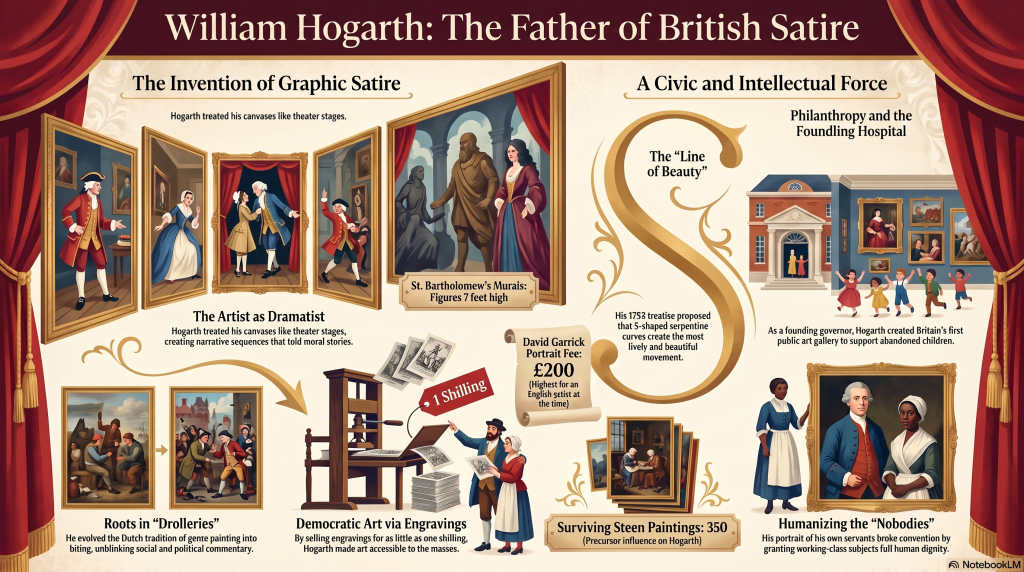
This lecture traces British social satire from Annibale Carracci’s unflinching naturalism in late sixteenth-century Bologna, through Dutch Golden Age moral genre painting, to William Hogarth, who invented the modern moral series, secured engravers’ copyright, helped establish Britain’s first public gallery at the Foundling Hospital, and theorised beauty through his serpentine Line of Beauty. The talk follows his influence forward through Gillray’s savage political caricature, Rowlandson’s ribald social comedy, and the Cruikshanks’ animated urban observation, showing how the printed image became Britain’s sharpest instrument of cultural and political commentary.
(My YouTube talk will be published on 9 January 2027)
My notes on 18thC British Art – Hogarth His Life and Society
An entertaining conversation about Hogarth His Life and Society created by Google NotebookLM from my notes:
Most of us think of art history as a story of beauty. But running beneath it is a darker, sharper current — artists who looked at power, hypocrisy, and social cruelty, and refused to look away. This is that story.
The World Invented “Everyday Life” as a Subject Shockingly Late
Before Annibale Carracci painted The Bean Eater around 1580, no serious Italian artist had treated a working man as a worthy subject in his own right. A labourer mid-meal — beans, bread, dirty fingernails — rendered without condescension or comedy. This unblinking objectivity actually predated Caravaggio’s naturalism, and in Italy it was genuinely radical. The snapshot we now take for granted in all visual art had to be invented.
Hogarth Didn’t Follow Other Painters — He Followed Writers
When Hogarth conceived A Harlot’s Progress in 1731, his reference points weren’t Dutch genre painters. They were Jonathan Swift and Henry Fielding. He described his method himself:
“I wished to compose pictures on canvas similar to representations on the stage… my picture was my stage.”
This theatrical logic — narrative sequences sold cheaply to a mass audience — was genuinely new. He invented the modern moral serial, and it made him famous overnight.
Piracy Forced Britain’s First Copyright Law for Artists
The engravings of A Harlot’s Progress sold 1,240 subscription sets at a guinea apiece. Pirate copies flooded the market almost immediately. Hogarth’s response wasn’t just outrage — he lobbied Parliament directly and secured the Engravers’ Copyright Act of 1735. Artists’ intellectual property rights in Britain exist partly because one engraver was furious enough to change the law.
Britain’s First Public Art Gallery Was Built Around Abandoned Children
Hogarth rallied Gainsborough, Hayman, and Richard Wilson to donate works to the Foundling Hospital’s Governors’ Court Room, effectively creating the first public art gallery in Britain. Handel contributed by conducting benefit performances of the Messiah. The institution that gave ordinary Londoners access to great art was funded by philanthropy for orphans.
Satire Replaced Civil War as Britain’s Preferred Weapon
After the trauma of the Civil Wars of 1642–1651, public “enthusiasm” — religious or political — became a social sin. Armed conflict was replaced by biting satirical wit as the weapon of choice. A growing middling class, coffee shops, and an expanding print trade supplied exactly the market it needed. The print shop window became, as one historian put it, a battlefield of competing visions of power.
The Most Famous Political Cartoon Ever Drawn Reduced Geopolitics to Dinner
Gillray’s 1805 Plumb-pudding in Danger — Pitt and Napoleon carving up the globe at supper — has been reproduced and reworked more than almost any other image in the British satirical tradition. It compressed an entire era of international conflict into a single, devastating visual joke. Some ideas are so clear they never stop being true.
From a Bolognese labourer’s dirty fingernails to Napoleon’s portion of the world-pudding, the thread connecting all of this is the same uncomfortable question: who gets to decide what is worth looking at — and who pays the price when the answer changes?
17-02b 18thC British Art – Hogarth’s World
17-02b 18thC British Art – Hogarth’s World
Eighteenth-century British art underwent a transformation from a culture that imported its finest painters from abroad — Van Dyck, Lely, Kneller — to one that produced artists of European stature in William Hogarth, Joshua Reynolds, Thomas Gainsborough, and George Stubbs. Hogarth’s great satirical series — A Rake’s Progress, Marriage A-la-Mode — invented a new genre of morally engaged narrative painting that was peculiarly British in its combination of social criticism, theatrical vitality, and robust humour. Reynolds, the first President of the Royal Academy founded in 1768, used the Grand Manner of the Italian tradition to elevate English portraiture to the status of history painting, producing images of aristocratic sitters draped in classical allusions. Gainsborough, his great rival, brought an entirely different sensibility to portraiture — more intimate, more lyrical, more attuned to landscape — that made him the most beloved portrait painter of the age despite (or because of) his complete lack of Reynolds’s learned ambition. The period also saw the emergence of watercolour as a distinctively British medium and landscape as a distinctively British subject, laying the groundwork for the revolutionary landscape painting of Constable and Turner in the following century.
An entertaining conversation about 18thC British Art – Hogarth’s World created by Google NotebookLM from my notes:
The Hook: London on the Brink
Welcome to 18th-century London, a spirit-soaked, smog-veiled theater of the absurd where the British Empire was amassing global wealth while its capital teetered on the edge of total collapse. This was a city where the “noisy, violent, and dead drunk” reality of the streets made every corner a potential crime scene. It was here that a new word was coined: the “mob,” describing the violent, destitute masses who could swarm and rob at will. Public executions were the leading form of entertainment, and even a notorious brothel-keeper like Mother Needham could find herself stoned to death by a crowd after a single day in the pillory. Into this grit stepped William Hogarth, an artist who realized that the canvas was far too small for his ambitions. He wasn’t just a painter; he was a “dramatic writer” who realized that London itself was his stage—a stage populated by venal lords, tragic harlots, and a city drowning in grain alcohol.
Takeaway 1: The “Gin Craze” Was the First Modern Public Health Crisis
In the first half of the 1700s, London wasn’t just drinking; it was self-destructing. “Gin”—a catch-all term for any fiery grain spirit—became the cheap, lethal anesthetic of the “inferior sort,” who made up a staggering 80% of the population. With an incredible 7,000 gin shops lining the narrow alleys, the poor found it easier to buy a glass of liquid oblivion than a loaf of bread. They “drown their hunger pains” in a spirit that promised relief but delivered only addiction, violence, and social rot. This wasn’t a social trend; it was a societal aneurysm that nearly unraveled the city’s fabric before the Gin Act of 1751 finally slowed the flow.
“The gin craze was, according to one magistrate, the ‘principal cause of all the vice and debauchery committed among the inferior sort of people.’”
Takeaway 2: Art as the Original “Binge-Watch” Series
Hogarth was the 18th-century’s answer to a showrunner. He pioneered the “Modern Moral Subject,” creating episodic, sequential narratives that functioned exactly like a modern streaming series. By announcing his engravings in the Daily Post and bypassing traditional publishers, he went “direct to the consumer,” a move that would make any modern independent creator proud. His “Progress” series—including the tragic descent of Moll Hackabout and the ruin of Tom Rakewell—were the water-cooler hits of their day. Produced in “limited editions” of exactly 1,240 sets, these prints were high-stakes storytelling for the “middling sort” who were desperate to see the inevitable, messy consequences of vice.
“I have endeavoured to treat my subjects as a dramatic writer; my picture was my stage and men and women my players.”
Takeaway 3: The Terrifying Reality of “Quack” Medicine
If the gin didn’t kill you, the doctors certainly would. The streets were crawling with “quacks” like Dr. Misaubin and Dr. Rock, charlatans who amassed fortunes selling “Practical Schemes” and the “Little Pill” to cure the “Secret Disease” (syphilis). The level of medical predatory behavior was nothing short of ghoulish; advertisements even pushed “Anodyne Necklaces” onto parents as cures for childhood ailments. In a city where half the children died before reaching adulthood, the “cures” were often more lethal than the diseases, consisting of little more than laudanum and proprietary sedatives.
“In 1769, William Buchan’s immensely popular tract ‘Domestic Medicine’ asserted that half of the children who died in London each year were killed by laudanum, spirits or proprietary sedatives.”
Takeaway 4: The Aristocracy Was Governed by a Lethal Code of “Honour”
While the poor died in gutters, the elite 2%—the aristocracy and gentry—lived in a debauched vacuum. This was a class personified by characters like Earl Squanderfield, a man so obsessed with his family tree “going back to William the Conqueror” that he failed to notice his mansion was falling apart and his son was a foppish, syphilitic wreck. This elite class followed a lethal code of “honour,” gambling away entire estates at White’s and dueling to the death over the most trivial perceived insults. Hogarth’s Marriage A-la-Mode exposed this high-life for what it truly was: a fragile facade of debt and arranged misery where ancient titles were traded for merchant-class dowries.
“They lived in a world of their own with the men gambling their family fortune away and duelling at the slightest perceived insult to their honour.”
Takeaway 5: The Surprising Origins of Copyright and “Hogarth’s Act”
Hogarth was as much a shark in the boardroom as he was a master at the easel. After A Harlot’s Progress was ruthlessly pirated by no fewer than eight different unscrupulous printers, Hogarth lobbied Parliament for protection. The result was the Engraving Copyright Act of 1734, famously known as “Hogarth’s Act.” In a brilliant display of business acumen, he intentionally delayed the launch of A Rake’s Progress until June 25, 1735—the very day the Act came into force. After his death, his wife Jane Hogarth proved to be a formidable guardian of his legacy, successfully campaigning to extend these protections to 20 years to ensure the family business remained profitable.
“His engravings were so plagiarised that he lobbied for the Engraving Copyright Act of 1734 (also known as Hogarth’s Act) as protection for original engravers.”
Takeaway 6: The “Middling Sort” and the Power of the Coffee House
The real engine of 18th-century social change was the “middling sort”—the 15% of Londoners who were literate, tax-paying, and perpetually “appalled.” Their habitat was the coffee house, a hub of gossip and newspapers where the “court of public opinion” was born. Haunted by the financial ruin of the South Sea Bubble of 1720, this group was obsessed with moral and economic stability. They were Hogarth’s primary patrons, buying his prints not just for their artistic merit, but as weapons of satire to be wielded against both the corrupt ruling elite and the “idle poor.”
“The middling sort… went to the phenomenon of the age, the coffee houses which were springing up everywhere, where they would read newspapers and gossip and they were appalled by what they saw around them.”
Closing: The Mirror of 1751
William Hogarth’s “moral stage” did more than just document the rot of the 18th century; it catalyzed a new era of public accountability. By moving the private scandals of the aristocracy and the tragedies of the poor into the harsh light of the printing press, he helped forge the modern world of social commentary. He remains the definitive critic of human vanity, a man who understood that beneath the powdered wigs and silk waistcoats, the human condition is often just one bad decision away from the madhouse.
As the author Henry Fielding once remarked: “I esteem the ingenious Mr. Hogarth as one of the most useful satirists any age has produced.” Three centuries later, as we scroll through our own digital feeds of scandal and social pathology, we must ask ourselves: have we truly left Hogarth’s world, or have we simply traded the copperplate engraving for the high-definition screen?
17-02c 18thC British Art – Hogarth’s World (for Save the Children)
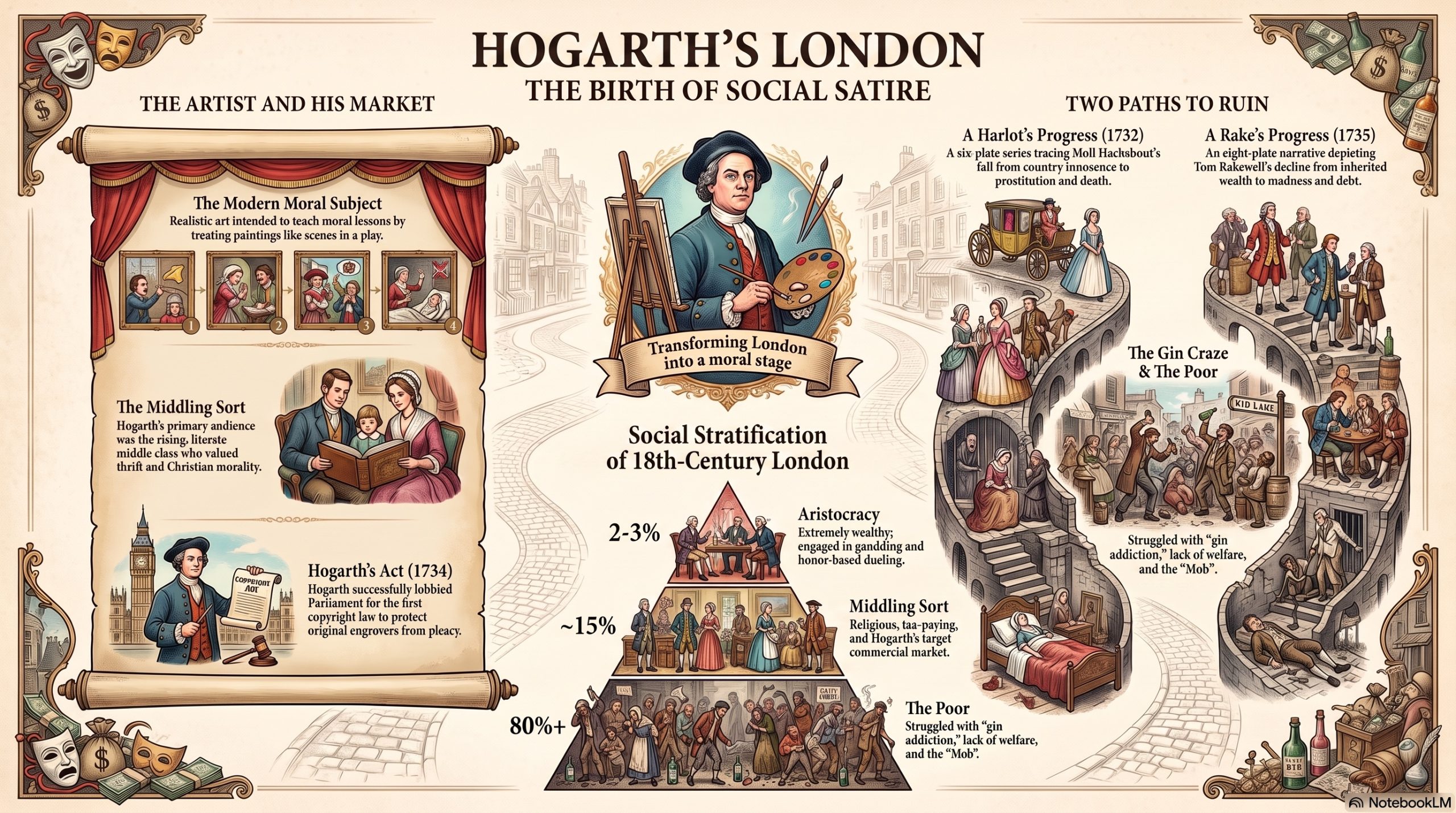
This lecture explores the social landscape of eighteenth-century London through the pioneering visual satire of William Hogarth. Bypassing traditional patronage, Hogarth targeted the literate, rising “middling sort” with a new genre he termed “modern moral subjects”. These narrative series functioned like theatrical stages, employing realistic, everyday settings rather than mythological allegories to deliver serious lessons on personal responsibility and social vice. By exposing systemic corruption, his work fostered an early middle-class consciousness and turned the press into a powerful forum for public opinion.
To illustrate this scope, the talk examines three celebrated print series. In A Harlot’s Progress, Hogarth chronicles the tragic deception and eventual demise of an innocent country girl led astray by urban corruption. Its male counterpart, A Rake’s Progress, charts the self-inflicted ruin of a wealthy heir who squanders his fortune on fashionable vices, ending his days in Bedlam. Finally, Marriage A-la-Mode satirises aristocratic hypocrisy, depicting a mercenary arranged marriage that culminates in adultery, murder and ruin. Together, these narrative sequences demonstrate how Hogarth utilised detailed copperplate engravings to criticise contemporary institutions and campaign for moral and legal reforms.

My notes on Hogarth’s World (PDF opens in a new tab)
17-02c Hogarth’s World — PDF notes
An entertaining conversation about Hogarth’s World, created by Google NotebookLM from my notes:
Hogarth recognised that in a modern commercial economy an artist’s most valuable asset was not simply a painting but the right to reproduce and sell its imagery. After the success of A Harlot’s Progress in 1732, at least eight unauthorised versions appeared. The copies diverted income from Hogarth and demonstrated that existing literary copyright offered printmakers inadequate protection.
Hogarth responded by lobbying Parliament. The resulting Engraving Copyright Act of 1735, commonly called Hogarth’s Act, extended statutory protection to original engravings. He delayed publication of A Rake’s Progress until the day the Act came into force, combining artistic production, political campaigning and careful commercial planning. The episode shows that Hogarth’s social influence depended not only on the content of his satires but also on his understanding of the new market for reproducible images.
17-03 18thC British Art – Thomas Gainsborough
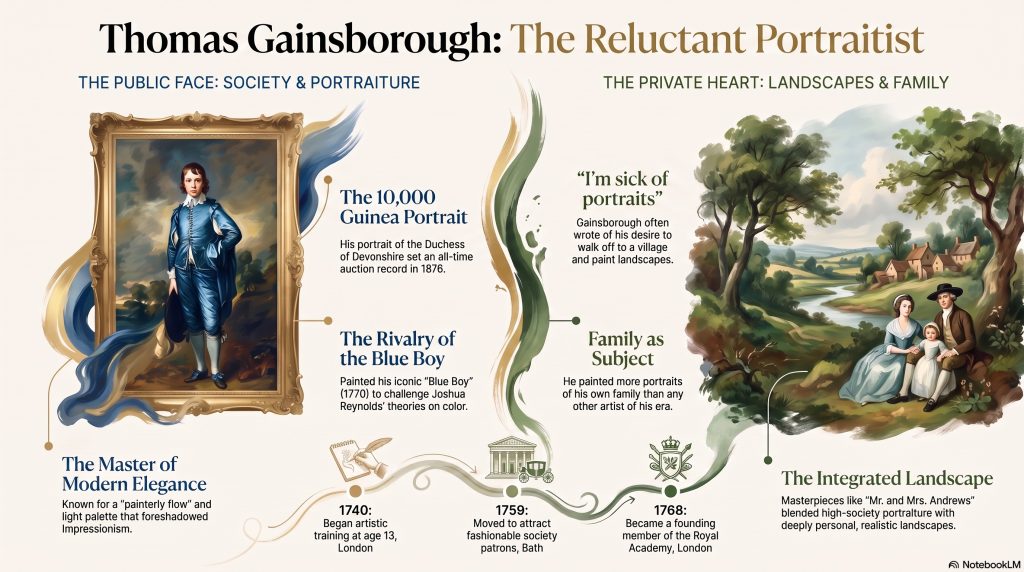
Thomas Gainsborough was a preeminent 18th-century English artist celebrated for his pioneering contributions to both portraiture and landscape painting. Although he achieved immense fame and royal patronage for his society portraits, he remained personally devoted to the English countryside, often lamenting the professional necessity of painting faces. An artistic prodigy from a modest background, he developed a signature rapid painting technique and a light palette that some critics view as a precursor to Impressionism. His personal life was marked by a deeply intimate series of family portraits, including numerous depictions of his daughters and his inventor brothers. As a founding member of the Royal Academy, he maintained a complex relationship with the art establishment while solidifying his legacy as a master of color and movement. This overview of his career highlights his transition from a provincial talent to a metropolitan icon whose work continues to influence the study of British art.
My notes on 17-03 18thC British Art – Thomas Gainsborough
An entertaining discussion on Thomas Gainsborough created by Google Notebook from my notes:
Thomas Gainsborough is often remembered as the quintessential face of 18th-century British elegance—a founding member of the Royal Academy and the creator of The Blue Boy, whose canvases defined the Rococo aesthetic of the Georgian elite. However, the man behind the easel was a far cry from the polished aristocrats he depicted. A rebellious figure of “lively wit” and “stubborn independence,” Gainsborough achieved global immortality by excelling at the very profession he claimed to despise. While history paints him as a high-society darling, his private life was a whirlwind of professional resentment, avant-garde technical experimentation, and a constant, restless yearning for the rural landscapes of his youth.
1. A Career Launched by a Double Murder
The refined world of Gainsborough’s art had a shockingly gritty beginning. The path to his eventual mastery was paved by a violent family tragedy that sounds more like a Victorian penny dreadful than an art history lecture. Gainsborough’s uncle and cousin—both also named Thomas—were murdered in cold-blooded revenge attacks after being warned by criminals not to pursue a specific debt.
At the time, the stakes for the young artist could not have been higher. Gainsborough’s father, a cloth merchant and weaver in Sudbury, had recently gone bankrupt, leaving the family’s future in peril. This double murder, however, resulted in a surprising financial lifeline. In his will, the uncle left a specific bequest to the eleven-year-old artist:
“In his will, the uncle left £40 to Gainsborough, then aged 11, with the proviso that he put it towards a ‘light handicraft.’”
This £40 inheritance was invaluable. It funded Gainsborough’s move to London at the age of thirteen, allowing him to escape his father’s financial ruin and begin training under masters like William Hogarth. There is a profound irony in the fact that the career of Britain’s most “elegant” painter, famed for his “tender” and “affecting” touch, was founded upon such a violent and bloody catalyst.
2. The “Damnd Faces” Paradox: A Portraitist Who Hated Portraits
Gainsborough was one of the most sought-after portraitists of his age, yet he viewed these commissions as a commercial shackle. He was a landscape painter by inclination, deeply devoted to the “conversation pieces” that integrated figures into the natural world. This created a lifelong friction between the “endless parade” of wealthy sitters who funded his lifestyle and his true artistic soul.
He grew increasingly cynical toward the vanity of the elite, whom he viewed less as patrons and more as necessary evils. In one particularly biting moment of candor, he wrote:
“They think… that they reward your merit by their Company… but I… know that they have but one part worth looking at, and that is their Purse; their Hearts are seldom near enough the right place to get a sight of it.”
His resentment boiled over in his correspondence, where he famously lamented being “sick of portraits” and expressed a desire to take his “viol de gamba” to a “sweet village” to paint landscapes in peace. He colloquially dismissed his lucrative bread-and-butter work as nothing more than painting “damnd Faces.” This paradox defined his legacy: he is remembered for the very faces he wished he never had to see.
3. A Revolutionary Approach to Fatherhood: The “Gainsborough Girls”
Gainsborough’s relationship with his daughters, Mary and Margaret, was both tender and decades ahead of its time. In an 18th-century society that offered few professional avenues for women, Gainsborough made the revolutionary decision to train his daughters as professional landscape artists. He did this with a pragmatic, if slightly anxious, paternal foresight, hoping to ensure their independence “in case they should miss getting husbands.”
This bond is immortalized in works like The Painter’s Daughters Chasing a Butterfly. Here, Gainsborough utilizes the “sensibility” of the era—an acute responsiveness to emotion—to capture a fleeting moment. The butterfly serves as a poignant symbol of the transience of beauty and the fragility of life.
Despite his efforts to empower them, the “Gainsborough Girls” met a tragic end. Both sisters eventually succumbed to severe mental illness and “delusions of grandness.” Mary, in particular, became convinced she was royalty, refusing to see any visitors unless they invented titles for themselves before entering her presence.
4. The Original “Speed Painter” and the Roots of Modernity
Technically, Gainsborough was a radical innovator. While his rival Joshua Reynolds utilized a traditional studio system—often delegating the painting of drapery and backgrounds to assistants—Gainsborough insisted on a “bravura” style that was entirely his own. Because he disliked the studio system, his “earning capacity” was limited by his own manual output, which forced him to develop an exceptionally fast, fluid technique.
To achieve this, he utilized “exceptionally liquid paint” and famously “lengthy brushes.” These brushes, sometimes six feet long, allowed him to stand at the same distance from the canvas as he did from the sitter. This enabled him to maintain a unified perception of the subject, applying paint in the “feathery,” translucent layers that characterize his late style.
This freedom of handling and “painterly flow” led later critics, such as Roger Fry, to champion him as a forerunner to Impressionism. His influence was so enduring that James McNeill Whistler later emulated his methods to achieve a similarly daring, “Art for Art’s sake” elegance.
5. The Deathbed Revelation: A Secret Forty-Two-Year Fortune
Gainsborough’s final days brought the resolution to a lifelong mystery. Throughout his 42-year marriage to Margaret Burr—the illegitimate daughter of a Duke—Gainsborough was known to “throw his money about” on a reckless social life of music, drink, and “wild-living.” He was perpetually puzzled by why, despite his immense success and tireless work, the family never seemed to have a surplus of wealth.
As he lay dying of cancer in 1788, he expressed deep anxiety that he had failed to provide for his daughters’ futures. It was only then that his wife revealed her quiet, four-decade-long pragmatism. Knowing his spendthrift nature, she had been secretly siphoning off portions of his earnings for forty-two years. She revealed a hidden fortune of £10,000—a staggering sum that ensured the family’s security.
Gainsborough died with his mind at ease, finding a final moment of artistic reconciliation. His rumored last words were a tribute to the master he most sought to emulate: “van Dyck.”
Thomas Gainsborough was a man of profound contradictions: a temperamental wit who charmed the elite he secretly mocked, and a master of the “damnd faces” who only truly found peace in the solitude of the woods. He left behind a visual record of 18th-century life that remains unparalleled in its fluidity and grace. Ultimately, his career invites us to wonder: if Gainsborough had abandoned the portraits he hated to paint only the landscapes he loved, would he still be a titan of art history? Or was his greatness born from that very friction between the duty of the purse and the passion of the soul?Gemini Notebook can be inaccurate; please double-check its responses.
17-04 Joshua Reynolds
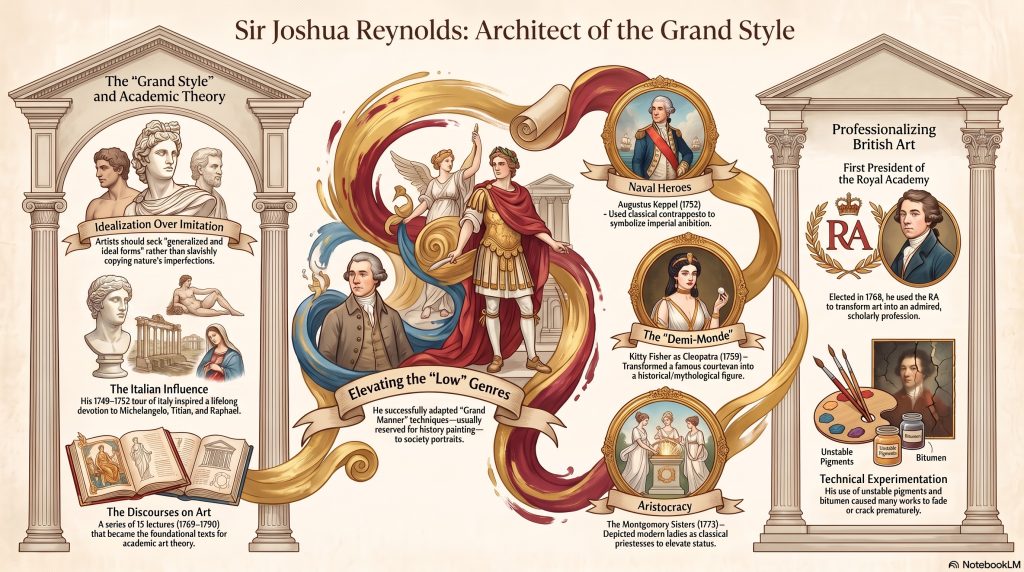
Sir Joshua Reynolds, the preeminent eighteenth-century British portraitist and inaugural President of the Royal Academy, is the central focus of these educational materials. The sources detail his influential “Grand Style,” which elevated portraiture by integrating classical ideals and techniques borrowed from Renaissance masters like Michelangelo and Raphael. Beyond his artistic output, the text highlights his role as an intellectual leader and theorist whose Discourses on Art established the foundation for British academic training. Detailed entries examine his famous works, including portraits of aristocrats, naval heroes, and notorious socialites, while noting his technical experimentation with pigments that occasionally led to paint degradation. The collection also captures his personal life, from his European travels and struggles with deafness to his final years of failing eyesight before his prestigious burial in St. Paul’s Cathedral. Ultimately, the documents portray Reynolds as a transformative figure who successfully transitioned the status of the artist from a mere craftsman to a respected scholar.
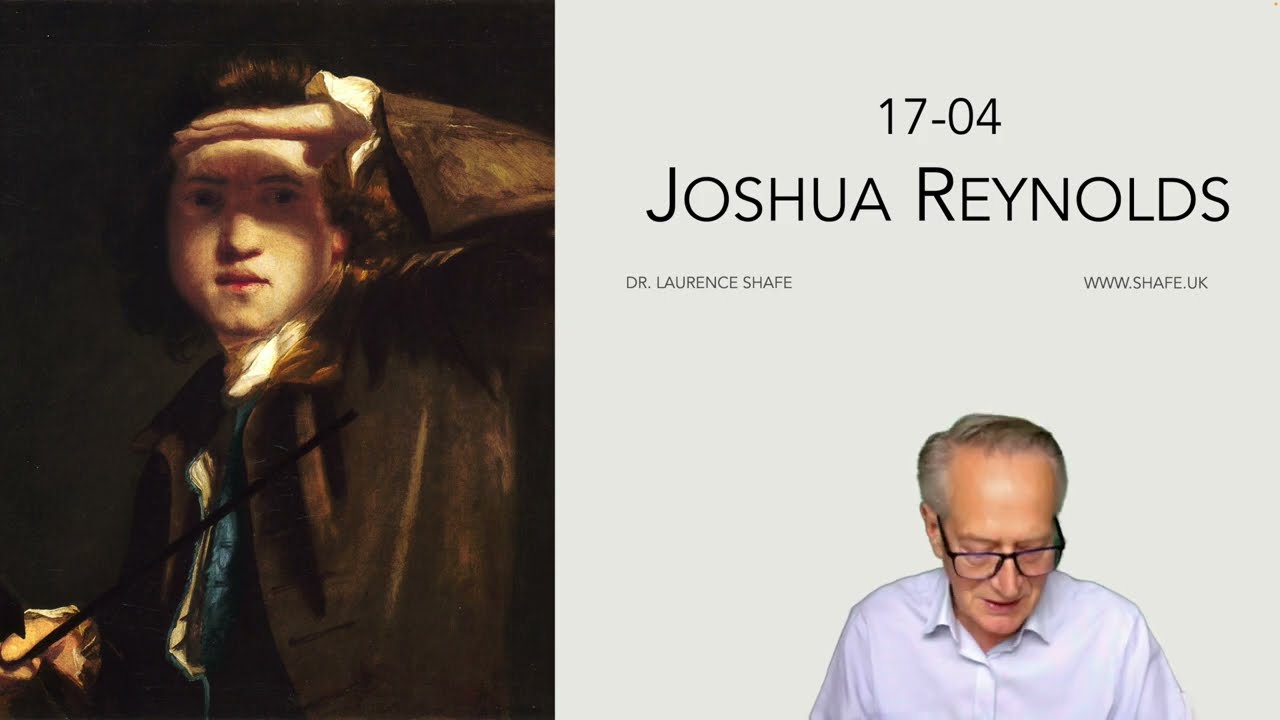
This briefing document summarizes the main themes and important facts about Sir Joshua Reynolds, a dominant figure in 18th-century British art, drawing from the provided sources.
Sir Joshua Reynolds (1723-1792) was the preeminent English portraitist of the 18th century, profoundly shaping British art for five decades. He is remembered for elevating portraiture to a higher art form and for his foundational role as the first President of the Royal Academy. As the source notes, “He dominated British art for five decades and is one of the most important British artists of the eighteenth century.” His reputation, though immense in his time, has “faded today perhaps because, although at the time he experimented with materials, he is today regarded as a safe painter of his time.”
Reynolds’ statue still greets visitors to the Royal Academy, a testament to his central role in British art history. He “became the Academy’s first President in 1768, and this work served as a visual testament to his legacy, emphasizing his commitment to elevating art through education and classical ideals.” His Discourses continue to be fundamental texts in academic art theory. He passed away as “artists such as J.M.W. Turner and John Constable championed the new Romantic style,” marking the end of an era.
My Notes on 17-04 Sir Joshua Reynolds
A Discussion of Joshua Reynolds created by Google NotebookLM
17-05 18thC British Art – George IV Art & Spectacle
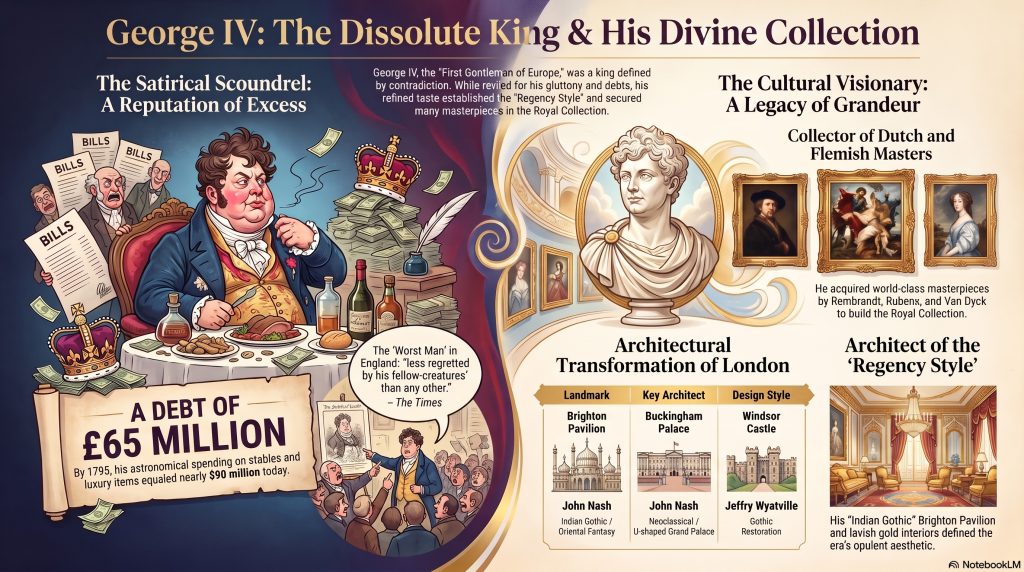
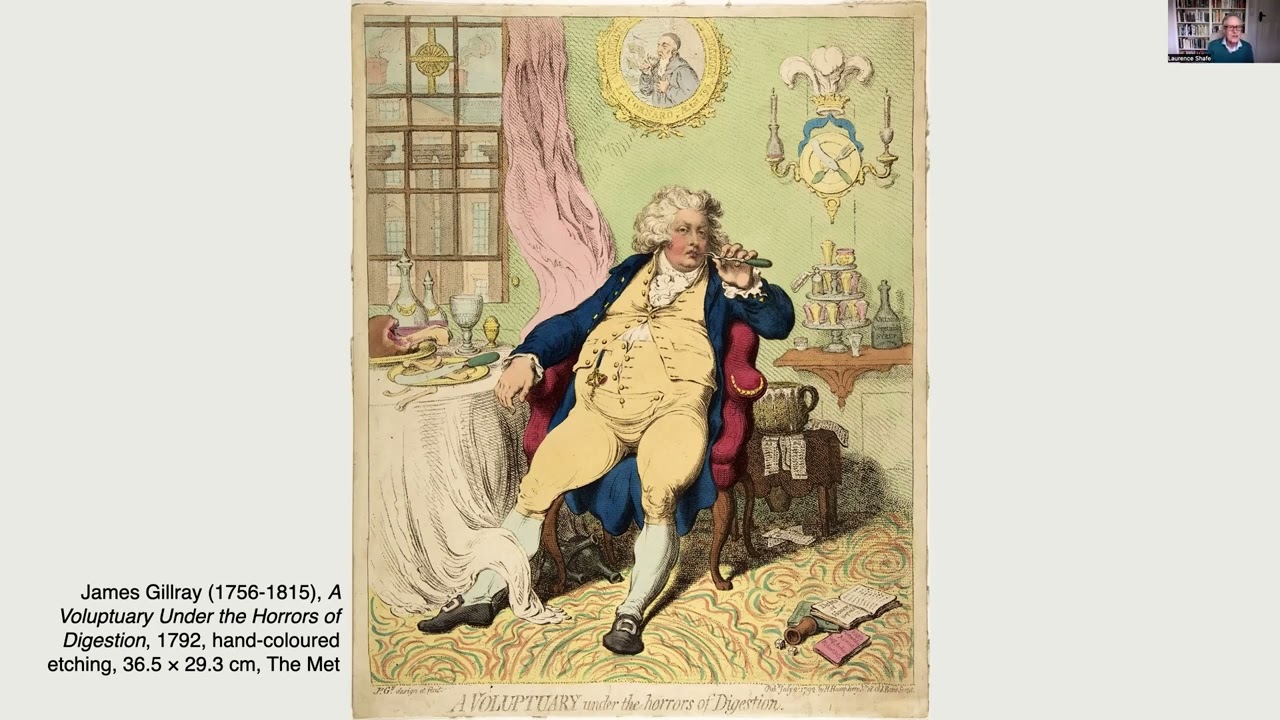
This talk examines the life and legacy of King George IV, balancing his reputation for excessive self-indulgence with his significant contributions to the British Royal Collection. Through a variety of satirical prints, the text explores the King’s public image as an obese, extravagant figure often ridiculed for his scandalous personal relationships and fiscal irresponsibility. Conversely, the sources highlight his sophisticated role as a magnificent patron of the arts, responsible for acquiring masterpieces by Rembrandt, Rubens, and Van Dyck. Architectural achievements such as the Brighton Pavilion and the extensive renovations of Buckingham Palace and Windsor Castle are detailed as centerpieces of the Regency style. Ultimately, the sources present a complex portrait of a monarch whose moral failings were rivaled only by his refined aesthetic vision.
My notes on 17-05 18thC British Art – George IV Art & Spectacle
An amusing conversation created by Google Notebook from my notes:
History remembers him by many names: “Prinny,” the “Prince Regent,” and most flatteringly, the “First Gentleman of Europe.” Yet to his contemporaries, King George IV was a man who seemed determined to test the structural integrity of every chair in Christendom. He was a figure of spectacular contradiction—a royal glutton whose laziness was as legendary as his taste was refined. How could a man so widely detested by his peers, a monarch who lived in a state of permanent dissipation, become the most magnificent patron of the arts in British history? To understand the Regency period, one must reconcile the image of the selfish socialite with the sophisticated connoisseur who quite literally designed the aesthetic of an era.
1. A Character of Total Contradiction
George IV was a man of startling dualities. On one hand, he was a child prodigy and a talented student who became a witty conversationalist fluent in French, German, and Italian. On the other, his gluttony eventually required a complete overhaul of men’s fashion; it was George who effectively ended the era of wigs and introduced darker, somber clothing for men, a strategic sartorial choice designed primarily to camouflage his own excessive size.
His personality divided even those who served him. The Duke of Wellington, who saw the King at his most vulnerable and his most difficult, provided a famously bipolar assessment of the monarch’s character:
“The worst man he ever fell in with his whole life, the most selfish, the most false, the most ill-natured, the most entirely without one redeeming quality… [yet also] a magnificent patron of the arts… the most extraordinary compound of talent, wit, buffoonery, obstinacy, and good feeling.”
2. The Secret Marriage and the Million-Pound Debt
George’s private life was a masterclass in financial and legal recklessness. At age 21, he became infatuated with Maria Fitzherbert, a Roman Catholic widow. Despite the fact that such a union would legally bar him from the throne under the Act of Settlement, George underwent a secret marriage ceremony. While the marriage was legally void without the King’s consent, the Prince was so deeply in debt that he was eventually forced to move in with Fitzherbert simply to hide from his creditors.
His spending was, quite frankly, astronomical. By 1783, he enjoyed an annual income equivalent to over £13 million today, yet his stables alone consumed a staggering one-third of that sum. By 1795, his debts had ballooned to a modern equivalent of £66 million. He eventually agreed to a disastrous, “void of affection” marriage to Princess Caroline of Brunswick for the most mercenary of reasons: Parliament refused to clear his mountainous debts unless he took a legal, Protestant bride.
3. Architecture as an “Oriental Phantasy”
While the broader Regency period is often associated with the sparse, neoclassical elegance of a Jane Austen novel, George IV’s personal taste was far more “lavish and opulent.” He viewed architecture as a stage for spectacle, a conviction that manifested in his “U-shaped” reimagining of Buckingham Palace—a project intended to rival the scale and grandeur of Versailles. Even the ground beneath the palace had a tawdry history; the site of the north-west garden was once a 17th-century mulberry garden described in 1648 as a “gay brothel.”
His most famous creation, the Royal Pavilion at Brighton, was transformed by architect John Nash into an “oriental phantasy.” This “Indian Gothic” masterpiece featured a Banqueting Room where a massive silver dragon held up the central chandelier. Satirists were merciless, viewing the Pavilion not as a palace but as a monument to frivolous excess. In the scathing print The Great Joss and His Playthings, the King was depicted as a bloated Chinese idol perched atop a massive teapot, surrounded by expensive “toys” like his palace models and a diplomatic gift giraffe—symbols of a lifestyle the public found increasingly contemptible.
4. The Discerning Eye: A Sophisticated Art Collector
Despite his personal failings, George IV possessed a genuine, sophisticated expertise in the visual arts that far exceeded mere “shopping.” He was a highly calculated collector who utilized a “trade-up” strategy to rationalize the Royal Collection. In one notable instance, he purchased a massive collection from the Baring family and subsequently sold 55 works from his existing holdings and 15 from the new acquisition to ensure only the finest masterpieces remained.
He was particularly drawn to the Dutch Masters, and his eye for technical mastery was unerring. When he acquired Rembrandt’s Agatha Bas, he recognized the artist’s genius in using an ebony frame to blur the line between painted and real space. He marveled at Rembrandt’s technical precision, such as the use of the brush end to incise fine hairs into the paint. His collection eventually included:
- Rembrandt: The Shipbuilder and His Wife (purchased for a then-record 5,000 guineas)
- Rubens: Landscape with St George and the Dragon (which he personally re-purchased after it had been sold during the Commonwealth)
- Jan Steen: A Woman at Her Toilet
His sophistication was such that he was surprisingly selective regarding price; the only work he is ever recorded to have refused solely on the grounds of cost was Rubens’s The Straw Hat.
5. A Death Unmourned and the Physical Toll of Excess
The King’s final years were a grim testament to a life of overindulgence. By the end of his reign, George was grossly obese, almost completely blind, and suffering from a litany of ailments including gout and dropsy. His addiction to laudanum was so pronounced that he often spent his days in seclusion at Windsor Castle, forced to sleep upright in a chair just to breathe.
His appetite, however, remained undiminished to the very end. His final recorded breakfast was a liquid suicide: three-quarters of a bottle of Mozelle, a glass of dry champagne, two glasses of port, and a glass of brandy. When he finally passed away in 1830 from a ruptured blood vessel in his stomach, the public reaction was one of cold, crystalline indifference. The Times published an obituary of such breathtaking brutality that it remains a landmark in the history of journalism:
“Never was an individual less regretted by his fellow-creatures than this deceased king. What eye has wept for him? … If he ever had a friend – a devoted friend in any rank of life – we protest that the name of him or her never reached us.”
Conclusion: The Legacy of a Flawed Connoisseur
George IV remains one of the most “contemptible” figures to ever wear the crown—a man whose private life was a wreckage of debt, broken hearts, and unbridled selfishness. Yet, one cannot walk through the streets of London or view the treasures of the Royal Collection without encountering his brilliance. He was the architect of the Regency style and the savior of the world’s greatest paintings.
We are left with a provocative question: can we truly separate the magnificence of a cultural legacy from the moral failings of the man who created it? In the case of George IV, the “First Gentleman” and the “Ultimate Voluptuary” are inextricably linked, leaving us with a history that is as beautiful as it is undeniably tawdry.Gemini Notebook can be inaccurate; please double-check its responses.
17-06 18thC British Art – Revolutionary Times, 1780-1810
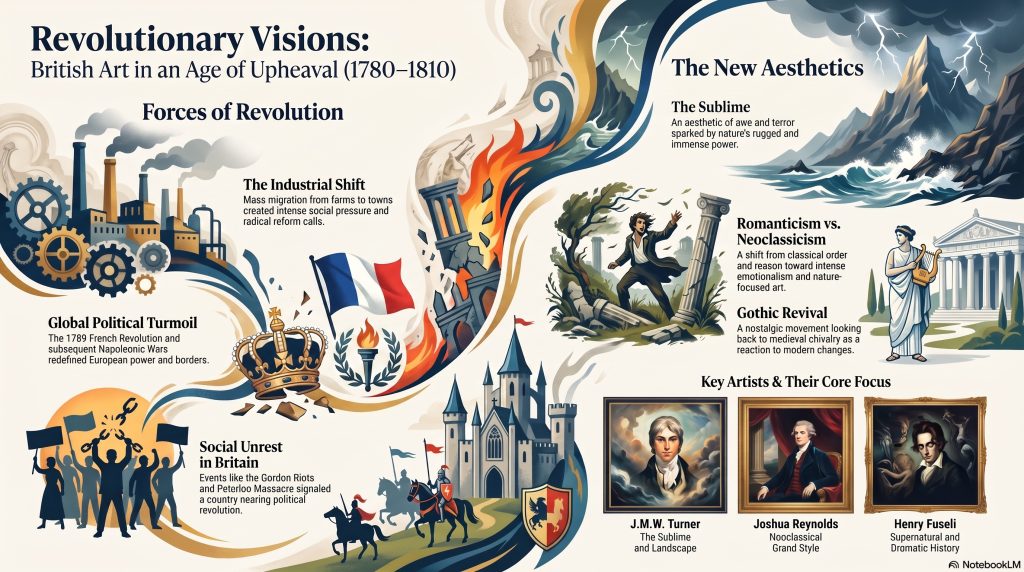
This talk provides a detailed examination of British art between 1780 and 1810, a period defined by significant political and social upheaval. The material explores the tension between Neoclassicism and Romanticism, highlighting how artists shifted from orderly classical traditions to an emotional focus on nature and the Sublime. Key historical influences mentioned include the French Revolution, the Industrial Revolution, and the Napoleonic Wars, all of which informed the dramatic themes of the era. The talk features profiles of prominent figures such as Thomas Gainsborough, Joshua Reynolds, and Joseph Wright of Derby, while analyzing specific masterpieces held at Tate Britain. Beyond high art, the talk documents the harsh realities of the time, including rural poverty, labor riots, and the complexities of the slave trade. Ultimately, the source serves as an educational guide to how visual culture mirrored the transition from the Enlightenment to a more turbulent, modern world.
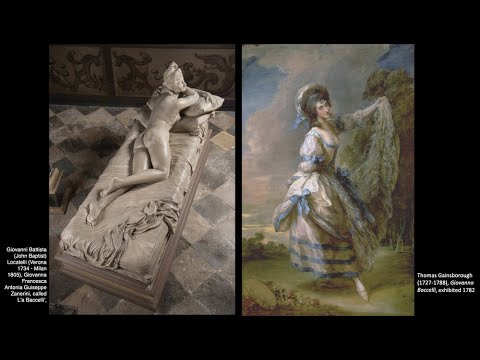
My notes on 17-06 18thC British Art – Revolutionary Times, 1780-1810
1. A World on the Brink
To the casual observer, the late eighteenth century is often reduced to a visual shorthand of “polite society”: the powdered symmetry of a wig, the rustle of a silk waistcoat, and the stately, ordered calm of a Georgian manor. Yet, beneath this veneer of classical restraint, the ground was shifting. Between 1780 and 1810—a period we now define as “Revolutionary Times”—Britain was a landscape of radical fractures. The mechanical clank of James Hargreaves’s spinning jenny was uprooting the rural poor, the stench of Newgate Prison hung over a rioting London, and the seismic shockwaves of the French Revolution were forcing the British elite to look across the Channel with mounting dread.
In the art world, this era marked a departure from the logic of Neoclassical hierarchy. Artists began to favor the visceral over the cerebral, setting the stage for a new era where “feeling” became the ultimate currency.
2. The “Sublime” Was Actually Terrifying
In the modern lexicon, we use the word “sublime” to describe a well-baked loaf of bread or a pleasant sunset. To the eighteenth-century viewer, however, the Sublime was an aesthetic of trauma. Rooted in Edmund Burke’s Philosophical Enquiry (1757), the Sublime was found in experiences of awe, terror, and danger—the strongest sensations the human mind could endure.
As Burke observed:
“Burke saw nature as the most sublime object, capable of generating the strongest sensations in its beholders.”
A master of this terrifying aesthetic was Philip James De Loutherbourg. In his An Avalanche in the Alps (1803), nature is not a backdrop but a merciless destroyer. A bridge is swept away; figures pray, flee, or stand transfixed by the “awesome power” of the crushing ice. De Loutherbourg’s ability to manipulate this terror was no accident—he was a seasoned theatre set designer who also created the “Eidophusikon,” a miniature theatre featuring animated landscapes, sound effects, and music. To him, the Sublime was a theatrical event intended to overwhelm the senses.
3. The Original “King Mob” and Art as News
In June 1780, London was consumed by the Gordon Riots, a week of anti-Catholic violence that left nearly 300 dead. At Newgate Prison, the inmates were freed under a defiant scrawl on the walls: “His Majesty, King Mob.”
This atmosphere of social disintegration turned art into high-stakes reportage. John Singleton Copley’s The Death of Major Peirson (1783) captures a rare British victory against a French invasion of Jersey—a moment of desperate celebration for a nation demoralized by the loss of the American War of Independence. Copley’s painting is a masterpiece of theatrical propaganda. Note the inclusion of Peirson’s black servant: he is depicted as the avenger, killing the sniper at the exact moment of his master’s death. By weaving this “national hero” narrative into a scene of contemporary conflict, Copley gave a fractured public the victory they were starving for.
4. Gainsborough’s Secret Disdain for His Wealthy Clients
Thomas Gainsborough remains the quintessential portraitist of the British aristocracy, yet his private letters reveal a man who found his own success to be an insufferable “humbug.” Mercurial and stubborn, Gainsborough viewed the grand commissions of the elite as a tedious distraction from his true love: the landscape.
His assessment of the socialites who sat for him was famously scathing:
“They think … that they reward your merit by their Company … but I … know that they have but one part worth looking at, and that is their Purse.”
This friction between commerce and artistic integrity manifested in his “speedy technique.” Gainsborough employed light, mercurial flicks of the brush—a shorthand for elegance that allowed him to capture a likeness with rapid, almost defiant efficiency. This independent spirit eventually curdled into a total withdrawal from the Royal Academy; he preferred to show his work in the privacy of his own home rather than submit to the “humbug” of the academy’s hanging committees.
5. The Dark Side of “Sentiment”: Wealth, Slavery, and Charity
In the 1790s, the height of fashion was “sentiment”—the public display of pity and heightened sympathy. William Beechey’s Portrait of Sir Francis Ford’s Children Giving a Coin to a Beggar Boy (1793) appears to be a heartwarming tableau of aristocratic kindness.
The reality is far more cynical. The children’s father, Sir Francis Ford, was a pro-slavery MP whose wealth was extracted from the labor of enslaved people on his Barbados estates. In this context, the painting is a sophisticated piece of political theatre. By showcasing the family’s charity toward a local English beggar, the work functioned as a visual argument for the pro-slavery lobby. The subtext suggested that plantation owners were benevolent caretakers of the poor in both the colonies and at home, while implying that English poverty was “abject” compared to the supposedly managed life of the enslaved.
6. Fuseli and the Art of the Nightmare
The era’s resident “weirdo” was Henry Fuseli, a self-taught dandy and former Swiss minister who had fled his homeland after exposing a corrupt magistrate. A man of volatile temper who famously declared, “I hate clever women,” Fuseli abandoned the “imitation of nature” for the dark recesses of the psyche.
His painting Titania and Bottom (c.1790) is a surreal fever dream. It features a dwarf-like creature led by a string—symbolizing the triumph of the senses over the mind—and artificial beings created by witches. While his peers painted pastoral scenes, Fuseli’s figures were “wraith-like” and grotesque. His rejection of reality was total; he famously exclaimed, “Damn Nature! she always puts me out.” Preferring the “lofty and terrible,” Fuseli’s work paved the way for the mystical, visionary art of the nineteenth century.
7. When Industry Became “Picturesque”
As the nineteenth century dawned, the “Picturesque” moved from the rolling hills of Suffolk to the smoke-choked valleys of Shropshire. In Paul Sandby Munn’s watercolour, Bedlam Furnace (1803), the “blazing furnaces” of the ironworks are rendered with the same awe once reserved for Alpine peaks.
This was the birth of the “Masculine Sublime”—a concept defined by terror, heat, and industrial domination, contrasting with the “Feminine Sublime” of spiritual rapture and infinite nature. The danger and scale of the ironworks were processed by the public as a new kind of dark beauty. By transforming these industrial sites into art, painters like Munn and De Loutherbourg helped the British public navigate the terrifying speed of technological change, finding a strange, awesome grandeur in the very machines that were dismantling their old world.
8. Conclusion: The Legacy of Feeling
The years between 1780 and 1810 represented a seismic shift in the human experience. It was the moment art fractured away from the rigid hierarchies of Neoclassicism to embrace the unpredictable, messy world of Romantic “feeling.” By prioritizing the individual’s emotional response to the world—whether that response was terror at an avalanche or awe at a furnace—these artists invented the modern gaze.
They found their sense of the Sublime in the crashing of ice and the roaring of iron. It leaves us with a haunting question for our own era: If the 18th-century “Sublime” was found in the physical terror of nature and industry, where do we find our sense of “awe and terror” in the digital age?Gemini Notebook can be inaccurate; please double-check its responses.
17-07 18thC British Art – The Royal Academy
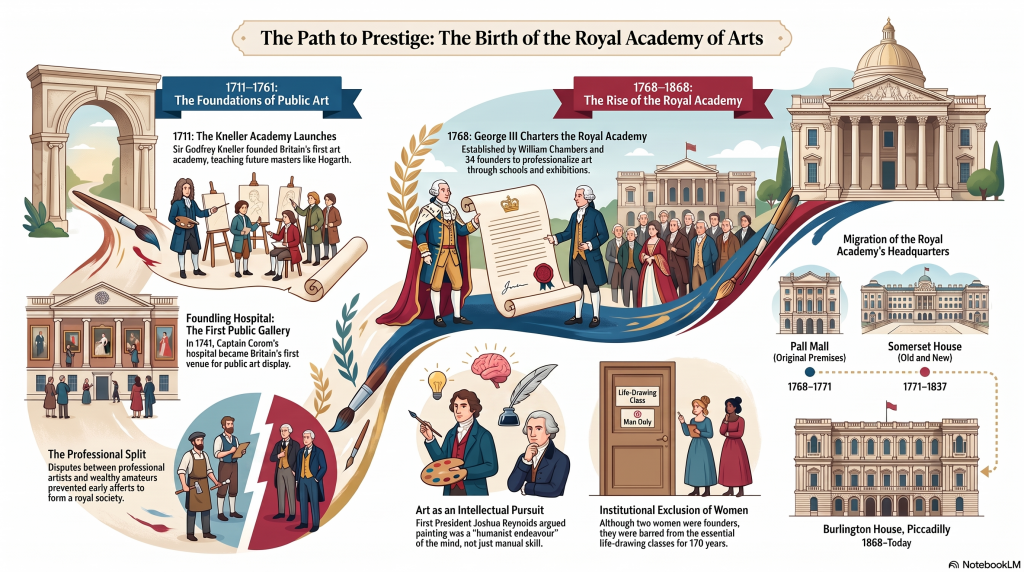
This lecture traces the institutional foundations of British art from Godfrey Kneller’s 1711 painting academy through to the Royal Academy’s establishment in 1768 under George III, with Joshua Reynolds as first President. It charts the Foundling Hospital’s pioneering public exhibitions, the Society of Dilettanti’s patronage networks, and the professional rivalries that shaped the Academy’s formation. Key founders including Chambers, Kauffman, Moser, West, and Zoffany are examined alongside Reynolds’s Discourses, the Summer Exhibition’s social dynamics, and the institution’s systematic exclusion of women from full membership for 170 years.
(My YouTube talk will be published on 16 January 2027)
An entertaining conversation about The Royal Academy created by Google NotebookLM from my notes:
We assume great art institutions simply exist — ancient, inevitable, authoritative. The Royal Academy of Arts feels like it was always there. It wasn’t. For decades, rivalries, snobbery, and a fundamental disagreement about who art was actually for blocked its creation. The story of how it finally came to be is one of the most revealing windows into Georgian Britain we have.
Here are the most surprising, counter-intuitive takeaways.
The RA Was Born From a Power Struggle, Not an Artistic Vision
The immediate cause of the Royal Academy’s founding in December 1768 wasn’t a grand cultural awakening — it was a bitter boardroom fight. Two architects, Sir William Chambers and James Paine, clashed over control of the Society of Artists. Paine won that internal battle. But Chambers held a trump card: direct personal access to George III. He used it. The RA was his institutional revenge, and his reward was becoming its first Treasurer.
Reynolds, the man history remembers as its founding father, only joined after some hesitation.
The World’s First Public Art Exhibition Was in a Children’s Hospital
Before the RA, before Somerset House, before any formal academy — the first place ordinary Londoners could see contemporary art was the Foundling Hospital, established by Captain Thomas Coram in 1741. William Hogarth drove the initiative, persuading Reynolds, Gainsborough, and others to donate works. The building became London’s most popular charity, backed by seventeen dukes, twenty-nine earls, and scores of aristocrats.
Art found its public audience through philanthropy before it found it through institutions.
Two Female Founders Were Written Out Through Composition Itself
Angelica Kauffman and Mary Moser were both founder Academicians in 1768. Yet in Zoffany’s famous group portrait of the Academicians, they appear only as paintings hanging on the wall — because women were barred from the life-drawing class entirely.
This wasn’t incidental. After their deaths, the Academy actively discouraged female membership. No woman joined again until Annie Louisa Swynnerton in 1922. Full membership waited until Laura Knight in 1936 — a gap of 170 years.
“From the beginning, women were excluded from holding any office within the organization and from attending life classes.”
Exclusion was encoded in the canvas before it was ever written into policy.
Reynolds Believed Painting Was Philosophy, Not Craft
In fifteen Discourses delivered between 1769 and 1790, Joshua Reynolds laid out a radical argument: that painting
“is not the industry of the hands, but of the mind.”
He traced this directly to the Italian Renaissance conviction that art is a humanist endeavour requiring knowledge of the classics. His instruction to study the great masters wasn’t about copying — it was about forming genius rigorous enough to eventually transcend rules altogether.
Turner requested burial at Reynolds’s side. His pupil Northcote wrote that he “almost worshipped him.”
The Summer Exhibition Was Designed to Keep Poor People Out
By the 1870s, the RA’s annual Summer Exhibition attracted around 300,000 visitors — at a shilling each. Contemporary reports suggested the entrance fee existed specifically to exclude “the noxious effluvia of the vulgar herd.”
A shilling was the going rate for a French lesson, a zoo visit, or a sheet of popular music. Morally respectable. Strategically exclusionary.
What Does It Mean That the World’s Largest Open-Submission Art Show Still Runs Today?
The RA’s Summer Exhibition has run continuously since 1769. It began with 136 works; today it receives around 13,000 submissions. The institution that was founded to elevate British art above the crowd now operates the world’s largest show open to any artist who applies.
Whether that’s the fulfilment of Reynolds’s founding vision — or its quiet contradiction — is a question worth sitting with.
17-08 18thC British Art – Zoffany and the Conversation Piece

This talk traces the conversation piece from its origins in the Italian Sacra conversazione, through Rubens and Watteau, to its flowering in Georgian Britain. Hogarth sharpened the format into social comedy whilst Devis, Reynolds, Gainsborough, and Stubbs each adapted it to negotiate questions of class, landownership, and self-presentation. Zoffany’s arrival in London crystallised the genre’s full possibilities, combining domesticity, celebrity, and moral complexity within apparently casual arrangements. A single portrait tradition thereby becomes a sustained record of how Georgian society, across every rank from monarchy to merchant, chose to imagine and display itself.
(My YouTube talk will be published on 6 February 2027)
My notes on Zoffany and the Conversation Piece
An entertaining conversation about Zoffany and the Conversation Piece created by Google NotebookLM from my notes:
We tend to think of old portraits as stiff, formal, and a little dull. But a remarkable tradition called the conversation piece — those informal group portraits that flourished in 18th-century Britain — turns out to be one of the most psychologically loaded art forms ever invented. Behind every casually arranged family on a manicured lawn lies a web of ambition, anxiety, commerce, and theatre. Here’s what those paintings are actually telling you.
A Sacred Idea Became a Status Symbol
The genre traces directly to the Sacra conversazione — Renaissance altarpieces where the Virgin sits surrounded by saints from different centuries. Palma Vecchio’s 1518 version even includes a live patron, Francesco Priuli, kneeling into the divine scene. The donor’s black robe, not red, is itself evidence: he hadn’t yet been appointed Procurator of Venice. A garment dates the painting more precisely than any archive. That slippage — devotion quietly serving ambition — never really left the genre.
Rubens Painted His Trophy Marriage as Classical Allegory
When the 53-year-old widower married 16-year-old Helena Fourment, Rubens didn’t just celebrate the union — he encoded it. The Garden of Love fills the canvas with cupids bearing yokes and doves, a Three Graces fountain signalling fertility, a peacock invoking Juno. He explained his choice of a merchant’s daughter over a noblewoman by noting a court lady
“would blush to see me take my brushes in hand.”
The painting isn’t romance. It’s a very sophisticated justification.
The Conversation Piece and the Novel Were Born Together
Both emerged in 1720s Britain — and for the same reason. A wealthy new middle class, enriched by empire and industry but socially excluded by the aristocracy, needed cultural forms that reflected their lives. William Hogarth drove this in paint; Defoe and Fielding drove it in prose. Allegorical portraits and epic poetry were the aristocracy’s idiom. Conversation pieces and novels were something rawer, more specific, more real.
Every Inch of the Canvas Was a Calculated Message
Arthur Devis painted his merchant patrons with conspicuously bare floors — not poverty, but status. Fixed carpets weren’t common in European interiors until Persian trade routes opened later in the century. George Stubbs rendered a bride offering flowers to her husband’s horse with scientific precision, without sentiment. Gainsborough pushed a couple to one side of Mr and Mrs Andrews and gave the land equal weight — almost certainly because the landowner wanted his acres acknowledged, not just implied.
Zoffany Smuggled Moral Complexity into Polite Scenes
In his portrait of the Sharp family making music on their Thames barge, Zoffany depicts a picture of Georgian leisure at its most refined. But Granville Sharp, holding his flageolet at the piano, had spent years fighting to free Jonathan Strong — a slave beaten nearly blind by his owner — and would dedicate fifty more years to abolition.
The same hands making music had begun dismantling British slavery.
The painting looks like an entertainment. It is also a monument.
A Clock Could Invert an Entire Moral Tradition
Dutch genre paintings of women dressing carried a clear vanitas message: beauty is fleeting. Zoffany knew this perfectly well when he painted Queen Charlotte at her dressing table. But he reversed the lesson entirely. The Father Time figure on the Ferdinand Berthoud clock bends to read exactly 2:30pm — the Princes have finished dinner, the governess waits, the Queen will dine at 4:00 precisely. Timekeeping isn’t vanity here. It is virtue.
A Dog Can Be the Most Honest Sitter in the Room
In The Sayer Family of Richmond, Zoffany pictures his old friend Robert Sayer with his new wife and his grown son — a psychologically loaded gathering of inheritance, remarriage, and cautious assessment. Each human face performs. The stepmother watches the stepson with guarded expectancy. The father leans forward with something between hope and anxiety. Only the dog
looks out at the viewer with an expression between boredom and irritation.
As scholar David Wilson observed, for Zoffany facial expressions and material possessions acted as “important indices of behaviour and personal presentation.” Sometimes the most honest index has four legs.
From a Renaissance altarpiece to a Thames-side dog rolling its eyes, the conversation piece spent two centuries holding a mirror to the people who could afford to commission one. The question it leaves us with is still live: when we carefully arrange how we want to be seen, what are we actually revealing?
17-09 18thC British Art – Joseph Wright of Derby (1734-1797)
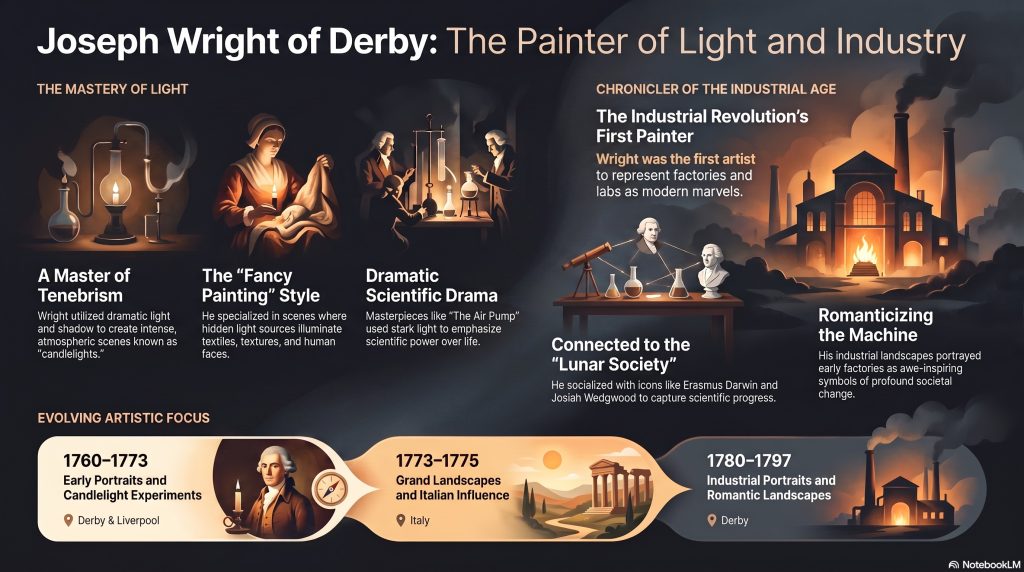
Joseph Wright of Derby was a prominent eighteenth-century British artist celebrated for his innovative portrayal of the Industrial Revolution and his mastery of light. While he initially gained fame for portraits and landscapes, he is most recognized for his “candlelight” paintings, which utilized dramatic chiaroscuro to depict scientific experiments and early factory scenes. These sources detail his professional journey from his training in London under Thomas Hudson to his influential role in recording the intellectual spirit of the Enlightenment through works like The Orrery. His close connections to the Lunar Society allowed him to capture the intersection of art, science, and industry, cementing his legacy as a “modern” painter. Beyond technical subjects, the texts highlight his emotional depth in late-career landscapes and somber narrative works. This comprehensive overview ultimately defines Wright as a versatile master who redefined the boundaries of British art during a period of profound societal change.

My notes on 17-09 18thC British Art – Joseph Wright of Derby (1734-1797)
An entertaining conversation about Joseph Wright of Derby created by Google Notebook from my notes:
1. Introduction: The Painter of the Scientific Sublime
In the mid-18th century, the British art world was a space of “polite” refinement. The elite commissioned flattering portraits that emphasized lineage, land, and stationary elegance. But while his contemporaries were capturing the soft glow of drawing rooms, Joseph Wright of Derby was looking into the mouth of a furnace.
Wright was more than a painter; he was the primary chronicler of a world-changing era. He turned his gaze toward the flickering light of scientific discovery and the raw energy of the early Industrial Revolution. By applying the dramatic techniques of the Old Masters to the grit of the laboratory and the forge, he captured the “scientific sublime” at the very moment the modern age was being forged.
2. The Rebel Who Chose the Provinces Over London
Born in 1734 to a lawyer’s family in Derby, Wright’s training began conventionally enough. At 17, he traveled to London to study under Thomas Hudson, the same master who trained the quintessential establishment painter, Joshua Reynolds. Yet, in a move that baffled his peers, Wright rejected the lure of the capital.
His colleagues believed a successful career required a London address, but Wright returned to the Midlands. This choice was a radical departure that allowed him to live at the epicenter of a revolution. By remaining in Derby, he didn’t just paint the elite; he painted the innovators, the inventors, and the very machines that were rewriting human capability.
“Joseph Wright of Derby has been described as ‘the first professional painter to express the spirit of the industrial revolution’” — Francis Klingender, Art and the Industrial Revolution.
3. The Gritty Reality Behind “The Alchemist”
In The Alchemist Discovering Phosphorus (1771), Wright presents a scene of high Gothic drama. We see the German alchemist Hennig Brand in a vaulted, church-like setting, falling to his knees as a flask erupts with a brilliant, magical light.
However, Wright’s genius lay in the tension between this romanticized aesthetic and the rational reality of the Enlightenment. Though set in the 17th century, the painting was a commentary on the 18th-century transition from superstition to chemistry. The “magical” glow was the discovery of phosphorus—the “Devil’s element”—a process that actually involved the unglamorous task of boiling down dozens of buckets of urine. This clash between the “Gothick” past and the rational present proved too unsettling for his audience; the painting, now considered a masterpiece, famously failed to sell until four years after Wright’s death.
4. Science as High Drama: The Ethics of the Air Pump
Wright’s 1768 masterpiece, An Experiment on a Bird in the Air Pump, elevated a scientific lecture to the status of a “history painting,” a genre usually reserved for great battles or religious scenes. The painting depicts a natural philosopher demonstrating the power of a vacuum by removing air from a bell jar.
The central conflict is a visceral struggle over life and death. Wright heightens the drama through specific, theatrical staging:
- The Cockatoo: In reality, itinerant lecturers typically used a simple bladder to show the effects of a vacuum, as killing animals was seen as “too shocking.” Wright intentionally chose a rare, expensive white cockatoo to maximize the emotional stakes.
- The Observers: A father consoles his daughters who turn away in fear, while a boy watches with cold curiosity, illustrating the varied human responses to scientific “progress.”
Adding a layer of historical grit is the man who bought the painting: Dr. Benjamin Bates. A physician and patron of the arts, Bates was also a notorious member of the “Hellfire Club,” an association known for hedonism and immoral activities. The fact that this profound meditation on ethics and science was hung in the home of a renowned hedonist adds a striking irony to its legacy.
5. A Secret Society of “Lunarticks”
Wright’s intellectual home was the Lunar Society of Birmingham. This informal group of industrialists and “natural philosophers” met during the full moon—not for any occult reason, but because the extra light made the journey home safer in an age before street lighting. The members humorously called themselves “lunarticks.”
While Wright was not a member himself—he felt he lacked the formal scientific knowledge—he was their unofficial court painter. Through these connections, he documented the faces of the men who were quite literally building the future:
- Erasmus Darwin: Physician, poet, and grandfather of Charles Darwin.
- Josiah Wedgwood: The legendary potter and abolitionist.
- Matthew Boulton and James Watt: The pioneers who perfected the steam engine.
- Richard Arkwright: The inventor whose factory system would change the face of labor forever.
6. The Beauty of the “Dark Satanic Mills”
Richard Arkwright serves as the bridge between Wright’s portraits and his industrial landscapes. In Arkwright’s Cotton Mill by Moonlight (1782), Wright depicts Arkwright’s seven-story factory at Cromford.
To capture this “wonder of the age,” Wright utilized tenebrism—an extreme form of light and dark contrast. He turned a functional industrial site into an awe-inspiring spectacle. The mill is seen operating 24 hours a day, with light burning in every window, a sight that signaled a permanent shift in human rhythm. While Wright saw the “sublime” beauty in this innovation, he also implicitly documented the birth of what William Blake would later call “dark satanic mills,” masking the reality of child labor and dangerous conditions beneath a romantic, moonlit glow.
7. The Man Who Told the Royal Academy “No”
Wright’s independence was as fierce as his subjects’. In 1781, he was elected as a full member of the Royal Academy but refused the honor. Like Thomas Gainsborough, he was a prickly character who quarrelled with the Academy over the hanging of his paintings, feeling his work was not given the prominence it deserved.
In a radical display of independence, he organized his own one-man show at Covent Garden in 1785. This was an unprecedented move, mirroring the self-reliant, revolutionary spirit of the industrialists he immortalized. He proved that an artist of sufficient genius did not need the validation of the London establishment.
8. From Faces to Forests: The Late-Life Pivot
While portraits were the “mainstay of his career,” Wright’s heart eventually wandered into the wilderness. In his later years, he suffered from depression and declining health, finding solace in the dramatic terrain of Matlock Tor and the Lake District. He became obsessed with the atmosphere of the outdoors, seeking the “sublime” in nature just as he had once found it in the laboratory.
As he famously wrote:
“I know not how it is, tho’ I am ingaged in portraits … I find myself continually stealing off, and getting to Landscapes.”
9. Conclusion: A Legacy Written in Light
Joseph Wright of Derby was the great synthesizer of the 18th century. He was the man who saw no contradiction between the beauty of a sunset and the glow of a forge, or the precision of a telescope and the emotion of a prayer. He moved beyond the “candlelight” gimmick to create an art that was as rigorous as science and as passionate as poetry.
His work leaves us with a challenging legacy. As we navigate our own era of rapid technological change, we must ask: Who is our Wright of Derby today? Do we have an artist capable of making our world of silicon and code as beautiful, as terrifying, and as deeply human as Wright made the world of iron and steam?Gemini Notebook can be inaccurate; please double-check its responses.