The Restoration of Charles II to the English throne in 1660 ended two decades of Puritan rule and inaugurated a period of cultural renewal in which the arts flourished with a new licence and cosmopolitan sophistication. Charles II had spent his years of exile at the courts of France and the Spanish Netherlands, and he returned determined to transform London into a city that could rival Paris in grandeur and cultural brilliance. Portrait painting dominated the period, with Sir Peter Lely and later Sir Godfrey Kneller establishing the conventions of the Baroque state portrait in England. The Great Fire of London in 1666 paradoxically created an opportunity for the greatest architectural achievement of the era — Christopher Wren’s rebuilding of the City, culminating in St Paul’s Cathedral. The period also saw the foundation of the Royal Society and a new enthusiasm for scientific observation that would influence artistic perception in the decades to come.
16-01 Restoration England – Introduction 1660-1800
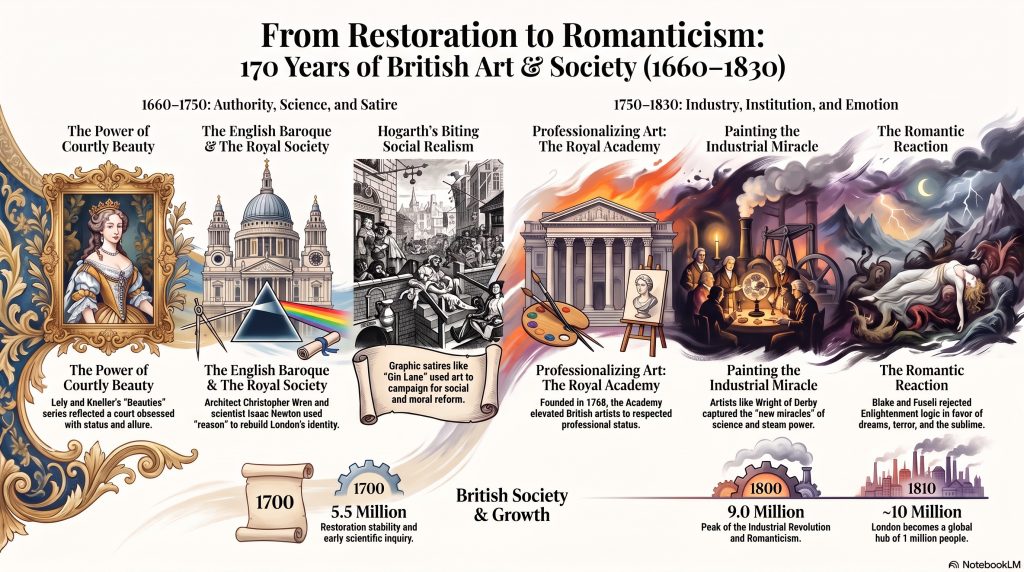
The provided talk details the evolution of British art and society from the Restoration in 1660 through the Romantic era ending in 1830. It tracks how major historical shifts, such as the Scientific Revolution and the Industrial Revolution, influenced creative expression and architectural styles like the English Baroque. Key figures like William Hogarth pioneered social satire, while Sir Joshua Reynolds and Thomas Gainsborough professionalized portraiture through the founding of the Royal Academy. The narrative also explores the tension between Enlightenment rationalism and the emotional intensity of the Romantic movement seen in the works of William Blake and Henry Fuseli. Ultimately, the sources illustrate how art transitioned from royal propaganda and courtly beauty to capturing the complexities of a modern, industrializing nation.
My notes on Restoration and Georgian Art
An entertaining conversation about Restoration and Georgian Art 1660-1830 created by Google NotebookLM from my notes:
The youTube video will be published on 3 October 2026
The Return of the King — A Court Hungry for Art: When Charles II sailed back to England in May 1660, he brought with him a sophisticated knowledge of French and Flemish art and a determination to use culture as an instrument of royal prestige. The court immediately became a centre of artistic patronage, importing portraits, tapestries, and decorative arts from Europe. The contrast with the austere iconoclasm of the Interregnum could not have been more dramatic.
Sir Peter Lely and the Baroque Portrait: Sir Peter Lely (1618–1680), a Dutch-born painter who had worked for Charles I, became the dominant portraitist of the Restoration court. His portraits of the aristocracy — languid, sensuous, exquisitely dressed — established the visual language of Restoration England. His series of the “Windsor Beauties”, depicting the most celebrated women of the court, perfectly captured the spirit of an age that had rediscovered the pleasures of elegance and display.
The Great Fire and the Rebuilding of London: The Great Fire of September 1666 destroyed eighty-seven churches and over thirteen thousand houses in the City of London. It was catastrophic — and also a unique opportunity. Christopher Wren was appointed Surveyor-General and over the following decades designed fifty-one new City churches, each a unique experiment in Protestant sacred architecture. His masterpiece, St Paul’s Cathedral, completed in 1711, stands as one of the supreme works of English Baroque.
Christopher Wren and English Baroque Architecture: Wren’s genius lay in his ability to synthesise continental Baroque drama with English practicality and Protestant restraint. He had visited France in 1665 and met the great Baroque sculptor Bernini, whose influence can be detected in the dramatic dome of St Paul’s. Yet Wren’s buildings never achieve the theatrical extravagance of Roman Baroque — they are more rational, more classical, more fundamentally English.
The Decorative Arts and Ham House: The Restoration also saw a revolution in interior decoration, as continental fashions — elaborate plasterwork ceilings, carved wood panelling, chinoiserie — transformed the English country house. Ham House in Surrey, remodelled in the 1670s, survives as the most complete example of a Restoration interior in England, its rooms furnished with a richness that shocked even foreign visitors.
Legacy — A New Visual Culture: The Restoration established the conventions of English portraiture, court culture, and civic architecture that would persist through the eighteenth century. Wren’s churches remain among the most beloved buildings in London. And the cosmopolitan ambition of the period — the sense that England could be a serious player in European cultural life — laid the groundwork for the Georgian flowering that followed.
16-02 Restoration England – The Power of Beauty in Restoration England
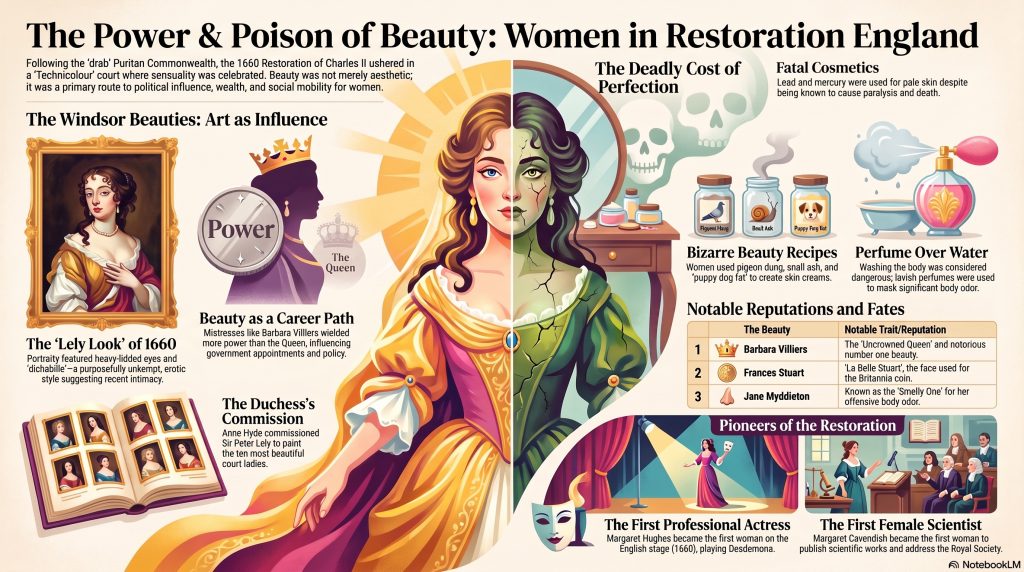
The Windsor Beauties comprise a famous collection of portraits painted by Sir Peter Lely during the Restoration of the English monarchy. Commissioned by Anne Hyde, Duchess of York, these paintings immortalize the prominent women of King Charles II’s court, emphasizing a specific ideal of feminine sensuality and grace. The era was defined by a shift toward licentiousness and luxury following the restrictive Puritan Commonwealth, where beauty often served as a primary gateway to political power. While some sitters were respected nobles, others were notorious mistresses like Barbara Villiers, whose influence earned her the title of “Uncrowned Queen.” Beyond the art, the sources describe a society where cosmetics and fashion were highly valued despite containing poisonous ingredients like mercury and lead. Ultimately, the collection serves as a visual record of a decadent court where gender roles, social status, and personal vanity intersected.
16-02 My notes on Restoration England – The Power of Beauty in Restoration England
An entertaining conversation about Restoration England – The Power of Beauty created by Google NotebookLM from my notes:
In 1660, England underwent a sensory explosion. After eleven years of the Puritan Commonwealth—a bleak, black-and-white era where plays were banned, entertainment was stifled, and women were covered in austere black—the Restoration of Charles II felt like a sudden shift into high-definition “Technicolour.” The Court became a kaleidoscope of music, dancing, and a fixation on aesthetic splendor. At the epicenter of this revival were the “Windsor Beauties,” a series of portraits by Sir Peter Lely depicting the most celebrated women of the age.
Yet, as a cultural historian peering behind the canvas, one finds that these famous pinups weren’t merely living a dream; they were navigating a toxic nightmare. To look at a Lely portrait is to see a carefully constructed lie. Beneath the “languorous” gazes and shimmering “studio drapery” lay a world of filth, professional espionage, and a slow-motion suicide of the vanity-obsessed.
1. The Literal “Price of Beauty” was Often Death
The “Windsor Beauty” look was defined by a pure, pale complexion and a “drowsy sweetness” in the eyes. Achieving this required a lethal cocktail of chemicals that would make a modern chemist shudder. To mimic the “virtuous” natural blush of a maiden, courtiers applied thick layers of white lead powder and stained their cheeks with scarlet leather or paper dyed with ground cochineal beetles.
This was more than vanity; it was a hazardous medical gamble. Mercury was used in almost everything, partially because it was already the standard, agonizing “cure” for syphilis, which was rife among the aristocracy. This cosmetic mask caused the skin to become “prematurely withered” and the hair to turn grey. For those seeking a more “natural” glow, the recipes were even more visceral: beauty creams were whipped from “puppy dog fat,” “pigeon dung,” “snail ash,” and even urine. Women slept in gloves made of chicken skin or unborn calf skin lined with cream to keep their hands soft.
The danger was fatal. As the courtier Henry Savile recorded in 1686:
“Lady Henrietta Wentworth sacrificed her life to beauty, by painting so beyond measure that the mercury got into her nerves and killed her.”
2. Becoming a Royal Mistress Was a Legitimate Career Path
In the 17th century, beauty was the primary currency for women in a society that legally erased them. Under the common law of feme covert, a married woman was legally invisible—unable to own property or control her own finances. Curiously, only widows held the right to control their own money. For a woman of ambition, the “Technicolour” Court offered a high-stakes loophole: catching the King’s eye.
Becoming a royal mistress was a strategic career move that provided wealth and political influence no legal marriage could offer. Barbara Villiers, the “Uncrowned Queen,” was so powerful she could depose government ministers. While she received a staggering £15,000 annuity, she was eclipsed by the French mistress Louise de Kérouaille, who secured a massive £19,000 (roughly £10.5 million today). Even Nell Gwyn, who rose from being a slum-dwelling “orange girl” to a mistress with a £5,000 allowance, proved that in the Restoration, a “meretricious” reputation was a small price to pay for financial sovereignty and dukedoms for one’s children.
3. The “Smelly” Reality of the World’s Most Beautiful Women
While Lely’s subjects appear ethereal, the physical reality of the court was pungent. There existed a terrifying hygiene paradox: while beauty was celebrated, washing the body was widely considered “dangerous and life-threatening.” To compensate for the lack of soap and water, courtiers doused themselves in “Hungary water”—a potent, stinging rub of alcohol, rosemary, cedar, and turpentine.
The result was a heavy, “sour” atmosphere that even the greatest beauties could not mask. Jane Myddleton, the eighth Windsor Beauty, was a prime example of this olfactory cognitive dissonance. Despite her striking looks, her lack of hygiene was a frequent topic of backroom gossip. Samuel Pepys recorded a dinner conversation where the “fine Mrs. Middleton” was scrutinized:
“…the fine Mrs. Middleton is noted for carrying about her body a continued sour base smell, that is very offensive, especially if she be a little hot.”
4. The Court Was a Breeding Ground for Bizarre Conspiracies
Life at court was governed by intense rivalries and professional espionage, leading to dark rumors of foul play. The most tragic case was that of Margaret Brooke, Lady Denham. Her rise and fall were lightning-fast: she became the public mistress of the Duke of York at 18 and was dead within a year.
When she died suddenly at age 20, the court was convinced of a “Death by Chocolate” plot. Rumors flew that she had been poisoned by a jealous rival—Henrietta Boyle, the Countess of Rochester—or perhaps by the Duchess of York herself. Although an autopsy found no trace of poison, the public’s thirst for a scandal involving arsenic-laced cocoa was unquenchable. The poet Andrew Marvell immortalized the conspiracy:
“What frosts to fruit, what arsenic to the rat, / What to fair Denham, mortal chocolate.”
5. The “Technicolour” Era Produced Unexpected Feminism
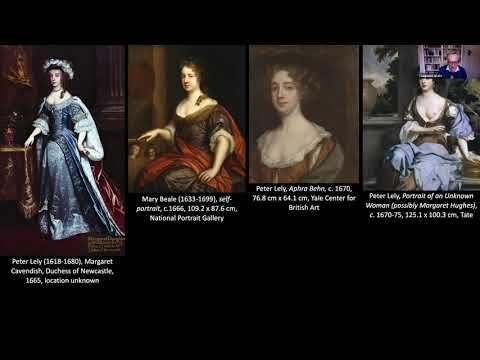
Ironically, the same licentious environment that produced these painted “pinups” also allowed pioneering women to break professional barriers. Sir Peter Lely himself ran an “investigative” production line; he would often only paint the faces of his sitters, leaving his assistants to finish the bodies in “numbered poses” and drape them in dishabille (a state of undress) to signal sexual availability to the male gaze.
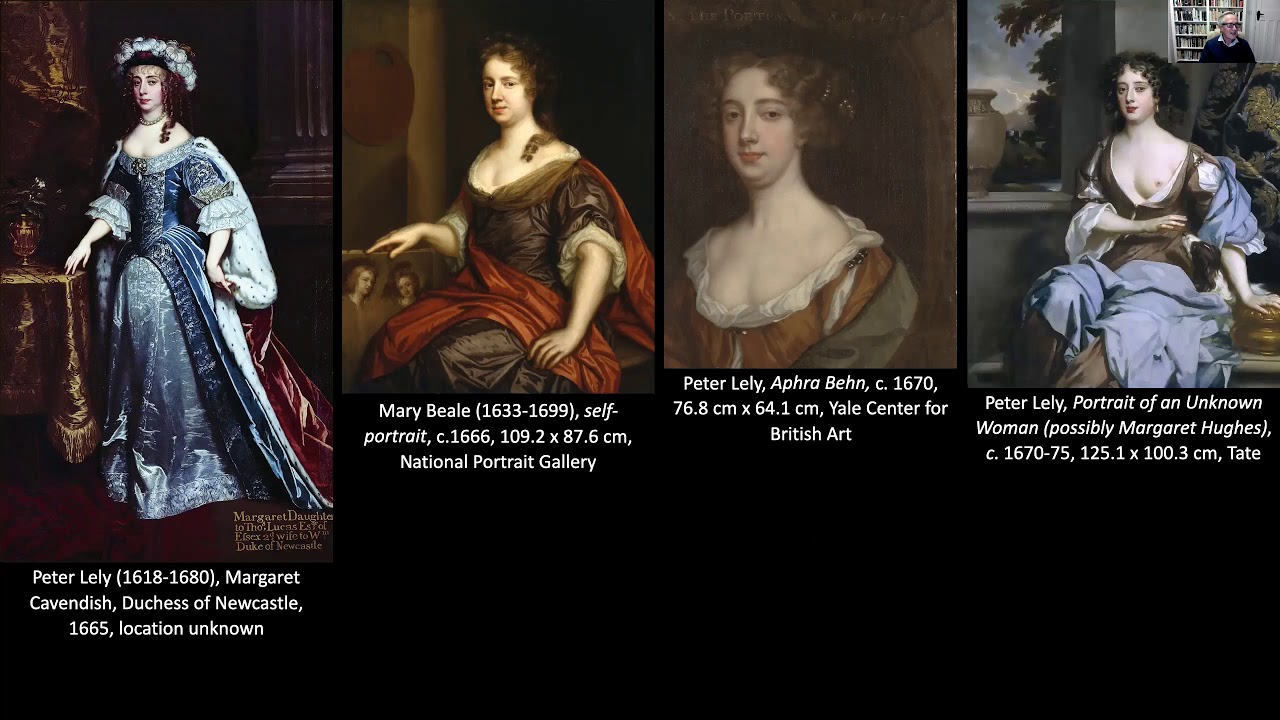
Yet, within this same society, intellectual breakthroughs were occurring. Margaret Cavendish became the first woman to speak at the Royal Society and the first to publish scientific works under her own name. Aphra Behn became the first woman to earn a living as a professional playwright, while Mary Beale became a professional artist and the primary financial provider for her family. This was the era of the intellectual shift, where Mary Astell used logic and reason—rather than historical precedent—to challenge the status quo:
“If all Men are born free, how is it that all Women are born Slaves?”
Conclusion: A Legacy of Grace or Vanity?
The Windsor Beauties represent a unique historical collision where beauty, sex, and power were inextricably linked. These women were more than the “silly and insipid” creatures later Victorian historians claimed; they were survivors navigating a world of toxic lead, professional rivalries, and rigid legal constraints.
As we look at modern advertisements for “unique” powders and pseudo-scientific beauty claims today, we must ask ourselves: have we truly evolved from the lead-painted courtiers of the 17th century, or are we still paying a mortal price for the “ideal” look?
16-03 Restoration England – The Commonwealth to the Georgian Period
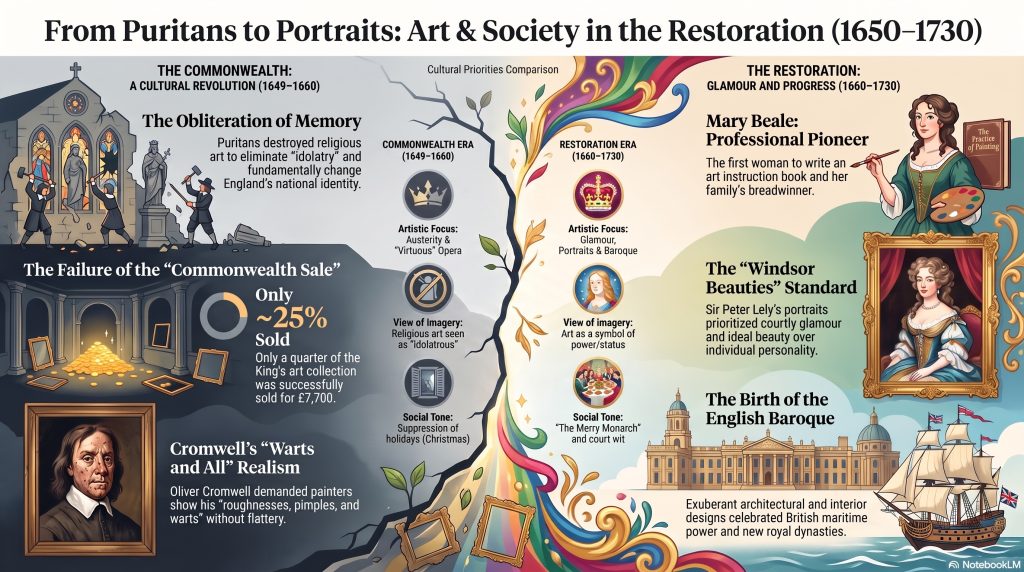
These lecture notes and gallery guides provide a historical overview of British art and society from the mid-17th to the early 18th centuries. The materials highlight the cultural transition from the Commonwealth’s iconoclasm and the sale of Royal collections to the flamboyant Restoration of the monarchy. Key artistic figures like Sir Peter Lely, Sir Godfrey Kneller, and the pioneering female painter Mary Beale are featured through their portraiture and narrative works. Significant emphasis is placed on the evolving role of women, examining how court beauties and professional artists navigated a shifting social landscape. Additionally, the sources describe the rise of English Baroque architecture and the emergence of the “conversation piece” as a popular genre in painting. Detailed catalogs and room descriptions from Tate Britain serve to illustrate these broader historical and aesthetic developments.
My notes on Restoration England – The Commonwealth to the Georgian Period
An entertaining conversation about Restoration England – The Commonwealth to the Georgian Period 1650-1730 created by Google NotebookLM from my notes:
1. Introduction: The Era of Cultural Whiplash
The mid-17th to early 18th century in Britain was a period of profound cultural whiplash. In a few mere decades, the nation swung from the austere, image-breaking iconoclasm of Oliver Cromwell’s Commonwealth to the hedonistic, silk-draped Restoration of Charles II. This was a “cultural revolution” designed to fundamentally reshape national identity, often by obliterating the records of the past.
As an art historian, I find this era particularly compelling because art was never just decoration; it was a tool for survival, a weapon of state propaganda, and a gritty record of radical social shifts. Beneath the idealized oil paintings of the era lie stories of financial desperation, professional innovation, and the sensory reality of a century of upheaval.
2. The Ultimate Political Survivor: Peter Lely’s “Warts and All” Strategy
In an age where shifting political winds could lead to the scaffold, Peter Lely was the ultimate survivor. Originally the official painter to Charles I, Lely navigated the transition to Cromwell’s strict Commonwealth, served Cromwell’s son Richard, and finally became the Principal Painter to Charles II.
Lely’s adaptability was famously tested by the demand for unvarnished realism. Horace Walpole, in his Anecdotes of Painting in England (1763), records the blunt directive allegedly given by Cromwell to the artist:
“Mr Lely, I desire you would use all your skill to paint my picture truly like me, and not flatter me at all; but remark all these roughnesses, pimples, warts, and everything as you see me; otherwise I will never pay a farthing for it.”
However, a closer look at the provenance of this story suggests a scholarly nuance: the “warts and all” instruction was likely intended for the miniaturist Samuel Cooper, whose watercolors reveal Cromwell’s facial imperfections with even greater scrutiny. Lely, ever the diplomat, balanced this demand for realism with “cultural prestige.” While he recorded the requested “roughnesses,” he elongated Cromwell’s features and depicted him in cuirassier armour—the heavy plate of a cavalry officer—to lend a martial authority to a man who professed to eschew the gaudy trappings of power.
3. The King’s Fire Sale: How a Tailor Ended Up with a Titian
Following the execution of Charles I in 1649, the Commonwealth Parliament passed an Act to sell the late King’s magnificent collection to pay off his creditors and fund the Royal Navy. From a modern perspective, this “Commonwealth Sale” was an act of “incomparable folly,” dismantling one of the greatest art troves in history for short-term debt.
The sale was a logistical catastrophe. The goal was £30,000, but only a quarter of the works sold, raising a meager £7,700. Because cash was scarce, the government forced creditors—including tailors and plumbers—to accept world-class paintings in lieu of payment. These tradesmen, unable to value the art, formed syndicates to offload works at “knocked down” prices. A Veronese might go for £11; a Van Dyck for a mere £23.
However, some speculators possessed a sharper eye. Colonel John Hutchinson purchased Titian’s Pardo Venus for £600 in 1649. Demonstrating merciless negotiation skills as the market recovered, he eventually sold it to the French ambassador for £4,900—an eightfold return on his investment.
4. The Chaste Huntress: The Woman Who Said No to the King
Frances Theresa Stuart, “La Belle Stuart,” was a rarity in the Restoration court: a woman who spurned the advances of Charles II and remained his favorite precisely because she maintained her “virtue.” The irony of her iconography is delicious. She was frequently depicted by Lely as Diana, the chaste virgin goddess of the hunt, even as she was being relentlessly “chased around the palace” by a predatory King.
Her refusal became a symbol of national protection. In 1667, her likeness was chosen to represent Britannia on a commemorative medal celebrating naval victories; her personal virtue was equated to Britain’s naval strength. This image of Britannia remained on British coinage for centuries, appearing on the fifty-pence coin as recently as 2006.
Stuart’s legacy is preserved in a bizarrely personal fashion at Westminster Abbey. Per her instructions, a 5′ 8″ wax effigy of her stands dressed in her coronation robes. Displayed beside her is her pet African Grey parrot—the oldest stuffed bird in existence—which reportedly died just days after its mistress.
5. The Baroque CEO: Mary Beale’s Household Empire
While women of this period were strictly defined by their marital status, Mary Beale emerged as a pioneering professional artist and the primary breadwinner. Her household functioned as a sophisticated corporation. In a total reversal of 17th-century norms, her husband, Charles, acted as her “studio manager,” mixing pigments, priming canvases, and meticulously tracking her commissions.
Beale’s success was no fluke; it was a result of aggressive business growth. Her studio’s income rose from £118 in 1671 to a staggering £429 by 1677. She was also an intellectual innovator, writing Observations in 1663—the first art instruction book authored by a woman—and an Essay on Friendship which proposed radical equality between men and women in marriage. While she often made a living by producing mezzotints or copies of Lely’s portraits, she intentionally “toned down” his more erotic elements, tailoring her work to a more pious, Puritan-leaning clientele.
6. The Invention of the “Spinster” and the Beauty with the “Sour Smell”
The Civil War had a grim demographic consequence: the massive loss of male life created a surplus of single women in towns. This gender imbalance led to the first use of terms like “spinster” and “old maid” to describe women who remained outside of marriage.
This social reality stood in stark contrast to the “Windsor Beauties” at court. In portraits of notorious mistresses like Barbara Villiers—nicknamed “The Curse of the Nation”—Lely painted women in “timeless” silk drapes. This was a deliberate stylistic choice; by removing the fashionable stomacher (the boned triangular panel of a bodice) and the farthingale (the hooped petticoat), Lely gave his subjects a classical, soft air.
But the reality was far less atmospheric. One of the era’s most famous beauties, Jane Myddleton, was described by John Evelyn as “incomparable,” but the diarist Samuel Pepys recorded a different story. His friend Elizabeth Pearse noted that “the fine Mrs. Middleton” was infamous for carrying a “continued sour base smell” that became “very offensive” whenever she grew warm. It is a striking reminder of the disconnect between the violet eyes and alabaster skin of the oil paint and the gritty, unwashed reality of 17th-century life.
7. The Painted Hall: Propaganda on a Grand Scale
The pinnacle of the English Baroque is the Painted Hall at Greenwich. Spanning 40,000 square feet, this exercise in trompe l’oeil (eye-fooling) propaganda was designed to celebrate British maritime power. The ceiling depicts King William III literally trampling on Tyranny, represented by the defeated French ruler, Louis XIV.
There is a poignant irony in the Hall’s history. It was originally intended as a dining hall for naval veterans, but the result was deemed “far too grand” for old sailors. Instead, it became a tourist attraction where the veterans themselves served as tour guides for a fee. The artist, James Thornhill, spent 19 years on the project but faced a staggering disparity in pay: he was compensated £3 per square yard for the ceiling, but only a lowly £1 per square yard for the walls.
8. Conclusion: A Legacy of Contradiction
The century between the Commonwealth and the early Georgians was a period of “continued destruction” and baroque magnificence. It was an era where art was used to obliterate memories and to create new ones—to settle state debts and to define national virtues.
We are left to wonder: does the true value of these works lie in their idealized beauty—the timeless silks and the heavenly ceilings—or in their ability to preserve the “roughnesses, pimples, and warts” of a deeply human and contradictory history?
16-04 Restoration England – Charles II: Art and Power
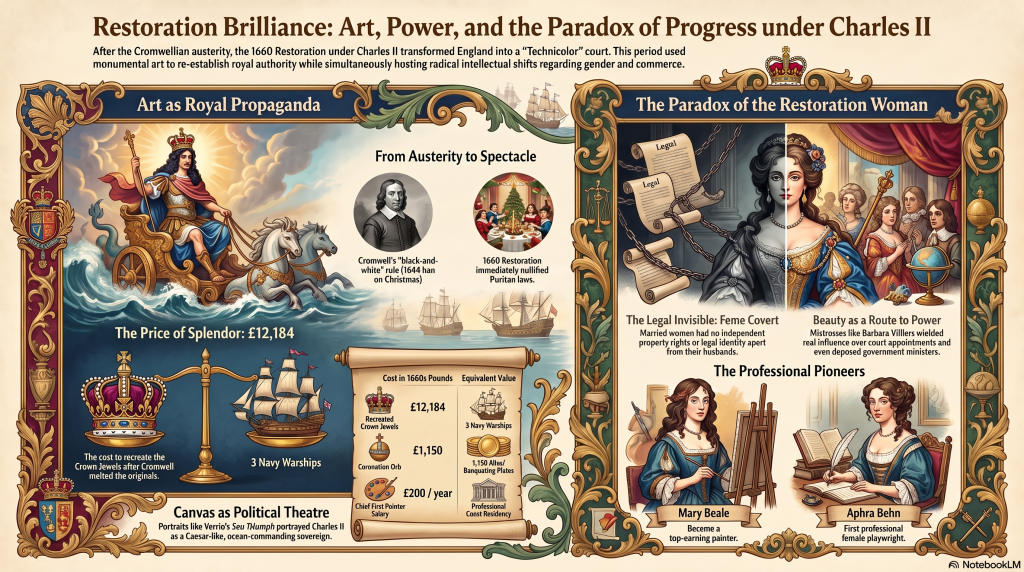
This talk details the political and cultural evolution of England surrounding the Restoration of the monarchy under Charles II. They contrast the Puritan austerity of the Interregnum—marked by the execution of Charles I and the abolition of Christmas—with the vibrant, spectacular court life that emerged in 1660. Central to this narrative is the use of monumental portraiture and propaganda, such as the works of Peter Lely and John Michael Wright, to re-establish royal authority and divine right. The sources also highlight the intellectual ferment of the era, including radical debates on suffrage and gender equality, as well as the rising influence of royal mistresses in the new social hierarchy. Ultimately, the text illustrates how art and power were intertwined to rehabilitiate the image of a shattered monarchy.
(My YouTube video of this talk will be published on 2 January 2027 as the first of my “cloned talks” produced by TAL, The Automated Lecturer)
My notes on Restoration England – Charles II: Art and Power
A conversation about Charles II: Art and Power created by Google NotebookLM:
The year 1660 remains one of the most jarring pivots in the British narrative. On 29 May—his thirtieth birthday—Charles II returned to London, stepping into a vacuum of power left by the collapse of the Puritan Commonwealth. For eleven years, the nation had inhabited a world of drab austerity, an era often visualised in the stark black-and-white of a woodcut. When the “Merry Monarch” processioned toward the Banqueting House in Whitehall, he brought with him a “Technicolour” court defined by beauty, power, and passion. Yet this was more than a mere change in aesthetic; it was a sophisticated reclamation of authority. In the Restoration, art was never purely decorative. It was high-stakes political theatre designed to heal a nation disorientated by regicide and to rewrite the image of a shattered monarchy through sheer, unapologetic splendour.
1. The Execution of a King Was Seen as Cosmic Blasphemy
To appreciate the visual excess of the Restoration, one must first confront the “theological horror” that necessitated it. On 30 January 1649, Charles I was beheaded outside the Banqueting House—the very site of his son’s later triumph. This moment is preserved in the haunting work The Execution of Charles I by an Unknown Dutch artist, now housed in the Scottish National Portrait Gallery.
The painting documents a crowd in the throes of a spiritual crisis. Witnesses are seen fainting, not from modern squeamishness, but because they were witnessing the violation of “divine right.” In a world where the King was seen as God’s representative on earth, regicide was the gravest possible blasphemy. In the painting’s lower right corner, onlookers press handkerchiefs to the scaffold to collect the “martyr’s” blood as a relic. This collective trauma created a visual and moral void that Charles II would eventually fill with aggressive propaganda, using art to equate his return with cosmic order.
2. New Year’s Day Used to Be in Late March
Navigating the history of this era requires crossing a “calendrical fault line.” For the modern reader, Charles I was executed in 1649, yet parliamentary records from the time list the date as 30 January 1648. This discrepancy exists because, from 1155 until 1752, England used “Lady Day” (March 25, the Feast of the Annunciation) as the legal start of the New Year.
This led to a bewildering system of dual dating, such as “1648/49.” While England clung to the Julian calendar, Catholic Europe had adopted the Gregorian system in 1582, meaning a contemporary in Paris would have recorded the King’s death on 9 February 1649. It was not until 1752 that Britain finally aligned with the Continent, “losing” eleven days in the process. This seventeenth-century quirk persists in the modern UK tax year, which begins on April 6—essentially “New Lady Day” adjusted for those lost eleven days.
3. A Crown Worth Three Warships
When Oliver Cromwell rose to power, he viewed the regalia of the monarchy as symbols of a “detestable rule” and ordered the Crown Jewels to be sold or melted down. Upon his restoration, Charles II had to commission an entirely new set of regalia to signal the permanence of the Stuart line.
The cost was a deliberate statement of magnificence, influenced by the nine years Charles spent in exile absorbing the “licentiousness and depravity” of Louis XIV’s French court. The recreated Crown Jewels cost £12,184—the equivalent of three warships. The orb alone, a gold sphere encrusted with 365 diamonds and 375 pearls, cost £1,150. Furthermore, an additional £18,000 was lavished on two tons of altar and banqueting plate. As the historian might observe:
“The Restoration has been described as suddenly switching into Technicolour following the drab black-and-white of the Puritan Commonwealth period.”
4. When Christmas Was a Secret, Subversive Act
While the court invested in gold and diamonds to restore the visual majesty of the crown, the common people were still navigating the remnants of a legal code that had stripped away the most basic of social comforts. Parliamentary Acts in 1644 and 1647 had effectively banned Christmas because it lacked “biblical authority.” Shops were forced to stay open, and “Old Christmas” became a personification of resistance, depicted in woodcuts as a figure turned away by soldiers but welcomed by the common worker.
However, it is a mistake to view the Commonwealth as merely “bleak.” It was an intellectually charged era that birthed radical egalitarianism. At the Putney Debates of 1647, held at St Mary the Virgin, the political movement known as the Levellers argued for a written constitution, biennial Parliaments, and the revolutionary concept of manhood suffrage—”one man, one vote.” These radical ideas regarding the “native rights” of Englishmen provided an intellectual heft that the subsequent Restoration would struggle to suppress.
5. The Rise of “Heroic Women” Amidst Institutional Inequality
The Restoration era saw the emergence of the first female professionals, though they operated under the oppressive legal doctrine of feme covert. Under this law, a married woman’s legal identity was absorbed by her husband; she could not own property or enter contracts. Yet, three “heroic women” successfully defied these barriers:
- Aphra Behn: A former spy (Agent 160) and the first woman to earn a living as a playwright, staging 19 plays. She was shockingly frank, becoming the only woman until the 20th century to write about erectile dysfunction in her poem The Disappointment.
- Mary Beale: One of the most successful Baroque portraitists and the primary breadwinner for her family. Her income rose to a staggering £429 by 1677, and she notably gave 10% of her earnings to charity. Her husband Charles served as her studio manager, mixing her pigments.
- Elizabeth Mallet: Founder of Britain’s first daily newspaper, The Daily Courant, in 1702. Located at Fleet Bridge (now Ludgate Circus), her publication was revolutionary for its restraint, providing foreign news without the editorial gossip typical of the era.
6. You Could Run the Coffee House, But You Couldn’t Sit in It
By 1675, England boasted over 3,000 coffee houses, known as “Penny Universities.” These were crucibles of the new commercial culture, yet they occupied a space of sharp gender contradiction. Sun Fire insurance records show that women owned roughly 10% of insured businesses—often coffee houses inherited through the “dower” system—yet they were strictly barred from entering as customers.
This exclusion spurred the “Women’s Petition Against Coffee” in 1674. Simultaneously, the demographic shift following the Civil War left many towns with an excess of single women. This gave rise to the derogatory terms “spinster” and “old maid” for the first time. In popular ballads, the “old maid” was a stock character who manipulated men to keep her money, reflecting the deep-seated social anxiety regarding independent women.
7. Ballads as Social Media: The Punishment of the Cuckold
While the elite commissioned portraits by Sir Peter Lely, the “social media” of the masses existed in the form of broadside ballads. Samuel Pepys collected 1,800 of these, which serve as a rare window into the lives of the poor. Ballads like ‘Rocke the Babie Joane’ and ‘Rocke the Cradle, John’ negotiated the shifting power dynamics of the household.
Central to these stories was the “cuckold”—a man whose wife had been unfaithful. Derived from the Italian cornuto, the term was visualised by a man wearing a hat with two horns. The social punishment was often a “skimmington,” where the husband was forced to ride backwards on a horse through town while neighbours banged kettles. In an era where a man’s masculinity was bound to his wife’s sexual reputation, these ballads revealed the precarious nature of social standing among the lower classes.
The Legacy of Spectacle
Charles II, the “Merry Monarch,” left a legacy that balanced the mind with the flesh. As a patron of the Royal Society and the personal supporter of Sir Christopher Wren, his reign redefined London’s skyline and the scientific world. His influence is not merely architectural or intellectual; it is genetic. His lineage continues through the late Princess Diana to the current British throne via the Dukes of Buccleuch, Richmond, Grafton, and St Albans.
Ultimately, we must ask: was the “Technicolour” freedom of the Restoration a genuine step toward social progress, or was it merely a shimmering coat of paint designed to mask an old and rigid hierarchy? Whether it was true evolution or sophisticated political theatre, the art of the era remains a testament to a monarchy that understood the absolute power of the image.
16-05 Restoration England – The Windsor and Hampton Court Beauties
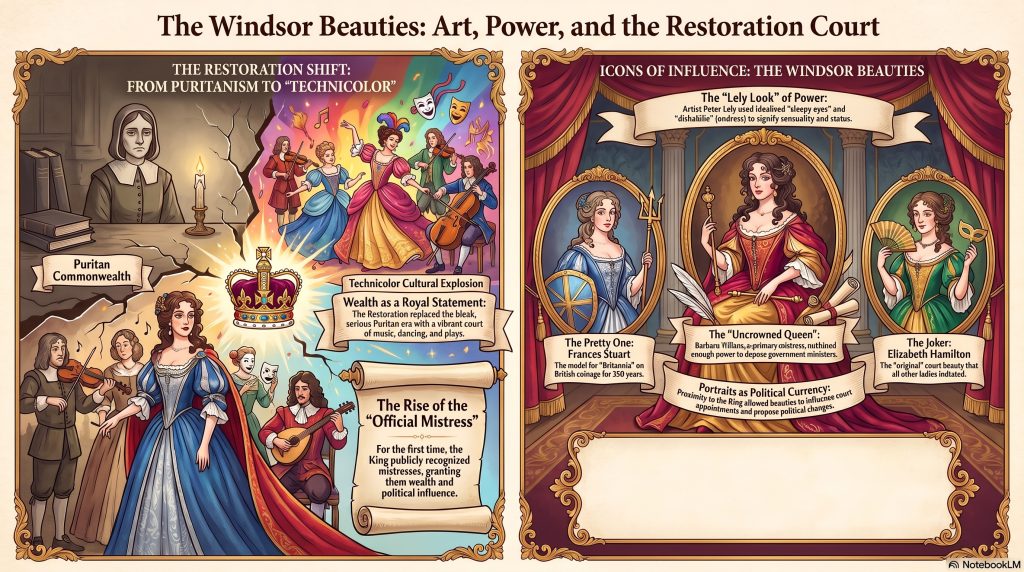
The sources provide a historical and artistic examination of the Windsor Beauties, a famous collection of portraits painted by Sir Peter Lely during the English Restoration. These paintings depict the most prominent women of King Charles II’s court, where physical allure often served as a primary pathway to wealth and political influence. The talk explores the transition from the somber Puritan Commonwealth to a more hedonistic era, highlighting how royal mistresses like Barbara Villiers and Nell Gwyn wielded significant power. Beyond the portraits, the material discusses the broader social status of women, the rise of coffee house culture, and the dangerous cosmetic practices of the 17th century. Each featured lady is profiled through a combination of biographical details, court gossip, and artistic analysis of Lely’s idealized style. Ultimately, the sources illustrate a unique period in British history where art, gender dynamics, and royal intrigue intersected at the palace.
My notes on Restoration England – The Windsor and Hampton Court Beauties
An entertaining conversation about Restoration England – The Windsor and Hampton Court Beauties created by Google NotebookLM from my notes:
1. From Puritan Gloom to Technicolour Scandal
In 1660, England underwent a transformation so radical it was as if a drab, black-and-white film had suddenly flared into brilliant Technicolour. For eleven years, the nation had withered under the black-and-white austerity of the Interregnum—a period of Puritan gloom where Oliver Cromwell’s Commonwealth suppressed music, dancing, and the theatre. With the return of King Charles II from exile, the somber silence was shattered by a chromatic explosion of a court defined by beauty, power, and unapologetic passion.
At the epicenter of this cultural upheaval are the “Windsor Beauties,” a series of portraits by the court painter Sir Peter Lely. Currently lining the communication gallery at Hampton Court Palace, these seemingly innocuous depictions of heavy-lidded women are far more than mere art. They are the primary documents of a decade defined by debauchery, documenting a unique historical moment when a woman’s “drowsy sweetness” was her most direct route to political sovereignty.
2. Truth #1: The Royal Mistress was a Formal Political Office
Under Charles II, the traditional structures of the English court were dismantled in favor of a startling new hierarchy. For the first and only time in British history, a monarch publicly recognized his mistresses, creating a power dynamic where “closeness to the King” superseded noble rank. Beauty became a tangible political currency, and no one spent it more ruthlessly than Barbara Villiers, the “Uncrowned Queen.”
Villiers, later the Duchess of Cleveland and Baroness Nonsuch, wielded power that terrified the establishment. She was formidable enough to depose government ministers like the Earl of Clarendon and secured dukedoms for her five acknowledged illegitimate children—a significant subset of the dozen or more offspring the King eventually acknowledged by various women. Her financial recklessness was as legendary as her temper; upon being gifted the incomparable Nonsuch Palace, she simply had the “most beautiful palace in Europe” demolished to sell the raw materials to pay off her gambling debts. The King’s inability to resist such women was immortalized by the 2nd Earl of Rochester:
“Restless he rolls from whore to whore / A merry monarch, scandalous and poor.”
3. Truth #2: The “Dishabille” Look was a Calculated Studio Product
The Windsor Beauties are defined by a specific aesthetic known as “dishabille” or “undress.” In these portraits, Lely portrayed high-born ladies in a state of carefully orchestrated disarray—as if they had, in the words of later critics, “just taken a tumble in the broom closet.” This look followed a counter-intuitive 17th-century logic: while bared breasts signified youth, innocence, or the status of a royal mistress, the mere sight of an ankle was considered truly scandalous.
However, this “undress” was rarely a reflection of reality. Lely ran a highly efficient production line, using “pattern books” of poses for his sitters. While Lely might spend an hour sketching the sitter’s face, the voluminous, shimmering drapery was often painted by studio assistants who had never met the woman in question. This manufactured aesthetic explains why the “Beauties” share the same sleepy-eyed, languid expression. By the 19th century, this style was loathed as “meretricious” by critics like William Hazlitt, who wrote in 1824:
“[They] look just what they were – a set of kept mistresses, painted, tawdry, showing of their theatrical or meretricious airs and graces…”
4. Truth #3: The Stage was a Battlefield for Intellectual Equality
The Restoration’s liberation was not confined to the bedroom. In 1662, Charles II issued a landmark decree: female roles, previously played by boys in drag, must henceforth be played by women. This ended the “unnatural vice” of men playing women’s parts and launched the career of Margaret Hughes, the first professional actress on the English stage.
This era also saw the rise of Aphra Behn, the first Englishwoman to earn a professional living by her pen. Behn and the painter Mary Beale were often described by contemporaries as having a “masculine” style. In the 17th century, this was intended as the highest form of praise—a begrudging acknowledgment that these women demanded intellectual equality with their male peers. Behn, a former spy who staged nineteen plays, was particularly noted for a wit that was considered a direct threat to the male-dominated status quo.
5. Truth #4: “Ideal Beauty” was a Literal Death Sentence
The “alabaster skin” captured in Lely’s oils masked a gritty, toxic reality. To achieve the required deathly pallor, women applied thick layers of white lead powder, often accented with cinnabar (mercury sulphide) for the lips and cheeks. This was not merely a cosmetic choice; it was a sacrifice of life to beauty. The lead “withered the skin,” turned teeth black, and shrank the gums.
The most tragic example was Lady Henrietta Wentworth, who reportedly “sacrificed her life to beauty,” dying after the mercury from her makeup seeped into her nerves. Hygiene offered no relief; washing the body was considered medically dangerous, as it was thought to open the pores to disease. To mask the resulting odors—most notably the “continued sour base smell” Samuel Pepys attributed to the celebrated Jane Myddleton—the court relied on heavy perfumes and bizarre DIY treatments. Women applied creams made of “puppy dog fat,” “pigeon dung,” “snail ash,” and even urine, while wearing gloves of chicken skin at night to keep their hands soft.
6. Truth #5: The Scandal of the “Mortal Chocolate”
Perhaps the most enduring mystery of the Windsor Beauties is the tragic fate of Margaret Brooke, Lady Denham. Married to Sir John Denham—a “stork-like” poet thirty years her senior—Margaret became the very public mistress of the Duke of York. When she fell suddenly and violently ill in 1667, she was convinced of foul play, insisting on a public autopsy before she expired.
The court was rife with rumors of a “poisoned cup of chocolate.” The diarist John Aubrey specifically pointed the finger at Henrietta Boyle, the Countess of Rochester, though others suspected the Duke’s wife, Anne Hyde. While the autopsy officially cited natural causes, the scandal sent Margaret’s husband mad and prompted Andrew Marvell to pen a grim poetic warning:
“What frosts to fruit, what arsenic to the rat, / What to fair Denham, mortal chocolate.”
7. Truth #6: The Revolution was a Fleeting Illusion
The “embryonic sexual revolution” of the Restoration was tied inextricably to the specific, rakish personality of Charles II. It did not survive him. Following his death and the brief, awkward reign of his brother James II, the court shifted toward a more moralistic and less erotic tone under Mary II. Though Mary herself engaged in intense, romantic same-sex correspondence with women like Frances Apsley, the public “freedoms” of the previous decade were replaced by a return to viewing women as the “weaker sex.”
Ultimately, Lely’s portraits remain as monuments to a golden cage. They remind us that in the Restoration, a woman’s power was often only as durable as her “drowsy sweetness.” We are left with a haunting question: Was this a genuine step toward female emancipation, or merely a decade where the chains were gilded with silk and white lead?
16-06 Restoration England – Wren and the English Baroque
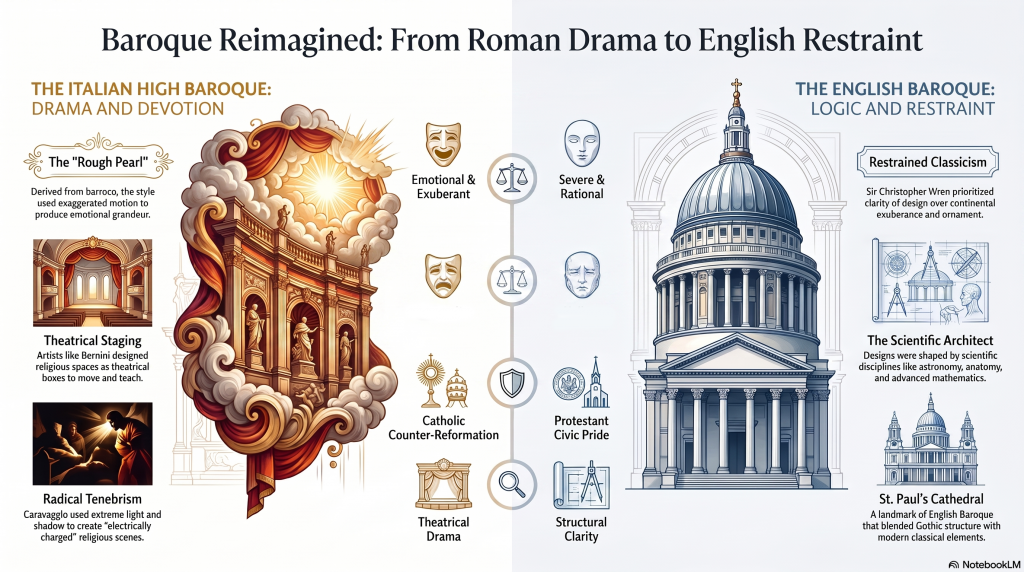
This talk examines the origins and evolution of the Baroque style, beginning with its Catholic roots in 17th-century Rome. The text highlights influential masters like Bernini, whose sculpture The Ecstasy of Saint Theresa epitomizes the era’s theatricality and emotional intensity. It also explores the architectural genius of Borromini and the radical naturalism and lighting techniques introduced by the painter Caravaggio. Beyond individual biographies, the material explains how the Counter-Reformation utilized this dramatic aesthetic as religious propaganda to move and inspire the faithful. Finally, the narrative traces the movement’s journey to Restoration England, where the style was adapted into a more restrained and civic form by figures like Christopher Wren.
(My YouTube talk will be published on 30 January 2027)
My notes on Restoration England – Wren and the English Baroque
An entertaining conversation about Restoration England – Wren and the English Baroque created by Google NotebookLM from my notes:
1. The Style That Wasn’t Supposed to Be English
History often begins with an insult. The word “Baroque” likely derives from the Portuguese barroco—a “rough or imperfect pearl.” To the Renaissance rationalist, this movement was a “noisy abundance” of eccentric redundancy, a startling departure from the symmetry of the past.
For England, a nation that prides itself on a “clear and sober” sensibility, the Baroque (1666–1711) was a scandalous inheritance. Born as Catholic propaganda in Rome to “teach, move, and serve” the faithful, the style used exaggerated motion and visceral drama to overwhelm the senses. How did this continental exuberance become the face of Protestant London? The answer lies in a series of accidents, scientific arrogance, and a few “un-English” secrets hidden in the stone.
2. Secret #1: The Saint with the Dirty Feet
The era’s soul was forged in the violent shadow of Michelangelo Merisi da Caravaggio. He didn’t just paint; he staged an assault on the eye using tenebrism—an extreme contrast of light and dark that lacked any intermediate safety net. Caravaggio was a man of radical contradictions: a painter of the sacred who lived as an outlaw. A contemporary, Floris Claes van Dijk, noted in 1601 that the artist was “ever ready to engage in a fight or an argument, so that it is most awkward to get along with him.”
This instability culminated in 1606 when Caravaggio killed a man and fled Rome under a papal death sentence. Yet, his “seedier side of life” became the Counter-Reformation’s greatest weapon. By painting sacred figures with “dirty feet” and placing them in contemporary rags, he brought the divine into the dirt. This radical naturalism was designed to provoke an emotional stimulus to piety, proving that even an outlaw could weaponize grace.
3. Secret #2: Staging the Divine
If Caravaggio provided the light, Gian Lorenzo Bernini provided the theatre. His masterpiece, The Ecstasy of Saint Theresa, translates a mystic’s vision into an almost “orgiastic” display of marble. Saint Teresa’s own words provided the blueprint: “So surpassing was the sweetness of this excessive pain that I could not wish to be rid of it.”
Bernini, a charming courtier who attended mass daily, turned the Cornaro Chapel into a literal auditorium. Flanking the altar are marble boxes containing portraits of the Cornaro family, shown conversing as though they are spectators in a theatre box. This was “theatricality” with a purpose: to enact the Council of Trent’s directive that art must move the laity. It was doctrine made visceral, designed to triumph over the rising tide of Protestantism through sheer, staged ecstasy.
4. Secret #3: The Popish Dome of a Scientific Mind
The Roman drama crossed the Channel not through a priest, but through a scientist. Christopher Wren was an astronomer and anatomist, a founder of the Royal Society who approached architecture with mathematical precision. Following the Great Fire of 1666, Wren faced the gruelling task of clearing Old St. Paul’s. The stones had been fused by molten lead, a structural nightmare he attempted to solve with gunpowder. When the explosions proved too lethal—killing workers in the process—the man of science switched to battering rams.
Wren’s “better manner of architecture” for the new cathedral was met with fierce suspicion. Critics detected an air of “Popery” in the heavy arches and gilded capitals, complaining they were “unfamiliar, un-English.” The addition of the great dome—one of the largest in the world—was seen as a provocative nod to St. Peter’s in Rome. It is a delicious irony that England’s greatest Protestant landmark was built by a scientist accused of Roman tastes.
5. Secret #4: The Gambler’s Church and the Great Fire Accident
The English Baroque was often a victim of chance and personality. Take Thomas Archer, a country gentleman whose architectural career was a side-hustle to his role as the court’s “Groom Porter.” Archer was responsible for licensing all gambling—dice, billiards, and tennis—at court. His St. John’s, Smith Square, earned the nickname “Queen Anne’s Footstool” based on the legend that the Queen, annoyed by his questions, kicked over her footstool and demanded the church look “Like that!” In reality, Archer’s four towers were a structural necessity to counter subsidence. Archer’s style remained idiosyncratic and “Berniniesque,” heavily influenced by the undulating façades of Borromini he saw on his Grand Tour.
Even the Royal Palace at Hampton Court was a product of “excessive speed” and accident. A “catastrophic collapse” in 1689, caused by poor mortar, killed two workers and nearly ended the project. The Baroque facade we admire today only exists because Whitehall Palace burned to the ground in 1698, forcing the crown to pivot to Hampton Court. Here, the “noisy abundance” was finally tamed by Huguenot ironwork from Jean Tijou and the delicate, graceful murals of Antonio Verrio, marking the final, sophisticated breath of the era.
Conclusion: A Legacy Hiding in Plain Sight
By 1711, the English Baroque began to fade, surrendering to the “austere classicism” of the Georgians. It was a delicate, graceful style that momentarily allowed England to flirt with continental drama before retreating into Protestant restraint.
Wren’s work, however, remains the definitive verdict on the period. In the crypt of his great cathedral, his epitaph reads: “Reader, if you seek his memorial, look around you.” If the Baroque was designed to “impress and triumph,” what does our modern, minimalist architecture say about our own era’s values? Perhaps we have finally achieved the “clear and sober” rationality that the 17th century so feared it might lose, trading the ecstasy of the pearl for the utility of the stone.