The Dutch Golden Age produced one of the most extraordinary flowerings of visual art in European history, driven by the remarkable prosperity of the Dutch Republic in the seventeenth century and the emergence of a new bourgeois market for painting. Unlike the court and Church patronage that dominated art elsewhere in Europe, Dutch art was shaped by merchants, craftsmen, and civic institutions who purchased paintings for their homes and guild halls. Rembrandt van Rijn, Johannes Vermeer, Frans Hals, and Jan Steen were among the giants of this period, each exploring the new genres of portraiture, landscape, still life, and genre painting with extraordinary skill. The emphasis on careful observation of the natural world, the play of light on surfaces, and the dignity of everyday life gave Dutch painting its distinctive character. This was an art that celebrated material prosperity and domestic virtue while remaining alert to the transience of all earthly things, as in the tradition of the vanitas still life.
A Republic, Not a Court — The New Market for Art: What made Dutch art of the seventeenth century unique was its market structure. In Catholic southern Europe, the Church and aristocratic courts remained the dominant patrons of art. But the Dutch Republic was Protestant, commercially dynamic, and governed by a merchant elite. Paintings were produced for sale at fairs and by dealers, and middle-class households acquired works in numbers unprecedented anywhere in Europe.
Rembrandt — The Master of Light and Shadow: Rembrandt van Rijn (1606–1669) is one of the handful of artists who can be said to stand outside time, his works as immediate and moving today as they were in the seventeenth century. His mastery of chiaroscuro — the dramatic play of light and shadow — transformed portraiture, religious painting, and mythology alike. His late self-portraits, painted as his fortunes declined, are among the most searching explorations of the human face in the history of art.
Vermeer and the Quiet Interior: Johannes Vermeer (1632–1675) worked slowly, leaving only about thirty-six authenticated paintings — yet these place him among the greatest artists who ever lived. His small domestic interiors, typically showing a woman reading a letter, weighing pearls, or pouring milk by a window, achieve an almost miraculous stillness. The quality of light in Vermeer’s work — cool, clear, perfectly distributed — has never been equalled.
The New Genres — Still Life, Landscape, and the Everyday: One of the most significant developments of the Dutch Golden Age was the elevation of formerly marginal genres to the highest artistic status. Still-life painting, landscape, portraiture, and scenes of everyday life (genre painting) became ends in themselves rather than accessories to religious or mythological narrative. Dutch artists explored these genres with a rigour and ambition that transformed the possibilities of European painting.
The Vanitas Tradition — Prosperity and Mortality: Beneath the surface of Dutch opulence lay a Protestant unease about material wealth. The vanitas still life, with its wilting flowers, guttered candles, and skulls, reminded the viewer that all earthly pleasures were transient. These works were not merely decorative but philosophical — an art of moral reflection embedded in the very objects of prosperity that surrounded their owners.
Legacy — The Foundations of Modern Painting: The Dutch Golden Age established many of the conventions of western painting that would persist into the modern era: the primacy of observation, the dignity of everyday subjects, the importance of light, and the possibility of painting as a commercial rather than a patronage art. From the Impressionists to Vermeer’s modern admirers, the debt to seventeenth-century Holland is immeasurable.
14-01 The Dutch Golden Age
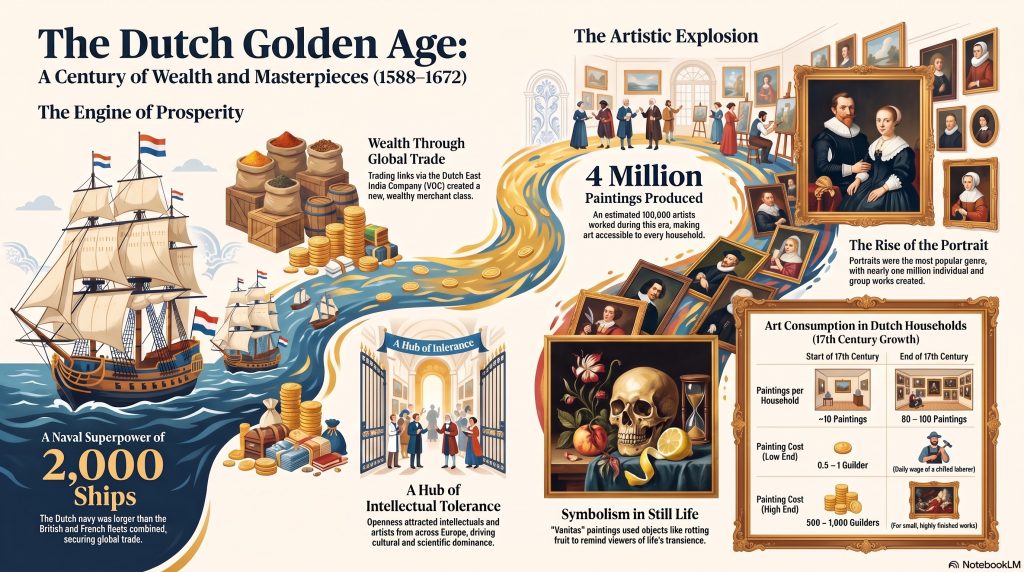
The Dutch Golden Age represented a unique era of immense prosperity and artistic proliferation, where an estimated four million paintings were created. Following independence from Spain, the Dutch Republic emerged as a global leader in trade and science, fostering a wealthy merchant class that commissioned diverse artworks beyond traditional religious themes. Masters such as Rembrandt, Vermeer, and Frans Hals specialized in specific genres, including penetrating portraits, vast landscapes, and meticulous still lifes. Artists utilized symbolism and moral allegories to depict everyday life, ranging from the rowdy tavern scenes of Jan Steen to the quiet domesticity captured by Pieter de Hooch. Despite this cultural peak, the Year of Disaster in 1672 signaled a gradual decline in the nation’s power and its vibrant art market. This period remains celebrated for its innovation in light and naturalism, leaving a legacy of masterpieces that continue to influence the art world today.
My notes on 14-01 The Dutch Golden Age
An entertaining conversation about The Dutch Golden Age created by Google NotebookLM from my notes:
Imagine a 17th-century Amsterdam baker. After a long day of kneading dough, he doesn’t simply retire to a dark, empty room. Instead, he might sit beneath a half-dozen oil landscapes, a meticulously painted still life, and perhaps a rowdy tavern scene.
In the Dutch Republic between 1588 and 1672, art was not a luxury reserved for the whispered halls of palaces; it was a common household staple. Despite its small geographic footprint, this newly independent nation became the wealthiest in Europe, fueling a “relatable curiosity” that turned the average citizen into a collector and the local tavern into an art gallery.
1. The First Mass Market for Art (4 Million Paintings)
The sheer scale of production during this era remains unparalleled in history. While other nations were painting for kings, the Dutch were painting for everyone.
An estimated four million paintings were produced during the Golden Age by a staggering army of 100,000 artists. This was a true mass market where supply met a voracious, cross-class demand.
The price of entry was surprisingly low. A simple work might cost as little as half a guilder—roughly the daily wage of a skilled laborer. At the higher end, “fine paintings” (fijnschilders) could fetch 1,000 guilders, but the accessibility for the middle class was the true engine of the boom. Each household could have some ten paintings at the start of the century rising to 80-100 paintings by the end of the century.
2. The “Tronie” – It’s Not Who You Think It Is
When we stand before Vermeer’s Girl with a Pearl Earring or Frans Hals’s The Gypsy Girl, our modern instinct is to search for a biography. We want to know who she was. However, in the 17th century, these were often not portraits at all, but “tronies.”
Derived from the Dutch word for “face,” a tronie was a character study of an anonymous figure, often dressed in exotic costumes or displaying exaggerated expressions. They represented “types”—the soldier, the youth, the shepherdess—rather than specific individuals.
This distinction is vital for the modern viewer. It shifts our focus away from the sitter’s identity and toward the artist’s technical bravado. These works were a stage for painters to flex their muscles, capturing the glint of light on a pearl or the psychological depth of a fleeting smirk without the constraints of a formal commission.
3. Hidden Codes and Erotic Lutes in Everyday Scenes
The rowdy genre paintings of the era—scenes of tavern brawls and messy kitchens—were more than just entertainment; they were sophisticated moral puzzles. Artists like Jan Steen and Gerrit van Honthorst packed their canvases with symbols that acted as “moral signposts.”
In Honthorst’s The Procuress, the shadow cast upon a lute is a deliberate wink to the viewer; at the time, the instrument was a common symbol for eroticism and the female body. The shadow signifies the physical union being negotiated between the client and the prostitute. A “Jan Steen household” became synonymous with familiar everyday sins of gluttony, sloth, and lust.
Interestingly, these depictions of “uncouth behavior” were often commissioned by the wealthy elite. By hanging a scene of drunken peasants on their walls, affluent collectors could distance themselves from such vices, using the images to laugh at the “lower orders” while simultaneously reminding themselves to stay on guard against the devil’s seductions.
4. The Original Crypto-Bubble? The Monkey Satire of Tulip Mania
Long before the digital speculation of the modern age, the Dutch Republic experienced “Tulip Mania” (1634–1637). At the height of the craze, a single rare bulb could cost more than an Amsterdam townhouse.
Artist Jan Brueghel the Younger skewered this economic insanity in his work A Satire of Tulip Mania. He didn’t just depict speculators; he portrayed them as “brainless monkeys” in contemporary Dutch dress. In the painting, these primates weigh bulbs, count money, and—in a biting final act—one monkey even urinates on the now-worthless flowers while another is carried to his grave.
It is a timeless critique of human folly. While a tulip was a fleeting, biological asset, historians often note the irony that it was at least more tangible than the digital bubbles of today.
5. The Forgotten Masters – Women of the Golden Age
History has a habit of narrowing its lens, often leaving brilliant women in the shadows of their male contemporaries. Judith Leyster and Clara Peeters, however, were titans of their time.
Leyster was a master genre painter and a member of the Haarlem Guild of St. Luke, yet her legacy was nearly erased. For centuries, her works were misattributed to Frans Hals. It wasn’t until a 1893 court case regarding a mislabeled painting that her distinct “JL” signature—hidden in plain sight—was rediscovered, restoring her place in the canon.
Clara Peeters was equally revolutionary, pioneering the “banketje” (banquet) still-life. She had a penchant for “micro-signatures,” hiding tiny, meticulously detailed self-portraits in the reflections of the objects she painted. If you look closely at the pewter vessels or the polished lids of her jugs, you can see the artist looking back at you—a defiant assertion of her presence in a male-dominated guild.
6. The “Year of Disaster” That Ended the Party
The Golden Age did not fade into a sunset; it hit a wall. In 1672, known as the Rampjaar (Disaster Year), the Dutch Republic was simultaneously invaded by France and England. The nation survived, but the economic engine that fueled the art market was shattered.
The collapse was swift and merciless. Even the most celebrated masters were not spared. In a poignant testament to the era’s end, the widow of Johannes Vermeer—now one of the most beloved painters in history—recounted how her husband was unable to sell a single work following the disaster of 1672. The party was over, and the market for “80 paintings per household” vanished almost overnight.
Conclusion: A Legacy of Light and Shadow
The Dutch Golden Age remains a unique historical anomaly: a moment when a nation’s commercial success, scientific curiosity, and middle-class pride converged to create a visual explosion. We see its legacy today in every “relatable” portrait and every meticulously lit interior in modern photography.
It leaves us with a provocative question for our own age: is a truly great artistic revolution only possible when a nation is at the zenith of its economic power, or is it the impending shadow of a “Year of Disaster” that truly forces us to capture the light?
14-02 Vermeer’s Complete Works (Part 1)
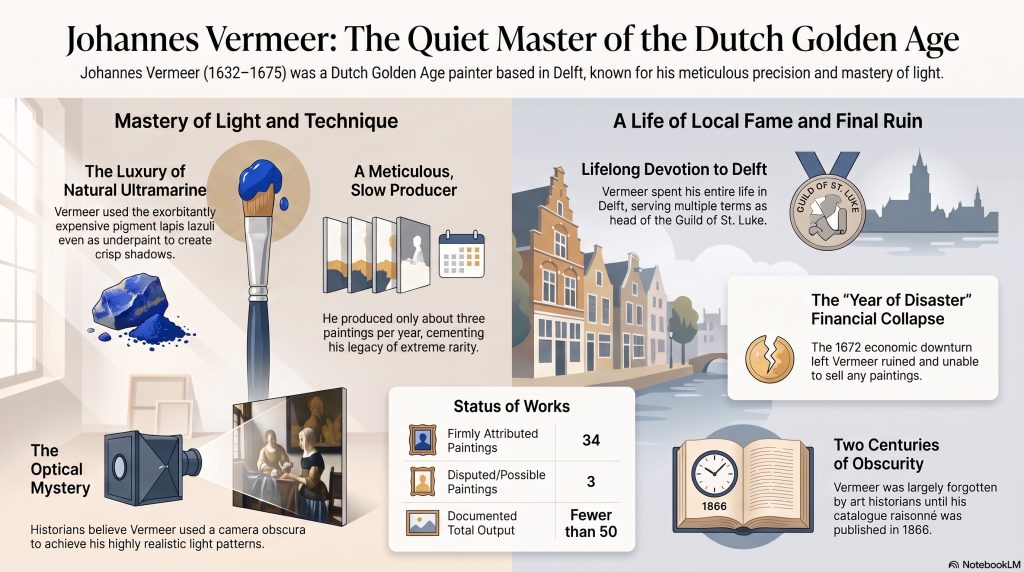
The provided talk offers a detailed biographical and artistic examination of Johannes Vermeer, a prominent painter of the Dutch Golden Age who spent his entire life in Delft. Despite his current status as a master, Vermeer was largely forgotten for two centuries and left behind a very small body of work, with only 34 paintings firmly attributed to him today. He was known for his meticulous technique, his early and lavish use of the expensive pigment lapis lazuli, and his possible use of optical tools like the camera obscura. The sources analyze several of his iconic domestic interiors and cityscapes, exploring how he utilized light, perspective, and symbolism to depict scenes of music, courtship, and everyday labor. Vermeer’s life was marked by financial instability and the challenges of a large family, eventually leading to a premature death at age 43 due to immense stress. Today, his works are celebrated for their stillness and technical perfection, having been successfully rescued from historical obscurity by 19th-century art critics.
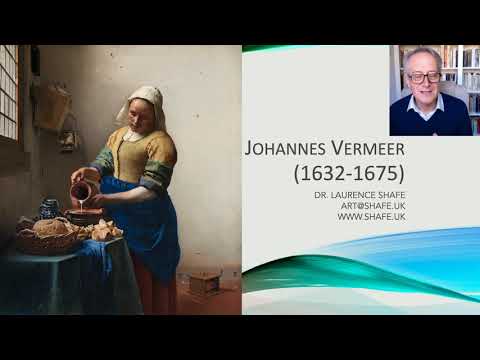
An entertaining conversation about Dutch Golden Age – Johannes Vermeer Part 1 created by Google NotebookLM from my notes:
Johannes Vermeer exists today as a secular saint of the Dutch Golden Age, a titan whose works are treated with near-religious reverence. Yet, for two centuries after his passing in 1675, he was little more than a “ghost”—an artist of such profound obscurity that his name was largely erased from the art-historical canon. The paradox of Vermeer lies in the chasm between the crystalline, “clean” aesthetic of his canvases and the chaotic, often tragic reality of his life.
His legacy is defined by a haunting rarity; only 34 to 37 paintings are currently attributed to him, a minuscule output for a master of his stature. This mystery is deepened by the artist’s own reticence; of this small body of work, only three paintings were actually dated by his hand. To deconstruct the mythos of the “Sphinx of Delft,” we must look past the hushed stillness of his interiors and confront a man living on the edge of financial and domestic ruin.
1. A Home Divided: Between 15 Children and a Violent In-Law
To the modern viewer, a Vermeer painting is the ultimate expression of domestic equilibrium. However, the artist’s studio—located on the second floor of his mother-in-law’s house—was a solitary refuge within a teeming and often terrifying household. Following his marriage to Catharina Bolnes, which likely required a strategic conversion to Catholicism, Vermeer moved into a home that was anything but serene.
Catharina gave birth to 15 children, a staggering number even by 17th-century standards, four of whom died before they could be baptized. The domestic strain was exacerbated by the presence of Vermeer’s brother-in-law, Willem Bolnes. Far from a silent observer of the artist’s craft, Willem was “extremely violent.” Court records reveal a harrowing reality: Willem once pulled a knife on his own mother in an attempt to stab her and threatened to beat the heavily pregnant Catharina with a stick when she was “pregnant to the last degree.” In this context, the preternatural silence of Vermeer’s work feels less like a reflection of his daily life and more like a necessary psychological sanctuary—a desperate imposition of order upon a world of household trauma.
2. The Ultramarine Addiction: Painting Beyond His Means
Vermeer’s technical brilliance was fueled by an obsession with quality that bordered on financial recklessness. His signature was his use of lapis lazuli—natural ultramarine—the most exorbitantly expensive pigment available to the 17th-century painter. While his contemporaries used it sparingly, Vermeer’s addiction to the color was absolute.
His commitment to this pigment was an intentional evolution. In his early work, Christ in the House of Martha and Mary, Vermeer notably abstained from ultramarine, opting instead for smalt and indigo. The result was a technical failure; the blues faded over time, leaving the work diminished. Perhaps learning from this, he never looked back. He began using lapis lazuli not just for the final flourishes, but as an underpaint to establish a “cool, crisp appearance,” such as in the deep shadows of the red dress in The Girl with the Wine Glass.
“There is no other 17th-century artist who employed the exorbitantly expensive pigment lapis lazuli… either so lavishly or so early in his career.”
Even as his debts mounted, he refused to compromise. This suggests a heavy dependency on his primary patron, the Delft collector Pieter van Ruijven, who purchased more than half of Vermeer’s entire output, effectively subsidizing the artist’s expensive “ultramarine habit.”
3. The Lens and the Mirror: Was Vermeer a Proto-Photographer?
Vermeer is often celebrated for a “see-through” perspective, or doorsien, that feels modern in its optical accuracy. Critics have long speculated that he utilized optical technology, such as the camera obscura or a comparator mirror, to achieve his realism. While no such devices were found in his estate, his close friendship with Antonie van Leeuwenhoek—the pioneering lens maker who served as Vermeer’s executor—strongly points toward a shared interest in the science of sight.
The evidence is in the paint itself. Vermeer utilized a pointillé technique—tiny white globules of paint—to mimic the way a lens captures light patterns, seen vividly in Officer and Laughing Girl and The Milkmaid. He rendered light “as it is” rather than how the brain perceives it; for instance, he meticulously captured the drop in intensity as light fades across a whitewashed wall, a physical reality that the human eye usually ignores.
Interestingly, his early struggles with this realism—specifically the “flat, plastic faces” found in his religious and mythological works—provided the very blueprint for 20th-century forgers like Han van Meegeren. By mimicking these technical “failures,” Van Meegeren was able to convince experts that his fakes were actually undiscovered “early Vermeers.”
4. Subversive Slang in the “Clean” Dutch Interior
While the Dutch were legendary for their obsessive cleanliness—washing cows, docks, and even abattoirs—Vermeer’s “clean” rooms often hid subversive narratives. In 17th-century Holland, art was a language of double entendres.
Take The Milkmaid. To the historian Simon Schama, the maid is a paragon of “thriftiness” and “modesty,” carefully using stale bread to create a pudding. However, a cultural critic sees a more lubricious subtext. At the time, the term melken (to milk) was slang for sexual attraction. The painting is peppered with symbols of arousal: the foot warmer (designed to be placed under a skirt) and the wide-mouthed jug, a known metaphor for female anatomy. Even the tile on the wall is a subject of intense debate; while many see Cupid, others argue the “wings” are actually a backpack, suggesting a traveling salesperson—a figure of transient, perhaps illicit, encounters. Like the Mona Lisa, the maid’s enigmatic smile allows her to oscillate between a symbol of virtue and a figure of quiet seduction.
5. Ruined by the “Year of Disaster”
The stability of Vermeer’s world was shattered not by a lack of talent, but by the volatility of the Dutch economy. For decades, Delft had transitioned from a brewing hub (dropping from 100 breweries to 15) to a center for “Delft Blue” porcelain. But in 1654, the “Delft Thunderclap”—a massive gunpowder explosion—devastated the city, a harbinger of the fragility to come.
The final blow was the Rampjaar (Year of Disaster) in 1672. War with France and England collapsed the art market, shuttering shops and schools. Vermeer, who produced only about three paintings a year and functioned as an art dealer for “Old Masters” he could no longer sell, was financially ruined. He died in 1675 at the age of 43, leaving his wife Catharina to petition the court for debt relief, citing the “stress of his financial problems” as the cause of his sudden decline. At the time of his death, his footprint was non-existent: he was almost unknown outside of Delft, he never had any pupils and he only produced about three paintings a year.
Conclusion: The Resurrection of a Master
The Vermeer we know today is a 19th-century invention. He was resurrected in 1866 by the critic Théophile Thoré-Bürger, whose decades of research transformed a forgotten local painter into a global phenomenon. This re-discovery sparked a frantic “spending spree” by American Gilded Age buyers, who were drawn to his rarity and the pristine stillness of his vision.
The story of Vermeer’s legacy raises a profound question about the nature of genius: If a single critic had not chosen to look closer two centuries later, would we still view the Dutch Golden Age the same way? Vermeer’s fame suggests that the value of art lies not merely in the artist’s hand, but in the eyes of a later generation that finally finds itself ready to see.
My notes for 14-02 Vermeer’s Complete Works (Part 1)
14-03 Vermeer’s Complete Works (Part 2)
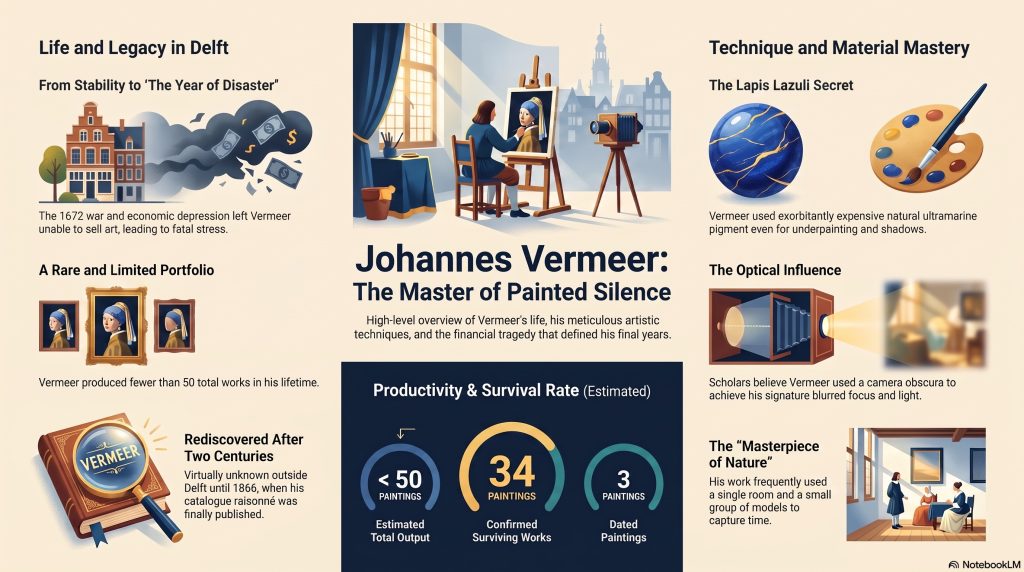
This talk provides a biographical and artistic analysis of the Dutch Golden Age painter Johannes Vermeer. It details his personal life in Delft, including his large family, conversion to Catholicism, and the financial instability that plagued his final years during the Dutch “Year of Disaster.” The sources examine his meticulous technique, specifically his use of rare pigments like ultramarine and his possible reliance on optical tools like the camera obscura. Readers are introduced to his limited body of work, featuring deep dives into famous canvases such as Girl with a Pearl Earring and The Art of Painting. Additionally, the talk explores the symbolism of household objects, the social status of his female subjects, and his posthumous rediscovery by art historians in the 19th century. Through this overview, Vermeer emerges as a master of light and silence who transformed domestic scenes into timeless masterpieces.
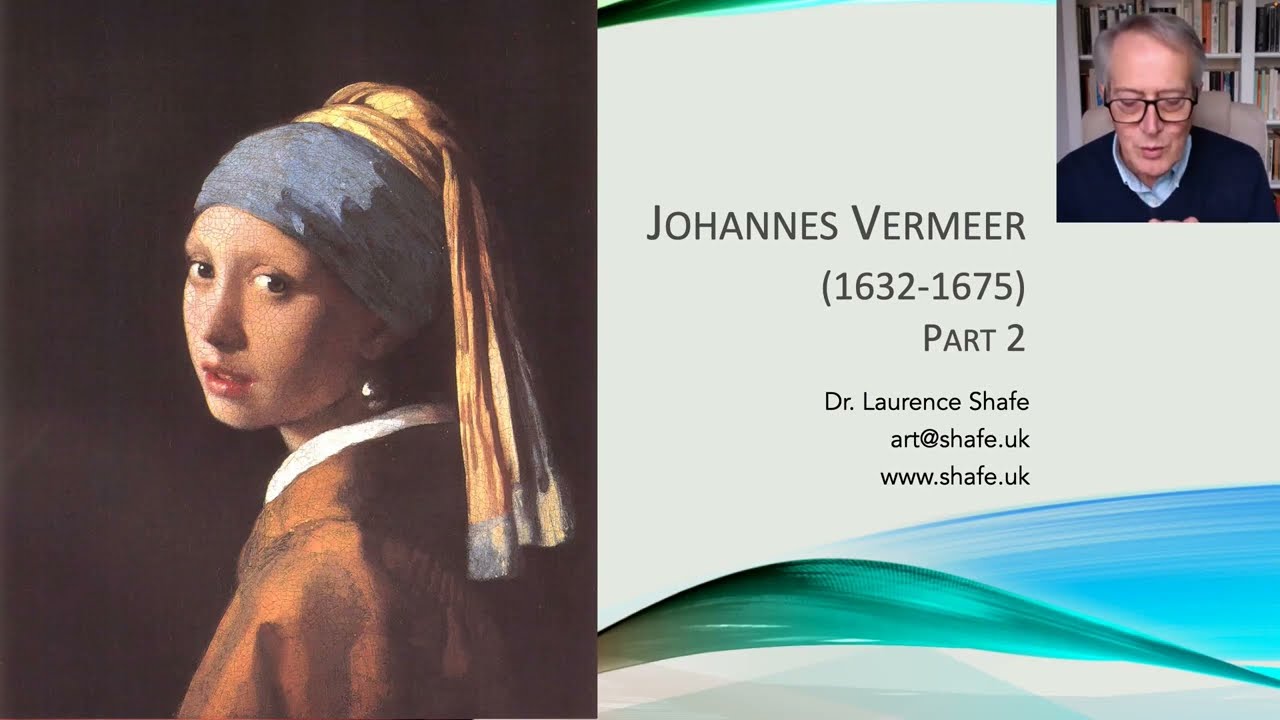
My notes on 14-03 Vermeer’s Complete Works (Part 2)
An entertaining conversation about Dutch Golden Age – Johannes Vermeer Part 2 created by Google NotebookLM from my notes:
History rarely remembers the quiet ones, yet Johannes Vermeer remains the great exception. He is the “Ghost of Delft,” an artist who spent his entire life within the confines of a single Dutch town, producing a startlingly small body of work—only 34 paintings are firmly attributed to him today. While his contemporaries produced hundreds of works to satisfy a bustling market, Vermeer moved with a meticulous, almost glacial slowness, completing roughly three paintings a year within a consistent domestic interior.
For two centuries after his death, Vermeer was a footnote, almost entirely unknown outside his local province. Yet, the serenity of his canvases belied a life of dramatic contrast. He lived through the “Delft Thunderclap” of 1654—a cataclysmic gunpowder explosion that leveled much of the city—and navigated a chaotic household that included a violent brother-in-law, Willem Bolnes, who once threatened Vermeer’s pregnant wife with a stick. To understand his mastery, one must look past the “pearl earring” and see the man behind the canvas: a father of eleven who found infinite depth in a single, sunlit room, painting moments of absolute stillness against a backdrop of domestic and national upheaval.
Truth #1: The Tragedy of the “Year of Disaster”
It is a bitter irony that Vermeer’s peak years of artistic mastery coincided with his complete financial destruction. While the Dutch Republic enjoyed immense wealth for much of the 17th century, this prosperity collapsed in 1672, the Rampjaar, or “Year of Disaster.” War with France and England triggered a severe economic depression; theaters, shops, and schools closed, and the art market evaporated.
Vermeer, who supported his family not only through his own meticulous brushwork but also by trading “old master” works, found himself unable to sell a single canvas. The stress of this decay was physical and immediate. In 1675, Vermeer died after a short illness at the age of 43, leaving his wife, Catharina Bolnes, to plead for mercy from creditors. Her legal petition provides a harrowing account of his final days: “…during the ruinous war with France he not only was unable to sell any of his art but also, to his great detriment, was left sitting with the paintings of other masters that he was dealing in. As a result and owing to the great burden of his children having no means of his own, he lapsed into such decay and decadence, which he had so taken to heart that, as if he had fallen into a frenzy, in a day and a half he went from being healthy to being dead.”
Truth #2: The Secret Prop Room and the 1676 Inventory
Vermeer achieved his signature sense of “frozen time” by working almost exclusively in two rooms of his house. He utilized a limited “repertory company” of household objects that reappeared across his career, effectively transforming his home into a laboratory of light.
Perhaps the most iconic of these props is the yellow satin, fur-lined jacket. This garment appears in six paintings, including Woman with a Pearl Necklace and A Lady Writing a Letter. While the plush white trim simulates exotic ermine, historical records reveal a more modest, domestic reality. The jacket was a personal possession of his wife, Catharina, and was officially recorded in Vermeer’s 1676 death inventory as “a yellow satin mantle with white fur trimmings.” Scientific analysis and Dutch inventories suggest the trim was not the winter coat of a stoat, but likely more common white squirrel, mouse, or even cat fur. This “recycling” of the same familiar objects allowed Vermeer to bypass the search for new subjects and focus entirely on the surgical precision of his compositions.
Truth #3: Science in the Shadows—Lenses and Lapis Lazuli
Vermeer’s work possesses a technical sophistication that feels almost photographic, a quality many scholars attribute to his use of a camera obscura. This interest in optics was likely bolstered by his friendship with Antonie van Leeuwenhoek, the pioneering lens maker who served as his executor. Vermeer didn’t just use the device to trace lines; he captured its optical artifacts, such as the “blurred” red and white threads in The Lacemaker or the vibrating strings in The Guitar Player. He even understood when to ignore the device: in A Lady Seated at a Virginal, he intentionally misrepresented the perspective of the landscape on the instrument’s lid because the “correct” optical foreshortening simply looked wrong to the human eye.
Beyond optics, Vermeer’s mastery was built on “exorbitant” materials. He used natural ultramarine—derived from the semi-precious stone lapis lazuli—with a lavishness almost no other 17th-century artist could afford. While peers used it sparingly as a final glaze, Vermeer employed it as an underpaint in the shadows of the red satin dress in The Girl with the Wine Glass to create a cool, crisp tonality. In his later works, such as A Young Woman Seated at the Virginals, he further experimented with light by using “green earth” pigments in the facial shadows, a rarity among his Dutch contemporaries that added a unique, pearlescent depth to his models.
Truth #4: The Dangerous Maid and the Surgical Use of Space
While Vermeer’s scenes appear peaceful, they are often encoded with sharp social commentary regarding the relationship between mistresses and maids. In 17th-century Dutch society, maids were viewed as “dangerous” figures who “knew all the secrets,” often acting as the essential bridge for illicit love letters. Vermeer unified these narratives through a sophisticated use of “negative space.” In Woman with a Water Jug, he famously moved the rod holding the map on the wall so that it nestled perfectly against the woman’s neck, creating a series of perfectly balanced negative spaces that lock the figure into the composition.
Vermeer also used background paintings to clarify the moral tone of his work, often contrasting “Sacred” and “Profane” love. In Lady Standing at a Virginal, the Cupid in the background holds a card with the Roman numeral “I,” symbolizing “one lover for life” — sacred love. In Lady Seated at a Virginal, the background features The Procuress (a work by Dirck van Baburen owned by Vermeer’s mother-in-law), a scene set in a brothel that suggests a darker, more amorous subtext to the music being played — profane love.
Truth #5: The 200-Year Silence and the Hidden Green Enamel
The most profound mystery of Vermeer is how close he came to being lost to time. Because his output was so small and the majority of his work was held by a single patron, Pieter van Ruijven, his fame never spread beyond Delft. For two centuries, his paintings were often misattributed to artists like Pieter de Hooch. It wasn’t until 1866, when Théophile Thoré-Bürger published a catalogue of his work, that the “Sphinx of Delft” was rediscovered.
Even his most famous work, Girl with a Pearl Earring, held secrets only recently revealed by modern science. During its 1994 restoration, researchers discovered that the flat, black background was originally a deep, translucent enamel green. Vermeer had applied a green glaze over a dark base, but the pigment has since faded into the iconic obsidian we see today. This level of technical obsession is precisely why his reputation reached such heights in the 20th century—so much so that the master forger Han van Meegeren was able to fool the world (and the Nazis) by mimicking Vermeer’s specific “slow” hand.
Conclusion: The Power of Less
Johannes Vermeer proved that an artist does not need to travel the world to capture the infinite. With just one house, a handful of models, and 34 canvases, he created a legacy of unmatched intensity. He reminds us that beauty is not found in the quantity of content, but in the quality of attention.
In our modern world of constant motion and endless digital noise, Vermeer’s work offers a profound sanctuary. He spent his life in one town, in one room, proving that within the silence of a single, frozen moment, there is a world of light waiting to be discovered. He remains the master of the “slow look,” a reminder that even the most mundane domestic scene, when observed with enough love and precision, can become eternal.