10-01 An Introduction to Renaissance Art
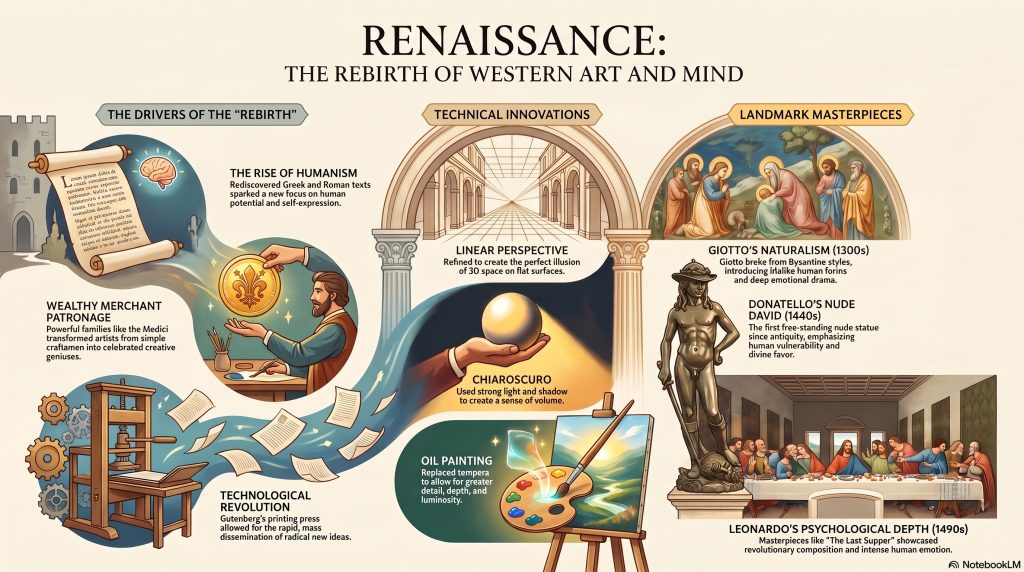
The Renaissance — meaning “rebirth” — describes the extraordinary flowering of art, literature, and learning in Italy from the early fifteenth century to the early sixteenth, driven by a renewed engagement with the art and thought of classical antiquity and a revolutionary new confidence in the capacity of human reason and skill.
In Florence, the sculptor Donatello and the architect Brunelleschi pioneered a new approach to the human figure and to architectural space based on careful observation of ancient Roman models, while the mathematician Alberti codified the rules of linear perspective that gave Renaissance painting its characteristic sense of coherent, measurable space.
Leonardo da Vinci, Raphael, and Michelangelo — the supreme trio of the High Renaissance — brought this project to a peak of formal perfection and psychological depth in the first two decades of the sixteenth century. The Renaissance was simultaneously a Florentine, a Roman, a Venetian, and eventually a pan-European phenomenon, spreading northward through the work of Dürer, Holbein, and their contemporaries who synthesised Italian lessons with the native Gothic tradition. Its legacy — the centralised composition, the ideally proportioned human figure, the illusion of three-dimensional space on a flat surface — remained the foundation of European art education and practice for four centuries.

My notes on 10-01 An Introduction to Renaissance Art
A conversation on Renaissance Art produced by Google NotebookLM based on my notes:
1. Introduction: Reimagining the Rebirth
In our collective imagination, the Renaissance is often viewed through a soft-focus lens: a serene gallery of “Old Masters” in velvet caps, calmly perfecting the world’s beauty. In reality, the rinascita was a chaotic, miraculous explosion of human potential forged in the wake of absolute catastrophe. This intellectual and artistic firestorm was fueled by a perfect storm of social upheaval: the grim aftermath of the Black Death, which inadvertently shattered feudal chains to create unprecedented social mobility, and the 1453 fall of Constantinople, which sent a desperate wave of Greek scholars fleeing to Italy with the “lost” manuscripts of antiquity.
This was not a period of quiet contemplation, but one of fierce, often bloodthirsty artistic rivalry. The era arguably found its symbolic spark in the 1401 competition for the Florence Baptistery doors—a contest that pitted genius against genius and set the stage for a century of innovation. To understand the Renaissance, we must look past the pristine museum walls and rediscover the gritty, counter-intuitive, and deeply human stories behind the masterpieces. From “clumsy” teenagers to technical disasters that nearly erased history, these five truths reveal a world of radical experimentation and dangerous social climates.
2. Takeaway 1: The “Clumsy” Teenager Who Changed Art Forever
It is one of the great ironies of art history that the man who pioneered the sophisticated language of the Early Renaissance is known to us by a derogatory nickname. Born Tommaso di Giovanni di Simone Cassai, the artist we call Masaccio (1401–1428) earned his moniker from a combination of “Maso”—an abbreviation of Tommaso—and the dilutive ending “-accio,” meaning messy, careless, or clumsy. This was not a critique of his brushwork, but a reference to his perceived indifference toward his personal appearance and the mundane affairs of the world.
Despite his nickname and a tragically brief career ending at age 26, “Clumsy Tom” revolutionized painting within the Brancacci Chapel in Santa Maria del Carmine, Florence. His masterpiece, The Tribute Money (c. 1425), discarded the flat, stylized Byzantine traditions of the past in favor of a radical naturalism. He utilized a single, consistent light source to create realistic shadows and refined linear perspective to grant his figures a weight and presence never before seen. In a fascinating display of either ego or a desire for immortality, Masaccio even included a self-portrait within the work, painting himself as one of the apostles standing at the very end of the group.
The fresco’s importance extends beyond its time, becoming a “training school” for later artists. Even Michelangelo studied and praised this work, recognizing its revolutionary nature and enduring influence on Renaissance art.
3. Takeaway 2: The Nude Hero and the “Tax on Sodomy”
Donatello’s bronze David (c. 1440s) stands as a monumental milestone: the first free-standing male nude cast since the fall of the Roman Empire. While the work is celebrated for its humanism, the physical form of the hero—physically delicate, effeminate, and androgynous—is often misunderstood. By portraying David as a vulnerable youth rather than a muscular warrior, Donatello emphasized that the victory over Goliath was achieved through divine intervention rather than raw physical strength.
However, the statue also reflects the complex, often “gritty” social reality of 15th-century Florence. While the sculpture’s sensual pose has sparked centuries of debate regarding Donatello’s own sexuality, it was created in a city where such “transgressions” were both legally prosecuted and socially pervasive. The sociological drivers were unique: Florentine men typically did not marry until they were 30, a delay that led to widespread sodomy, which was largely “taken for granted” provided it followed specific age-based roles. The legal system eventually adapted, turning prosecution into a revenue stream.
In a city of only 40,000 people, 17,000 men were fined at least once… Men who were caught were fined and it was called a tax on sodomy.
In this context, David is not just a biblical hero but a reflection of a city navigating the tension between strict religious law and the lived reality of its citizens.
4. Takeaway 3: Why One Saint’s “Miracles” Were Actually His Paintings
Within the cloisters of the Convent of San Marco in Florence, the Dominican friar known as Fra Angelico (born Guido di Pietro) achieved a rare synthesis of medieval devotion and Renaissance technique. Giorgio Vasari, the chronicler of the era’s greats, wrote that it was “impossible to bestow too much praise on this holy father,” noting that his works were produced with an extraordinary “facility and piety.”
Fra Angelico was informally called “Beato” (Blessed) for centuries, but his official path to beatification took 500 years. Typically, the Catholic Church requires evidence of a supernatural miracle to grant such status. In 1982, however, Pope John Paul II recognized that the artist’s contribution to the human spirit was miraculous in its own right. The Pope bypassed traditional requirements, pointing instead to the serene, divine light captured on the friar’s chapel walls.
Pope John Paul pointed to his paintings and said, “These are his miracles.”
By declaring the art itself to be the miracle, the Church solidified Fra Angelico’s unique legacy: a man who found the divine not in a single extraordinary event, but in the lifetime of discipline and grace he brought to the canvas.
5. Takeaway 4: The “Technical Failure” of the World’s Most Famous Meal
Leonardo da Vinci’s The Last Supper is a cornerstone of High Renaissance psychological depth, yet from a conservation standpoint, it is a catastrophic technical failure. Leonardo, ever the rebel, harbored a disdain for the traditional constraints of fresco. The standard “safe” method required painting into wet plaster in rapid, unchangeable daily sections (giornate), which did not suit his meticulous, experimental style.
In a move of rebellious experimentation at the Convent of Santa Maria delle Grazie in Milan, Leonardo rejected wet plaster. He instead sealed the stone wall with gesso, pitch, and mastic, then painted over it in oil and tempera to achieve greater luminosity and the freedom to revise his work. This experimental sealant was a disaster; the dampness of the wall caused the paint to begin flaking away almost immediately. The physical masterpiece was further desecrated in 1652 when architectural indifference led to a door being knocked through the wall, effectively removing Christ’s feet. Today, the work is a “ghost” of Leonardo’s vision, preserved more by reputation and copies than by his original brushstrokes.
6. Takeaway 5: The Masterpiece Saved by a Disobedient Soldier
Piero della Francesca’s The Resurrection (c. 1463) is a work of cold, mathematical brilliance. Piero was more than a painter; he was a noted mathematician who wrote treatises on geometry, embodying the Renaissance ideal of the “universal scholar.” In this fresco, located in the Museo Civico di Sansepolcro, Piero’s obsession with harmony led to an “impossible” anatomical choice: the guard holding the spear is painted without legs to ensure the composition remained perfectly balanced.
The painting’s survival into the modern era is the stuff of legend. During World War II, a British artillery officer named Tony Clarke was ordered to shell Sansepolcro. However, Clarke recalled reading about the painting’s “importance” and, risking his career, reportedly disobeyed the order to shell the town. While historians note this story is “possibly embellished,” its persistence highlights the painting’s role as the central symbol of Sansepolcro’s identity. The work stands as a testament to the transition from spiritual death to new life, a theme mirrored in its own narrow escape from 20th-century destruction.
7. Conclusion: The Echoes of the Renaissance
These stories serve to humanize the “Old Masters,” moving them from the realm of untouchable genius back into the world of real people. They were men who navigated clumsy nicknames, navigated dangerous social climates with a “tax on sodomy,” and struggled with their own technical errors and professional rivalries. By understanding their humanity, we see that the Renaissance wasn’t just a rebirth of ancient texts, but a very human struggle to create something enduring amidst chaos.
If the Renaissance was born from the social, economic, and political fallout of the Black Death and the collapse of empires, it leaves us with a hauntingly relevant question for our own time: If such beauty and intellectual explosion can be crafted from the ashes of upheaval, what “rebirth” might our own era of transition currently be crafting?
10-01a The Early Italian Renaissance
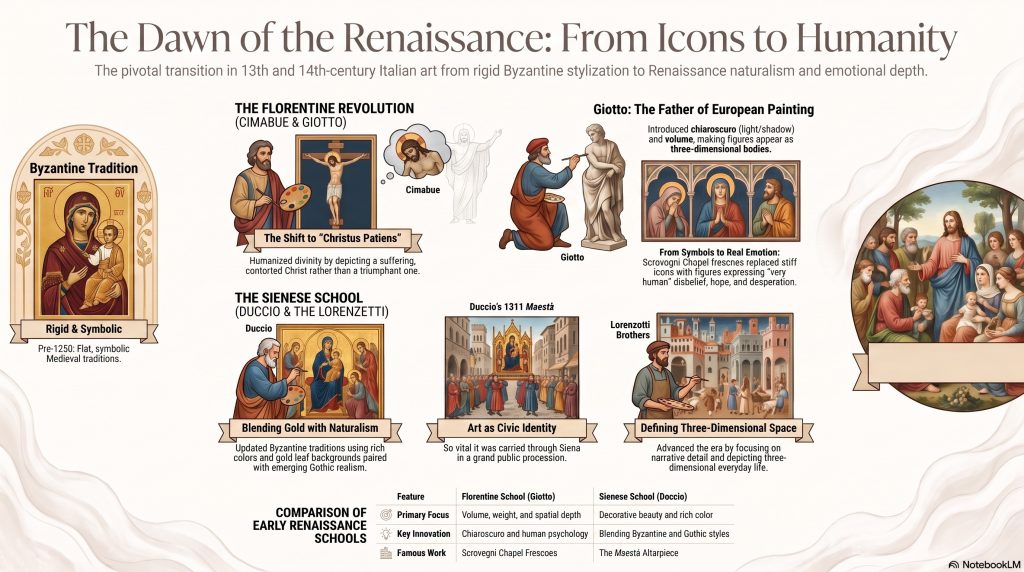
This collection of educational materials explores the foundational era of the Early Italian Renaissance, focusing on the pivotal shift from Byzantine stylization to naturalism. The talk highlights Cimabue as a transitional figure who introduced greater realism and human emotion into religious subjects, such as his large-scale crucifixes and Maestà paintings. His legendary apprentice, Giotto di Bondone, is celebrated as the “Father of European painting” for revolutionizing art with three-dimensional forms, light, and perspective. The sources also acknowledge the Sienese school and other masters like Duccio and the Lorenzetti brothers for their contributions to this artistic rebirth. Through detailed analyses of specific frescoes and panels, the documents illustrate how these innovators replaced medieval rigidity with emotional depth and spatial logic. Ultimately, the materials document a crucial historical progression that laid the necessary groundwork for the High Renaissance.
My notes on 10-01a the Early Italian Renaissance
A conversation on the Early Italian Renaissance produced by Google’s NotebookLM based on my notes
Subject: Review of Main Themes and Important Ideas in the Early Italian Renaissance as Presented by Dr. Laurence Shafe (written by Google NotebookLM)
Overview:
The talk focuses on the transition from the Byzantine style to the more naturalistic approach of the Renaissance, highlighting the pivotal roles of artists such as Cimabue and Giotto in Florence, and the significant contributions of the Sienese School. The works discussed demonstrate the development of perspective, three-dimensionality, and emotional expressiveness in painting, laying the groundwork for the later High Renaissance.
Main Themes and Important Ideas:
1. Transition from Byzantine to Renaissance Style:
- The period covered represents a crucial shift in Western art away from the stylised and often symbolic representations of the Byzantine era towards a more naturalistic and human-centred approach.
- The works discussed “represent the transition from the Byzantine style to the more naturalistic approach of the Early Renaissance.”
- This transition involved a move towards “the rebirth of classical art and architecture that characterizes the Renaissance.”
2. The Foundational Role of Cimabue and Giotto:
- Cimabue (c. 1240–1302) is presented as a pioneering artist who was “the last great Italian painter in the Byzantine style, while simultaneously laying the groundwork for the naturalistic approach that would define Renaissance art.“
- His work began to show “early signs of more naturalistic representations.”
- Key works by Cimabue discussed include his Crucifix in Arezzo, the Maestà in the Louvre, and the Santa Trinita Maestà in the Uffizi.
- Regarding the Arezzo Crucifix, Dr. Shafe states, “It marks a pivotal moment in the transition from medieval to Renaissance art.” He highlights the shift towards the “‘Christus patiens’ (Suffering Christ), a departure from earlier Byzantine traditions of portraying a triumphant Christ.”
- Cimabue’s Maestà in the Louvre demonstrates his “innovative approach to painting, breaking away from the rigid Byzantine tradition. He sought to humanise holy figures and create the illusion of reality, particularly in his rendering of space.“
- The Santa Trinita Maestà further exemplifies this transition, with Dr. Shafe noting Cimabue’s “subtle break with Byzantine methods pointed towards the potential for pictorial three-dimensionality and more lifelike representations.“
- Giotto di Bondone (1267–1337), Cimabue’s apprentice, is considered a “pioneering figure” who “further developed this approach with his groundbreaking frescoes in the Scrovegni Chapel, which depicted figures naturalistically and conveyed real emotion.“
- Giotto’s revolutionary contributions as:
- Three-dimensional figures with volume and weight
- Use of chiaroscuro (light and shadow) for depth
- Emotional expressiveness in characters
- Naturalistic space and perspective
- Dynamic composition
- Key works by Giotto discussed include:
- Madonna and Child (San Giorgio alla Costa): Demonstrated Giotto’s “departure from the rigid Byzantine style, introducing a more naturalistic and human approach to religious subjects.”
- St. Francis preaching to the Birds (Assisi frescoes): Highlighted Giotto’s introduction of “greater naturalism and emotional depth to religious painting. His innovative approach is evident in the realistic portrayal of the birds and the expressive gestures of the figures.“
- Frescoes in the Scrovegni (Arena) Chapel: Described as “a pivotal moment in Western art history” where Giotto introduced “naturalism, emotional depth, and early attempts at perspective.” The Resurrection scene (“Noli me tangere”) is used as an example of Giotto moving “a long way from the stylised representations of Byzantine art.“
- Ognissanti Maestà: Represented “a significant evolution in the Maestà tradition, departing from the wider format typical of Sienese examples. Giotto’s vertical composition and innovative approach to perspective and naturalism mark a pivotal moment in the transition from Byzantine-influenced art to the early Renaissance style.“
- The relationship between Cimabue and Giotto is highlighted, with the legendary account of Cimabue discovering Giotto’s talent. Dr. Shafe notes that “Perhaps Cimabue’s most lasting legacy was his influence on the next generation of Italian artists, particularly his apprentice Giotto.“
3. The Significance of the Sienese School:
- The talk introduces the Sienese School as another important centre of artistic development during this period.
- Siena is described as a major commercial and banking centre, and its artistic prominence in the late 13th and early 14th centuries is noted before Florence eventually surpassed it.
- Key Sienese artists discussed include:
- Duccio di Buoninsegna (c. 1255–1318): Considered “the father of Sienese painting and one of the founders of Western art.” His Maestà (1308-1311) is highlighted as a “monumental work that influenced subsequent generations of painters” and reflected both “religious devotion and civic pride.” His earlier Madonna Rucellai (1285-1286) is also discussed as a “monumental masterpiece of early Italian Renaissance art” that blended “Byzantine traditions with emerging Gothic naturalism.“
- Simone Martini (c. 1284–1344): Known for his “refined elegance and courtly style.” His Maestà (1315) in Siena’s Palazzo Pubblico is described as “a symbol of good governance and civic pride” showcasing his “innovative style, blending Byzantine traditions with Gothic naturalism.” His frescoes in the San Martino Chapel in Assisi and the Annunciation with Lippo Memmi are also highlighted.
- Pietro Lorenzetti (c. 1280–1348): His Birth of the Virgin (1335–1342) is discussed as an example of his “innovative approach…evident in his depiction of a continuous space across the three panels, a departure from traditional triptych compositions.” His attention to “architectural detail and spatial rendering” is also noted.
- Ambrogio Lorenzetti (c. 1290–1348): His Allegory of Good and Bad Government (1338–1339) is presented as groundbreaking for being “the first secular painting of Siena’s early Renaissance and featuring one of the earliest detailed landscape depictions in Italian art.” The frescoes are described as a “powerful reminder of the impact of governance on society, blending allegorical representation with realistic depictions of 14th-century Sienese life.“
- The Sienese style is characterised by “the use of rich colours, gold leaf backgrounds, and a blend of Byzantine influences with early Renaissance naturalism.”
4. Innovations in Artistic Techniques:
- The talk emphasises the development of key artistic innovations during this period.
- Perspective: Cimabue’s angled throne in the Maestà is mentioned as an “early attempt at perspective“, a technique further developed by Giotto. Pietro Lorenzetti’s continuous space in his triptych also demonstrates spatial innovation.
- Three-dimensionality: Giotto’s figures are described as having “volume and weight“, a significant departure from the flatter figures in Byzantine art.
- Emotional Expressiveness: Giotto’s characters are noted for conveying “real emotion“, exemplified in Mary Magdalene’s expression in the “Noli me tangere” scene. Cimabue’s “Christus patiens” also emphasizes suffering.
- Naturalism: The overall move towards more lifelike representations of figures and settings is a central theme, evident in the works of both the Florentine and Sienese artists.
- Use of Chiaroscuro: Giotto’s use of “light and shadow for depth” is highlighted as a key innovation. Taddeo Gaddi’s “Annunciation to the Shepherds” is noted as the “first night scene in Italian fresco painting“, demonstrating innovative use of light.
5. Patronage and Context:
- The role of religious orders (Dominicans, Franciscans, Vallombrosian) and wealthy individuals (Enrico Scrovegni, Baroncelli family) in commissioning these works is mentioned, providing context for their creation.
- The civic pride and political motivations behind commissions like Simone Martini’s and Ambrogio Lorenzetti’s frescoes in Siena’s Palazzo Pubblico are also discussed.
- The changing religious attitudes of the 13th century, with mendicant orders advocating for a more humanised religiosity, influenced artistic representations of Christ’s suffering.
6. Legacy and Influence:
- The talk concludes by emphasising the lasting impact of these early Renaissance artists.
- Dr. Shafe states that “the innovations of Cimabue, Giotto, and the Sienese artists provided crucial foundations for later masters like Masaccio, Fra Angelico, Botticelli, Leonardo da Vinci, Michelangelo, and Raphael.“
- While the Florentine School eventually overshadowed the Sienese tradition due to its focus on perspective and humanism, the groundwork laid by all these artists was essential for the development of Renaissance art.
Conclusion:
The talk outlines the transition from the Byzantine style and highlighting the pivotal contributions of Cimabue and Giotto in Florence, alongside the distinctive developments of the Sienese School. The emphasis on innovations in naturalism, perspective, and emotional expression underscores the significance of this period as the foundation for the artistic achievements of the High Renaissance.
10-02 The Renaissance Nude
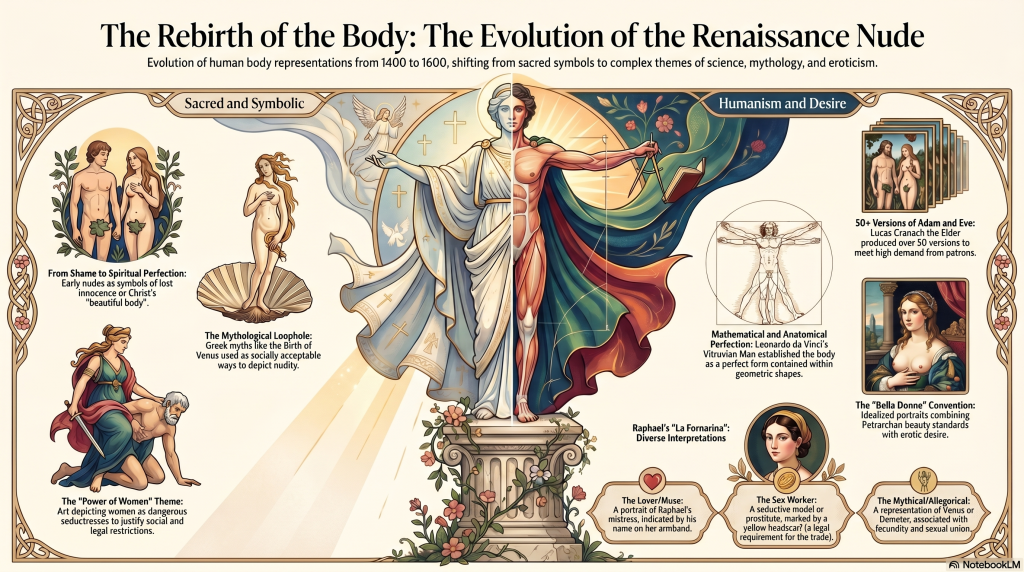
The Renaissance nude developed in 15th-century Italy as artists revived the ideals of ancient Greek and Roman art, celebrating the beauty and proportions of the human body. Inspired by classical sculpture, artists such as Sandro Botticelli, Michelangelo, and Titian created idealised nude figures in religious and mythological scenes. The nude symbolised beauty, harmony, and humanism, becoming a central subject in Western art and influencing generations of artists.
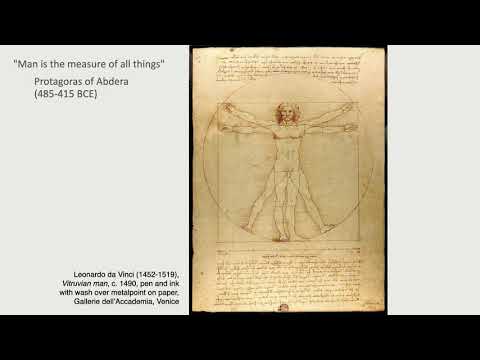
My notes on 10-02 The Renaissance Nude
An entertaining conversation about The Renaissance Nude created by Google NotebookLM from my notes:
Overview:
This document summarizes a presentation inspired by ‘The Renaissance Nude’ exhibition at the Royal Academy in 2019. It explores the evolution of the representation of the naked human body during the Renaissance (primarily 14th-16th centuries), covering religious, mythological, everyday life, philosophical/anatomical, and erotic themes. The presentation emphasizes the “rebirth” of classical art and philosophy, the growing interest in the human body as a symbolic form, and the complex interplay between artistic expression, religious doctrine, and social attitudes during this period.
Key Themes and Ideas:
- Rebirth of Classical Influence:
- The Renaissance was a period of cultural “rebirth,” heavily influenced by classical Greek and Roman art and literature. “The Renaissance was a period when European culture and art were ‘reborn’— inspired by classical art.”
- The rediscovery of classical texts (through Arabic translations) and the literal “digging out” of ancient sculptures fueled this interest. “As classical texts became available in Europe through translations made by the Arab world interest in the period grew particularly in Italy… There was a rediscovery of classical art as ancient sculpture was literally dug out of ground.”
- A central concept was “man as the measure of all things” (Protagoras), giving the human body new significance. “This was interpreted in 14th century Italy as the measure of all things in the Earthly realm… this meant the human body took on a new significance as it represented God’s ultimate creation and God’s form on Earth.” This contrasts with the Medieval period where “God who was the measure of all things.”
- Symbolism of the Human Body:
- The human body became a focus of artistic representation, symbolizing a range of attributes: motherhood, eroticism, strength, and beauty. “The human body was an important focus of as it symbolised many attributes such as motherhood, eroticism, strength and beauty.”
- The form and structure of the body held increasing symbolic importance in art. “The form and structure of the body took on an increasing symbolic importance in more and more works of art.”
- Thematic and Chronological Approach:
- The presentation adopts a thematic approach, examining different views of the body as they developed between 1400 and 1600. “My approach is thematic and chronological. I will take you through various views of the body as they developed from about 1400 to about 1600 starting with religious themes, then mythological, then everyday life and finally the erotic.”
- Religious Views of the Nude:
- The presentation begins with the Christian view of the body, exploring its relationship with biblical stories. “Religious: I start with the Christian view of the body and its relationship with various Biblical stories from Adam and Eve, to Christ to death, the Last Judgement and heaven and hell.”
- Examples include Adam and Eve, the crucified Christ, and depictions of the Last Judgement, showing the nakedness of the damned and the semi-nakedness of those ascending to heaven. “The damned in hell are naked those going to heaven are semi-naked.”
- Artists like Lucas Cranach the Elder frequently depicted Adam and Eve, maintaining “a balance between a purely decorative style and a lively and natural representation of the figures.” The presentation highlights the symbolic meanings of animals depicted alongside Adam and Eve, such as the roebuck, stag, sheep, and stork.
- The story of Bathsheba is used to show different interpretations of the female nude, where she is either the weak point of a powerful man (made for Anne of France), or as a seductress to be avoided (made for Claude Molé).
- Mary Magdalene’s image shifts from being partly draped as she laments for her sins, to being partly clothed with symbols of a book and skull.
- Michelangelo’s “Last Judgement” in the Sistine Chapel was controversial due to its extensive nudity, leading to censorship efforts after Michelangelo’s death. “The most famous representation of the Last Judgement is in the Sistine Chapel… When the fresco was being painted the Master of Ceremonies at the Vatican opposed the work as unworthy of a church and he described it as more suited ‘for public baths and taverns’.”
- Mythological Nudes:
- Classical works had a significant impact on Renaissance artists, who incorporated classical ideas into their art. “Mythological: I then consider the impact classical works had on artists and how the ideas raised were incorporated in their art.”
- Examples include Botticelli’s “The Birth of Venus,” drawing from the “Venus Pudica” pose found in classical statues. The nude Venus in Botticelli’s work was unusual due to its size and prominence.
- Christine de Pisan reinterpreted mythological tales, giving women an equal standing with men. “For example, although Actaeon comes upon Diana bathing naked all her assistants are clothed and try to hide her.” In Pisan’s version, Diana does not become angry and kill Actaeon but calmly turns him into a stag so his own dogs kill him.
- The story of “Aristotle and Phyllis” exemplifies the “Power of Women” theme, where women are portrayed as highly sexualized beings who endanger men.
- Nudes in Everyday Life and Philosophy:
- Depictions of day-to-day life were less common, but examples exist, such as bathhouses and representations of witches. “Everyday life: day-to-day was rarely depicted directly but there are example, from the bathhouse to witches as well as ceremonies and marriage.”
- The presentation touches on the “uncanny,” “abject,” and “excessive” themes within this category.
- The era was too early for science as it is understood today, but there was an interest in the structure and anatomy of the body as God’s work, best exemplified by Leonardo da Vinci.
- Erotic Nudes:
- The erotic element underpins much of the art of the period. “Erotic: The erotic underpins a lot of the work.”
- Mythology provided a “loophole” to make erotic subjects acceptable. “Mythology was used as a loophole to make the subject acceptable.”
- Examples include Giorgione’s “Laura,” Raphael’s “La Fornarina,” and Titian’s “Venus of Urbino,” showcasing a taste for erotic subject matter that expanded in the 16th century. “She is a beautiful woman, no need to know more.”
- The “Bella Donna” image became popular, often depicting beautiful women with exposed breasts.
- The Witch Hunt & The Power of Women:
- The period saw increasing focus on women’s sexuality and the association of women with the devil, culminating in witch hunts. “Women’s sexuality became linked to the devil and in 1487 Heinrich Kramer wrote in Hammer of Witches (Malleus Maleficarum) “all witchcraft comes from carnal lust, which in women is insatiable”.”
- This belief led to the torture, burning, hanging, or beheading of approximately 40,000 people, primarily women. “There is something particularly tragic about the myth of witches…some 40,000 people, mostly women were tortured, burned at the stake, hung or beheaded.”
- Love Magic:
- It was believed magic could be used to create sexual passion or romantic love. “During the Renaissance it was believed that magic could cause severe damage to the caster and so was not undertaken lightly.” In painting, it was shown that women cast spells over men, when in reality young men were casting them over young women.
- Individual Artist Styles & Business Acumen:
- Lucas Cranach the Elder painted over 70 versions of Venus to sell to wealthy patrons.
- Titian would adapt old artworks with new innovations, with his Venus pose based on the figure attributed to Giorgione.
Notable Examples Mentioned:
- Laocoön and His Sons: Ancient sculpture excavated in 1506.
- Wilton Diptych: Medieval British artwork showing Richard II presented to the Virgin Mary.
- Très Riches Heures du Duc de Berry: Late medieval manuscript showing everyday life.
- Lucas Cranach the Elder, Adam and Eve: Example of religious nude, noting the various animal symbols within the painting.
- Lucas Cranach the Elder, Cupid Complaining to Venus: Example of mythological nude.
- Michelangelo, The Last Judgement: Controversial work due to nudity, later censored.
- Botticelli, The Birth of Venus: Famous Renaissance nude depicting Aphrodite.
- Hans Baldung, Aristotle and Phyllis: Example of the “Power of Women” theme.
- Titian, Venus of Urbino: Sensual and erotic nude, sparking controversy.
Conclusion:
The Renaissance nude reflects a complex interplay of classical ideals, religious beliefs, and evolving social attitudes. The presentation provides a thematic exploration of this subject, examining how artists used the human body to express a range of ideas from spiritual devotion to erotic desire. The rediscovery of the body was pivotal, both from an artistic and anatomical perspective, that is still felt today.
10-03 Piero della Francesca

These documents provide a biographical and artistic examination of Piero della Francesca, a pivotal figure of the Early Italian Renaissance who famously unified mathematical geometry with painting. Born in Sansepolcro, Piero refined his revolutionary techniques in Florence under the influence of masters like Masaccio and Alberti, eventually becoming a sought-after artist for powerful patrons in Urbino and Rimini. The sources highlight his technical mastery of perspective and light, specifically as demonstrated in monumental works such as the fresco cycle The Legend of the True Cross and the enigmatic Flagellation of Christ. Beyond his visual art, the talk emphasizes his intellectual legacy as a theorist who authored significant treatises on spatial perspective. His career is portrayed as a sophisticated blend of civic duty, scientific inquiry, and serene humanism that influenced both his contemporaries and modern artists. The overview concludes with a chronological catalog of his surviving masterpieces, illustrating his enduring reputation as a “monarch of painting.”
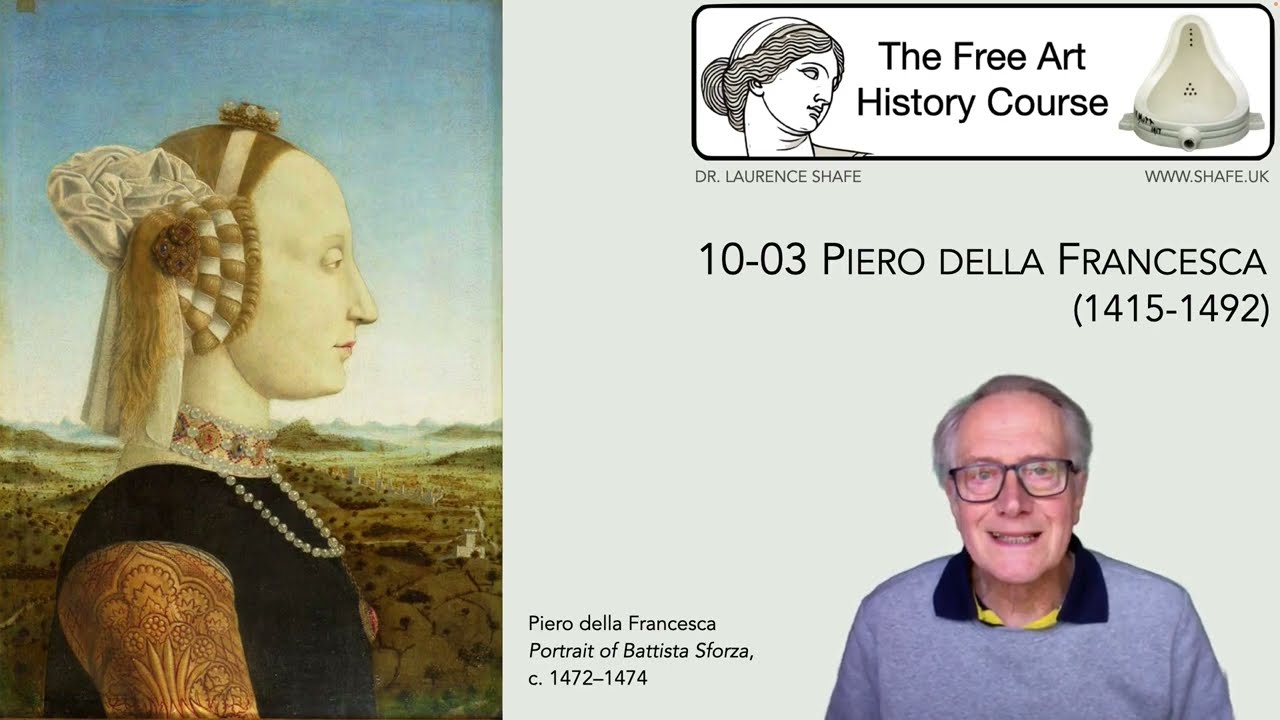
My notes on 10-03 Piero della Francesca
An entertaining conversation about Piero della Francesca created by Google NotebookLM from my notes:
Introduction:
This document provides an overview of Piero della Francesca, a pivotal figure of the Early Italian Renaissance, renowned for his innovative approach to art combining mathematical precision with artistic skill. He was both a painter and a mathematician, leaving a significant legacy in both fields. The document draws from excerpts of a talk about Piero della Francesca by Dr Laurence Shafe, covering his biography, key works, and lasting influence.
Biography and Key Dates:
- Birth: Born in Borgo Santo Sepolcro (modern Sansepolcro), Tuscany, around 1415 (exact date unknown). “His exact birth date remains elusive—typical of a Renaissance man who preferred enigmatic brilliance over paperwork.”
- Early Life: His father, Benedetto de’ Franceschi, was a leather and wool merchant. Piero’s mother, Romana, named him “della Francesca” after her maiden name. He was apprenticed to local painter Antonio di Giovanni d’Anghiari.
- 1439: At 24, he worked in Florence, assisting Domenico Veneziano on frescoes for the Sant’Egidio church (now lost). This exposure to Renaissance luminaries like Donatello, Brunelleschi, and Masaccio was crucial to his development. He likely met Leon Battista Alberti during this period.
- 1442: Elected to Sansepolcro’s town council, demonstrating his political acumen.
- 1445: Returns to Sansepolcro; receives commission for the Polyptych of the Misericordia which took 17 years to complete. Showcases early mastery of perspective.
- 1452: Begins work on “The History of the True Cross” fresco cycle in Arezzo.
- 1460: Paints “The Flagellation of Christ,” a highly enigmatic work.
- 1470s: Settled in Urbino under Federico da Montefeltro, creating portraits and altarpieces. He also wrote “De Prospectiva Pingendi,” a treatise on perspective.
- 1492: Died on October 12 in Sansepolcro. “His will divided his goods between family and church, a quiet exit for a man whose work shouted genius.”
Key Works and Themes:
- The History of the True Cross (Arezzo): Considered his magnum opus. It was completed in 1466. These frescoes in the Basilica di San Francesco narrate the story of the True Cross, drawing from Jacobus de Voragine’s “Golden Legend.” “Replacing the late Bicci di Lorenzo, he turned medieval legends into a Renaissance masterpiece, showcasing his knack for serene humanism and geometric precision.”
- The narrative spans from the time of Adam through to Constantine and Heraclius. Key scenes include: The Death and Burial of Adam, The Adoration of the Sacred Wood and Meeting Between Solomon and the Queen of Sheba, Constantine’s Dream, The Battle of Heraclius and Kosroës. The cycle’s non-chronological arrangement emphasizes thematic connections.
- The Baptism of Christ: An early work showcasing his spatial composition, linear perspective, and use of muted tones. The influence of Masaccio and Alberti is evident. The landscape is thought to be inspired by his native Tuscany.
- Flagellation of Christ: A small tempera painting known for its complex composition and ambiguous meaning. The painting is divided into foreground and background, with perspective connecting the two spaces. There are varying interpretations of who the figures in the foreground are, including suggestions that they are political figures, Duke of Urbino and his advisors, angel flanked by Latin and Greek churches and the Byzantine Emperor.
- Polyptych of the Misericordia: Took 17 years to complete (commissioned in 1445, finished in 1462). It displays blend of traditional iconography with Renaissance techniques. The Virgin Mary extending her mantle over kneeling supplicants is a traditional religious theme blended with new artistic techniques.
- The Resurrection: Depicts Christ rising from the tomb, surrounded by sleeping soldiers. One of the sleeping soldiers is believed to be a self portrait of Piero.
- Madonna del Parto: A unique fresco showing the pregnant Virgin Mary, located in Monterchi (birthplace of Piero’s mother).
- St. Mary Magdalene: Fresco in Arezzo Cathedral. Showcases monumental, statuesque figures.
- Polyptych of Saint Anthony: Created for the church of Sant’Antonio in Perugia. Demonstrates the artist’s ability to work with traditional religious formats.
- Portraits of Federico da Montefeltro and Battista Sforza: Profile portraits reminiscent of ancient Roman coins. The landscape background is a departure from traditional portraiture of the time. Battista is said to have engaged Piero in lengthy discussions about perspective and mathematics, which reportedly influenced his theoretical writings on art.
- Brera Madonna (Montefeltro Altarpiece): Harmonious composition with the enigmatic ostrich egg. Notable for its harmonious composition, masterful use of perspective, and serene, monumental figures.
- Madonna di Senigallia: Demonstrates Piero’s mastery of light to create intimate religious scenes.
- The Nativity: Piero’s later work, showcasing the mature style and mastery of light and perspective.
Artistic Style and Techniques:
- Perspective: Piero della Francesca was a master of perspective. He even wrote treatises on the subject. “He penned De Prospectiva Pingendi, a treatise on perspective that was well received by both artists and mathematicians.”
- Light and Colour: He used light to create volume and a sense of serenity. He also displayed an innovative approach to colour.
- Geometric Precision: His works are known for their geometric orderliness. His painting style combined mathematical precision with poetic beauty.
- Monumental Figures: His figures have a sense of dignity and monumentality, reflecting Renaissance ideals.
Legacy and Influence:
- Piero’s treatises on perspective and geometry influenced artists and mathematicians.
- He is considered one of the most important figures of the Early Renaissance. “Vasari called him ‘the monarch of painting’.”
- Rediscovered in the 19th century, his work inspired modernists like Seurat.
Anecdotes:
- During the painting of The Baptism of Christ Piero became so absorbed in perfecting the reflection of Christ in the water that he forgot to eat for an entire day.
- Sigismondo Pandolfo Malatesta, known for his volatile temper, was initially displeased with the portrait.
- While painting The Battle of Heraclius and Kosroës Piero became so absorbed in perfecting the perspective of the lances and banners that he worked through an entire night.
- During the painting of The Flagellation of Christ, the court was initially silent, unsure how to interpret its complex composition.
- During World War II, the British artillery officer Tony Clarke refrained from shelling Sansepolcro after remembering that Aldous Huxley had described The Resurrection as “the greatest painting in the world.”
- During a restoration in the 20th century, conservators discovered a small sketch of a chicken on the back of the Madonna del Parto.
- When Federico first saw The Brera Madonna, he was perplexed by the ostrich egg.
- When Madonna di Senigallia was rediscovered in the 19th century, it was being used as a notice board in a small church in Senigallia.
Conclusion:
Piero della Francesca’s contribution to the Renaissance was profound, blending artistic skill with mathematical precision to create works of enduring beauty and significance. He was an innovative artist, and his focus was always accuracy in detail.
10-04 Mantegna and Bellini
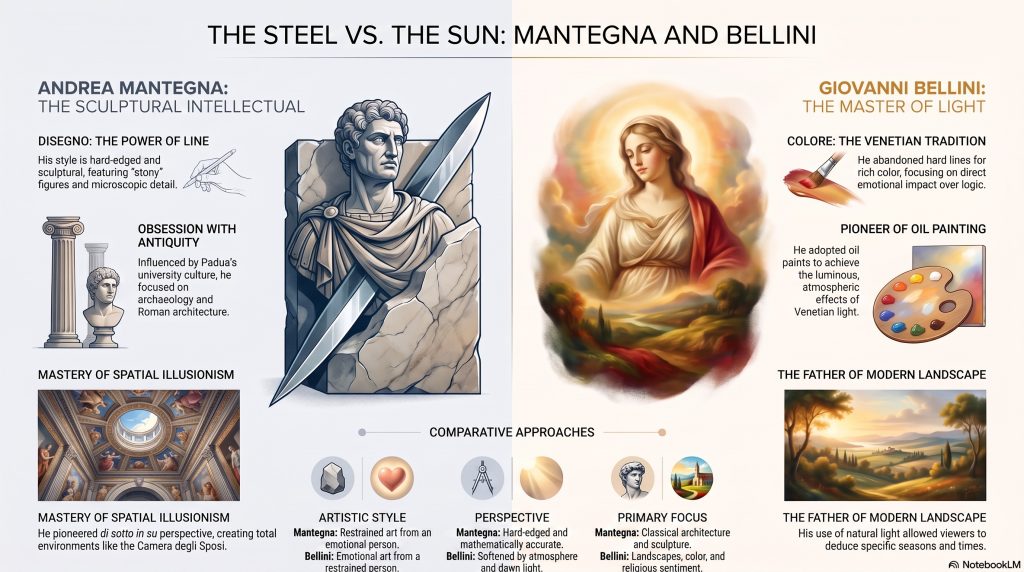
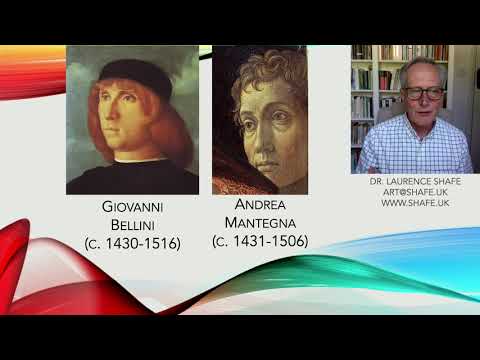
This talk examines the professional lives and artistic relationship between Giovanni Bellini and Andrea Mantegna, two influential Renaissance figures who became brothers-in-law in 1453. While Bellini hailed from a prestigious Venetian family and focused on color and atmosphere, Mantegna rose from humble origins in Padua to become a master of linear precision and classical archaeology. The sources contrast their distinct temperaments, noting that Bellini’s serene personality produced deeply emotional religious works, whereas Mantegna’s aggressive nature resulted in a controlled, intellectual style. Through a comparison of specific masterpieces like The Agony in the Garden, the talk illustrates how the two artists exchanged techniques such as perspective and landscape naturalism. Ultimately, the material highlights how Bellini became the father of Venetian painting while Mantegna pioneered spatial illusionism, both leaving a permanent mark on Italian art.
My notes on 10-04 Mantegna and Bellini
An entertaining conversation about Mantegna and Bellini created by Google NotebookLM from my notes:
Introduction:
This document provides a summary of the artistic lives and works of Andrea Mantegna (c. 1431-1506) and Giovanni Bellini (c. 1430-1516), two significant Renaissance artists who, despite their close familial connection (Mantegna married Bellini’s sister), developed distinct artistic styles and approaches. The source material is primarily derived from Dr. Laurence Shafe’s talk comparing the two artists and their relationship, particularly in relation to the National Gallery exhibition ‘Mantegna and Bellini’. The talk uses two sets of works to compare the artists: ‘The Agony in the Garden’, and their versions of ‘The Presentation at the Temple’.
Key Themes and Ideas:
- Contrasting Backgrounds and Personalities:
- Mantegna was born into a poor family outside Padua; his father was a carpenter. He showed early artistic talent and was mentored early on.
- Bellini was born into the leading family of artists in Venice; his father, Jacopo Bellini, was a famous and innovative artist. He was part of a well-established artistic dynasty.
- “Bellini was a restrained person who produced emotional art and Mantegna was an emotional person who produced restrained art.” This highlights the paradox in their artistic expression versus their personal dispositions.
- Mantegna was intellectual, interested in classical antiquity, and known for his meticulous detail. He was described as an “angry young man” who was known for his aggression and ferocious vocabulary.
- Bellini was more emotionally driven, deeply affected by the Christian message, and content to remain in Venice throughout his life. He was described by Albrecht Durer as “Everyone tells me what an upright man he is, so that I am really fond of him. He is very old, and still he is the best painter of them all.”.
- Early Influences and Artistic Development:
- Bellini’s early work shows the influence of his father and, significantly, Mantegna (“Bellini’s early drawing of the crucifixion shows elongated figures and is Mantegnesque is style.”).
- Mantegna was strongly influenced by the classical associations of Padua, a Roman city with a leading university. He developed a deep understanding of Roman archaeology and culture. He elevated the profession to the highest levels of academic status
- Both artists experimented with perspective and foreshortening to create emotional impact.
- Venice vs. Padua/Mantua:
- Bellini remained in Venice, becoming a central figure in the Venetian Renaissance. Venice, with its wealth and links to the Byzantine Empire, provided a fertile ground for his artistic development. The venetian tradition focused on “colore” which created “more emotional, more sensuous and more spontaneous” art.
- Mantegna moved to Mantua, becoming court painter to the Gonzaga family. Mantua, valuing classical learning, provided an environment where he could explore his interest in antiquity.
- Key Works and Artistic Styles:
- Mantegna’s defining work is the Camera degli Sposi in the Ducal Palace in Mantua, demonstrating his mastery of perspective and illusionistic space. He also was very talented in the area of “spatial illusionism”
- Bellini’s masterpiece is the altarpiece in S. Zaccaria in Venice, exemplifying his use of colour, light, and harmony to create a believable and divine world. The humid Venetian atmosphere made fresco painting impractical, so Venitian artist relied on “oil paintings [which] are durable and oil paints provide rich colours and allow naturalistic effects.”
- The document refers to comparisons between their versions of “The Agony in the Garden” and “Presentation at the Temple” highlighting their distinct approaches to the same subjects. Mantegna’s version is noted for its hard-edged style and strong colour contrasts, while Bellini’s is softer, more human, and uses light to model forms. Bellini “may have been the first artist to capture dawn in a painting and it gives the painting a unearthly, magical atmosphere.”
- Legacy and Influence:
- Mantegna’s influence on Italian art is marked, especially in spatial illusionism and ceiling decoration.
- Bellini is considered the father of the Venetian Renaissance, with its emphasis on colour and emotion. His pupils, Giorgione and Titian, surpassed him in world fame.
- The Importance of ‘Colore’ vs ‘Disegno’:
- The document touches on the Renaissance debate about the importance of “colore” (colour) versus “disegno” (design or drawing).
- Bellini is presented as a key figure in the “colore” tradition, emphasizing emotion, sensuality, and spontaneity.
- The relationship between classical and religious themes
- Mantegna combined his “detailed knowledge of antiquity with a rational yet expressive approach to Christianity.”
- Bellini referenced classical antiquity in a meaningless way because it meant nothing to him.
Specific Works Mentioned (with key points):
- The Agony in the Garden (Mantegna & Bellini): Highlights their differing styles and interpretations of the same biblical scene. The article notes that the two pictures “both probably derive from a drawing by Giovanni’s father, Jacopo Bellini”
- Presentation at the Temple (Mantegna & Bellini): Again, used for comparison, with Bellini’s work inspired by Mantegna’s.
- Camera degli Sposi (Mantegna): Demonstrates Mantegna’s mastery of perspective and illusionistic space.
- San Zaccaria Altarpiece (Bellini): A key example of Bellini’s mature style and use of colour and light. Simon Schama regards it as Bellini’s finest work.
- Triumphs of Caesar (Mantegna): Illustrates Mantegna’s interest in classical antiquity and his skill in depicting historical scenes.
- Madonna of the Meadow (Bellini): Noted for its composition and symbolic elements.
Quotes:
- “Bellini was happy to follow in the style of his father Jacopo yet his later work is uniquely his own. He was deeply and emotionally affected by the Christian message and his images were designed to have a direct emotional impact.”
- “There is not a single person in the vicinity with whom he agrees”. He was famously for his ferocious vocabulary and his aggression sometimes went beyond verbal abuse.
- “It seems to me that the nearer painting approaches sculpture the better it is”.
Conclusion:
Mantegna and Bellini, though related, represent distinct artistic paths within the Italian Renaissance. Mantegna’s art was marked by his intellectual rigour, interest in classical antiquity, and mastery of perspective. Bellini’s art was characterized by its emotional depth, emphasis on colour and light, and its foundation of the Venetian school of painting. Their contrasting styles provide a valuable lens through which to understand the artistic debates and innovations of the period.
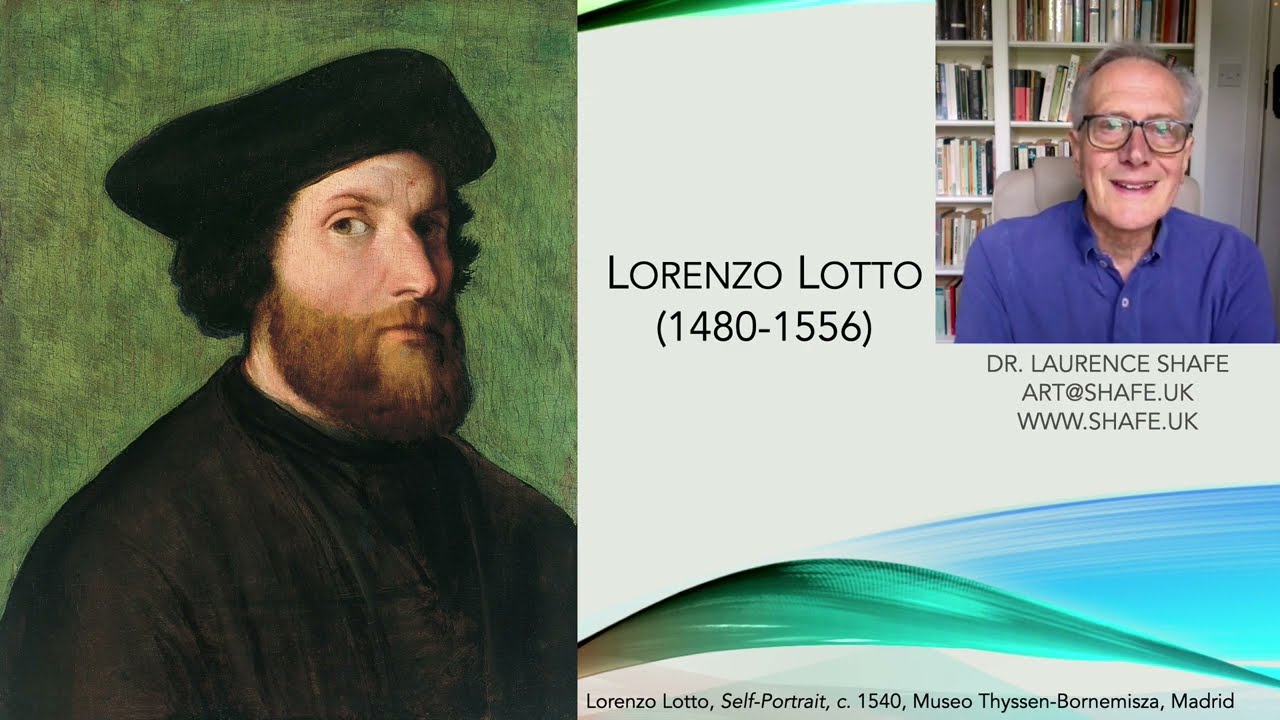
10-05 Lorenzo Lotto
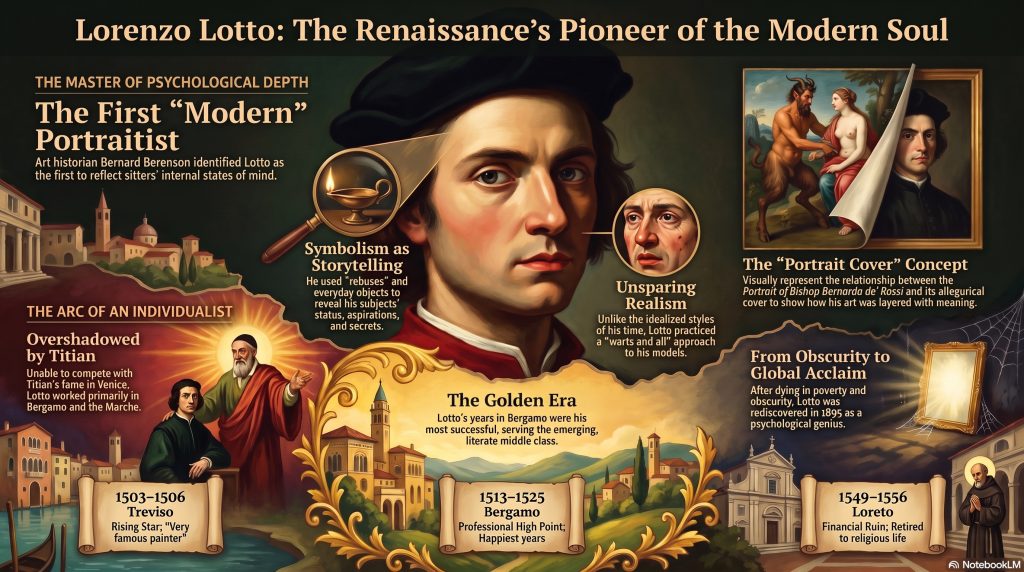
Lorenzo Lotto was a uniquely talented Renaissance painter whose reputation has shifted from relative obscurity to being celebrated as the first modern portraitist. These sources highlight his ability to capture the inner psychological state of his subjects, often using complex symbolism and everyday objects to define their personal identities. While he was born in Venice, he spent much of his career working in other regions like Bergamo and the Marche, frequently finding himself overshadowed by his contemporary, Titian. The provided materials detail a major exhibition of his work, featuring a range of masterpieces from religious altarpieces to intimate portraits of the middle class. Despite experiencing financial struggles and professional isolation in his later years, Lotto’s legacy is preserved through his personal diary and a highly individualistic artistic style. These documents offer a chronology of his life, tracing his movements across Italy and his eventual retirement to a religious community.
My notes on 10-05 Lorenzo Lotto
An entertaining conversation about Lorenzo Lotto created by Google NotebookLM from my notes:
For over three centuries, the name Lorenzo Lotto was little more than a ghost haunting the margins of the Italian Cinquecento. While his contemporaries—titans such as Titian and Raphael—secured their legacies in the glittering courts of kings and popes, Lotto seemingly vanished. He was a master who fell into almost complete obscurity, only to be resurrected by modern eyes as a painter born centuries too early.
Today, we recognize Lotto not merely as a “lost master,” but as an artist whose “expressive sensitivity and immediacy” make him feel more like our contemporary than a man of the 1500s. Here are five surprising truths about the Venetian nomad who looked past the finery of the Renaissance to capture the flickering light of the human spirit.
1. He Was the World’s First “Psychological” Portraitist
In an era where portraiture functioned primarily as a tool for “typology”—a method of social branding designed to broadcast a sitter’s status and aspirations—Lotto did something radical. He prioritized the subject’s state of mind over their social standing.
While Titian was celebrated for his “sensuous colors” and the ability to imbue the elite with a god-like grandeur, Lotto offered a “melancholic empathy.” He moved away from the rigid stereotypes found in the model books of his day, choosing instead to define his subjects by their “inner life.” This shift from the external mask to the internal confession was so profound that art historians view him as the spiritual ancestor of modern psychoanalysis. As the pre-eminent art historian Bernard Berenson famously observed:
“He seems always to have been able to define his feelings, emotions and ideals, instead of being a mere highway for them, this makes him pre-eminently a psychologist… The portraits all have the interest of personal confessions.”
2. He Lived in the Shadow of a Giant (and Was Better for It)
Lotto’s career was defined by a fundamental inability to compete with Titian, known in Venice as “The Sun Amidst Small Stars.” Because Lotto was an idiosyncratic painter, he was simply not accepted by the Venetian art world, which favored the mainstream aesthetic of the time.
However, being marginalized in Venice forced Lotto to become a nomad. He spent his life traveling to the “outskirts”—places like Bergamo, Treviso, and the Marche. Far from the stifling expectations of the Venetian elite, he was free to develop a highly individualistic style. His work became characterized by deeply saturated colors and a bold, dramatic use of shadow that his more “successful” rivals never dared to explore. By remaining an outsider, Lotto ensured his artistic voice remained pure and uncompromising.
3. His Paintings Had Secret “Protective Covers” and Hidden Riddles
For Lotto, a portrait was often a complex intellectual game. In the first half of the sixteenth century, personal portraits were frequently protected by “portrait covers”—allegorical panels that slid into or hinged onto the frame to protect the image and offer a moral commentary on the sitter.
A prime example is his portrait of Bishop Bernardo de’ Rossi, which was originally hidden behind the Allegory of Virtue and Vice. This cover is a visual treatise on the soul; it features a central tree sprouting a fresh branch above a shield containing a lion—the specific seal of the Bishop.
Lotto also mastered the “rebus,” embedding names and identities into visual puns. In his portrait of Lucina Brembati, he constructed her name by placing the letters “ci” inside a moon (luna), creating Lu-ci-na. He even added a layer of psychological mystery to her image; she is shown with her hand on her stomach and wearing a weasel stole—a likely reference to the legend of Hercules’ birth, suggesting a possible pregnancy. Other recurring symbols in his “riddle” paintings include:
The Squirrel: Often found asleep, representing constancy.
The Lapdog: A symbol of fidelity.
The Fly: A stark reminder of mortality, notably seen on the handkerchief of the Physician Giovanni Agostino della Torre.
4. He Found Beauty in the “Warts and All” Reality of the Middle Class
Lotto was remarkable for focusing his lens on a broad cross-section of the middle class—merchants, clerics, and humanists—rather than the ultra-elite. His “unsparingly frank” approach to the human face, meticulously rendering skin imperfections and the physical reality of his subjects, was heavily influenced by Northern and German portraiture. Having worked in Treviso, a major trade route from Germany, he would have been intimately familiar with the detailed prints of Albrecht Dürer.
This empathy for the “real” person extended to the lowest rungs of society. In his masterpiece The Alms of Saint Antoninus of Florence, Lotto unusually paid poor citizens to sit for him as models, imbuing them with the same dignity and “expressive sensitivity” as the high-ranking officials.
This deep-seated compassion was likely born of his own suffering. Lotto’s account books reveal a man who lived beyond his means, eventually becoming poor, depressed, and isolated. In his later years, he suffered from what modern historians would identify as clinical depression. This “melancholic empathy” eventually led him to retire as a lay brother in a religious community at Loreto, where he died in 1556.
5. He Was Rediscovered by the Father of Art History—and Freud
Lotto’s return to the canon of great artists in 1895 was a masterstroke of historical timing. When Bernard Berenson published the first monograph on the artist, the intellectual world was witnessing the birth of Freudian psychoanalysis.
Berenson’s interpretation of Lotto as the “first modern portraitist” resonated because the artist’s interest in reflecting “states of mind” mirrored the new scientific curiosity regarding the human subconscious.
The Modern Bridge: This connection between the Cinquecento and the 19th century created a bridge that brought Lotto back from 300 years of obscurity. He was no longer seen as a “failed” Venetian, but as a visionary who understood the “personal confession” of the human face long before the rest of the world caught up.
The Mirror of the Soul
Lorenzo Lotto’s legacy remains one of “expressive sensitivity and immediacy.” His work serves as a reminder that the human face is not just a surface to be curated, but a map of an internal landscape.
As we look at his portraits five centuries later, we are forced to hold up a mirror to our own age. In our current era of the digital “selfie”—where images are often used for social branding and status—have we lost the psychological depth that Lotto pioneered? Are we capturing our souls, as he did, or have we merely returned to the era of the stylized mask?
10-06 Botticelli

This biography of Sandro Botticelli details his evolution from an apprentice to the preferred artist of the Medici family during the Early Renaissance. The talk highlights his technical mastery in iconic works like The Birth of Venus and Primavera, noting his use of complex humanistic symbolism and innovative techniques such as real gold leaf. A significant portion of the narrative focuses on the 1490s, when the fiery sermons of Girolamo Savonarola caused Botticelli’s style to shift toward more somber, religious, and apocalyptic themes. Following this artistic transition and the rise of High Renaissance masters like Michelangelo, the documents describe how Botticelli’s popularity waned until his eventual nineteenth-century rediscovery. The records also catalog his major commissions, including frescoes in the Sistine Chapel and early triumphs like Fortitude, while touching on personal legends regarding his muses.

An entertaining conversation about Botticelli created by Google NotebookLM from my notes:
1. Introduction: The Famous Painter Nobody Knew
Today, Sandro Botticelli (1445–1510) is celebrated as a pillar of the Italian Renaissance, his works synonymous with classical beauty and lyrical grace. However, for three centuries following his death, he was largely a ghost in art history. His current global fame is a relatively recent phenomenon, sparked by a dramatic 19th-century “rediscovery” led by the Pre-Raphaelites and championed by the Victorian critic John Ruskin. This massive gap in his legacy serves as a poignant reminder that even the greatest masters can fall into total obscurity before being reclaimed by future generations.
2. The 300-Year Disappearing Act
His Legacy was Lost for Three Centuries It is a counter-intuitive fact that Botticelli’s reputation declined sharply toward the end of his life and remained dormant for three hundred years. By the time he died in 1510, his signature “linear and decorative style” had become outdated. Florence had moved on to embrace the High Renaissance, where the volumetric, atmospheric mastery of Leonardo da Vinci, Michelangelo, and Raphael defined the new artistic standard. To the eyes of the 16th-century elite, Botticelli’s work lacked the three-dimensional weight and “sfumato” of the new era.
[SOURCE_IMAGE_33]
He lived his final years in relative obscurity, receiving fewer commissions and becoming increasingly introspective. It wasn’t until the 19th century that scholars and artists—most notably John Ruskin—stimulated a reappraisal of his work. They recognized the complex symbolism and “Neoplatonic ideals” that modern audiences now admire. His story demonstrates that artistic fame is not a continuous line, but a fragile cycle of neglect and rediscovery.
3. The Radical Rebellion of the “Birth of Venus”
The Birth of Venus was a Technical and Social Gamble Botticelli’s most iconic work, The Birth of Venus (c. 1485), was a radical departure from the norms of the 15th century. It was revolutionary for its time, presenting a large-scale nude figure in a non-religious context—a bold social gamble even under the protection of his Medici patrons.
[SOURCE_IMAGE_1]
Technically, the work was equally unusual. It was executed on canvas rather than the traditional wood panel, a choice possibly dictated by its intended location or influenced by Venetian practices. Furthermore, the sea we see today as a muted green was originally a much brighter, vibrant blue; over time, the azurite pigment degraded, forever changing the painting’s atmosphere.
[SOURCE_IMAGE_41]
The painting’s subject matter is rooted in a visceral ancient myth that reflects the era’s fascination with classical antiquity:
The myth of the birth of Venus (told by Hesiod in his Theogony) was that the severed genitals Uranus, the sky god, were cast into the sea by his son Cronus and Venus emerged fully grown from the foam.
Beyond the myth, the painting contains overt “Medici branding.” The orange grove in the background features the mala medica—oranges—which were a specific symbol of the Medici family (the palle). This subtly linked the divine emergence of beauty to the wealth and political power of his Florentine patrons.
4. From Mythic Nudes to Burning Books
The Fiery Influence of a Doomsday Preacher In the 1490s, Botticelli’s career underwent a dramatic and somber shift. Following the death of Lorenzo the Magnificent in 1492, the Dominican friar Girolamo Savonarola rose to power, preaching against the moral decay and “vanities” of Florentine society.
The artist, once the producer of lush Neoplatonic allegories like Primavera, was deeply affected by Savonarola’s apocalyptic warnings. His style transitioned from the celebration of harmony to intense spiritual fervor, best exemplified by The Mystical Nativity (c. 1500). During the “Bonfire of the Vanities” in 1497, Savonarola’s followers burned luxury items, books, and secular art. It is widely believed that Botticelli, experiencing a personal spiritual crisis, may have personally destroyed some of his own secular works in these fires—a testament to the profound turmoil of a city caught between Renaissance humanism and radical religious reform.
5. A Literal Nightmare: The Artist’s Fear of Marriage
Botticelli was Terrified of the Altar Despite his mastery in depicting the female form, Botticelli was famously averse to marriage. He never wed and lived in the same Florentine neighborhood for nearly his entire life. A humorous but revealing anecdote involves his patron, Tommaso Soderini, suggesting the artist take a wife.
Botticelli’s response was recorded as follows:
[He] replied that a few days before he had dreamed that he had married, woke up “struck with grief”, and for the rest of the night walked the streets to avoid the dream resuming if he slept again.
While John Ruskin later claimed the beautiful Simonetta Vespucci was the artist’s muse and secret love, modern scholars like Ernst Gombrich dismiss this as a “romantic myth.” However, the link to the Vespucci family is visible in other “surprising” ways: in his painting Venus and Mars, wasps buzz around Mars’s head—a clever pun on the Vespucci name (vespa means wasp in Italian). This painting also hides a botanical secret: the satyr in the lower right holds a “Chinese lantern plant” (or love apple), a symbol of fertility, rather than a common apple.
6. The Master of the “Hidden Edit”
He was a Meticulous Perfectionist Who Changed His Mind Recent technical analysis, including infrared reflectography, has revealed that Botticelli was a meticulous perfectionist who frequently revised his compositions mid-process. These “hidden edits” prove his work was the result of a grueling, iterative technical craft.
[SOURCE_IMAGE_9]
Specific findings from recent restorations include:
• Fortitude: Botticelli adjusted the figure’s arms and altered the design of her throne. Interestingly, the model for this virtue was likely Smeralda Brandini, his sister-in-law.
• The Annunciation: Restoration revealed significant changes to the angle and positioning of the angel’s wings to achieve a more perfect compositional balance.
• Portrait of a Man with a Medal: This work features a brilliant trompe l’oeil effect; the medal is a physical reproduction by the sculptor Bertoldo di Giovanni, showing the workshop’s multimedia approach.
[SOURCE_IMAGE_43]
He also utilized an innovative technique called “incisione,” using a stylus to make incisions in the surface to guide the most intricate details—not just for the figures’ hair, but for the complex manes of horses as well. This level of precision reveals an artist constantly wrestling with his medium to achieve a specific, ethereal vision.
7. Conclusion: A Legacy Reclaimed
The life of Sandro Botticelli was defined by a profound transition—from the peak of Medici-era Neoplatonism and mythic beauty to a somber, religious introspection fueled by the city’s apocalyptic turn. His story serves as a powerful reminder of the fragility of artistic reputation. If he hadn’t been “rediscovered” in the 1800s by Ruskin and the Pre-Raphaelites, our modern concept of “Renaissance beauty” would be fundamentally unrecognizable today.
If Botticelli had remained lost to history, would we still have the same visual vocabulary for grace, or is a “masterpiece” only a masterpiece when there is someone there to find it again?
10-07 Leonardo da Vinci
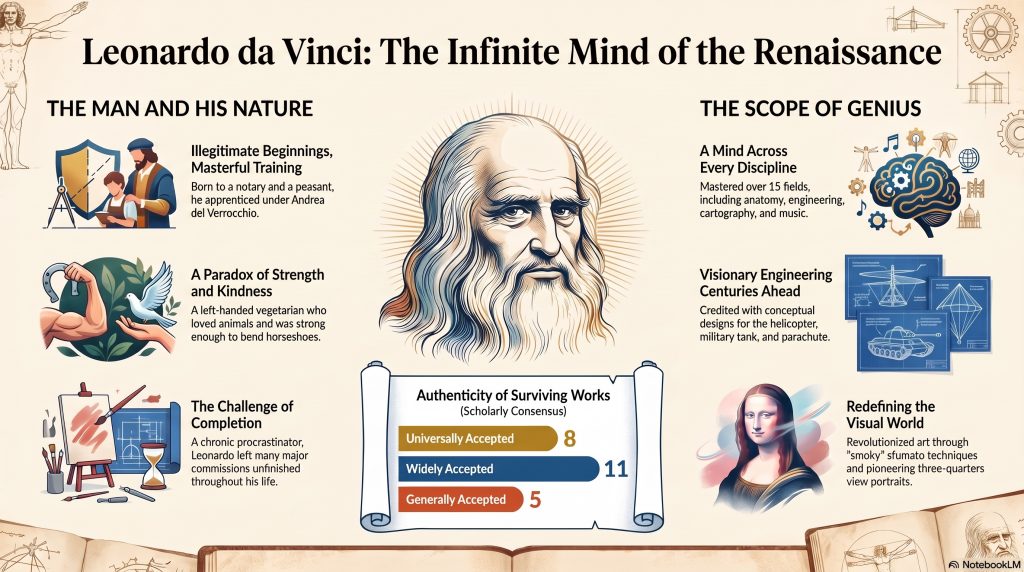
This talk provides a biographical and artistic examination of Leonardo da Vinci, the Renaissance polymath who excelled in fields ranging from anatomy to engineering. The talk details his early life as the illegitimate son of a notary and his subsequent apprenticeship under the master Andrea del Verrocchio in Florence. Despite a relatively small total output of roughly twenty-four accepted works, Leonardo is celebrated for his revolutionary techniques like sfumato and masterpieces such as the Mona Lisa. The overview highlights his personal traits, noting that he was a left-handed vegetarian and a chronic procrastinator whose scientific ideas were centuries ahead of their time. Specific early works, including the Landscape Drawing for Santa Maria Della Nave and The Annunciation, are analyzed to illustrate his burgeoning talent and lifelong fascination with the natural world. Ultimately, the material portrays a man of immense physical strength and intellectual curiosity whose legacy defines the High Renaissance.
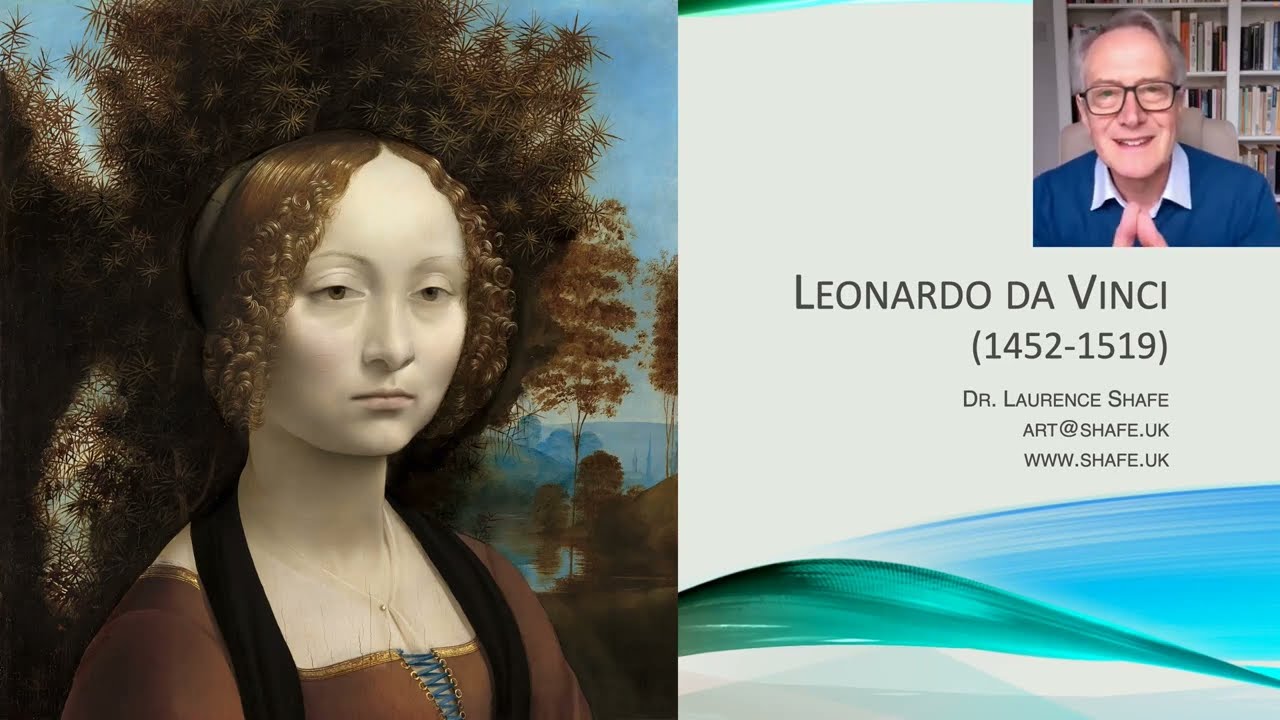
My notes on Renaissance – Leonardo da Vinci
An entertaining conversation about Renaissance – Leonardo da Vinci created by Google NotebookLM from my notes:
Leonardo da Vinci is the ultimate household name, a figure we’ve canonized as the “Universal Genius.” We see him as the grandfather of modern technology—the visionary who sketched the helicopter, the parachute, and the tank. Yet, as a Renaissance historian peering through the layers of varnish on his life, I find the real Leonardo far more eccentric and counter-intuitive than his polished reputation suggests.
How do we reconcile the man who revolutionized anatomy with the chronic procrastinator who could barely finish a commission? The “Renaissance Man” was, in reality, a social outsider who wrote backward from right to left—a habit known as mirror writing—as early as his 1473 Landscape Drawing for Santa Maria Della Nave, now held in the Uffizi Gallery. To understand him, we must look past the myth and into the life of a man who was as much a “ghost” as he was a celebrity.
1. Da Vinci Wasn’t Actually His Last Name
In our modern era of branding, we treat “Da Vinci” as a surname, but to a 15th-century Italian, this would have sounded like a simple geographic tag. His formal identity was Leonardo di ser Piero da Vinci. “Vinci” was his hometown—a small village about 20 miles (25 km) west of Florence—and “Ser Piero” referred to his father, Messer Piero Fruosino di Antonio da Vinci, a wealthy and influential notary.
Leonardo was the illegitimate son of Ser Piero and a 15-year-old orphaned peasant girl named Caterina di Meo Lippi. While illegitimacy was often a social barrier, for Leonardo, it was a pivotal “lucky break.” Because he was born out of wedlock, he was legally barred from the family trade of being a notary. This exemption spared him from a life of monotonous legal paperwork and, coupled with his lack of formal education, forced him to become a self-taught polymath. He was free to apprentice under Andrea del Verrocchio and follow his own insatiable curiosity rather than a pre-written family script.
2. He Was the Renaissance “Action Hero” (and a Fashion Icon)
The popular image of Leonardo is often that of a frail, elderly philosopher. However, contemporary accounts describe a man of staggering physical presence. Leonardo was remarkably handsome, with long, curly hair that reached his chest, and he possessed the raw strength required to bend a metal horseshoe with his bare hands as if it were lead.
He was also a provocateur in the streets of Florence. In an era where respectable men wore long, somber robes, Leonardo opted for “shock value” fashion: short, vibrant tunics in shades of pink, purple, and crimson. This flamboyant exterior matched an deeply ethical interior; he was a dedicated vegetarian and an animal lover who famously purchased caged birds at markets just to set them free.
The biographer Giorgio Vasari captured his essence with a sense of historical awe:
“The radiance of his countenance, which was splendidly beautiful, brought cheer to the most melancholy of spirits, and his words could move the most obstinate to ‘yes’ or ‘no’. He was so strong that he could withstand any violence; with his right hand he could bend the ring of an iron door-knocker or a horseshoe as if they were lead.”
3. The Greatest Painter With the Smallest Portfolio
It is a profound paradox that a man considered one of the greatest painters in history left behind a catalog smaller than many modern hobbyists. His accepted output is a mere 24 works (excluding drawings). As an art historian, I find the breakdown of this portfolio telling: only 8 works are universally accepted, 11 are widely accepted by a majority of scholars, and 5 remain generally accepted but controversial.
This tiny output was driven by a lifelong struggle with focus. Leonardo was a master of the “pivot,” frequently abandoning a painting the moment a more compelling scientific problem presented itself. This chronic procrastination weighed on him until the very end. On his deathbed, he reportedly lamented that he had “offended against God and men by failing to practice his art as he should have done.” His career remains a testament to quality over quantity; he achieved immortality through a collection he himself viewed as a failure of discipline.
4. He Was a “Darwinist” Three Centuries Early
Leonardo’s scientific intuition was so far ahead of his time that it bordered on the prophetic. Long before the modern biological framework existed, Leonardo classified humans as belonging to the same “genus” (using his era’s terminology for species) as apes and monkeys.
This was not mere guesswork. Leonardo reached these radical conclusions through the grueling, illicit work of anatomical dissection of cadavers. By peeling back the skin of both humans and primates, he saw the undeniable structural similarities. This departure from the religious orthodoxy of the 15th century—which viewed humans as divinely separate from nature—was a monumental leap in thought that would not be validated until Charles Darwin’s work more than 300 years later.
5. The Two-Year “Ghost” Period and the Scandal of 1476
In 1476, at the age of 24, Leonardo’s career almost vanished before it began. He was charged with sodomy along with several male companions. In the 15th century, Florence had such a reputation for these relations that it was known abroad as the “capital of the sodomites,” yet the charge remained a capital offense.
Leonardo was eventually acquitted because his accuser remained anonymous, but the scandal was transformative. Immediately following the trial, he disappeared from the public record for two years. There is no account of his whereabouts or his work during this “ghost period,” leading many to believe he was forced to keep a low profile to escape the lingering stain of the charge. It was during his later life that he would reflect on his internal struggle, as evidenced by his notebook philosophy:
“Intellectual passion drives out sensuality. . . Whoso curbs not lustful desires puts himself on a level with the beasts.”
6. His “Biggest” Project Was a Total Disaster
Leonardo’s greatest ambition was never the Mona Lisa; it was the Sforza equestrian monument. This massive 25-foot-high bronze statue was intended to be the largest in the world. He spent years obsessing over the physics of its casting, finally completing a full-scale clay model in 1492.
The project’s end was a masterpiece of irony. In 1494, the 75 tons of bronze intended for the horse were diverted by Ludovico Sforza to be cast into cannons to defend Milan from French invasion. When the French finally took the city in 1499, their troops used Leonardo’s clay horse for target practice, reducing his life’s work to rubble. It is the ultimate tragedy for a man who claimed to hate violence; his “engineering wonders”—which included a mechanical lion and the double-helix staircase at Chambord—were often funded because patrons wanted weapons, and those very weapons eventually destroyed his greatest artistic dream.
7. That Famous “Self-Portrait” Is Likely a Fake
If you close your eyes and picture Leonardo, you likely see the red chalk drawing of a wizened, long-bearded sage currently held in the Royal Library of Turin. However, modern stylistic analysis suggests this image is a historical misnomer.
The drawing is dated on stylistic grounds to the 1490s, a period when Leonardo was only in his mid-forties. He did not grow a beard until his final years—an unusual choice for an Italian of that period, where beards were often reserved for travelers or the elderly. The “Turin Sage” cannot be an accurate portrait of the artist at forty-five. We remain attached to it because it fulfills our cultural need for Leonardo to look like a “wise old philosopher” like Aristotle, ignoring the reality of the clean-shaven, physically active man who spent most of his life as an outsider.
Conclusion: The Complexity of Genius
Leonardo da Vinci was a man of deep, unresolved contradictions. He was a pacifist who designed machine guns; a master of the arts who left most of his canvases blank; and a socialite who remained an enigma.
Does knowing Leonardo was a chronic procrastinator and a social outlier make his achievements less impressive? Quite the opposite. It humanizes him. He was not a divine machine of productivity, but a man whose mind moved so quickly that his hands—and the limited technology of the 15th century—could never hope to keep up. Leonardo’s life reminds us that true genius is rarely a finished product; it is a messy, unfinished, and profoundly human pursuit of the “why” behind everything.
10-08 Raphael
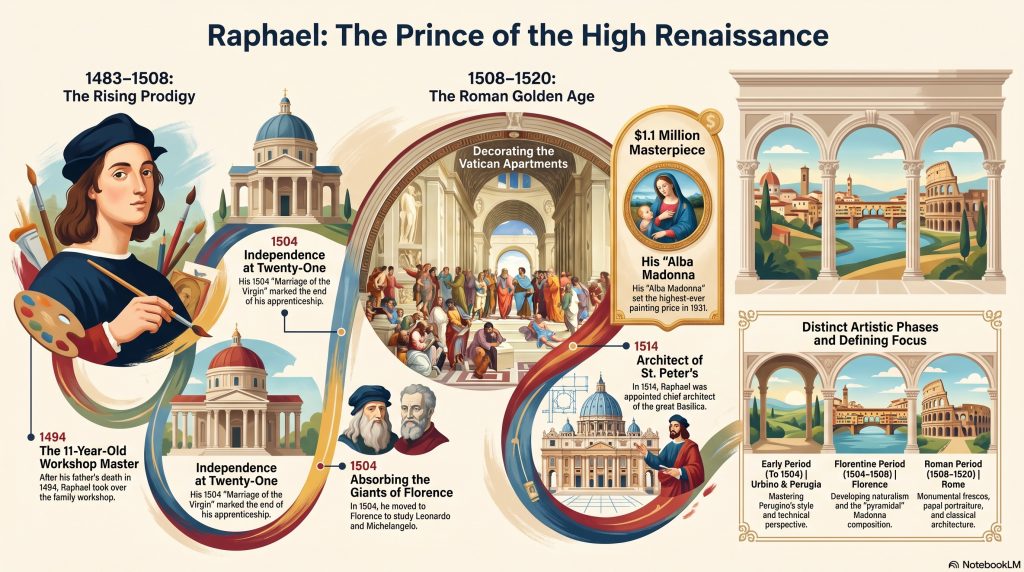
These sources offer a comprehensive look at the life and artistic evolution of Raphael, a preeminent figure of the Italian High Renaissance. The provided text traces his journey from a childhood prodigy in Urbino to a master architect and painter in Rome, where he served the papacy. Key masterpieces like The School of Athens and the Madonna del Granduca are analyzed to highlight his mastery of perspective, harmony, and classical beauty. The material also explores his ability to integrate the influences of Leonardo da Vinci and Michelangelo into his own uniquely graceful style. Technical details revealed through X-ray analysis and historical anecdotes provide a deeper understanding of his creative process and professional rise. Ultimately, the collection underscores Raphael’s enduring legacy as an artist who balanced technical perfection with profound emotional depth.
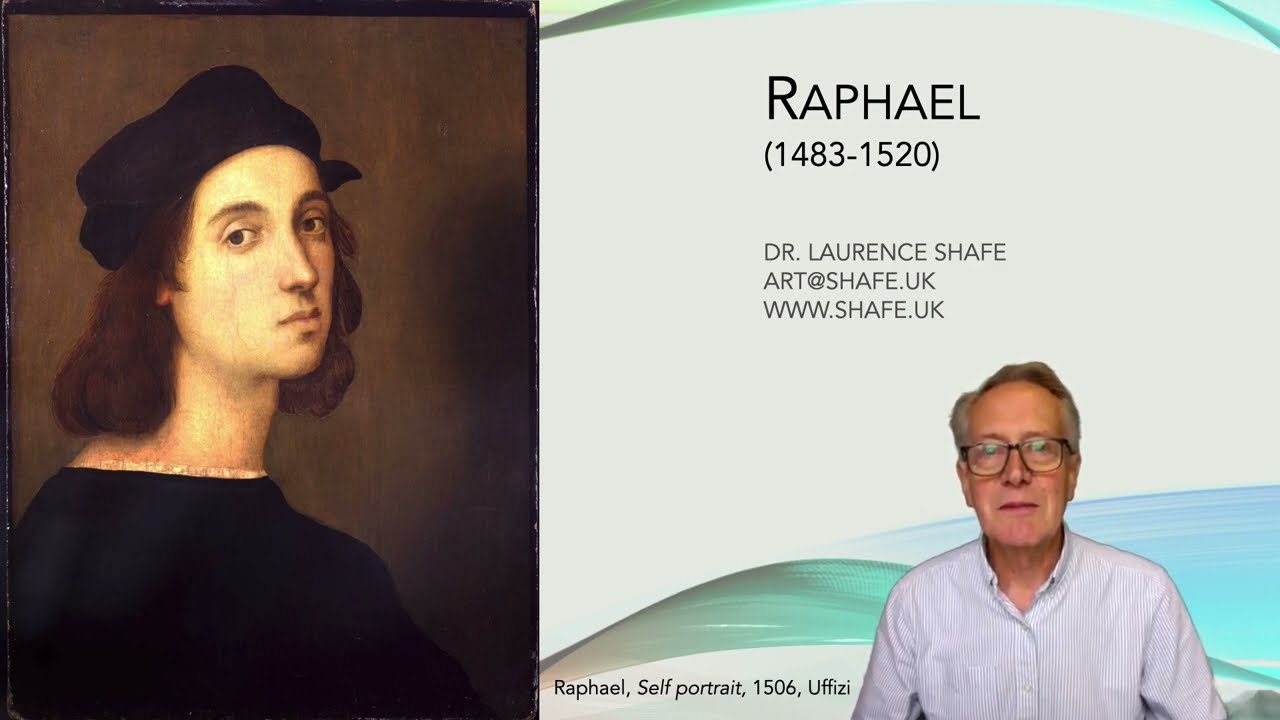
An entertaining conversation about Raphael created by Google NotebookLM from my notes:
1. Introduction: The Perfectionist of the Renaissance
While nearly every student of Western civilization knows the name Raphael, few realize the intense psychological drama and the calculated tactical secrets that lie beneath his seemingly “perfect” compositions. Celebrated as the ultimate arbiter of High Renaissance harmony, Raphael’s work is often viewed as the visual equivalent of a flawless choral arrangement—technically peerless, classically beautiful, and spiritually resonant. Yet, there is a poignant irony to his meteoric ascent: he was the original “young prodigy,” enjoying a career that saw him crowned as the “prince of painters,” only to vanish from the stage on his 37th birthday in 1520. Behind the serene Madonnas and the balanced geometry of his frescoes are stories of precarious survival, bold political maneuvers, and artistic “cover-ups” that modern science is only now beginning to untangle.
2. The 11-Year-Old CEO: Raphael’s Precocious Start
Raphael’s rise was less a gradual climb and more a vertical launch. Born Raffaello Sanzio in the sophisticated court of Urbino, he was the son of Giovanni Santi, the court painter to the Duke. When tragedy struck and his father died in 1494, the young Raphael did not merely inherit a legacy; he took over the family workshop—effectively becoming a “Renaissance startup” CEO at just 11 years old.
This early burden of leadership demanded a level of virtuosity that extended beyond the brush. To keep the workshop afloat, Raphael had to cultivate a “charming and affable” persona, a strategic social grace that stood in stark contrast to the famously brooding and solitary Michelangelo. This charm was further polished between 1500 and 1504 during his apprenticeship with the Umbrian master Pietro Perugino. It was here that Raphael mastered the art of professional diplomacy, allowing him to navigate the high-stakes world of elite patronage with ease. By the age of 23, having moved to the artistic battlefield of Florence, he was already being hailed as a “prince of painters,” a title usually reserved for masters with decades of experience.
3. The Art of the “Cover-Up”: Secrets Revealed by X-Rays
Modern conservation science has acted as a historical detective, pulling back the curtain on Raphael’s creative process to reveal fascinating pentimenti—the traces of earlier versions hidden beneath the paint. X-ray analysis of the Madonna del Granduca (1505) reveals that Raphael’s original vision included a landscape and a complex headdress. In a move toward radical simplicity, he painted these out, creating a dark, contemplative void to heighten the intimacy of the devotional work.
Perhaps the most dramatic reveal occurred with the Portrait of a Lady with a Unicorn. For centuries, the painting was a confused palimpsest; a later artist had even added a wheel to transform the subject into Saint Catherine. It wasn’t until a major restoration in 1935 that the saintly wheel was removed to reveal the unicorn beneath. However, further X-ray analysis showed that even the unicorn was an alteration—originally, the sitter held a small dog, a traditional symbol of marital fidelity. This suggests the painting was likely a bridal commission before being updated with the unicorn’s symbol of purity.
“This painting was long attributed to Pietro Perugino until its true authorship was recognized in the early 20th century.”
This misattribution speaks volumes about Raphael’s early apprenticeship; his ability to mimic and then transcend his master’s style was so complete that for years, scholars couldn’t tell where the teacher ended and the student began.
4. The “Sistine” Misnomer: A Cultural Icon with a False Name
The Sistine Madonna is one of the most recognized images in the world, yet its very name is a historical accident. It was never intended for the famed Sistine Chapel in the Vatican; rather, it was commissioned for the church of San Sisto in Piacenza.
There is a delightful irony in the work’s legacy: its most famous residents—the two bored, leaning cherubs at the bottom—were never part of the original brief. Raphael added them as a spontaneous “artistic flourish” to balance the composition. These cherubs have since achieved a level of fame that arguably eclipses the Madonna herself, appearing on everything from high-end stationery to kitschy ornaments. The painting’s status as a global treasure was cemented during World War II, when it was desperately hidden in a tunnel in Saxony to shield it from Allied bombing.
5. A Philosophy of Anachronism: Secrets of “The School of Athens”
When Pope Julius II invited Raphael to his ultimate residency in the Vatican, the result was The School of Athens. This monumental fresco is a masterclass in perspective, but it also serves as a gallery of Renaissance “easter eggs.” Raphael populated this ancient Greek academy with his contemporaries: the central Plato is a clear portrait of Leonardo da Vinci, while the solitary, brooding Heraclitus—painted in late as a tribute—is modeled after Michelangelo.
The true secret of the work, however, lies in its radical inclusivity. Raphael included Averroes, a 12th-century Islamic philosopher, among the pantheon of Greek thinkers. In the heart of the Vatican, this was a bold anachronistic statement, signaling that the pursuit of truth was a universal, cross-cultural endeavor. Raphael tucked himself into the lower right corner as the ancient painter Apelles, a subtle but confident declaration that he had officially arrived as the peer of the greatest minds in history.
6. The “Warrior Pope” and the Invention of Modern Portraiture
In 1511, Raphael redefined the visual language of power with his Portrait of Pope Julius II. At the time, papal portraits were expected to be static icons of divine authority. Instead, Raphael depicted the “Warrior Pope” in a moment of startling vulnerability.
The most significant detail is the Pope’s beard. Julius II grew it during a period of bitter military defeat, vowing not to shave until his enemies were expelled from Italy. By capturing the beard, Raphael didn’t just record a physical trait; he recorded a psychological state of introspection and humanity. While this portrait revolutionized the genre, it is often confused with later works; it was actually the Portrait of Pope Leo X with Cardinals that was so lifelike viewers reportedly felt “tempted to bow before it as if the Pope were really present.” Long thought to be lost to history, the original Julius II was only rediscovered in a private collection as recently as 1970.
7. Chivalry and Diplomacy: The Secret of the Blue Garter
Raphael understood that in an era before digital media, tiny, exquisite paintings were the “high-resolution branding” of the Renaissance. His Saint George and the Dragon (1506) is a prime example of art-as-diplomacy. Measuring a mere 28.5 by 21.5 cm, this was a portable, high-stakes gift likely sent from the Duke of Urbino to King Henry VII of England.
The “secret” encoded in the image is the blue garter strapped to the Saint’s leg. It is an explicit nod to the Order of the Garter, England’s highest order of chivalry, signaling the Duke’s loyalty to the English crown. The enduring market value of Raphael’s name is staggering: while this work served as a diplomatic pawn, another of his Roman masterpieces, the Alba Madonna, was sold to Andrew Mellon in 1931 for $1,116,000—the highest price ever paid for a painting at that time.
8. Conclusion: The Eternal Harmony of a Brief Life
Raphael’s legacy is defined by his supernatural ability to synthesize disparate influences—the sfumato of Leonardo, the muscularity of Michelangelo, and the architectural clarity of Bramante—into a uniquely harmonious style. Despite a life cut short at age 37, he moved with breathtaking speed from an 11-year-old apprentice to the chief architect of St. Peter’s Basilica in 1514, arguably the most powerful architectural post in Christendom.
One is left with a haunting historical question: if Raphael achieved the status of chief architect of the Vatican and revolutionized the history of portraiture before his fourth decade, what heights might he have reached had he lived to the ripe old age of his rivals? His work remains a testament to a brief, brilliant window in time where naturalism and classical beauty achieved a perfect, if fleeting, equilibrium.
10-09 Michelangelo
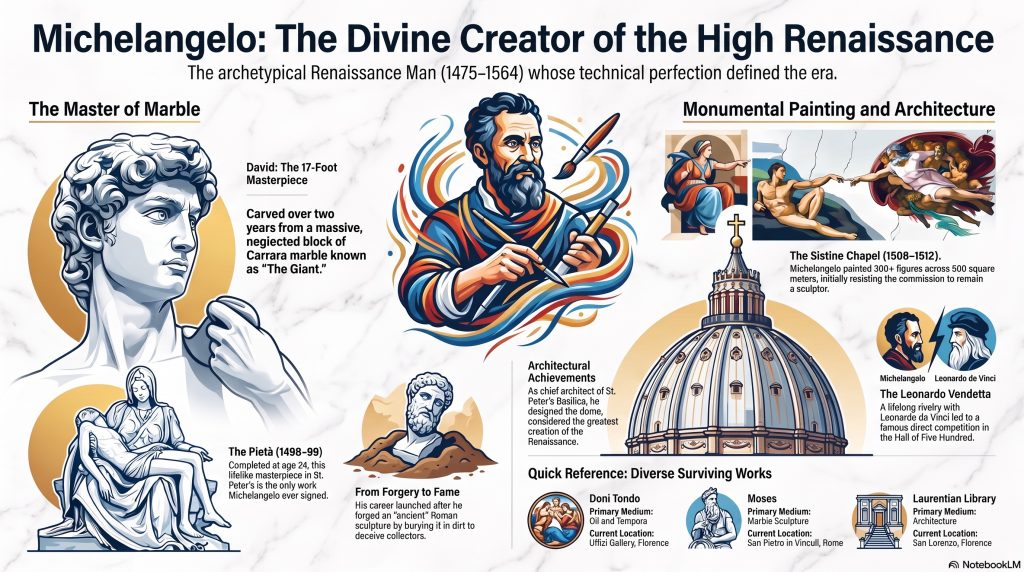
This source material provides a comprehensive biographical overview of Michelangelo Buonarroti, emphasizing his status as a legendary High Renaissance polymath. The text details his early life in Florence, including his apprenticeship under Ghirlandaio and his rise to prominence through both his immense skill and early penchant for classical forgery. Key masterpieces such as the Pietà, David, and the Sistine Chapel ceiling are highlighted as central to his artistic legacy. Beyond his professional achievements, the documents explore his difficult personality, marked by a solitary lifestyle and a storied rivalry with Leonardo da Vinci. Finally, the sources examine his later contributions to architecture and poetry, illustrating a life dedicated to spiritual and physical expression.
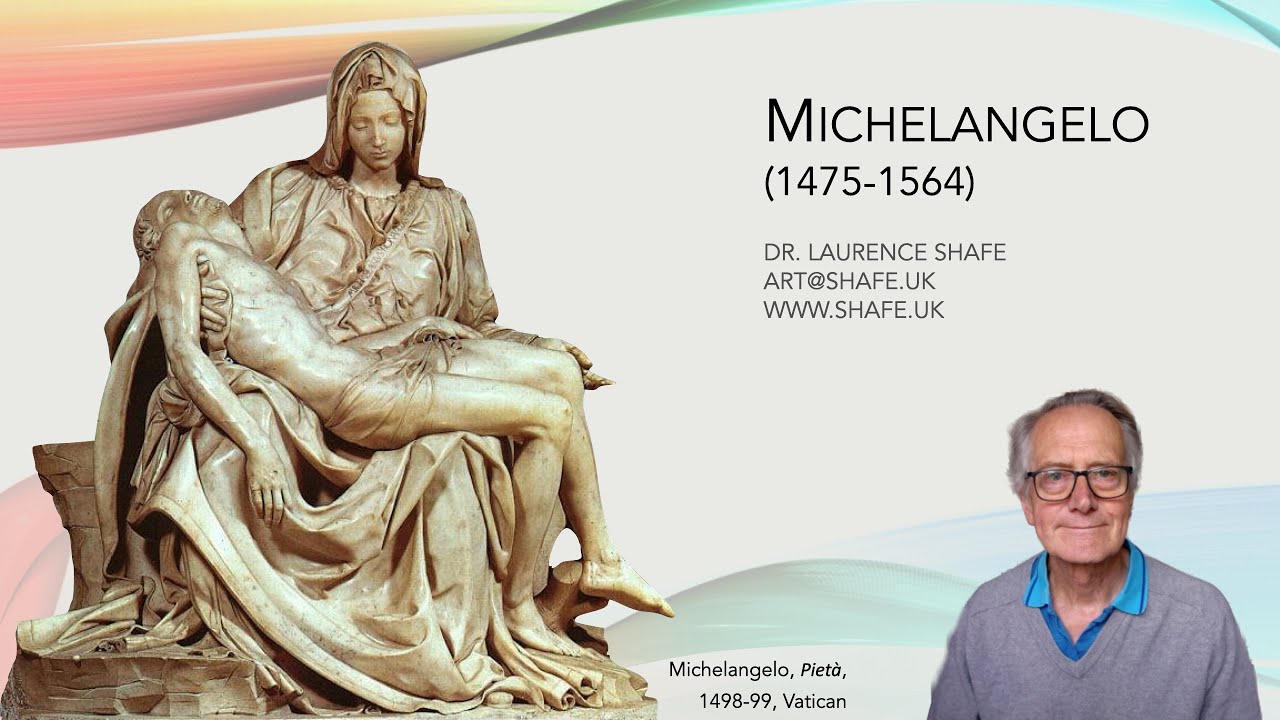
An entertaining conversation about Michelangelo created by Google NotebookLM from my notes:
Introduction: The Man Behind the Marble
History remembers Michelangelo Buonarroti as Il Divino—the divine one. As a sculptor, painter, architect, and poet, he was the titan of the High Renaissance whose works achieved a level of perfection that seems to transcend human capability. Yet, the man who conjured such celestial grace was far from divine in his daily existence. Born in 1475 to a father obsessed with a supposed noble lineage that never quite materialized, Michelangelo’s genius was forged not in ivory towers, but in the stonecutter’s yard. After his mother’s death, he was raised by a nanny whose husband was a stonecutter, famously remarking later that he sucked in the craft with his nurse’s milk.
To understand the terribilità—the emotional intensity—of his art, one must reconcile the “divine” output with a man who was volatile, solitary, and lived in shocking personal squalor. In a violent age where public executions involved “red-hot pincers” and public torture to satisfy the Roman crowds, Michelangelo’s internal battles were just as visceral. He was a man of immense insecurities and contradictions: a pauper-living millionaire who turned discarded, “impossible” marble into the symbols of Western civilization.
1. The Master Forger: His Big Break Was a Fraud
Long before he was the darling of the papacy, a twenty-one-year-old Michelangelo launched his Roman career through an act of criminal deception. In 1496, after a brief apprenticeship in the massive Florentine workshop of Ghirlandaio, he carved a marble sculpture of a Sleeping Cupid. Seeking to maximize its value, he intentionally aged the piece by burying it in the earth, ensuring it emerged with the “spots and marks” of an ancient Roman artifact.
The forgery was sold to Cardinal Raffaele Riario for a significant sum. While the Cardinal was initially furious upon discovering the fraud, he was so struck by the technical brilliance required to fool an expert that he invited the young artist to Rome. In the Renaissance, the ability to perfectly mimic a master was not seen as a lack of ethics but as a supreme demonstration of disegno and skill. As his first biographer, Paolo Giovio, noted:
“Michelangelo achieved the highest glory in sculpture when he made Eros of marble and afterwards kept him buried in the ground for some time, and then presented the light again… in such a way that Eros looked like an ancient one.”
It is a poignant irony of art history that this specific “breakthrough” work is now lost to time; we only know of its brilliance through the descriptions of those it fooled.
[SOURCE_IMAGE_13]
2. The Living Vendetta: A Rivalry Beyond Art
Michelangelo’s relationship with Leonardo da Vinci was not a friendly professional competition; it was a “life and death” vendetta fueled by the “very violent age” in which they lived. The two were polar opposites: Leonardo was elegant, sophisticated, and prone to the “quiet, thoughtful elegance” of the studio, while Michelangelo was described as “like a bear,” quick to temper and perpetually covered in stone dust.
Their feud reached a public breaking point outside the Palazzo Spini in Florence. When Leonardo suggested that a group of citizens ask Michelangelo to explain a passage of Dante, Michelangelo—convinced he was being mocked—hurled a stinging personal insult regarding Leonardo’s failure to cast a major bronze project:
“Explain it yourself! You who designed a horse to be cast in bronze, which you could not cast and shamefully gave up.”
This friction extended into the Paragone, the intellectual debate over the hierarchy of the arts. Leonardo bitingly described the sculptor’s work as involving “physicality, mess, and noise,” a brutal characterization of Michelangelo’s method. Michelangelo’s career became a physical rebuttal to this insult, proving that the grit of the stonecutter’s yard could produce a reality that no canvas could rival.
3. Divine Work, Human Squalor: The Abstemious Titan
Despite his family’s unproven belief in their aristocratic nobility—an obsession that fueled Michelangelo’s lifelong insecurity—the artist lived in conditions that bordered on the ascetic. His father was a failed banker who became a local magistrate, leaving a legacy of financial anxiety that Michelangelo carried even as he became incredibly wealthy.
He was famously “abstemious,” indifferent to food and drink, eating only out of necessity. His personal hygiene was legendary for its neglect; he frequently slept in his clothes and his boots, consumed by a “solitary and melancholy” genius that rendered the physical world a nuisance. The reality of his existence was visceral: at the time of his death at age 88, his clothes were so “dirty and plastered on his body” that they had to be cut and peeled away from his skin. He lived like a pauper to preserve a fortune for a family he believed was noble, a counter-intuitive truth of his “divine” existence.
4. The Midnight Inscription: An Act of Regretted Pride
The Pietà, completed when Michelangelo was only 24, established his global reputation. However, its fame was nearly stolen by a rival. Upon hearing onlookers attribute the masterpiece to the sculptor Cristoforo Solari, Michelangelo’s pride flared. He reportedly broke into St. Peter’s Basilica at night to carve his name into the sash across the Virgin Mary’s breast.
The inscription reads: MICHAELA[N]GELUS BONAROTUS FLORENTIN[US] FACIEBA[T] (“Michelangelo Buonarroti, the Florentine, made this”). It remains the only work he ever signed, an act of “regretted pride” he never repeated. When critics questioned why he made the Virgin Mary look so young, he defended his choice with a theological argument on the physical nature of purity:
“Do you not know that chaste women stay fresh much more than those who are not chaste? How much more in the case of the Virgin, who had never experienced the least lascivious desire that might change her body?”
[SOURCE_IMAGE_2]
5. The “Giant” Nobody Wanted: Salvaging the “Supine” Block
The David was not born from a pristine, perfect block of stone. Instead, it was salvaged from a 17-foot piece of Carrara marble known as “The Giant.” For 26 years, this block sat neglected in the yard of the cathedral workshop, exposed to the elements and considered a ruined “mess.” An inventory of the workshop in 1500 described the piece as “badly blocked out and supine.”
It had been abandoned by previous sculptors, including Agostino di Duccio, who had “gouged a hole between the legs,” making the stone seem useless. While older masters like Leonardo were consulted on how to save the costly material, it was the 26-year-old Michelangelo who convinced authorities he could see “life” inside the ruined, “supine” giant. He began carving in 1501, spending two years turning a discarded failure into the most famous sculpture in history, solidifying his reputation for having both “extraordinary technical skill and a strong imagination.”
[SOURCE_IMAGE_25]
Conclusion: The Fragility of Greatness
To look at Michelangelo’s work is to see the peak of human achievement, but to look at his life is to see the fragility of the human spirit. He was a man of immense insecurities, a legendary temper, and a near-total disregard for his own physical well-being. He was the product of a violent age, a stonecutter’s milk, and a father’s failed aristocratic dreams.
His story suggests that the “divinity” found in high art is often the result of a singular, almost punishing obsession—one that separates the creator from normal society. It leaves us with a final, haunting ponderance: Would the David exist if Michelangelo had been a well-adjusted, easy-going man, or was the “solitary and melancholy” squalor of his life the very fuel required to strike fire from stone?
10-10 Titian
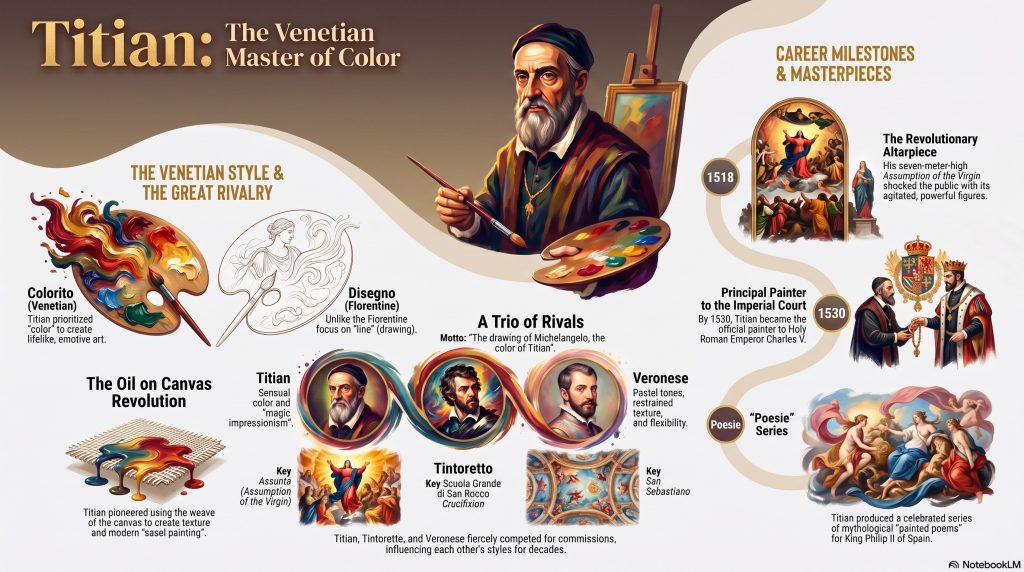
These sources provide a comprehensive biographical and artistic examination of Titian, the preeminent figure of the sixteenth-century Venetian school. The documents detail his early training under the Bellini family and Giorgione, tracing his rise to international fame as the principal painter for the imperial court of Charles V. Central to the text is the intense artistic rivalry in Venice between Titian and his younger contemporaries, Tintoretto and Veronese, which spurred significant innovations in oil on canvas and easel painting. The material also highlights the historical debate of disegno versus colorito, emphasizing the Venetian focus on expressive color and light over the strict line-work favored in Florence. Furthermore, the sources list Titian’s major masterpieces, such as the Assumption of the Virgin, and describe how his evolving, free brushwork ultimately moved toward abstraction in his final years. Together, these excerpts illustrate how Titian’s revolutionary techniques and competitive environment fundamentally reshaped the trajectory of Western art history.
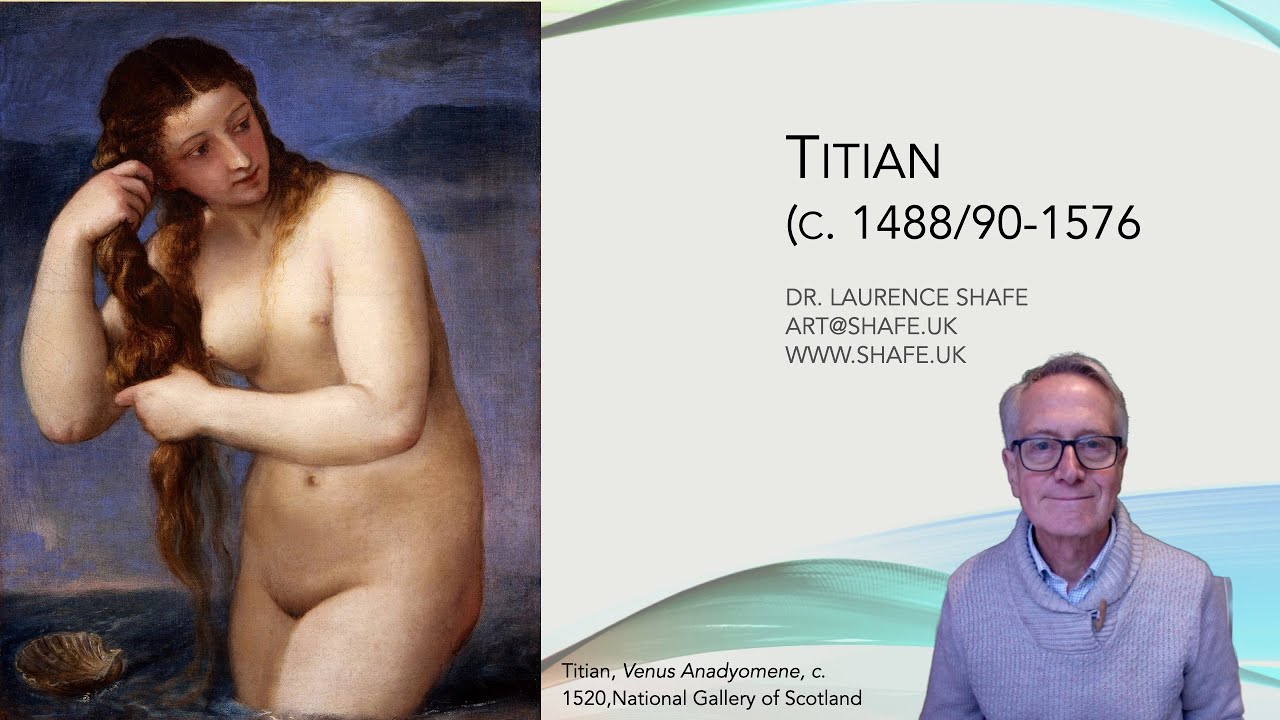
10-10 Titian Podcast (produced by Google NotebookLM)
The gilded frames of the world’s great museums often grant the “Old Masters” a reputation for being stuffy, silent, and safe. But step back into 16th-century Venice, and you find a reality that was anything but quiet. This was a cosmopolitan melting pot of immense wealth and staggering ego, a city where the “harsh salt-laden wind” that famously corroded external frescoes was matched only by the corrosive nature of professional envy. Here, art was not a hobby; it was a high-stakes blood sport.
At the center of this whirlwind was Tiziano Vecellio, known to us as Titian. A revolutionary who effectively shattered the traditional rules of the Renaissance, Titian did not just paint; he staged an aesthetic coup that resonates to this day. Here are five surprising truths about the man who transformed the soul of Western art.
1. The Great “Aesthetic War”: Line vs. Color
In the 1500s, an intellectual battle known as the paragone (comparison) divided the art world into two warring camps. On one side stood the Florentine tradition of disegno—an emphasis on line, perspective, and structured composition championed by Michelangelo and Leonardo da Vinci. On the other side stood the Venetian school of colorito, led by Titian.
For Titian, color was not merely a filler for shapes; it was the fundamental basis of existence. While Florentine art was seen as an intellectual exercise, Titian’s work was visceral, utilizing visible brushstrokes and thick layers of oil paint—the impasto technique—to represent the “sensuality of flesh” and the play of light. This shift, focusing on the “medium rather than the message,” was the true birth of modernism. Without Titian’s bravery, the path to the raw emotional power of artists like Francis Bacon, Lucian Freud, or Mark Rothko would simply not exist.
The Florentines were famously unimpressed; Michelangelo once remarked that the Venetians “did not learn to draw well in the first place.” Yet, there is a sophisticated historical irony at play here. Titian often leaned on a specific argument made by Leonardo da Vinci to defend his path:
“Now consider which is a closer examination of man, his name or his similitude? The name for man varies in different lands, and the form is mutated only by death… the painter [acts] by way of the more worthy sense of the eye.”
Leonardo—a Florentine—was originally arguing for the superiority of painting over poetry. However, Titian subverted this “visual truth” logic to defeat the Florentines’ own rigid focus on line, proving that the eye is captured by the vibration of color, not the safety of a contour.
2. The Savage Rivalry: When Art Became a Full-Contact Sport
Venice was a city of ruthless “one-upmanship.” For nearly forty years, the careers of Titian, Tintoretto, and Veronese overlapped in a climate of “savage rivalry.” It was a battle for primacy where artists would work for the mere cost of materials just to steal a commission from a competitor.
Tintoretto, nicknamed Il Furioso for his phenomenal energy and boldness, famously pulled a legendary “cheat” at the Scuola Grande di San Rocco. During a 1564 competition for the Sala dell’Albergo ceiling, while other masters submitted introductory drawings (modelli), Tintoretto secretly installed a finished painting. When the judges arrived, he pulled down a piece of cardboard to reveal the completed work already in place. Because the confraternity’s rules forbade them from refusing a gift, they were forced to grant him the commission, much to the fury of his rivals.
Titian, the elder statesman, was a master of the long game. He often utilized the younger Paolo Veronese as a “pawn” to undermine Tintoretto’s rising influence. In a chilling display of his “savage” nature, Titian actually served as a judge on the commission for the Palazzo Ducale—ensuring his protégé Veronese won the contract specifically to “do Tintoretto down.” Far from degrading the art, this bitter competition served as a “spur,” driving all three to innovations that transformed European painting.
3. The “Cursed” Masterpiece That Shocked the Public
When Titian unveiled his nearly seven-meter-high Assumption of the Virgin at the Frari church in 1518, the public reaction was one of genuine shock. At just 30 years old, Titian had the audacity to abandon the “meditative stillness” typical of Bellini’s saints.
Instead, he painted a scene of explosive movement. The Virgin Mary was depicted as a “mature, powerful woman” rather than a meek maiden, and the apostles below were so agitated that critics at the time dismissed them as “quarrelling conspirators.”
The Franciscan monks were initially so hesitant to keep the revolutionary work that the project seemed doomed. However, a counter-intuitive twist of fate intervened: an envoy of Emperor Charles V was present at the unveiling and immediately offered to buy the painting if the friars decided they didn’t want it. Realizing the Emperor’s representative saw a masterpiece where they saw a scandal, the monks quickly changed their tune. Titian’s “youthful audacity” had effectively launched his international career.
4. Subversive Details and Patrician Nods: The Story in the Details
Titian’s masterpieces are filled with subversive details that reveal the whims of his patrons and his own sharp wit.
• The Cheetahs and the Spaniel: In the iconic Bacchus and Ariadne, Bacchus’s chariot is drawn by two cheetahs. While the poet Ovid’s original text specifies tigers, Titian replaced them with cheetahs because his patron, the Duke of Ferrara, kept pet cheetahs in his private menagerie. For a touch of journalistic humor, look at the foreground: a small cocker spaniel barks at the divine procession—a “barking at divinity” moment that adds a slice of mundane court life to the mythological drama.
• The Latin “Brand”: On that same painting, Titian placed his signature on a bronze vase in the foreground. He didn’t just sign it; he engraved the Latin “TICIANVS” to look like an ancient artifact, a clever way of branding himself as a master equal to the greats of antiquity.
• The Invisible Muses: The Pastoral Concert, long misattributed to Titian’s mentor Giorgione, remains a puzzle of “invisible” participants. The two nude women represent “comic or pastoral poetry” and “elevated poetry,” respectively. They are muses from the spiritual realm, entirely invisible to the dressed men in the scene—a visual representation of the imaginative process of creation.
5. The Goddess Who Settled a Modern Tax Bill
Perhaps the most surprising life Titian’s art has led is its role in modern economics. In 2003, his masterpiece Venus Anadyomene was acquired for the nation of Scotland. In a bizarre collision of 16th-century beauty and 21st-century bureaucracy, part of the painting’s value was used to offset a massive inheritance tax bill. Essentially, the goddess of love was used to settle a modern debt.
The painting itself was a high-stakes challenge to the ancient world. Titian’s focus on Venus wringing her hair was a direct attempt to out-do the lost masterpiece of the Greek painter Apelles, mentioned in Pliny’s Natural History. By recreating this specific detail, Titian sought to prove that his Venetian color could surpass even the legends of the past. There is a delicious irony in a timeless goddess, born of the sea, inadvertently navigating the mundane waters of modern-day tax regulations.
Conclusion: From “Magic Impressionism” to the Edge of Abstraction
In his twilight years, Titian’s style underwent a final, radical evolution. In works like The Death of Actaeon and the Pietà—originally intended for his own tomb—he abandoned descriptive reality for a style known as “magic impressionism.” Pushing his art to the very edge of abstraction, he used his fingers as much as his brushes to “caress” the paint into form.
This leaves us with a final, provocative thought: If Titian had followed the “intellectual” rules of Florentine line rather than the “sensual” path of Venetian color, would Western art have ever found the freedom to become modern? Perhaps great art requires more than just talent; it requires the “spur” of a bitter rival and the audacity to shock the public. Titian proved that while lines may define the boundaries of our world, it is color that provides its soul.
10-11 Tintoretto

The provided text offers a detailed biographical and artistic account of Jacopo Tintoretto, a prominent Venetian Renaissance painter known for his intense energy and speed. It highlights his competitive relationship with contemporaries Titian and Veronese, illustrating how these rivalries and the adoption of oil on canvas spurred significant creative innovation in Venice. The sources describe Tintoretto’s distinctive style, characterized by muscular figures and bold perspectives, as well as his aggressive tactics to secure prestigious commissions like those for the Scuola Grande di San Rocco. Key masterpieces such as The Paradise and The Miracle of the Slave are examined to demonstrate his mastery of light and composition. Additionally, the documents provide historical context on Venetian landmarks and the technical shift from tempera to oil that redefined the art market. Together, these excerpts paint a portrait of an ambitious artist who shaped the course of art history through his “furious” dedication to his craft.

10-11 Tintoretto Podcast (produced by Google NotebookLM)
In the mid-16th century, the Venetian art market was a fortified hierarchy. At the summit sat Titian, the undisputed “king” whose prestige reached the courts of Spain and the palaces of Rome. To break into this world didn’t just require talent; it required the grit of a street-level disruptor. Enter Jacopo Robusti, a man born with no pedigree other than his father’s trade: dyeing cloth. This “little dyer,” or Tintoretto, would become the most “furious” force in the history of art.
Known to his contemporaries as Il Furioso, Tintoretto was the ultimate narrative of the “hustle.” He didn’t just paint; he staged a hostile takeover of the Venetian scene through aggressive marketing, impossible deadlines, and a blatant disregard for the polished perfection of the establishment.
Here are five ways the dyer’s son defied the masters to rewrite the rules of the Renaissance.
1. The Professional “Mic Drop”: The Rivalry That Built a Self-Taught Giant
Tintoretto’s career was forged in the fires of a high-stakes rejection. Around 1537, a spirited and independent 19-year-old Jacopo secured a coveted apprenticeship in Titian’s workshop. It lasted exactly ten days.
Legend suggests that Titian, sensing a formidable rival or perhaps simply clashing with the young man’s “furious” personality, threw him out. This was a professional death sentence in Venice, but Tintoretto turned his outsider status into a brand. While his rivals enjoyed the “gold” prestige of the establishment, Jacopo retreated to a cramped, modest studio near the Church of Madonna dell’Orto, working through the night and day to outpace his enemies.
On his studio wall, he inscribed his defiant manifesto:
“Michelangelo’s drawing and Titian’s colour.”
It was a bold synthesis aimed at his critics. When Florentine masters like Michelangelo sneered that Venetians “did not learn to draw well,” Tintoretto doubled down, combining muscular, anatomical precision with the vibrant, sensual color of Venice to create a style that Titian’s protégés simply couldn’t touch.
2. The Gift They Couldn’t Refuse: A Masterclass in Aggressive Marketing
In 1564, the Scuola Grande di San Rocco announced a prestigious competition for a central ceiling painting. The elite of Venice—including the rising star Veronese—were invited to submit preliminary drawings. The rules were standard; the process was slow.
Tintoretto had no interest in playing by the rules. While the other artists labored over their sketches, Jacopo secretly measured the ceiling and executed a finished masterpiece. On the day of the adjudication, as his rivals prepared to unveil their paper drawings, Tintoretto pulled down a piece of cardboard from the ceiling to reveal a fully installed, completed painting.
The judges were furious. His rivals were stunned. But Tintoretto played his final card: he offered the work as a gift. Because the confraternity’s constitution legally forbade the rejection of a gift, the work remained. This high-impact “mic drop” effectively hijacked the commission, eventually securing him the contract to decorate the entire building—a project that would span two decades.
3. The “Iron Pencil” and the High-Stakes Art of Prestezza
Tintoretto’s nickname, Il Furioso, wasn’t just about his temper; it was about his prestezza—a fast painting technique that allowed him to overwhelm the market by sheer volume. In a city where public opinion dictated fame, speed was a business necessity.
The Venetians often spoke of the three “styles” of the city: gold, silver, and iron. Titian represented the gold—expensive, polished, and elite. Tintoretto chose the iron pencil. It was a blue-collar branding move that prioritized the raw energy of the brushstroke over the finished message.
The output was staggering. The artist Sebastiano del Piombo famously remarked that Tintoretto could paint in two days what would take other artists two years. By working “night and day,” Jacopo ensured his work was everywhere, creating a physical presence in the city that his slower-moving rivals couldn’t hope to match.
4. The Strategic “Loss Leader”: Disrupting the Venetian Price Point
Long before modern startups used “disruptive pricing,” Tintoretto was undercutting the competition to gain creative freedom. In the early days of his career, he frequently worked for next to no pay, or even on a “cost-only” basis, just to secure real estate in high-profile locations like the Scuola di S. Marco.
This wasn’t charity; it was a cold-blooded business strategy. By offering his services for materials-only, he gained an unprecedented say in the subject matter of his paintings—a privilege usually reserved for the patron. He used these low-cost canvases to experiment with radical, theatrical compositions that eventually won him the fame required for massive paydays, such as the 1548 Miracle of the Slave.
Jacopo’s hustle never stopped. He even petitioned the authorities for tax reductions, claiming his rivals were spreading lies about his actual income. He was a man who understood that to stay at the top, you had to fight for every ducat while appearing to give your work away for free.
5. The Innovator of Special Effects: Miniature Stages and Large-Scale Production
To achieve the soaring, “architectural fantasy” found in works like The Presentation of the Virgin, Tintoretto turned his studio into a technical laboratory. He didn’t rely on imagination alone; he built miniature theater stages. He arranged small wax and clay models on these stages, illuminating them with candles from various angles to master the deep perspective and dramatic “stormy skies” that became his signature.
This technical rigor allowed him to scale his “hustle” to impossible proportions. His life’s work culminated in The Paradise in the Doge’s Palace—the largest painting on canvas ever produced. However, even this monument was a testament to his efficiency as a “CEO” of art: the work was largely executed by his son, Domenico, and his workshop. Tintoretto provided the vision and the management, while his production line turned it into a reality.
Conclusion: The Modernity of the Mannerist Rebel
Jacopo Tintoretto was a pioneer of the “modern” focus on the medium of paint over the message. He understood that in a world of established hierarchies, boldness and speed were the only tools that could topple a king like Titian.
He leaves us with a compelling question: In a world that often values polished, safe perfection, what can we learn from the “Furious” defiance of a dyer’s son who refused to stay in his place? Tintoretto’s legacy is proof that even the most formidable masters can be overthrown by someone with enough “phenomenal energy” and the strategic audacity to break every rule in the book.
10-12 Veronese
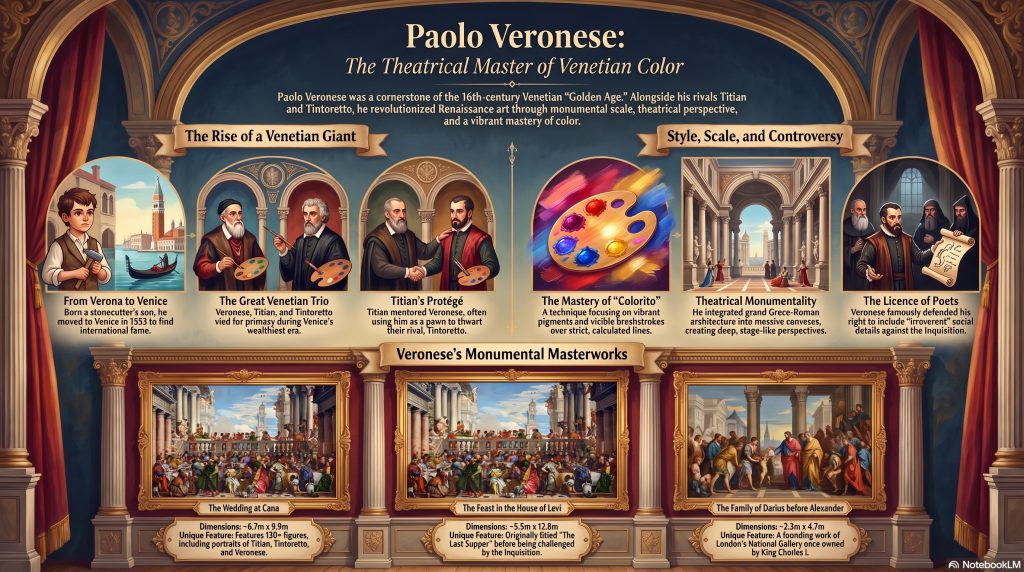
These documents examine the life and legacy of Paolo Veronese, who was a leading figure of the Venetian Renaissance alongside his rivals Titian and Tintoretto. Born into a family of stonecutters in Verona, he eventually relocated to Venice, where he established a massive workshop and achieved fame for his grand feast scenes and theatrical use of architectural settings. The texts highlight his technical mastery of oil on canvas, a medium that allowed him to experiment with vibrant colors and rich textures while moving away from traditional wood panels. Key milestones discussed include his extensive work on the Church of San Sebastiano, his legal encounter with the Inquisition regarding the secular details in his religious art, and his role in the development of the Venetian “colorito” style. Ultimately, the sources illustrate how the intense competition for commissions among Venice’s three greatest masters fostered an era of unprecedented artistic innovation and fame.

An entertaining conversation about Veronese created by Google NotebookLM from my notes:
Sixteenth-century Venice was a city of unparalleled splendor—a maritime empire and a global “melting pot of products and ideas.” In this fertile climate, art was far more than decoration; it was a high-stakes currency of power and prestige. A fierce rivalry emerged among the “Big Three” of Venetian painting: the reigning sovereign Titian, the hyper-energetic “defiant” Tintoretto, and the sophisticated newcomer, Paolo Veronese.
This was art as a blood sport. These three titans vied for lucrative state commissions and church altarpieces, pushing one another toward technical innovations that would permanently alter the course of Western art. The competition was so personal that Titian, reportedly harboring a mutual dislike for Tintoretto, looked to the younger Veronese as a strategic “pawn” to thwart Tintoretto’s rising influence.
But how did a young man, born the son of a simple stonecutter in Verona, navigate this cutthroat market to become the protégé of the legendary Titian? His journey from a provincial workshop to the halls of the Inquisition is a masterclass in brand reinvention and artistic defiance.
Truth #1: The Stonecutter’s Secret and the Art of the Brand
Long before he was celebrated for his grand Venetian banquets, the artist was simply Paolo Spezapreda—a name that literally translated to “stonecutter.” Born the fifth child of a craftsman in Verona, his early identity was tied to his father’s labor. However, Veronese understood that the Venetian patronage system favored those with noble associations.
He strategically reinvented himself, adopting the name “Caliari” from his mother’s side, as she was the illegitimate daughter of a nobleman named Antonio Caliari. By the 1550s, he had fully transitioned from a laborer’s son to a sophisticated professional. Eventually, he became known simply as “Veronese,” a name that functioned as a powerful brand, signaling his origins from the largest possession of the Venetian Republic and marking him as a high-level outsider ready to conquer the capital.
Truth #2: The Venetian “Game of Thrones” and the V-Shaped Mastery
When Veronese arrived in Venice in 1553, he was thrust into a pre-existing “antipathy” between Titian and Tintoretto. Titian used his immense influence to favor Veronese, serving as a judge to ensure the newcomer won commissions like the Doge’s Palace specifically to “do Tintoretto down.” This rivalry served as a vital source of artistic revival. As the biographer Carlo Ridolfi noted in 1642:
“Having Veronese as a competitor caused Tintoretto to put greater effort into these paintings, for rivalry sometimes serves as a spur, making the artist more attentive so as not to fall behind his competition.”
This era saw a shift toward Colorito—the use of visible brushstrokes and thick colors to capture the “sensuality of flesh.” This stood in sharp contrast to the Florentine Designo, championed by Michelangelo, which focused on the “reason and planning” of meticulous underdrawing. Michelangelo himself criticized the Venetians, claiming they “did not learn to draw well.”
Veronese, however, possessed a precocious architectural eye. In early works like The Conversion of Mary Magdalene (1548), he demonstrated a “historian’s insight” by arranging the heads of his figures in a precise “V” shape, a technical maneuver designed to lead the viewer’s eye directly to the moment of spiritual renunciation.
Truth #3: The Ultimate Power Move: Tintoretto’s San Rocco Loophole
The cutthroat nature of the Venetian market peaked during the 1564 competition for the ceiling of the Scuola San Rocco. The confraternity requested modelli—thorough introductory drawings—from four leading artists, including Veronese and Tintoretto. While Veronese prepared his drawings, Tintoretto engaged in a breathtaking act of one-upmanship.
On the day of the review, while his rivals presented their paper designs, Tintoretto pulled away a piece of cardboard from the ceiling to reveal a finished, fully installed painting. When the judges reacted with fury at this breach of the rules, Tintoretto deployed a brilliant legal maneuver: he offered the work for free. Because the confraternity’s rules strictly “dictated that they could not refuse a gift,” he secured the commission for the entire building, effectively blocking Veronese and his other rivals through sheer audacity.
Truth #4: Defying the Inquisition: “Poets and Jesters”
Veronese’s penchant for grand, theatrical scenes eventually brought him into conflict with the Holy Office. In 1573, he painted a massive Last Supper for a Dominican friar. The Inquisition was appalled by “irreverent details” Veronese had added to the sacred scene: dwarfs, parrots, jesters, and German soldiers.
Called to account for these “buffooneries,” Veronese delivered a landmark defense of artistic freedom, arguing that painters should have the same creative license as other creators.
“Veronese defended the painter’s right to ‘take the same licence as poets and jesters take’.”
In a move of “theological rebranding,” Veronese satisfied the Inquisitors without changing a single stroke of paint. He simply renamed the painting The Supper in the House of Levi. By changing the title instead of the art, he preserved his vision while outmaneuvering the most feared institution in Europe.
Truth #5: The Musical Supergroup and Napoleon’s Theft
Veronese’s mastery of the “grand social event” reached its zenith with The Wedding at Cana. This was no budget commission; the contract specifically required the use of “optimal colors,” specifically the incredibly expensive ultramarine (lapis lazuli). For his labor, Veronese was paid 324 ducats, a barrel of red wine, and his daily meals in the refectory.
The painting features a famous “Easter Egg”: the musicians in the foreground are a “supergroup” of the era’s artistic rivals.
• Veronese: Playing the viola da braccio.
• Jacopo Bassano: Playing the cornetto.
• Tintoretto: Playing the viola da braccio.
• Titian: Playing the violone.
However, the painting’s history took a tragic turn centuries later. In 1797, Napoleon’s troops seized the 1.5-ton canvas. To facilitate transport to Paris, they brutally cut the masterpiece into sections. Though it was later reassembled, it was never returned to Venice and remains in the Louvre today, still bearing the scars of its journey.
Conclusion: A Legacy Painted in Technicolor
Paolo Veronese and his rivals did more than decorate palaces; they pioneered a “focus on paint” as a medium. This Venetian emphasis on colorito and the expressive possibilities of oil on canvas paved the way for modern masters, from the bravura brushwork of John Singer Sargent to the atmospheric color fields of Mark Rothko.
In an age where we still debate the boundaries of artistic license and AI-assisted creativity, does Veronese’s 500-year-old defense of “poets and jesters” hold more weight than ever? Perhaps his greatest lesson is that the most enduring art is born not just from talent, but from the courage to protect one’s vision against any authority.