Page Contents
03-01 The Invention of Antiquity
The YouTube video is about how we have created a particular view of classical art:
03-01 Notes on the The Invention of Antiquity
Source: Excerpts from “The Invention of Antiquity” by Dr. Laurence Shafe
Introduction:
This document reviews excerpts from a talk entitled “The Invention of Antiquity” by Dr. Laurence Shafe. The central argument is that our understanding of classical antiquity, particularly its art, is not a straightforward reflection of historical reality but rather a product of ongoing interpretation influenced by present-day cultural assumptions, limited surviving evidence, and the agendas of different historical periods. The talk explores how objects from antiquity have been rediscovered, reinterpreted, and sometimes deliberately misrepresented to fit the prevailing aesthetic and cultural ideals.
Key Themes and Ideas:
Conclusion:
Dr. Shafe’s talk “The Invention of Antiquity” urges caution in our interpretation of classical art. We should be aware of our own biases, the limitations of the evidence, and the historical contexts in which these objects were rediscovered and reinterpreted. Ultimately, our understanding of antiquity is a constantly evolving construct, shaped by the perspectives and agendas of each generation. “This talk was partly an introduction to classical art and partly a warning that much of antiquity is invented by each generation and each new culture or, more precisely, by each person whose assumptions and beliefs colour their perception and interpretation.”
03-02 Greek Art
Introduction:
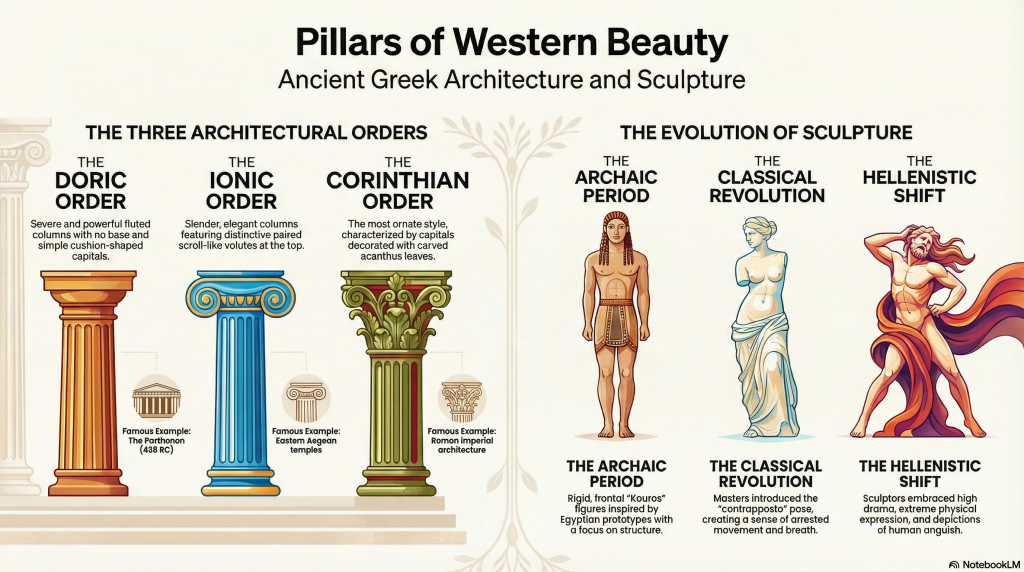
This document provides an overview of ancient Greek art and architecture, spanning roughly a thousand years and highlighting its profound influence on Western civilisation. The briefing aims to address the question of how this artistic development arose “in that place at that time” by examining the historical and societal context. It will briefly cover the Minoan and Mycenaean civilisations, and the Archaic, Classical, and Hellenistic periods. Key materials (marble, terracotta, limestone), major themes (religion, myth, civic expression, everyday life), and architectural orders (Doric, Ionic, Corinthian) will be touched upon.
I. Early Greek Art and Architecture (1200-800 BCE): Minoan and Mycenaean Civilisations
II. Archaic Period (800-480 BCE)
III. Classical Period (480-323 BCE)
IV. Hellenistic Period (323-146 BCE)
V. Greek Influence on Rome
VI. Summary and Legacy
This briefing document provides a foundational understanding of ancient Greek art and architecture,